Introduction
This article examines the organisation of rotating savings and credit associations (roscas) among low-income urban households in Turkey. Roscas are a worldwide phenomenon, referring to a form of informal financial organisation composed of members who make periodic payments to a fund which is given to each contributor in turn (Ardener, Reference Ardener1964, Reference Ardener, Ardener and Burman1995). The term ‘rotation’ indicates each member's turn to receive the fund or lump sum. The receipt of the fund signifies a change in member status from being a creditor to a borrower, which, in the absence of a legally binding contract, increases the risk of default. Members are expected to continue for at least a ‘round’ of rotations: that is, until each member's turn has been served. After the completion of a round, they can decide whether to continue, disband or quit the rosca. This represents the general workings of roscas, which can vary, for example, in terms of the fund medium. As will be shown later, Turkish roscas also differ in form but are given the generic name gün (meaning day) to indicate each member's turn.
Roscas have attracted considerable research attention from diverse disciplines, including economics, sociology and development studies. The study of roscas, and informal financial credit and savings associations in general, is also significant from a social policy perspective in that it contributes to our understanding of how individuals or households function in ‘self-welfare’ and the extent to which they have access to financial opportunities likely to improve their well-being. Thus, questions such as the following are of particular interest here: Who participates in roscas and why? What factors affect access? How do members cope with the risks involved? What are rosca savings used for? The literature has sought answers to such questions, drawing mainly from Asian and African countries and immigrant populations living in the West. Relevant conclusions from four research strands are outlined below.
The first focuses on rosca participants and the factors affecting their participation. One group of studies explores the link between gender and participation. It is now well-established that rosca participation is predominantly a female activity. Scholars endeavour to explain this, for example, through a focus on cultural and economic factors, intra-household dynamics of resource allocation or intra-household norms of income and expenditure flows and their management (Anderson and Baland, Reference Anderson and Baland2002; Johnson, Reference Johnson2004; Tsai, Reference Tsai2000). Another group of studies examines the association between income and participation. These highlight the importance of income size (Bellér-Han, Reference Bellér-Hann and Rasuly-Paleczek1996; Levenson and Besley, Reference Levenson and Besley1996; Burman and Lembete, Reference Burman, Lembete, Ardener and Burman1995) and income regularity (Kimuyu, Reference Kimuyu1999; Levenson and Besley, Reference Levenson and Besley1996; Sterling, Reference Sterling1995).
The second strand tackles the question of why individuals prefer risky rosca participation to saving in isolation. Scholars advance a number of complementary motives. According to the proponents of the ‘indivisible good hypothesis’, individuals join roscas to make an early purchase of a ‘lumpy’ consumer durable (Besley et al., Reference Besley, Coate and Loury1993, Reference Besley, Coate and Loury1994; Handa and Kirton, Reference Handa and Kirton1999; van den Brink and Chavas, Reference van Den Brink and Chavas1997). Another group of scholars view risk insurance as a specific motive for participation in bidding roscas where the funds are allocated through auction (Calomiris and Rajamaran, Reference Calomiris and Rajaman1998; Klonner, Reference Klonner2003). For the advocates of the household conflict hypothesis who emphasise ‘the illiquidity function’ of roscas, women join these associations to protect savings against the immediate financial demands of their husbands and/or relatives (Anderson and Baland, Reference Anderson and Baland2002; Mayoux and Anand, Reference Mayoux, Anand, Ardener and Burman1995; Niger-Thomas, Reference Niger-Thomas, Ardener and Burman1995). Other scholars underline the idea of social gain, considering, for instance, the desire to gain access to various forms of social support to be the key rationale (Oh, Reference Oh2007). Similarly, to organise social gatherings on the day of each rotation was shown to be an important motive for middle-class women in Turkey (Bellér-Hann, Reference Bellér-Hann and Rasuly-Paleczek1996) and Northern Cyprus (Khatib-Chahidi, Reference Khatib-Chahidi, Ardener and Burman1995) to participate in güns. Last, the supporters of the ‘commitment hypothesis’ contend that individuals join roscas to overcome their self-control problems and develop financial self-discipline (Ardener, Reference Ardener1964; Ambec and Treich, Reference Ambec and Treich2007; Bouman, Reference Bouman1995; Bortei-Doku and Aryeetey, Reference Bortei-Doku, Aryeetey, Ardener and Burman1995; Chamlee-Wright, Reference Chamlee-Wight2002; Fessler, Reference Fessler2002; Guérin, Reference Guérin2006; Gugerty, Reference Gugerty2007; Sterling, Reference Sterling1995). From this viewpoint, roscas are often described as a ‘forced savings mechanism’, which relies on social sanctions to promote the discipline of making payments at regular intervals (Miracle et al., Reference Miracle, Miracle and Cohen1980; Shanmugam, Reference Shanmugam1991). The need for discipline is explained in different ways. Some scholars emphasise psychological factors by arguing that roscas help individuals overcome their inability to defer gratification (Fessler, Reference Fessler2002; Sterling, Reference Sterling1995). Others draw attention to the contingencies of people's life circumstances. Guérin (Reference Guérin2006), for instance, reports that women join roscas to be able to create situations that would compel them to earn an income.
The third strand explores how members cope with the risk of default. The bulk of the literature demonstrates the importance of psycho-cultural factors such as mutual trust, the operation of gossip mechanisms, social ostracism, peer pressure, feelings of shame and/or concerns about reputation in preventing members from ‘committing malfeasance’ (Ardener, Reference Ardener1964; Fessler, Reference Fessler2002; Geertz, Reference Geertz1962; Oh, Reference Oh2007; Sterling, Reference Sterling1995; van den Brink and Chavas, Reference van Den Brink and Chavas1997). The literature also addresses elements inherent in the institutional design of roscas (Handa and Kirton, Reference Handa and Kirton1999; van den Brink and Chavas, Reference van Den Brink and Chavas1997). These are shown to include the selection of members from higher-income groups, allocation of new risky members to last rotations, and the use of separate funds for emergencies.
The fourth one focuses on the use of rosca funds. One key issue here concerns the extent to which roscas contribute to savings mobilisation or asset accumulation. The bulk of research indicates the importance of rosca savings in capital accumulation by small entrepreneurs, traders or farmers (see Adebayo, Reference Adebayo1994; Alila, Reference Alila1998; Bortei-Doku and Aryeetey, Reference Bortei-Doku, Aryeetey, Ardener and Burman1995; Kan, Reference Kan2000). There are a few studies which demonstrate a significant investment potential for roscas organised by impoverished groups (Hospes, Reference Hospes, Ardener and Burman1995; Nelson, Reference Nelson, Ardener and Burman1995), or which acknowledge their double function for both ‘survival’ and investment (Kimuyu, Reference Kimuyu1999). Most research emphasises their instrumental role in meeting basic needs, such as food and medical assistance (Almedon, Reference Almedon, Ardener and Burman1995; Kurtz, Reference Kurtz1973; Mayoux and Anand, Reference Mayoux, Anand, Ardener and Burman1995).
This article makes three main contributions to informal finance literature. First, it throws light on the general characteristics of various Turkish roscas that have attracted little research attention (see Bellér-Hann, Reference Bellér-Hann and Rasuly-Paleczek1996; Khatib-Chahidi, Reference Khatib-Chahidi, Ardener and Burman1995; White, Reference White1994),Footnote 1 and demonstrates their distinctive ability to function smoothly under inflationary circumstances through the application of a simple compensatory mechanism. Second, it challenges the dominant view of Turkish roscas as being a leisure activity for middle-class women by demonstrating how poor households use them as a ‘self-welfare’ instrument to develop the discipline of saving towards both their consumption and investment needs. Finally, the study calls into question the widely held assumption that the poor resort to informal credit and savings instruments because formal options are not available to them.
The remainder of the article is structured as follows. The next section presents the research method used. This is followed by an analysis of patterns and composition of membership and motives for participation. The analysis then turns to compare the characteristics of different gün types and finishes with an exploration of household plans about gün savings and the extent to which these plans were realised. The conclusion links the research findings with the wider debates outlined above.
The research design and method
The research presented here forms part of a broader longitudinal study of 17 low-income households living in Ankara (Eroğlu, Reference Eroğlu2004). The study involved two visits to the field, one in April 2002 and the other in October 2002. Longitudinal design was chosen because it comprises a robust research base for identifying causal processes, and collecting high-quality data. The choice of design helped enhance data quality especially through allowing time for building rapport, which proved to be a gradual process. Field visits were set six months apart because, although there is no perfect time for longitudinal research, shorter studies are less susceptible to external shocks and sample attrition. This study was indeed able to avoid both risks. Besides, the six-month gap was first considered and then proved adequate for exploring household plans and whether they were realised.
The research setting was selected from a typical gecekondu settlement of Ankara which predominantly consisted of pre-1985 rural to urban migrants from surroundings of the city or other parts of Central Anatolia (Güvenç, Reference Güvenç and Yavuz2001). Gecekondu originally refers to squatter housing which was partly legalised in the 1980s. These areas make up a considerable part of the population in big cities of Turkey and tend to have a higher incidence of poverty (Bulutay, Reference Bulutay1998). The chosen settlement reflected this general tendency. There was also heterogeneity in the levels of poverty experienced in the settlement, given the occupational status of its inhabitants, which extended from public sector employees and seasonal labourers to the unemployed.
The sample included households with an average monthly incomeFootnote 2 below US$370,Footnote 3 four members, nuclear structure, one child at or above the age of 15 and Alevi and Sünni religious backgrounds. Those who fell below the threshold correspond to the bottom 15 per cent of the Ankara population (Sönmez, Reference Sönmez2001). Further, the intended household size and structure reflect the typical characteristics of urban households in Turkey, including gecekondu dwellers, and the selected religious groups represent the two largest Islamic sects in Turkey, which differ in terms of their religious practices, political viewpoints and their approaches to women (Ayata, Reference Ayata1997; Shankland, Reference Shankland and Rasuly-Paleczek1996).
The sample was obtained through random selection by starting from an official database containing the intended household size, structure and age of children for two areas within the same gecekondu settlement: one predominantly Sünni and one predominantly Alevi. Random number tables were used to select from a sample frame, including 156 out of 2005 households, and then households with an income above US$370 were excluded during access negotiations.
Data were drawn from semi-structured interviews conducted separately with both partners. In all but one household they were interviewed on both occasions to cross-check their accounts. Qualitative interviewing was preferred to a household survey in order to generate detailed and valid data. The sample size was therefore small, requiring further research to test whether conclusions reached here are applicable to the wider population. Qualitative interviewing was also considered more appropriate for this part of the research than participant observation in that it made it possible to gather information about households’ financial motives and plans.
The generated data were analysed both qualitatively and quantitatively. Qualitative analyses sought to provide a detailed understanding of the gün features, member characteristics, risk-coping mechanisms, rationale for participation and the scope for asset accumulation. Quantitative analyses were performed to explore patterns of gün membership and its relationship to income. Due to the small sample size, these were based on descriptive statistics only, and used qualitative data and theoretical knowledge obtained through literature review as a basis for causal inferences made from cross-tabulations.
Understanding patterns of overall gün participation
In contrast to earlier studies where gün organisation was described as an activity of the middle class (Bellér-Hann, Reference Bellér-Hann and Rasuly-Paleczek1996; Khatib-Chahidi, Reference Khatib-Chahidi, Ardener and Burman1995), this research revealed considerable interest from low-income households. In April, 53 per cent (9 out of 17) reported participation in various güns. The total number of güns observed was ten, as one household took part in two. By October, the participation rates had fallen to 41 per cent (7 out of 17). The total number of güns recorded in October was nine, since this time there were two households with two separate memberships. Four of the güns recorded in April ended after the completion of the first round, and five new güns were formed by those with at least one membership in April, out of which one was completed before October. Hence, the total number of güns observed throughout the study was 15.
Compared to formal credit and savings institutions, güns seem more accessible to these households, as in April and/or October only 17 per cent (3 out of 17) had a bank loan and 12 per cent (2 out of 17) had savings in a deposit account, so there were in total five households with access to formal channels (29 per cent), four of which were also gün participants and had at least one regular earner. The only one without a regular income had a loan credited officially to a relative who had a secure job.
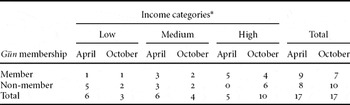
Despite the popularity of güns among the poor households, April figures indicate a greater tendency for those with a relatively higher income to have a membership. Table 1 shows that in April all higher-income households participated in at least one gün, whereas the participation rate was only 17 per cent (1 out of 6) for those with a lower income, which is expected given the former's greater capacity to save.
Household income categories by gün membership in April and October

Notes: *Income categories were formed by using cut-off points obtained through the SPSS frequency facility. These points correspond to 240 and 307 US dollars.
However, October results suggest a weaker relationship between membership and income size,Footnote 4 indicating a decline in the participation of higher-income households to 40 per cent (4 out of 10). How can we make sense of this decline? Between April and October, 71 per cent (12 out of 17) had experienced a considerable rise in their incomes due to this period being the peak work season. Nearly all non-member households with a relatively low or medium income in April had one or more seasonal earners, most of whom were main earners working in the construction sector for a daily wage. Despite an increase in their earnings over the six months, these households tended to avoid gün participation. There were two-member households with predominantly seasonal incomes, but these were able to participate only in güns involving either very small payments or a few members to allow quick completion of a round. The general tendency for non-participation may be attributed to income irregularity, which undermines the household capacity to keep up with long-term periodic payments. The following extracts from spousal interviews confirm this point.
(1)
Interviewer: Do you take part in a gün?
CX: I really can't, it isn't convenient.
Interviewer: Why?
CX: A man without a regular job [her husband] is almost unemployed. There's money today, none tomorrow. Even if there is, it isn't enough. I'm unable to meet the payments even if they're in small amounts, I mean. As I said, if I can't save any money then how am I supposed to find the money to give others? It's impossible . . .
(2)
Interviewer: Are you involved in any güns?
DY: Can't ’cause I don't have a regular daily wage . . . You have to set aside a certain amount for this. Maybe little, but you have to have a regular income so that you could set it aside. Say, there's a gün tomorrow, what am I going to do? Where will I find it?
(3)
Interviewer: Are you a currently member of any güns?
IX: No.
Interviewer: I suppose you weren't in April, either. . .
IX: No, I never was . . . I can't join; I don't dare join ’cause I don't have a regular income. I've never been able to get involved in such affairs as I'd be embarrassed if I was unable to pay; I'd be ashamed so I thought there's no need . . .
Incidentally, the feeling of shame and embarrassment provoked by the thought of default appears to have affected decisions against participation. This is supported further by the excerpt below, taken from an interview with a female spouse:
Interviewer: Are you involved in any güns?
RX: No, I can't join one. My neighbours and relatives invite me to join but if you can't afford to pay you can't join. . . If you join, sometimes you'll be able to pay, sometimes you won't then what? You'd feel ashamed . . .
Overall, three main conclusions can be drawn here. First, seasonality in the labour market is likely to reduce gün participation by creating income instability as well as reducing the amount of annual income available. It will be shown in the next section that seasonal work can also affect participation by undermining trust-building among work-mates, which is needed to compensate for the lack of a formal contract. Second, income stability may play as important a role as income size in determining gün enrolment. Third, poor households do not necessarily turn to gün-type informal credit and savings instruments because they lack access to formal opportunities. Their motives for participation will be explored later in detail.
Composition of gün membership
This section explores the composition of gün membership in terms of gender, the length of acquaintance and the nature of social contexts to which members belong. Thereby, it seeks to throw light on some of the risk-coping mechanisms used.
First of all, the majority of the observed güns were all-female. Only in 13 per cent (2 out of 15) did both spouses have a separate or a joint membership. Second, the güns generally consisted of members who had medium- to long-term acquaintance. This meant that members had formed an opinion of each other's level of trustworthiness and creditworthiness, as a strong trust basis is considered a requirement to ensure that members are committed to the payment schedule in the absence of a formal contract. Newcomers were also allowed entry through a reference from a trustworthy member, but this was quite a rare occurrence. Of the ten güns observed in April, for instance, two had one newcomer each; both were from the respondent households which participated in güns within adjacent neighbourhoods. Although newcomers were not well acquainted with other members, they were granted access through their member relative(s) who had long-term residence in the area.
Last, the güns contained members who belonged to relatively stable social contexts. In all but one of the güns observed, the neighbourhood was the social context that connected nearly all members. Most members were close neighbours of either the respondents or their relatives and had a long history of residence in the same gecekondu settlement. Their relationship was multi-stranded in nature; apart from being neighbours they were also relatives, hemşehris from the same home town, friends and/or affiliates from a particular religious circle. The Alevis and Sünnis tended not to mix. A much less common social context was the workplace. Only one of the observed güns comprised members who were regular employees of a textile factory, the implication being that for güns to be organised among work-mates, there had to be a certain degree of stability at the workplace. The following extract from an interview with the husband of a woman who was enrolled in this gün confirms this inference:
Interviewer: Do you take part in a gün?
HY: No, I can't but my wife does. She did enter one, but in our [work] place no one can ’cause it is not secure; ’cause it's seasonal . . . so no one can enter. No one knows what sort of people work there. They come and go as they're migrants from outside, coming from villages [of] Çorum, Yozgat, Kırıkkale.
Two points can be made about the social context of membership. First, it seems that relatively stable social contexts are the more likely preference for membership. Second, the choice of social context appears to reflect the work situation of female gün members who represented the majority. In the sample, all but one female member were either housewives or had casual jobs that involved working in isolation (such as daily house cleaners or home-based pieceworkers). Hence, the social context from which güns were most likely to draw members remained the neighbourhood with its stable as well as convenient base for membership.
Overall, two criteria appear central to the selection of gün members: length of acquaintance and stability of the social context. Both help reduce the risk of default by strengthening the trust basis. The latter also allows a certain degree of surveillance over members’ movements, which pressurises them to maintain the payments as well as improves their ability to chase the defaulters. Therefore, the selection criteria can be viewed as one of the mechanisms used to cope with the risk of default.
Motives for gün participation
This section explores what motivates low-income households to become gün members. It starts by discussing why certain motives are less likely.
Firstly, despite women's disproportionately greater involvement in güns, the need to protect savings from men's conflicting financial demands is unlikely to be the key motive, as none of the memberships was concealed from husbands. This research did reveal secret kitties kept by women to this effect. However, these were separate from gün savings and were obtained from other sources. To illustrate, women cut back on claimed personal expenditure or inflated claimed household expenditure to generate funds for their kitties (Eroğlu, Reference Eroğlu2009).
Moreover, women are unlikely to have become members for purposes of leisure, as the social gathering aspect, which is a common feature of the güns organised by middle-class women (Bellér-Han, Reference Bellér-Hann and Rasuly-Paleczek1996; Khatib-Chahidi, Reference Khatib-Chahidi, Ardener and Burman1995), was missing from almost all of the güns observed. Women avoided such gatherings due to the monetary costs involved. The motive to obtain social support is also less likely given the length of acquaintance and the degree of connectedness among members.
Finally, as will be shown in detail later, gün savings were either kept for rainy days or used to buy household supplies in bulk or to service loans borrowed for investment puposes. The early purchase of a ‘lumpy’ consumption item, however, appears less likely as a primary motive mainly because the risk of being the last recipient is equalised across members through random assignment (see also Gugerty, Reference Gugerty2007). This risk seems rather to act as a deterrent as it means a delay in gaining access to funds when needed. This is evident from the excerpt below:
Interviewer: Are you currently involved in any güns?
MY: Well, my wife wants to join one with five or six people for sugar or a small gold coin, but I don't think it's necessary.
Interviewer: Why not?
MY: The money we earn is just about enough for ourselves. If you come first in the draw, it's fine, but what happens if you come last of the six? Then you'll be out of pocket.
So going back to our original question: what was the key rationale for low-income households to join güns? One possible answer can be found within the following excerpt from an interview with a man who jointly participated with his wife in a gün that contained 11 members and required contributing a small gold coin every month.
Interviewer: Why did you feel the need to join this gün?
NY: If you save one coin on your own every month, it makes 11 coins in 11 months too. But then you'd say ‘well I'm doing this by myself’ so when it's inconvenient you wouldn't save; you'd say ‘I won't bother this month’. Gün is like a promissory note that you sign when you buy things on instalment. It's like a condition, you're conditioning yourself: this is my debt; I have to pay it even if I don't have the money in my pocket; I have no choice. It's like a debt against which a protest can be lodged. Otherwise [if you saved on your own] you could say, ‘well I don't have any money this month so I could do without saving any’ . . . The best way to save is to become indebted to others [because then] even if you had to go without food that month, you would make sure you buy and give the coin in order not to be disgraced in public.
Evidently, the failure to make gün payments was viewed as strongly as ‘being disgraced in public’. What seems implicit here is the concern for reputation and avoidance of shame and embarrassment one would feel in the case of default (see also above). From the strength of this perception, it appears that members were compelled to make regular savings for gün payments in order to preserve their reputation as a trust/creditworthy person and avoid feelings of shame and embarrassment. It also seems that such financial discipline may not be entirely self-imposed but emanate from community pressure. The excerpt below illustrates how the neighbourhood community could force members to remain faithful to a payment schedule:
Interviewer: Are you involved in a gün?
FX: No . . .
Interviewer: Why not?
FX: Well how can you without a regular income? If you fail to pay your debts, you'd hear lots of insulting things here . . .
Interviewer: Really?
FX: Of course, there would be lots of quarrels . . . Here you should die of hunger but never become indebted to anyone. Even if they have billions of Lira in their pocket, they wouldn't say you're out of pocket, so pay me back two or three months later. If someone lends you money, (s)he'd say ‘I'll have it back on the fifteenth’, for instance. It's good if you can pay it on the fifteenth, but if you can't, then you'd lay yourself open to insult.
In light of these considerations, gün organisations can be construed as a ‘forced savings mechanism’ providing the poor households with the discipline of saving a portion of income which would otherwise be easily spent on pressing consumption needs. Hence, one key motive for participation can be to achieve the discipline required to resist the consumption pressures obstructing the objective to save. As will be shown in detail later, the general tendency for households to have clear plans about their gün savings substantiates this argument.
Key features of the observed gün types
This study identified three gün types locally known as şeker günü (meaning sugar day), altın günü (meaning gold day) and dolar günü (meaning dollar day). This section explores their key features and working principles.
Gün types had the following features in common. First, all of them were based on a verbal contract. Second, none of them required a specific person to be assigned the role of organiser, as in roscas observed in other parts of the world (see Ardener, Reference Ardener1964). Third, the number of members was fixed for one round. Fourth, the order of rotations was determined by drawing lots. Fifth, gün payments or contributions at each rotation were the same for all members. Last, either the contributions or the lump sum was fixed to a medium whose value could be protected against inflation during the life of the gün.
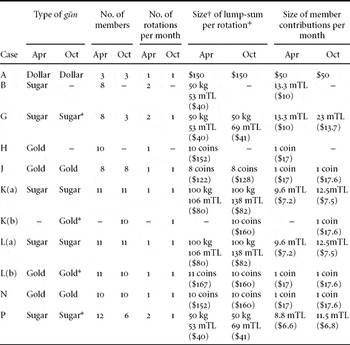
The most distinctive difference among these güns was in the medium of the contributions or the lump sum, according to which they were labelled. There were also variations in terms of membership size and rotation frequency, but these features were not specific to any particular type (see Table 2).
Distribution and characteristics of the güns observed in April and October

Notes: * indicates the new güns that were formed after the April interviews. Also note that the tables exclude one şeker günü which was organised after April and completed before October.
† in determining the dollar equivalence of member contributions and the lump-sums, the study drew on April and October averages for the price of one quarter gold coin and dollar in the free market. The averages were obtained from the gold and dollar rates for the 1st, 15th and 30th of the given months, published respectively by Ankara Association of Jewellers and Altınkaynak (2002) Foreign Exchange Rates Archive.
The working principles of these güns are summarised below to examine the differences more closely. Starting with şeker günü, the lump sum here was in Turkish Lira but based on the wholesale price of 50 or 100 kg of sugar. At each rotation, the price was obtained from a certain dealer and divided by the number of members to determine the size of contributions. This allowed price increases to be accommodated, thereby giving members an equal chance to buy the same amount of sugar. In altın günü, the lump sum was composed of quarter gold coins. In every rotation, each member contributed a small gold coin, known as çeyrek (that is, quarter), to a fund which was then given to the member whose turn was due. Thereby, all members were able to acquire the same amount of coins, despite changes in the price of gold.
Finally, dolar günü was based on similar working principles as altın günü, the key difference being that the contributions were fixed to the US dollar (equivalent to $50 per member at each rotation). The lump sum was equal to the fixed amount multiplied by the number of members. This meant that members had the opportunity to obtain an equal amount of US dollars despite possible fluctuations in exchange rates.
The three gün types compared
This section examines the popularity and investment potential of the three gün types and compares their ability to cope with the risk of default, enable rapid access to funds, and prevent unequal distribution of (dis)advantages between members. Through this comparison, the pros and cons of the different gün types are highlighted.
Of the three types, şeker günü was most popular and dolar günü least. Şeker günü membership was evident in 53 per cent of all the güns observed (8 out of 15), whereas the respective figures for altın and dolar günü memberships were 40 per cent (6 out of 15) and 7 per cent (1 out of 15). Popularity seems inversely related to the size of contributions, which was smallest in şeker günü and greatest in dolar günü. From Table 2, it can be seen that the monthly contributions to the şeker günüs were less than half the size of those made to the others. It follows from this that in circumstances of poverty, the size of contributions can be critical to the popularity of a gün type since the smaller the size, the less the pressure on income and hence the lower the risk of default.
Güns’ popularity was thus closely linked with their ability to cope with the risk of default. Although there were no defaults, şeker günü members were better protected against this risk as the amount they had to contribute was very small. The fixed nature of the lump sum gave them the advantage of being able to keep the size of contributions small by increasing the number of members participating in a round. Members of altın and dolar günü were denied this advantage due to their contributions being fixed. Yet they had the flexibility to increase the fund size by admitting more participants at the start of a round. Şeker günü was less flexible as the need for sugar and/or other household supplies set the limits of the funds. Combined with the payment size, this explains why the fund sizes of altın and dolar günü tended to be larger than those of şeker günü (see Table 2). The opportunity to gain access to larger funds made the first two types more suitable for investment purposes.
The ability to allow urgent access to the funds was dependent on the order of rotations and rotation frequency. As mentioned earlier, in all güns the order by which members received the lump sum was determined by lots drawn before starting the rotations. This meant that the lump sum was not necessarily accessible by members when they needed it most. Nevertheless, those güns with more frequent rotations at least enabled quicker access. Table 2 demonstrates that all of the altın and dolar günüs rotated on a monthly basis, whereas some of the şeker günüs had twice-monthly rotations. Owing to the small size of contributions, members of şeker günü had the advantage of being able to organise more frequent rotations, and hence a greater capacity to respond to the urgent household needs, which required more cash than was normally available.
Finally, in comparing the ability of güns to prevent unequal distribution of (dis)advantages between members, it should be borne in mind that such inequalities are likely to occur where there is high inflation and/or an opportunity to obtain real returns from the lump sum. In an inflationary situation, members are faced with the risk of depreciation of the real value of the lump sum, which would disadvantage its subsequent recipients. In her study of altın günü, Khatib-Chahidi (Reference Khatib-Chahidi, Ardener and Burman1995) described the application of gold standard as a uniquely simple method of administration and organisation, which allows the members to combat inflation without having to use complicated compensatory mechanisms such as discounting and auctioning. This description can be extended to all three gün types as they simply apply the gold, dollar or sugar standard to protect the value of savings throughout rotations.
Şeker günü effectively counteracted inflation by accommodating changes in the wholesale price of sugar. Between April and October, the increase in the six-monthly rate of inflation was approximately 14 per cent (TÜİK, 2002a), whereas the price of sugar increased by 25 per cent: the cost of 100 kg sugar rose from 106 million TLFootnote 5 (US $80) to 138 million TL (US $82). The additional cost was equally distributed between members, resulting in an increase in their contributions. In this way, all members had an equal chance to buy the same amount of sugar despite changes in price. On the other hand, the effectiveness of altın and dolar günüs in offsetting inflation was dependent on whether the rates of real return from gold and US dollars were positive. The respective six-monthly rates for the period between April and October were 16.9 per cent and 11.8 per cent (TÜİK, 2002b),Footnote 6 indicating that altın and dolar günüs were also able to provide effective protection against inflation.
The above-inflation increases in the price of gold, sugar and US dollars indicate a possibility to make real returns from the funds during the life of the güns. However, the potential for real returns was subject to fluctuations in the commodity and money markets and tended to be limited. In particular, şeker günüs were likely to produce the lowest level of real returns as they had the smallest fund size. However, this put them in a better position to avoid inequalities likely to emerge in the distribution of real returns due to market fluctuations. Such inequalities might be more pronounced in altın and dolar günü whose members, due to the rotational allocation of funds, are faced with the risk of missing the opportunity to convert the funds into Turkish Lira when the gold or currency prices were more favourable. However, this risk was perceived as not significant enough to prevent participation.
Plans and reality: how were gün savings used?
Through an exploration of household plans, this section seeks to understand how gün savings were used, and to what extent they contributed to asset accumulation. The following analysis thus focuses on households with membership in April.
At this stage, nine households participated in güns, but as one household was a member of two separate güns, the observed total was ten. Three households, all of which were members of şeker günü, had received their lump sum payments prior to the interviews in April. Two of them used their gün savings to buy food and cleaning supplies in bulk (such as sugar, oil and washing up liquid), and carried on as members of the same gün whose first round continued throughout the fieldwork. The third used the lump sum to pay off a small portion of the loans borrowed over a period of unemployment for everyday needs. Given the size of the lump sum (53 m TL, or US $40 in April) which was equal to 3.6 per cent of the household's outstanding debts for that month, this household was unable to secure significant debt relief. Also the prospects for their new şeker günü membership were also low given the limited nature of the lump sum expected (69 m TL or US $41 in October).
On the other hand, seven households were due to receive their lump sum by October. Two of them were şeker günü members. Their plan was to use the lump sum for consumption purposes; for example, to buy food and cleaning supplies in bulk. Both households fully realised their plans, and, having obtained adequate supplies for the forthcoming winter, one quit after the first round ended, whereas the other embarked on a new şeker günü with fewer people due to further need for winter supplies.
The remaining five were either members of an altın or a dolar günü, with plans to use their lump sums for investment purposes. Two of them had the intention to keep the gün savings for ‘rainy days’. One was able to act as planned but had to quit after completing the first round since the coincidence of the second round with the school year made monthly savings no longer viable for this household. The other, however, abandoned its plan and used all the gün savings, according to the wife rather unwisely, to pay towards an old second-hand car. Despite some financial difficulty, this household managed to remain a member of the same gün whose first round continued throughout the fieldwork.
The other three households had plans to service part of the investment loans they borrowed from a bank or other people. One was planning to use the lump sum to finance the quarterly instalments of the title deed for the gecekondu they currently occupied. Separate membership of each spouse within the same altın günü had the potential to secure considerable debt relief, yielding funds that were nearly equal to two instalments per year (22 gold coins, equal to US $334 in April). However, the couple was able to pay off the June instalment only, as the rest was needed to cover the cost of their attendance at a relative's wedding and the following month's contribution to the new altın günü that was set up with ten members soon after the successful completion of the previous one. As her husband had recently been made redundant, only the female spouse took part in this gün, and managed the monthly savings with the help of their working son. As a result, the household's capacity to secure cumulative debt relief through gün membership was reduced by more than half.
The second household was intending to pay off part of the loans borrowed to set up a family bakery. The specific plan was to return the twisted golden bracelet they owed to a neighbour by topping up the lump sum with the female spouse's earnings from bootee sales. Although this plan did not fully materialise, the household was able to pay back US $180, corresponding to 6.7 per cent of their outstanding debts in April. The repayment was less than planned for because within the April–October period, when the effects of economic crisisFootnote 7 in 2001 had been still felt rather strongly, the female spouse was able to earn very little from bootee sales despite her large network of potential clientele. The female spouse was indeed fully aware that gün membership brought little debt relief. In actual fact, neither her earnings nor gün savings prevented the bakery from going bankrupt two months prior to the October interview. Despite the bankruptcy, the household managed to carry on in the same gün whose first round still continued, but their prospects for participation in future rounds were weakened dramatically.
The last household was planning to use the lump sum to pay off a portion of the debts accumulated through the purchase of a two bedroom flat. The lump sum (US $150) corresponded to 3.5 per cent of this household's outstanding debts for April. The expectation was to secure cumulative debt relief through several quick rounds between a few members. After the completion of the first round, it appeared difficult to realise this plan because, due to being composed of casual and seasonal labourers, this household lacked the regular and adequate income needed to make sizeable gün payments. The household managed to avoid default by becoming indebted to other gün members as well as using the first lump sum obtained to pay off the debts created in the process. The female spouse was able to continue with the second round but voiced her intention to quit after this round due to income constraints.
Overall, most households were able to use their gün savings in accordance with their consumption or investment plans. However, the level of success achieved in realising these plans varied greatly due to income constraints linked with precarious/seasonal work conditions, and the wider effects of the economic crisis. From the ways in which savings were used, it became apparent that the observed güns acted as a means of survival and/or investment. Şeker günüs appealed more to households with consumption plans, and were used to obtain extra cash required to buy certain household supplies in bulk. Except for the last recipient, all members had the opportunity to purchase these commodities earlier than they would if they had to save on their own. This gün type was much less attractive to households with an investment plan. Conversely, altın and dolar günüs were used either to make emergency savings or to service loans obtained for investment. However, their ability to promote asset formation was highly restricted for two reasons. First, the size of savings obtained through a single round was often very small, as compared with the amount of debts incurred on large-scale assets. Second, most members were unable to sustain membership beyond the first round due to the same constraints on income. Thus, for the majority, güns provided little scope for asset accumulation.
Conclusion
The research presented in this article has focused on Turkish rotating savings and credit associations, locally known as gün, in order to understand their significance in the lives of poor urban households. This section outlines its main contributions to the informal finance literature and discusses some of its implications for policy. It also addresses issues left for future research.
To begin with, this study shed light on the general characteristics of various Turkish roscas that have attracted little research attention, namely şeker, altın and dolar günü. As an extension to a study of altın günü (Khatib-Chahidi, Reference Khatib-Chahidi, Ardener and Burman1995), these roscas were shown to possess the distinctive ability to operate smoothly under inflationary conditions. This ability stemmed from the simplicity of the compensatory mechanism used to protect the real value of savings throughout rotations, which involved using the sugar, gold or dollar standard.
The study also challenged the dominant view of Turkish roscas as being a leisure activity for middle-class women by demonstrating the interest they attracted from poor gecekondu households. These households were shown to use roscas as a self-welfare instrument whereby they acquired the discipline of saving towards their consumption as well as investment needs.
Thus, the findings from this research provided some support for the commitment argument put forward to explain the primary motive for rosca participation; that is, to develop financial discipline. However, unlike most studies that emphasise the significance of psychological traits in explaining the need for an external source of discipline, this study has drawn attention to the contingencies present within people's life circumstances. Hence, given the pressures on a limited income from competing expenditure and saving demands, the desire to build up resistance against certain consumption pressures was considered as one likely reason why poor households seek the required discipline externally. Combined with people's desire to maintain reputation as a trusty/creditworthy member and to avoid feelings of shame, community pressure was identified among the key forces that promoted discipline.
Alternatively, the research evidence contradicted the prevailing view that reduces the role of roscas in poor people's lives to ‘basic survival’, in that it highlighted the contributions of different gün types to meeting basic consumption and/or investment needs of poor households. It was shown that şeker günü acted more as a tool for buying supplies in bulk while altın and dolar günü were used more for investment. Their scope for investment was nevertheless restricted by income constraints, such as precarious or seasonal work conditions that appear to have been worsened by the economic crisis in 2001.
Furthermore, the study called into question the general assumption that the poor resort to informal credit and savings instruments because they lack formal options. It was shown that poor households used güns in circumstances where formal instruments were available to them. Nevertheless, access to such instruments was restricted to the few households who had relatively secure/regular incomes, and appeared a less likely option than roscas. However, it was also shown that the rosca option was not open to all who were poor. Certain households tended to be excluded from güns, such as those with lowest or irregular incomes (for example, seasonal and/or casual earners), short-term tenants and newcomers without any connection to the trustworthy members of a neighbourhood community. The reasons for exclusion appear linked not only with the affordability of periodic payments (or income size and stability) but also with the selection criteria applied to cope with the risk of default. The main criteria related to the length of acquaintance and the stability of the social context, imposed not only to strengthen the trust basis but also to ensure some surveillance over members.
The results from this study are thus of considerable relevance to policies aimed at reducing poverty and financial exclusion. They suggest that substantial improvement to the access of poor households to financial opportunities would require eliminating precarious conditions in the labour market. Further but less radical avenues for improvement may involve the provision of credit and saving schemes tailored to the needs of poor households. The research findings contribute to the design of such schemes in two distinct ways. First, through providing an indication of which households are more likely to face financial exclusion, they help identify target groups. Households predominantly composed of seasonal and/or casual earners appear as one group which may be given priority due to their greater tendency to have neither formal nor informal options. Second, by drawing attention to the conditions which obstruct households from rosca participation and/or compel them to participate in such associations, the findings help determine the design features that remove barriers to participation. For instance, a flexible repayment option can be built into the design of credit schemes to compensate for fluctuations in the earnings of seasonal and casual workers. Or, certain incentives can be incorporated into savings schemes to help poor households overcome commitment problems caused by pressing consumption demands on their limited income. These may involve a legal promise of higher return on the monthly or annual contributions that reach or exceed an estimated amount.
There remain, however, certain questions for future research. The study confirmed earlier findings by demonstrating the predominant gün participation of women but provided little explanation for this. The only point made here was that it may have less to do with their desire to protect savings against men's conflicting demands, since women were found to use other ways to fund the secret kitties they created partly for this purpose. Further research is therefore needed to understand the gendered nature of gün participation and the extent to which existing theoretical explanations are applicable to the Turkish case.
Acknowledgements
I would like to acknowledge the valuable feedback I have received from Professor Chris Pickvance on earlier drafts of this article. I am also grateful to the two anonymous referees and the editors of the Journal of Social Policy for their constructive comments. Any remaining errors belong to the author. Furthermore, I would like to thank the Foundation for Urban and Regional Studies, School of Social Policy and Social Research at the University of Kent and Overseas Research Students Award Scheme for funding my Ph.D. study upon which this article is based.