


Introduction
Hazelnut spreads triggered a diplomatic tension between Algeria and France in June 2025 when the latter banned imports of the Algerian-made product El Mordjene on the pretext that it contained dairy ingredients. Algerian officials objected, arguing the real reason for the ban was their hazelnut spread’s increasing popularity in France that posed a threat to Nutella’s domination in the market, the French being the largest consumers of the hazelnut spread made by the Italian company Ferrero (Collins Reference Collins2025). In October 2025, Ferrero announced it was holding off purchases from the world’s largest producer of hazelnuts, Turkey, following a growing season marred by a spring frost and a pest outbreak, and that it would for a while procure from other suppliers. The company claimed that Turkish traders engaged in price speculation on the grounds of a low output; in return Turkish exporters blamed the Italian company for having become “the world’s biggest hazelnut broker” (Savage and Rathbone Reference Savage and Rathbone2025). While these two incidents exemplify the power of multinationals in global value chains (GVCs) in the agrifood sector, they disguise from view the position of hazelnut farmers and farm workers. In the past decades, incorporation of agricultural production into GVCs has been both hailed for its potential for economic and social upgrading for farmers and agricultural laborers and condemned for leading to social downgrading instead. In seeking to contribute to that literature, this article focuses on the hazelnut value chain in Turkey to examine its outcomes for both farmers and seasonal agricultural workers.
Although there is a large literature on hazelnut production in Turkey, there are few studies which specifically adopt a value chain approach (but see Kavak Reference Kavak2025; Levent et al. Reference Levent, Yükseker, Şahin, Erköse and Sert2018; Macit and Ilkay Abacı Reference Macit and Ilkay Abacı2023). Drawing on qualitative fieldwork conducted in three provinces along the Black Sea coastFootnote 1 and an analysis of secondary literature, we seek to show that being part of a GVC has not brought positive outcomes for many farmers and seasonal migrant farm workers in terms of income and working conditions, and that hazelnut farming itself is maintained largely thanks to the availability of the latter’s labor. To make our argument, we attempt to put the GVC literature into conversation with studies on seasonal migrant agricultural labor in Turkey. The scholarship on agrifood value chains does not pay enough attention to the labor process and, while research on seasonal migrant agricultural labor richly describes the conditions of laborers, it often does not consider the position of seasonal labor with respect to forward linkages in a value chain. Below, we first review the literature on GVCs. Then we describe Turkey’s position within the hazelnut GVC. In a subsequent section we examine hazelnut farmers’ predicament. The following section is devoted to farm labor, where we first review the scholarship on seasonal migrant agricultural work in Turkey to elucidate the labor process and then use its insights to discuss the conditions of hazelnut harvest workers.
GVCs in agriculture: a critical review
GVCs refer to patterns of value creation and concentration, and the organization of activities in the production of commodities from inception to final sales in an environment of economic globalization. For a particular commodity, if power is concentrated in “lead” firms or “buyers” in the Global North, value creation is expected to be concentrated there. However, large supplier firms in the Global South, according to this perspective, have the capacity to “economically upgrade,” that is, move up to higher value-added activities (Gereffi Reference Gereffi2014). Since the 2010s, GVC analysis has become increasingly associated with development policy making and scholarship and was embraced by international agencies such as the World Bank and the United Nations Conference on Trade and Development (Werner et al. Reference Werner, Bair and Fernández2014). This led to a concern with “social upgrading,” that is, to what extent inclusion and economic upgrading in a GVC would also lead to better employment conditions, good jobs, and higher wages (Gereffi Reference Gereffi2014). Economic upgrading in a value chain is described as an increase in (i) the world export market share (i.e. international competitiveness of exports) and (ii) the export unit value (i.e. exports of higher-value products) whereas social upgrading is operationalized as an increase in (i) employment and (ii) an increase in real wages (and/or improvement in labor standards) (Bernhardt and Milberg Reference Bernhardt and Milberg2011, 5–7).
The World Bank has presented value chains as a path through which small agricultural producers in developing countries could reach global markets (McMichael Reference McMichael2009). The United Nations’ Sustainable Development Goals also included a renewed emphasis on agriculture, predicting that production for global agribusiness could play a role in poverty reduction, profitability, societal benefits, and ecological sustainability (Spann Reference Spann2017). Meanwhile, the International Labour Organization (ILO) issued a “value chain development” guide for the creation of decent jobs, targeting policy makers and practitioners (International Labour Organization 2021). But the promise of GVCs had already come under criticism for its bias in favor of large agribusiness. McMichael (Reference McMichael2013) emphasized how smallholders were pushed into “chains of dependency” by entering markets over which they had no control and argued that value chains provided global agribusiness new avenues for extracting surplus from small producers and hence for capital accumulation. The GVC approach, McMichael (Reference McMichael2013) and Taylor et al. (Reference Taylor, Newsome, Bair, Rainnie, Newsome, Taylor, Bair and Rainnie2015) argued, “sanitizes” the erstwhile concept of commodity chains (Hopkins and Wallerstein Reference Hopkins and Wallerstein1986), by neglecting the role of the labor process in value creation and by assuming automatic social upgrading.
Research on social upgrading/downgrading in agricultural GVCs has mixed results (Malanski et al. Reference Malanski, Schiavi, Dedieu and Damansceno2022). Some studies claim that participation in commodity chains would benefit small farmers in terms of welfare effects and income increase (e.g. Cramb et al. Reference Cramb, Manivong, Newby, Sothorn and Sibat2017; Maertens et al. Reference Maertens, Minten and Swinnen2012). Others point to the effects of the power asymmetry in agrifood value chains, saying that even if global prices of commodities rise, farmers do not benefit proportionately (Bargawi and Newman Reference Bargawi and Newman2017; Elsby Reference Elsby2020). Incorporation into agrifood GVCs and the rising power of international buyers have increased the demand for informal, low-waged, insecure, and often gendered seasonal/temporary farm labor for various farm products in the Global South, pointing to social downgrading (Barrientos Reference Barrientos2014; Bernhold and Palmisano Reference Bernhold and Palmisano2022; Dolan Reference Dolan2004; Neilson and Shonk Reference Neilson and Shonk2014; Pegler Reference Pegler2015; Pegler et al. Reference Pegler, Siegmann, Vellema, Helmsing and Vellema2011).
Meanwhile, due to increasing concern about social upgrading, civil society campaigns in the Global North have demanded corporations procuring from firms in the Global South to create “codes of labor practice” (Gereffi and Lee Reference Gereffi and Lee2016). In globally competitive markets, the effectiveness of such codes has also been questioned since the quest to minimize costs may violate labor practice codes or even national legislation (Barrientos Reference Barrientos2008, Barrientos et al. Reference Barrientos, Gereffi and Rossi2011). Moreover, civil society initiatives on codes of conduct have been replaced in many cases by corporate initiatives such as corporate social responsibility (CSR) programs in the past decade, contributing to their ineffectiveness (Kavak Reference Kavak2025; Krauss and Barrientos Reference Krauss and Barrientos2021).
Studies usually emphasize the role of capital in agricultural GVCs (Castañón Ballivián Reference Castañón Ballivián2024), although some research scrutinizes local power relations and the role of states (e.g. Karaçimen and Değirmenci Reference Karaçimen and Değirmenci2025). In this paper, our goal is to shift the emphasis to farmers and harvest laborers, and the power relations contained therein, while continuing to frame the issue with respect to capital and the state. We want to bring back the labor process into the analysis of production relations in agricultural GVCs. As a commodity chain is traced from a final product back to its production process, there may appear a range of labor forms and forms of labor control from unpaid household labor and wage labor to degrees of coerced labor (Hopkins and Wallerstein Reference Hopkins and Wallerstein1986).
Our claim is that social upgrading cannot be studied mechanically only in terms of employment creation and wage increase. In the case of hazelnuts, one needs to examine the social arrangements that make cheap seasonal migrant agricultural labor available and the reasons why that labor is essential for farmers, who are themselves adversely impacted by market conditions.
Turkey in the global hazelnut value chain
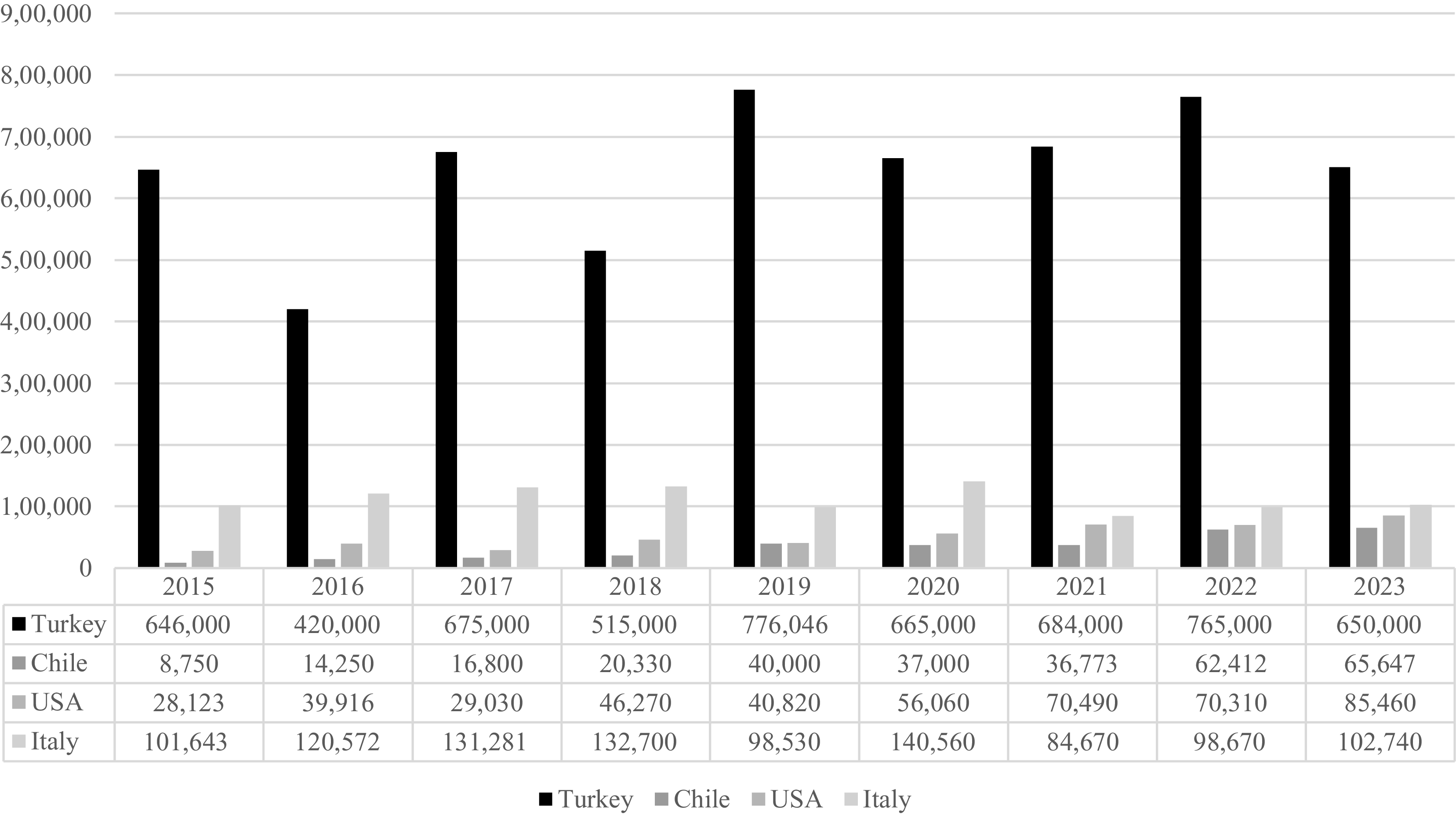
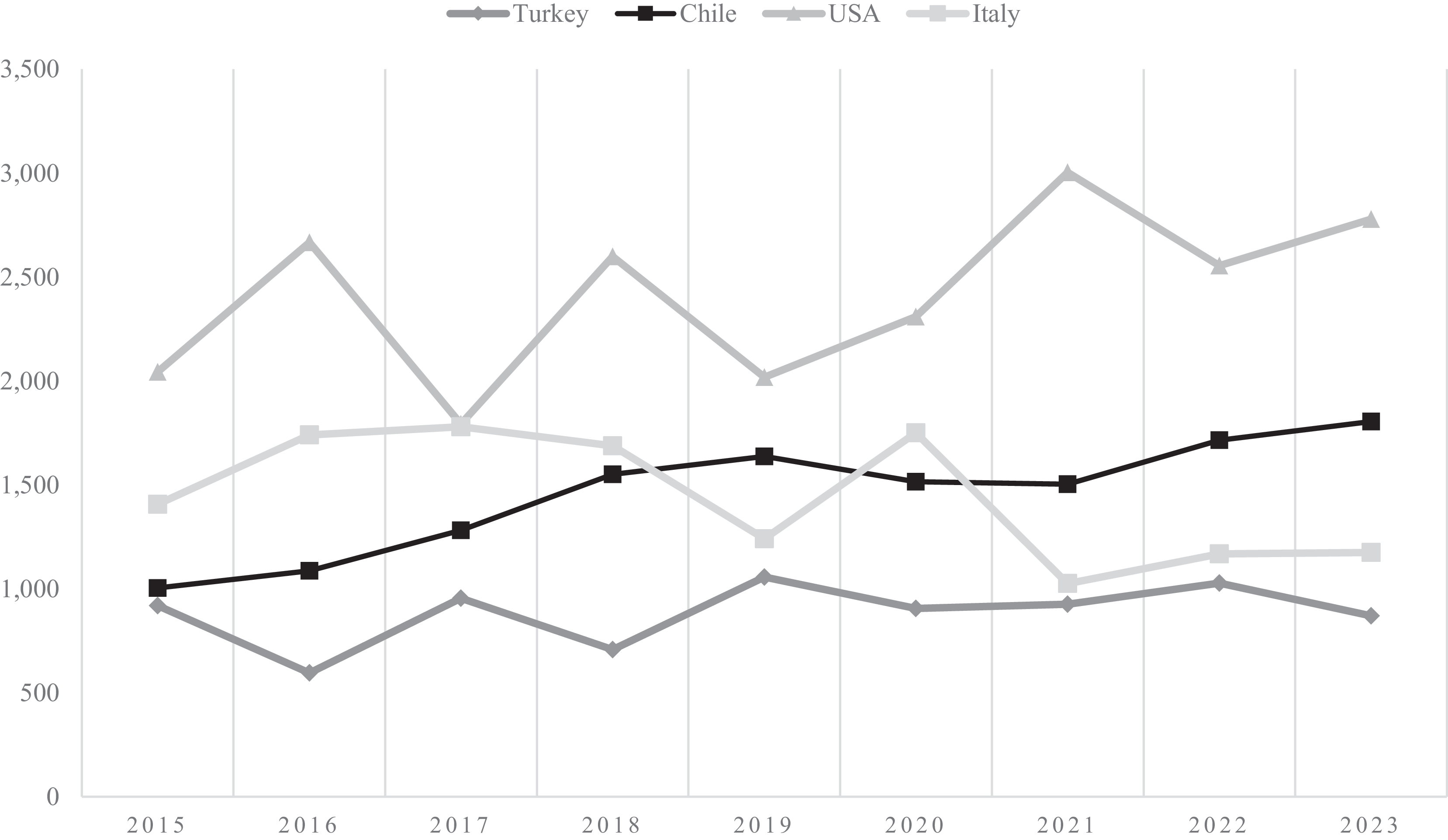
Turkey grows 65 to 75 percent of hazelnuts in the world annually, with Italy, Chile, the United States of America (USA), Georgia, and Azerbaijan being other notable producers. Production has increased over many years despite fluctuations, reaching 760,000 tons in 2022 (Figure 1). The acreage of hazelnut trees in the sixteen provinces in the Black Sea region where it is commercially grown has also steadily increased: in 2000, hazelnut cultivation took place on 549,500 hectares (ha) of land; by 2023 it had climbed to 746,749 ha. However, productivity (production per ha) has not increased in tandem. Productivity is consistently lower in Turkey compared to other major growers such as the USA, Chile, and Italy (Figure 2).
Hazelnut production in Turkey, Chile, United States of America (USA), and Italy (tons).
Source: Food and Agriculture Organization

Productivity in hazelnut cultivation in Turkey, Chile, United States of America (USA), and Italy (kg/ha).
Source: Food and Agriculture Organization

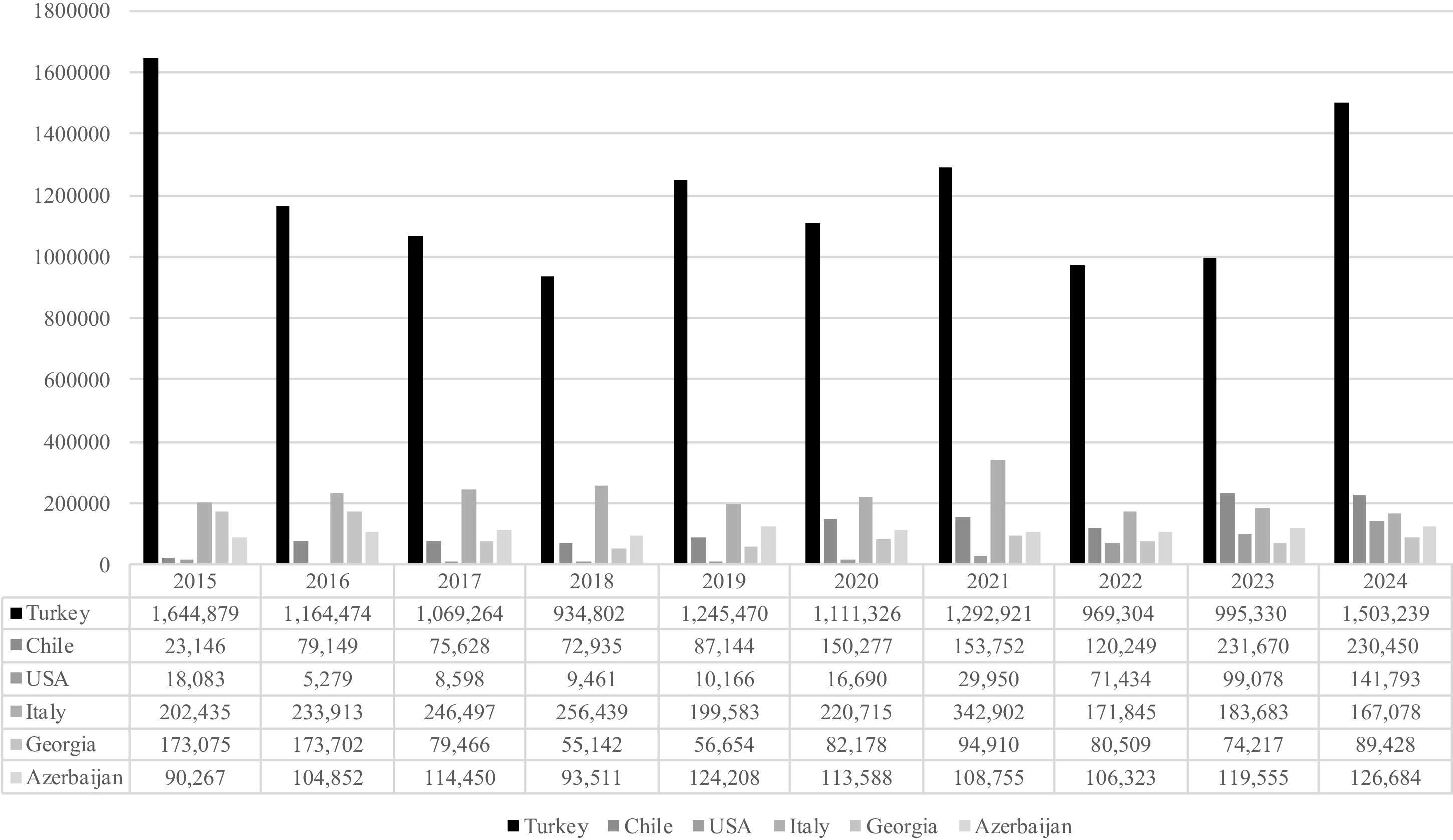
Turkey has long been the leading exporter of hazelnuts, with around three-quarters of all hazelnut exports in recent years. In 2024, it exported hazelnuts without shells with a value of more than 1.5 billion US dollars (USD), followed by Chile, Italy, the USA, and Azerbaijan (Figure 3). The primary destination of Turkish hazelnuts is the European Union. The annual average export price of shelled Turkish hazelnuts (calculated by the authors from World Bank trade data) has remained relatively stable in the past decade – ranging from 8.68 USD (2016) to 8.21 USD (2024) – with the exception of years with low yields that pushed up prices to 9.12 USD and 11.46 USD in 2014 and 2015, respectively.
Annual hazelnut exports from Turkey, Chile, United States of America (USA), Italy, Georgia, and Azerbaijan (1,000 US dollars).
Source: World Bank

The Union of Hazelnut Agricultural Sales Cooperatives (FİSKOBİRLİK) was established in 1938 at the instigation of the state, alongside other similar cooperative unions. Starting in 1964, governments supported hazelnut farmers through FİSKOBİRLİK, which bought hazelnuts from growers at annually set support prices. The state stopped entrusting FİSKOBİRLİK with hazelnut procurement in 2002 (Ticaret Bakanlığı 2019) as part of the restructuring of cooperatives in line with the World Bank’s Agricultural Reform Implementation Project (ARIP) initiated in 2001. Without the state’s financial backing, FİSKOBİRLİK faced financial difficulties and its hazelnut purchases dwindled until 2006, when it failed to pay farmers. The uncertainty surrounding the purchase price that year led to a massive protest march in Ordu province in July 2006, which prompted the government to authorize the Office of Soil Products (Toprak Mahsülleri Ofisi - TMO) to intervene in the hazelnut sector by making large purchases. Between 2006 and 2009, the TMO bought hazelnuts from farmers at prices announced at the beginning of the harvest season. This policy was replaced with “income support based on land” in 2009, according to which, regardless of the volume of production, the state paid a lump sum to hazelnut farmers for their hazelnut gardens registered in the Farmer Registration System (Çiftçi Kayıt Sistemi - ÇKS). This was in line with the stipulates of ARIP, which sought to reduce state support of agriculture. Nevertheless, the TMO once again started purchasing hazelnuts in the 2017 harvest season in order to stem farmer dissatisfaction in line with its populist policies (Gürel et al. Reference Gürel, Küçük and Taş2019); the TMO has continued to purchase hazelnuts at government-announced prices but not at scales that would influence the market price.
The global demand for hazelnuts is driven by the confectionery industry, as hazelnuts are a significant ingredient in hazelnut spreads, chocolate bars, and other confections.Footnote 2 The largest buyer of hazelnuts in the world is Ferrero (Italy); other large buyers include August Storck (Germany), ofi (Olam Food Ingredients) (Singapore), Delica AG (Switzerland), and Nestlé (Switzerland) (Volza nd). Among national companies that purchase, process, and export hazelnuts, Balsu Gıda is the leader, followed by Yavuz, Durak, and Poyraz Poyraz. Both the international and national buyers in Turkey operate hazelnut cracking facilities across the Black Sea region, where the nuts are separated from the shells, classified according to their size and the proportion of fruit to shell, and roasted or ground according to market demand.
Given that value chains are global, international companies procure hazelnuts from multiple countries. In the past decade, Italy, the USA, and Chile have all increased production. The most remarkable case is Chile, which has significantly increased productivity and exports compared to all other growers (see Figures 2 and 3). In the tension between Ferrero and Turkish exporters mentioned in the introduction, Ferrero officials said they were in no rush to buy Turkish hazelnuts at a high price because they had other suppliers, chiefly Chile. Ferrero has been making investments in Chile in hazelnut cultivation and procurement since the 1990s (Ferrero nd). Balsu also set up a subsidiary in Chile in 2017 for hazelnut cultivation and procurement. It seeks to diversify its supply, taking advantage of Chile’s location in the southern hemisphere for its buyers in Europe and East Asia (Balsu nd a). Both Ferrero and Balsu boast of the traceability of their hazelnut value chains in Chile, referring to how the final product can be traced back to its grower as well as the farming and social practices used in cultivation. Finally, Nestlé buys from ofi, Balsu, and Yavuz in Turkey, its major supplier, while it also purchases from Spain, Italy, and Azerbaijan.
To summarize, market power is concentrated at the top of the hazelnut value chain, where global confectionery firms are located. International and national suppliers are located just below them. Next come the cracking factories. The TMO and local wholesalers are located between the crackers and the hazelnut farmers. At the bottom of the value chain are the seasonal migrant farm workers who harvest hazelnuts. At the national level, the state also is an actor in the GVC by virtue of intervening in the market through the TMO and the regulation of seasonal migrant farm laborers’ wages and working conditions.
Methodology
The article relies on the findings of qualitative fieldwork conducted in three major hazelnut-producing provinces. To bring the data up to date and validate the insights, we also examined recent datasets and reports and reviewed the recent scholarship on hazelnut cultivation and seasonal migrant labor in Turkey. We conducted fieldwork in August and September 2017 in the districts of Akçakoca (Düzce province), Karasu (Sakarya province), and Ünye, Fatsa, and İkizce (Ordu province). Ordu was selected since it has been the largest hazelnut producer in the country (both in tons and acreage) in the past several decades and exemplifies the cultivation conditions in the Eastern Black Sea region (which includes Giresun, Samsun, and Trabzon) with steep slopes and lower productivity. Sakarya and Düzce are two neighboring provinces in the Western Black Sea region where the terrain is relatively flat and productivity is higher. Together, these two provinces accounted for more than 23 percent of hazelnut production in 2023, while Ordu claimed more than 31 percent (Bars Reference Bars2023). Our case selection sought to capture the variety in hazelnut farming and the conditions of seasonal migrant farm workers. Twenty-three farmers, fifty-three Kurdish seasonal migrant workers, and several labor contractors (intermediaries) and local wholesale traders were interviewed. The interviewed farmers included those who only cultivated their own orchards, those who rented some orchards in addition to their own, as well as people who planted hazelnuts on public land in addition to their own orchards. All except one farmer were men. Migrant worker participants included a balanced number of men and women. We also interviewed representatives of civil society organizations (CSOs) that worked with seasonal migrant workers and of local public agencies. On the higher links of the value chain, three interviews with representatives of two leading national hazelnut suppliers were carried out.
Interviews with seasonal migrant workers, all of whom were Turkish citizens, were conducted in Turkish or Kurdish. Our sample did not include any Syrian or Georgian seasonal migrant workers. The interviews with hazelnut farmers included questions on their sources of income, debts, the stages of hazelnut cultivation, and associated costs; we asked seasonal migrant workers questions on incomes, debts, and costs and conditions of transport and accommodation in the harvest region. We used convenience and snowball sampling to reach workers and farmers with the help of local contacts including farmers, CSO workers, and labor contractors. Therefore, our sample does not claim to be representative of the population of 400,000 to 600,000 hazelnut farmers (Özkan Reference Özkan2021, Reference Özkan2023); and tens of thousands of seasonal migrant hazelnut harvest workers.Footnote 3 Before each interview, we gave assurances to the participants about anonymity, and that all personal and institution-related information would be kept confidential. The interviews with farmers, seasonal workers, intermediaries, and local traders were voice recorded, fully transcribed and then manually coded for themes such as costs, production process, profitability, the labor process, and working and living conditions. Only notes were taken in the interviews with institutional representatives.
The fact that we relied on local contacts to form a convenience sample precluded us from reaching women in farming families. This prevented us from inquiring about the gendered dynamics of unpaid family labor in hazelnut cultivation. Therefore, our analysis below on production and labor relations relies predominantly on our observations on paid labor, augmented by secondary sources.
Hazelnut cultivation
Hazelnut farmers face wholesalers and (inter)national buyers in the market and seek to maintain or increase their incomes from sales, given their land endowments and cost structure. However, they cannot affect prices (Konyalı and Demir Reference Konyalı and Demir2024), as attested to by the relative stability of export prices mentioned earlier.
Small land holdings
The size of land holdings is small because of the subdivision and geographical dispersion of farms due to inheritance; despite that, family farms have persisted in hazelnut cultivation, like for other crops in Turkey (Keyder and Yenal Reference Keyder and Yenal2013). The average hazelnut holding size has remained around 1.4 ha in the past two decades (Bars Reference Bars2024).
In 2021, 504,000 ha of hazelnut gardens were registered in the ÇKS system (Özkan Reference Özkan2021) although the land under cultivation was 738,920 ha. That is because farmers also plant hazelnuts on public land by clearing forests (so-called 2/B lands that have been taken out of forest status and de facto opened for cultivation or development). We could not find overall data on forest clearance for hazelnut orchards, but a study on changing rural landscapes in Ordu, the province with the largest hazelnut acreage, is an indicator of the transformation. Between 1990 and 2008, the proportion of forests in landcover declined by 2 percent in Ordu; between 2012 and 2018 this transition accelerated and nearly half of it was from forests to agricultural use (Dıkçınar Sel Reference Dıkçınar Sel2021).
Among the interviewed farmers, holding sizes were between 0.2 ha to 10 ha (including land with title deeds, cultivated public lands and rented orchards), with both the mode and the median values at 4 ha (Levent et al. Reference Levent, Yükseker, Şahin, Erköse and Sert2018). Their average holding size was larger than the national average since many had also planted on public lands and/or were renting others’ gardens.Footnote 4 However, a farmer whose land is not registered cannot receive direct income support, get Agricultural Credit Cooperative loans, or sell his/her produce to the TMO. The observations of a farmer in Ordu exemplifies this problem:
I think the greatest problem in the Black Sea region is property relations. For instance, land with title deeds is very little. Usually, hazelnut gardens have been set up on forest land or public land. In my village, at least 70 percent of the land has insecure legal tenure. There are families who have no title deeds. And lands with titles have become too complicated as a result of inheritance (hazelnut farmer and village muhtar [elected officer in a village], Ünye, Ordu).
From family labor to reliance on wage labor
Traditionally, teenage and adult children helped parents in the year-round care of the hazelnut gardens (such as weeding, hoeing, trimming, spraying pesticides, and spreading fertilizers) and during the harvest. Relatives and neighbors would pool labor – on a reciprocal basis or for wages – during the harvest that takes place sometime between July and September. However, in recent decades, the hazelnut harvest has come to rely largely on seasonal migrant farm workers; this stems partly from the aging of hazelnut farmers – the average age being in the fifties (Bars Reference Bars2024) – and the outmigration of young people, and is also exacerbated by cultivation on cleared forests on steep hills (Yıldırım Reference Yıldırım2021). In our study, farmers recalled how the village community used to labor collectively on each other’s gardens, as in the following example:
Back in the old days, it used to be easy. You could find local workers in your village. There even used to be communal labor (imece). But now, everyone has migrated to İstanbul, Ankara, or İzmir. There is no longer a population who will work on the farm. Everyone comes during the harvest season and finds seasonal workers (hazelnut farmer, Ünye, Ordu).
Especially the migration of youth to cities in search of higher education or wage jobs has changed the pattern of hazelnut growing, as the following testimonies indicate:
There are eighty households in this village. Many consist of retirees above 50 or 60 years of age … A man has a hazelnut garden. He must work on that. But what will he do? He cannot do it himself. Therefore, he turns to workers. When he employs workers, then the cost goes up … You have to also consider the people here who have to a make a living solely by growing hazelnuts (hazelnut farmer, Yenice, Akçakoca).
There are five people in the family … When the kids are in school, you have to employ workers to get the work done. Only during the harvest do my children supervise the workers. All of this depends on money. Trimming, cleaning the field, all of that … When the cost rises, nothing remains in our hands (hazelnut farmer, Balatlı, Akçakoca).
The shortage of unpaid family labor has rendered wage labor indispensable also for the year-round care of trees and gardens. Trimming of branches, hoeing, spreading fertilizers, spraying pesticides, and cleaning the field require machinery and tools (tractors, saws, threshing machines, mechanical scythes, etc.) as well as diesel fuel; however, the most important input is skilled labor. Daily wages for these activities were three to five times the daily wage for harvesting labor in 2017. Some farmers hired skilled local laborers, whereas others skipped all or part of these activities. Thus, dependence on paid labor either pushed costs up or its absence created productivity problems. The following testimony illustrates the dilemma between high costs versus low yields:
Six years ago, we started using herbicides. This eroded the chemistry of the soil, drying all the living organisms … A layer of dust appeared on the topsoil, the most valuable layer. In the past, agricultural engineers would instruct us not to use herbicides, and instead to cut the weeds twice a year using a scythe. Because no fertilizer is as rich as decomposed weeds. But diesel fuel became too expensive. And the daily wage for weeding is 300 TL, including the rent of the mechanical scythe … However much we don’t want to use herbicides, we cannot do without using them … My fields have not seen a blade in 10 years (hazelnut farmer, Balatlı, Akçakoca).
Persistence of low productivity
Productivity can be increased by using machinery in tending for the hazelnut orchards and during the harvest. Since our fieldwork, the limited use of mechanization for harvesting has persisted (Çıkmak Reference Çıkmak2025). Small holdings cannot take advantage of economies of scale from the use of mechanical tools and machinery because they are expensive and cannot be used effectively in steep gardens. Thus, only families with larger gardens were likely to make such investments. Among the participants, a farmer who rented orchards in addition to his own had bought a tractor, a mechanical scythe, a threshing machine, a mechanical saw, and other implements on credit. He could use them himself and did work for neighboring farms for wages. He was also planning to buy a hazelnut harvesting machine next year. He explained the rationale for that plan as follows: “If someone with 5 hectares of land would spend the money he pays to harvesting workers on a harvesting machine, he would pay off the machine in a year” (hazelnut farmer, Döngelli, Akçakoca).
Another farmer in Akçakoca boasted of having eleven different machines that can be attached to a tractor for various activities on hazelnut orchards that helped him save time and labor, which, he said, also increased productivity, as he describes below:
You pay too much in wages when you pick by hand … I also help neighbors in return for a fee. I have a threshing machine. I have a harvesting machine. I have a spraying machine. When my work is done, I do my neighbors’ work … Ten years ago I would get a yield of 10 to 12 tons from 10 hectares. Now I get 30 tons (hazelnut farmer, Göktepe village, Akçakoca).
Uncertainties associated with the market and climate conditions preclude many farmers from making investments into mechanization on bank credit. Therefore, seasonal migrant workers’ labor continues to be essential for harvesting. Most of the farmers we interviewed considered the harvest wages to be too high for them to make a reasonable profit. Our calculations based on the reported costs and expected revenues of the farmer participants in 2017, though not representative, indicated that smallholdings, especially, were not profitable (Levent et al. Reference Levent, Yükseker, Şahin, Erköse and Sert2018). Studies on the cost structure of production for the entire hazelnut region are scant; nevertheless, local studies show the fragility of profitability. For instance, in Giresun, the TMO purchase price barely covered costs in 2018; farmers made a profit only thanks to the area-based support and subsidies for fuel (Hazneci et al. Reference Hazneci, Naycı and Çelikkan2022). Another study in Samsun showed that hazelnut farmers made a profit, but it was less than what the families would have earned had adults in the family had wage jobs (Aydoğan and Meral Reference Aydoğan and Meral2024); a GVC-based analysis of hazelnut cultivation, also in Samsun, likewise indicated meager profits (Macit and Ilkay Abacı Reference Macit and Ilkay Abacı2023).
Low incomes from hazelnuts and indebtedness
Fluctuation in yields and prices and increasing costs have driven many farmers into indebtedness to banks and to local wholesalers. Among our interviewees, many were repaying bank loans in addition to personal debts to local wholesalers. When production is low in a year, the sales price might be relatively high in nominal terms, leading farmers to take out loans to buy tractors or other implements, but if the sales price turns out to be low in the next several years, then they run into difficulty with debt repayment. Thus, fluctuations in production trigger fluctuations in price, eventually leading to a spiral of indebtedness. As we were moving from one village to another in Düzce and Ordu, we frequently heard the following phrase: “We eat hazelnuts on the branch” (fındığı dalında yiyoruz). Many farmers took out informal loans from the local wholesalers before the harvest to pay seasonal farm workers’ wages. Hence the metaphor “eating nuts on the branch.” Most farmers did not have storage facilities; when they sold produce to wholesalers, they also entrusted the nuts to them for safekeeping. Local wholesalers sold hazelnuts to cracking companies in batches after the harvest season. Thus, if the market price rose sometime after the harvest season based on international demand, the wholesalers, the cracking firms, and the national hazelnut dealers could make a profit over and above the price paid to farmers. Recalling the skirmish between Ferrero and Turkish traders in October 2025, price speculation could benefit national buyers but not necessarily the farmers, who would have already sold most of their produce.
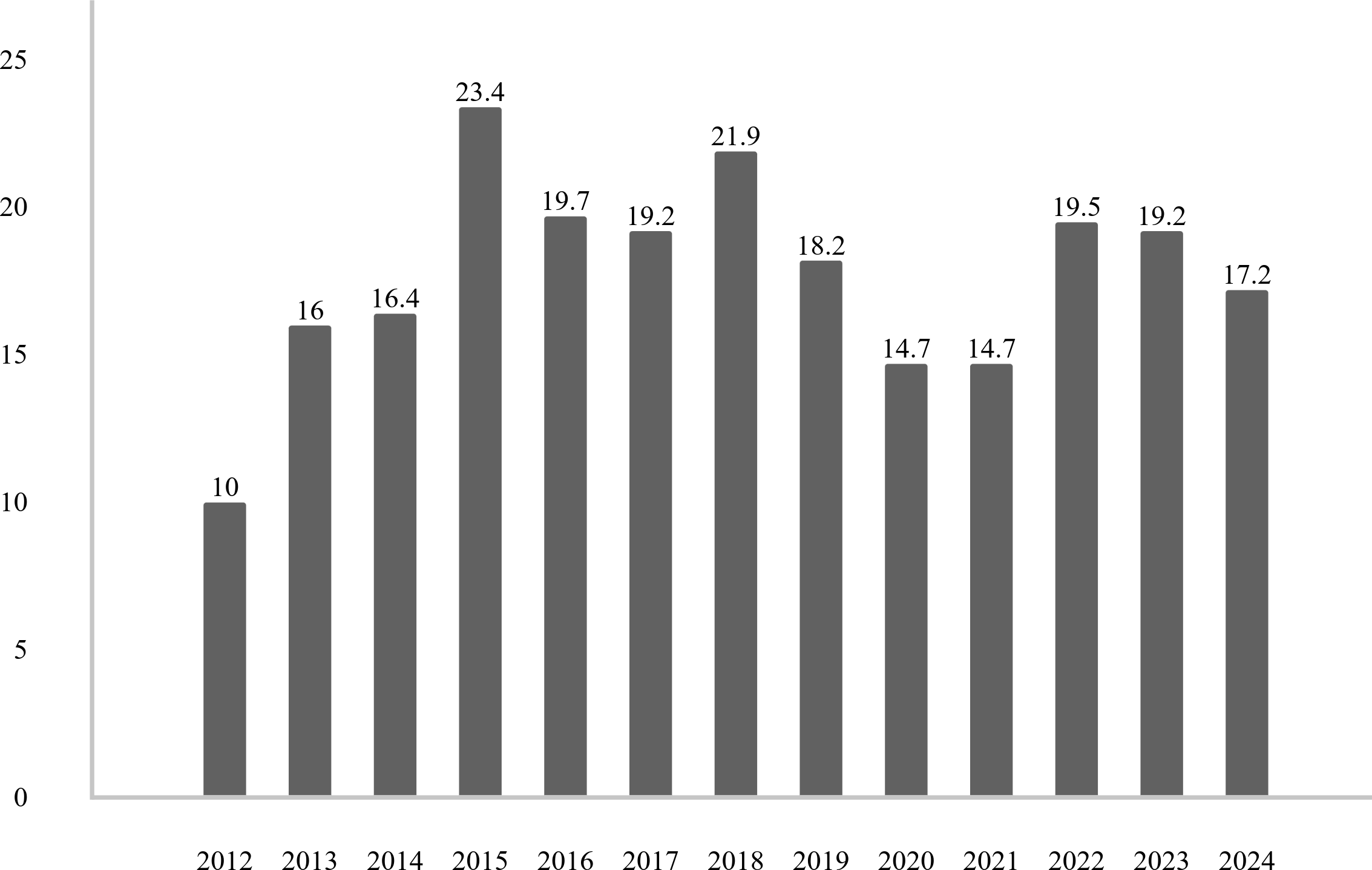
Price fluctuation exacerbates the insecurity of those who rely on hazelnut cultivation for a living. Halfway through the fieldwork in the summer of 2017, the government announced that the TMO would purchase hazelnuts at 10 TL per kg (USD 2.8/kg) (for Levant-grade hazelnuts with 50 percent fruit to shell ratio). This price was lower than what farmers in Akçakoca had been telling us would be a fair price (that covered their costs and left them a decent profit). A representative of a national buyer told us that if the TL depreciated against the USD in the months after the harvest, the real value of the sales price would further drop (from July to the end of 2017, the exchange rate of USD rose from 3.53 to 3.77 TL, around a 10 percent depreciation; in the following years the TL’s value fell further against the USD). At any rate, the TMO bought only around 21 percent of the total harvest of hazelnuts in 2017. The next year, it purchased a little above 26 percent. Since then, TMO purchases have remained below 20 percent of total production and have become negligible in the past 4 years (Figure 4). Therefore, the TMO’s purchases have more symbolic and political significance than affecting the market price.
Share of Office of Soil Products (TMO) purchases in hazelnut production.
Source: Authors’ own calculations from TMO Activity Reports, Food and Agriculture Organization, World Bank, and Ordu Trade Exchange

Despite the financial challenges described above, farmers nevertheless insist on growing hazelnuts. Even if their gardens are small or located on marginal land, they need the proceeds from hazelnut cultivation for household expenses. Incomes from hazelnut cultivation are indispensable, although the majority of the twenty-three farmers had other sources of income, primarily wages (thirteen of the participants) and pensions (eight of the participants). An important goal expressed by some farmers was to put children through school so that they would not become farmers like their parents, as the following narrative demonstrates:
I have 1.2 hectares and spend 7 days to hoe the field myself. No one else would do it because my field is steep and full of rocks … But I have to do it. I am putting my daughter through university (hazelnut farmer, Balatlı, Akçakoca).
To summarize this section, productivity remains low due to the use of marginal lands (exacerbated by the populist policy of allowing steep 2/B land to be cultivated), little use of machinery, as well as ecological conditions such as irregular rainfall and frosts (Ekologos 2020). Harvest wages and maintenance costs have a high share in revenues (Hazneci et al. Reference Hazneci, Naycı and Çelikkan2022), leading to indebtedness. Despite these odds, farmers persevere because hazelnuts continue to be a significant income source.
Turkish hazelnuts’ quality and price competitiveness account for sustained international demand (Yıldırım et al. Reference Yıldırım, Bozoğlu and Urago2024). Yet, Turkey has not improved its position in the hazelnut GVC due to exporting low-value goods (mainly in-shell and cracked hazelnuts) and no significant increase in the export unit price, in addition to the above-discussed production-related problems. Domestic firms in the sector concentrate on cracking and pressing hazelnuts but not so much on processing for higher-value confectionery products (Bozoğlu and Kabaoğlu Reference Bozoğlu and Kabaoğlu2023). Companies like Ferrero control the hazelnut GVC by virtue of being able to control the procurement price as well as the market for high-value products. Under these conditions, we argue below, hazelnut cultivation relies primarily on the social arrangements that make seasonal migrants’ cheap labor available year after year.
Migrant seasonal agricultural workers
Reliance on precarious migrant labor in agriculture is a global phenomenon (Dedeoğlu Reference Dedeoğlu2023). In Turkey, the transition to cash crops has gained pace since the initiation of ARIP in 2001. Coupled with increasing rural to urban migration and the aging of farmers, this transition has expanded the need for the labor of migrant seasonal farm workers in different stages of agricultural production.
An ethnicized and precarized labor force
Although seasonal farm labor has historically been important for some crops, for hazelnuts it has become vital in the past several decades. Kurds from southeastern provinces, present in the sector for a long time, have remained the major group of migrant seasonal agricultural workers. Syrian refugees have augmented Kurdish labor since the 2010s (Kavak and Eren Benlisoy Reference Kavak and Eren Benlisoy2025). A smaller seasonally migrating group of workers are Georgians and Azerbaijanis. There are also local laborers who do farm work close to where they live. Syrians have the weakest bargaining power in the labor market due to insecure legal status (temporary protection), poverty, fear of deportation, and reliance on labor contractors for finding work (Pelek Reference Pelek2019). Seasonal migrant farm workers are thus both ethnicized, given the predominance of Kurds and Syrian refugees (Pelek Reference Pelek2022) and precarized (Dedeoğlu Reference Dedeoğlu2023). The laboring unit is often the family, as men, women, and children travel together and participate in harvest work (Dedeoğlu Reference Dedeoğlu2023). For both Kurdish laborers (Kavak and Eren Benlisoy Reference Kavak and Eren Benlisoy2025) and Syrian refugee laborers (Dedeoğlu Reference Dedeoğlu2022), the double burden of livelihood and social reproduction of the household is on women’s and children’s shoulders.
The labor process in the hazelnut harvest
The labor process in seasonal migrant farm work, involving ethnicization, control by contractors, and precarity also shapes the characteristics of the hazelnut value chain.Footnote 5 The government’s regulation of seasonal migrant workers’ labor and the farmers’ and labor contractors’ control over it create a labor process whose main goal is to make workers available at minimal costs. To investigate whether there is social downgrading, following Hopkins and Wallerstein (Reference Hopkins and Wallerstein1986), we discuss not only wages, but the whole labor process including the use of child labor, the role of labor contractors in labor control, workers’ accommodation and transport conditions and work accidents.
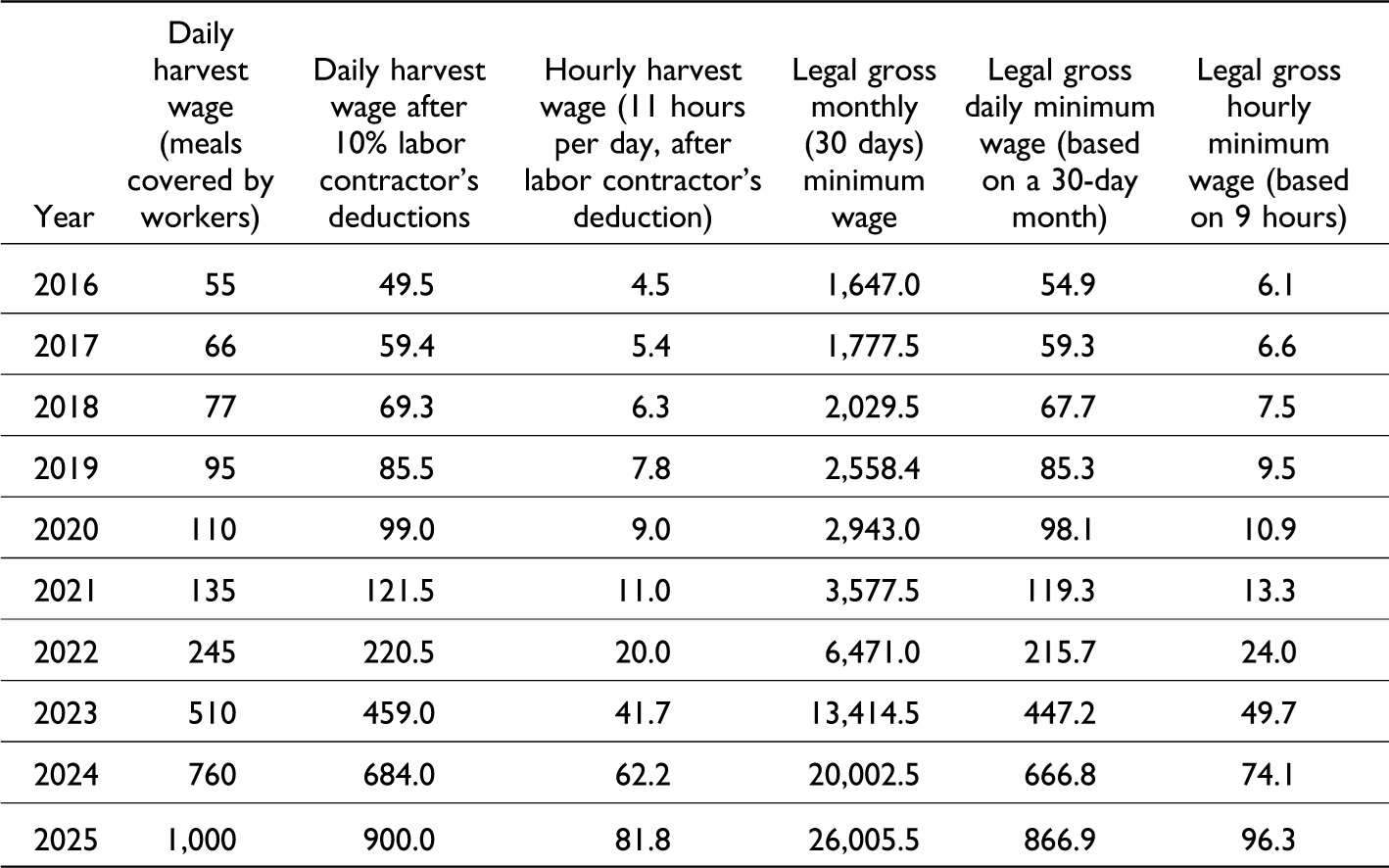
Daily wages of seasonal migrant farm workers in the hazelnut harvest are determined each summer by provincial boards. Labor Law’s (Resmi Gazete 2003) clauses on the legal minimum wage do not apply to agricultural labor in establishments with less than fifty workers. Likewise, laborers under temporary protection – the predominant legal status for Syrian refugees – are exempted from having to get work permits (Resmi Gazete 2016). When determining daily wages of seasonal workers, provincial boards assume that workers will register for social security and pay their social security premiums, which is in practice not implemented. The nationally determined minimum wage presumes a work week of 5–6 days and 45 hours; work over and above that should be compensated with overtime payment. However, seasonal migrant agricultural workers toil 10–12 hours per day and 7 days a week in the hazelnut harvest without overtime payment (Beydili Gürbüz and Yılmaz Reference Beydili Gürbüz and Yılmaz2021). In addition, they pay 10 percent of their wages to the labor contractor who mediates between the employers and laborers. Therefore, their gross hourly wages are much below the gross legal hourly minimum wage as our calculations indicate (Table 1). Seasonal migrant farm workers pay for their travel between their hometowns and the harvest areas in buses or vans. They also buy and prepare their own food during the harvest. By the end of the harvest, workers often cannot take back home more than half to two-thirds of earned wages after deducting transportation and food costs. Thus, the income earned from the hazelnut harvest is not a “living wage” that can be earned in normal working time, is enough to support a family, and which would provide a basic but decent standard of living (Anker and Anker Reference Anker and Anker2017).
Gross daily minimum wages and gross daily wages of hazelnut workers (TL)

Table 1 Long description
A table comparing gross daily minimum wages and gross daily wages of hazelnut workers from 2016 to 2025. The table has 10 rows and 6 columns. Column headers are: Year, Daily harvest wage (meals covered by workers), Daily harvest wage after 10 percent labor contractor’s deductions, Hourly harvest wage (11 hours per day, after labor contractor’s deduction), Legal gross monthly (30 days) minimum wage, Legal gross daily minimum wage (based on a 30-day month), Legal gross hourly minimum wage (based on 9 hours). Row 1: 2016, 55, 49.5, 4.5, 1647.0, 54.9, 6.1. Row 2: 2017, 66, 59.4, 5.4, 1777.5, 59.3, 6.6. Row 3: 2018, 77, 69.3, 6.3, 2029.5, 67.7, 7.5. Row 4: 2019, 95, 85.5, 7.8, 2558.4, 85.3, 9.5. Row 5: 2020, 110, 99.0, 9.0, 2943.0, 98.1, 10.9. Row 6: 2021, 135, 121.5, 11.0, 3577.5, 119.3, 13.3. Row 7: 2022, 245, 220.5, 20.0, 6471.0, 215.7, 24.0. Row 8: 2023, 510, 459.0, 41.7, 13414.5, 447.2, 49.7. Row 9: 2024, 760, 684.0, 62.2, 20002.5, 666.8, 74.1. Row 10: 2025, 1000, 900.0, 81.8, 26005.5, 866.9, 96.3.
Source: Authors’ own calculations from Giresun Governorate’s annual harvest wage announcements and the legal gross minimum wages for each year (2022 and 2023 wages valid after July). Hourly harvest wages were calculated assuming an 11-hour workday (excluding lunch break); hourly gross minimum wages were calculated based on the assumption of a 9-hour work day (excluding lunch break).
Given that their income from farm work is so low, seasonal migrant workers are often indebted, sometimes to the labor contractors. A family may get in debt to work in the harvest and then work more to repay it. Workers we interviewed described how their wages barely covered their expenses; if something extraordinary takes place, their margin could easily be destroyed (Levent et al. Reference Levent, Yükseker, Şahin, Erköse and Sert2018). The description below by a young man who came to Ordu with his family of ten people indicates how indebtedness becomes a vicious cycle:
I borrowed money from the labor contractor today for our family’s daily needs … We need to eat and drink; we need stuff such as clothing, gloves, and shoes … I reckon that we will need to curb our diet and additional expenses. However, if we eat less, we are not able to work properly. We have to eat to continue to work … We are indebted to the grocery store, the bakery in our hometown. We took a loan for the car … For the next harvest season we still need to find a job and have to ask for loans again and are obliged to come here (male worker from Şanlıurfa, interviewed in Ordu, 20 years old).
The low level of wages also contributes to the incidence of child labor. Poor families strategize by increasing labor effort, putting more members to work in the harvest. In Sakarya and Düzce, some young harvest workers had come there not with their families but siblings and cousins, trying to save money for higher education and financially contribute to their families (Beydili Gürbüz and Yılmaz Reference Beydili Gürbüz and Yılmaz2021; Yılmaz and Yıldırım İşler Reference Yılmaz and Yıldırım İşler2021). A woman harvest worker we interviewed in Akçakoca explained why child labor exists in the following words:
24-or 25-year-old men would never come here to work. And when they don’t come, who is going to do the harvest? The wage paid for this work is too low for a 25-year-old man … That’s why these tasks are mostly done by children (female worker from Şırnak, interviewed in Akçakoca, 19 years old).
The working conditions of seasonal migrant farm workers are regulated through two government circulars (T.C. Başbakanlığı 2017; T.C. Cumhurbaşkanlığı 2024), which explicitly promise fighting against child labor. They also say that local public authorities will ensure that housing is adequate, safe, and sanitary, basic healthcare is available, and that traffic controls will be carried out for ensuring safe transportation of workers between the farms and their accommodations as well as between the harvest regions and their hometowns. During the hazelnut harvest, seasonal migrant workers either stay in makeshift housing units provided by hazelnut farmers or in tents. In Düzce and Sakarya, workers we interviewed stayed in buildings, but some structures had holes in the roof; others had dirt floors which the workers covered with rugs they had brought from home. In Ordu, workers mostly stayed in tents, some without electricity and proper toilets. On rainy days, the tents and the rugs on the ground got wet; therefore tents smelled of mold. Seasonal workers’ tents may become uninhabitable in the case of heavy flooding and mudslides, showing the vulnerability of seasonal migrant labor to ecological hazards (Pelek et al. Reference Pelek, Yıldızcan and Turhan2025).
Labor intermediaries should be registered with the Employment Agency (İŞKUR), prepare written contracts for the workers, should get a commission only from the employers, and negotiate with the employers for adequate lodging for the harvest workers (Çalışma ve Sosyal Güvenlik Bakanlığı 2010). However, in practice, most labor contractors, who often hail from the same rural areas as the laborers they recruit, work informally. They invariably deduct the 10 percent commission from the seasonal migrant workers’ daily wages, never make written contracts, and do little in the way of ensuring that employers provide adequate accommodation. Seasonal migrant workers are often compelled to find work through contractors. Some workers say they are dependent on the labor contractors for finding work, solving problems with the employers, and organizing transportation. Because labor contractors make agreements with the hazelnut growers, they may threaten laborers who complain about the working or living conditions with preventing them from finding employment in the next season in the same locality (Beydili Gürbüz and Yılmaz Reference Beydili Gürbüz and Yılmaz2021).
The role of labor contractors is somewhat reminiscent of foremen in the classical labor control process in manufacturing which is an open and face-to-face relationship of control. The contractors minimize the tension between the hazelnut farmers and laborers, they discipline the laborers with threats of unemployment but at the same time lend money, occasionally make gifts of food or help with taking a sick child to the hospital, as we heard from our participants. Employers also play a role in labor control. When seasonal migrant workers arrive in a town for the hazelnut harvest, they often work in the orchards of more than one hazelnut grower, a process organized by the labor contractor. The hazelnut farmers are keen to have the workers finish the harvest as quickly as possible so that they can economize on the wage bill. Therefore, they can push workers to work longer hours, shorten the lunch break and, while doing this, they may use verbal abuse and derogatory language. Workers endure the same treatment from several employers during one harvest.
A farmer may have 2 decares of land and may produce 1 ton of hazelnuts … Still, they consider themselves as the owners of Turkey and consider us their servants … We work 12 hours a day and, if we stop just for 1 minute while working, they get offended. If you want to finish the shift say only 5 minutes before 7 in the evening, they warn you … They consider themselves as landlords (male worker from Şanlıurfa, 20 years old).
Public authorities also partake in the shaping of the labor process by ostensibly regulating and then turning a blind eye to the working and accommodation conditions of seasonal migrant farm workers. The COVID-19 pandemic crystallized this predicament in 2020. The Minister of Interior issued a circular allowing the transportation of seasonal workers from specific provinces in the Southeast to meet labor demand in agriculture. Circulars by the Ministry of Agriculture and Forestry and the Ministry of Health described the conditions for transportation, accommodation, and health controls. Workers and labor contractors interviewed in a study in Sakarya reported that there were no visits by healthcare personnel; the housing units and bathroom facilities did not conform to the hygiene and social distancing conditions set forth in the circulars and the transport vehicles were not controlled. In effect, the government and local public authorities made sure that workers were available for the hazelnut harvest during the pandemic but did not do much in the way of ensuring safe and healthy working conditions (Yılmaz and Yıldırım İşler Reference Yılmaz and Yıldırım İşler2021). In another study in Akçakoca, Düzce, clauses of the circular on preventing child labor were reportedly not implemented. For instance, daycare centers for small children, stipulated in the circulars, were not available. Workers in Akçakoca also complained that public authorities were putting no pressure on farmers to provide better housing, thus giving impunity to employers (Beydili Gürbüz and Yılmaz Reference Beydili Gürbüz and Yılmaz2021).
Both the road trip to the Black Sea region and transportation to the hazelnut gardens are hazardous for workers. A labor contractor described the accident risks of the bus trip as “taking their shrouds (kefen) with them on the bus” (Beydili Gürbüz and Yılmaz Reference Beydili Gürbüz and Yılmaz2021, 948). Hazelnut growers transport workers to their gardens on either tractors or patpat, a vehicle made by modifying a hoeing machine and attaching a tow that is used for carrying hazelnut sacks. Although the circular mentioned above bans the use of patpat or tractors for transporting people, they are regularly used even in steep orchards.
In recent years, work-related deaths of both farm workers and farmers, caused by traffic accidents between their hometowns and harvest regions and between their accommodations and hazelnut farms, have been on the rise as a proportion of deaths in work-related accidents (İşçi Sağlığı ve İş Güvenliği Meclisi nd) (Figure 5). Overcrowded vans speed to transport seasonal migrant workers to harvest regions to cut costs. Traffic accidents become the inevitable consequence of cost-cutting by employers with the collusion of labor contractors who organize transportation (Yıldırım Reference Yıldırım2016).
Share of agricultural worker deaths in deaths in work-related accidents (%).
Source: Authors’ compilation from İşçi Sağlığı ve İş Güvenliği Meclisi annual reports

Efforts for compliance with social codes
Some international buyers have initiated and implemented projects in Turkey with national partners for the elimination of child labor. Despite that, the use of child labor has continued to make international headlines (e.g. Whewell Reference Whewell2019). The Caobisco confectionery firm (Belgium) and Ferrero (Italy) have separately partnered with the ILO’s Turkey Country Office to carry out projects for ending child labor in the hazelnut region. The Fair Labor Association, in partnership with Nestlé and two of its Turkish suppliers, has carried out a similar project (Caobisco 2022; Ferrero 2020; Nestlé Global nd). While these companies invest into programs such as daycare centers and summer schools for the children of hazelnut harvest workers, they also have pushed their suppliers in Turkey such as Balsu, ofi, and Yavuz to comply with social codes for eliminating child labor and providing decent working conditions for seasonal migrant workers (e.g. Balsu nd b; ofi nd). International organizations that certify environmentally and socially compliant farmers are also present in the hazelnut sector. For example, a report on the impact of the UTZ certification program between 2014 and 2018 says that some improvements were recorded regarding the conditions of seasonal farm workers and the incidence of child labor (Development Workshop 2018). Nevertheless, child labor, labor contractors’ deductions from wages, and poor living conditions have persisted, as the same report and other studies document. Thus, social codes have not been quite impactful for improving seasonal migrant workers’ conditions. As mentioned at the outset, codes of conduct and CSR may not be effective for social upgrading because of the commercial logic behind them and the imperative to cut costs in globally competitive markets (Barrientos et al. Reference Barrientos, Gereffi and Rossi2011).
Conclusion
In this paper we scrutinized Turkey’s position within the global hazelnut value chain with a focus on production and labor relations in three provinces along the Black Sea coast. Hazelnut production in Turkey targets global markets due to high demand in the international confectionery industry. As agricultural support policies have declined, farmers more directly faced markets; multinational actors that procure hazelnuts as well as cocoa, coffee, and other crops have concentrated their market power. Turkish hazelnuts’ incorporation into the global hazelnut value chain has thus become more pronounced since the 2000s.
Our findings regarding hazelnut farmers point to the persistence of low productivity, lack of technical improvement, vulnerability to extreme weather and, therefore, limited profitability. Nevertheless, production and exports have not declined. Given hazelnuts’ status as an export commodity and the concern for not politically alienating the farmers, governments want to sustain hazelnut cultivation under the stipulates of the global market through populist policies. Cooperatives have long been dismantled, and the government pretends to support farmers through the TMO’s less than consequential purchases, area-based direct income support, and the promise of regularizing cultivation on 2/B land. It allows farmers to increase their yields by turning a blind eye to hazelnut groves on forested steep hills, which contributes to low productivity, susceptibility to extreme weather, and more dependence on seasonal migrant labor. Meanwhile, there are no policies for encouraging investments for the safe storage of hazelnuts, mechanization of the harvest, increasing productivity, or industrial incentives for moving up to higher-value added goods. Farmers are left to the mercy of wholesalers, crackers, and national and international buyers in that order. The incidents described at the beginning of the paper show the power of international confectionery firms; yet it was Turkish national buyers who sought to size up Ferrero through price speculation. Farmers have no say in that process, while the state pretends to protect farmers from international actors through populist window-dressing. As the hazelnut value chain increasingly becomes globalized, as exemplified by Chile’s advance in the sector through multinational investments, Turkish farmers’ position is likely to become even weaker.
Ensuring the availability of seasonal migrant workers’ cheap labor in abundance has been the other component of sustaining hazelnut production. There is a long history of seasonal migrant labor in Turkish agriculture. Then, what is the particularity of seasonal farm work in hazelnuts? Migrant labor is required primarily for the short period of the hazelnut harvest, unlike some other crops where labor demand might be spread throughout the year for various tasks. The partial replacement of cotton by vegetables in the Southern and Aegean regions, for instance, has rendered migrant farm labor a year-round phenomenon. Another important difference is the prevalence of small holdings, for instance, in contrast to cotton production, where landholdings are typically large. Hazelnuts’ full integration into a GVC as an export crop, the lack of mechanization in farming, and the absence of contract farming, which puts producers in direct contact with capital, are other particularities. Together, these factors give hazelnut farming its specific characteristics, which account for the entanglement between farmers, the state, and seasonal farm workers. The social arrangements surrounding seasonal migrant harvest work and the labor process, in which the state, farmers, and labor contractors take part to ensure the precarity of migrant agricultural laborers, are essential conditions for sustaining hazelnut cultivation and exports. Company-led programs for improving laborers’ conditions and preventing child labor appear to be only palliatives for a structural problem. Therefore, social upgrading is currently not likely in Turkey’s hazelnut value chain, not for seasonal farm workers, but probably also not for hazelnut farmers.
Acknowledgments
The original field research for this study was supported by the Fair Labor Association in 2017 under the title “Hazelnut Barometer: Procurement Price Study.” We are grateful for their support.
Competing interests
The authors declare no competing interests.


 Open access

