Introduction
The strawberry spider mite, Tetranychus turkestani Ugarov and Nikolski (previously known as Tetranychus atlanticus McGregor), is one of the most important polyphagous tetranychid mites in the world (Jeppson et al., Reference Jeppson, Keifer and Baker1975). It has been recorded on 25 host plant species belonging to 15 plant families (Jeppson et al., Reference Jeppson, Keifer and Baker1975; Kamali et al., Reference Kamali, Ostovan and Atamehr2001). Tetranychus turkestani is a cosmopolitan mite found throughout Russia, Europe, the United States, the Near East, the Middle East and China (Jeppson et al., Reference Jeppson, Keifer and Baker1975; Zhang, Reference Zhang2003).
Feeding by T. turkestani on the lower surface of leaves leads to the appearance of white spots on the upper surface and copious webbing on the underside. In cases of heavy infestation, leaf drop can occur, and flower production may be significantly diminished. Due to its short developmental duration and high reproductive capability, T. turkestani can quickly reach the economic injury level, resulting in a substantial reduction in crop yield (Jeppson et al., Reference Jeppson, Keifer and Baker1975; Sohrabi and Shishehbor, Reference Sohrabi and Shishehbor2008).
Euseius scutalis (Athias-Henriot) (Acari: Phytoseiidae) is a type IV lifestyle pollen-feeding generalist predator (McMurtry et al., Reference McMurtry, De Moraes and Sourassou2013). It is an active phytoseiid mite found in Africa, the Middle East, and southern Europe, including Algeria, Canary Islands, Cape Verde, Cyprus, Egypt, Ghana, Greece, Iran, Israel, Italy, Jordan, Madeira Island, Morocco, Oman, Peru, Saudi Arabia, Spain, Syria, Tunisia, Turkey, and Yemen (Demite et al., Reference Demite, de Moraes, McMurtry, Denmark and Castilho2025). Additionally, E. scutalis has been reported as an active phytoseiid mite feeding on T. turkestani on castor bean and on hollyhock (Althea officinalis L.) (Shishehbor, Reference Shishehbor1991; Shishehbor et al., Reference Shishehbor, Rahmani Piyani and Riahi2022) in Khuzestan Province. Although it is classified as a pollen-specialist phytoseiid, it has been shown to prey on Tetranychus spp., and pollen availability can enable early establishment and persistence of this predator in crop systems, thereby improving its potential for suppression of spider-mite outbreaks (Abbassy et al., Reference Abbassy, Hendy, Mowafi and Nawar2012; Stathakis et al., Reference Stathakis, Kapaxidi, Papadoulis and Papanikolaou2021; Zergani et al., Reference Zergani, Shishehbor, Naser Nakkai and Riahi2023).
Functional and numerical responses are key traits determining the predatory efficiency of phytoseiid mites. The functional response describes how the rate of predation changes with prey density (Solomon, Reference Solomon1949) and has been classified into three types by Holling (Reference Holling1959), with type II being the most commonly observed in phytoseiid mites. Different types of functional responses influence prey population dynamics and the effectiveness of biological control (Begon et al., Reference Begon, Mortimer and Thompson1996). The numerical response refers to changes in predator population size as influenced by prey density (Hassell, Reference Hassell1978), and it has been reported that long-term exposure to prey or alternative foods can affect both the functional and numerical responses of predatory mites (Khanamani et al., Reference Khanamani, Fathipour, Talebi and Mehrabadi2017; Nemati and Riahi, Reference Nemati and Riahi2020).
It has been reported that the mass rearing of natural enemies for multiple generations affects their quality and foraging efficiency (Sørensen et al., Reference Sørensen, Addison and Terblanche2012). In previous study, Neoseiulus californicus (McGregor) with a long-term feeding history on pollen or alternative diets was shown to maintain stable functional and numerical responses (Castagnoli and Simoni, Reference Castagnoli and Simoni1999). Similarly, another study reported that mass rearing of Neoseiulus cucumeris (Oudemans) on almond pollen or combined diets did not impair predator efficiency over multiple generations (Yazdanpanah et al., Reference Yazdanpanah, Fathipour, Riahi and Zalucki2022). In our previous study (Gorji et al., Reference Gorji, Shishehbor, Kocheili and Riahi2024), we assessed various biological characteristics of E. scutalis over 30 generations of rearing on cattail pollen and found that its performance remained consistent throughout this period. However, it remained unclear whether a predator mass-reared for an extended period on an alternate diet, such as cattail (Typha latifolia L.) pollen, could effectively seize and capture prey. Therefore, we evaluated the functional and numerical responses of E. scutalis when fed different densities of its natural prey, T. turkestani, after long-term rearing on cattail pollen.
Material and methods
Pollen collection
Typha latifolia pollen was collected in early August 2022 from Dorud City, Lorestan Province. After separating and sieving, the pollen grains were oven-dried at 40 °C for 36 h and then stored at −20 °C for long-term storage and at 4 °C for short-term storage.
Stock colonies of predatory and prey mites
Cultures of spider mites were originally collected from a weed (Convolvulus arvensis L.) at the Faculty of Agriculture, Shahid Chamran University of Ahvaz, Iran. Adult females of T. turkestani were reared on cowpea (Vigna unguiculata [L.] Walp.) growing in plastic pots (20 cm in diameter) at 25 ± 5 °C, 65 ± 10% RH, and a photoperiod of 16:8 (L:D), with illumination (4000 lux) provided by fluorescent lamps. New plants were introduced as needed to build up their populations.
The initial population of the predatory mite E. scutalis was collected from marshmallow (A. officinalis L.) leaves infested with the strawberry spider mite (T. turkestani) at the Shahid Chamran University of Ahvaz campus in 2021. The rearing was started with approximately 50 adult females. Predators were reared in an arena consisting of a plastic sheet on foam inside a Plexiglas box (6 cm × 6 cm), which was half-filled with water. To provide food, cattail pollen was added to the units every other day, allowing E. scutalis to be reared for 30 generations under laboratory conditions of 25 ± 2 °C, 65 ± 5% RH, and a photoperiod of 16:8 h L:D. To prevent overlapping of generations, approximately 200 mated females from the stock colony were transferred to new rearing units supplied with cattail pollen. After a 4–day oviposition period, all adult females were removed, and only the eggs were allowed to develop to adulthood. The gravid females were again transferred to new rearing units. After 3–4 days, these females were also removed, and the process was repeated for each generation up to 30 generations to ensure that only synchronous cohorts were maintained.
Functional response
Typha latifolia was used as the only food source for the predators during the experiment. Predatory mites were preserved under laboratory conditions as mentioned above. The functional responses of E. scutalis reared on cattail pollen in G1, G10, G20, and G30, and feeding on different developmental stages of the strawberry spider mite, were evaluated.
Experimental arenas consisted of a green plastic sheet (3 cm × 3 cm) placed on a thick foam pad of similar size, within a plastic Petri dish (9 cm diameter, 2 cm height) that was half-filled with water. The edges of the plastic sheet were covered with tissue paper soaked in water to prevent E. scutalis females from escaping and to provide a water source. At the centre of each plastic sheet, a few cotton threads were placed to provide shelter and oviposition sites for the predators.
Seven densities of the nymphal stages of T. turkestani (2, 4, 8, 16, 32, 64, and 128 individuals) were provided to adult female predators separately, including eggs, larvae, protonymphs, and deutonymphs in similar proportions (Elmoghazy et al., Reference Elmoghazy, Elsherbini, Mashlawi, Ibrahim, El-Mansi and El-Sherbiny2024). Based on our observations, this method was employed because E. scutalis did not favour any stage of T. turkestani over the other developmental stages. Specifically, density 2 included 1 larva and 1 protonymph; density 4 included 1 egg, 1 larva, 1 protonymph, and 1 deutonymph; density 8 included 2 eggs, 2 larvae, 2 protonymphs, and 2 deutonymphs; density 16 included 4 eggs, 4 larvae, 4 protonymphs, and 4 deutonymphs; density 32 included 8 eggs, 8 larvae, 8 protonymphs, and 8 deutonymphs; density 64 included 16 eggs, 16 larvae, 16 protonymphs, and 16 deutonymphs; and density 128 included 32 eggs, 32 larvae, 32 protonymphs, and 32 deutonymphs. Immature stages of T. turkestani were removed from the leaves of cowpea plants using a fine paintbrush (no. 000) and then placed at the desired density (as mentioned above) in Petri dishes containing a newly emerged mated female (less than 24 h old). This procedure was repeated for G1, G10, G20, and G30. After 24 h, the number of dead prey was counted; all immature stages were combined in the final counts. Each density of T. turkestani was replicated 10 times. The number of eggs laid by a female predator was recorded after 24 h. This experiment lasted for 4 days (Carrillo et al., Reference Carrillo and Peña2012). We used the total number of eggs laid over the 4 days for data analysis. The experiment was conducted in the laboratory at 25 ± 2 °C, 65 ± 5% RH, and a 16:8 (L:D) h photoperiod.
Data analysis
The data on functional response were assessed in two steps using SAS software (SAS ver. 9.1) (Juliano, Reference Juliano, Scheiner and Gurevich2001). The type of functional response was determined by a polynomial logistic regression of the proportion of prey eaten (Na/Nt) as a function of prey density (Nt). In the output of the logistic regression, P 0, P 1, P 2, and P 3 represent the maximum likelihood estimates for the intercept, linear, quadratic, and cubic coefficients, respectively. If the sign of the linear coefficient (P 1) being negative (P 1 < 0), it describes a type II functional response, whiles If P 1 being positive and P 2 is negative implies a type III functional response (Juliano, Reference Juliano, Scheiner and Gurevich2001). In next step, the attack rate or searching efficiency (a) and the handling time (Th) were estimated by Rogers’s random predator equation (Hassell et al., Reference Hassell, Lawton and Beddington1977; Rogers, Reference Rogers1972).
Data were analysed using a factorial design with two fixed factors: predator generation (four levels: G1, G10, G20, and G30) and prey density (2, 4, 8, 16, 32, and 128). The effects of generation, prey density, and their interaction on prey consumption and oviposition were assessed using the General Linear Model (GLM) procedure in SPSS software (ver. 9.1). When significant interactions were detected, simple effects were examined using the slice method, and mean comparisons were conducted with Tukey’s test at a 5% significance level.
Results
Functional response
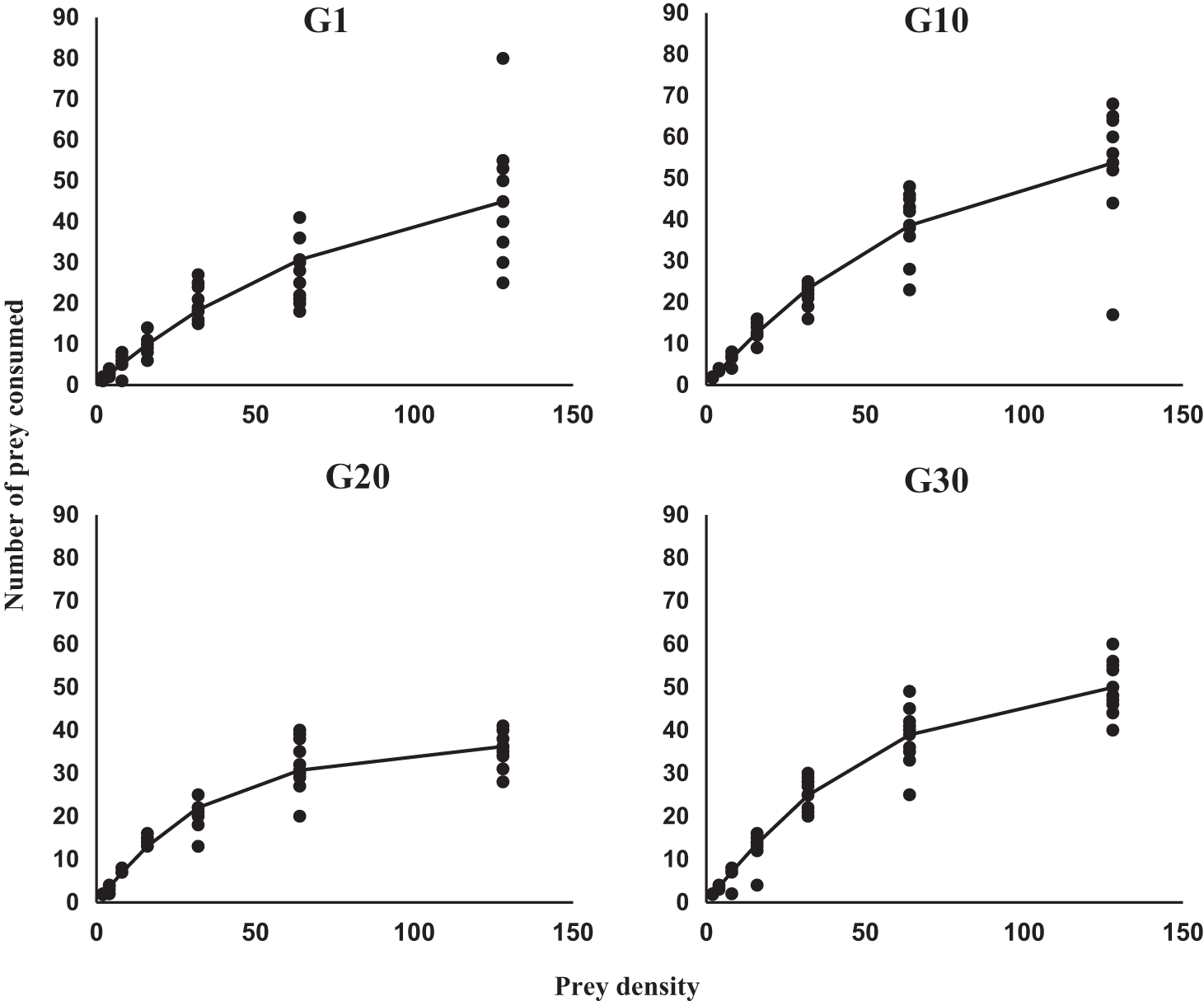
The functional response and percentage of prey consumption of E. scutalis reared on cattail pollen across different generations and varying densities of T. turkestani are displayed in fig. 1. Distinct functional response curves were observed among the different generations of the predator tested (fig. 1). The number of T. urticae killed per day increased with rising prey density, ranging from 2 to 128 (fig. 1). The percentage of consumed T. turkestani decreased as prey density increased in all four generations tested (fig. 1). Results of the logistic regression (table 1) indicated that the functional response of E. scutalis to different developmental stages of T. turkestani across all tested generations was of type II. The values of the attack rate increased as the number of generations progressed from G1 to G30 (table 2). The handling time (Th) values varied among generations, decreasing from G1 to G10, then increasing to G20, and decreasing again in G30. The shortest Th of 0.3184 h and the longest Th of 0.5207 h were observed in G10 and G20, respectively. The estimated maximum attack rate (T/Th) for the female of E. scutalis on T. turkestani in G1 (72.73 prey/day) and G10 (75.38 prey/day) was higher than those reared in G20 (41.90 prey/day) and G30 (62.19 prey/day) (table 2).
Number of Tetranychus turkestani consumed by various generations of Euseius scutalis over different prey densities in functional response experiment.

Results of logistic regression analysis of Euseius scutalis reared on cattail pollen in G1, G10, G20, and G30 to the proportion of different densities of Tetranychus turkestani

Estimated (±SE) attack rate, handling time, and estimated maximum attack rate (T/Th) of Euseius scutalis reared on cattail pollen in G1, G10, G20, and G30 to different densities of Tetranychus turkestani

a, attack rate; Th, handling time; T/Th, maximum attack rate. [R 2 = 1 − (residual sum of squares/corrected total sum of squares)].
The effects of prey density and predator generation on the predation rate of E. scutalis on T. turkestani, along with their interaction, were significant (table 3). Prey consumption increased steadily with prey density across all generations (table 4). At low densities (2–8 prey), consumption levels did not differ significantly among generations, whereas at higher densities (≥16 prey) clear differences were detected. The maximum consumption was observed in generation 10 (53.8 prey at density 128), followed by generation 30 (50.0 prey) (table 4). The significant density × generation interaction confirmed that the influence of predator generation became evident only at higher prey densities.
Analysis of variance for the effects of predator generation and prey density on predation rate of Euseius scutalis reared on cattail pollen in G1, G10, G20, and G30 to different densities of Tetranychus turkestani

Prey consumed (means ± SE) at different Tetranychus turkestani densities by Euseius scutalis reared on cattail pollen in G1, G10, G20, and G30

Means followed by different letters are significantly different (P ≤ 0.05, Tukey’s test).
Numerical response
The effect of prey density, predator generation, and the interaction between them on the number of eggs laid by the predatory mite E. scutalis (numerical response) when feeding on T. turkestani was significant (table 5). At the lowest prey density (2 eggs), the mean number of eggs laid during 4 days ranged from 1.70 ± 0.10 (G30) to 2.90 ± 0.13 (G20) (table 6). The highest oviposition was observed at prey density of 64 eggs in G10 (12.20 ± 0.18) and G20 (12.00 ± 0.12), followed by G1 (7.70 ± 0.18) and G30 (9.00 ± 0.15) (table 6). At the highest prey density tested (128 eggs), females of G1 produced the greatest number of eggs (11.60 ± 0.18), while oviposition in later generations was significantly lower (9.30 ± 0.22 in G10, 8.90 ± 0.16 in G20, and 9.40 ± 0.19 in G30). Overall, the numerical response followed a positive trend with increasing prey density, but the magnitude of response differed significantly among generations. Females from G10 and G20 generally showed higher reproductive performance at intermediate prey densities, whereas G1 produced more eggs at the highest density (128 prey).
Analysis of variance for the effects of predator generation and prey density on oviposition of Euseius scutalis reared on cattail pollen in G1, G10, G20, and G30 to different densities of Tetranychus turkestani

The number of eggs laid (±SE) by Euseius scutalis reared on cattail pollen in G1, G10, G20, and G30 to different densities of Tetranychus turkestani

Means followed by different letters are significantly different (P ≤ 0.05, Tukey’s test).
Discussion
The present study evaluated the functional, predation, and numerical responses of E. scutalis reared on cattail pollen across multiple generations when exposed to T. turkestani, providing critical insights into the predator’s adaptive potential and performance over time. A Type II functional response was observed for E. scutalis across all generations examined. While predators exhibiting a Type III functional response are considered effective biological control agents (Omkar and Prevez, Reference Omkar and Prevez2004), arthropod predators with a Type II functional response have also demonstrated successful results (De Clercq et al., Reference De Clercq, Mohaghegh and Tirry2000; Fathipour and Maleknia, Reference Fathipour, Maleknia and Omkar2016). Type II functional responses have been reported for E. scutalis on Eutetranychus orientalis (Klein) (Yalçin et al., Reference Yalçin, Döker and Kazak2023) and several other phytoseiid mites, including N. californicus on T. urticae (Farazmand et al., Reference Farazmand, Fathipour and Kamali2012), Amblydromalus limonicus Gorman & McGregor and N. cucumeris on Bactericera cockerelli Sulk (Patel and Zhang, Reference Patel and Zhang2017), N. californicus on T. urticae (Khanamani et al., Reference Khanamani, Fathipour, Talebi and Mehrabadi2017), Phytoseiulus persimilis Athia-Henriot on T. urticae (Fathipour et al., Reference Fathipour, Karimi, Farazmand and Talebi2018), Amblyseius swirskii Athias-Henriot on T. urticae (Fathipour et al., Reference Fathipour, Karimi, Farazmand and Talebi2017; Nemati and Riahi, Reference Nemati and Riahi2020), and A. swirskii on T. turkestani (Rahmani Piyani et al., Reference Rahmani Piyani, Shishehbor, Kocheili and Riddick2021). This functional response type suggests that E. scutalis may exert stronger population regulation on T. turkestani at low to moderate prey densities but could become less efficient as prey density increases due to handling time limitations.
It has been reported that the functional and numerical responses of phytoseiid mites are influenced by various factors, including predator age (Dalir et al., Reference Dalir, Hajiqanbar, Fathipour and Khanamani2021; Fathipour et al., Reference Fathipour, Karimi, Farazmand and Talebi2017, Reference Fathipour, Karimi, Farazmand and Talebi2018), feeding history (Castagnoli and Simoni, Reference Castagnoli and Simoni1999), prey species (Escudero and Ferragut, Reference Escudero and Ferragut2005), availability of supplementary foods (Fathipour et al., Reference Fathipour, Maleknia, Bagheri, Soufbaf and Reddy2020), prey stage (Farazmand et al., Reference Farazmand, Fathipour and Kamali2012), pesticides (Poletti et al., Reference Poletti, Maia and Omoto2007), temperature (Farazmand and Amir-Maafi, Reference Farazmand and Amir-Maafi2021), and long-term rearing of the predator on pollen (Khanamani et al., Reference Khanamani, Fathipour, Talebi and Mehrabadi2017; Nemati and Riahi, Reference Nemati and Riahi2020; Yazdanpanah et al., Reference Yazdanpanah, Fathipour, Riahi and Zalucki2022; Eini et al., Reference Eini, Jafari, Fathipour and Prager2023). The results of the current study indicated that the type of functional response remained type II across generations. However, while the overall response type was not affected, potential variation in functional response parameters (attack rate and handling time) may still occur and could provide further insights if compared statistically. Similar to our results, a type II functional response has been reported for long-term reared phytoseiid species such as N. californicus on almond pollen and fed on T. urticae (Khanamani et al., Reference Khanamani, Fathipour, Talebi and Mehrabadi2017), A. swirskii on almond pollen and fed on T. urticae (Nemati and Riahi, Reference Nemati and Riahi2020), and N. californicus on Quercus spp. pollen and fed on T. urticae (Castagnoli and Simoni, Reference Castagnoli and Simoni1999). Although these predators may belong to different feeding groups, the expression of a type II functional response appears to be a common outcome among phytoseiid mites under laboratory conditions, largely due to the limited prey densities provided in experimental arenas and their prey-handling constraints.
Li et al. (Reference Li, Yang, Wan, Liu, Chen, Li and Fu2017) emphasised that, in addition to the functional response, several other factors should be considered when evaluating the foraging behaviour of a biological control agent. These factors include the predator’s intrinsic rate of increase, host plant characteristics, prey patchiness, and environmental conditions. Our recently published data on the effectiveness of E. scutalis during long-term rearing on cattail pollen showed that the life table parameters of this predator did not significantly decline in later generations compared to earlier ones (Gorji et al., Reference Gorji, Shishehbor, Kocheili and Riahi2024). In the 30th generation, E. scutalis exhibited higher daily consumption of T. turkestani than in previous generations across all tested prey densities. The findings of this study indicate that long-term rearing of E. scutalis on cattail pollen does not negatively impact its attack and consumption rates when feeding on T. turkestani.
The attack rate and handling time are used to characterise functional response (Prevez and Omkar, Reference Prevez and Omkar2005). Our results indicated that as the number of generations increased from G1 to G20, the attack rate (a) increased, remaining constant from G20 to G30. Various factors affect the handling time of a natural enemy, including predator and prey movement and the time required to kill and consume an individual prey (Hassell, Reference Hassell1978), which relates to the defence mechanisms of prey. In the current study, the handling time values varied across the different generations tested. The results indicated that handling time decreased up to G10, then increased in G20, and finally decreased again in G30. Based on these results, as the long-time rearing of E. scutalis on cattail pollen continued, the predator improved its efficiency, as evidenced by a decrease in handling time. The improved attack rate in later generations may reflect behavioural or physiological adaptations due to prolonged exposure to cattail pollen as a supplemental food source.
The maximum attack rate in the current study was estimated to be 75.38 prey/female/day, which is higher than the values reported for N. californicus (72.09), which were long-time reared on almond pollen and fed on T. urticae nymphs (Khanamani et al., Reference Khanamani, Fathipour, Talebi and Mehrabadi2017), and for A. swirskii (59.52), also long-time reared on almond pollen and fed on T. urticae nymphs (Nemati and Riahi, Reference Nemati and Riahi2020). Additionally, it exceeds the value reported for N. californicus (26.96), which was long-time reared on thorn apple pollen and fed on deutonymphs of T. urticae (Eini et al., Reference Eini, Jafari, Fathipour and Prager2023). However, it is lower than the 85.87 reported for N. cucumeris, which was reared on almond pollen and fed on T. urticae nymphs (Yazdanpanah et al., Reference Yazdanpanah, Fathipour, Riahi and Zalucki2022).
When evaluating the efficiency of a predator, the numerical response is likely more important than the functional response, as the numerical response is more closely related to the population increase of a predator, which in turn leads to future predation (McMurtry and Rodriguez, Reference McMurtry, Rodriguez, Slansky and Rodriguez1987). Our results indicated that the oviposition of E. scutalis increased with the density of T. turkestani, which is consistent with the numerical response of N. cucumeris to T. urticae (Dalir et al., Reference Dalir, Hajiqanbar, Fathipour and Khanamani2021; Yazdanpanah et al., Reference Yazdanpanah, Fathipour, Riahi and Zalucki2022). However, Patel and Zhang (Reference Patel and Zhang2017) found no significant correlation between the oviposition rate of N. cucumeris and the density of potato psyllid (Bactericera cockerelli) eggs. Additionally, the results of the current study showed that as generations progressed, E. scutalis females laid more eggs at each density, which is directly related to their higher predation rates at those densities. Sabelis (Reference Sabelis1981) stated that approximately 70% of the biomass of laid eggs originates from prey consumption. Therefore, the reproductive rate is positively correlated with the predation rate, as the food consumed by phytoseiid mites is primarily used for the egg-laying process (Sabelis and Janssen, Reference Sabelis, Janssen and Houck1994).
From an applied perspective, these findings provide encouraging evidence that E. scutalis can maintain and even enhance its predatory and reproductive performance over multiple generations when supplemented with cattail pollen. This supports previous recommendations to use alternative foods to sustain phytoseiid populations in conservation or augmentative biological control programmes (Nemati and Riahi, Reference Nemati and Riahi2020; Yazdanpanah et al., Reference Yazdanpanah, Fathipour, Riahi and Zalucki2022). The generational improvements observed highlight the potential for mass-rearing protocols that condition predators over multiple generations to maximise field efficacy.
In conclusion, our study demonstrates that generational rearing on cattail pollen can significantly influence the functional and numerical responses of E. scutalis. These generational changes could be leveraged in integrated pest management programmes to optimise the effectiveness of biological control agents. Although our study revealed significant effects of generation on the functional response of E. scutalis, no clear trend in the parameters was observed across generations. We acknowledge that including a control group reared solely on T. turkestani for 30 generations, as well as correlation analyses between functional response parameters and generations, would have provided a more precise interpretation of generational effects. These points represent limitations of this study and are suggested as directions for future research. Additionally, future research should explore the underlying mechanisms driving these generational shifts, such as genetic adaptation, behavioural plasticity, or microbiome-mediated effects, and assess the field performance of pollen-conditioned populations in diverse crop systems.
Acknowledgement
Financial support (Grant no. SCU. AP 1403. 400) of this research by research deputy of Shahid Chamran University of Ahvaz is greatly appreciated.
Conflict of interest
None.