Introduction
This paper has two main purposes: first, it presents an account of Buddhist ‘nuns’ involved in the teaching of Pali language, and in a form of Buddhist Higher Education (Abhidhamma—a term explained below), in Bangkok in the early 2000s, phenomena which seem to have gone unnoticed in the western ethnographic record. Second, it reflects in a deliberately open-ended manner on both the emic-Buddhist and etic-interpretative vocabularies which have been used to describe these women and their social role(s) and status(es). Readers who are familiar with the topic will understand the need for inverted commas around the word nuns; others will not, and we explain what is involved briefly below. We hope that our discussion of both emic and etic terminologies will help in making sense of the sociological complexities involved, and also in providing an orderly way to progress beyond the simple binary opposition between laity and members of the Buddhist monastic Order (the saṅgha), especially as it has been used in the study of Buddhism under the influence of Weberian comparativism. We aim to go beyond the lens of victimizers/victimized in thinking about ‘nuns,’ and to celebrate the large and increasing numbers of Pali-scholar ‘nuns’ in modern Thailand.
‘Nuns’ have existed, for example, since at least the nineteenth century in Burma and Sri Lanka, and in Thailand for much longer.Footnote 1 But a striking characteristic of the twentieth century, especially in its second half, has been the greatly increased number of women adopting this role, and in particular the greatly increased number of younger women doing so.Footnote 2 Previous scholarship on this phenomenon in Sri Lanka and Burma has adopted a Weberian approach: Gombrich and Obeyesekere saw such women as an example of the more general phenomenon of the ‘laicization’ of modern (and modernist) BuddhismFootnote 3; Houtman on Burma, Holt on Sri Lanka, and Cook on Thailand have turned the tables and referred rather to ‘monasticization,’ in relation to the increasing practice of meditation by laity and ‘nuns’.Footnote 4 The use of both terms can be defended: but perhaps we need not simply choose between one or the other term from a Weberian binary opposition, but rather speak of the pluralization of practice(s) and status(es).Footnote 5
It is not our intention to criticize Weber overall: his writings on Buddhism were and still are incisive and thought-provoking, indeed awe-inspiring given the quantity and quality of materials available to him. But were he alive now, a century later, he would not give the same account: our knowledge of Buddhism and our forms of interpretation have moved on. The authors of this paper cannot hope to match his genius, but we would like to offer some ethnographic reportage and some terminological precision which might facilitate the work of a latter-day Weber, should we be blessed with one. An overall assessment of Weber is impossible here.Footnote 6 In relation to our present concerns, the most important notion of which we need to rid ourselves is that of ‘the world,’ and the idea that Buddhist monastic life ‘rejects’ it, as in Weber's very influential ‘Religious Rejections of the World and their Directions’.Footnote 7 This concept of ‘the world’ is, like so much of his vocabulary, taken from Christian theology and—seemingly but in fact insufficiently—secularized as a term of comparativist description and analysis. It is impossible to extricate a sociologically descriptive sense of this word from its theological context: as a technical term it is irredeemably ambiguous.Footnote 8 One so often reads, given the ubiquitous involvement of Buddhist (and, indeed Hindu and Christian) monastics with all or part(s) of the rest of society, and in wording borrowed from St Paul, that they are ‘in’ the world but not ‘of’ it—a mystifying phrase which serves in effect to preclude rather than facilitate further analysis of the very many social roles and statuses which monastics have, and have always had. It is true that there does exist an analogous Buddhist dichotomy, between lokiya and lokuttara,Footnote 9 which can be translated as ‘worldly’ and ‘super-worldy’—but these terms are not standardly given a sociological sense in Buddhism: they are used for a number of different soteriological evaluations, and refer to Buddhist cosmology and related individual behaviours in relation to it (and to what is beyond it) rather than to society.
Lay and monastic statuses
The basic distinction between lay and monastic statuses is, certainly, a fundamental and ubiquitous division in Buddhist thought, although equally certainly it has always had complex and varying relations to practice throughout the Buddhist world. On the level of thought and imagination it is implicated, conceptually and metaphorically, in the most basic structure of Buddhism, as both an analogy to and a part of the dichotomy between saṃsāra, the world(s) of rebirth, and nirvāṇa (Pali nibbāna), the timeless beatitude which constitutes the transcendence of suffering and rebirth. To use the widespread imagery of dwelling in a house (‘householder,’ gihi, gahapati, etc., is a standard binary opposite of ‘monastic’): the monastic leaves his or her home physically, by going to live with the Monastic Community; then the individual, though of necessity still living in the house of the body, aims not to produce another such body-house so that at death he leaves the household-world of saṃsāra forever.Footnote 10 Two verses of the Dhammapada (153–154), attributed to the Buddha on achieving Enlightenment, put it thus:
I have wandered through many births, seeking but not finding the house-builder; repeated birth is full of suffering. Housebuilder! You are seen, you will not build a house again. . . My mind is beyond conditioning and has reached the end of desire.Footnote 11
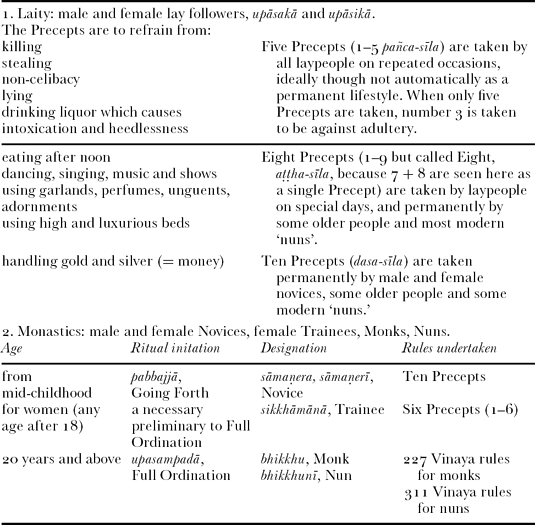
When this basic dichotomy is enlarged to include gender, there are said, again standardly and ubiquitously, to be four ‘Assemblies’ (parisā): monks, nuns, laymen, and laywomenFootnote 12. But already we are in the thick of translation issues: the English words ‘monk’ and ‘nun,’ which are firmly established now and are quite acceptable, translate bhikkhu and bhikkhunī (Sanskrit bhikṣu and bhikṣuṇī), which are desiderative adjectives from the root √bhaj, to have a share: monks and nuns are in this sense those who do not produce their own means of sustenance but wish to share in those provided by others. ‘Monk’ does not come, as is often said in popular books, from Greek monos = alone, but from monachos = single (unmarried); ‘nun’ comes from medieval Latin nonna, which like the masculine nonnus was an honorific used for older people, both in general and in monasticism. This is true of most modern terms used in the Theravāda world for what we will call ‘professionally celibate women’ (see Appendix 2). Laity, male and female, are referred to in this four-fold division as upāsaka-s and upāsikā-s, from the root √upa-ās, to serve, show respect to: a lay follower takes The Three Refuges, in the Buddha, the Teaching (dhamma) and the Monastic Order (saṅgha), and standardly also undertakes to observe the Five Precepts, repeating this undertaking on numerous ritual occasions, and sometimes Eight (see Table 1). Sometimes the terms upāsaka or upāsikā are used of laity with some special status in the Buddhist world generally: modern women meditation teachers, for example, to be discussed briefly below, often have upāsikā as a kind of special title. It is also often used in relation to older people who spend more time at temples than others, notably on ritually special days and in the Rainy Season: for example those among the Shan also called ‘temple-sleepers’.Footnote 13
Lay and monastic statuses in regard to the Precepts (sīla)
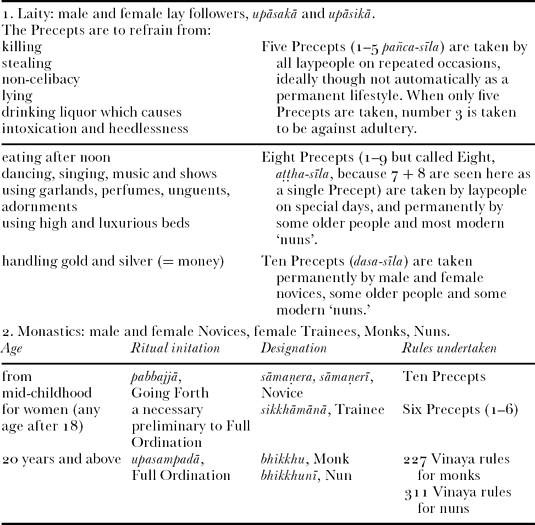
The binary opposition between monastic and lay statuses, widened to a quartet with gender included, is further elaborated in Pali texts in terms of the Buddhist Precepts (sikkhāpada-s, see Table 1). Entry into the monastic Order requires one preliminary stage for men, and two for women. Both can become Novices (sāmaṇera-s, sāmaṇerī-s)Footnote 14 at any time from mid-childhoodFootnote 15, preceded by a specific ritual, pabbajjā, ‘Going Forth’. (This term can also be used in a general sense for what South Asian traditions of all kinds call ‘Going Forth from Home to Homelessness’.) There is also another status for women, little-studied: a woman must spend two years as a Trainee (sikkhamānā, from the same root as sikkhāpada), keeping to Six Precepts, before initiation as a Nun.Footnote 16 Initiation to become a bhikkhu or bhikkhuṇī is called upasampadā: candidates have to be, inter alia, 20 years old. The Vinaya for Monks has 227 rules; that for nuns 311. The titles thera, therī and mahāthera, mahātherī, can be accorded after ten and thirty years, respectively, in the robe.
The single question which has dominated study of this issue in what are now called ‘Theravāda countries’, as also in relation to the Tibetan tradition, is that the female statuses of Novice and Nun (and therefore Trainee) have either died out or, in some areas, seem never to have been established (see ‘The history of the Order of Nuns’ below). A great deal of energy has been spent, even more in the international, globalized Buddhist world than within Asian countries, on the question of re-establishing the Order of Nuns, culminating in the summer of 2007 with a large-scale International Conference in Hamburg, attended by the Dalai Lama.Footnote 17 The issue is simple to state, but not easy to solve: in Buddhist monastic law, ordaining bhikkhunī-s requires five already fully-ordained ones: if none now exist, then it seems that the order cannot be revived. The majority opinion in Asian countries, among women as much as men, which is supported by our data, is that indeed the Order of Nuns cannot be revived before the arrival of the next Buddha Metteyya (Maitreya), and so is simply out of the question. Indeed, the majority of professionally celibate women explicitly oppose the idea of Ordination, on various grounds, amongst which perhaps the most obvious is that such Ordination would put them according to the Vinaya under the direct legal control of Monks, which many regard as undesirable.Footnote 18 However, here our concern is not to contribute to this debate, although we will revert to it on occasion. The issue will be resolved by Buddhists, making their own history. From an academic perspective now what is needed, inter alia, is much more ethnography, to describe what such Buddhist women actually do; and perhaps also some discussion and possible clarification of categories to help situate this activity socially.
Some etic categories
First, some reflection on etic categories: we think it useful to speak of professional (female) celibates, who practice, in a general sense, asceticism. In this phrase the term celibate, as in Latin caelebs and French celibataire (but not in modern English) refers not, or not merely, to the practice of chastity, for any length of time, but to the permanent or at least long-term social status of being single, unmarried.Footnote 19 The word professional is not meant ironically: The Oxford English Dictionary (OED) has proper to, or connected with a profession or calling; it gives the sense pertaining to or marking entrance into a religious order, before giving the modern sense of doing something as a livelihood, for money, rather than as a pastime, as an amateur. A professional has a vocation; in most cases with a particular form of dress and a recognizable form of deportment undertaken as a continuing, often lifelong, way of life. Greek askēsis, from askeō, practice, means primarily training, the practice of self-discipline, where self-discipline means self-fashioning; Sanskrit and Pali sādhan  , bhāvanā are much the same. Our usage of the word does not imply what OED refers to as the exercise of extremely rigorous self-discipline, severe abstinence, austerity. In many cases where there is an aspect of educating or training others, in meditation, scholarship, or any other métier, teachers of either gender, ascetic or not, can be referred to by the vernacular equivalents of words for ‘teacher,’ such as Pali ācariya, Sanskrit ācārya = Thai ajaan; guru = Thai khru, Cambodian grū Footnote 20, etc. For our purposes, the mae chi on whom we report are professional (female) celibates following an ascetic vocation, with a distinct social status (or a number of fluctuating statuses) concomitant with that role and with their activity as teachers. As will be seen, their lifestyles, their vocations, can be many and various.
Appendices 1 and 2 offer an introductory survey of terms for such professional celibates, male and female, in Pali texts and in modern vernaculars. Here, before coming to the history and present position of Buddhist nuns and ‘nuns,’ we must turn to something any conceptual binary seems inevitably to entail: what of individuals who do not fall easily into one or another category? One possible option would be to categorize those who do not have straightforwardly one or another status as occupying a third status, or grouping of such statuses. In the history of Christian, especially Catholic monasticism, for example, there has been for many centuries a standard category of Third or Tertiary Orders, which refer to men and women with a status and lifestyle which is in varying ways partially, though not fully, monastic.Footnote 21
In cross-cultural Gender Studies an influential book edited by Gilbert Herdt in 1994 introduced the category Third Sex/Third Gender Footnote 22: adopting this approach we might speak in the Buddhist case of Third Status(es). Herdt's project was not to reduce the multiform varieties of human sexuality and gender, of behaviours and identities, to three instead of two. Rather, for him and for us, the Third category is provisional and heterogeneous, aiming not at comprehensiveness in description or analysis, but simply at breaking down a previously assumed dimorphism. In this area of study an important distinction is made between sexual and/or gendered acts and identities: often non-western vocabularies contain words for the former but not for the latter, and introducing a western discourse of permanent or semi-permanent identities creates a need for corresponding terms in indigenous lexicons.Footnote 23 For us, acts and identities are two ends of a continuum: we will be concerned with women who have chosen professional celibacy as a permanent or semi-permanent identity. A final example: Patricia A. McBroom's (1986) anthropological study of women in business was entitled The Third Sex: The New Professional Woman.Footnote 24
The history of the Order of Nuns
But why, historically, have we arrived at circumstances where women cannot, according to the majority opinion, become Novices or Nuns? The history of bhikkhunī-s is reasonably clear but in various ways puzzling.Footnote 25 They existed in India and Sri Lanka from at least the time of Aśoka's reign in the third century BC, until the start of the second millennium AD. Inscriptions show that they were often as numerous as monks, and that they often had sufficient wealth to make large donations, have monuments erected, and so forth. Epithets and titles used for them indicate significant achievements in asceticism, scholarship, and the formation and maintenance of lineages. Evidence for their existence starts to diminish from the mid-first millennium AD, with a last (possible) reference from Nepal in the early eleventh century: this is part of the general mystery of the disappearance of Buddhism in India. In Sri Lanka it seems that by the eleventh century the number of bhikkhunī-s available became less than the five necessary for Ordinations, and no kings could or did have bhikkhunī-s come from elsewhere to resuscitate the Order, as happened often with bhikkhu-s. From the middle of the first millennium, elites throughout Southeast Asia adopted different kinds of Buddhism, along with other elements of Indic civilization arriving from Northeast and South India, and Sri Lanka,Footnote 26 but there is no certain evidence for ordained bhikkhunī-s anywhere in Southeast Asia at any time.Footnote 27
So it is clear that nuns existed in India and Sri Lanka, and just possibly, briefly, in some parts of Southeast Asia, until the end of the first millennium AD. Evidence suggests that many of them were highly educated, and were involved in textual learning and teaching. But despite these achievements we have no evidence, with a very few possible exceptions, for bhikkhunī-s composing texts in Pali, as opposed to memorizing and transmitting them.Footnote 28 Historians may one day determine why the order of bhikkhunī-s died out in some parts of the Buddhist world, and seems never to have appeared in others, and also why there seems to have been such a clearly gendered division of labour in relation to composing versus transmitting texts. Mae chi in the early-modern and modern worlds seem to have been involved in neither, but contemporary mae chi in Thailand are very often involved in education at all levels, albeit that like their earlier premodern forebears they do not compose Pali texts—but then scarcely anyone does nowadays.
Mae chi in Thailand
In the term mae chi (sometimes romanized as ji) the word chi/ji is an honorific derived from Khmer, used for any person who occupies a position of respect, including both male and female asceticsFootnote 29; mae is mother, often used as an honorific for hierarchical as well as familial relationships. It can also be used as a pronoun, in the first, second and third persons.Footnote 30 There exist many different portraits of mae chi, and certainly many more remain to be drawn. In accounts by premodern European travellers, and in much ethnographic literature, mae chi are described as older women, dressed in white and living in or near temples, acting as cooks and maidservants to monks, an often denigratory perception of them which still continues today.Footnote 31 More recently mae chi, especially the increased numbers of younger women who have adopted that lifestyle, have been described in various roles: as participants and sometimes teachers of meditationFootnote 32; as involved in many kinds of social and psychological work, often subsumed in the category of Engaged BuddhismFootnote 33: perhaps the best-known is Mae Chi Sansanee, whose institution in Bangkok, the Sathira-Dhammasathan, has been the subject of much media attentionFootnote 34; as involved in teaching, notably at the Dhammajarinee Witthaya Schools founded by Khun Mae Prathin,Footnote 35 and at the tertiary level Mahapajāpati Therī College, which was initiated by Khun Ying Kanittha though not started until after her death in 2002.Footnote 36 From a social-historical perspective, this increase in the number of younger mae chi is to be seen as part of the broader expansion of education, vocations and lifestyles for single, as also for married women in modern Thailand, for example in many different kinds of business (including, alas, prostitutionFootnote 37) and politics.Footnote 38
Case studies: mae chi teaching Pali
We know of no studies devoted to Buddhist mae chi studying and teaching Pali and Abhidhamma, nor of the institutional contexts in which they do so. The Abhidhamma is the third of the three ‘Baskets’ (piṭaka) of the Pali Canon, and is regarded by its followers and practitioners as the most profound aspect of the Buddha's teachings, both in itself and in connection with the practice of meditation. For the most part it consists of lists and analyses of the momentary Existents (dhamma-s) which make up the world and experience of it.Footnote 39
Although we talked with many mae chi, formal interviews were only conducted with those who had either passed higher level Pali examinations or who held advanced degrees in Buddhist Studies. We developed a questionnaire (four pages of detailed questions in Thai), handed it out and then conducted formal interviews based on the answers: there was no shortage in eligible mae chi to take part in both. The formal interviews were mostly conducted in July and August 2006Footnote 40; nearly all were recorded digitally and all interviewees agreed to be photographed and used their real names, although they were told that they need not do so. Questions included the place, date and reason for ordaining as mae chi, and experience of Pali study, along with such questions as: is the study of Pali necessary to the practice and teaching of Buddhism? Is Pali necessary for mae chi? Why? Why not? Are you satisfied with opportunities to study Pali? What do you think of the textbooks used? Do you think there should be fully ordained bhikkhunī-s in Thailand? We interviewed and collected questionnaires from a lot more nuns than we can include in this short study.
The institutions studied are specifically monastic, where sometimes ‘studying’ or ‘knowing’ Pali refers primarily to the memorization of texts used in chanting; in monastic scholarly training, where Pali is usually studied without Sanskrit, there are nine levels of attainment, called prayōg Footnote 41; monks who attain the 9th level receive a stipend of 3000 baht ( = $100) a monthFootnote 42; mae chi, who can (though not all do) receive 800 baht a month stipend, also receive a 900 baht a month bonus for passing 9th level exams. So a 9th level scholar-mae chi can only make 1700 baht ($56) a month. This was, unsurprisingly, a bone of some contention among the mae chi who were interviewed, who feel that it is insufficient for their needs.
Undoubtedly the doyenne of all Pali scholars, male and female, in Thailand, has published under her lay name, Supaphan Na Bangchang, but is now known as Ajaan Mae Chi Vimuttiyā, sometimes with the epithet anagārikā, ‘homeless’ (see Appendix 2 for this term in Nepal). She made an edition of a Pali commentary for her PhD thesis in Sri Lanka in 1978, and has since published and edited many books on Pali grammar, language and literature in Thai, being considered one of the leading scholars of Pali literature, not only in Southeast Asia but also in the worldFootnote 43. She lived for some years in a forest temple outside Chiang Mai, but is now director of the prestigious International Tripitaka Hall, at Chulalongkorn University (secular) in Bangkok, a library of rare and valuable Pali texts. She is responsible for developing education programmes for advanced students of Pali and for greeting foreign guests and VIPs at the hall. She commands a great deal of respect, and has been honoured with awards from the Thai royal family. Despite holding a PhD she recently earned a masters degree at Abhidhamma Jotika College (see below). In our interview, she thought the fact that she was a scholar and a mae chi should be of no surprise. She expressed no desire to become a bhikkhunī even if it was possible, because now she is free to live in her own apartment, control her own schedule, write, work, and meditate, and also to interact freely with students and colleagues. She encouraged us to visit and speak with mae chi throughout the city and see for ourselves how Pali scholarship was flourishing.
Abhidhamma Jotika College, in the grounds of Wat Mahathat in Bangkok, is the premier school of Abhidhamma Studies in Thailand, and now has five branches nationally. Many, if not most of its professors are mae chi; some of the very highest scores in the royally-sponsored Pali examinations are achieved by its students, and many of the highest ranking students at the college are mae chi.Footnote 44 Many of the Pali teachers we met at other institutions graduated from there. One such, Mae Chi Bunchuai Sriprem, a 9th level Pali scholar who received the title ‘Abhidhamma Pandit’ from Abhidhamma Jotika College, is, at 39 years old, one of the most well-respected teachers of Pali grammar and dissertation advisors at the elite central campus of Mahamakut Monastic University, in the grounds of Wat Boworniwet in Bangkok. One of the top two monastic universities in the country, this royally-sponsored institution has traditionally produced the brightest monks and mae chi of the Thammayut lineage, drawing students from Europe, Japan, China, Australia, Indonesia, Cambodia, Sri Lanka, Laos, Malaysia, Nepal, Korea, and elsewhere. Mae Chi Bunchuai, like many highly educated mae chi, resides at nearby Wat Chanasongkhram. She is originally from Suphanburi province, a farming region two hours drive north of the capital. At the time of our interview, she had been in the white robes for 19 years; she is ‘determined to be a mae chi for the duration [of her life]’. She ordained to have the time to
study Buddhism until I understood it correctly and until I could lead others in practice and study. In order to make my heart and mind pure according to the fundamental words of the Buddha. At that time, I was studying Abhidhamma. Therefore, it was necessary to study Pali in order to understand the Abhidhamma.
This relationship between studying Pali grammar and the Abhidhamma, stated in our first interview, was consistently invoked by other educated mae chi, including those who had not studied at the Abhidhamma Jotika College. Although she stated that she did not teach courses in Pali, simply tutoring monks and other mae chi and advising dissertations and Masters theses, we believe Mae Chi Bunchuai was being self-deprecating: McDaniel observed her teaching a formal Pali class in which all but one of the 17 students were monks. When asked about this, she jokingly said, ‘well, sure, I teach monks, but they are not “my students”, they are above me’. She nonetheless took the teaching of Pali very seriously: ‘teachers of Pali should possess the qualities of a true expert. They should have the ability to transfer their knowledge of Pali and allow their students [to] understand easily and memorize correctly.’ She described the Pali skills of monks and mae chi as
most likely not different, but the lecture style and the pedagogical method are different. This is due to the fact that teachers are people who have studied hard to understand the meaning deeply. The only reason for doing this is to teach.
So despite denying the ability to teach Pali formally, Mae Chi Bunchuai does so and considers herself, rightly, an expert. She emphasized that her intellectual focus as a mae chi was a good model, because ‘people who ordain in Buddhism (besides those who ordain for a short time or only to perform morning and evening liturgies or just practice meditation) should pass on the teaching of the Buddha’; she saw no barrier to mae chi who wanted to study for advanced degrees in Pali and other Buddhist Studies subjects:
there are resources for mae chi who want to study Pali. Furthermore, householders also get to study in the Pali curriculum just like monks and novices do. It [the Thai system] is a good system if you want to learn Pali.
Like most mae chi we interviewed Mae Chi Bunchuai also stated that the opportunities for them to acquire a Pali education would not increase or even be affected if Thai women could become bhikkhunī-s. In fact, she spoke directly about the subject:
I do not think there should be bhikkhunī-s, because the lineage of bhikkhunī-s in Theravāda has been lost in India already. . . . It is not necessary to ordain as a bhikkhunī in Thailand, because mae chi are able to study and spread Buddhism and be part of the Buddhist community.
Mae Chi Bunchuai is far from being the only accomplished nun at Mahamakut University. There are dozens of mae chi studying for masters and doctoral degrees in Buddhist Studies there; masters theses and doctoral dissertations by mae chi are available in their library, and any visitor will notice mae chi prevalent on campus. This is in part due to the fact that the headquarters of the Sathaban Mae Chi Haeng Chat (National Office of Mae Chi) is located there. Mae Chi Ladda Komalasing, a 38 year old, 9th level Pali scholar who holds a PhD in Dhamma Studies and a post-doctoral degree in Abhidhamma Studies, had first ordained in Chonburi Province, 30 kilometers southeast of Bangkok, at age 18, and moved to the city for higher education (in secular subjects also). She gave straightforward answers to our questions, saying that she studied to spread the dhamma and was determined to remain ordained for the rest of her life because of this mission. She felt that the study of Pali
is extremely necessary for studying and teaching pariyatti-dhamma Footnote 45 . . . in order to give us the ability to understand the Pali vocabulary word-by-word. It allows us to understand the roots of words. It helps us understand the meaning of the vocabulary—every single word in the Buddhavacana. Therefore, we can translate the dhamma in a profound way. It allows us the ability to review the Dhamma perfectly.
Although Mae Chi Ladda Komalasing was qualified after more than a decade of formal Pali study, she chose not to teach Pali and instead concentrated on teaching Abhidhamma and meditation to mostly lay groups:
every part of the Dhamma in the curriculum and outside the curriculum should be part of education. This education should focus on the details and analysis [of the mind while meditating and going about daily work].
In response to our question if it mattered if a Pali teacher was a monk or a mae chi, she stated emphatically (in fact this was the only time she became animated during the interview) that
whether a person is a monk or mae chi has nothing to do with it. It depends on the teacher. Do they have an objective when they teach? Do they care for their students? Are they hardworking and focused? These are the important qualities of a teacher.
She did, however, unlike almost every other person we interviewed, complain about the lack of resources for mae chi studying Pali. She thought that better dormitories and stipends were needed, although the textbooks and pedagogical methods were fine. The problem she believed had nothing to do with gender, but with Thai people's support for Pali. The general populace did not sympathize, and had no respect for how hard it is to study Pali: monks were the only members of society to support mae chi-s’ studies. Although she was highly critical of the state of Pali study (for monks, mae chi, and laity), she did not believe that the ability to ordain as a bhikkhunī would help. She did not see how being a bhikkhunī would increase the resources to study Pali or any other Buddhist subject. She had no problem with what she saw as Mahāyāna bhikkhunī-s coming to Thailand, but she did not think that status was necessary for Theravadins.Footnote 46 The possibility of ordaining as a bhikkhunī, she stressed, had ended. There was no need to talk about it anymore.
Mae Chi Ladda's bluntness was softened and complicated by Mae Chi Wanpen Anuson, a 39 year old woman who ordained at 15 years old in the northern province of Kampaengphet, and who attained 9th level status in Pali. She also believed that bhikkhunī ordination is unnecessary, pausing between answers to reflect that it would not have helped her in her studies. She changed the focus of the questioning and asked us why it is important to study Buddhism at all. Before we could answer, she stated that it was ‘to end suffering’. Suffering was most acute in the householder's life. Mae chi were not householders, they were working to end suffering for themselves. They had the time to meditate, study, and serve the monastery. Even though she had studied Pali seriously for over 10 years, she did not, unlike most others, see Pali as essential. In fact, she said, it was useless without practice (paṭipatti). Nonetheless mae chi could and should teach Pali (she had been a teacher for one year at that point). She said that teachers
should know the roots of words and grammar in great detail. They should care when teaching. . . . Each word has existed for a long time. [Pali words] are the basis of the Dhamma. The teachings of the Buddha are the foundation.
This ability to teach and care for students ‘has nothing to do with gender. It depends on the education and training of the teacher, as well as the quality of their work.’ She did not answer questions regarding bhikkhunī on the questionnaire and found them silly when we asked them in person. Mae Chi Wanpen's friend and colleague, Mae Chi Wannana Rungriang, age 40, from Angthong Province 120 kilometers north of Bangkok, had been an agricultural student before getting a doctorate in Buddhist Studies and a Masters in Abhidhamma Studies, as well as passing 8th level Pali examinations. She was reticent with us. She was planning to ordain for life because of her faith and to free herself from suffering. She thought
the study of Pali is necessary for Buddhists, because Pali is the language of the Traipitok, that is the Vinaya, Sutta, and Abhidhamma. It leads us to practice samatha-kammaṭṭhāna [concentration meditation] and vipassanā-kammaṭṭhāna [insight meditation] correctly.
In this regard, she saw no difference between monks and mae chi. She referred to them as ‘two children in the same basket’. They both have the same ability. In a surprisingly bold answer, she stated that bhikkhunī ordination was fine and good for Mahāyāna Buddhists, but not for Thai Buddhists, since ‘our Buddhism is better’: there was no need for bhikkhunī ordination. As the interview progressed, she became more and more heated about the subject, stating that the life of a mae chi was difficult, but it could lead to liberation. ‘Foreign women,’ she asserted, ‘are interested in Buddhism in Thailand, but when they see the lives of mae chi they run away.’ She stated that if Thai Buddhism had bhikkhunī-s, then she might ordain if it led to liberation, but if not, then ‘it didn't matter. . . my life as a mae chi has allowed me to study the Dhamma and Vinaya. It has allowed me to practice meditation. I can die satisfied.’
The other top University for Pali studies is Mahachulalongkorn (not to be confused with the non-monastic University mentioned above), the largest monastic university in the country with five colleges and nine regional campuses. The main campus is located on the banks of the Chao Phraya River and is surrounded by the Grand Palace, Thammasat University (secular), the amulet and herbal medicine markets, and a number of bookstores. Hundreds of mae chi study there, especially in the evening and at weekends. Some of them are students, many are meditators who attend weekend sitting sessions, and others are regular students in the Buddhist Studies college, the Pali Studies programme run by Phra Sompong, or in the Abhidhamma Jotika College which occupies the same grounds. The best known scholar mae chi in residence at the monastery on campus (Wat Mahathat) is Mae Chi Kritsana, from Ubon Ratchathani Province in the northeast. She was very comfortable with foreigners and had studied English for several years.Footnote 47 She comes from a very poor farming family, and has been ordained 26 years, earning a Masters degree in Buddhist Studies at Mahachulalongkorn and becoming a 9th level Pali scholar. She is finishing a dissertation on the history of bhikkhunī-s in India. She had wanted to study Pali to learn the meaning of the chanting she heard as a young child, and is now a full-time professor of Pali syntax, Pali grammar level three, and 1st and 2nd level Pali-Thai translation. She also teaches classes in the mornings at Wat Chanasongkhram and in the evenings at Wat Sampraya. On Sundays she teaches a special 8th level advanced Pali course. Almost all of her students are monks and novices, although she denied, with a self-deprecating air like that of Mae Chi Bunchuai, that she could actually ‘teach monks anything’. She claimed that the only discrimination she has experienced as a woman at the university was when one monk from a rural area thought it was strange that a mae chi was teaching Pali, and teaching him. He was upset, but most of the city monks told him that this was normal in the city, and that she was the best teacher of syntax. He apologized and took several courses with her. She too connected Pali studies with Abhidhamma and meditation: the four fundamental concepts of the Abhidhammatthasaṅgaha (citta, cetasika, rūpa, and nibbāna) were essential to understanding the inner workings of the mind when meditating.Footnote 48 She believes that women might be better suited for Abhidhamma and advanced Pali and meditation training because of their patience. Women, she stated, like details. Monks gravitated towards Sutta and Vinaya Studies.
As well as these colleges and universities (and the Mahāpajāpati College for Nuns, which we were not able to visit), and in addition to living at wats, nuns live and study in various kinds of institution, one of which is called a samnak. Of the 20–30 such institutions, one of the most important is Samnak Santisuk, the oldest nunnery in Thailand, about 45 minutes drive northwest of Bangkok,Footnote 49 which was established in 1898, has its own museum of mae chi history, a library of Pali and Thai Buddhist materials, several classrooms, a meditation pond and garden, and is completely operated by mae chi, who provide all the Pali and Buddhist Studies instruction. It houses mae chi (42 in 2006–2007), as well as many temporary dhammacārinī-s (white-robed female students who take ten precepts) and nang dam (women who take eight precepts, but do not shave their heads, and who wear black pants and a white blouse instead of white robes). The abbot of Samnak Santisuk is Mae Chi Pranom Wingmat. At 58, she is a 9th level Pali scholar, and has been ordained since she was a teenager in Ratchburi Province in Central Thailand. She entered into the nunhood originally not for herself but for her mother. As she grew into a young woman, she realized that the teachings of the Buddha made sense and gave her confidence, and so knowing them in detail, in Pali, became more and more important to her:
Pali is extremely necessary, because it permits us to study and teach students. From the very first sentence to the very last sentence, there is meaning in each word of the Buddha. From the lowest level up until the highest level there is [a teaching that will help] surpass suffering. Furthermore, Pali is useful and can be used for scholarly reference. The spoken words [of the Buddha] are clear and direct. [Pali] helps us preserve the teachings.
She has taught Pali grammar for over 20 years at Wat Chanasongkhram and Samnak Santisuk, and has never felt discriminated against in her teaching or studies. She states that
the curriculum is similar and the basic concepts behind the teaching are largely the same. In terms of lecture style and pedagogical method, it really depends on the personality [of the teacher]. Therefore, [women and men] are most likely not the same [because they have different personality types].
However, if they both use Prince Wachirayan's Pali curriculum, she argued, women and men would teach the same ways. She regarded the question of bhikkhunī ordination in Thailand as ‘simply not an important issue.’
Other highly educated mae chi at Samnak Santisuk, such as Mae Chi Oom Chanphaeng and Mae Chi Chaemchit Klat, gave similar answers. The former, who had been ordained for 21 years, saw no significant difference in the way monks and mae chi approached their teaching or practice, but she believed that women are better teachers than men because of their compassion towards students. They also have a better sense of humour. The latter stated that Pali was very important to study ‘because Pali is the language of every Buddha. It is the language that is beautiful and gentle. It carries deep meaning.’ Bhikkhunī ordination was not one of her goals. She thought it would not change the way women could study and practice openly in Thailand. She was happy and bhikkhunī ordination would not make her happier. Mae Chi Sūrathā Udomwarakhun, a 9th level Pali scholar, who had spent 11 months studying in Nepal and taught Pali grammar at the Samnak Santisuk, emphasized that she joined the order of mae chi for advanced Pali study.
The final institution we shall discuss is, in some ways, the most interesting. Wat Paknam, in Thonburi, is the temple where the Dhammakaya (Thammakai) movement began, with the monk Luang Pho Wat Paknam (Phra Thepmuni) and his star pupil, the laywoman Khun Yay, who went on to found the huge Thammakai temple at Pathum Thani north of Bangkok.Footnote 50 Khun Yay was illiterate, so the movement, a controversial group popular with university students, which practices a form of meditation unusual (at least in modern times) and which, according to some opponents, teaches unacceptable doctrines, tends to downplay textual and linguistic learning in its rhetoric and advertising. At Wat Paknam, however, this is not the case. It does house a very large number of ‘kitchen mae chi’ (mae chi krua) who wear dark skirts and a distinctive dark sash over their white blouses. They are somewhat looked down upon as well as pitied by mae chi who concentrate on meditation and/or study, because they spend all their time cooking, serving and cleaning up after monks. Mae chi from all over Thailand have flocked to live at Wat Paknam for a number of reasons: the meditation system emphasizes that anyone of any rank, gender, and background can achieve enlightenment through visualization and breathing exercises; there is free dormitory housing for mae chi (approximately 300 rooms); they receive free courses in Buddhist Studies, Pali grammar, and secular subjects, along with a stipend of 800 baht a month.
The Thammakai is often criticized for its overt commercialism, modern marketing campaigns, missionary zeal, and ‘new age’ approach to science and meditation. Despite these criticisms, monks and mae chi from the Thammakai do very well on royally-sponsored Pali examinations and many of their monks occupy powerful positions in the national ecclesiastical councils. Mae chi attracted to the Thammakai generally are less traditional in their attitudes towards religion and have more favourable attitudes to modern uses of technology, rationality, and science in education and meditation. Although a mae chi does not have to associate herself with the Thammakai lineage in order to study and reside at Wat Paknam, many mae chi we interviewed were intrigued by the teaching of the Thammakai. One of these was Mae Chi Nathathai Chatninwat. Unlike many of the mae chi we interviewed, she had a strictly secular educational training: a BA in Sociology from Chiang Mai University and an MA in Women's Studies from Thammasat University. She is now a PhD student in Buddhist Studies at Mahamakut University. Her brother received a Masters degree in Engineering from the University of Oregon (US) and she had travelled broadly—an unusually cosmopolitan background. She had already passed her 6th level Pali examinations and planned to continue until she achieved 9th level. Although she was reluctant to tell us details of what led her to make such a switch from a successful secular education to a religious one, she did speak broadly about the need for women in Thailand to work hard in all aspects of education and for them to study Pali in order to understand the intricacies of meditation. She saw it as her mission ‘to continue my studies in the Dhamma and to apply my education in Women's Studies in the service of women's development’. Although many nuns focus on Pali in order to meditate and be able to teach meditation, she studies Pali in order to spread the teachings of the Buddha. Therefore, she was what she called a mae chi pariyatti, ‘a scholar mae chi’, and not a mae chi thammakai who concentrated on meditation and for whom studies are secondary. This learning-for-learning's-sake approach was a great source of pride for her. In fact, at one point in our interview, she stopped a young monk from interrupting us. She told him directly that the foreigners wanted to interview her because of her high level of Pali scholarship. They did not want to interview him, she subtly suggested, because he wasn't a student of Pali. The monk, mildly insulted, walked away without arguing. This incident led to Mae Chi Nathathai telling us that she was upset with the Sangha policy of giving monks a monthly bonus of 3,000 baht for passing 9th level examinations when mae chi could only receive a total of 1700 baht a month. Still, this injustice did not make her think bhikkhunī ordination was a good idea. She was proud to be a mae chi and did not want to become a bhikkhunī even if it was an option. Mae chi were not lesser bhikkhunī, but a particular career choice for women that permitted them a chance to study and advance psychologically; mae chi were not below monks, but bhikkhunī would be. However, she would support bhikkhunī ordination if it actually helped women get more opportunities to study. She said that she had little difficulty in finding good textbooks at mae chi educational centres such as Wat Paknam, Wat Chanasongkhram, and Wat Thammakai, but that many mae chi in rural areas had very little. She doubts having a bhikkhunī education would change that; she would prefer improved funding opportunities to form more schools that would provide free food and education to mae chi who wanted to study Pali at a high level. There are many monasteries like Wat Paknam, she said, which simply did not have enough space for all of the mae chi who wanted to study. She stated that she enjoyed the freedom to enter and leave the monastery at her leisure and to study and interact with other like-minded mae chi on her own terms. She worried about mae chi without this network of family and colleague support.
Mae Chi Nathathai introduced us to several like-minded mae chi pariyatti, who were later interviewed more formally. McDaniel was also able to sit in on classes at Wat Paknam where mae chi students were present in large numbers. One of Mae Chi Nathathai's mentors was a Pali teacher named Mae Chi Sunantha Rianglaem, originally from the seaside city of Mahachai south of Bangkok. She is a 9th level Pali scholar and was studying for a masters degree in Buddhist Studies from Mahachulalongkorn. Presently she teaches Pali grammar and translation at Samnak Santisuk and Mahachulalongkorn. She had experienced few obstacles in her career as a student and teacher and her main complaint was that the 1700 baht a month stipend was not enough to live on, even with free housing. Mae chi had to pay about 50 baht a day for food, although some went on morning alms rounds.Footnote 51 However, she had little problem with the system and lauded the National Mae Chi Office for providing for her while she studied. She could not receive any support if she was a layperson. Mae Chi Rachata Hophet, a 51 year old 6th level Pali scholar from Suratthani in the South, sat in on our interview; she was shy, but occasionally chimed in, especially when discussing the issue of bhikkhunī ordination. She stated quite vigorously that bhikkhunī ordination was a terrible idea. She believed that women fighting for this right were simply looking for fame (cheu siang). All human beings, she said, were simply external ‘form’ (rūp, referring to the body and to appearance in general). The way a person dressed or what colour robes they wore was unimportant. An honest student and focused meditator could achieve great merit even if he or she were a layperson. Finally, Mae Chi Yupa Thongbhut, a 36 year old 8th level Pali scholar from Chantaburi province, about 5 hours drive east of Bangkok, was very quiet in the formal interview, but needed several sheets of extra paper to fill out her questionnaire. She felt more comfortable expressing herself on paper. Using terms similar to those Mae Chi Oom Chanphaeng of Samnak Santisuk had used about the Buddha's teaching, she wrote that the life of a mae chi was a beautiful life that gave her the opportunity to make merit for herself and all women. She was now living in peace and had little stress. This peaceful lifestyle gave her opportunities to study (she had been studying Pali formally for 14 years) and she enjoyed studying with teachers, who, when qualified, ‘spoke beautifully’.
The idea of a mae chi's life as ‘beautiful,’ with meticulous and inspiring pedagogy, sophisticated learning and meditative expertise as goals and values per se, with intrinsic virtue as well as instrumental value in reducing suffering and leading to nirvana, has not been emphasized enough in the existing literature, which tends too often to concentrate on the issue of bhikkhunī ordination, and more generally to focus on mae chi-s’ hardships (which are often many), and on discrimination in the Thai ecclesia. Our interviews with a small number of the many highly educated mae chi show that, despite inequality and discrimination, there are many opportunities for women to study and teach the two subjects, Pali grammar and Abhidhamma, considered to be the most difficult and therefore the most prestigious to pursue in Thailand.
It seems clear to us that the scholarly ethnographic record and sociological analysis of mae chi in Thailand, of ‘nuns’ in the Buddhism of South/Southeast Asia and Tibet, and indeed the ‘status’ of women in Buddhism generally, needs to get out of the cul-de-sac into which the dominant concern with bhikkunī/bhikṣuṇī ordination has driven it. This is, of course, a vital and dominant concern for many Buddhist women (albeit that this is more, as mentioned above, on the international, global stage than in the lived worlds of women in those parts of Asia). But the academic description of women's lives and the many and various social positions they occupy needs far more detailed ethnography than we currently have, despite some very good studies. It needs an expanded ethnography which leaves the issue of ordination aside, and which also goes beyond the Weberian dichotomy of ‘the world’ and ‘renouncing’ it, and the resultant question (for example) of whether to use the terms ‘laicization’ or ‘monasticization’ to understand what is happening before our eyes. The lives and aspirations of the educated women we have described, the hopes and aims they have for themselves and their pupils, are not in any way usefully understood as matters of ‘the world’ and what is ‘inside’ or ‘outside’ it: we have suggested that the category of professionally celibate women (and men), in the sense in which we use the terms, locates them in society quite accurately; and we have suggested, as a preliminary category at this stage of our understanding, that the various terms in Pali texts and contemporary vernaculars which refer to those who occupy such a social position might be gathered together under the heading of Third Status(es), following existing models in the history of Christianity and modern Gender Studies. Further ethnography, and further academic study of women in Buddhism, past and present, will one day need to go beyond that also.
Appendix 1: terms for non-monastic ascetics in Pali texts
Mae chi and almost all other Buddhists in Thailand look to the heritage of Pali texts as the centrally authoritative account of Buddhist teaching and history. It is for that reason that we collect data here from Pali, not because we regard the Pali tradition as uniquely privileged as a source of Buddhist history. Most modern scholars see the Pali Canon as only one amongst probably a number which circulated, in various forms of Indo-Aryan language, in ancient India; but it is the only complete Buddhist Canon to survive. Later Pali literature was written in South and Southeast Asia. Pali texts are therefore only one of a number of resources, textual, epigraphical, archeological, etc., with which we might attempt to write Buddhist history. They have many terms translatable as ascetic, celibate, renouncer, religieux (religieuse), etc. They are often used grammatically in the unmarked masculine; sometimes the context shows that men or women are being specifically referred to. They can all also, on occasions, be used as synonyms for Buddhist bhikkhu-s and bhikkhunī-s. But often there are contexts in which a specifically Buddhist identity is either irrelevant or impossible; the latter is the case most obviously in Jātaka stories of previous lives of Gotama, set at times when there was no institution of Buddhism. They give a sense of the wider range of ascetic statuses within which Buddhists have situated their own bhikkhu-s and bhikkhunī-s. Here as everywhere in Pali more research is necessary. Feminine forms are noted where they occur:
brahmacariya often translated celibacy (brahmacārin/brahmacārinī, celibate), literally means living as a Brahma in one of the Brahma realms, located above the heavens where gods and goddesses, deva-s and devī-s liveFootnote 52. Unlike the gods and goddesses, these beings are ungendered, in the sense that they have no genitals (liṅga); they do, however, have the outward shape and physical form (saṇṭhāna) of men. The terms are applied metaphorically to all humans, of both genders, who live on earth a life of chastity.Footnote 53
isi/isinī (Skt. ṛṣi), for which the standard translation is seer. In cases where the Buddhist sāsana does not exist, or is not relevant, the term isi-pabbajjā is used, for the act of renunciation.
muni, is often rendered silent sage, though it does not necessarily involve silence; lay and monastic forms are specifically differentiated; this word, and yati, are both used very widely as terms for ascetics, Buddhist and non-Buddhist.
muṇḍa(ka), bald, shaved, shaveling, is often used in a pejorative sense of male or female ascetics.
pabbajjā, going forth (from home to homelessness), paribbājjaka/paribbājjikā, one who has gone forth. These words are derived from the root √vraj, which is simply a verb of motion, to go, proceed, etc., and which with the prefixes pra [pa- in Pali] or pari- have come to have a specific meaning indicating the act, or less often the state, of renunciation. It is also used, as noted above, in a narrower sense as a technical term for entry into the monastic order, as a Novice.
samaṇa/samaṇī. It is perhaps best to render these words by the (deliberately vague) French terms current in English, religieux/religieuse. Recluse, wanderer, and other such terms are often used, but they are hardly self-explanatory. The word is from the root √śram, (thus Sanskrit śramaṇa), to make an effort, to exert oneself.
tapas, asceticism, tāpasa/tāpasī, ascetic. These terms need no exegesis for Asianists. Occasionally they refer to the extreme asceticism rejected by Gotama on his way to Buddhahood.
yogin/yoginī, the well-known pan- Asian term for practitioner of yoga, is found, in both general and specific senses (depending on the denotation of the concept of yoga); it can refer specifically to the practice of Buddhist meditation rather than having the general sense of ‘religious practice.’
yogāvacara, also practitioner of yoga, is a term especially in need of research: it can refer to lay or monastic practitioners, male and female, and it seems to have had a special connection with the meditational and ritual practices which have recently led some scholars to refer to ‘tantric Theravāda’.Footnote 54 The existence of such forms of Theravāda practice has been known at least since the text called ‘The Yogāvacara's Manual,’ and the translation entitled ‘The Manual of a Mystic’ were published in 1896 and 1916 respectively by the Pali Text Society.Footnote 55
Other terms also specify, as sub-categories, particular kinds of non-Buddhist ascetics, who can sometimes be identified as Jains or other historically-evidenced groups: acelaka-s are naked ascetics, jaṭila-s are matted-hair ascetics, ājīvika, ‘one who lives a (specific, i.e. ascetic) lifestyle’, can be a general term or a proper name.
Appendix 2: vernacular terms for modern professionally celibate women—‘Third Status(es)’
The terms given here, culled from the ethnographic and other secondary literature available to us, can be nothing but an opening overview of work done mostly in relation to specific places. Much more work is needed. Our intention is to collect together in one place as many of this kind of name and status as we can, with accompanying bibliographical footnotes, as a source for future scholars to use and add to.
Nepal: ‘nuns’, central to the twentieth-century revival of Theravāda, have been influenced by Burma (as, for example, in dress-style); they are called anagārikā, ‘homeless,’ or gurumā, ‘teacher-mother’.Footnote 56
BanglaDesh: very little has been written on women and Buddhism.Footnote 57 The Insight Meditation (vipassanā) teacher, Dipa Ma Barua, was born there, but after the age of fourteen lived in Burma and later moved to Calcutta.Footnote 58
Maharashtra: in Dalit Buddhism, feminist concerns are often very important, emerging especially in literature; anecdotal accounts tell of older women living in temples, but there have been no reports of specific institutional arrangements for celibate women, although some individual cases are reported, and some women were involved in the mass ordination of bhikkhunī-s at Bodh Gaya in 1998.Footnote 59 In the group known in Maharashtra as Trailokya Bauddha Mahāsangha Sahāyaka Gaṇa (TBMSG), and elsewhere as the Friends of the Western Buddhist Order (FWBO), women of a certain status, who may be celibate, are called dharmacārinī (practitioner of Dharma).Footnote 60
Sri Lanka: the most common term is dasa sil mātā (10 Precept mother), although other terms, including upāsikā, are used; there are women seen, by themselves and others, as bhikkhunī-s.Footnote 61
Burma: the most common term for nuns is thilashin, those who practice sīla,’ where the latter term refers specifically to the taking of the Eight or Ten Precepts.Footnote 62 There are very many such women in Burma, usually living in their own institutions and apart from monks. A smaller-scale male analogy is the pothudaw, males who wear white and live at monasteries serving monks and novices.Footnote 63 Contemporary practitioners of Vipassanā meditation, male and female, monastic and lay, are called yogi-s.Footnote 64 Some men (monastic or lay, but not women) are called weikza, from Pali vijjā (Sanskrit vidyā), ‘knowledge’, meaning ‘magician’ or ‘wizard (the term is a shortening of vijjādhara/vidyādhara). They are defined by their aim to remain alive, often in the Himalayas, until the coming of the next Buddha Metteyya when they will attain final nirvana. Their practices can include standard Buddhist meditations, but they can also practice alchemy, inter alia as a means to effect the necessary physical prolongation of their bodies.Footnote 65
Thailand has been discussed the most, both in the western academy and within Thailand, where work on mae chi and others is often blended with feminism.Footnote 66 Much of the public awareness of ‘women and Buddhism’ in Thailand has concerned the issue of ordination of women, from a previous status as mae chi or directly, as sāmaṇerī-s or bhikkhunī-s, and much of that has concerned the former professor of philosophy, Chatsumarn Kabilsingh, now known as Ven. Dhammananda, and her group at Wat Songdhammakalyani.Footnote 67 There are some reports of other claims to sāmaṇerī status.Footnote 68 As noted above, the word chi/ji can also be used of men; nuns have in the past also been called nang jī, but the term seems to have gone out of fashion. Mae chi are also called mae khaw (mother in white), which is a gender sub-category of pha khaw, ‘ascetic in white’.Footnote 69 The figure of the reusi (Sanskrit ṛṣi, Pali isī), is very common, in stories and in paintings (where they are marked by their leopard-skin ‘uniform’), and is sometimes used of contemporary people (always male).Footnote 70 A range of what Hayashi calls ‘Ritual Specialists’ (mo) are almost exclusively male and often ex-monks: thus a mo tham is a ‘secular (lay) monk’.Footnote 71 The highly publicly-visible Dhammakaya (Thammakai) group, very modernist and very wealthy, was strongly influenced by the lay woman, Khun Yay; their publications refer to her as either Upāsikā or Ācariya (or both).Footnote 72 She taught a distinctive form of meditation adapted from that developed by the monk Luang Pho Wat Paknam (Phra Thepmuni).Footnote 73 Thammakai is often paired with a strikingly different group (both together as ‘sects’ or ‘new Buddhist movements’), the Santi Asok, whose celibate and non-celibate followers have very strict, austere lifestyles, and are increasingly involved in sustainable-agriculture ecology projects.Footnote 74 Some women are called sikkhamāt-s, ‘Precept Mothers’. They dress in brown robes, take 8 Precepts, and it is said that were it not for the Santi Asok rule that there must be at least one monk (ordained according to their own ritual) for each sikkhamāt, the women professional celibates in the movement would be far more numerous than men.Footnote 75
Laos: where mae chi are also referred to as mae xin or mae khao, ‘women in white,’ very little ethnography is available.Footnote 76
Cambodia: the devastations of the twentieth century, especially during the Khmer Rouge years 1975–1979, have caused great changes to the practices of everyday life, as also to the academic study of them. Some male ascetics are known by the word tāpas(a); there is a type of spirit medium known as grū pāramī who can be male or female, monastic or lay.Footnote 77 Nuns are called don chi (ṭūn jī), mae/nāṇ jī or yāy jī.Footnote 78 Before the Khmer Rouge era there were mostly older women, living and working in temples, who were not accorded great respect; there were a few younger women, sometimes called sīlavatī, ‘Women (who have taken the) Precepts’.Footnote 79 After the revival of Buddhism in 1979, there have been many older women in this role because of economic necessity; but there is also a movement of younger don chee, who look for legitimation not only to Buddhism but also to the international discourse of women's rights and to NGOs: the Heinrich Böll Foundation, for example, has sponsored the main don chee organisation, the Association of Nuns and Lay Women of Cambodia (ANWLC), the younger nuns in which are focused on meditation, social work or both.Footnote 80
Vietnam:Footnote 81 there is a small community of Theravāda Buddhists among the Khmer Khrom in the South; there are nuns, mostly it seems older women, in the traditional roles.
England: in the Theravāda group deriving from the Thai teacher Ajahn Chah (whose monks live in monasteries at Chithurst and Amaravati in the UK, women have the status of anagārikā and sīladhārā.Footnote 82