INTRODUCTION
The relative impact of cognitive complexity, syntactic complexity and input frequency on the types and rate of use of certain grammatical forms in children's early language development has received considerable focus in recent years (e.g. Goldberg, Reference Goldberg1995; Tomasello, Reference Tomasello2003, Reference Tomasello, Kuhn and Siegler2006). Dative constructions are one of those that have been examined. Dative constructions are grammatical constructions that encode the transfer of objects (and information) from one individual to another. Among the three types of English dative constructions (double-object dative, to dative, and for dative), the double-object dative is most often the first one to emerge. While Snyder & Stomswold (Reference Snyder and Stomswold1997) explain this early emergence of the double-object dative from a structural point of view following the Universal Grammar framework, Campbell & Tomasello's (Reference Campbell and Tomasello2001) analysis shows that superior frequency of occurrence in the adult input can provide an alternative explanation. Tomasello's (Reference Tomasello2003) usage-based theory considers input frequency along with factors including structural complexity in children's development of linguistic constructions. Cantonese provides a unique opportunity to explore a range of other potential impact factors in the adult input on children's use of dative constructions, specifically multiple construction types, variant structures, optional elements and polysemous word meanings. This paper explores the use of dative constructions particularly with the word bei2 Footnote 1 ‘to give’ in parents and their three-year-old Cantonese-speaking children. First, we outline the nature of these constructions in Cantonese, including the four challenges facing young learners, then review what is known about the development of these forms before turning to the study proper.
Multiple construction types
There are three basic dative constructions in Cantonese and their description varies (e.g. Tang, Reference Tang and Matthews1998; Matthews & Leung, Reference Matthews and Leung2002). According to Tang (Reference Tang and Matthews1998), the three types include the double-object (DO) [V–R–T], the inverted double-object (IDO) [V–T–R] and the prepositional [V–T–bei2–R] dative constructions where V stands for verb, R for recipient and T for theme. We will call the first two types ditransitive dative constructions, after their lexical verb (V) which typically takes two arguments: the theme (T), and the recipient (R). Each construction type is associated with one or more of the semantically defined verb classes. For example, the ‘teach’ verbs such as gaau3 ‘to teach’ and haau2 ‘to test’ can only occur in the double-object construction, while the ‘give’ verbs such as bei2 ‘to give’ and sung3 ‘to give as a present’ can occur in all three construction types. Chan (Reference Chan2003), however, argues that in contemporary Cantonese only bei2 ‘to give’ in the ‘give’ verb class can occur in the inverted double-object dative, hence making it the only verb that can actually occur in all three dative construction types. The challenge of multiple construction types is therefore particularly salient for dative constructions with the word bei2 ‘to give’. Examples (1) to (3) illustrate the use of the three basic bei2-dative constructions.
(1) Double-object (DO) bei2-dative [bei2–R–T] bei2nei5 loeng5 zek3 daan2 tung4 jat1 go3 baau1 give you two CL egg and one CL bun ‘(I'll) give you two eggs and one bun.’
(2) Inverted double-object (IDO) bei2-dative [bei2–T–R] bei2zek3 daan2 nei5 give CL egg you ‘(I'll) give you an egg.’
(3) Prepositional or serial-verb (P/SV) bei2-dative [V–T–bei2–R] zyu2 zek3 daan2 bei2nei5 cook CL egg give you ‘(I'll) cook you an egg.’
As Chan (Reference Chan2003) pointed out, under pragmatically neutral conditions, the canonical form for bei2 ‘to give’ dative is the IDO dative, and the DO dative is appropriate only in marked contexts when the theme is long, involving more than four syllables, or when it is stressed. In Tang (Reference Tang and Matthews1998), the [V–T–bei2–R] construction is described as a prepositional dative, where bei2 ‘to give’ is considered a goal-marking preposition. A variety of verbs can appear before the theme in this construction, including another bei2 ‘to give’, although this [bei2–T–bei2–R] is acceptable only when the two bei2 ‘to give’ words are separated by a rather long phrase (Tang, Reference Tang and Matthews1998), or when the speaker wants to highlight the role of the noun phrase as the recipient (Chan, Reference Chan2003). Tang's analysis of the [V–T–bei2–R] construction is rather consistent with Cheung's (Reference Cheung2007) analysis of this construction using a traditional description of Chinese grammar. For Cheung (Reference Cheung2007), the two predicatives form a predicative–complement relationship with the second modifying the first predicative. In a different analysis, Matthews & Leung (Reference Matthews and Leung2002) interpreted the prepositional dative as a serial-verb construction, where bei2 ‘to give’ is also considered a verb, with the first verb specifying the particular type of ‘giving’ activity involved (e.g. give by moving, buying). Typically in serial-verb constructions, the two verbs together form one clause and represent one single predicate (Matthews, Reference Matthews2003). Regardless of differences in the analysis, given the use of an extra verb in addition to bei2 ‘to give’, the prepositional/serial verb (P/SV) bei2-dative construction often expresses a more elaborate transfer event, and is syntactically more complex than the DO and the IDO ditransitive bei2-dative constructions.
As in other serializing languages, additional verbal predicatives can be added to the three basic ditransitive and the P/SV bei2-dative construction types by extending the transfer event to another related act (Newman, Reference Newman, de Stadler and Eyrich1999). Following Chan (Reference Chan2003), we call these more complex bei2-dative constructions extended bei2-datives. While extended DO bei2-datives are not acceptable, examples (4) and (5) illustrate the extended IDO bei2 and the P/SV bei2-dative constructions respectively. In these extended bei2-dative constructions, the transfer event expressed by the verb bei2 ‘to give’ ‘leads to and enables the subsequent act’ of eating (p. 6).
(4) Extended IDO bei2-dative [bei2–T–R] [–V] bei2zek3 daan2 nei5 sik6 Give CL egg you eat ‘(I'll) give you an egg to eat.’
(5) Extended prepositional or serial-verb (P/SV) bei2-dative [V–T–bei2–R] [–V] zyu2 zek3 daan2 bei2nei5 sik6 cook CL egg give you eat ‘(I'll) cook you an egg to eat.’
Although extended IDO bei2-dative constructions involve two verbs, as does the P/SV bei2-dative construction, they show different underlying structures. An extended IDO bei2-dative construction is in fact a collapse of a verb–object and a subject–verb structure with the object–recipient of the first verb also playing the role of the subject–agent of the second verb. In fact, extended IDO bei2-dative constructions are examples of pivotal constructions. Extended P/SV bei2-dative constructions involve three verbs, revealing an even more complex relationship between the verbal predicatives. The first and second predicatives form a predicative–complement relationship as in the P/SV bei2-dative construction and the second and third predicatives form a pivotal relationship as in the extended IDO bei2-dative construction. In sum, the word bei2 can appear in all three basic dative construction types, and each of these types can be made more complex with the use of an additional verbal predicative.
Variant structures
There are variations to the ordering of arguments in these different bei2-dative constructions, and these variations are used for special pragmatic purposes in certain discourse or physical contexts. Hence these variations can be considered as ‘non-canonical’. An example of one such variation is the movement of the object from its canonical postverbal to the sentence-initial position as topic. Examples of topicalized bei2-dative constructions are presented in (6), (7) and (8).
(6) Topicalized ditransitive bei2-dative [T–bei2–R] zek3 daan2 bei2 nei5 CL egg give you ‘The egg is for you’.
(7) Topicalized prepositional or serial-verb (P/SV) bei2-dative [T–V–bei2–R] zek3 daan2 zyu2 bei2nei5 CL egg cook give you ‘The egg is cooked for you.’
(8) Topicalized extended ditransitive bei2-dative [T–bei2–R–V] zek3 daan2 bei2nei5 sik6 CL egg give you eat ‘The egg is for you to eat.’
Topicalization relates to a typological feature of the Chinese language, commonly known as topic-prominence (Matthews & Yip, Reference Matthews and Yip1994). In Cantonese, as in English, speakers topicalize the object noun or noun phrase to contrast it with another one that can be inferred from the context or that they have mentioned previously. In addition to topicalization, variations from the canonical word order can also be a result of right-dislocation. In bei2-dative constructions, this involves the postposing of one of the arguments to the end of the sentence, as illustrated in example (9).
(9) Right-dislocated T in the extended IDO bei2-dative [bei2–R–V–SFP–T] bei2nei5 sik6 gaa3 zek3 daan2 give you eat SFP CL egg‘The egg is for you to eat.’
Optional elements
Examples given so far show all the arguments that can be present in Cantonese bei2-dative constructions. Unlike English and other Germanic languages, however, noun phrase arguments in a sentence can be omitted, or optional, when they can be understood in the physical or discourse context (Matthews & Yip, Reference Matthews and Yip1994). For IDO and DO bei2-dative constructions, the recipient, the theme or sometimes both can be omitted in conversations, resulting in examples such as (10), (11) and (12).
(10) Omitted argument R in the ditransitive bei2-dative [bei2–T] bei2zek3 daan2 give CL egg ‘Give (me) the egg.’
(11) Omitted argument T in the ditransitive bei2-dative [bei2–R] bei2ngo5 give I/me ‘Give me.’
(12) Omitted arguments T and R in the ditransitive bei2-dative [bei2] bei2 give ‘Give (me).’
Omission of arguments in the P/SV bei2-dative, extended IDO bei2-dative and extended P/SV bei2-dative constructions results in examples such as (13), (14) and (15).
(13) Omitted argument T in prepositional or serial-verb (P/SV) bei2-dative [V–bei2–R] zyu2 bei2ngo5 cook give I/me ‘Cook me (this).’
(14) Omitted argument T in extended IDO bei2-dative [bei2–R–V] bei2ngo5 sik6 give I/me eat ‘Give me (this) to eat.’
(15) Omitted argument T in extended prepositional or serial-verb (P/SV) bei2-dative [V–bei2–R–V] zyu2 bei2ngo5 sik6 cook give I/me eat ‘Cook me (this) to eat.’
We describe utterances with all arguments as ‘full’ and those with omitted elements as ‘non-full’.
Polysemy
The form bei2 ‘to give’, which is used in all dative constructions, carries polysemous meanings and serves different syntactic functions depending on whether it occurs in dative, permissive and passive constructions (see Wong, Reference Wong, Fischer, Norde and Perridon2004, for details).
In summary, if, as Tomasello's (Reference Tomasello2003) usage-based constructivist account proposes, children's language learning involves pattern analysis and schematization of the input, ‘multiple construction types’, ‘optional elements’, ‘variant structures’ and polysemy of the transfer word bei2 ‘to give’ can create potential challenges. In this study, we focused on the first three of these challenges, and examined the frequency they actually appeared in parents' speech to young children. In our analysis, we made no assumptions about young children's knowledge of the abstract underlying derivational relationships among the many patterns in the adult input. Instead, we described the adult input and the children's productions in their surface forms. Multiple construction types can create difficulties for form–meaning mapping. Variant structures and optional elements result in inconsistent patterns of the same construction, making the analysis and abstraction of the arguments in the structure difficult for the young language learner. The analysis can be further complicated by the lack of grammatical morphology for marking case roles in Cantonese. We also discuss how these features could affect children's learning of bei2-dative constructions. First though, we review the distribution of optional elements and variant structures in adults' and children's productions of ditransitive bei2-dative constructions (Chan, Reference Chan2003), and report current knowledge of the development of the ditransitive and P/SV bei2-dative constructions (Wong, Reference Wong, Fischer, Norde and Perridon2004).
Previous work
Many studies of Cantonese are founded on the CANCORP database (Lee et al., Reference Lee, Wong, Leung, Man, Cheung, Szeto and Wong1996). The CANCORP includes language samples from four boys and four girls, who were observed every two weeks for one year, starting between 1 ; 05 (year; month) and 2 ; 08 and ending between 2 ; 07 and 3 ; 08. These children engaged in conversations with a research assistant, the child's caretaker(s) and other individuals in the child's family such as siblings who happened to be present at the time of recording. A total of 171 one-hour samples were collected from the eight children, with a range of 16 to 27 samples per child. Here we review Chan (Reference Chan2003) and Wong (Reference Wong and Johnston2004)'s findings based on the CANCORP.
Chan (Reference Chan2003) described both adult's and child's use of the ditransitive bei2-dative constructions, examining the use of full versus non-full, and within full, canonical versus full non-canonical forms, using language samples from CANCORP. There was no report of non-full non-canonical forms. Full forms include both the theme and the recipient, and in full canonical forms these arguments are presented in the canonical word order. The canonical form is the IDO [bei2–T–R]. Chan (Reference Chan2003) also included the use of the [bei2–R–bei2–T] form in this analysis of ditransitive bei2-dative constructions and considered them as full non-canonical.
Adult usage
In 1880 tokens of bei2-datives, the ratio of non-full to full forms was 1·68:1 (1178 versus 702 tokens). Among the full forms, the ratio of canonical forms to non-canonical forms was 3·78:1 (555 versus 147 tokens). Full non-canonical forms involved primarily topicalization [T–bei2–R] (e.g. paau2ce1 bei2nei5 ‘sports car give you’), and right-dislocation of the theme [bei2–R–SFP–T] (e.g. bei2keoi5 laa1 nei1 gaa3 ce1, ‘give s/he SFP this car’). In the latter, as Chan (Reference Chan2003) reminded us, the theme is displaced right after the sentence-final particle, making it different from the DO bei2-dative [bei2–R–T] where the theme immediately follows the recipient. The third in order of frequency of occurrence was the [bei2–T–bei2–R] form. In addition, the adults were reported to use 922 tokens of the P/SV bei2-dative construction with a first verb other than bei2, about 49% of the total number of ditransitive bei2-datives.
Chan (Reference Chan2003) pointed out that although non-full canonical and full non-canonical forms of ditransitive bei2-dative constructions appeared in different shapes in the input, there was consistency in the argument that was omitted or displaced. In fact, the adults were more likely to omit or displace the theme, leaving the recipient to co-occur frequently with bei2 ‘to give’. The [bei2–R] sequence occurred in 77·33% (911 tokens) of all the non-full forms, and 88·44% (130 tokens) of all the non-canonical forms.
Child usage
All eight children used non-full bei2-datives before their first spontaneous use of a full bei2-dative. For all but one child the [bei2–R] sequence emerged earlier than the [bei2–T] sequence as a non-full bei2-dative. The children as a group used the [bei2–R] sequence four times more often than the [bei2–T] sequence, at 75 and 16 tokens respectively. All but one child produced their first full bei2-dative before the end of the sampling period, but only two of these children used them in any substantial amount. They used 11 and 15 tokens, while the others used between 2 and 5 tokens. Of the 62 tokens of full forms recorded in all the samples, 50 (80·6%) of them were non-canonical. This pattern of use was different from that reported for the adults, where only 20·9% of full forms was non-canonical. These full non-canonical forms included primarily topicalization and DO bei2-datives, accounting for 44 tokens. Right-dislocation was only used twice, and there were four tokens of the [bei2–T–bei2–R] form. In all these full non-canonical forms, the argument recipient follows the word bei2 ‘to give’, illustrating the [bei2–R] sequence. The 12 tokens of full canonical bei2-datives [bei2–T–R] came only from three of the eight children, each producing four tokens. One child produced all his four tokens between 2 ; 03 and 2 ; 06, and one child produced three of his four tokens before 3 ; 0, while the other child produced his four tokens after age 3 ; 0. Chan (Reference Chan2003) thus concluded that children before age three would not have acquired this construction.
Chan (Reference Chan2003) interpreted this late acquisition of the canonical [bei2–T–R] form as being consistent with the input properties hypothesis she proposed on the basis of the usage-based theory (Tomasello, Reference Tomasello2003). The input properties hypothesis states that ‘children find it easier to abstract from a linguistic environment structures whose functional items consistently occur in particular positions’ (p. 41). The frequent use of non-full ditransitive bei2-datives, and the dominance of the [bei2–R] sequence in the non-full and full non-canonical bei2-datives in the adult input are called upon to explain the children's use of the [bei2–R] before the [bei2–T] forms, and their preference for the former over the latter. These input properties are also said to pose difficulty for the children to abstract the full [bei2–T–R] form.
Since there was no report of the use of non-full forms after the emergence of the full canonical ditransitive bei2-dative [bei2–T–R] in Chan (Reference Chan2003), we do not know the children's distribution of full and non-full canonical forms in relation to mature adult speakers of Cantonese. We also do not know whether the frequent occurrence of the [bei2–R] sequence persists in their productions.
Wong (Reference Wong and Johnston2004) examined the development of the polysemous form bei2 ‘to give’ in the ditransitive bei2-dative and the P/SV bei2-dative constructions, as well as in the permissive and passive constructions. A uniform set of 16 language samples from each of the eight Cantonese-speaking children originally reported in the CANCORP (Lee et al., Reference Lee, Wong, Leung, Man, Cheung, Szeto and Wong1996) was analyzed. These children were between 1 ; 10 and 3 ; 04, and for the purposes of the investigation they were divided into a younger group with a start age between 1 ; 10 and 2 ; 00 and an end age between 2 ; 07 and 2 ; 09, and an older group with a start age between 2 ; 02 and 2 ; 08 and an end age between 3 ; 02 and 3 ; 04.
Wong (Reference Wong and Johnston2004) found that ditransitive bei2-dative constructions were used more frequently than the P/SV bei2-dative construction, although the difference was reduced in the older group. In the younger group, 69% of the bei2 forms were ditransitive bei2-datives (62·25 tokens) and 11% were P/SV bei2-datives (9·75 tokens). In the older group, 39% were ditransitive (41·25 tokens) and 19% were P/SV bei2-datives (19 tokens). Such a preference for the ditransitive over the P/SV bei2-dative constructions was seen in each of the eight children and suggested a developmental order of these two bei2-dative constructions. Wong did not report on the patterns of use of full versus non-full, or full canonical versus full non-canonical forms in the different constructions associated with the polysemous form ‘to give’.
In summary, we know that: (a) both young children and adults use the ditransitive at a greater frequency than the P/SV bei2-datives, and this difference reduces over time for the children; (b) adults use ditransitive bei2-dative constructions in non-full forms almost twice as often as in full forms, and young children used non-full before full forms; (c) [bei2–R] is the dominant non-full form in the adults and the children; and (d) adults produce full ditransitive bei2-datives more often in canonical order than non-canonical orders, whereas children prefer full non-canonical orders. Obvious questions remain. We know little about the pattern of use of the P/SV bei2-dative construction in parents when speaking with their three-year-old children. We know even less how the confluence of multiple construction types, optional elements and variant structures in the adult input might affect children's learning of the different bei2-dative constructions. To answer these questions, we first asked:
(a) Do adults/three-year-old children use more ditransitive than P/SV bei2-datives?
(b) Do adults/three-year-old children use more non-full than full forms in their ditransitive and P/SV bei2-datives?
(c) Do adults/three-year-old children use more full canonical than full non-canonical forms in their ditransitive and P/SV bei2-datives?
(d) Do adults/three-year-old children use more [bei2–R] than [bei2–T] sequences in their non-full and full non-canonical forms of the ditransitive bei2-dative constructions?
Predictions
Given that the children in this study covered a rather wide age range and on average were only slightly older than those reported in Chan (Reference Chan2003) and Wong (Reference Wong and Johnston2004), and that this study also involved conversational data, we predicted the same pattern of use of ditransitive bei2-datives, and the same preference for ditransitive over P/SV bei2-datives in the children and the adults as summarized earlier. Given the lack of prior report on the usage pattern of the P/SV bei2-dative construction, the null hypothesis was that both the children and the adults would show the same distributional patterns as reported for the ditransitive bei2-dative constructions. In summary, our predictions were:
(a) For both adults and children: ditransitive >P/SV.
(b) For both adults and children ditransitive and P/SV: non-full >full.
(c) For adults: full canonical >full non-canonical for ditransitive and P/SV.
For children: full canonical <full non-canonical for ditransitive and P/SV.
(d) For adults and children, within ditransitive non-full and full non-canonical forms: [bei2–R] >[bei2–T]
If the adults used ditransitive more often than P/SV bei2-datives, the effect of input frequency will suggest that the children would do the same, although syntactic complexity can provide an alternative explanation. If the adults used non-full more often than full forms in their ditransitive as well as P/SV bei2-datives, the effect of optional elements will suggest that the children would have difficulties abstracting the full forms for all bei2-dative constructions, and would use non-full forms more often. If the adults used full canonical forms more often than full non-canonical forms, it will confirm that variant structures are not typical in the adult input. Alternative explanations will then have to be sought for the children's preference for full non-canonical instead of full canonical forms in their ditransitive as well as P/SV bei2-datives, if this preference was again confirmed in this study. If the adults used the [bei2–R] sequence more often than the [bei2–T] sequence in their non-full and full non-canonical ditransitive bei2-datives, the input properties hypothesis will suggest that the children would have difficulties abstracting the canonical IDO ditransitive bei2-dative [bei2–T–R] construction and would use the [bei2–R] sequence more often.
METHOD
One-hundred-and-one language samples collected for a longitudinal project on the development of early literacy in Cantonese-speaking children in Hong Kong provided the data for this study. There were 53 boys and 48 girls and they were between 3 ; 01 and 4 ; 07 years of age, with a mean of 3 ; 09 years. These children were initially recruited from five Maternal and Child Health Centres in Hong Kong for the normative study of Cantonese MacArthur-Bates Communication Development Inventories (Tardif, Fletcher, Zhang & Liang, Reference Tardif, Fletcher, Zhang and Liang2008). They engaged in a conversation at home with their parent(s), and for most children their mothers, who were instructed to speak with their children as they normally would at home. A standard set of objects, including a cook set, some building blocks and two cars, acted as prompts for their conversations. Each child–parent conversation lasted for ten to fifteen minutes, and the samples were transcribed orthographically by trained research assistants and entered in CHAT format (MacWhinney, Reference MacWhinney2000).
The children produced a mean of 110 utterances, with a range of 22 to 185, and the adults produced a mean of 191 utterances, with a range of 34 to 421. All utterances with the form bei2 ‘to give’ were extracted from the samples using a CLAN command, and those that were incomplete, wholly or partly unintelligible, semantically unclear or partial repetitions of the previous utterance, were excluded from the dataset. There were 21 of these utterances from the adults and 20 from the children. To restrict the analysis to the ditransitive and the P/SV bei2-dative constructions, 11 tokens of the bei2-permissive from the children, 20 tokens of the bei2-permissive and 4 tokens of the bei2-passive constructions from the adults, and 24 tokens (4 in the children and 20 in the adults) in which the bei2-utterances did not involve an animate recipient (e.g. bei2di1 jau4 lok6 heoi3, give CL oil down go, ‘Put some oil in there.’) were excluded from the analysis. Another 117 adult tokens of bei2-datives involving a communication verb (e.g. waa6 ‘to tell’, gong2 ‘to say’) where the object is a clausal argument (e.g. nei5 waa6 bei2 ngo5 teng1 hai2bin1 aa3, you tell give I/me listen where SFP, ‘You tell me where it is.’) were excluded. Forty-eight children did not produce any bei2-datives in their samples. A total of 142 bei2 ‘give’ dative constructions were identified from the remainder of 53 children, 25 boys and 28 girls, with a mean age of 3 ; 09 and a range of 3 ; 01 and 4 ; 03. They used on average 2·7 tokens with a range between one and 11 tokens. Given that only three children produced 10 or more tokens, the child data were combined for further analysis.
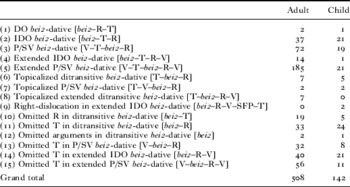
Fifteen adults did not produce any bei2-datives in their samples. A total of 508 tokens of bei2 ‘give’ dative constructions were identified from the other 86 adults, and they used an average of 5·9 tokens with a range between one and 22. Data from these parents were examined descriptively as a group. Appendix A gives an example of a child, or where appropriate, an adult production of the 15 different bei2-datives. Table 1 shows the number of tokens recorded for the adult and child group. Please note that the forms [V–T–bei2–R] and [V–T–bei2–R–V] included instances in which the first verb was also the word bei2 ‘to give’. The adults produced only one token of the [bei2–T–bei2–R] and one token of the [bei2–T–bei2–R–V], while the children produced two tokens of the former. One hundred bei2 ‘to give’ dative utterances, 80 from the adults and 20 from the children, were re-classified by a trained research assistant and inter-rater reliability was 94%. Disagreement was resolved through discussion with the first author.
Tokens of the different forms of the basic and extended ditransitive and P/SV bei2-dative constructions observed in 53 children and 86 parents

RESULTS
The different forms of the bei2-dative constructions reported in Table 1 were then sorted into two separate groups. The ditransitive group includes the DO and IDO bei2-dative constructions, and their extended forms. The P/SV group includes the P/SV bei2-dative construction and its extended forms. On the basis of the presence (full vs. non-full) and order (full canonical vs. full non-canonical) of the two arguments, they were further described as full canonical ditransitive (2, 4), full canonical P/SV (3, 5), full non-canonical ditransitive (1, 6, 8, 9), full non-canonical P/SV (7), non-full ditransitive (10, 11, 12, 14), and non-full P/SV (13, 15) bei2-dative constructions. The adult and child data are reported in Tables 2 and 3 respectively. Although the ages of the children spanned a rather wide range, we could not analyze their data with age as a factor with altogether only 142 productions of bei2-datives observed in 53 children. Given that there were only 48 parent–child pairs from the sample who both used any bei2-dative constructions, and that there were only five pairs where both the parent and the child used five or more of these constructions, instead of testing our hypotheses statistically, we examined our predictions from descriptive data.
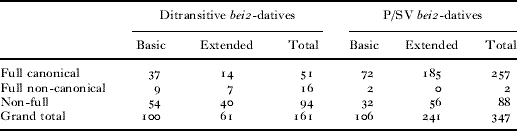
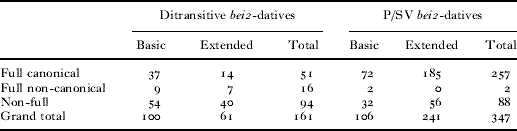
Number of tokens of full vs. non-full, and full canonical vs. full non-canonical, ditransitive and P/SV bei2-datives in 86 parents
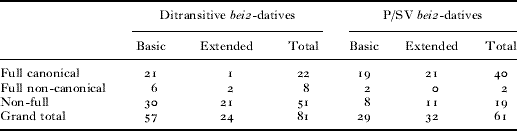
Number of tokens of full vs. non-full, and full canonical vs. full non-canonical, ditransitive and P/SV bei2-datives in 53 children
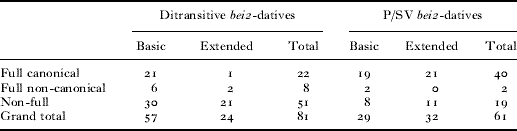
Adult data
Table 2 reveals that of the 508 adult tokens, 31·7% (161 tokens) were ditransitive bei2-datives. Our hypothesis ditransitive >P/SV was not confirmed, as our findings indicated the reverse. The adults produced P/SV bei2-datives 2·2 times more often than ditransitive bei2-datives when speaking with three-year-old children. The ditransitive and P/SV bei2-dative constructions differed in their distribution of full vs. non-full forms. As predicted, the adults used more non-full than full ditransitive bei2-datives, at a ratio of 1·4:1 (94 and 67 tokens respectively). The same preference was observed for the basic and extended ditransitive bei2-datives when they were examined separately. Our prediction of the same preference for non-full forms of the P/SV bei2-dative construction, however, was not confirmed. The adults used 2·9 times more full (259) than non-full (88) forms. Again the same preference was observed for the basic and extended P/SV bei2-datives when they were examined separately. Together these results suggested that the adults deployed the arguments for the ditransitive and P/SV bei2-dative constructions differently.
Our prediction for the adults' preference for full canonical over full non-canonical forms for both the ditransitive and the P/SV bei2-dative constructions was confirmed. Full canonical ditransitive forms were used 3·2 times more often than their full non-canonical counterparts (51 and 16 tokens respectively). Consistent with Chan (Reference Chan2003), for the adults in this study, IDO [bei2–T–R] was clearly the canonical form for the basic ditransitive bei2-dative constructions. As Table 1 reveals, the adults used IDO bei2-datives overwhelmingly more often than DO bei2-datives, at 37 and 2 tokens respectively. The ratio of full canonical to full non-canonical P/SV bei2-datives was 129:1 (257 and 2 tokens respectively). The strong preference for full canonical over full non-canonical forms was also observed for the basic and extended ditransitive bei2-dative constructions when they were examined separately and for the basic and extended P/SV bei2-datives when they were examined separately.
Finally, we examined whether the adults consistently omitted or displaced the same argument in their non-full and full non-canonical ditransitive bei2-datives. Excluding the two tokens of bei2 ‘to give’ in isolation, Table 1 reveals that the adults omitted the argument theme more often than the argument recipient in their ditransitive bei2-datives (10, 11, 14). There were 73 tokens of the [bei2–R] sequence as compared to 19 tokens of the [bei2–T]. As Chan (Reference Chan2003) reported for the children, two-thirds of the theme in the [bei2–T] sequence was cin1 ‘money’. The adults' preference for the [bei2–R] in non-full ditransitive bei2-datives was confirmed. Table 1 also reveals that the adults displaced the argument theme more often than the argument recipient in their full non-canonical ditransitive bei2-datives (6, 8, 9). All fourteen tokens of these bei2-datives involved the [bei2–R] sequence. Our hypothesis [bei2–R] >[bei2–T] for non-full and full non-canonical ditransitive bei2-dative constructions was confirmed.
Child data
Table 3 gives the distribution of the 142 tokens of the ditransitive and P/SV bei2-dative constructions for the 53 children. Fifty-seven percent (81 tokens) of these constructions were ditransitive bei2-datives, showing a distribution unlike that reported for the adults. Our prediction ditransitive >P/SV was confirmed, as the children used 1·3 times more ditransitive than P/SV bei2-datives. As predicted, the children used more non-full than full forms of the ditransitive bei2-dative constructions (51 and 30 tokens respectively). The same pattern was observed when the basic and extended ditransitive bei2-datives were examined separately, although it was less pronounced for the basic ditransitive bei2-datives (30 non-full vs. 27 full forms). Our prediction for the same preference for non-full forms of the P/SV bei2-dative construction, however, was not confirmed. The children used 2·2 times more full (42 tokens) than non-full (19 tokens) forms for the P/SV bei2-dative construction. Again the same pattern was observed when the basic and extended P/SV bei2-datives were examined separately. Together these results suggested that the children deployed the arguments for the ditransitive and P/SV bei2-dative constructions differently, in much the same way as the adults did.
Our prediction for the children's preference for full non-canonical over full canonical forms was not confirmed for either the ditransitive or the P/SV bei2-dative constructions. Like the adults, the children preferred full canonical than full non-canonical forms for all bei2-dative constructions. Table 3 reveals that full canonical ditransitive bei2-datives were actually used 2·8 times more often than their full non-canonical counterparts, at 22 and 8 tokens respectively. The ratio of full canonical to full non-canonical P/SV bei2 ‘give’ dative forms was 20:1 (40 and 2 tokens respectively). The same preference for full canonical forms was reported for the basic ditransitve and the basic and extended P/SV bei2-datives. For the extended ditransitive bei2-datives, only one token was observed for the full canonical and two for the full non-canonical forms.
Excluding the one token of bei2 ‘to give’ produced in isolation, Table 1 reveals that, like the adults, the children omitted the argument theme more often in their non-full ditransitive bei2-datives (10, 11, 14). They produced the [bei2–R] sequence 9 times more frequently than the [bei2–T] sequence, at 45 and 5 tokens respectively. Table 1 also reveals that, like the adults, the children also displaced the argument theme more often in their full non-canonical ditransitive bei2-datives (6, 8, 9). They produced [bei2–R] sequence in all seven tokens of these full non-canonical ditransitive bei2-datives. Our prediction [bei2–R] >[bei2–T] was confirmed in the children's production of non-full and full non-canonical ditransitive bei2-dative constructions.
In summary, when they engaged in conversations, the adults and the children in this sample used a range of bei2-dative constructions to communicate about transfer. The children used predominantly the ditransitive bei2-dative constructions, while the adults produced primarily the P/SV bei2-dative construction. For the ditransitive bei2-dative constructions, the adults used predominantly non-full instead of full forms, and the children showed a distribution in the same direction. For the P/SV bei2-dative construction, the adults used predominantly full instead of non-full forms, and the children showed the same direction of preference. In their full ditransitive and P/SV bei2-datives, both the adults and the children revealed canonical order of the arguments. Both the adults and the children omitted, or displaced, the argument theme more often than the argument recipient, resulting in the consistent appearance of the sequence [bei2–R] in their non-full and full non-canonical ditransitive bei2-datives.
DISCUSSION
Grammatical constructions for transfer involving the form bei2 ‘to give’ illustrate the confluence of four features of Cantonese: multiple construction types, optional elements, variant structures and polysemous forms. This is the first report of how frequently the first three features were realized by parents during conversations with their three-year-old children, and in the children themselves. In this section, we will first compare our findings with those reported in the literature, focusing on the developmental changes in this slightly older group of children. We will then discuss how children's patterns of use might relate to the confluence of these three features in the adult input. Given that half of the children in this sample did not produce any bei2-datives, and the number of bei2-dative tokens observed in the remaining 53 children was not substantial, our results are tentative. This discussion aims to provide insights for future research.
Developmental changes in bei2-dative constructions
Despite the fact that the average age of the 101 children in this study was 3 ; 09, only four months older than the oldest child in the CANCORP database reported in Chan (Reference Chan2003) and Wong (Reference Wong and Johnston2004), we did observe changes in their use of the bei2-dative constructions. While the children in this study produced ditransitive more often than P/SV bei2-datives, the difference was now only 14% (43% vs. 57%) as compared to 37% (31·5% vs. 68·5%) in the younger children in Wong (Reference Wong and Johnston2004). Another developmental change was observed in the children's use of ditransitive bei2-datives. Unlike the younger children reported in Chan (Reference Chan2003), the children in this study produced the full ditransitive bei2-dative construction primarily in its canonical order. All of these changes were in the direction of the adults' pattern of use. One pattern remained the same for this and the younger group of children (Chan, Reference Chan2003). The theme was the argument that was omitted and displaced more often in the children's non-full and full non-canonical ditransitive bei2-datives resulting in the frequent occurrence of the [bei2–R] sequence, as reported in the adults.
Multiple construction types
When talking with their three-year-old children, the parents in this study used the ditransitive and the P/SV bei2-dative constructions to express object or information transfer. The use of multiple construction types for expressing the same meaning is not unique to Cantonese. There are also three different dative constructions in English. The parents, however, showed a clear dominance of one construction over the other. In English, it is often the double-object dative (Campbell & Tomasello, Reference Campbell and Tomasello2001) for a range of verbs. In this study on Cantonese, we only examined dative constructions with the verb bei2 ‘to give’, and we learned that the P/SV bei2-dative construction is used the most often in the adult input with this older group of three-year-old children. Campbell & Tomasello (Reference Campbell and Tomasello2001) interpreted the English-speaking children's preference for the double-object dative construction as reflecting the power of input frequency. Here though, three-year-old Cantonese-speaking children did not use the P/SV bei2-dative construction despite its higher frequency in the adult input. The children used instead the syntactically simpler ditransitive bei2-dative constructions the most often. This suggests that syntactic complexity, rather than input frequency, shapes three-year-old children's production of the ditransitive bei2-datives.
Optional elements
We have also learned from this study that optional elements (non-full sentences) are more common in some constructions than others in the adult input. Parents frequently omitted one or both arguments in their productions of the ditransitive but not the P/SV bei2-dative constructions, and the same pattern was observed in their extended forms. If, as Tomasello (Reference Tomasello2003) argues in his usage-based constructionist account of language development, children learn language through active analyses of the input patterns, frequent occurrence of optional elements in the adults' utterances can create difficulties for young children. With inconsistent patterns of the same construction, children would have difficulties not only with the analysis of its structure, but also the appreciation of the physical and discourse contexts in which these different patterns are allowed. Preliminary data from this study showed that this was the case. The children used full forms less often in ditransitive than P/SV bei2-datives.
What might account for this different pattern of use of optional elements in the ditransitive and the P/SV bei2-dative constructions? The ditransitive and P/SV bei2-dative constructions both involve the arguments theme and recipient and the form bei2 ‘to give’. In ditransitive bei2-dative constructions, the form bei2 ‘to give’ functions as a lexical verb, and there is no morphological form within this construction that obligates the presence of either the theme or the recipient. Instead, the expression of arguments in ditransitive bei2-datives is controlled by the physical or the discourse contexts, as suggested by Matthews & Yip (Reference Matthews and Yip1994) in their description of Cantonese grammar. If the speaker assumes that the listener can recover optional elements in the ditransitive bei2-dative from context, s/he can use a non-full form. In the P/SV bei2-dative construction, however, the expression of noun phrase arguments, and the recipient in particular, seems to be linguistically controlled, and hence less likely to be optional. Recall that in the P/SV bei2-dative construction [V–T–bei2–R], the lexical verb precedes the theme, and the form bei2 ‘to give’ precedes the recipient. The form bei2 ‘to give’ in this construction cannot carry an aspect marker, like most lexical verbs do. Wong (Reference Wong and Johnston2004) therefore argues that the form bei2 ‘to give’ in the P/SV bei2-dative construction is in the process of being grammaticalized into a morphological marker for the recipient that follows, and its presence therefore obligates the use of the recipient.
Variant structures
In this study, the adults used a range of different full non-canonical forms of bei2-dative constructions when speaking with children, but these forms appeared in very low frequencies. The infrequent use of variant structures is consistent with Chan (Reference Chan2003) and is expected since typically non-canonical word orders are a result of topicalization, which is often used for special discourse and pragmatic purposes, or a result of situations when one of the object noun phrases is too long, as in the DO [bei2–R–T]. Following Chan (Reference Chan2003), we predicted that full non-canonical forms would be more frequent than full canonical forms in children's ditransitive bei2-datives. In this study with slightly older children, we reported that the children produced the ditransitive and the P/SV bei2-dative constructions more often in their canonical order. Preliminary data from this study suggest that variant structures, given their relatively low frequencies in the input, do not seem to pose a challenge for the children's learning of the canonical form of the bei2-dative constructions. Their early preference for non-canonical forms did not seem to be supported by adult input (Chan, Reference Chan2003), nor was it likely to indicate the ability to manipulate word order of a construction for special discourse or pragmatic purposes, such as topicalization. As Berman & Slobin (Reference Berman, Slobin, Berman and Slobin1994) pointed out, this ability generally develops after the mastery of its canonical structure. Young three-year-old children's frequent use of full non-canonical forms, as reported by Chan (Reference Chan2003), is likely to be due to their inadequate knowledge of the word order for the full canonical ditransitive bei2 ‘give’ dative construction.
Interacting factors and future research
Multiple construction types and optional elements were observed in the adults' bei2-datives during conversations with their three-year-old children. Input frequency did not determine the children's preference for ditransitive over P/SV bei2-datives. Syntactic complexity might instead play a role here. The prevalence of optional elements in the adults' ditransitive bei2-datives might have simplified the ditransitive bei2-dative constructions for the children even further, and one might then argue that optional elements may in fact facilitate the development of these constructions. Although the children showed the same preference for non-full ditransitive bei2-datives as the adults, they did not necessarily have adequate use and knowledge of these datives, particularly their full canonical forms. To be able to use a construction in the same way adults do, children need to learn how the construction is mapped onto its meaning. The challenge of optional elements, for the ditransitive bei2-dative constructions in this case, might not come only from the analysis of the structure of the construction. It can also come from the appreciation of the physical and discourse context to ensure that the listener can recover the element(s) omitted without leading to communication breakdowns. Such an appreciation requires the speaker to secure joint attention with the communication partner, and to monitor the listener's knowledge status relative to one's own as the discourse evolves (Wong & Johnston, Reference Wong and Johnston2004). With only written transcripts from audio records, this study did not allow us to evaluate whether the children's non-full ditransitive bei2-datives were used appropriately in context, or to infer that they had adult knowledge of the full canonical form.
To do so, future research should consider experimental investigations where the child's joint attention, or any prior mention of the object and recipient involved in a transfer scene, is manipulated. An alternative would be the use of more intensive and longitudinal parent–child language samples (Tomasello & Stahl, Reference Tomasello and Stahl2004) with complementary video records (e.g. Allen, Reference Allen2000). Such data will provide adequate tokens for in-depth analysis of the physical and discourse contexts of the use of bei2-dative constructions, and allow direct examination of how the nature of input, particularly multiple construction types and optional forms, affects the child's learning. Such evidence is critical for our understanding of how different input characteristics interact with syntactic complexity in young children's learning of ditransitive bei2-dative constructions. Future research should also examine children's development of dative constructions with other verb types in relation to the adult input. We should also ask whether the preference for non-full forms is also prevalent in adults' ditransitive dative constructions with verbs other than bei2 ‘to give’, especially in light of the fact that the verb bei2 ‘to give’ is the only one that takes the IDO [bei2–T–R] as its canonical form.
APPENDIX A: EXAMPLE OF bei2-DATIVE PRODUCTIONS FROM A CHILD OR AN ADULT*
(1) bei2 nei5 nei1 di1 give you this CL ‘(I) give you this.’
(2) bei2 faan1 go2 di1 ngo5 give back that CL I/me ‘(You) give me back those.’
(3) ngo5 zyu2 faan6 bei2 nei5 I/me cook rice give you ‘I'll cook you some rice.’
(4) ngo5 bei2 seoi2 nei5 jam2 I give water you drink ‘I'll give you water to drink.’
(5) Daddy, ngo5 tong1 jyu2 bei2 nei5 sik6 aa1 Daddy, I kill fish give you eat SFP ‘Daddy, I'll kill you some fish to eat.’
(6) caa1 bei2 nei5 aa3 fork give you SFP ‘The fork is for you.’
(7) ngo5 soeng2 ngo5 go2 gaa3 maai6 bei2 ze4ze1 I want I/me that CL sell give sister ‘I want my (car) sold to the older lady.’
(8) laa4, nei1 go2 bei2 nei5 cai3* PRT, this CL give you put-together ‘Here, this one is for you to put-together.’
(9) ngo5 bei2 go4go1 sik6 gaa3, nei1 go3 hung4lo4baak6 I give brother eat SFP, this CL carrot ‘This carrot is for the older brother to eat.’
(10) bei2 nei1 go3 give this CL ‘Give (me) this one.’
(11) ngo5 bei2 nei5 I give you ‘I give you.’
(12) bei2 zo2 mei6 aa3? give ASP yet SFP ‘Have (you) given (him/her) (this)?’
(13) guk6 bei2 nei5 sin1 bake give you first ‘Bake you (this) first.’
(14) lou5si1, bei2 nei5 sik6 aa1 teacher, give you eat SFP ‘Teacher, I give you (this) to eat.’
(15) ngo5 lo2 bei2 lou5si1 sik6 sin1 I bring give teacher eat first ‘I'll bring the teacher (this) to eat first.’