Introduction
Parasites are a grossly underestimated component of the ecosystem (Poulin, Reference Poulin2004). Recently included in the evaluation of biodiversity, it has become evident that they are a major component (Poulin & Morand, Reference Poulin and Morand2004). Indeed, the finding that virtually all free-living organisms harbour one or more parasite species, led some authors (Windsor, Reference Windsor1995, Reference Windsor1998; Poulin & Morand, Reference Poulin and Morand2000; Rohde, 2010) to suggest that the number of parasite species is at least equal to, or probably greater, than the number of non-parasitic species. Global research on parasites has been directed towards the study of their diversity, distribution, life cycles and pathogenicity. In Tunisia, these include studies on myxozoans (Bahri et al., Reference Bahri, Marton, Marques and Eszterbauer2010; Yemmen et al., Reference Yemmen, Szilvia, Eszterbauer and Bahri2012, Reference Yemmen, Marton, Bahri and Eszterbauer2013), copepods (Ben Hassine, Reference Ben Hassine1983; Essafi et al., Reference Essafi, Cabral and Raibaut1984; Benmansour & Ben Hassine, Reference Benmansour and Ben Hassine1997, Reference Benmansour and Ben Hassine1998), nematodes (Gargouri Ben Abdallah & Maamouri, Reference Gargouri Ben Abdallah and Maamouri2006), isopods (Charfi Cheikhrouha et al., Reference Charfi-Cheikhrouha, Zghidi, Ould Yarba and Trilles2000), monogeneans (Neifar et al., Reference Neifar, Euzet and Ben Hassine2002, Reference Neifar, Euzet and Olivier2004; Neifar & Euzet, Reference Neifar and Euzet2007), cestodes (Mokhtar-Maamouri & Zamali, Reference Mokhtar-Maamouri and Zamali1981, Reference Mokhtar-Maamouri and Zamali1982) and digeneans (Gargouri Ben Abdallah & Maamouri, Reference Gargouri Ben Abdallah and Maamouri1997, Reference Gargouri Ben Abdallah and Maamouri2002, Reference Gargouri Ben Abdallah and Maamouri2005a, Reference Gargouri Ben Abdallah and Maamourib, 2008; Gargouri Ben Abdallah et al., Reference Gargouri Ben Abdallah, Trigui El Menif and Maamouri2009, Reference Gargouri Ben Abdallah, Bohli and Maamouri2010, Reference Gargouri Ben Abdallah, Antar, Hosni, Trigui El Menif and Maamouri2011a, Reference Gargouri Ben Abdallah, Antar and Maamourib; Antar & Gargouri Ben Abdallah, Reference Antar and Gargouri Ben Abdallah2013).
Hitherto, no study has been conducted on the acanthocephalans of teleost fish from the Tunisian coasts. In this paper we present, for the first time, ecological data on infection by several species of acanthocephalans recovered from 14 fish species collected from the Bizerte lagoon, and we compare their sites of infection with those of the most frequently encountered gastrointestinal helminths (Digenea) in order to identify eventual interspecific interaction. A comparison with other studies in other locations would be interesting for biogeography and for understanding the distribution of acanthocephalans of teleost fish.
Materials and methods
Study site
Fish were collected from along the Bizerte lagoon situated in northern Tunisia (37°8′–37°16′N, 9°46′–9°56′E) between Lake Ichkeul and the Mediterranean Sea (Dellali et al., Reference Dellali, Gnassia Barelli, Romeo and Aissa2001). This lagoon, with an area of 15 × 106 m2, is considered to be the third largest lagoon in Tunisia and represents an economically important water body, where a variety of fishing and aquaculture activities takes place. The lagoon has sandy-clay to clay–silt–sandy sediments and a maximum depth of 12 m (Soussi, Reference Soussi1981). In this biotope, the mean annual water temperature is 18.28°C and the mean annual salinity is 34‰. Bizerte lagoon, being subject to eutrophication, is also susceptible to anthropogenic disturbances of various origins: domestic and industrial wastes released by the neighbouring towns (400,000 inhabitants are recorded in the Bizerte district and 400 industrial units are present around the lagoon), and pesticides and chemical fertilizers through soil erosion and runoff (cultivated lands occupy an area of 172 × 106m2 mainly devoted to cereal production (78 × 106m2) which utilizes 20.5 tons/year of fertilizers) (ANPE, 1989; Dellali et al., Reference Dellali, Gnassia Barelli, Romeo and Aissa2001; Ben Said et al., Reference Ben Said, Goñi Urriza, El Bour, Duran and Aissa2010).
Collection and examination of fish
Between December 2011 and December 2012, a total of 306 teleost fish belonging to 14 species were examined for acanthocephalans: 26 Atherina boyeri (Risso, 1810), 23 Diplodus annularis (Linnaeus, 1758), 18 D. puntazzo (Walbaum, 1792), 19 D. sargus sargus (Linnaeus, 1758), 20 D. vulgaris (Geoffroy Saint-Hilaire, 1817), 25 Lithognathus mormyrus (Linnaeus, 1758), 27 Liza aurata (Risso, 1810), 16 Pagellus erythrinus (Linnaeus, 1758), 9 Pagrus pagrus (Linnaeus, 1758), 30 Solea senegalensis (Kaup, 1858), 30 Sparus aurata (Linnaeus, 1785), 20 Spondyliosoma cantharus (Linnaeus, 1758), 23 Trachinotus ovatus (Linnaeus, 1758) and 20 Trachurus trachurus (Linnaeus, 1758).
Fish nomenclature was validated according to Fischer et al. (Reference Fischer, Seneider and Bauchaut1987) and Froese & Pauly (Reference Froese and Pauly2014). These species, living on various bottoms (sand, mud, rocks, gravels, conglomerates, posidonia) are gregarious or solitary. They live at depths varying from 20 to 420 m. Apart from L. aurata which reaches sexual maturity at 3 or 4 years, the fish become mature during the first or the second year of life. They feed on algae, worms, molluscs, small crustaceans, echinoderms, larvae of fish, cephalopods and bivalves (Fischer et al. Reference Fischer, Seneider and Bauchaut1987).
A post-mortem examination of each fish was carried out no later than 3 h after capture, and the oesophagus, stomach and intestine were removed. Food items in the stomach of each species of fish were observed and noted. The intestine was divided into four parts, duodenum, mid-intestine, posterior intestine and rectum. All organs of the digestive tract were carefully examined for acanthocephalans under the binocular microscope.
Acanthocephalans were studied in vivo under the microscope or preserved for later observation. They were fixed alive under slight coverslip pressure in boiling 95% ethanol and stained with boric acetocarmine. The specimens were dehydrated in three successive baths of alcohol (70–95–100%), cleared in Gaulteria oil and then mounted in Canada balsam. The specimens were identified according to Amin (Reference Amin2013). Parasitological terms follow Margolis et al. (Reference Margolis, Esh, Holmes, Kuris and Schad1982) and Bush et al. (Reference Bush, Lafferty, Lotz and Shostak1997). Following Holmes & Price (Reference Holmes, Price, Anderson and Kikkawa1986), the terms ‘satellite species’ and ‘rare species’ were assigned to those species of acanthocephalans with prevalence varying from 6 to 40%, and less than 6%, respectively.
Results and discussion
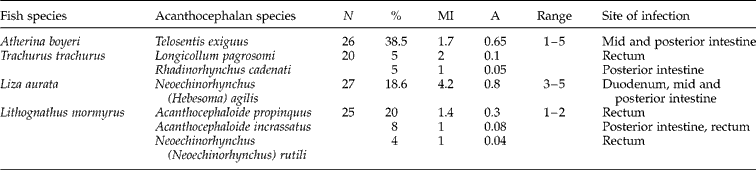
In the present study, seven species of acanthocephalans belonging to five families were collected in teleost fish from the Bizerte lagoon in Tunisia: Acanthocephaloide incrassatus (Molin, 1858) Meyer, 1932; A. propinquus (Dujardin, 1845) Meyer, 1932 (Echinorhynchida: Arhythmacanthidae); Longicollum pagrosomi Yamaguti, 1935 (Echinorhynchida: Pomphorhynchidae); Neoechinorhynchus (Hebesoma) agilis (Rudolphi, 1819) Van Cleave, 1916; N. (Neoechinorhynchus) rutili (Müller, 1780) (Neoechinorhynchida: Neoechinorhynchidae); Rhadinorhynchus cadenati (Golvan et Houin, 1964) Golvan, Reference Golvan1969 (Echinorhynchida: Rhadinorhynchidae); and Telosentis exiguus (von Linstow, 1901) Van Cleave, 1923 (Echinorhynchida: Illiosentidae) (table 1). Acanthocephalans were recorded from only four species of fish: A. boyeri, L. aurata, L. mormyrus and T. trachurus.
The prevalence (%), mean intensity (MI) and abundance (A) of infection of acanthocephalans in teleost fish species from the Bizerte lagoon; N=number of fish examined.
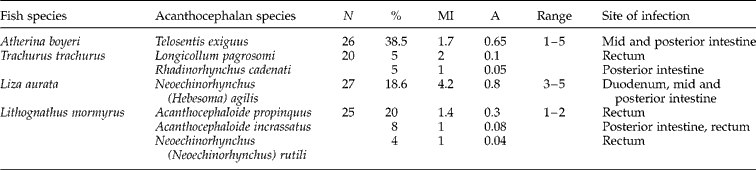
Lithognathus mormyrus harboured more acanthocephalans than any other fish species (A. propinquus, A. incrassatus and N. (N.) rutili). The relatively high species richness in this fish species is probably related to its diet. Indeed, according to Froese & Pauly (Reference Froese and Pauly2014) and Fischer et al. (Reference Fischer, Seneider and Bauchaut1987), L. mormyrus feeds on worms, molluscs and small crustaceans. Besides, our observations indicated that amphipods and, to a lesser degree, ostracods (which serve perhaps as intermediate host for these acanthocephalans) were more numerous than other prey in the stomach contents of this fish species. Trachurus trachurus was infected by two species (L. pagrosomi and R. cadenati), whereas, A. boyeri and L. aurata showed the lower diversity, not exceeding one species, T. exiguus and N. (H.) agilis, respectively (table 1).
The majority of acanthocephalans recorded in L. mormyrus and T. trachurus (A. propinquus, A. incrassatus, N. (N.) rutili, L. pagrosomi, R. cadenati) were restricted to the posterior intestine and/or the rectum, relatively poor-quality habitats in the alimentary tract. The restriction of these parasites species to these niches is probably due to the presence of other helminth species in other parts of the gastrointestinal tract. In order to escape interspecific competition in the anterior and mid intestine, acanthocephalan species are forced to occupy marginal habitats. Indeed, as reported by the authors working on digeneans of teleost fish from the Bizerte lagoon (Gargouri Ben Abdallah et al., 2011b; Antar & Gargouri Ben Abdallah, Reference Antar and Gargouri Ben Abdallah2013), most digeneans (Ectenurus lepidus, Lecithocladium exisum, Monascus filiformis, Prodistomum polonii, Tergestia acanthocephala, Allopodocotyle pedicellata, Holorchis pycnoporus, Lepocreadium album, Lepocreadium pegorchis, Macvicaria maillardi and Macvicaria mormyri) occupy the stomach, duodenum and mid intestine of L. mormyrus and T. trachurus, whereas the rare species (Diphterostomum brusinae, Proctoeces maculatus and Tergestia laticollis) were often recorded in the posterior intestine and rectum. On the other hand, Combes (Reference Combes1995) formulated another hypothesis to explain the restriction of parasite species to their niches. He thinks that the parasite has a vital need for the expression of certain host genes and can survive only in the organs, parts of organs or cells where the genes are expressed. Furthermore, by restricting the dimension of the site, the parasite increases the probability of encountering a sexual partner. Neoechinorhynchus (H.) agilis, a frequent and abundant acanthocephalan, seems to be less restricted, and inhabits three parts of the intestine (table 1). Telosentis exiguus from A. boyeri, colonizes the mid and posterior intestine. Probably there is no interspecific competition in the gut of this fish as it harbours a single digenean species (Bacciger bacciger) which is limited to the duodenum. Neoechinorhynchus (H.) agilis from L. aurata occupies the anterior, mid and posterior intestine despite the relatively large number of digeneans (Dicrogaster contractus, Haploporus benedeni, Haplosplanchnus pachysomus, Lecithaster helodes, Lecithobotrys putrescens, Saccocoelium tensum, Saccocoelium obesum, Schikhobalotrema sparisomae) at these sites of the alimentary tract. The intestine of this fish is relatively long and, therefore, can harbour a diverse fauna. It seems that space and resources at various levels of the intestine are largely sufficient for all parasites. No acanthocephalan was found in the stomach. According to Petrochenko (Reference Petrochenko1956), adult acanthocephalans are found in the intestine of vertebrates, their most favourite habitat, due to their requirement for simple nutrients that can be absorbed across the body wall (Crompton, Reference Crompton1973). Nevertheless, some species parasitizing fish have been reported in the stomach (Petrochenko, Reference Petrochenko1956) since this habitat is considered an absorptive site (Crompton, Reference Crompton1973). On the other hand, Aznar et al. (Reference Aznar, Bush, Balbuena and Raga2001) considered that the presence of adult acanthocephalans, and in particular Corynosoma cetaceum, in the stomach of marine mammals is puzzling because the stomach of these hosts is involved only in digestive functions.
The analysis of parasite infracommunities shows that the majority of host species (95.7%) harbour only one species of parasite, and the occurrence of two species (4.4%) is much less frequent. The infracommunities are poor. As indicated by Combes (Reference Combes1995), we believe that the infection of fish by a species of parasite prevents the establishment of other parasites and leads consequently to their exclusion.
The present results show that N. (H.) rutili recorded from L. mormyrus and L. pagrosomi and R. cadenati from T. trachurus attained low prevalences of less than 6% (table 1). These results suggest that these acanthocephalan species should be considered as rare species. All other parasites (A. incrassatus and A. propinquus in L. mormyrus, T. exiguus in A. boyeri and N. (H.) agilis in L. aurata) should be considered as satellite species. The highest prevalence value (38.5%) of T. exiguusoccurred in A. boyeri, followed by 20% prevalence of A. propinquus in L. mormyrus and 18.6% of N. (H.) agilis in L. aurata.
The values of abundance and mean intensity were generally low for all parasites species and not exceeding values of 0.8 and 4.2, respectively. The proboscis of Acanthocephala damages the host gut and is more likely to evoke a strong immune response. Sanil et al. (Reference Sanil, Asokan, John and Vijayan2011) think that the immune system appears to intervene to reduce the number of Acanthocephala in order to ensure the survival and sustainability of the host. Some species, and especially L. pagrosomi, can cause histopathological effects in the digestive tract and, in cases of massive infection, it can even cause the death of the host (Kim et al., Reference Kim, Lee, Kim, Oh, Kim, Park and Park2011). Heavy infections (number/fish: 26–68) of N. (H.) agilis also cause damage to the digestive tract of Mugil cephalus. At the site of parasite attachment the surface of the intestine appeared thickened and the mucosal epithelium showed compression and abrasion (Jithendran & Kannappan, Reference Jithendran and Kannappan2010). Acanthocephaloide propinquus may also have an adverse effect on female Gobius bucchichii. Indeed, Sasal et al. (Reference Sasal, Faliex, De Buron and Morand2001) found that the reproductive success of these fish is negatively correlated with worm burden of this acanthocephalan species.
Differences between the parasitological loads obtained from different species of acanthocephalans in fish from the Bizerte lagoon could be related to the sampling effort and period for each species of the host. Indeed, Golvan & De Buron (Reference Golvan and De Buron1988) found that some host species harbour a species of acanthocephalan only during a definite period of the year. This variation can also be explained by the variation in frequency of occurrence of the intermediate hosts and in the food of fish species. Golvan & De Buron (Reference Golvan and De Buron1988) consider that the determining factor for acanthocephalan parasitism is the feeding behaviour of fish hosts. The reproductive season of the host can influence the feeding activities, and consequently the values of the parasitological loads; the trophic activity of fish increases gradually during the pre- and post-laying period.
A comparison of the species of acanthocephalans infecting T. trachurus from the Bizerte lagoon with other localities (i.e. Turkey and European waters) showed a higher diversity in European waters. Indeed, Corynosoma strumosum and Corynosoma wegeneri, reported in Portugal and Ireland (Campbell, Reference Campbell2008), are absent in the Bizerte lagoon and Turkey (Oguz & Kvach, Reference Oguz and Kvach2006). In addition, R. cadenati recorded from European waters and Bizerte lagoon is absent in Turkey. Longicollum pagrosomi recorded in T. trachurus from Tunisia and Turkey is also reported from the sparid fish Pagrus major (Kim et al., Reference Kim, Lee, Kim, Oh, Kim, Park and Park2011) and from the sciaenid fish Sciaena umbra (Akmirza, Reference Akmirza2014). Furthermore, N. rutili in L. mormyrus from the Bizerte lagoon is the first report from Mediterranean sparids. Acanthocephaloide incrassatus and A. propinquus, recorded in L. mormyrus in our lagoon, have already been reported in other sparids, P. erythrinus from Corsica (Ternengo et al., Reference Ternengo, Levron and Marchand2005) and D. annularis from the gulf of Cagliari (D'aminco et al., 2006), respectively. These three acanthocephalans occur in a large number of teleosts of other families: Gobiidae, Merlucciidae, Serranidae, Trachinidae, Triglidae, Labridae, Soleidae, Uranoscopidae and Cyprinidae (Golvan, Reference Golvan1969; Orecchia et al., Reference Orecchia, Paggi, Minervini and Di Cave1985; Radujković, Reference Radujković1989; Dezfuli et al., Reference Dezfuli, Boldrini and Rossi1992; Belhgyti et al., Reference Belghyti, Berrada-Rkhami, Boy, Aguessa and Gabrian1994; Paggi et al., Reference Paggi, Mariniello, Ortis, Mattiucci, D'Amelio, Di Cave and Orecchia1998; Aydogdu et al., Reference Aydogdu, Yildirimhan and Altunel2000; De Buron & Chauvet, Reference De Buron, Chauvet, Combes and Jourdane2003; Oguz & Kvach, Reference Oguz and Kvach2006) and have consequently an euryxenic specificity. Neoechinorhynchus (H.) agilis found in L. aurata in the present work was reported in the same host from the Black Sea (Tepe & Oğuz, Reference Tepe and Oğuz2013). This species was also recorded from the Mistras lagoon (Sardinia) in five species of Mugilidae: L. aurata, L. saliens, L. ramada, Chelon labrosus and Mugil cephalus (Merella & Garippa, Reference Merella and Garippa2001) and from India in M. cephalus (Jithendran & Kannappan, Reference Jithendran and Kannappan2010). Telosentis exiguus, occurring in A. boyeri from our lagoon, was reported in the Mediterranean basin from a variety of hosts (Engraulidae, Atherinidae, Clupeidae, Belonidae, Anguillidae, Gasterosteidae, Syngnathidae, Gobiidae, Blenniidae and Labridae) (Kvach & Sasal, Reference Kvach and Sasal2010). Pomphorhynchus françoisae in T. ovatus from the Black Sea (Golvan & De Buron, 1988); A. propinquus from Sardinia (D'aminco et al., 2006), Acanthocephalus lucii (Müller, 1776) from Gökçeada Island (Akmirza, Reference Akmirza2002) in D. annularis; A. incrassatus in P. erythrinus from Corsica (Ternengo et al., Reference Ternengo, Levron and Marchand2005); and Echinorhynchus clavula and Pomphorhynchus laevis in Solea senegalensis from the Portuguese continental coast (Carvalho-Varela & Cunha-Ferreira, Reference Carvalho-Varela and Cunha-Ferreira1987) are absent in these fish from the Bizerte lagoon. This absence may be related to a small sample size of the host and its body length, the low frequency of intermediate hosts in the study site, or to the variation in physical and chemical parameters of the biotope that can influence the host. Indeed, a study conducted off the Labrador coast of Canada showed that a decrease in temperature affected the frequency of certain species of crustaceans, acting as intermediate hosts, causing their depletion, and led to a decrease in the abundance of the acanthocephalan Echinorhynchus gadi in Gadus morhua (Mas-Coma et al., 2008). Pollution in the Bizerte lagoon does not seem to influence the frequency of Acanthocephala directly, since these worms have the ability to accumulate higher concentrations of heavy metals than their hosts. However, as Sures (Reference Sures2004, Reference Sures2008) claimed, pollution can affect the health of the intermediate hosts and cause their scarcity or loss; therefore, the success of the life cycle of Acanthocephala is limited. Moreover, Lafferty & Kuris (Reference Lafferty and Kuris1999) think that as stressors such as pollution can degrade environments, reduce species diversity or decrease host populations, their impact on parasites will also often be negative.
No acanthocephalans were found in D. vulgaris, D. sargus, D. puntazzo, S. aurata and S. cantharus from the Bizerte lagoon or in other localities. The absence of these helminths in these species of sparid fish could be related to their diet. It seems that the invertebrate intermediate hosts for acanthocephalans are not consumed by these fish species. However, these fish harbour numerous species of Digenea.
Acknowledgements
We are grateful to Dr R.A. Bray from the Department of Life Sciences of the Natural History Museum of London, for revision of the English text, and Jesús Servando Hernández-Orts from the Institute of Parasitology, Biology Centre, České Budějovice, Czech Republic, for his relevant comments about the manuscript.
Conflict of interest
None.