


Introduction
Cognitive-behavioural models of obsessive-compulsive disorder (OCD) assert that intrusive thoughts develop into clinically significant obsessions when they are appraised as meaningful, potentially harmful to self or others, and/or when they evoke a sense of responsibility for preventing the perceived harm portended by the thoughts (Rachman, Reference Rachman1997, Reference Rachman1998; Salkovskis, Reference Salkovskis1985, Reference Salkovskis, Scott, Williams and Beck1989). The most effective psychological treatment of OCD to date is Exposure with Response Prevention (ERP; e.g. Foa, Franklin and Kozak, Reference Foa, Franklin, Kozak, Swinson, Antony, Rachman and Richter1998), in which people are exposed to their obsessions while refraining from compulsive acts and avoidance. ERP has been found to be at least as effective as, and in many cases superior to, pharmacological approaches to the treatment of OCD (Foa and Kozak, Reference Foa, Kozak, Mavissakalian and Prien1996). However, when treatment refusal and drop-out rates are considered, its success is estimated at about 50% (Salkovskis and Westbrook, Reference Salkovskis and Westbrook1989). It has been argued that cognitive interventions may be helpful both in reappraising the erroneous beliefs associated with OCD symptoms and in reducing their meaning (Salkovskis, Reference Salkovskis1985; Salkovskis and Kirk, Reference Salkovskis, Kirk, Clark and Fairburn1997). As Salkovskis notes, such interventions may help de-toxify the obsession enough to engage in exposure, and there is some evidence that this reduces treatment dropout (Vogel, Stiles and Götestam, Reference Vógel, Stiles and Götestam2004). However, in general the addition of a cognitive component to treatment has not been found to have a superior outcome to ERP alone (see Eddy, Dutra, Bradley and Westen, Reference Eddy, Dutra, Bradley and Westen2004).
Over the past decade there has been a proliferation of acceptance-based and mindfulness-based therapeutic approaches to the treatment of anxiety problems (e.g. Hayes, Strosahl and Wilson, Reference Hayes, Strosahl and Wilson1999; Kabat-Zinn, Reference Kabat-Zinn1990; Linehan, Reference Linehan1993; Segal, Williams and Teasdale, Reference Segal, Williams and Teasdale2002). These approaches all emphasize the alteration of the relationship that an individual has towards their thoughts, (i.e. a “metacognitive” emphasis), rather than directly attempting to change the form or content of thinking. Acceptance and Commitment Therapy (ACT; Hayes et al., Reference Hayes, Strosahl and Wilson1999) is an approach that incorporates various “cognitive defusion” techniques to help individuals to “defuse” from the literal meaning of their thoughts (i.e. experiencing thoughts as “just thoughts”, instead of valid indicators of reality). There is evidence that the effectiveness of ACT interventions may be mediated by changes in metacognitive understanding such that individuals come to appraise their negative thoughts as being less believable (e.g. Hayes, Luoma, Bond, Masuda and Lillis, Reference Hayes, Luoma, Bond, Masuda and Lillis2006). Consistent with this, the introduction of a metacognitive rationale for ERP has been found to result in a greater reduction in anxiety and distress, metacognitive beliefs, and the urge to engage in compulsive rituals, than ERP administered with the traditional habituation rationale (Fisher and Wells, Reference Fisher and Wells2005).
One cognitive defusion technique that is commonly used in ACT is the verbal repetition of a distress-evoking, emotionally relevant word (VR), which results in the subjective experience of loss of meaning of that word and hence the reduced need to engage in defensive behaviours (Hayes et al., Reference Hayes, Strosahl and Wilson1999; Tichener, Reference Tichener1910). Masuda, Hayes, Sackett and Twohig (Reference Masuda, Hayes, Sackett and Twohig2004) examined the impact of VR in reducing the believability in and discomfort evoked by self-critical thoughts and found that VR presented with a cognitive defusion rationale resulted in significantly greater reductions in both negative appraisal of and discomfort with the targeted thoughts. Masuda and colleagues have since replicated and extended these findings in both a parametric study that determined the amount of VR required to produce decreases in discomfort and belief (Masuda et al., Reference Masuda, Hayes, Twohig, Drossel, Lillis and Washio2009), and in a clinical analog study of individuals with elevated levels of depressive symptoms (Masuda et al., Reference Masuda, Twohig, Stormo, Feinstein, Chou and Wendell2010).
The loss of meaning following the rapid repetition of a word has also been studied in cognitive psychology under the label of “semantic satiation”. A number of studies using a Category Membership Decision Task (CMDT) have reliably detected a semantic satiation effect after a word is repeated (see Black, Reference Black and Shohov2003, for a review). In this task, a category name (e.g. animal) is repeated aloud, after which a rapid decision is made as to whether a target word (e.g. dog) is a member of the previously repeated category. Semantic satiation is said to be evidenced by an increase in response time for member, but not nonmember, target words when preceded by verbal repetition of the category name (i.e. a significant interaction of decision type by repetition length).
The VR technique, then, may be a useful means of ameliorating obsessional problems, either by changing the relationship the individual has with her/his obsessions, or by “de-toxifying” the obsession so that ERP can be undertaken effectively. To date, there are no studies to our knowledge that have examined the efficacy of VR specifically in the management of obsessional thoughts. Does VR actually result in semantic satiation? Given that it involves repeated exposure to the offending word, are its effects more powerful than standard imaginal exposure (IE)? Study 1 compared the effects of VR, an equivalent period of IE, and no intervention (CONT) in reducing the believability, distress, and meaningfulness of contamination-related thoughts in individuals reporting high levels of contamination fears immediately following the intervention and at one-week follow-up. Participants also completed a CMDT task to examine whether a semantic satiation effect occurs following VR and/or IE, and if the magnitude of the effect was related to changes in negative response to the thought. Study 2 was a replication of Study 1, but investigated the impact of daily rehearsal of the VR and IE interventions on negative appraisals, as well as the extent to which VR and IE leads to changes in relevant defensive behaviours.
Given that VR requires overt rehearsal of the offending word, purportedly diluting its semantic meaning, we hypothesized that VR would produce significantly greater reductions in negative response to the thought than would an equivalent period of IE or CONT. We also hypothesized that VR, but not IE, would result in semantic satiation and that the magnitude of the semantic satiation effect would be associated with thought ratings at both post-intervention and follow-up.
Study 1: Method
Participants
Participants were 93 individuals (n = 82 women, n = 11 men) with a mean age of 19.39 years (SD = 1.76). Participants were selected from a large pool of individuals enrolled in an introductory psychology course at the University of Waterloo. All individuals had completed a large number of psychological measures as part of the course, including the Padua Inventory-Washington State University Revision (PI-WSUR; Burns, Keortge, Formea and Sternberger, Reference Burns, Keortge, Formea and Sternberger1996). There is evidence that nonclinical individuals with high scores on self-report measures of OCD symptoms are a suitable group for studying obsessive-compulsive phenomena (Burns, Formea, Keortge and Sternberger, Reference Burns, Formea, Keortge and Sternberger1995). Participants were selected on the basis that their score on the contamination subscale was equal to or greater than the mean subscale score (14) of a clinical sample of individuals diagnosed with OCD (Burns et al., Reference Burns, Keortge, Formea and Sternberger1996). None of the participants in the present study reported receiving psychological and/or medication treatments for anxiety at the time of the study. Informed written consent was obtained from all participants, and ethical clearance was obtained for both studies, which were conducted in accordance with institutional ethical guidelines.
Measures
PI-WSUR. The PI-WSUR is a 39-item self-report measure of obsessions and compulsions. Each item is rated on a 5-point scale (0 = not at all to 4 = very much) according to the degree of disturbance caused by the thought or the behaviour. The factor structure of the PI-WSUR has been supported, and there is good internal consistency of the different subscales (Burns et al., Reference Burns, Keortge, Formea and Sternberger1996).
Positive and Negative Affect Schedule (PANAS; Watson, Clark and Tellegen, Reference Watson, Clark and Tellegen1988). The PANAS is a 20-item self-report measure of two broad mood states, termed positive affect (10 items) and negative affect (10 items). Items are rated on a 5-point scale (1 = very slightly or not at all to 5 = extremely). Good internal consistency has been shown in nonclinical samples, and adequate construct validity has also been demonstrated (Watson et al., Reference Watson, Clark and Tellegen1988).
Procedure
Participants were randomly assigned to one of three intervention groups: i) VR; ii) IE; or iii) CONT. All groups completed the PANAS and then were given a list of nine contamination-relevant words drawn from published studies examining attentional biases and/or memory in OCD (e.g. disease, germs, urine) and asked to rank, in order, the three words that are most distressing to them. Participants then wrote a brief sentence describing a distressing thought they experienced involving each of the three words. They then rated the three thoughts (baseline ratings) on Belief – “How believable is the thought?” (0 = not at all believable to 100 = very believable), Distress – “How distressed are you by the thought?” (0 = not at all distressed to 100 = very distressed), and Meaningfulness – “How meaningful is the thought?” (0 = not at all meaningful to 100 = very meaningful). Participants were also given a list of automobile words and asked to select the three most familiar ones. Participants were then seated at the computer and given instructions for the CMDT task.
The CMDT task was based on Smith (Reference Smith1984; Experiment 1). Participants were required to make rapid member/nonmember decisions for a series of target words based on the category word preceding it. There were 116 trials in total. The first block of trials consisted of 44 presentations of either neutral category/member target (TOOL/hammer) pairings or neutral/nonmember (BIRD/doll) pairings. The second block of trials consisted of 36 trials of either contamination/member (CONTAMINATION/virus), or contamination/nonmember (CONTAMINATION/toyota) pairs and, to control for familiarity, 36 trials of either automobile category/member target (AUTOMOBILE/toyota) or automobile/nonmember (AUTOMOBILE/virus) pairs. The order of the first and second block of trials was counterbalanced. The target words used in the latter two blocks of trials were the three contamination words and the three automobile words participants had identified as their most distressing/most familiar.
Each trial began with the appearance of a fixation cross to signal the participant to start the trial by pressing a key. The category name would then appear in capital letters in two locations in the centre of the screen for 1000 ms. For the VR group (VR participants plus 15 randomly assigned CONT participants), the category word was displayed for 500 ms either 3 (short trial) or 30 (long trial) times, with a 200 ms interval between each presentation. Each time the word appeared, the VR group was to say it aloud. For the IE group (the IE participants plus 15 randomly assigned CONT participants), after the initial 1000 ms presentation, the word turned into a symbol of equivalent length (TOOL to %%%%). That symbol was then displayed either 3 or 30 times for 500 ms, at 200 ms intervals, during which the IE group was instructed to imagine a scene involving the category word. After the 3 or 30 repetitions of the category word, a signal would sound and a fixation cross would appear for 1000 ms. A target word would then appear in the middle of the screen. All participants were instructed to signal “as quickly and accurately as possible” whether the target was a member or nonmember of the preceding category. This completed the trial. After completion of the 116 trials, participants rated their contamination thoughts on the three dimensions (pre-intervention ratings).
Participants then underwent their respective interventions. VR participants (n = 33) viewed a 5-minute, 30 second videotape describing the rationale for cognitive defusion, adapted from Masuda et al. (Reference Masuda, Hayes, Sackett and Twohig2004). This rationale highlights the problem of language and thought in creating anxious thinking, and includes a demonstration of VR, whereby the actor is asked to repeat the word “milk” out loud as fast as possible for 30 seconds to demonstrate how its context changes and its meaning disappears with the repetition of the word. IE participants (n = 30) viewed a 4-minute 15 second videotape delivered by the same person and filmed in the same setting, describing the habituation rationale for exposure, adapted from Baer (Reference Baer2000) and similar in format to the VR rationale. This rationale explains how imaginal exposure to anxious thoughts can help with the process of habituation to anxious thoughts so they do not seem so distressing. It includes a demonstration of imaginal exposure, whereby the actor is asked to imagine in detail an anxious event (a scary-looking dog barking at her) for 30 seconds to demonstrate how the scene becomes less distressing as she continues to concentrate on it. CONT participants (n = 30) sat quietly for a period of 3 minutes, receiving no instructions.Footnote 1 VR and IE participants rated the credibility of their intervention using a single-item Visual Analog Scale (VAS) rating (0 = not at all credible to 100 = very credible). VR participants then engaged in 30 seconds of VR, repeating the first of the three contamination words they had identified from the list earlier “out loud and as fast as possible”. They then rated the word again on belief, distress, and meaningfulness (post-intervention ratings). The same process was repeated on the second and third identified words. IE participants engaged in 30 seconds of IE for each of their three thoughts, rating each thought at the end of each 30 second period of imagining. CONT participants completed appraisal ratings for each thought at the end of the “sitting quietly” period. All participants returned to the lab one week later and completed the PANAS, the PI-WSUR, and the appraisal ratings for each of their three thoughts (follow-up ratings).
Study 1: Results
Participant characteristics
Ninety-three participants (VR n = 33; IE n = 30; CONT n = 30) attended the first session and 88 participants (VR n = 30; IE n = 30; CONT n = 28) returned to the follow-up session one week later. There were no significant differences between participants who returned for the follow-up session and participants who did not return (all ts < −1.33, ps > .18); as such, all subsequent analyses were conducted using only participants who attended both sessions. There were also no differences between VR, IE, and CONT participants in regards to baseline PANAS scores [F (2, 87) = .77, p = .47; overall positive affect M = 26.85, SD = 5.69; F (2, 87) = 1.03, p = .36; overall negative affect M = 14.43, SD = 4.94], PI-WSUR total scores [F (2, 87) = 1.23, p = .30; overall M = 53.50, SD = 20.39], or PI-WSUR contamination subscale scores [F (2, 87) = 1.74, p = .18; overall M = 21.19, SD = 5.11].
CMDT task
Forty-five participants completed the CMDT task using verbal repetition instructions (30 VR participants and 15 CONT participants), and 45 participants completed the task using imaginal exposure instructions (30 IE participants and 15 CONT participants). The mean response times (RTs) for the correct category membership decisions were obtained for each of the following four trial types: i) “short” repetitions or imagining/member target; ii) “short” repetitions or imagining/nonmember target; iii) “long” repetitions or imagining/member target; and iv) “long” repetitions or imagining/nonmember target. Trials with incorrect category membership decisions were excluded from the analyses. Comparisons of response times for participants who completed the neutral block of trials first and those who completed the contamination block of trials first revealed no significant differences (all ts < 1.8, ps > .08), indicating that trial block order was not a significant factor. A series of two-way repeated measures ANOVAs (Category type; member vs. nonmember X trial length; long vs. short trials) on mean response times in each block by each group were conducted. A semantic satiation effect would be indicated by a significant decision type by trial length interaction.
For participants using VR during the CMDT trials, there were significant main effects of number of repetitions (all Fs > 8.751, ps < .05), and main effects of decision type (all Fs > 8.78, ps < .05), such that participants were slower to respond after 30 repetitions and were slower on nonmember target trials. However, contrary to hypotheses, there were no interactions of decision type by number of repetitions in any of the blocks of trials (all Fs < .36, ps > .55), indicating no semantic satiation of either the neutral or the contamination category word. For the participants instructed to do IE during the CMDT trials, there were significant main effects of trial length (all Fs > 20.66, ps < .001), and main effects of decision type (all Fs > 16.38, ps < .001) such that participants were slower to respond after a long period of imagining and were slower on nonmember target trials. As hypothesized, there were no decision type by trial length interactions on any blocks of trials (all Fs < .56, ps > .45), indicating no semantic satiation.
Effects of the interventions
Preliminary analyses. The dependent measures of the effectiveness of the VR and IE interventions were the three ratings of the three thoughts at each time point. The nine baseline ratings had moderate correlations with each other (r's range from. 23 to .57). Therefore, to simplify analyses, the dimension ratings for each thought at each time point were averaged to create a single “negative response index”. Subsequent analyses were conducted using these averaged ratings. There were no significant differences between VR, IE, and CONT groups in regards to baseline appraisal ratings [F (2, 87) = 1.13, p = .33] or pre-intervention appraisal ratings [F (2, 87) = .59, p = .56], indicating equivalency of groups prior to intervention.
Analyses of credibility ratings revealed that the VR rationale was rated as more credible (M = 72.43, SD = 15.43) than the IE rationale [M = 56.97, SD = 25.05; t (58) = 2.88, p < .01]. To determine whether the changes in the negative response index were influenced by credibility ratings, a 2 (time; Pre-intervention, Post-intervention; within Ss factor) by 2 (group; VR, IE) mixed ANOVA was conducted on the negative response indices, with participants’ credibility ratings entered as a covariate. There was a significant time by group interaction, which remained statistically significant after controlling for participants’ credibility ratings [F (1, 57) = 6.26, p < .05], suggesting that changes in negative response across time and group were not due to differences in credibility ratings. Finally, there was the possibility that engaging in the CMDT task resulted in significant reductions in negative response across groups, given that it involved 564 seconds total of exposure to either the word “contamination”, or a visual image representing it. To test this, a 2 (time; baseline to pre-intervention) X 2 (group; VR vs IE) ANOVA was conducted on the aggregated ratings. There was no main effect of time [F (1, 85) = 1.63, p = .18] or group [F (2, 85) = .85, p = .43], and no time by group interaction [F (2, 85) = .17, p = .85], evidence that the CMDT task did not produce significant changes in appraisal ratings.
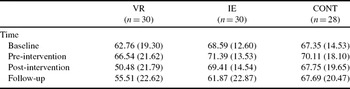
Effect of VR vs. IE on thought ratings. To examine within-group changes in negative response over time, a 4 (time; Baseline, Pre-intervention, Post-intervention, Follow-up) × 3 (group; VR, IE, CONT) mixed between and within-Ss ANOVA was conducted on the negative response indices. Means and standard deviations are reported in Table 1. Post hoc analyses using Fisher's Protected Tests (Cohen and Cohen, Reference Cohen and Cohen1983) were conducted. In this procedure, tests of simple main effects are conducted using the same alpha level used to determine the significance of the main effect or interaction. For significant time by group interactions, we conducted post hoc analyses to determine whether there were immediate (within-group change from pre-intervention to post-intervention) and/or long-term (within-group change from baseline to follow-up) effects of the intervention.
Aggregated negative appraisal ratings for contamination-related thoughts – Study 1

Note. Standard deviations are in parentheses. VR = Verbal Repetition; IE = Imaginal Exposure; CONT = No Intervention.
There was a main effect of time, F (3, 83) = 13.55, p < .001, qualified by a significant time by group interaction, F (3, 83) = 3.94, p = .01. To determine the changes in ratings across time for each group, post hoc analyses comparing pre-intervention to post-intervention and baseline to follow-up indices within each group were conducted. For the VR group, there was a significant decrease in ratings pre- to post-intervention [F (1, 85) = 41.47, p < .001] and from baseline to follow-up, [F (1, 85) = 7.71, p < .01]. For the IE group, there was no change in ratings from pre-intervention to post-intervention [F (1, 85) = .63, p = .43]; however, there was a significant decrease in ratings from baseline to follow-up [F (1, 85) = 6.62, p < .05]. For CONT participants, there were no significant changes in ratings (all Fs < .85, ps >. 35).
To determine if there were significant differences between groups, post hoc analyses comparing the change in ratings across groups were conducted. The change in ratings pre- to post-intervention was greater for the VR group than the IE group [F (1, 85) = 15.07, p < .001], but the change in ratings from baseline to follow-up were equivalent for the two groups [F (1, 85) = 1.25, p = .27]. The VR group showed a significantly greater decrease in ratings than did the CONT group at both pre- to post intervention [F (1, 85) = 12.10, p = .001], and baseline to follow-up [F (1, 85) = 4.42, p < .05]. The change in ratings was the same for the IE and CONT groups from pre-to post-intervention [F (1, 85) = .11, p = .74] and baseline to follow-up [F (1, 85) = 1.01, p = .32].
These data suggested that VR was significantly more effective than either IE or CONT in the immediate reduction of negative appraisals of contamination-related thoughts, and VR participants had a less negative response at follow-up than CONT participants. Contrary to hypotheses, VR did not produce a less negative response to thoughts at follow-up than IE. Also contrary to our hypotheses, we did not find a semantic satiation effect for VR using a CMDT task.
Study 1: Discussion
Our hypotheses were not fully supported in that VR did not result in a greater reduction in negative response to the thought at follow-up than IE, and that there was no evidence of semantic satiation. However, it is possible that the single dose intervention conducted only in the lab was insufficient to effect lasting changes. Perhaps differences would emerge if participants practised the intervention daily. Furthermore, we were interested in assessing the impact of VR and IE on a broader range of metacognitive appraisals, and also on factors other than cognitive appraisal and distress. If VR results in acceptance of negative thoughts, thereby obviating the need for defensive behaviours, we may see a differential change in experiential avoidance of the thoughts, as well as in the nature and frequency of overt defensive responses to the thought. Finally, we wondered if the CMDT task we used included too many trials, leading to fatigue, and too few contamination target items, such that category membership decisions were a product of rehearsal and possibly obscuring a semantic satiation effect.
Study 2
Study 2 was conducted to address the shortcomings of Study 1, as noted above. The same general paradigm was used, but this time participants also completed measures assessing a broader range of negative appraisal of their contamination thoughts, including responsibility, thought-action fusion, and control appraisals; these types of appraisals are implicated in the development and persistence of OCD. Furthermore, participants completed measures assessing behavioural responses to the thought (vigilance and avoidance). The CMDT task was altered to include more target items on contamination trials, and we omitted the “automobile” trials from Study 1 to reduce the total number of trials. We also had concerns about the validity of the single-item rating used previously to assess participants’ perceptions of the credibility of their intervention, so we included a validated measure of treatment credibility (TEI-SF) as an additional credibility measure. We hypothesized that: 1) VR, but not IE, would result in semantic satiation; 2) VR would result in a greater decrease in negative appraisal and distress than would IE; 3) the VR group would report less negative appraisal as well as less experiential and behavioural avoidance of the thought.
Study 2: Method
Participants
Participants in this study were 134 nonclinical individuals (n = 88 women, n = 46 men) with a mean age of 19.33 years (SD = 1.80).
Measures
Interpretation of Intrusions Inventory (III; Obsessive-Compulsive Cognitions Working Group, 2001). The III is a 31-item self-report measure that assesses three dimensions of appraisal of intrusive thoughts, including the importance of thoughts, the perceived responsibility for having these thoughts, and control of thoughts. The III has been shown to have good reliability and convergent validity (OCCWG, 2001). Participants rated each of the 31 items on a 100-point scale of beliefs (0 = I did not believe this idea at all to 100 = I was completely convinced this idea was true). For the data analysis for the present study, the 100-point scale was transformed to a 10-point scale.
Acceptance and Action Questionnaire (AAQ; Hayes et al., Reference Hayes, Strosahl, Wilson, Pistorello, Polusny, Dykstra, Batten, Bergan, Stewart, Zvolensky, Eifert, Bond, Forsyth, Karekla and McCurry2004). The AAQ is a 9-item self-report measure of experiential avoidance, or the tendency to avoid unwanted internal experiences. Items are rated on a 7-point scale (1 = never true to 7 = always true) and include statements such as “Anxiety is bad” and “I'm not afraid of my feelings”. The AAQ has been found to have adequate internal consistency, as well asadequate convergent, discriminant, and concurrent validity (Hayes et al., Reference Hayes, Strosahl, Wilson, Pistorello, Polusny, Dykstra, Batten, Bergan, Stewart, Zvolensky, Eifert, Bond, Forsyth, Karekla and McCurry2004).
Treatment Evaluation Inventory-Short Form (TEI-SF; Kelley, Heffer, Gresham and Elliott, Reference Kelley, Heffer, Gresham and Elliott1989). The TEI-SF is a self-report measure of the acceptability of a given treatment that asks participants to rate their agreement with items such as “I believe this treatment is likely to be effective.” The 7 items on the TEI-SF were rated using a 5-point scale (1 = strongly disagree to 5 = strongly agree). The TEI-SF has been found to have good internal consistency and construct validity (Kelley et al., Reference Kelley, Heffer, Gresham and Elliott1989).
Vigilance and Avoidance Questionnaire (VAQ; Purdon and Watson, under development). This is a self-report measure we created to assess both the increased awareness of obsessive thoughts and the control/neutralization/avoidance strategies that individuals with OCD engage in when experiencing these thoughts. This measure consists of 20 items rated using a 7-point scale (1 = never to 7 = always) and included three types of behaviours: i) avoidance of thoughts or situations (e.g. “I avoid thinking of things that might trigger the obsession”), ii) monitoring of thoughts or behaviours (e.g. “I monitor my thoughts to see if I'm in danger of having the obsession”), and iii) neutralizing acts (e.g. “I do certain activities in order to keep the obsession from entering my mind”). Participants were asked to rate the items with regard to their most distressing self-identified contamination-related thought. The internal consistency reliability (Crohnbach's alpha) of the VAQ was found to be .94. In addition, in the present study, VAQ total scores were positively related to both PI-WSUR total scores (r = .31; p < .01) and III total scores (r = .70; p < .001), suggesting convergent validity with well-validated self-report measures of obsessive-compulsive phenomena.
Procedure
Participants completed the AAQ, VAQ, III, TEI-SF, and then the same procedures used in Study 1 were conducted. On the CMDT task, six additional target items were added to the “contamination” trials; in addition, the “automobile” trial block was removed to shorten the length of the task. At the end of the first session, VR and IE participants were given instructions to practise their intervention once each day, for a period of approximately 5 minutes, using their intervention once for each of their three identified thoughts. Participants were asked to register online each day after completing their intervention practice. Upon return to the lab at one-week follow-up, the AAQ, VAQ, III, and TEI-SF were re-administered.
Study 2: Results
Participant characteristics
Sixty-six percent of VR participants (n = 29), 82% of IE participants (n = 37) and 76% of CONT participants (n = 34) returned for the follow-up session [χ2 (2) = 3.16, p = .21]. As there were no significant differences between participants who returned for the follow-up session and participants who did not return (all ts < 1.38, ps > .069), all subsequent analyses were conducted using only participants who attended both sessions.
There were no differences between groups in regards to gender, age, PANAS scores [F (2, 97) = .72, p = .49; overall positive affect M = 25.83, SD = 6.33; F (2, 97) = 2.40, p = .10; overall negative affect M = 13.68, SD = 3.56], PI-WSUR total scores [F (2, 97) = .77, p = .49; overall M = 48.71, SD = 22.47] or PI-WSUR contamination subscale scores [F (2, 97) = .80, p = .46; overall M = 19.49, SD = 7.16]. In addition, VR participants and IE participants reported practicing their intervention during the week equally [VR M = 5.68, SD = 1.73 versus IE M = 5.76, SD = 1.81; t (38) = −.14, p = .89].
CMDT task
On neutral trials for the VR group there were significant main effects of number of repetitions [F (1, 44) = 15.24, p < .001], and decision type [F (1, 44) = 157.88, p < .001], but, contrary to hypotheses, we again found no decision type by number of repetitions interaction [F (1, 44) = .24, p = .62]. In contrast, during the contamination items trials, there was a significant main effect of number of repetitions [F (1, 44) = 6.60, p = .01], qualified by a decision type by number of repetitions interaction [F (1, 44) = 4.99, p < .05]. Post hoc analyses indicated that VR participants were significantly slower to make member decisions following 30 repetitions (M = 839.78, SD = 295.91) than following 3 repetitions [M = 784.87, SD = 269.04; t (45) = −3.15 p < .01], whereas there was no difference in response time for nonmember decisions following 3 repetitions (M = 818.71, SD = 274.95) and 30 repetitions [M = 822.55, SD = 253.05; t (45) = −.22, p = .82]. Thus, a semantic satiation effect was observed for this block of trials. For the IE group, there were significant main effects of trial length (all Fs > 69.13, ps < .001), and main effects of decision type (all Fs > 5.19, ps < .05), but, as hypothesized, there were no decision type by imagining length interactions on any blocks of trials (all Fs < .50, ps > .47), indicating no semantic satiation effects.
Effects of the interventions
Preliminary analyses. Again, there were moderate correlations between the three dimension ratings for each thought at baseline (r's range from .26 to .44), and to simplify data analyses, a “negative response index” was calculated by averaging the three ratings across the three thoughts at each time point. There were no significant differences between VR, IE, and CONT groups in regards to baseline appraisal ratings [F (2, 99) = .84, p = .43] or pre-intervention appraisal ratings [F (2, 99) = 1.00, p = .37], indicating equivalency of groups prior to intervention.
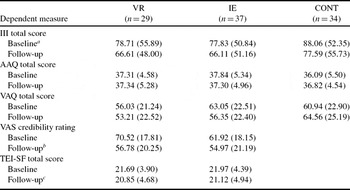
Analysis of the single-item intervention credibility rating indicated that, as in Study 1, the VR rationale was rated as more credible (M = 70.52, SD = 17.81) than the IE rationale [M = 61.92, SD = 18.15; t (64) = 1.93, p = .06]. However, there was no difference in TEI-SF scores in the VR (M = 21.69, SD = 3.90) and IE participants [M = 21.97, SD = 4.39; t (64) = −.27, p = .79]. At follow-up, the VAS credibility rating of VR participants (M = 56.78, SD = 20.25) was not different from that of IE participants [M = 54.97, SD = 21.19; t (58) = .34, p = .74], nor was the TEI-SF total score for VR (M = 20.85, SD = 4.68) versus IE [M = 21.12, SD = 4.94; t (58) = −.22, p = .83]. Given the greater reliability of the validated measure, we concluded that there were no differences in the credibility of the rationale. However, to determine whether changes in negative responses were related to the credibility ratings, a series of 2 (time; Pre-intervention, Post-intervention) by 2 (group; VR, IE) repeated measures ANOVAs were conducted, first with participants’ single-item VAS credibility ratings entered as a covariate, and again with participants’ TEI-SF total score entered separately as a covariate. Each of the time by group interactions remained statistically significant after controlling for participants’ credibility ratings (all Fs > 6.34, ps <.05).
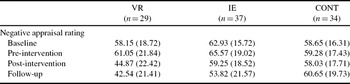
Effect of VR vs. IE on thought ratings. Means and standard deviations of the negative response indices are reported in Table 2. A 2 (time; baseline to pre-intervention) X 2 (group; VR vs IE) ANOVA revealed no main effect of time [F (1, 97) = .97, p = .32] or group [F (2, 97) = .93, p = .40], and no time by group interaction [F (2, 97) = .84, p = .43], evidence that the CMDT task did not produce significant changes in appraisal ratings. A 4 (time; Baseline, Pre-intervention, Post-intervention, Follow-up) x 3 (group; VR, IE, CONT) mixed within and between-Ss ANOVA revealed a main effect of time [F (3, 95) = 19.83, p < .001], qualified by a significant time by group interaction [F (3, 95) = 6.23, p < .001]. Post hoc analyses examining changes across time within each group indicated that the VR group had a significant decrease in ratings from pre-intervention to post-intervention [F (1, 97) = 65.66, p < .001] and from baseline to follow-up [F (1, 97) = 32.56, p < .001]. For IE participants, there was a significant change in ratings from pre-intervention to post-intervention [F (1, 97) = 12.78, p < .001] and from baseline to follow-up [F (1, 97) = 14.15, p < .001]. For CONT participants, there were no significant changes in ratings (all Fs <.64, ps >.42).
Aggregated negative appraisal ratings for identified contamination-related thoughts – Study 2

Note. Standard deviations are in parentheses. VR = Verbal Repetition; IE = Imaginal Exposure; CONT = No Intervention.
Post hoc analyses were conducted to determine if there were significant differences between groups in negative appraisal ratings at each time point. At post-intervention, the VR group had significantly lower ratings than the IE group [F (1, 97) = 9.64, p < .01] and the CONT group [F (1, 97) = 7.14, p < .01]. The VR group also had lower ratings at follow-up than the IE group [F (1, 97) = 4.73, p < .05] and the CONT group [F (1, 97) = 11.74, p = .001]. The IE and CONT groups did not differ at post-intervention [F (1, 97) = .07, p = .79] nor at follow-up [F (1, 97) = 1.89, p = .17].
Did the change in negative appraisal ratings correlate with degree of semantic satiation? For VR participants, contrary to hypotheses, there was no relationship between semantic satiation scores on contamination CMDT items and post-intervention or follow-up ratings (all rs < −.23; ps >.26).
Effect of VR vs. IE on general appraisal and avoidance. To determine the effect of VR and IE on changes in metacognitive appraisals, experiential avoidance, and overt avoidance, a series of 2 (time; baseline, follow-up) by 3 (group; VR, IE, CONT) repeated measures ANOVAs were conducted on the III, AAQ, and VAQ total scores. Means and standard deviations are reported in Table 3. There was a significant main effect of time on III scores, such that scores decreased from baseline (M = 81.59, SD = 52.49) to follow-up [M = 70.19, SD = 51.68; F (1, 96) = 18.20, p < .001]. However, there was no effect of group [F (2, 96) = .49, p = .62] nor a time by group interaction [F (2, 96) = .03, p = .97], indicating that each intervention group experienced a similar reduction in ratings.
Means and standard deviations of III scores, AAQ scores, VAQ scores, single-item VAS credibility rating, and TEI-SF scores – Study 2

Note. a. VR n = 28; b. VR n = 27, IE n = 33; c. VR n = 27, IE n = 33
VR = Verbal Repetition; IE = Imaginal Exposure; CONT = No Intervention; III = Interpretations of Intrusions Inventory; AAQ = Acceptance and Action Questionnaire; VAQ = Vigilance and Avoidance Questionnaire; VAS = Visual Analog Scale; TEI-SF = Treatment Evaluation Inventory – Short Form. Standard deviations are in parentheses.
Examination of the change in AAQ scores over time revealed no significant main effects or interactions (all Fs <.82, ps >.44). Examination of change in VAQ scores revealed no main effect of time [F (1, 97) = 1.46, p = .23] or group [F (2, 97) = 1.15, p = .32]. However, there was a significant time by group interaction [F (2, 97) = 3.62, p <.05]. Post hoc analyses revealed a significant decrease in scores from baseline to follow-up for the IE group [F (1, 97) = 6.31, p <.05] but not for the VR group [F (1, 97) = .88, p = .35], or the CONT group [F (1, 97) = 1.69, p = .20].
Study 2: Discussion
VR was found to be significantly more effective than IE and CONT in reducing negative appraisals at post-intervention and one-week follow-up, providing support for our hypotheses. Unexpectedly, all groups reported a similar change in general metacognitive appraisals one week later, and only IE participants reported a decrease in strategies to avoid or control obsessive thoughts following intervention; these findings are difficult to interpret and need to be replicated.
As in Study 1, we found that the VR rationale was rated significantly higher than the IE rationale, using a one-item VAS rating. However, no differences in perceived credibility of the VR and IE rationale was found on the TEI-SF, a more sophisticated measure of treatment credibility. This suggests that differences were not likely to be due solely to a differential impact of the intervention rationale on VR and IE participants.
Fewer VR participants returned for the follow-up session, although the difference between intervention groups was not statistically significant. It is possible though that had an “intention-to-treat” data analysis strategy been employed, the observed differences between intervention groups might have been reduced or eliminated.
General discussion
The first purpose of the studies was to determine the relative merits of VR vs. IE in reducing negative responses to contamination thoughts typical of those experienced by people with OCD. It was hypothesized that VR would result in a greater decrease in negative response to contamination relevant thoughts than would IE, due to the effect of exposure plus the dilution of semantic meaning. The support for this hypothesis was mixed. In Study 1, although VR resulted in a greater immediate decrease in negative appraisal ratings, the ratings at follow-up were equivalent to the decrease observed in the IE group. Contrary to hypothesis, there was no evidence that VR resulted in semantic satiation of the contamination thought. It was therefore not possible to determine whether or not the decrease in negative response in the VR group was associated with semantic satiation.
In Study 2, in which IE and VR were practised about 5 out of 7 days between post-intervention and follow-up, we found that VR was associated with a greater decrease in negative appraisal ratings (believability, meaningfulness and distress) at both post-intervention and follow-up than was IE or no intervention. There was also evidence that VR led to semantic satiation of the contamination thought in the CMDT task. However, degree of semantic satiation was not associated with the observed decrease in negative response to the thought. Furthermore, decreases in appraisals of responsibility, control and importance of thoughts were equal across groups, and there was no change in experiential avoidance. Scores on the measure of behavioural avoidance and thought vigilance decreased from baseline to follow-up for the IE group, but not the VR group.
Thus, VR, but not IE, resulted in semantic satiation of the contamination thought when the overall number of trials was reduced and the number of target words increased. However, an alternative explanation for this difference could relate to the fact that participants in the IE condition of the CDMT task were free to choose their own “contamination” scene, whereas all VR participants repeated the word “contamination”.
When practised on an almost daily basis, VR also appeared to be associated with a less negative response to specific contamination thoughts, but not with changes in metacognition, experiential avoidance, or other forms of defensive behaviour, such as overt avoidance of thought triggers. IE, on the other hand, was associated with a decrease in avoidance of thoughts and thought triggers, as well as thought vigilance. VR's emphasis on reducing the perceived meaningfulness of anxiety-provoking words is similar to another recently developed technique for reducing obsessive thoughts, termed “association splitting” (Moritz, Jelinek, Klinge and Naber, Reference Moritz, Jelinek, Klinge and Naber2007). In this technique, individuals with OCD are taught to re-associate feared words (e.g. “cancer”) with more neutral but related words (e.g. “zodiac sign”). A recent examination of association splitting in a sample of individuals with OCD found that the technique significantly reduced OCD symptoms in 42% of participants (Moritz et al., Reference Moritz, Jelinek, Klinge and Naber2007). The present findings suggest that VR may have potential as a strategy for de-toxifying obsessional thoughts. Given that the satiation effect was not associated with its ameliorative effects and that the VR group showed no change in experiential avoidance or vigilance/avoidance of obsessional thoughts, nor any more change in metacognition than the other groups, the causal mechanism may simply be exposure to the thought, as opposed to metacognitive change and increased acceptance. Furthermore, the fact that VR during the CMDT task did not result in a change in thought ratings from baseline to pre-intervention in either study also suggests that, on its own, in the absence of a rationale and without practice, it may not have an ameliorative effect. That VR practice may be essential is suggested by the fact that its superior effect to IE was only observed in Study 2.
Why did VR have a superior effect on the thought response indices to IE and CONT in Study 2? First, the IE practice was conducted somewhat differently than traditional exposure, in that exposure was terminated after a certain time interval as opposed to when there had been a salient reduction in negative affect. Thus, habituation may have been more difficult to achieve. Second, it is possible that compliance with the instructions varied more in the IE group. In the VR group, compliance with instructions was readily observable as the words had to be repeated aloud. The IE group, though, could continue to avoid the feared words, either by not imagining them at all, by omitting anxiety-evoking details from their images, or by keeping their images vague and distant. Unfortunately, participants were not asked to report on how vividly they imagined the words, so it is not possible to determine compliance. However, IE was associated with a decrease in vigilance/avoidance of the contamination thought. Perhaps people feared having thoughts less after being required to deliberately conjure them, even if they still found them distressing, meaningful and believable.
Another possibility is that the thought ratings were heavily influenced by the demand characteristics of the rationale for the intervention participants heard. However, if this were solely the explanation, the addition of having participants practise the intervention in Study 2 should not have yielded different results, nor would we have expected VR to have a superior effect, given that the credibility of the rationale was equal and unrelated to changes in the dependent measures.
One puzzling finding was that the semantic satiation effect demonstrated by Smith (Reference Smith1984) with neutral items was not replicated in the present studies. In Study 1, we reasoned that we had simply included too many trials so that boredom and fatigue may have affected response times. However, we should have seen satiation in response to neutral words in Study 2. Why this robust finding was not replicated in our study is unknown, given that our paradigm was derived straight from Smith (Reference Smith1984) and given that the semantic satiation effect was observed with contamination words.
As a means of potentially de-toxifying obsessive thoughts, VR is easy to administer and perform, particularly when compared to the demands of cognitive restructuring. The treatment rationale was also rated as quite credible, at least by this nonclinical sample. However, this study was unable to identify the mechanism by which it effects change. It is important to note that the ameliorative effect was exclusive to specific appraisals of the thoughts being repeated, and not to more general appraisals and other defensive responses to the thought. Perhaps continued practice over a greater time period would yield such changes. Overall, more research on VR's causal mechanisms, and the utility of VR in a clinical sample of individuals with OCD, appears warranted.



Comments
No Comments have been published for this article.