Beijing's Long-Term Educational Strategies in Xinjiang
Muslim minorities in China's Xinjiang Uyghur Autonomous Region, especially the Uyghurs, have received increasing attention from scholars because they are “one of the most politically sensitive minorities among which there exists a strong aspiration for independence from China.”Footnote 1 Over the past decade or so, driven by the rising demand for skilled labour under the “open up the west” development programme (xibu dakaifa 西部大开发) as well as the heightened sensitivity over issues of social stability and security in Xinjiang, the Chinese government has begun to rethink its ethnic integration strategies and devise cultural and educational policies to ease inter-ethnic tensions.Footnote 2 In 2000, the government launched a boarding school project aimed at ethnic minorities in Xinjiang, termed the Neidi Xinjiang gaozhong ban 内地新疆高中班 (hereafter, Xinjiangban 新疆班). The project is the brainchild of the Ministry of Education (MOE), and its primary motive is to provide high-achieving junior secondary school graduates in Xinjiang, mostly Uyghurs, with access to senior secondary schools (gaozhong 高中) in predominately Han cities in China. Unlike the infamous nation-building experiments with boarding schools for indigenous people in Australia, Canada and the United States, the Xinjiangban programme appears to be gaining in popularity.Footnote 3 Over the past 15 years, the Xinjiangban network has spread to encompass 93 schools cross 45 inland cities. In 2015, there were more than 34,000 incumbent pupils and nearly 43,000 graduates. As Yangbin Chen points out, the policy has far-reaching implications for Uyghur–Han inter-ethnic relations in China.Footnote 4
The significant development of the Xinjiangban has attracted the attention of both domestic and international scholars. Not surprisingly, most research produced in domestic China simply reproduces state propaganda and contends that the policy is rational and legitimate.Footnote 5 Arguing to the contrary, a limited but growing number of studies published in English have reviewed the policy from the angle of students’ experiences. Chen examines a Xinjiangban in terms of social capital, arguing that Uyghur students play active roles in negotiating the agenda of ethnic integration designed by the state.Footnote 6 Timothy Grose has conducted a study on language use and the future plans of college students who have graduated from the Xinjiangban; he suggests that the Xinjiangban fails to enhance ethnic unity.Footnote 7 From a different perspective but in a comparable gist, Chen argues that interactions between Uyghur students and local Han students give rise to negative stereotypes and feelings.Footnote 8 More recently, Chen has attempted to unpack the diversity among Uyghur youth, which has evidenced intra-ethnic discrimination among Uyghur students in universities.Footnote 9 Moreover, Grose takes note of the revival of Islamic identity among Uyghur students during their university years and argues that, in contrast to the expectation of the state, the Xinjiangban is not capable of weakening students’ religious identity.Footnote 10
Although the number of studies on the Xinjiangban is increasing, the current research, both in Chinese and English, largely focuses on the interplays between the institutionalized authority of the state agenda and the responses of Uyghur students. However, interactions between Uyghur students, teachers, local Han students and other ethnic minority students are understudied. Moreover, the English scholarship tends to regard the policy as seamless, given and static, while ignoring the dynamics of the ongoing reproduction and reinvention of the policy within China's social and political hierarchies. This has resulted in a dearth of studies on the dynamics of policy implementation across various levels of government. There has also been insufficient attention paid to the spatial dimension of the Xinjiangban. This paper, however, argues for the importance of spatial implications. The school is a space where multicultural encounters occur. School spaces are not passive containers of everyday routines and interactions. The specific spatial–temporal configurations of the schools are actually intended to enact the norms and rules inherent to the policy. This paper argues that space shapes the everyday politics of Xinjiangban and plays an active role in structuring and conditioning multi-ethnic interactions.
Building on the ideas of “space of prescription” and “space of negotiation,” adopted from Jonathan Murdoch's work, this paper attempts to elaborate the local ecology of the Xinjiangban. We first examine the interpretation and implementation of the policy across China's political hierarchy, which spans from the central to the local. We continue by exploring how school spaces are constructed as spaces of prescription, where dominant norms and rules are recurrently reiterated, reinstituted and re-asserted. Finally, the paper investigates Xinjiang students’ responses to the prescriptions. We place a specific emphasis on the space–time strategies that Xinjiang students utilize to navigate and negotiate the dominant prescriptions.
Space and the Politics of Prescription and Negotiation
The sociological knowledge on social capital and social networks has been a source of theoretical inspiration for the study of the Xinjiangban. In his widely cited work, Chen introduces the concept of bonding social capital to examine the way in which Uyghur identity is reconstructed and reinforced in everyday schooling.Footnote 11 However, a few areas worthy of interest have been overlooked in the existing studies of the Xinjiangban. First, the analyses tend to take structural factors such as political hierarchy and power configuration as pre-existing and static. Yet, the Xinjiangban policy is not carried out locally in coherent and consistent ways, and thus should be re-measured in terms of its actual implementation at various levels of government. Second, the Uyghur–Han dichotomy has dominated this line of inquiry, and few studies have discussed the local dynamics of the Xinjiangban with foci not only on Han and Uyghur but also on the other ethnic minorities involved. Third, space, which has long been regarded as a passive setting for social life and interactions, is now understood by social scientists to be an active medium of social (re)production.Footnote 12 For instance, in his reading of the dialectics of time, space and being, Edward Soja argues that the production of spatiality, in conjunction with the making of history, can be described as both the medium and the outcome, the presupposition and the embodiment, of social relationships.Footnote 13 Spatiality – that is, the constellation of material and contextual conditions whose changes are embedded in social processes – is integral to the interrogation of social life.Footnote 14 Within the sociology of education, where the bulk of the literature on the Xinjiangban is anchored, Susan Robertson has argued for the necessity of “spatializing” the sociological research of education.Footnote 15 Although there has been critical thinking about space among sociologists, and, as mentioned above, the Xinjiangban has distinctive spatial implications, there has to date been no systematic research done on the implementation of the policy with an explicit spatial reference.
Given the importance conferred to spatiality in this study, the article engages with Jonathan Murdoch's thesis of space that draws from the actor–network theory (hereafter, ANT) to offer the conceptualizations of spaces of prescription and spaces of negotiation.Footnote 16 Ontologically, the ANT sees agency lying with multiple human and non-human elements and explores the ways in which heterogeneous elements are enrolled and assembled in a network.Footnote 17 Murdoch goes on to argue that a network can be understood in terms of translation – the processes of negotiation, representation and displacement across actors, entities and spaces within a network, from which politics emerges.Footnote 18 In this vein, the space of prescription refers to the network where translations are perfectly accomplished. In spaces of prescription, entities have a predilection to conform to specific rules, norms and codes laid down by centrally placed actors. In this study, the space of prescription is where the dominant ideas and discourses of ethnicity are institutionalized and concretized by variegated practices of policy implementation. Spaces of negotiation, in contrast, are sites of “alternative ordering,” where resistance, uncertainty and unpredictable ideas and behaviour are made possible by less empowered actors.Footnote 19 Even the most formalized and regulated space of prescription is open to negotiation, which means that the boundary between the space of prescription and the space of negotiation is fluid rather than rigid.Footnote 20
In the case of the Xinjiangban, prescription is tantamount to processes in which policy implementers seek to shape and define the dispositions and behaviour of policy recipients.Footnote 21 Policy implementers are principally those in charge of the implementation of the Xinjiangban policy at local levels, including officials from the municipal government, school administrators and teachers. Policy recipients are those who are at the receiving end of the policy, primarily Xinjiang students but also local Han students. Negotiation is the process by which policy recipients comply with, negotiate, and in some cases, subvert the prescriptions enacted by policy implementers.
Prescription and negotiation are means to act within a space. Tara Fenwick and Richard Edwards reflect on the relationship between space and the ANT, arguing that educational spaces can be understood in terms of a multiplicity of entities and the multiple networks of relations emerging amidst them. Space is enlivened not only by humans but also by non-human entities.Footnote 22 Drawing from Fenwick and Edwards, we argue that all entities that add to and construct the experiences of everyday schooling, including administrators, teachers, students, desks, textbooks, propaganda banners, spatial arrangements in the classroom and even the layout of the campus, are exercising agency in one way or another and remake educational spaces with specific meanings.Footnote 23
Based on this framework, this study attempts to elaborate on the politics of prescription and negotiation among various actors within the network of state education programmes. Specifically, we probe into the capabilities of policy implementers and recipients in arranging and structuring spaces and practices in everyday schooling. The space–time contingencies in a local Xinjiangban are teased out to examine the dialectics between spaces of prescription and negotiation. Notably, we not only examine the interplays of state education and the agency of Uyghur students, as most existing studies have done, but we also take into account the multiple relations among Uyghur, Han and other ethnic groups in the Xinjiangban.
Research Methods
The accessibility of Xinjiangban schools has long been a limitation for researchers. Until now, Chen has been the only author to carry out an in-depth ethnography of a Xinjiangban. Grose collected data from university students who had graduated from the programme. The majority of existing studies, however, are based on second-hand data. Our paper is based on nearly four years of follow-up study of a Xinjiangban. One of the authors (hereafter, the researcher) has been a teaching assistant in a Xinjiangban since 2012. The school in our study is located in one of the richest cities in southern China and is known for its high performance in the public educational system. It hosts around 300 Xinjiangban students and more than 2,000 local Han students. Unlike the Xinjiangban students in Chen's studies, who were isolated from local students, the Xinjiangban students attending the studied school undergo a one-year preparatory class and then enrol on a three-year standard programme in ethnically mixed classes with local Han students, making multicultural encounters an everyday norm. It is worth noting that this policy of mixing Xinjiang students and local Han students together in one class has gradually been adopted nationwide with the aim of enhancing inter-ethnic interactions.
By participating in the teaching and management of the Xinjiangban, the researcher was able to make close and detailed observations. Conversing in the Uyghur language with Xinjiang students helped him to establish a rapport and build mutual trust with students. Apart from participant observation, the data shown in this paper also draw from 32 in-depth interviews and six focus group discussions involving Xinjiang students, teachers and school administrators that took place between 2012 and 2014. In line with the campus rules on language, all interviews were conducted in Mandarin.
Consideration has been given to the balance of the socio-demographic profiles of the informants. In terms of ethnicity, Uyghur students account for more than 70 per cent of the Xinjiang students and Kazakh students account for 15 per cent; other ethnic groups such as Han, Hui, Kyrgyz and Tajik make up the remaining 15 per cent. Although the Uyghurs are the majority group in the Xinjiangban, this paper also presents the views and practices of other minority students, including Kazakh, Kyrgyz and Hui, among others.Footnote 24 The ratio of male to female informants is 60 per cent to 40 per cent, which reflects the gender ratio of the studied Xinjiangban. Because the researcher is male, information about how female students behaved in their dormitories was gathered exclusively through interviews instead of observation. All names, including those of the school and the informants, are either anonymized or presented as pseudonyms.
In addition, the researcher collected all relevant policy documents (including various opinions, regulations and by-laws instituted by various political entities), and teaching materials such as textbooks, students’ weekly ideological reports, teachers’ working logs, and so forth. Furthermore, the researcher paid specific attention to the spatial settings of the school, aiming to unpack the constitutive role of space in the everyday politics of the Xinjiangban.
Cultivating Loyal Subjects: Translation of Norms and the Construction of the Space of Prescription in the Xinjiangban
From central to local: the production of the dominant norms in the Xinjiangban
As Murdoch argues, spaces of prescription are capable of persuading entities to behave in line with the norms and scripts inscribed and defined by those with centralized authority.Footnote 25 For the Xinjiangban, there is no doubt that the deployment of all resources, including teaching materials, finance and personnel, is arranged according to the policy implementers’ interpretation of the prescriptions of the policies. In this section, we investigate the ways in which policy implementers mobilize symbolic and material resources in implementing and concretizing the policy.
According to the numerous notices and instructions issued by the central government, the Xinjiangban aims not only to cultivate a group of professionals who can serve the “open up the west” development programme but also to educate qualified patriots to distance themselves from separatist and religious extremist elements in Xinjiang. Very little detailed guidance on the methods of implementation has been given though, apart from the instruction that “all Xinjiangban students, regardless of ethnicity, are mixed together and taught in Chinese.” From the outset, gaining modern professional skills and know-how and nurturing patriotism have been the key “prescriptions” imparted to the students participating in the programme. Ethnic integration is evidently a Xinjiangban policy priority, as demonstrated by the insistence that students from different ethnic backgrounds mix together.
During the process of implementation, the management of expressions of ethnicity is essential to the making of prescriptions at the local level. Since the provinces and municipalities receiving Xinjiang students are not located in areas with concentrated ethnic minority populations, there is little local experience of dealing with ethnic issues. The Xinjiangban programme is a top–down assignment from the central government, which local political entities are forced to translate and respond to. In the province where our research was conducted, there are two provincial-level policies and one municipal-level policy devised for localization. The provincial policies reproduce the political rhetoric of the central government, stating that the Xinjiangban programme is a “glorious and important political task.” However, unlike the provincial-level translation, the “action plan” issued by the municipal government interprets the Xinjiangban as a “glorious but arduous political task” (emphasis added). As the policy implementer working at the coalface, the municipal government has to deal with the challenges of assembling financial resources, personnel, spaces, etc., in order to turn the policies into reality. According to the action plan, it is essential to “keep in mind that ethnicity and religion are non-trivial issues. And we need to hold strong political sensitivity in this matter.” In this sense, local policy implementers tend to highlight political sensitiveness and pressure. Consequently, policy implementers work prudently to avoid any political risk. The policy was localized by a work team led by the deputy mayor – the high-profile leadership was intended to ensure the effectiveness of implementation.
As the MOE does not specify how to manage the Xinjiangban on a daily basis, the policy leaves space for implementers to address issues in their own way.Footnote 26 The principal of the studied school, also a key figure in the work team, interpreted the central tenet of the policy to be “to change the inherent ethnic and religious ideas in students’ minds.”Footnote 27 When considering the relationship between ethnic identity and the aim of cultivating “successors of socialism” (shehuizhuyi jiebanren 社会主义接班人), the principal asserted that “if a student has a strong feeling of his/her ethnicity, he/she must be inclined to his/her ethnic and religious groups. However, a successor of socialism must be a citizen who places his/her nation at the first place.”Footnote 28 In this vein, to transform ethnic minority students into adherents of the state, rather than those who prioritize their affinities to ethnicity and religion, has become the foremost task for the school. As one school administrator suggested,
For Xinjiangban students, ideological education takes precedence. Their safety comes second, and study comes last. The reason that the government has paid such a large amount of money to fund them is to foster citizens who are thankful to the CCP (dui (gongchan) dang xincun ganen 对 (共产) 党心存感恩).Footnote 29
Consequently, highlighting students’ national identity and downplaying the ethnic dimension of their self-identity have become the dominant prescriptions of schooling at the local level. In the following sections, we discuss how various entities, human and non-human alike, contribute to the construction of spaces of prescription in the cultural politics of the Xinjiangban.
Curricula, textbooks and everyday schooling
Curricula, the key resource when reproducing the prescriptions set down by policies, are at the heart of schooling. The dissemination of national culture, as noted by He Baogang, is closely associated with the spread of Han scripts (hanzi 汉字).Footnote 30 In the context of the Xinjiangban, Fei Yan and Geoff Whitty argue that Han scripts and Mandarin Chinese have been prioritized within its curricula.Footnote 31 In the compulsory education that spans four years, subjects such as Chinese, history, geography and politics are highlighted as important vehicles through which to perpetuate the perception of the “backwardness” of minorities and, simultaneously, the “modernity” of the country's heartland. For example, history textbooks use derisory terms like “barbarians” (manyi 蛮夷) to represent minorities’ ancestors. Moreover, political subjects prioritize the evangelizing of not only communist ideologies but also, more importantly, patriotism. Great emphasis is placed on the achievements and the legitimacy of the Chinese Communist Party. Moreover, atheism and Marxist dialectical materialism are upheld as the orthodoxies that a patriot should follow. This, of course, contradicts and upsets the Islamic identity of Muslim students. Resonating with Grose, patriotic education takes precedence over all other educational goals in the Xinjiangban.Footnote 32 Even more, according to the Semester Schedule of 2012–2013, an extra “hidden curriculum” was embedded within patriotic education. During a semester that lasted nearly five months, there were four general meetings and one lecture on ideological and patriotic education. In addition, a “to-be-a-patriot” class meeting was held in the middle of the semester; a patriotic song competition was arranged for Youth Day (4th May); and it was compulsory to watch China Central Television's daily news broadcasts. Through participating in such mundane daily activities, the students develop the discipline to practice and display political conformity, allowing the state to govern through daily participation.
Teachers are key actors who interpret and implement the policy in the everyday schooling of their pupils. As most teachers in the Xinjiangban are Han and few have had experience in teaching ethnic minority students, they tend to see students’ ethnicities and religious affinities as contradictory to ethnic unity. In an interview, a school administrator remarked,
The programme is to separate them [Uyghur students] from the influences of religion and ethnic bonding, which go against our ethnic unity.
The researcher: Do you think Uyghur ethnicity contradicts ethnic unity?
I don't know, but the terrors in Xinjiang are caused by the Uyghur Muslims, so I think that their ethnicity and Islamic belief does have something to do with the terrorism in ChinaFootnote 33
To some extent, the educators adhere to the seemingly pervasive stereotypes of Uyghurs and Muslims in China as dangerous trouble makers and separatists.Footnote 34 In this sense, the translations of dominant norms in school are profoundly shaped by the broader social context, transcending the spatial boundaries of the school. Consequently, most educators willingly align themselves with the state agenda of managing ethnic attachments and transforming minority students into loyal subjects.
Temporal–spatial arrangements of the school
In order to minimize inter-ethnic conflicts, the municipal government built an independent campus for the Xinjiangban. This gated campus is located beside the local Han students’ campus (hereafter, Han campus). All facilities, such as classrooms, dormitories and sport grounds, follow the same design as those on the Han campus, except for the Halal canteen. Not surprisingly, there is little representation of any Xinjiang culture within the landscape design of the Xinjiangban campus. Instead, the blackboards on the walls of the campus bear signs of propaganda promoting ethnic unity and patriotism. While there is an independent space for the Xinjiang students, students need to take classes on the Han campus with local Han students. In contrast, local students are not permitted to enter the Xinjiangban campus. All Xinjiangban students’ activities are confined to the campus. Hence, the gated campus is a carefully designed and coded space with strict boundary management being deployed to concretize the translations of the policy at the local level.
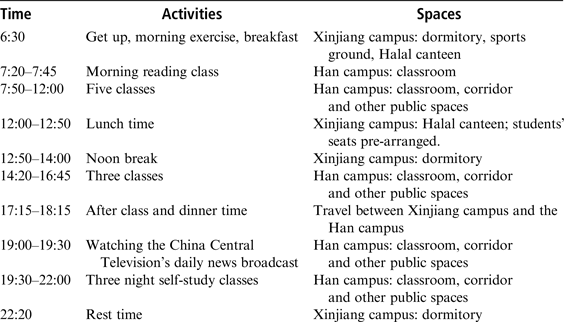
As with the spatial arrangements, management of the students themselves is military like. A highly organized space–time schedule is enforced to structure the everyday life of students (see Table 1). According to both students and teachers, student life on campus is closely controlled and monitored. Xinjiangban students are housed separately in two dormitory buildings. The Uyghur students are split up from each other intentionally and are mixed with other ethnic minority students like Russians, Mongols and Kazakhs. This prevents the Uyghur students from forming associations and obstructs the formation of ethnicity-based social ties. Meanwhile, the dorm supervisors, ethnic Uyghurs dispatched by the Department of Education in Xinjiang, live in the same buildings as the Xinjiangban students, providing guidance and maintaining everyday surveillance.
Temporal–Spatial Schedule of the Xinjiangban in the Studied School
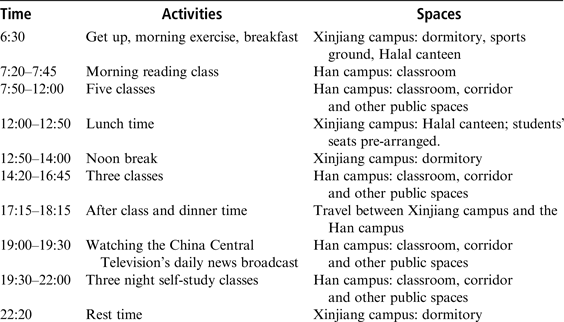
As shown by their daily schedule, the routines followed by the Xinjiang students and the spaces they move through are highly regulated. The daily schedule has been designed to leave no time–space affordances for students to do things which are regarded as controversial according to the prescriptions of the Xinjiangban education. For example, all students are required to get up at 6:30 am; yet, in order not to give Muslim students the chance to do morning prayers, the school forbids students to get up any earlier than 6:30 am. Special means of control are employed in dormitories to keep a check on students. Abu, a male Uyghur in grade one, recalled his experience in a sudden dormitory check:
The principal led a team to my dormitory. They said they had come for “prohibited items.” At that moment, I thought the “prohibited items” should be dangerous things like a knife. However, they tore down a poster which depicted a scene of a Uyghur community. Moreover, some calligraphy in the Uyghur language was also removed. They contended that these actions were taken to keep dormitories tidy and maintain a “standard” look.Footnote 35
From Abu's experience, it appears that the school administrators view items coded with ethnic culture as conflicting with school regulations. According to the “Rules for Xinjiang Students,” a copy of which was pinned to a wall in the Xinjiangban campus, any outward appearance of ethnicity and Islamic belief, such as a beard or a headscarf, is strictly prohibited. Furthermore, the only relief students are afforded from the confinements of the campus is during weekend shopping trips, which are for two hours only, once a month. During this outing, Xinjiangban students, accompanied by a teacher, board a school bus and head for a linear-shaped commercial pedestrianized street, deliberately selected so that surveillance can be conducted more easily. In sum, we argue that a space of prescription has been established in the Xinjiangban based on patriotism and ethnic integration and the subtle management of students’ ethnicities. Heterogeneous entities, including policies, teachers, spatial–temporal arrangements, etc. are assembled to serve a dominant pedagogy. In the next section, we look at the responses of various actors and how they negotiate this space of prescription.
Constructing Spaces of Negotiation in Response to the Dominant Prescriptions
Compliance as negotiation: aspirations for upward mobility
In this section, we explore the construction of spaces of negotiation in the Xinjiangban. As Murdoch argues, the space of prescription is never complete but always open to negotiation.Footnote 36 Spaces are constructed as a result of complex interactions between ordering, de-ordering and re-ordering. Likewise, Xinjiang students are active in negotiating and even resisting dominant prescriptions through their everyday practices. Specifically, we examine the interactions between Uyghur students and other actors (in this case, Han teachers, local Han students and other ethnic minority students in the Xinjiangban), and the space–time contingencies in which the interaction occurs.
Spaces of negotiation are constructed as alternate translations to dominant prescriptions. In the case of the Xinjiangban, we find that Xinjiangban students are inclined to interpret the policy in favour of individual career expectations and ethnic identity, rather than prioritizing the dominant prescriptions that reinforce state rationalities. They negotiate the policy in tune with three concerns: achieving upward social mobility, preserving ethnic culture and defending Islamic identity.
Space: a classroom on the Han campus
Time: a Chinese class
Today, I sit in Class 10, grade two, to join a Chinese class. The teacher taught ancient Chinese prose, which is one of the most challenging subjects for Xinjiangban students. What surprises me is all five Xinjiangban students in this class were active in raising and answering questions … The Chinese teacher asked, “How many ancient writings could represent the meaning of demotion?” A Xinjiangban student raised his hand immediately to win the chance to answer. Although this student spoke broken Chinese and did not give a perfect answer, the teacher and other Han students still listened patiently and applauded him (Field notes, March 2013).
Contrary to the intuitive view that minority students hold negative feelings towards state-led education in the Xinjiangban,Footnote 37 we find that most ethnic minority students have open-minded attitudes not only to the imparting of knowledge indifferent to ethnic differences but also to the rhetoric of patriotism and ethnic integration. Almost all interviewed Xinjiangban students recognized the significance of learning Chinese. In her weekly report, a female Uyghur student in grade one wrote, “this week, I took the first monthly exam. My Chinese is poor, so I really struggled in a writing test. The good news is that my Chinese is improving since I made friends with Wang Ying [a local Han student]. While talking with her, I force myself to speak Chinese. In this way, I can make progress.” The Xinjiang students have largely internalized the state discourse that claims that Han society is open and modern, eastern cities are more prosperous, and Xinjiang is blocked and backward. This has actually given them an incentive to maximize the utility of the education they receive on a daily basis. A Han student from Xinjiang wrote in his weekly report that “as a Han, I feel happy that my ethnic minority roommates could accept the Spring Festival. I thought they would keep a distance from this festival because of their religious and ethnic culture. But the reality is that they actively participated in making dumplings and other activities. Surprisingly, the New Year Scrolls (chunlian 春联) in our dormitory were bought by my Uyghur roommates.”
The students’ recollections of their original intentions when enrolling in the Xinjiangban help us to understand the quiescent conformity to prescriptions. In response to the question, “why did you choose to study in the Xinjiangban?”, the most common answer was that the Xinjiangban provides better facilities, more qualified teachers and better chances for a successful career in the future. According to a questionnaire survey of 150 Xinjiangban students conducted by the authors in 2012, more than 75.5 per cent of the Xinjiangban students in the studied school came from rural areas; 56.7 per cent were children of farmers and herdsmen; and 71 per cent came from less wealthy families whose annual household income was less than 10,000 yuan (US$1,516).Footnote 38 A “gain–risk” calculation determines the ways that students negotiate the prescriptions.Footnote 39 The calculation takes into consideration the benefits, which include having access to the alleged progressiveness of Han culture, gaining a competitive advantage in the market economy and landing a decent job, and the risks, which include the loss of labour for the household, separation from families and cultural communities, and fear of losing ethnic and religious identity. A female Uyghur student in a preparatory class confessed that,
I come from a peasant family. My parents fall ill often. To reduce the burdens of supporting my education, I desired the opportunity to study in the Xinjiangban. Simultaneously, the Xinjiangban is good for my future. I came here bearing the hopes of my whole family.Footnote 40
Removing students from their original communities and confining them within the campus are “spatial approaches” aimed at cultivating a labour force for the “open up the west” development programme and promoting inter-ethnic interactions. This kind of multi-ethnic encounter is a novel experience for many Xinjiangban students. Indeed, students in the Xinjiangban experience at first hand the cultural, economic and religious differences between the eastern coast and the west. Hence, many Xinjiangban students actually see the necessity of establishing social networks with Han Chinese. A female Kazakh student in grade two explained:
Studying here [in the Xinjiangban] gives me a clear and direct recognition of the differences in regional economic progress. I think learning here can provide a great chance for us to socialize with Han people, know their culture and ways of thinking and doing things. In this way, we can become middlemen connecting Xinjiang and the eastern provinces.Footnote 41
Moreover, students, who have already undergone lessons in patriotism in primary and junior secondary schools, are not particularly fazed by the patriotism promoted by the Xinjiangban. Compared to their former experiences, some students even believe that the patriotic education in the Xinjiangban is more relaxed than the indoctrination they received in Xinjiang. A male Uyghur student in grade one stated that “we were obliged to undergo too much patriotic education in Xinjiang. Sometimes, I even suspected that the primary goal of receiving education was to be patriotic. I think that patriotism is already in our minds. If schools pay too much attention to patriotism, we would feel stressed. Fortunately, the patriotic education here [in the Xinjiangban] is much milder than in Xinjiang.”Footnote 42 The students’ relaxed attitude towards their lessons in patriotism is formed based on a comparison with the rigorous and pervasive pedagogies in Xinjiang. In this sense, even though patriotism is central to the rigid prescriptions in everyday schooling, for most Xinjiang students, it becomes acceptable.
Furthermore, local Han students play positive roles in the Xinjiangban students’ adaptation to the spaces of prescriptions. Indeed, the exigency of ethnic integration is imposed not only on Xinjiangban students but also on local Han students. Local Han students in the school are also taught and expected to avoid ethnic conflict and to defend ethnic unity. In everyday inter-ethnic interactions, local Han students learn to be multicultural agents who understand their peers’ ethnic cultures and self-regulate their language, gesture, clothing and diet in the school to avoid conflict. We once observed a local Han student standing in the locker room at the back of the classroom eating some fried noodles bought from a non-Halal canteen for breakfast. Out of respect for his Muslim classmates, he had chosen to eat his food in a discrete place and manner. Likewise, most Han students try to avoid using words like “pig” and “theft” in the classroom. Moreover, the self-discipline displayed by Han students is reflected in their physical behaviour. Local Han students tend to avoid close physical contact with their Muslim classmates – for example, not touching or approaching too closely when chatting, discussing or playing.
It is not our intention to deny that boundaries persist between ethnic groups but our field observations show that most local Han students are indeed familiarizing themselves with the cultures of ethnic minorities. This in turn contributes to Xinjiangban students’ positive attitudes to inter-ethnic interactions. A male Uyghur student in senior one explained that “honestly, I was never acquainted with Han students when studying in Xinjiang. But the experience [in the Xinjiangban] tells me that they [local Han students] are in fact nice and have higher suzhi 素质 (quality).”Footnote 43
However, this does not mean that Xinjiang students have taken the spaces of prescription as the sole basis for ordering their lifeworlds. Indeed, Xinjiangban students invent alternative prescriptions that emphasize both the development of personal careers and the preservation of ethnic identity. The Xinjiangban students have access to an attractive package of welfare and subsidies. This is an economic incentive to submit themselves to the dominant prescriptions mentioned above. However, ethnic minority students do counteract the rationales of the state. As a countermove to the state agenda of downplaying ethnicity, the ethnic identities of minority students are in fact being reinforced. The students’ struggle with the spaces of prescription is premised on a strong sense of their ethnic culture being at risk and their heightened cultural awareness. In a focus group with eight Uyghur students conducted in June 2012, we raised the question, “what do you want to say to Uyghur students?” Without hesitation, a female Uyghur student answered: “Please don't forget our ethnic culture!” Similar expressions, such as “we should learn and develop our ethnic culture” and “we must keep intact our ethnic identity,” are also reflective of shared aspirations among the Uyghur and other ethnic groups. Within the state education, Uyghur students’ ethnic difference is spotlighted rather than suppressed. This is because, on a daily basis, they need to confront state discourses contrasting ethnic minorities with the Han Chinese who are promoted as the vanguards of modernity and development. This, ironically, leads to a deepened cultural self-awareness. A male Uyghur student in grade two admitted that:
I cannot deny that this [attending the Xinjiangban class] is a good opportunity for us [to achieve success]. However, I am deeply concerned that this policy will lead us to forget our own culture. I am very anxious about the disappearance of our culture!Footnote 44
Stevan Harrell and Erzi Ma remind us that the minority group can tactically use education as a “mobility strategy”: they can preserve their ethnic identity and still opt into the school project attuned with dominant values.Footnote 45 By employing tactical self-discipline, minority students can pursue upward mobility and empower themselves in the social hierarchy via the Xinjiangban. A male Uyghur student in senior two remarked that the social mobility of an individual Uyghur is in accordance with the needs and interests of the entire ethnic group:
I force myself to study hard here because I want to change the inferior and marginal status of the Uyghur by my own efforts. I want to be a senior official of education in the government in the future. Only in doing so can I use political power to change the position of the Uyghur.Footnote 46
The construction of alternative ordering in the Xinjiangban
Space: corridors
Time: ten-minute break between classes
After attending a physics class in class 15, grade one, I stepped out to the corridors to have a break. Alim and Diyar, two male Uyghur students, in class 15 and 16 respectively, bumped into each other in the corridor and offered a greeting in the standard Uyghur style: they said “Salaam” first, then put the right hand on the chest while bending down. Then, they shook hands and talked in Uyghur (Fieldwork notes, March 2013).
In the studied school, the Uyghur students greet each other according to their ethnic custom. In Chen's view, maintaining the Uyghur form of greeting is one way for Uyghur students to maintain their ethnic identity within the boarding school.Footnote 47 The break time leads to a temporary suspension of the teachers’ surveillance, as teachers will have a short break in their offices and the CCTV cameras only monitor the classrooms. The corridor, as Maryann Dickar notes, is a space that is naturally free from the direct control of teachers, leading to a “corridor culture” which subverts the authority of teachers so pervasive in the classrooms.Footnote 48 Uyghur students tactically seize the chance to transform the corridor into a space of negotiation, greeting each other in Uyghur style. In doing so, Uyghur students reinforce communal solidarity and re-assert the distinction between Uyghur and non-Uyghur. A male Uyghur student in grade one explained the greeting rituals:
When we encounter each other in the corridor at break time or in the dinner hall in meal time, I greet my Uyghur brothers in the standard Uyghur style. If they sit together in the canteen, I will greet them one by one. It is a way to remember that we are Uyghur; we are Muslims.Footnote 49
In addition to the greeting rituals, using their own language is another way in which minority students can reclaim their ethnic identities. Chen indicates that the Uyghur language is a kind of bonding social capital which represents ethnic norms and sanctions.Footnote 50 The working plan of the Xinjiangban at the studied school states that Mandarin Chinese is the only legitimate language in school. However, since oral transmission is the most pervasive and covert form of everyday resistance, it is difficult for the teachers to enforce this policy fully.Footnote 51 Jiesur, a male Uyghur in grade one, expressed his worries and explained his insistence on using his own language:
I insist on the idea that we need to speak our own ethnic languages. I think Uyghurs should use Uyghur language when we chat with each other. Now, if a Uyghur speaks Chinese with me, I will warn him, “if you don't speak in Uyghur, please don't talk to me.”Footnote 52
Space: dormitory
Time: 11:00 p.m. (half an hour after the rest bell)
Today, a female Uyghur girl told me about her tactics to maintain her Muslim identity. She said that her roommates are all Muslims and they have found out the regular pattern of the dorm supervisor's patrols and checks. After 11:00 p.m., it is the “safe time” for them. A girl will act as a “guard” to make sure that there is no surveillance. Then, they will take a headscarf out from under the pillow and wear it (Fieldwork notes, December 2012).
Although Xinjiangban students come from different ethnic groups, the vast majority of them are Muslims. In response to the dominant spaces of prescription, Muslim identity has been re-asserted across ethnic groups. The fieldwork notes quoted above record one of the “post-11 p.m. stories” observed by the researcher. There is no regular surveillance of students between 11 p.m. and 6 a.m. This provides the Muslim students with the opportunity to accomplish what they call their “unfinished homework” – donning their headscarves, praying, reading the Qur'an, etc. In other words, Muslim students reclaim their Muslim identity under the cover of night. Since public presentations of ethnicity and Islamic identity are prohibited, Muslim students tactically respond to the dominant prescriptions by creating their own spatial–temporal punctuations, evading the regular surveillance of the teachers and building up a “counter-surveillance system” in the dormitory. Irm, a male Uyghur in grade one, recounted his own experiences:
When the lights are turned off, I hide myself under the quilt. Staying inside the quilt gives me a sense of being pure and sacred. In this private space, I recite the Qur'an in whispers. Only after finishing this work can I sleep feeling relaxed … A Uyghur roommate will be the guard who keeps an eye out for the teachers. When the countersurveillance is on, my Muslim roommates and I will discuss our confusion about why the school wants to suppress our ethnicity and how can we respond to them.Footnote 53
Furthermore, the shared Muslim identity of Uyghur, Kazakh, Kyrgyz and Hui students encourages mutual monitoring with regard to religious disciplines. For example, a female Kazakh informant in grade two commented that “wearing sexy clothes is taboo for our Muslim women. Although the climate is hot here (Southern China), if a Muslim girl wears a very short shirt or skirt, other girls will gently remind her not to do this.”Footnote 54 Likewise, a male Kyrgyz informant in grade three remarked, “we Muslims would do specific gestures to thank Allah for the meal. Sometimes, some Muslim students forget to do that. Other Muslims would remind him of the ritual.”Footnote 55 In fact, when they have meals, Muslim students sit in peripheral areas to avoid being monitored by the teachers. As one Uyghur student put it, “although doing the ethnic greeting and praying after the meal will be warned against or even punished by teachers, I will continue to do it in more covert ways, because it gives me a feeling of spiritual purity.”Footnote 56 In sum, ethnic minority students exploit the moments when they are not under surveillance to keep alive their ethnic and religious practices. Accordingly, spaces of negotiation are embedded in fluid and improvised time–space settings – wearing headscarves in the middle of the night, reading the Qur'an under the quilt, monitoring each other for correct religious conduct, physical gestures, and so forth.
Reinforcing resistant consciousness in cyberspace
In addition to material spaces, we also interrogate the effects of virtual space and communication technologies on students’ negotiation practices. The widespread use of mobile phones poses a challenge for the teachers. On the one hand, as the principal mentioned, “although the Ministry of State Security monitors Muslim students’ expressions on the internet, the available technology still cannot pinpoint specific expressions precisely to specific individuals. So, students can access and transmit improper information in anonymous forms.”Footnote 57 On the other hand, since students use mobile phones to connect with their families, the school is reluctant to impose a strict management of mobile phone usage for fear of creating discontent among the students. Consequently, smart phones represent spaces of “transgression” in which students can connect with the Muslim world and transcend the physical confinement of the campus. Some students showed us the apps on their smart phones which allow them to read the Qur'an online and to access social media such as Weibo and QQ Zone. Such social media allow them to store articles and pictures closely related to ethnic cultures and Islamism. The fast-growing usage of smart phones and their falling prices make it easier for Uyghur students to construct a space of negotiation in cyberspace. For example, Abu is a Uyghur student who took a part-time job in Xinjiang during the summer holidays in order to earn enough money for a smart phone costing 1,000 yuan (US$163). The first thing he did once he had bought the phone was to download the full text of the Qur'an. Adli also told us that his “dream” was to buy an Apple iPhone 5, because he also wanted to use a smart phone to access websites in Uyghur, like his Uyghur classmates. Additionally, students are eager to search for up-to-date information on Mecca, Turkey and other Muslim regions, an act that strengthens their cultural pride. Abu claimed that every Sunday, when the teachers relax monitoring, he uses his phone to read news from the Arab world, and this helps to purify his mind and reinforce his will power. As Lily Kong argues, technological developments have opened new spaces of religious practices, refiguring the intersection of domination and resistance.Footnote 58 Such technological developments have created new political spaces for Muslim students to transgress the control practised in material spaces.
Conclusion
In contrast to previous studies that commonly reified a Uyghur–Han dichotomy, this paper borrows a spatialized framework to probe into the cultural politics of a Xinjiangban. Our observation finds that prescriptions are encoded in the spatial–temporal arrangements of everyday schooling by policy implementers so as to persuade ethnic minority students to act in ways that are aligned with the state agenda of cultural governance. Ethnic minority students’ aspirations to gain upward social mobility and the political economic logic of the policy provide explanations for the tendency of students to comply quiescently with the prescriptions of patriotic education and ethnic integration. Interestingly, both Xinjiang students and local Han students are active in building some sort of mutual understanding and social cohesiveness. Nonetheless, Xinjiangban students do resist prescriptions in innovative, improvisational and contingent ways. Minority students actively use space–time tactics to keep alive and indeed strengthen their ethnic and religious affiliations. By examining the everyday practices through which the ongoing interplays between spaces of prescription and negotiation occur, this paper has demonstrated that the boundary between spaces of prescription and negotiation is fluid. Moreover, a focus on the spatial setting of the Xinjiangban enables us to delineate a clearer contour of the situated dynamics of this policy regime.
Our analysis shows that although the Chinese government has assumed that the graduates of the Xinjiangban will eventually develop into a group of docile ethnic elites who will uphold and promote ethnic integration and modern development in Xinjiang, the ways in which Xinjiangban students create and use spaces of negotiation imply that they are far from automatons who passively act out the dominant goals of the policy. This paper argues that although the Xinjiangban does provide some ethnic minority students with better educational opportunities, which may translate into competitiveness in mainstream Chinese society, economic and ethnic-cultural logics are far from mutually exclusive. In fact, the Xinjiangban students’ ethnic identities are very much alive and tangible in their everyday routines and practices.
In this sense, if the implementers of the Xinjiangban policy continue to think that students’ ethnic identities are at odds with integration or even national security, and if they enforce measures to silence ethnic expressions, it may be reasonable to foresee the intensification of ethnic tension, rather than its alleviation. However, it is worth noting that although the policy may fail to dilute students’ ethnic expressions, mutual interaction between local Han students and ethnic minority students has indeed been substantially enhanced. We suggest, albeit in a necessarily tentative gesture, that to teach Han students to be multiculturally sensitive and responsive is equally important and potentially rewarding. Given that daily encounters and interactions reduce the likelihood of hostility between local Han students and ethnic minority students, evidenced by the current study at the very least, it may be postulated that an unintended side product of the Xinjiangban policy is the cultivation of Han students who are at least willing to enter into multi-ethnic/multicultural interactions. This may have positive implications for building and enhancing ethnic relations in China in the long term.
Acknowledgement
The authors thank Dr Lewis Mayo of the Centre for Contemporary Chinese Studies at the Asia Institute, the University of Melbourne, for his kind suggestions on the conceptual framework of this paper. We are also grateful to the two anonymous referees for their critical and insightful comments. Funding for this research came from the National Science Foundation of China (Grant No. 41328002), the Provincial Science Foundation of Guangdong Province (Grant No. 2016A030313427), and the Foundation of the Ministry of Education of China for Outstanding Young Teachers (Grant No. 15YJCZH009).
Biographical notes
Zhenjie Yuan is a PhD candidate at the Centre for Contemporary Chinese Studies at the Asia Institute in the University of Melbourne. His research is interdisciplinary, traversing the geography of education, sociology of education and Chinese studies. He focuses particularly on the politics of multi-ethnic interactions of the “Xinjiang class.”
Junxi Qian is an assistant professor in China studies at the geography department of the University of Hong Kong. His work is sited at the intersection of geography, urban studies and cultural studies. He holds a PhD in human geography from the University of Edinburgh. His recent research focuses on urban public space, ethnic minorities and frontiers, religion and the restructuring of urban China.
Hong Zhu is director of the Centre for Human Geography and Urban Development in Guangzhou University, China. His research interests lie in tourism geography and cultural geography. He is currently the principal investigator of a key project of the National Science Foundation of China which focuses on human–place interaction and the negotiation of place for various types of migrants in the context of China's globalization and modernization.