Non-technical Summary
We describe a new family Shundeagrionidae, new genus, and new species of damselfly from the Paleocene Buxin Formation (about 61–62 million years ago) of China. Together with six other extinct families of Paleogene damselflies, this new group demonstrates that the damselfly fauna was very different during the Paleocene–Eocene than the modern one. The extant families progressively emerged during the Oligocene (about 23–34 million years ago) and the Neogene (about 3–23 million years ago) while the Dysagrionidae, Sieblosiidae, Whetwhetaksidae, Menatlestidae, Latibasaliidae, and Shundeagrionidae n. fam. became extinct.
Introduction
The odonatan faunas of the Paleocene and Eocene periods are becoming better and better known through recent studies on faunas from Europe, North America, and South America (e.g., Bechly et al., Reference Bechly, Garrouste, Aase, Karr, Grande and Nel2020; Archibald et al., Reference Archibald, Cannings, Erickson, Bybee and Mathewes2021; Nel and Jouault, Reference Nel and Jouault2022; Nel et al., Reference Nel, Palazzo and Aase2023). While the Mesozoic Odonata from China and Myanmar are now well studied (e.g., Zheng, Reference Zheng2021), those from the Chinese Paleogene remain less well documented (e.g., Xia et al., Reference Xia, Zheng, Krieg-Jacquier, Fan, Chen and Nel2022; Huang et al., Reference Huang, Lian, Fu and Nel2023). This period is crucial for the post-Cretaceous diversification of these insects. Paleocene and Eocene Odonata appear quite different from those, more modern, of the Oligocene and Miocene. Several Paleogene families are known that are no longer present in the Late Miocene, probably replaced by the extant groups. These extinct families are Dysagrionidae Cockerell, Reference Cockerell1908 (Cretaceous to Early Miocene), Sieblosiidae Handlirsch, Reference Handlirsch1907 (Oligocene to Early Miocene), Whetwhetaksidae Archibald and Cannings, Reference Archibald, Cannings, Archibald, Cannings, Erickson, Bybee and Mathewes2021 (Eocene), Menatlestidae Nel and Jouault, Reference Nel and Jouault2022 (Paleocene), and Latibasaliidae Petrulevičius and Nel, Reference Petrulevičius and Nel2004 (Paleocene).
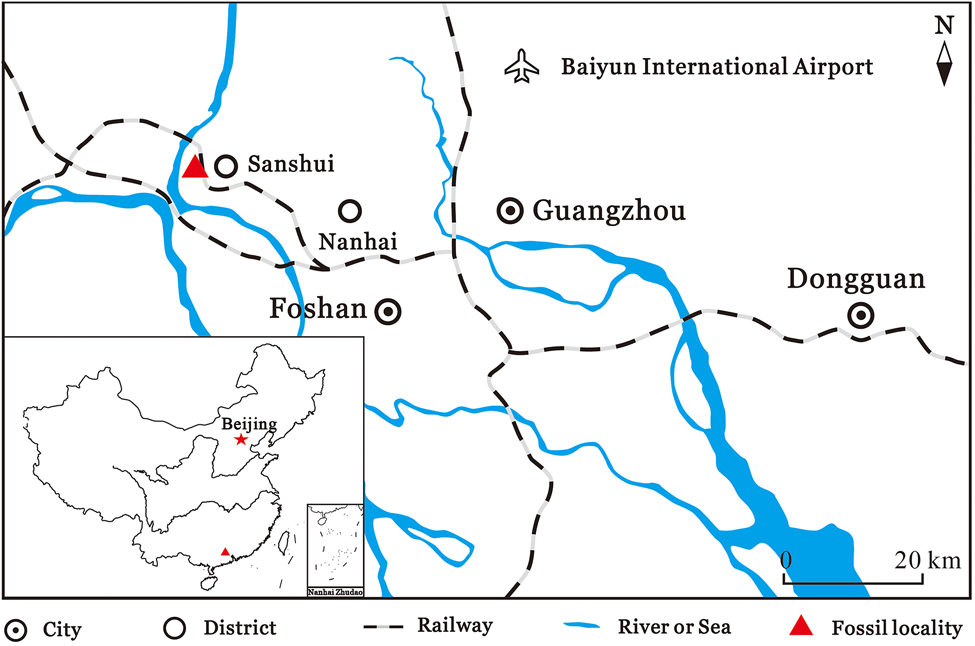
Here, a new damselfly that represents a new family, new genus, and new species described from the Paleocene Buxin Formation at the Sanshui Basin, South China (Fig. 1), supporting the hypothesis of an important worldwide diversification of these insects during the Paleocene and Eocene.
Fossil locality map.

Material and methods
Only one specimen with part and counterpart was collected from the well-laminated shale of lower part of the Buxin Formation at the Haobangshou Factory, Sanshui Basin, Foshan City, Guangdong Province, South China. This specimen was collected by Mr. Weichao Chen. He donated it for our study. The type specimen is housed in Shunde Museum, Shunde, Foshan City, Guangdong Province.
The Paleogene deposit of the Sanshui Basin of South Guangdong Province can be divided into the Xinzhuangcun, the Buxin, the Baoyue, and the Huachong formations from bottom to top. A recent integrative study indicated that the age of Buxin Formation is 62.2–59.2 Ma, mainly based on a paleomagnetism study (Wang et al., Reference Wang, Li, Bai, Jin, Mao and Meng2019). The isotopic age 59.3 ± 0.2 Ma more likely corresponds to the volcanic events of the lower Buxin Formation (Zhou et al., Reference Zhou, Xiao, Dong, Wang, Wang and Ni2009). The above analysis indicates that the age of the present fossil insect layer is approximately 61–62 Ma. The fossil insects from the Buxin Formation were collected from layers near the boundary of the Xinzhuangcun and Buxin formations and lower parts of the Buxin Formation (Huang et al., Reference Huang, Lian, Jouault, Gao and Nel2022a; Zhang et al., Reference Zhang, Wang, Liu and Zhang2022). Other fossil insects from the Sanshui Basin have been also found in the Baoyue Formation, along with some fragments (Zhang et al., Reference Zhang, Zhou and Chen1993), and caddis cases in the Huachong Formation (Huang et al., Reference Huang, Su, Lian and Gao2022b).
Photographs were taken using a digital camera attached to a Zeiss Discovery V20 microscope and Canon 5D Mark II camera with a 100 mm macro lens. The map was made using CorelDraw 2020 software.
We followed the wing venation nomenclature of Riek and Kukalová-Peck (Reference Riek and Kukalová-Peck1984), emended by Nel et al. (Reference Nel, Martínez-Delclòs, Paicheler and Henrotay1993) and Bechly (Reference Bechly1996). The higher classification of fossil and extant Odonatoptera, as well as familial and generic characters followed in this work are based on the phylogenetic system proposed by Bechly (Reference Bechly1996).
Wing vein abbreviations
AA = analis anterior; Ax0, Ax1, Ax2 = primary antenodal crossveins; C = costa; CuA = cubitus anterior; CuP = cubitus posterior (CuP-crossing); d = discoidal cell; IR = intercalary radial vein; MA = media anterior; MAa = anterior-most branch of MA; MAb = posterior branch of MA distally closing discoidal cell; MP = media posterior; N = nodus; O = lestine oblique vein; Pt = pterostigma; RA = radius anterior; RP = radius posterior; ScP = subcosta posterior.
Life Science Identifier (LSID)
urn:lsid:zoobank.org:pub:9F72B2DB-FDEC-4137-8109-4E59E69F87A2.
Repositories and institutional abbreviations
Shunde Museum (SDM), Guangdong Province, China.
Systematic paleontology
Order Odonata Fabricius, Reference Fabricius1793
Suborder Zygoptera Selys-Longchamps in Selys-Longchamps and Hagen, Reference Selys-Longchamps and Hagen1854
Family Shundeagrionidae new family
Type genus
Shundeagrion new genus.
Diagnosis
As for the type genus.
Occurrence
Paleogene Buxin Formation, Sanshui Basin, South Guangdong Province, China.
Life Science Identifier (LSID)
urn:lsid:zoobank.org:act:38AB6960-C31A-4B0E-89A8-CE21EC3181A9.
Shundeagrion new genus
Type species
Shundeagrion cheni new species.
Diagnosis
Wing venation characters: pterostigma elongate with basal edge very oblique and elongate with 2–3 crossveins between it and C; two rows of cells between C and RA distad pterostigma and two rows between RA and RP1 below pterostigma; bases of RP3/4 and IR2 between arculus and subnodus, far from subnodus; nodal crossing and subnodus very oblique; no lestine oblique crossvein ‘O’; discoidal cell elongate but with MAb distally moderately oblique; CuA with a triadic pattern; cubital area very broad; postnodal crossveins very numerous.
Occurrence
Paleogene Buxin Formation, Sanshui Basin, South Guangdong Province, China.
Etymology
Named after Shunde City where the specimen housed and the genus name Agrion; gender masculine.
Life Science Identifier (LSID)
urn:lsid:zoobank.org:act:F76D9293-4722-46CB-8162-B30E19E4F43F.
Remarks
Because the body is in poor condition, we only used wing venation characters. Only the type species, Shundeagrion cheni n. gen. n. sp., is in the new genus Shundeagrion.
Holotype
2024004001, a complete individual with four wings in connection, stored in Shunde Museum, Guangdong Province, China.
Shundeagrion cheni n. gen. n. sp., holotype SDM2024004001, general habitus.

Shundeagrion cheni n. gen. n. sp., holotype SDM2024004001, details. (1) left forewings and hind wings; (2) right forewings and hind wings; (3) pterostigma of forewings and hind wings; (4) foreleg; (5) head and thorax; (6) bases of wings. Scale bars = 5 mm (1, 2, 5), or 2 mm (3, 4, 6). Ax1, Ax2 = primary antenodal crossveins; CuA = cubitus anterior; d = discoidal cell; IR = intercalary radial vein; MAa = anterior-most branch of media anterior; MP = media posterior; N = nodus; Pt = pterostigma; RA = radius anterior; RP = radius posterior; sd = subdiscoidal cell.

Diagnosis
As for the genus. Basal parts of fore- and hindwings hyaline and distal half parts brown-colored.
Occurrence
Paleogene Buxin Formation, Sanshui Basin, South Guangdong Province, China.
Description
Body rather poorly preserved, visible from dorsal side. Head 3.2 mm long, 4.1 mm wide, with distance between compound eyes ~2.0 mm. Thorax rather strong, 5.5 mm long, ~4.0 mm wide, with trace of white and five brown bands; only forelegs visible, tibia slightly curved, armed with a row (~10) of strong spines at middle to posterior parts, tarsi three-segmented, first tarsomere rather wide and short, second tarsomere elongate, third tarsomere as long as first and second tarsomeres together, tarsal claw big, as long as third tarsomere, curved. Abdomen dark brown, 32.6 mm long, 2.4 mm wide, with faint traces of cerci, no visible secondary genital organs on segment 2, but this is very poorly preserved.
All preserved wings identical in shape, dimensions, and venation, with basal part up to nodus level hyaline and part distad brown; pterostigma apparently white; wing 31.6 mm long, 7.8 mm wide, broad and with numerous small cells; distance from base to arculus 4.5 mm, from arculus to nodus 5.3 mm; primary antenodal crossveins Ax1 and Ax2 well defined; Ax1 2.9 mm from wing base, distance between Ax1 and Ax2 1.4 mm; Ax2 just distad arculus; no secondary antenodal crossveins; ~36 postnodal crossveins, not well aligned with postsubnodal crossveins. Pterostigma rather long and broad, 3.3 mm long, 1.0 mm wide, covering numerous cells; two rows of cells between RA and RP1 below pterostigma and distad it; basal edge of pterostigma very long and much more oblique than distal one, with two crossveins between it and C; pterostigmal brace absent; two rows of crossveins between C and RA distal of pterostigma; posterior part of arculus (= basal discoidal crossvein) present, therefore discoidal cell basally closed; discoidal cell trapezoidal, elongate, narrow (1.5 mm long, 0.7 mm wide), and free of crossveins, with MAb moderately oblique; origins of RP and MA separated in arculus; bend of ScP at nodus Z-like; nodal vein and subnodus very oblique; subnodus aligned with nodal crossvein; no crossveins in antesubnodal area; median space free of crossveins; submedian space free of crossveins except for CuP-crossing; CuP-crossing situated distinctly distad base of AA; subdiscoidal cells free; anal area narrow (0.3 mm wide in middle), not wider than subdiscoidal cell, with two crossveins below subdiscoidal cell; cubito-anal area max. 2.8 mm wide in its broadest part, with five rows of cells; CuA well-defined and curved; CuA with a triadic pattern; area between MP and CuA progressively broadened; MP regularly curved, not distally zigzagged, and ending between nodus and pterostigma; basal half of postdiscoidal area between MA and MP narrow with only one row of cells, but greatly widened distally, and with two long secondary longitudinal veins; MA ending just basad pterostigma level; MA, RP3/4, and IR2 rather straight, but distally curved towards hind margin; no antefurcal crossveins between basal parts of RP and MA; area between RP3/4 and MA narrow with one row of cells between them in basal half, but distally widened; area between RP3/4 and IR2 progressively broadened, with two long secondary longitudinal veins; RP3/4 ending beneath pterostigma; base of RP3/4 3.9 mm basad subnodus; base of IR2 just distad that of RP3/4; RP1/2 straight at subnodus; base of RP2 very far from subnodus, at six cells distal from it; IR1 well defined, long, and curved, originating ~10 cells distad RP2; no lestine oblique vein ‘O’ between RP2 and IR2; RP2 and IR2 with only one row of cells between them until level of base of pterostigma; RP1 without distinct bend at pterostigmal brace; wings well petiolated, petiole 3.5 mm long.
Etymology
Named in honor of the collector, after his family name “Chen”.
Life Science Identifier (LSID)
urn:lsid:zoobank.org:act:C0FDAC88-B490-48A3-ADB4-CD5C41E4E8B9.
Remarks
The holotype is the only specimen.
Discussion
This damselfly shares several characters with the Thaumatoneuridae Fraser, Reference Fraser1957 (extant Thaumatoneurinae plus Cretaceous Euarchistigmatinae Carle and Wighton, Reference Carle, Wighton and Grimaldi1990, and Paleogene Eodysagrioninae Rust, Petrulevičius, and Nel, Reference Rust, Petrulevičius and Nel2008): (1) elongate and narrow discoidal cell, (2) long petiole, (3) nodus situated in a very basal position correlated with a large number of postnodal crossveins, and (4) distal third of wing very broad (Bechly, Reference Bechly1996, Reference Bechly2016; Rust et al., Reference Rust, Petrulevičius and Nel2008; Bechly et al., Reference Bechly, Garrouste, Aase, Karr, Grande and Nel2020). The new fossil strongly differs from the Euarchistigmatinae in the basal edge of the pterostigma very oblique and the broad cubital area (Bechly, Reference Bechly2010). The Thaumatoneurinae (Thaumatoneura McLachlan, Reference McLachlan1897) and Eodysagrioninae (Tynskysagrion brookeae Bechly et al., Reference Bechly, Garrouste, Aase, Karr, Grande and Nel2020, Oreodysagrion tenebris Bechly et al., Reference Bechly, Garrouste, Aase, Karr, Grande and Nel2020) also have the basal side of the pterostigma very oblique and a broad cubital area (Münz, Reference Münz1919; Bechly et al., Reference Bechly, Garrouste, Aase, Karr, Grande and Nel2020).
This new fossil differs from the Thaumatoneurinae and the Eodysagrioninae in the nodus in a less basal position, subnodus well distad bases of IR2 and RP3/4, and discoidal cell distinctly broader in its distal part than in its basal part with oblique MAb versus perfectly rectangular and MAb perpendicular to MA/MAa. But it shares with these groups the presence of several rows of cells between C and RA distad the pterostigma and between RA and RP1 below and distad it. It also shares with Thaumatoneura a triadic pattern of CuA (Bechly, Reference Bechly2016).
These two last characters are also present in Megaloprepus Rambur, Reference Rambur1842 (Pseudostigmatidae Tillyard, Reference Tillyard1917) and in the Cretaceous Mesomegaloprepidae Huang et al., Reference Huang, Azar, Cai, Maksoud, Nel and Bechly2017), but the new fossil strongly differs from these two families in the shape of the elongate pterostigma with more oblique basal edge, the bases of RP3/4 and IR2 distinctly basad subnodus, and the discoidal cell distally broader than basally (Münz, Reference Münz1919; Huang et al., Reference Huang, Azar, Cai, Maksoud, Nel and Bechly2017; Zheng et al., Reference Zheng, Nel, Jarzembowski, Chang, Zhou and Wang2018).
Some Dysagrionidae and Sieblosiidae have a discoidal cell similar to that of the new fossil—rather elongate and with a broad distal part—but the taxa of the former family also have the base of IR2 below the subnodus, and those of the latter have a lestine oblique crossvein ‘O’, unlike in the new fossil, even though they have the bases of RP3/4 and IR2 between arculus and nodus, as in the new fossil. All these damselflies also have no triadic pattern of the CuA (Archibald et al., Reference Archibald, Cannings, Erickson, Bybee and Mathewes2021). The head of the new fossil would have resembled those of the ‘Cephalozygoptera’ (Dysagrionidae, Sieblosiidae, and Whetwhetaksidae) in its compacted shape with compound eyes approximate, but Nel and Zheng (Reference Nel and Zheng2021) showed that this is due to deformations of the head when the fossil damselfly is dorsally fossilized in compression (clearly visible in fossil Lestidae).
The Devadattidae Dijkstra et al., Reference Dijkstra, Kalkman, Dow, Stokvis and van Tol2014 (Devadatta Kirby, Reference Kirby1890), Amphipterygidae Tillyard, Reference Tillyard1917 (Amphipteryx Selys, Reference Selys-Longchamps1853), and Lestoideidae Münz, Reference Münz1919, of the subfamily Diphlebiinae Heymer, Reference Heymer1975 (Diphlebia Selys, 1869), share with the new fossil a discoidal cell with an oblique distal side, bases of RP3/4 and IR2 situated between the arculus and the nodus, and a strongly oblique basal edge of the pterostigma. But these damselflies strongly differ from the new fossil in the bases of RP3/4 and IR2 situated very close to arculus versus midway between arculus and subnodus, and very narrow cubital areas with at most three rows of cells between the CuA and wing margin versus five rows.
The family Menatlestidae from the Paleocene of France shares with the new fossil broad wings, bases of RP3/4 and IR2 between arculus and subnodus, elongate discoidal cell, no lestine oblique vein, very numerous postnodals, but Menatlestes Nel and Jouault, Reference Nel and Jouault2022, has a strongly oblique MAb and a basal edge of pterostigma weakly oblique (Nel and Jouault, Reference Nel and Jouault2022).
There remains the Paleocene family Latibasaliidae (Latibasalia elongata Petrulevičius and Nel, Reference Petrulevičius and Nel2004, and L. quispeae Petrulevičius and Nel, Reference Petrulevičius and Nel2004) from Argentina. These damselflies share very broad wings, bases of RP3/4 and IR2 between arculus and subnodus, elongate discoidal cell, no lestine oblique vein, very numerous postnodals, and a triadic pattern of CuA. But their vein MAb is basally obliquely oriented instead of being distally oriented and the basal edge of the pterostigma is not strongly oblique (Petrulevičius and Nel, Reference Petrulevičius and Nel2004, Reference Petrulevičius and Nel2007).
Considering all of the characters, the new fossil does not fit in any of the known damselfly families. We attribute it to a new family, but its exact affinities remain uncertain and would need a complete re-analysis of the phylogeny of the extant and fossil damselfly families.
Conclusion
The Shundeagrionidae n. fam. is, together with the Dysagrionidae, Sieblosiidae, Whetwhetaksidae, Menatlestidae, Latibasaliidae, Euarchistigmatinae, and Eodysagrioninae, the seventh major group of Paleogene damselflies with large wings, very long postnodal area, and nodus basally recessed. If these large damselflies were flourishing in South America, North America, Europe, and Asia during this period, it seems that they greatly decreased in diversity during the Miocene when only few Sieblosiidae are still present (Nel, Reference Nel1991). At the same time, the Calopterygoidea, which were quite rare during the Paleocene and Eocene, began to diversify during the Oligocene and progressively replaced them in the Miocene (Lin et al., Reference Lin, Petrulevičius, Huang, Nel and Engel2010).
Acknowledgments
We thank two anonymous reviewers for their valuable comments on an earlier version of this work. This project was supported by the National Natural Science Foundation of China (41925008 and 42288201).
Competing interests
The authors declare no competing interests.