Nicknamed “bloody Walter,” SS Obersturmführer Walter Hauck embodied the Nazi ideal of manly toughness. Born in 1918, he started a career with the German police, joined the SS, and served as a company leader with the 12th Waffen SS Division “Hitler Youth” during the second half of World War II. He enjoyed a reputation for being a reckless, if not ruthless, soldier, the model of a “warhorse” and “political soldier,” a dedicated Nazi warrior who had elevated himself above any sentiment or sense of morality allowing for compassion for the weak. After the war, he was found guilty and sentenced to death in France for a massacre that had taken place in the French town of Ascq in Normandy, which he had launched in revenge for a partisan attack in April 1944. The next spring, in May 1945, he initiated the murder of twenty-six civilians in the Czech village of Leskovice. Yet, “Bloody Walter” was hard on himself as well. Earlier in the war, he had suffered—and recovered—from an attack on his tank that had almost burned him to death, leaving him with facial disfigurements that were still visible fifty years later, when I interviewed him. (Hauck was amnestied in 1957.)Footnote 1
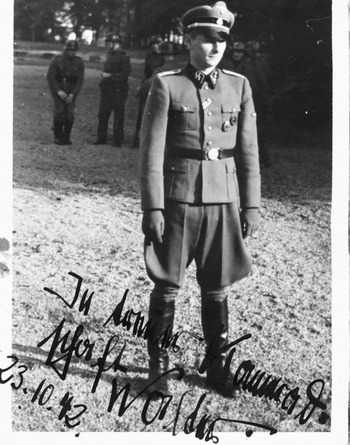
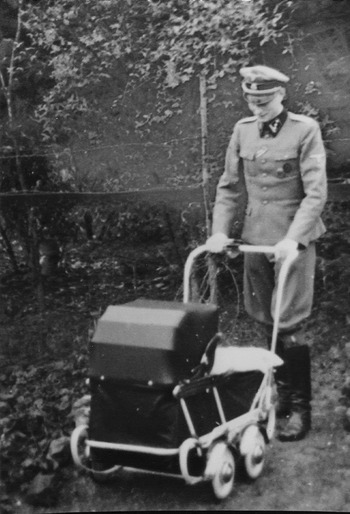
Our conversation took place in a casual atmosphere of sorts in Hauck's middle-class home in Stuttgart. His wife served cake and coffee. A little chitchat about our respective children helped introduce an air of relaxation to this encounter between a proud SS veteran and a young historian who did not hide his own distance, or that of his parents, from Nazi ideology and Nazi militarism. The conflation of trading war stories and petty bourgeois Kaffeeklatsch warmed up the interview, however, and led right to the topic that held my interest: what did being a man mean for Hitler's soldiers? During the conversation, Hauck showed me two photos, one of which depicts Hauck in a genuinely soldierly, manly pose; the handwriting dedicates it to a fellow SS officer, in “loyal comradeship” [Fig. 1]. The other photo shows Hauck as a soldier and father, yet in an obviously feminine role [Fig. 2]. He pushes a baby carriage, a symbolically loaded gesture that, at that time, was widely considered to be an ostensive violation of the common (not specifically Nazi) code of manliness. Men pushing baby carriages were mocked or frowned upon, and the Nazi Stormtroopers (Sturmabteilung, or SA) formally banned such unmanly activity.Footnote 2 The photo reproduced here was taken in a private setting, but it was part of a collection that “bloody Walter” used to show his comrades.
Private photograph from the early 1940s of SS Obersturmführer Walter Hauck as a comrade. Source: Author's collection.

Private photograph from the early 1940s of SS Obersturmführer Walter Hauck as a father. Source: Author's collection.

Though the basis of Hauck's manly self-certainty was his tough and relentless soldiering, the pride of being a family father nurtured it as well. The point is that the code of manliness in Nazi Germany was not as unambiguous as it might seem to modern observers. In sharp contrast to the SA ban, the SS journal Das Schwarze Korps advised its readers that it was, by no means, “unmanly” for a man to care about and nurse his children in public. A man, the SS journal averred, “doesn't lose a bit of his manliness by doing so, but simply proves that his love for his wife and his children is not just lip service.”Footnote 3 This advice was part and parcel of Heinrich Himmler's homophobic family policy, of course—of his obsessive fear of homosexuality, and of his definition of the SS as an exclusively “Aryan” order that included women and did not shy away from empowering them, if only symbolically.Footnote 4 But that this advice seemed to be necessary—and, moreover, its decisive tone—suggest that not even SS men were confident about what “manliness” meant precisely, or about how one must behave to be considered a man.
Studying Masculinities
This uncertainty about what it meant to be a man, and the ways in which German men dealt with that during the Third Reich, are the subjects of this article. Focusing on soldiers, it examines different men and their different responses to the challenges that resulted from the ambiguities of manliness, arguing that men of different cultural, ideological, and social identities, including those whom the Nazi state denigrated, oppressed, or ostracized, clung to a hegemonic ideal of “hard” manliness that demanded aggressiveness, strength, discipline, and control over others and over oneself. A broad range of men shaped themselves accordingly, to different degrees and in different ways, depending on their personalities and cultural backgrounds. It is paradoxical, however, that once a man achieved this norm, he then enjoyed some exemptions from it, and could even violate it. A tough soldier, a “real” man, I shall argue, adopted feminine roles without undermining his manliness. Walter Hauck could afford to display seemingly unmanly affection, even in public and among men, as well as in front of women, precisely because his male identity was beyond any doubt. The code of manliness was thus much more flexible, more integrative, and more inclusive than scholars of the Third Reich, military cultures, and masculinities have previously acknowledged.Footnote 5
Discarding vernacular concepts of manhood as a never-changing, biological given inherent to all human cultures, gender scholars stress the social and historical fluidity and changeability of what societies consider to be manly.Footnote 6 Even still, they assert—often under the influence of Freudian theories about little boys suppressing, under social coercion, their identification with their mothers—that masculinity is defined in modern society by the “repudiation of femininity.” As sociologist Michael Kimmel, a pioneer of men's studies in America, explains, being a man means “not being like a woman,” and, at the same time, it means ruling over and controlling women—hence the “polarization of sexual stereotypes,” classically analyzed by historian Karin Hausen.Footnote 7 Men are energetic, powerful, brave, bold, aggressive, independent, rational, intellectual, and knowledgeable, according to such stereotypes, whereas women embody the opposite: they are weak, yielding, modest, dependent, emotional, and intuitive.Footnote 8
Kimmel argues further, however, that young men suffer from “the terror that [they] will be unmasked as a fraud” who has only superficially managed to rid himself of his mother's traits. The feminine coding of homosexuality and homoerotic desires creates an additional, yet related, threat. These desires must therefore be suppressed, and masculinity means the repudiation of the “homosexual within.” Male homosociality—i.e., all-male bonding—is, paradoxically, entrenched by homophobia, Kimmel argues. The latter is “the fear that other men will unmask us, emasculate us, reveal to us and to the world that we don't measure up, that we are not real men.” Masculinity is uncertain, “tenuous and fragile.”Footnote 9
The workings of this web of uncertainty, homophobia, and patriarchy have been widely analyzed by scholars of different disciplines—most prominently by the German literature scholar Klaus Theweleit in his inquiry into “male fantasies”—as they appear in the misogynist and militarist autobiographical writings of the German post-World War I paramilitary fighters in the Freikorps. In Theweleit's view, men in the Freikorps radicalized common Western and German norms about male self-control, as well as about cold, tough, and “hard” masculinity, into a perpetual war against women and femininity—especially against femininely coded desires for domesticity, tenderness, and compassion within men. The men whom Theweleit examined needed to fight the “hybrid substances” of the body and all ambiguous, allegedly feminine, emotional conditions, the “stickiness of sucking kisses” and the “warmth that dissolves physical boundaries.”Footnote 10
A broad range of research, not least on Nazi Germany, has nevertheless shown that relations between men and women, between concepts of manliness and femininity, between different men, as well as between different women, were all more complicated and complex than such binary models suggest—and that Theweleit's evidence allows for diverse interpretations.Footnote 11 Not all men are equally able to achieve, and many do not even aim to achieve, “hard” masculinity. They adhere instead to alternative masculinities that often depend on and intersect with their racial, class, professional, religious, and sexual identities. Gender scholars have therefore challenged simple binary notions of gender. They instead suggest exploring diverse masculinities and their historically contingent hierarchies in various institutions, nations, and societies. Different men—for example, generals as opposed to the rank-and-file, war volunteers as opposed to draftees, soldiers as opposed to civilians, blue- as opposed to white-collar workers, black as opposed to white men, Jewish as opposed to Christian men—may adhere to different masculine norms. But these norms operate in a constant state of competition for broader social approval and power. In other words, they struggle for hegemony.
R. W. Connell's theory of hegemonic masculinity accommodates the existence and rivalry of multiple conceptions of masculinity, analyzing their hierarchic order in a Gramscian fashion. Male subordination of women constitutes hegemonic masculinity, she argues, but this masculinity also allows for a range of diverse yet hierarchically ordered male identities. Subordinate masculinities, represented paradigmatically by gay men throughout most of the twentieth century in Western societies, defy heterosexual hegemony and are thus considered illegitimate. Complicit masculinities fail to embody the dominant standard as well, but they do not do so willingly. They support it, though insufficiently, in order to achieve at least a junior partnership of sorts in the patriarchal society, i.e., they wanted to reap the “patriarchal dividend.” Such masculinities are embodied, for instance, by men in a militarized society who are considered unfit for service, or by unemployed men in civilian society. “Complicit” men still rule over women and rank above men with “illegitimate” male identities.Footnote 12
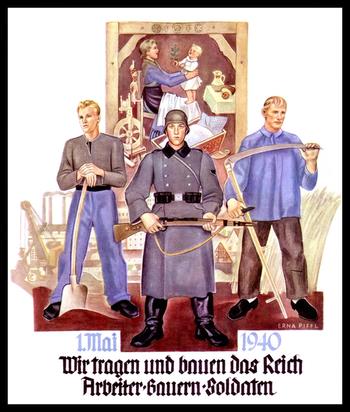
In Nazi Germany, soldierly masculinity reigned at the top of male identities in Aryan society, yet, other male identities were also legitimate, as the 1940 cover page of the journal NS-Frauenwarte illustrates [Fig. 3]. Three categories of men occupy the foreground of the image. A blue-collar worker is on the left, a farmer on the right. A soldier stands in front of them, dominating the entire picture. The caption reads: “We carry and build the Reich // Workers—Farmers—Soldiers.” Women are not excluded but instead relegated to the background: a mother and her baby are depicted in a picture within the cover picture. The image leaves no doubt, then, about gender hierarchies: first the soldier, then other professional groups of men. Women are included only symbolically, but they are nevertheless included.Footnote 13
Cover of NS-Frauenwarte, May 5, 1940. Source: Author's collection.

Arguing with or expanding on Connell's sociological concepts, and frequently inspired by poststructuralist theory, scholars of male emotions, identities, and sociability have pointed to the “tensions and contradictions” of masculinity, as well as to its fluidity and hybridity.Footnote 14 They have cautioned against overemphasizing the antifeminine nature of masculinity, suggesting instead that researchers “explore the locus of expression of ‘non-masculine’ sentiments by men.”Footnote 15 The language of intimacy and the pathos of tenderness, care, empathy, and love between men that permeate testimonies and recollections of former soldiers adumbrate the ambiguity of manliness. In a pioneering way, Joanna Bourke's 1996 book, Dismembering the Male: Men's Bodies, Britain, and the Great War, uses the private writings of ordinary British servicemen during World War I to highlight the fluidity and ambiguity of experiences of masculinity by focusing on men's interaction in all-male, homosocial settings, such as military units or veterans’ associations. Rather than fleeing domesticity and femininity, men worked on weaving these ideals into complex and fragile constructions of male identity.Footnote 16
But how far did the inclusion of femininity go, what counted as femininity, and how was it tied to masculinity? The latter may be fragile and fluid, but, at the same time, it has been proven to be extraordinarily stable and resilient. As gender theorist Todd Reeser notes, a concept such as fluidity is meaningful only in conjunction with its opposite, i.e., a “stable notion of gender that is subsequently destabilized in some way.”Footnote 17
Joseph Thorak's Freiheitsdenkmal (monument to freedom) in Danzig, shown at the Great German Art Exhibit in Munich in 1943. Source: Die Kunst im Deutschen Reich 7, no. 7/8 (1943): 149.

Hard Masculinity
Though often criticized for his ahistorical generalizations and methodological breeziness, Theweleit hit on some crucial elements of the masculine standard in Nazi Germany.Footnote 18 According to the tenets of Nazi racism, Aryan soldier-men embodied absolute hardness, whereas Jewish men represented the opposite: an effeminate, weak manliness.Footnote 19 The semantic of hardness was complex, however. It entailed three dimensions: men's physical performance, their emotional conditions, and their moral constitution. German boys were to become as “swift as a greyhound, as tough as leather, and as hard as Krupp steel,” as Hitler announced at a party rally in 1935, putting into words what Nazi sculptors such as Joseph Thorak or Arno Breker were hammering in stone or casting in bronze: supernatural models of invincible and immortal warrior men that lionized the Aryan master race and dramatically exaggerated the modern athletic cult of the body inspired by classical Greece.Footnote 20 Nazi and military propaganda never ceased to praise superhuman masculinity as an exclusively Aryan feature. Even in death on the battlefield, Kleo Pleyer claimed in 1943, German soldiers, used to withstanding even “inhumane pain,” would “retain their composure” and not moan or whine—in sharp contrast to the “tearful way of dying” of “other peoples.”Footnote 21
Yet, only a few men lived up to these exaggerated expectations, and the Nazi and military elite knew that. The SS even struggled to attract enough volunteers who met Heinrich Himmler's minimum height standards, which ranged from 172 to 178 cm (depending on the elite status of the unit).Footnote 22 The uniform, more than anything else, allowed men of different body shape to display male dominance visually and without any doubts. Humiliated in 1934 by all kinds of denigrations during basic training, recruit Gerhard Modersen nevertheless confided to his diary that he “was now proud to be a soldier,” hailed by everyone, including women, “like a general”—all thanks to the uniform, which enabled him to “walk upright, like a tree.”Footnote 23
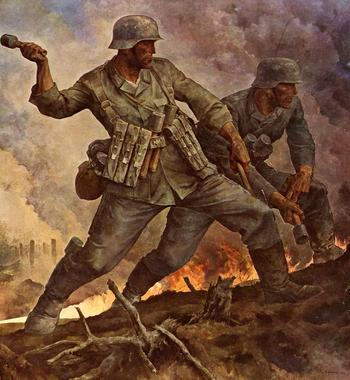
Painting of Rudolf Lipus, Kämpfer, shown at the Great German Art Exhibit in Munich in 1943. Source: Die Kunst im Deutschen Reich 7, no. 7/8 (1943): 141.

Emotional hardness meant decisiveness, aggression, brutality, discipline, and control over others: over women and weaker men, but also over oneself, one's own body, impulses, and fears. The SS code embraced the concept of stoicism in the face of physical stress, emotional exhaustion, and lethal danger as “toughness against oneself.”Footnote 24 The ultimate testing ground of this aspect of hardness was the battlefield, where a man was expected to overcome the fear of losing life or limb, and to demonstrate that he had internalized the basic law of military masculinity: death before dishonor. In the spring of 1940, after successfully completing his training period as a tank gunner, twenty-three-year-old Karl Fuchs wrote to his father that he wished nothing more than to be transferred to the front. He knew “that our women don't understand this wish.” He also knew that “that cannot matter … Women do not understand anything about the necessary struggle of a man … A man must prove himself in battle” if he did not wish to run the risk of being tagged a coward—Karl's biggest fear: “I couldn't live with the shame.” Karl proved himself in battle before being killed on the Eastern Front in the fall of 1941.Footnote 25
Next to displaying physical strength and overcoming the fear of being killed, surmounting any qualms about actively killing and thus violating the most basic law of Judeo-Christianity—“Thou shalt not kill”—was the third component of hardness. To most ordinary soldiers, especially the conscripted ones, killing in battle remained murder, even if ordered and sanctioned by military or civilian authorities, or justified by sophisticated discourses on just wars and soldierly citizenships.Footnote 26 However, as Ernst Jünger explained, it was precisely the ability to neutralize guilty feelings about killing and other civilian restraints that made the soldier-man one of the masterminds of German military masculinity. He managed to rid himself of scruples and pangs of conscience, civilian sentiments of “humanness,” the morality of the female-dominated world back home.Footnote 27 Jünger's martial rhetoric, highly influential in the Third Reich, still operated within traditional categories of war between combatants, but the Nazis took another decisive step in disparaging as unmanly the Judeo-Christian tradition of human compassion and pity for the weak. The Nazis’ “political soldier” even elevated himself above guilty feelings about murdering civilians.Footnote 28 In this fashion, SS officer Felix Landau, after shooting “defenseless people” with an Einsatzkommando in Poland, proudly noted in his diary in July 1941 that he was “completely unmoved. No pity, no nothing.” In the same spirit, Adolf Eichmann declared in Jerusalem in 1961, while awaiting the death penalty: “Repentance is for little children.”Footnote 29
Martial masculinity was not meant to be performed in a solipsistic fashion. Instead, it depended on social interaction, i.e., on being performed in the actual or virtual presence of—and needing affirmation by—other men. At the same time, martial masculinity was tied to a sophisticated discourse on citizenship, i.e., on social, communal, and national obligations. The SS man who neutralized feelings of guilt about killing Jewish or non-Jewish civilians did so on behalf of the German Volksgemeinschaft and its quest for racial purification, according to Nazi ideology. The soldier-man who steeled his body and stormed into the battlefield did so together with his outfit and in order to defend his Fatherland. In contrast to civilian versions of masculinity, embodied by the breadwinner, the family father, or the successful businessman, martial masculinity did not manifest itself privately but instead socially—something that scholars have often overlooked by relying on idealized, often preternatural visual representations of heroic male bodies.Footnote 30 In this regard, Nazi Germany radicalized common, nineteenth-century European traditions that conflated male citizenship and military service. The citizen-soldier worked for and together with his fellow citizens, for the public sphere and the state, and he fought in war together with his comrades, sacrificing himself on behalf of his country.Footnote 31
Tenderness and Toughness
To become a real man, a boy needed to rid himself of his infantile, private, allegedly egocentric identity, rooted in the maternally dominated world of his family. Military and paramilitary discourse, already in interwar Germany but even more so in Nazi Germany, embraced such training as a “period for effacing the wrong consciousness,” for replacing “the private self, the individual” with a collective self that served the “higher and larger community.”Footnote 32 Since the nineteenth century, the army had been organized as a “school of manliness” that transformed “weak” (i.e., feminine) boys into “hard,” real men. Simultaneously, the army served as the “school of the nation,” merging men of different civilian identities, classes, religions, and regions into a homogenous body of citizens able to replace or even dismiss their particularist civilian identities on behalf of a communal, soldierly one. The Nazi state racialized and totalized this tradition. Only Aryan boys qualified for developing into full-fledged members of the racially exclusive Volksgemeinschaft, and a broad range of paramilitary organizations, including the Hitler Youth and the National Labor Service, aimed at making sure that no such boy fell through the cracks of the school of manliness.Footnote 33
The contemporary term used to address the social essence of martial masculinity was Kameradschaft (comradeship), the epitome of an “all-male society.”Footnote 34 It was juxtaposed with the concept of friendship.Footnote 35 One could choose one's friends according to one's sympathies; it was up to an individual to start and end a friendship. Because friendship catered to the self and was soaked with “individual sentiments,” the veterans’ journal Kyffhäuser spitefully explained in 1932, it was unreliable, unstable, and ambiguous. Friendship radiated femininity—comradeship, by contrast, manliness.Footnote 36 The latter, it was claimed, served the larger cause, the community, the “we,” and it was embedded in coercion, destiny, the threat of death, as well as the need to cope with these matters. Each man would be assigned to a group of comrades by some authority, often randomly, and would not be asked whether he liked it or not. “The soldier has to get along with his comrades … He may not abandon them in battle, [in times of] distress or danger, but must support them as much as possible, whenever they need him,” the German military code unambiguously declared.Footnote 37 When, in 1942, two SS officers “blatantly ignored the code of comradeship and engaged in violent arguments about chicken breeding,” Himmler ordered them to live together in one room for six weeks so that they had a chance “to consider the concept of comradeship.”Footnote 38 Comradeship, in other words, meant suppressing individual feelings and interests on behalf of the functioning of the community.
Still, the hardening effect of pressure, coercion, and conformity represented only one side of the male initiation rite and the social fabric of the male bond. The other side was softness, relief, and pleasure. Sebastian Haffner, the son of an educated, liberal, Berlin middle-class family, experienced both sides in 1933 in a Nazi training camp he had to attend in order to obtain his law degree. If someone committed “a sin against comradeship,” “acted superior,” or “showed off,” exhibiting more individuality than was permissible, a nighttime court would judge and condemn him to corporal punishment, e.g., being dragged under the water pump for minor misdemeanors. At the same time, Haffner admitted, there was also the “happiness of comradeship.” Even to him, an anti-Nazi and antipode to the soldier-man, “it was a pleasure to go for a cross-country run together in the morning, and then to go naked into the communal hot showers together, to share the parcels that one or another received from home, to share also responsibility for misdemeanors that one of your comrades had committed, to help and support one another in [a] thousand little ways.”Footnote 39
The Wehrmacht's official training manual, the “Reibert” (named after its initial author, Wilhelm Reibert), consequently juxtaposed discipline and comradeship. Both served as “the indispensable glue [that] kept the army together. Without discipline, [the army] would be a rampant crowd; without comradeship, the soldier's life would be unbearable.”Footnote 40 Comradeship allowed hard men to recharge their batteries, so to speak, by indulging in softness. In an order for the Lichtenberg concentration camp in Saxony, commandant Theodor Eicke stipulated that, in “service, there is only merciless severity and hardness; outside service hours there is heartwarming comradeship.”Footnote 41 Nazi Stormtroopers sentimentalized “the warm heart, the helping hand,” and the “emotional and spiritual harmony” that filled their retreats, the “storm bars.” This kind of “comradeship,” they claimed, was “home and pleasure,” a guarantee of “repose and protection from the enemy.”Footnote 42
In a task-oriented group where everyone had to do their share, nobody was to fail or remain off to the side. In basic training, if one comrade failed in some task or simply stepped out of line, the entire group was blamed and penalized. On the battlefield, such individual failure might cause collective death, so comradeship was intended to contain the damage caused by the weak. To avoid collective punishment, harm, or death, stronger or more experienced comrades enforced a rigid pecking order and shamed the weaklings, but they also helped them get along.Footnote 43 This ideal of solidarity ultimately became real when a soldier rescued an injured comrade from the battlefield, or secured his corpse, or stayed with the dying comrade in his last moments—ensuring that nobody was left behind.
In the early nineteenth century, Ludwig Uhland wrote the poem “Der gute Kamerad” (The Good Comrade), which was later set to music and sung by Germans whenever they mourned fallen soldiers. In the poem, two soldiers fight side by side until one takes a bullet and dies. The other is filled with grief, having lost a “part” of himself. The song did not suggest losing oneself in mourning, but was instead meant as a tutorial for how to overcome grief, i.e., it was a tutorial of manliness. It demands that the survivor continue functioning as a soldier in war: the surviving comrade reloads his gun when his comrade dies. Yet, the song is filled with uncertainty and ambivalence. It demands hardness (“continue fighting!”), but it also sentimentalizes the tender attachment of the two men. They were comrades, but they were also friends, as the song reveals at its end: “My friend, I cannot ease your pain / In life eternal we'll meet again / And walk once more as one.”Footnote 44
From 1939 to 1945, the Wehrmacht drafted some 17 million men. A little over 5 million were killed: at least 2.3 million in action, most of them on the Eastern Front during the last three years of the war.Footnote 45 Facing the death of their comrades, innumerous soldiers relived the Uhland song—such as Lieutenant Fritz Farnbacher, born in 1914. During the Wehrmacht's advance on the Soviet Union in the summer of 1941, he befriended a junior officer, Peter, who was a “friend in whom I can confide, who understands me, and who accompanies me.” Each single meeting was enchanting: “We shake hands again and again, and then don't stop asking ‘How are you’ and ‘How have you been.’” Like a mother would do with her child, Farnbacher popped “a cookie into Peter's mouth; but he doesn't notice it, he is so sound asleep, sitting up straight, so that I have to put a few more on his arm.” When it was time to say farewell, he gave Peter chocolate, “which I still ha[d] from mom.”Footnote 46 Homoeroticism and reminiscences about loved ones back home shaped the intimate relationships that existed between comrades; as close friends, they rejoiced in deep conversations, as well as in each other's sunny moods, shining eyes, beaming faces, and ways of walking. Eventually, the omnipresence of death reminded the soldiers of the primacy of hardness. In late November 1941, Peter was fatally injured in combat. Farnbacher watched over his dying friend, letting his mind wander between the front line and “our mothers” at home, mourning the “part of myself” he had lost, as the Uhland song put it. But, just as in the Uhland song, the battle went on. Action was called for, not paralysis—rejoining the combat unit instead of lonesome suffering. Two comrades took care of Farnbacher, empathically “shaking hands with me heartily because they know what close friends we were,” but not leaving him alone until he reunited with them in battle: “Our men put up a good fight.”Footnote 47
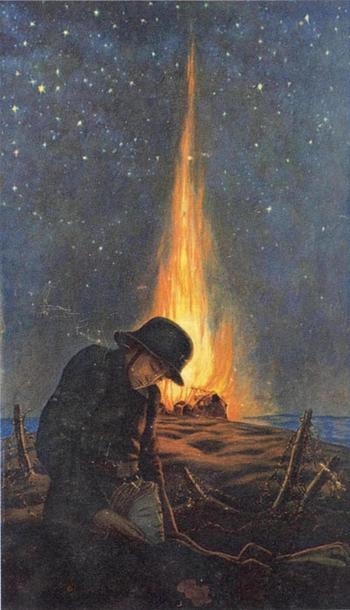
Altar painting, Riesenberg Chapel in Konstanz, Germany, 1925. Source: Stadtarchiv Konstanz, Germany.
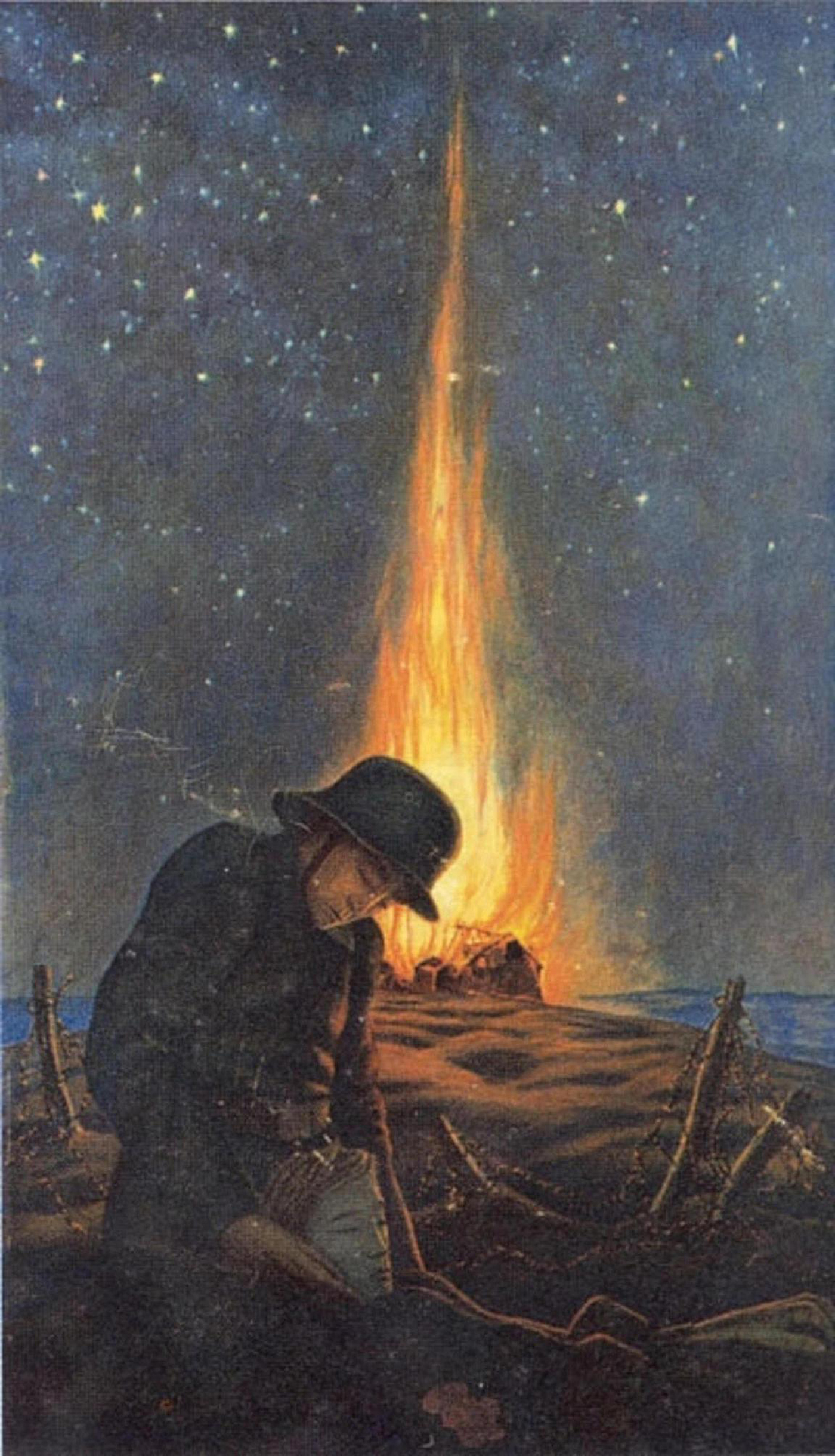
“O, what is man,” lamented former Wehrmacht lieutenant Tim Gebhardt during a memorial service for his regiment's war dead in 1955: “What is virility, when death intervenes and obliterates everything?” Of course, being hurt, physically and mentally, had always been part and parcel of the construction of military masculinity. Initiation into the ranks of “real” men began with indignities and humiliations during the training period—not ending there but shaping the soldier's career until the end. The soldier-man was never fully sure of his “virility.” Accepting this uncertainty and risk of failing, and knowing how to get up again, were precisely what made a man. This knowledge granted at least some certitude amid uncertainty.
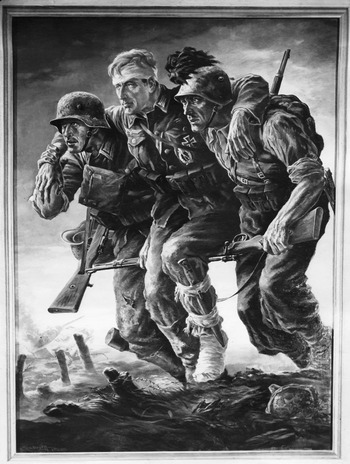
Richard von Rudolph's 1943 painting, Kameraden. Source: Süddeutsche Zeitung Photo Archive (Munich).

The cement of the male community was the shared knowledge of this uncertainty. That is what Tim Gebhardt meant when he apodictically invoked the memory of soldiers’ sacrifice in the East: “The best thing in the life of a man is comradeship.” As Gebhardt explained, comradeship meant empathizing with “the hardships and worries of others,” risking one's life “when it comes down to rescuing a wounded soldier so that he won't fall into enemy hands. And when this wounded man, now a rescued comrade, feels his rescuer gently stroke his hair, just as a mother would, then he can die in peace.” Tender manliness, even crying—otherwise the epitome of unmanliness—became respectable in the presence of death. The sphere of death ensured that the symbolic hierarchies—hardness over weakness—were in effect.Footnote 48
Farnbacher's recorded experience in 1941 and Gebhardt's memento mori of 1955 were indicative of an integrative discourse on masculinities that can be traced back to time immemorial, but that was popularized in Germany only under the impact of World War I.Footnote 49 It reconciled the paradoxes of soldiers’ lives, deaths, and experiences in war. Ideals of hardness, success, and action stood on shaky ground, and weakness, failure, and passivity often prevailed.Footnote 50 Thorak's and Breker's sculptures portrayed superhuman ideals, but did not address the reality of confused, vulnerable, broken, and destroyed masculinity that soldiers had faced in the trenches of the Great War—and that they would face again in the next one.
As John Horne has noted, “‘sacrifice’ became the mostly widely used trope” after the Great War “to express the cost of obeying the norms of militarized masculinity on the battlefield.”Footnote 51 The glory of sacrifice was tied to the traumatic experience of suffering: from death and mutilation, but also from paralysis, powerlessness, and emasculation. The experience of emasculation shattered seemingly stable ideas about “manliness being owned only by men, and femininity only by women.”Footnote 52 As even proud war volunteers and warmongering writers such as Franz Schauwecker admitted, the soldiers often had to contend with a “tender, womanlike sentiment” that needed to be expressed within, not outside of, the army's all-male society.Footnote 53
Men suffered in different ways from the war, and they assigned different meanings to the trope of sacrifice. Whereas some drew pacifist lessons from it, others, such as Jünger, Thorak, or Breker, tied it to a radical cult of martial hypermasculinity. Most men, however, sought inclusive and fluid, rather than exclusive and rigorous, notions of martial masculinity that gave meaning to the ambivalent, ambiguous, and complex desires, emotions, and experiences of men. Inclusive notions of masculinity built bridges over diverging experiences and united disrupted identities, and could be adopted by different types of men fighting together in modern, conscripted mass armies. Such concepts of masculinity even demonstrated how femininity and masculinity could coexist on good terms within one person. The protean fabric of the concept of masculinity allowed soldiers to switch between different emotional and moral states without losing their male identity.
Such balancing acts were not easy, of course. Peter Pfaff, for example, came from a religious family, and he was one of those many young Germans who had managed to combine Christian faith with unconditional support for the Nazi war effort. His military career started at the age of eighteen, when, in April 1943, he began serving with the Reichsarbeitsdienst (National Labor Service). It ended in October 1944 in Latvia on the Eastern Front, where he was killed in action. Pfaff was a noncommissioned officer (NCO) of the Wehrmacht and an officer cadet at the time of his death. Being a soldier meant to Pfaff pursuing one goal: becoming a man. He accepted being pulled out of the “sphere of motherly protection,” embraced the process of self-hardening and toughening, and prided himself on slowly adjusting to and fitting into the community of men. “I can trade stories as they do, join in. They include me fully in their community—slowly I am getting integrated, I can't believe it—what I always wanted,” he noted in his diary right before he was killed. A few days earlier, he had written to his parents (his father had served as well) how he did it: “I need to adjust to the community, need to share everything with them, need to support the community as it is and must not try to change it.” But, in the midst of this tough sociability, homesickness still came to the fore—an “unresolved tension,” in his words. This tension was “suppressed in a manly fashion,” he asserted. Yet, Pfaff added, there was still the tender chitchat with the comrade: “the one you really need, who listens silently,” and who “feels and suffers with you.” He was describing a friend who, in so doing, had replaced motherly love by performing male tenderness.Footnote 54
The term protean refers to the Greek sea god Proteus, who not only watches over the elusive, constantly changing quality of the sea and over the liquidity of water in general, but who can also change his own shape. By extension, the adjective connotes the ability “to change or adapt,” and is synonymous with the words variable or versatile.Footnote 55 Psychologist Robert Jay Lifton has illuminated the nature of the “protean self” that “emerges from confusion” and from being exposed to allegedly “unmanageable historical forces and social uncertainties,” but that does not “collapse under these threats and pulls.” Instead, “it turns out to be surprisingly resilient.”Footnote 56 Protean masculinity worked in the same fashion. It allowed for flexibility and emotional sea changes. But it did not undermine the hegemony of hard martial masculinity; it made it liveable.
Role Sharing and Group Cohesion
The language of femininity, often used to address ambiguous experiences of masculinity, is nevertheless tricky. Performing femininity did not express men's longing for, or appreciation of, actual women.Footnote 57 Instead, the imagery of femininity—effeminacy—enabled men to cope with ambivalent and contradictory emotions, desires, and deprivations. It included whatever did not fit into straight and rigid concepts of manliness, and men (and women) could visit those ambivalences whenever they needed to do so.Footnote 58 Inquiring into “masculinities in disguise,” Todd Reeser has noted further, “effeminacy or other types of non-masculinity may permit a man to better hide masculinity so that he can deploy gender hegemony more effectively.” Men's cross-dressing, for instance, may not serve to render a man “effeminate or womanlike,” but, “paradoxically,” to affirm “masculinity by contrast.” It signifies that “the attempt to incorporate the feminine into or onto the male body is doomed to failure,” and this proves “masculinity's inability to be anything but male.” In short, a man can, in various ways, “deploy effeminacy or woman-like traits for ends that are anything but non-hegemonic.”Footnote 59
The imagery of the family, consisting of a father, a mother, and children, offered a common symbolic tool to address both the male bond's functional differentiation and its patriarchal structure.Footnote 60 In a platoon, the commander assumed the role of the father, and was called Papa. He ruled over the unit rigorously, yet justly, and had an open ear for all and everyone, i.e., for his “children.” Despite occasionally showing empathy, which was coded as feminine, he nevertheless represented the tough, manly side of the military. The sergeant, or an experienced and older private, occupied the second position in the hierarchy of the platoon, usually with a clearly restrained demeanor. Just as the mother operated within the family, taking care of its physical and emotional health, the “mother of the company,” combining sensitivity and severity, took care of its apparel and equipment. In this way, he possessed a “superfine sense” of whether one of his men-children was unwilling or unable to do his job. Anyone unable to do so could count on “motherly” care, whereas anyone who was just unwilling would encounter “motherly” strictness.Footnote 61
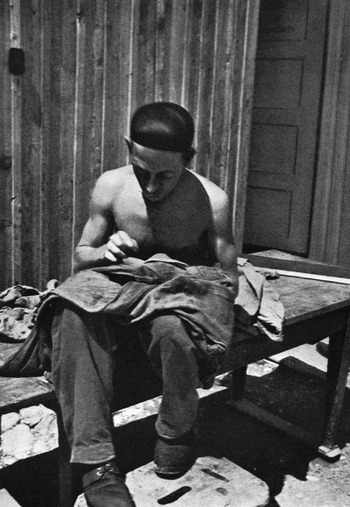
The language of womanhood, femininity, and patriarchal family signaled the inclusion of diverse personalities and emotional conditions, but on a rigidly hierarchical basis. Paramilitary training in the Hitler Youth and the Reichsarbeitsdienst, and then, even more so, in basic training in the army, already introduced young men to an inclusive hierarchy by forcing them to do jobs such as “cleaning, mending, darning, making beds, peeling potatoes, folding the wash,” all of which were “not at all a man's job” but had been done for him at home by his mother. It was ironic that, for a boy to become a real man, he had to become a woman first; this was a core part of military and paramilitary humiliation rituals. Yet, they not only served to teach novices the hierarchy of the male bond, but also provided a lesson in the male bond's social autarky: “A man has to do things by himself. So does the soldier. He is also on his own on the battlefield.”Footnote 62 Embedded in this popular appeal is the kernel of a powerful idea: in an all-male society, the male bond is independent of the rest of the world. In particular, it is independent from women.
“Zu Hause hat Mutter immer gestickt” (At home, stitching was always mother's job). Source: Jesco v. Puttkamer, Deutschlands Arbeitsdienst (Oldenburg i.O.: Stalling, 1933), 24.

By expressing feminine qualities and recreating family-like settings, exclusively male societies did not simply refresh or remember their ties to the civilian world at home. Rather, they imagined themselves as independent from women and families back home—i.e., from civilian society and civilian morality. “Today one of you moms should have been with us,” wrote Fritz Farnbacher to the mother of a fallen comrade, “not to help us, oh no, but to watch us cooking … This is so amazing, watching these gorgeous men, upon whom you can always rely, who always succeed, and with whom you are tied together in a fighting community.”Footnote 63 The message was this: being on their own, men are able to generate a warm sense of family, even if they fight in a cold-blooded fashion shortly thereafter; they are emotionally independent. They may (or may not) miss the world at home, but they now create it themselves.
Demonstrating the independence of male society from the world back home went far beyond performing family-like sociability and solidarity in the face of lethal danger. It culminated, paradoxically, in violating the very morality that the comradely community claimed to honor. An entire set of “manly” rituals, all of which violated domestic and civilian norms, served to confirm the claim for autarky. Demonstrative excessive drinking, bragging about sexual adventures, using misogynic rhetoric in a boasting manner, acting rowdily, even committing collective rape in extreme cases: all of this achieved its social momentum by being staged—practiced, reported, applauded—together. Abusing women in the occupied areas was the ultimate expression of performative masculinity, i.e., it was an extreme assertion of the sovereignty of the male bond.Footnote 64
Gerhard Modersen, whose ego had been boosted in 1934 by the uniform he wore as a Reichswehr recruit (this was the precursor of the Wehrmacht), may not have raped women; at least, his diary does not indicate that he did. He nevertheless practiced and philosophized about the theory of the transgressive nature of the male bond in a decidedly sexist way. For most of the war, Modersen served as an officer with the mobile Feuerschutzpolizei (Fire Protection Police), a branch of the Third Reich's Ordnungspolizei (Order Police). Unhappily married, he found the life of a soldier and police officer often away from home attractive, not only because of the prestige it awarded, but also because there was always a comrade around—someone with whom “you could get up to something [Pferde stehlen] now and then.” This “getting up to something” meant to him one thing: sexual adventures, which he proudly recorded in this personal diary. Frankly admitting on paper to the immorality of his passion, he used the ambivalent concept of masculinity to justify the weakness of the adulterer. In his case, such weakness was not coded femininely, but childishly: “In any man, even in the most mature one, hides the little boy who longs to return to the arms of his mother.” The boy-man, in other words, was immature and thus not fully responsible for what he was doing. But this boyishness defined only a small part of his personality. By no means did it undermine its genuinely manly nature; rather, it received ultimate sanction because it fueled male solidarity. Planning, executing, and enjoying “getting up to something” together, and then trading war stories about it, secured comradeship.Footnote 65
The moral grammar of comradeship always obeyed the same rule: anything that enriched and intensified social life was permissible. Defined simultaneously by its separation from civilian society—reenacting the latter and yet mocking it at the same time—comradeship created a new society from scratch. A new, liminal society seemingly emerged, welding together men with different civilian identities, personalities, and desires, replacing their identities with a new, mutually shared group identity and martial morality that revolved around death, around killing and being killed.
The protean concept of soldierly masculinity secured the male identity of much different soldier-men, such as Peter Pfaff, Fritz Farnbacher, Gerhard Moderson, and Felix Landau, to the extent that they accepted the absolute priority of the group over the self. Elmar Roth, born in 1925 and deeply rooted in the Third Reich in the remnants of the Catholic youth movement, felt unsafe when he entered the paramilitary Reichsarbeitsdienst in 1943—which, after six months, would seamlessly lead into service with the Wehrmacht. Roth was aware of the challenges he would face in Adolf Hitler's army as a dedicated Catholic. But the charismatic leader of his local Catholic youth branch, also a soldier, cheered Roth up and reminded him of the basic rule of military service: “Make sure always to perform selfless comradeship and fulfill your duties, so that everyone sees in you the model of a Christian of Action [Tatchrist]. Then you'll be fine. You'll enjoy all kinds of leeway if you stick to the rules of comradeship.”Footnote 66
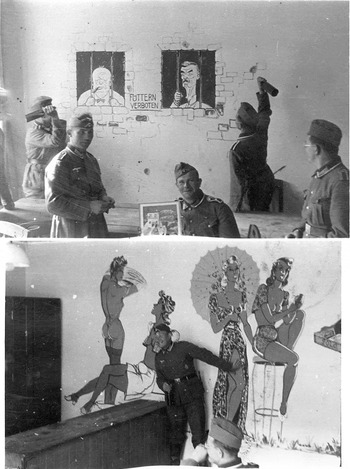
Private photos, taken in the early 1940s in the German casino of Nowy Sącz, in Nazi occupied Poland. Source: Yad Vashem Archive, Jerusalem.

In essence, it was all about fitting in. Accepting the priority of the group's “we” over the individual “I” granted the latter some leeway. This did not mean that all men were equal when it came to assessing their degree of manliness, or that various emotional states were considered equal. Protean masculinity was, in part, tied to subtle, sometimes rigorous hierarchies, which, in turn, fueled the group dynamic. In the summer of 1941, Lieutenant Farnbacher praised the bravado of his regiment's commander, the epitome of a soldier-man: “While all men are on the ground, taking cover from shrapnel and missiles, Lieutenant Colonel Lüttwitz stands upright amid it all during the attack, stoically assessing the situation, pondering the options, eventually making his decisions …, a true leader with sweeping power … None of his men ever saw him dither or yield.” Farnbacher, by contrast, felt “like a rabbit.” He was, on another occasion, similarly in awe of Lüttwitz, who, together with a few men, rescued a German fighter pilot who had bailed out behind enemy lines and fallen into Soviet hands. That “really pepped up the battalion,” Farnbacher remarked.Footnote 67 A practicing Protestant and not much of a hero—certainly no “alpha male” or Nazi—he was proud of serving on the Eastern Front with the prestigious Fourth Tank Division; this, in fact, secured his male identity, which, in daily practice, he enacted mostly in a “motherly” fashion. Farnbacher stood ready to nurse wounded comrades, cook for them, and organize sentimental Christmas parties that reenacted a “motherly” sense of home far away from actual homes and families.
Farnbacher eventually also found what he was really seeking in the army: male identity. So, too, did other soldiers who were more obviously outsiders in Hitler's army. “Now I am blessed with a great new experience. I blend into the society of men [unter die Männer passe]. They have shared with me their best,” Private Jochen Klepper confided to his diary in the fall of 1941 in the East.Footnote 68 Klepper, who was married to a Jewish woman, was eventually ousted from the Wehrmacht. Precisely because of his precarious status in Nazi Germany, the army had meant the world to him. In fact, he experienced it as an anti-world to that of the Nazis. “Among comrades,” he observed, “different opinions are openly discussed. It is the uniform that allows diversity.” In the army, he noted after meeting a traveling soldier in need of accommodation, with whom he then shared his bed—a symbolically charged demonstration of comradeship—“German men” still got along, “leaving aside all partisan issues.” Klepper enjoyed his profound nightly talks with this “very sensible, warmhearted, bright young man,” even though—or because—he was an SA man.Footnote 69
Klepper would soon learn that the open-mindedness of Hitler's soldiers was limited; in fact, the army's widespread antisemitism hit him particularly hard. Numerous anti-Nazi soldiers who had relied on the alleged nonpartisan solidarity of their wartime comrades saw themselves betrayed by ones who later denounced them.Footnote 70 Still, the idea that the all-male society of the army, tied together by the bonds of comradeship and the threat of death, was elevated above the rest of the world—above its political ideologies, above civilian society (or what was left of it under the Nazi dictatorship)—gathered enormous momentum in the Wehrmacht, thus compensating, even if only temporarily or momentarily, for the soldiers’ constant frustrations, deprivations, and mortal fears.
“Joining in” with the group may have secured a spot in the common male bond and bestowed manliness, but not on an equal basis. The contrast between the “rabbit,” Farnbacher, and the commander-hero, Lüttwitz, was just one example of this. A consideration of Himmler's murderous SS Einsatzgruppen, as well as of the mobile police battalions, illuminates another facet of this hierarchical structure. The Nazi machine of annihilation bore a surprisingly high degree of tolerance toward men who shied away from murdering Jews or other unarmed people. When Police Battalion 101 was ordered to murder the Jews of Józefów in Poland in 1942, a minority eagerly agreed. They had internalized what counted in Nazi Germany as the ultimate proof of manliness: the ability to overcome moral restraints and feelings of guilt about murdering Jews, including women and children. Most of the battalion was not able simply to discard those restraints, yet, it still acted as ordered, haunted by pangs of guilty conscience. Another minority refused to participate, neither able nor willing to suppress feelings of guilt. They had to swallow being derided as weaklings, cowards, or Pimpfs (the term for the youngest members of the Hitler Youth, aged ten to fourteen). They were placed at the bottom of an informal hierarchy led by the “tough” guys.Footnote 71
It is important to notice, however, that the “weaklings” were not ousted from the unit. In fact, they avoided that fate precisely by claiming to be “too weak” to commit murder. They had the choice of averring that they were “too good” to participate, but rarely did so. They claimed instead to be too weak—or, they at least accepted being seen that way. This was a crucial difference: it meant that they did not question the symbolic order of the male community, but instead interpreted their own make-up as somehow deviant. They presented themselves as exceptions to the rule of hardness, thereby confirming the rule and accepting the dominance of the alpha males. They avoided being ousted in this way, and instead received a place within that community, though on the lowest level. The all-male society needed weaklings: the German army, just like other armies and paramilitary groups—even Himmler's murderous troops. In a culture of hard masculinity, the weaklings represented the other, which helped make the hegemonic virtues properly visible.Footnote 72
This was the mechanism that kept all kinds of soldiers within the army, even those who were looked at as weak or effeminate—in some cases, even homosexuals, as long as they honored the hierarchy of masculinities and men, i.e., the principle of hegemonic masculinity.Footnote 73 When Klaus Aberg rested at night with his Waffen SS platoon in a railway car, one of his NCO comrades fumbled for Klaus's penis. This did not remain a secret but caused a momentary brouhaha; yet, after a brief deliberation, the group decided to cover up for him, a nice fellow who was otherwise considered a good comrade who generally enlivened and supported the group. Yet, he, too, was forced to align himself with the core concept of hegemonic masculinity: demonstrating control over his body and psyche. From that incident onward, he knew that he had to suppress his homosexual identity and desires.Footnote 74
The Hegemony of Hardness
Protean masculinity allowed men to switch back and forth between manliness and effeminacy, but they could switch back and forth only so far and so often. It did not mean that men could remain in femininely-coded states or activities permanently. Indulging in the occupation of such a state was considered only temporarily legitimate, and it was a state that one was supposed to abandon, to overcome, sooner or later. Protean masculinity remained tied to the workings of hard hegemonic masculinity and its correlates, i.e., toughness, aggressiveness, stoicism, endurance, self-control. “Soft” manliness could be displayed, preferably, if one were ready to prove—or, even better, if one had already proven—one's “hard” manliness. For it was not the soft side of man that defined him, but rather his ability to overcome it—not just once and for all, but again and again.
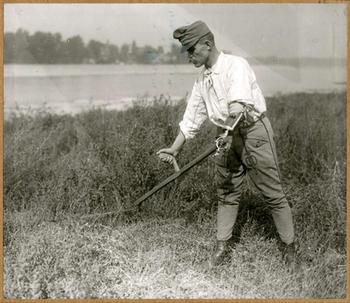
The most prominent links between the two poles of protean masculinity were the experience of suffering and the stoicism required to cope with it. Conjuring up sacrifice did not mean dismissing the hard side of military masculinity; it was all about coping. The cult around prosthetics, which supposedly repaired all kinds of war damage and were used in all countries after World War I, most decisively made this concept of masculinity material. Losing a leg could not destroy manliness, and it certainly need not prevent a man from serving as a breadwinner. Enough technology, tools, and therapies stood ready to reconstruct a man's functionality and power, so that physical harm was not necessarily a lasting threat to masculinity.Footnote 75 The soldier-man faced and admitted to periods of weakness, but he also knew how to overcome them, to get up again, eventually to keep functioning and even fighting—hence the praise of the manliness of the mutilated soldier. “He lost an arm and three fingers on his remaining hand,” Ursula von Kardorff wrote in February 1944 after meeting Colonel Claus von Stauffenberg. But none of this, or the fact that she “had to cut up his meat for him” at dinner, irritated her: it only fueled her adoration for Stauffenberg's “very masculine” appearance.Footnote 76
Photograph of a veteran farmer with an amputated forearm, at work using a prosthesis. Source: Österreichisches Staatsarchiv-Kriegsarchiv, Vienna.

The “very masculine” aura that radiated from Stauffenberg stoically coping with his crippled body may have been a peculiarity of the National Socialist warrior society, but the idea that a war invalid could make up for his physical disability, and thus still embody hegemonic masculinity, was not limited to warhorses like Stauffenberg.Footnote 77 Stefan Schmidhofer, for example, was drafted into the Wehrmacht in 1940 at the age of thirty-one, with no interest at all in soldiering. Though he would have rather pursued his private life as a happily married bricklayer in Bavaria, he adjusted to military culture, to the extent that it was unavoidable, until he lost a leg after being severely wounded on the Eastern Front. Wondering about his future and his marriage, he wrote to his wife from the hospital: “What shall I say? I am no longer the one who swaggers next to you as I did when I was so happy with you. But, my darling, do know that I will remain a man for you. There will be enough fun for you.” He wrote again a while later: “I swear to you, my dearest honey, I love you and only you. I will be your man as you have always had him. No wimp, and no crybaby, mummy, no. I will be your protector with words and deeds whenever you need help.” After losing his ability to overcome physical challenges, Stefan made it clear that he would not give up, but instead overcome his disability by resorting to alternative features of male identity: virility and wisdom.Footnote 78
Schmidhofer's efforts to cope with his physical disability illuminate the power and nature of hegemonic masculinity, which the soldier represented more than anyone else in Nazi Germany. The soldier embodied a willingness to cope with all kinds of denigrations and weaknesses, as well as an ability to rise up again—something that non-soldiers could, of course, claim as well. In line with a more recent stream of inquiry into historical masculinities, the argument here stresses the fluidity and diversity of masculinity more than R. W. Connell's does. The soldier represented hegemonic masculinity in a pure fashion, but there were still a variety of ways to meet that standard. Hitler's Wehrmacht offers a particularly vivid example of this. The army was not equally “nazified” throughout; instead, many units and commanders adhered to and defended traditional military ideals. Masculinity was not defined in that realm by an ability to murder civilians in cold blood, but instead by having the courage to speak up against, or even resist, orders that many men in the Wehrmacht still considered criminal. Yet, toughness, stoicism, and strength, however defined, remained the pinnacle of masculinity in the Third Reich, and the comradely attitude—the willingness to join in—remained the sine qua non of inclusion in the male bond.
Heinrich Böll, who, after the war, became an icon of West German pacifism, refused to fit in, and hence had a difficult time in Hitler's army. Born into a Catholic family, Böll was a twenty-two-year-old intellectual when drafted in 1939. He was the model of an outsider in the army. It was the brawling, obscene, and misogynist sociability of his comrades that bothered him most. “The party last night again made me really aware of my individualism: 130 men herded and squeezed together, sweating, all looking alike and ordered to be happy, boozing and gabbling and bawling … What a torture, these military exhilarations.”Footnote 79 What Böll found bothersome was the military's demand that its members renounce their civilian self for the sake of group cohesion and dynamics. He would have found a like-minded person in Sebastian Haffner, who, in his 1939 memoir, feminized the male bond, mocking the “soft cushions of comradeship” and contrasting it to the “hardness of civilian life.” In the latter, Haffner asserted, individuals were responsible for themselves and had to make decisions on their own, whereas comradeship relieved them from exactly that burden.Footnote 80 In the same spirit, Böll denounced male comradeship as unmanly precisely because it devalued the concept of individuality and individual responsibility. In one letter, he called the community of comrades a “gathering of fishwives,” and, in his 1949 war novel The Train Was on Time, the soldier Andreas found it “terrible being only among men all the time. Men are so womanish.”Footnote 81
Individualists like Böll did not, however, abandon the hegemonic concept of masculinity altogether. Ideal manly hardness could be understood and appropriated in different ways, thus allowing different male personalities to establish their manliness. Reading Ernst Jünger in early 1943, at the time of the Wehrmacht’s military disaster at the Battle of Stalingrad, left Böll fascinated with the heroic warrior who fought ahead of and above the mass of comrades—in Böll's words, “absolutely martially, truly the absolute soldier.”Footnote 82 But that was not all: Böll, like many other Christian believers, especially Catholics, found solace by picturing themselves reenacting the sufferings and sacrifice of Jesus Christ. In this way, even the antimilitarist Böll blended into a grand community, both imagined and experienced, of soldiers whose brawling, cynicism, and aggression were but desperate expressions of never-ending mourning. As Böll saw it, the soldiers grieved not only for their fallen comrades but even more so for their own lost selves, which they had sacrificed on behalf of the army, the war, the Fatherland, and the Volksgemeinschaft. As was the case for most of his fellow soldiers, Böll stayed with the army through at least early 1945—and thus practiced, often consciously, a crucial piece of martial masculinity: the stoicism needed to endure endless pain, deprivation, and desolation.Footnote 83
Conclusion
Hegemonic masculinity in Nazi Germany meant physical, emotional, and moral “hardness.” The ideal man, embodied by the soldier, was tough and aggressive: in control of his body, mind, and psyche. He was also genuinely social. He got along with his comrades whether or not he liked them; comrades were peers who worked together toward reaching a goal, such as fighting enemies on the battlefield or elsewhere. In the racist ideology of the Nazis, hardness included the ability to discard feelings of remorse when it came to murdering civilians and alleged racial enemies of the Volksgemeinschaft.
Hardness also meant sacrificing the self on the altar of the “we,” the Fatherland, or the group of comrades. The type of sociability at stake here was rigidly limited to the in-group, which could be defined in various ways. The charismatic leader, the one who united a group and fuelled the group dynamic, thus epitomized hegemonic masculinity in Nazi Germany just as the fearless heroic warrior had in earlier times. But the male bond needed more than just charismatic leaders. Social cohesion and group effectiveness rely on job sharing—on functional differentiation. The male bond needed different types of men, a diverse set of talents and capabilities, as well as a diverse set of personalities. Hierarchies among different men and their ability to conform to hegemonic standards certainly mattered, but one should not overlook the inclusive dynamic of military masculinities: a broad range of men performing different ideas of manliness were accepted as full-fledged members of the male bond, if they energized its social life and accepted the standard of hardness in principle, if not necessarily always in practice.
Diversity and flexibility were required in the social practice of male interaction. These qualities allowed for the display of femininely-coded affection, for tenderness, empathy, caring, and tolerance toward emotional breakdowns and moments or periods of weakness. Soldiering provided men with a male identity that was not ultimately defined by a repudiation, but rather an integration, of femininity, thus allowing men to experience themselves as whole human beings in a way that seemed, at least to many of them, impossible in civilian life. What eventually counted, when it came to assessing manliness, was the ability to support the social dynamic of the group—by demonstrating heroism on, and rescuing wounded comrades from, the battlefield, or by organizing sentimental Christmas parties afterward.
Thanks to its inclusive nature, this type of soldierly masculinity allowed different types of soldier-men to establish male identities. Its protean nature allowed them to switch between different emotional and moral states—but without losing their manliness. Protean masculinity built bridges across divergent experiences, united disrupted identities, and ultimately even demonstrated how femininity and masculinity, tenderness and toughness, could coexist on good terms within a single man.