I. INTRODUCTION
Since steel working tools face high thermal and mechanical pressure, they are always damaged, which leads to the liberation of some debris. Particles in a loose or compacted form gathered between the contacting surfaces can also happen during the sliding process. Reference Munoz-Escalona, Dıaz and Cassier1 The origin of this wear fragments can be the external contamination to the augmentation of wear fragments. This kind of particles in a tribo-system has been mentioned as “third body” or “tribo-particulate”. Reference Jiang, Stott and Stack2–Reference Colombie, Berthier, Floquet, Vincent and Godet4 Therefore, wear fragments particles are deeply included in the wear processes. Reference Wang, Wei, Wang and Zhao5 Generally, a tribo-layer is formed on worn surfaces. In the most cases, the tribo-layer is considered to be a mechanically mixed layer (MML), which is comprised of materials from both the sliding counterparts. Reference Zhan and Zhang6,Reference Li, Elmadagli, Gertsman, Lo and Alpas7 Thus, the formation of tribolayers is an expected phenomenon during the sliding of metals. Certainly, tribo-oxides appear in air. Hence, the tribolayers are generally referred to as tribo-oxide layers. Reference Ruiz-Andres, Conde, de Damborenea and Garcia8–Reference Wang, Wei, Wang, Cui and Dong11
In fact, transitions in wear with sliding time are basically caused by the improvement of wear-protective layers coming after the compaction of wear fragments particles on the rubbing surfaces. The conformity of the tribo-particulates to each other and to the contacting surfaces plays an efficient role in the quick decline in the value of the friction coefficient. Moreover, friction or externally applied parameters promote the oxidation of the contacting metal or alloy surfaces. Consequently, wear processes can get modified because they are related to the change from metallic fragments to oxide fragments. An advantageous consequence of the third body was detected to be a role of normal load and reciprocating amplitude. Reference Iwabuchi12 The total oxide particles behaved as free abradants, which accelerated the wear of the rubbing surfaces, in a specific range of load and amplitude. Behind certain conditions, affording the oxide particles was efficient to wear protection thanks to the quicker creation of compact oxide layers. In constant sliding wear experiments, were in general decreased by the introduction of oxide particles essentially by an element of three. Reference Iwabuchi, Kubosawa and Hori13 It is worthy to note that the amount of oxide formed during a test at high-temperature friction is much more significant than that obtained in the case of the static oxidation. Reference Berthier, Godet and Brendle14 Stott actually, the mechanical distortion can result in huge oxidation of surfaces. Reference Barnes, Wilson, Stott and Wood15 Besides, the chemical motion of the small metallic particles can be stimulated during a distortion, which may clarify the big amounts of the created oxide. Otherwise, the created oxide on the metal surface was accomplished in brief regime. Reference Stott and Wood16 Many functional situations of this kind of oxidation have been investigated over the previous 45 years. The multitude has been issued with the oxidation provoked by frictional heat during room temperature unidirectional sliding. Reference Eyre and Maynard17–Reference Merz, Brodyanski and Kopnarski19 For instance, at higher speeds, the rubbing surfaces construct successive oxides about the contact areas. Reference Panin, Kolubiev, Tarasov and Popov20 In fact, the sliding speed of at least 1 m/s may create an electrical discharge temperature on the edge of 700 °C. In the oxidizing delicate wear system, the oxidation investigated at the level of contact points is the result of the friction and then the created oxide increases until achieving an important density. Lim and Ashby announced that beyond 10 m/s, the oxidation gets so crucial and then it the consequence of the shift for a method of hard oxidizing wear. Reference Lim, Ashby and Brunton21 In this procedure, the oxide gets concentrated and moves on to liquid state. In spite of room temperature, metal-on-metal sliding is always followed by an opening period of wear beyond a transition to a lower wear degree, named mild wear. This shift is supported by several parameters, like low sliding speed, low load, and elevated degrees of oxidation. Furthermore, there is a shift in temperature (whether it is an ambient temperature or surface temperature because of the frictional heat) for several metals and alloys. The reason behind this contribution is to evaluate some wear mechanisms concerned with drawing process at room temperature by the friction of X40CrMoV5 hard high-alloyed steel against soft Fe360B steel.
This research work was carried out with pin-on-disc tribometer with an open sliding contact. The function of wear fragments particles during sliding in the wear procedure and the combination of the involvement of wear fragments particles in wear-protection were discussed.
II. EXPERIMENTAL DETAILS
A. Tribological test
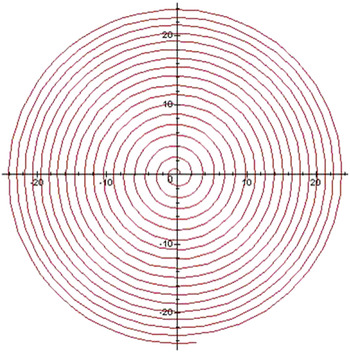
The tests were conducted with a specific high temperature pin-on-disc tribometer with an open sliding contact on a constantly refreshed disc surface. Reference Mnif, Baccouch, Elleuch and Richard22 The machine is based on an open contact at high temperature. The high-temperature tribometer was presented before. Reference Marzouki, Kowandy and Richard23,Reference Baccouch, Mnif, Elleuch and Richard24 The pin was conformed to a translation movement (v) by a direct unit. Its removal was mechanically managed by thrusts. The pin began from the center of the disc and cross to the edge. The disc moved in rotary direction (ɷ) managed by an electric motor. The normal load (F) and the rotary sliding speed (ɷ) were retained invariable. The experiment lasted 60 s on each disc. The same test parameters were used for all the specimens: ambient temperature; 5, 10, 15, N for the normal charge; 25, 50, 75–100 rpm for the rotation speed; 1–128 mm/s for the sliding speed; 1500 mm for the sliding distance. The obtained trajectory was spiral (Fig. 1).
Analytic spiral trajectory of the wear traces. Reference Marzouki25

After each experiment and to distinguish the damage procedure, wear surfaces were examined by a scanning electronic microscope (SEM) followed by an energy-dispersive ray (EDX). A Philips XL30 ESEM-FEG (FEI Company, Hillsboro, Oregon) environmental sample was made into practice for these investigations.
B. Materials
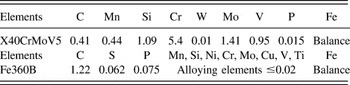
The X40CrMoV5 high alloy steel was used as a pin in this study. The pin steel was studied in quenched and tempered conditions. The Fe360B steel disc were representing drawing products. The disc was 45 mm diameter and 2 mm in thickness. The heat approaches were accomplished to realize a primary hardness of 47 HRC with tempered martensitic microstructure. The contact surface area was 1.5 mm. The arithmetic average roughness (R a) of the disc and the pin was 1.53 and 1.72 µm, respectively. Table I shows the chemical elementary composition of X40CrMoV5.
Chemical elementary composition of X40CrMoV5 high alloyed steel and Fe360B ultra high carbon steel (in weight percent, wt%).

III. RESULTS AND DISCUSSION
A. Friction behavior of X40CrMoV5/Fe360B
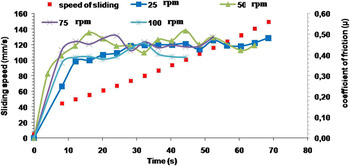
Figure 2 shows the evolution of the coefficients of friction versus time for the tribological test under a rotation speed (ɷ) passing from 25 to 100 rpm, at room temperature and under a normal load of 70 N. It can be noted that four frictiogrammes are evolving at the same way. Indeed, at the beginning of the test, these coefficients of friction increase until reaching a stable value after approximately 15 s for a test at 25 rpm.
Evolution of the friction coefficient and the speed of sliding as function time for different rotation speeds of the disc at (T = RT, F = 70 N).

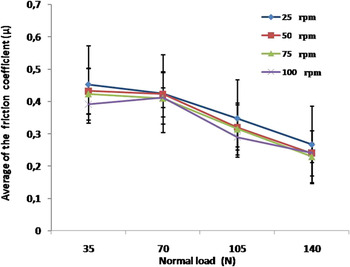
Figure 3 presents the evolution of the coefficient of average friction according to the rotation speed of the disc at a different normal. The friction coefficient decreases when the sliding speed increases for every normal load. This evolution of the friction coefficient was so much also observed by Savaskan et al. Reference Savaskan and Alemdag26 and He et al. Reference He, Lin and Chen27 However, it is necessary to note that the sliding and load speeds are the most influential parameters on the average value of the friction coefficient. Indeed, they have shown that the speed of sliding and the time are parameters that influence the mechanisms of degradation of steels with tools. The authors have also explained the decrease of the friction coefficient according to the speed. The important temperatures reached in the contact at high rotation speed lead to the decrease of the average friction coefficient.
Evolution of the average of the friction coefficient as a function of time for different rotation speeds (ɷ) of the disc and different normal loads at (T=RT).

B. Observations and analysis of the wear surfaces X40CrMoV5 pin
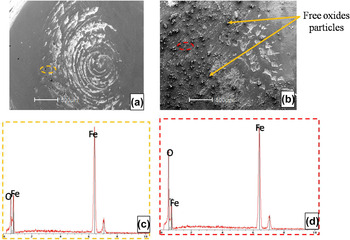
To compare the effect of the rotation speed, we tried to keep the same distance of sliding for the entire tribological test. At room temperature in a rotation speed (ɷ = 25 rpm), the contacting surface of the X40CrMoV5 presents a layer of the third compacted body [Fig. 4(a)]. In the case of the rotatory speed of the pin (ɷ = 100 rpm) [Fig. 4(b)], the third particles of oxides was pulverulent and ejected outside the contact. The EDS analysis of the surface of the pin confirms that oxides are in the contact, at room temperature. These triboparticulates were mostly from the disc Fe360B.
SEM Observation and EDS analysis of the surface pin X40crMoV5 rubbed against Fe360B as a function of the rotation speed of the disc at (T = RT, F = 70 N). (a) ω =25 rpm, (b) ω = 100 rpm, (c) EDS analysis, (d) EDS analysis.

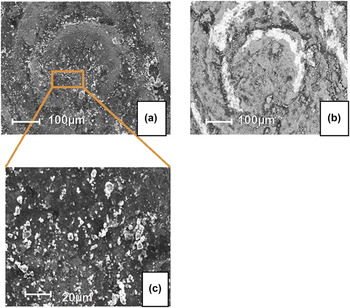
In the case of Fig. 5, the third body formed on the surface of the pin consists at the same time of pulverulent ejected particles [Fig. 5(c)] and a compacted layer of oxides correspondent in whitish zone of the SEM observation of Fig. 5(b). Thus, enhancing the normal load and the rotation speed apparently makes the quantity of oxides on the surface of the pin increase. Reference Barrau, Boher, Gras and Rezaï-Aria28
Surface analysis of the X40CrMoV5 pin (T = RT, F = 105 N, ω = 50 rpm). (a) SEM–SE mode (secondary electron—topographical contrast), (b) SEM–BSE mode (back scattered electron–chemical contrast), (c) detail.

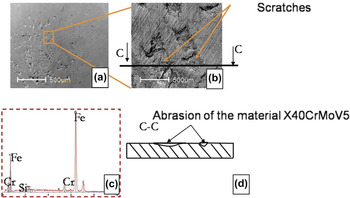
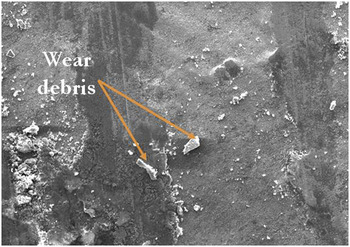
Figure 6 illustrates the surfaces of X40CrMoV5 pin rubbed against a Fe360B disc, at room temperature, at different loads of rotation of the disc (ɷ = 25 rpm). We notice an important abrasion on the surface of the X40CrMoV5 pin [Fig. 6(b)] under a normal load of 140 N. The deformed layer on the surface would be more important with the increase of the applied load. Reference Straffelini and Molinari29 Indeed, for all studied loads, independently of the decrease of the mechanical properties, the triboparticulates in this test were produced from the oxidation of debris of metal particles made from the X40CrMoV5 pin [Fig. 6(c)]. Thus, the wear of the pin was affected by the presence of debris particles. In fact, during sliding, wear debris particles were generated by the relative motion under load. The wear mechanism of the pin is the severe wear, as shown schematically in Fig. 6(d).
Worn surface of the X40CrMoV5 pin (T = RT, F = 140 N, ω = 25 rpm). (a) Surface analysis of the pin, (b) detail, (c) EDS analysis, (d) schematic representation.

C. Observations and analysis of the wear surfaces Fe360B disc
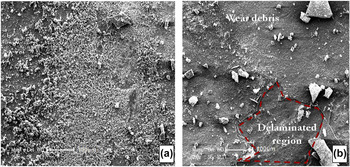
Figure 7 shows the analysis of the wear of the surface of the disc Fe360B at room temperature under a normal load of 70 N and two sliding speeds of 25 rpm and 100 rpm. There is debris free oxides [Fig. 7(a)]. The actual contact surface has a vitreous appearance characterized by a plastic deformation. The increase of the speed of rotation of the disc increases the contact temperature between the first two bodies. This result leads to the formation of larger oxide particles [Fig. 7(b)]. We also note the presence of an oxidized debris compacted in the surface of the disc Fe360B at a high speed (ɷ = 100 rpm). There is an abrasion of the surface of the track caused by the presence of metal debris, which is detectable by delaminated regions.
Worn surface of the disc Fe360B (T = RT, F = 70 N) (a) ω = 25 rpm, (b) ω = 100 rpm.

Figure 8 shows the SEM morphology of worn surfaces after an open sliding contact at room temperature. In the wear tracks surface deformation, ripped traces and longitudinal grooves parallel to the sliding direction can be observed.
Worn surface of the Fe360B disc (T = RT, F = 140 N, ω = 25 rpm).

In fact, due to the low temperature, the tribolayer was incompact and weak. Hence, this surface was delaminated, which converges with the results reported by other researchers. Reference Barrau, Boher, Gras and Rezaï-Aria28,Reference Straffelini and Molinari29 Commonly, the tribooxide layers have a protective role due to the unfavorable Pilling–Bedworth ratio and the internal stresses resulted from the mismatch in the thermal expansion between the subsurface alloy and the oxide. Reference Pauschitz30
D. Wear debris
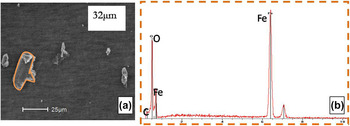
The generation of wear debris was observed for all tribological tests under different conditions. We are interested in analyzing the debris of the test in X40CrMoV5 steel pins on tracks in Fe360B at room temperature, under normal load of 140 N. For each test, recovered debris was taken with a scalpel, and then it was diluted in pure ethanol at 95%. After that, the obtained solution was filtered through a Millipore provided with mounting Isopore® polycarbonate filters of porosity 0.4 µm. The particles were subsequently separated and can be observed electron microscope scanning environmental effect [Fig. 9(a)]. The EDS analysis of the debris show that this triboparticulate are from the disc Fe360B [Fig. 9(b)].
(a) Micrographies of wear debris (F = 140 N, ω = 50 rpm), (b) EDS analysis.

IV. CONCLUSIONS
The purpose of this study was to identify the origin of oxides detected in the extreme surface to clarify the mechanisms that operate in the ambient temperature for various speed rotations. The importance of tribo-layers, at room temperature for different speed rotation, in wear and its implications for wear protection were discussed. The decrease of the friction coefficient mainly resulted from the development of wear-protective layers following the compaction of wear debris particles on the rubbing surfaces. Tribo-oxidation can have, on the one hand, a beneficial effect on reducing wear during the sliding of metals and alloys, particularly by preventing metal–metal contact. The heat required for oxidation can be induced by friction. On the other hand, it can be detrimental since during high-speed and load, the surface temperatures may cause the melting of the oxide, leading to severe oxidation wear at the surface of the pin.
In the future, it will be very interesting to highlight the wear mechanism phenomena in our open contact for the studied couple X40CrMoV5/Fe360B at high temperature.
ACKNOWLEDGMENTS
The authors would like to acknowledge the help of SOPAL Society (Tunisia), especially its head manager for his precious aid and contribution to this research.