Introduction
Promotive voice is a type of citizenship conduct that entails conveying thoughts to advance organizational functions and improve the status quo (Duan, Kwan, & Ling, Reference Duan, Kwan and Ling2014; Liang, Farh, & Farh, Reference Liang, Farh and Farh2012). The constructive focus of promotive voice encourages employees to form new associations, innovatively combine different views, and use co-workers' expertise to energize ensuing ideas (Harvey, Reference Harvey2014). It also helps firms seek unique perspectives to facilitate innovation (Zhou & George, Reference Zhou and George2001), improve the quality of decisions, and catalyze essential changes. Given its positive outlook and outcomes, extant research mainly focuses on positive antecedents of promotive voice, such as core self-evaluation, felt responsibility, organizational commitment, psychological safety, ethical leadership, and leader openness (Chamberlin, Newton, & Lepine, Reference Chamberlin, Newton and Lepine2017).
In this study, we espouse a slightly different viewpoint by concentrating on a critical source of organizational input that may influence and hinder promotive voice: co-worker ostracism, defined as employees' perception of exclusion when they face the silent treatment, get excluded from conversations, or feel left out of collective events by colleagues (Hitlan, Cliffton, & DeSoto, Reference Hitlan, Cliffton and DeSoto2006). This could be a distressing act as targeted employees feel incapacitated with regard to building linkages with co-workers, and unable to integrate different perspectives to solve problems and offer resolutions (Rink, Kane, Ellemers, & Van der Vegt, Reference Rink, Kane, Ellemers and Van der Vegt2013). As a result, research into co-worker ostracism is pervasive in practice as well as in academic research, and demands continued consideration (Scott, Zagenczyk, Schippers, Purvis, & Cruz, Reference Scott, Zagenczyk, Schippers, Purvis and Cruz2014; Wan, Chan, & Chen, Reference Wan, Chan and Chen2016; Yang & Treadway, Reference Yang and Treadway2018).
We seek to investigate an unmapped feature that underlies the association between employees' perception of co-worker ostracism and their promotive voice, namely organization-based self-esteem (OBSE), defined as ‘the self-perceived value that individuals have of themselves as organization members acting within an organizational context’ (Pierce, Gardner, Cummings, & Dunham, Reference Pierce, Gardner, Cummings and Dunham1989: 625). Prior studies have shown that OBSE is positively associated with job satisfaction, organizational commitment, job involvement, in-role job performance, and organizational citizenship behavior, but negatively linked to depression (Bowling, Eschleman, Wang, Kirkendall, & Alarcon, Reference Bowling, Eschleman, Wang, Kirkendall and Alarcon2010; Pierce, Gardner, & Crowley, Reference Pierce, Gardner and Crowley2016). Here, we specifically propose that (1) an important reason why exposure to co-worker exclusion may hinder employees' promotive voice is their threatened perception of self-esteem and proficiency as an organizational associate (Pierce & Gardner, Reference Pierce and Gardner2004), and (2) this process, in turn, is mitigated by their emotional stability, a dispositional feature that helps them display positive psychological characteristics, such as self-confidence, resilience, adaptability, and positive affect (McCrae & Costa, Reference McCrae and Costa1991).
To present our hypothetical claims concerning this implied effect of co-worker exclusion on employees' promotive voice through OBSE, and the mitigating role of emotional stability in this process, we rely on self-consistency motivational theory (Korman, Reference Korman1970). This theory proposes that employees build their self-esteem around social and organizational encounters, which impacts their work outcomes. In an organizational context, employees with high self-worth nurture a favorable work outlook while those with low self-esteem uphold damaging work attitudes and display irresponsible organizational behaviors. Hence, employees may regulate their OBSE to match their job attitudes or behaviors. Although the number of studies developed to test self-consistency motivational theory is substantial (e.g., Lau, Lam, & Wen, Reference Lau, Lam and Wen2014; Wu, Birtch, Chiang Flora, & Zhang, Reference Wu, Birtch, Chiang Flora and Zhang2018; Wu, Liu, Kwan, & Lee, Reference Wu, Liu, Kwan and Lee2016), there is a lack of research that has utilized this context to examine the connection between employees' perception of co-worker ostracism and their promotive voice.
First, we expect that co-worker exclusion will harm employees' OBSE, which in turn will discourage them from offering any constructive suggestions to improve future organizational performance (Svendsen, Unterrainer, & Jønsson, Reference Svendsen, Unterrainer and Jønsson2018). Consistent with recent research, we find that being ostracized by colleagues signals employees' decreased worth to the organization, marked by a devaluation in their OBSE (Chan, Huang, Snape, & Lam, Reference Chan, Huang, Snape and Lam2013).
The self-consistency motivational mechanism also posits that employees' perception of co-worker exclusion may be associated with reduced OBSE to the degree to which they perceive ostracism. Consistent with this logic, we recommend that employees' emotional stability could protect against their threatened sense of self-worth, signaled by reduced OBSE in response to co-worker exclusion, which in turn diminishes the likelihood of hindered promotive voice. Previous research suggests that emotionally stable employees tend to withstand stress and have a positive outlook on life, which helps them cope with adverse work conditions (Henle & Gross, Reference Henle and Gross2014). Formally, when employees have emotional stability, the adverse effect of co-worker exclusion on their OBSE should be attenuated (Li & Ahlstrom, Reference Li and Ahlstrom2016).
Combining the abovementioned arguments, we seek to make the following contributions to existing research. First, we extend the literature by highlighting a unique source of social exclusion in the workplace: co-worker ostracism (Williams, Reference Williams2007). Emerging research suggests that the identification of disparate employee reactions to a distinct source of ostracism (e.g., supervisor, co-workers) may help us adopt specific interventions to minimize its negative impact (Hitlan & Noel, Reference Hitlan and Noel2009). Second, we discuss promotive voice, illustrating the degree to which employees share innovative suggestions about organizational thinking, procedures, and practices, through sharing knowledge with co-workers (Liang, Farh, & Farh, Reference Liang, Farh and Farh2012). We understand that an explanation of the different causes which help or hinder promotive voice may offer support in reconciling its alternative views and dimensionality (Maynes & Podsakoff, Reference Maynes and Podsakoff2014). Third, we apply self-consistency motivational theory to elucidate that employees' perception of co-worker exclusion may hinder promotive voice due to their impaired OBSE. Fourth, we investigate when this translation of perceived co-worker exclusion into reduced OBSE might be less likely to occur. We propose that employees' emotional stability may buffer the harmful effect of co-worker ostracism on their perception of self-worth in an organizational context, which in turn may enhance their promotive voice. By considering this buffering role of emotional stability, we extend previous studies which observe the mitigating effects of other valuable resources on social exclusion, such as ingratiation and political skill (Wu, Yim, Kwan, & Zhang, Reference Wu, Yim, Kwan and Zhang2012), psychological capital, gender (Hitlan, Cliffton, & DeSoto, Reference Hitlan, Cliffton and DeSoto2006), 360-degree feedback and negative reciprocity beliefs, moral disengagement (Zhao, Xia, He, Sheard, & Wan, Reference Zhao, Xia, He, Sheard and Wan2016), and construal level (Pfundmair, Lermer, Frey, & Aydin, Reference Pfundmair, Lermer, Frey and Aydin2015). Finally, using a three-wave time-lagged data collection approach, this study reduces common method bias (Podsakoff, MacKenzie, & Podsakoff, Reference Podsakoff, MacKenzie and Podsakoff2012), and allows us to address the challenges highlighted by Bowling et al. (Reference Bowling, Eschleman, Wang, Kirkendall and Alarcon2010) to conduct studies that are not purely cross-sectional in nature. Our theoretical structure and its constitutive hypothesis are summarized in Figure 1.
Conceptual model.

Theoretical foundations and concepts
Workplace ostracism and promotive voice
Feeling ostracized is incredibly unpleasant for an individual, and has many negative effects on both personal and organizational levels. For the purpose of this study, we define ostracism as employees' perception of exclusion when they face the silent treatment, get excluded from conversations, or feel left out of collective events by colleagues (Hitlan, Cliffton, & DeSoto, Reference Hitlan, Cliffton and DeSoto2006). According to existing research, co-worker exclusion encourages interpersonal forms of counterproductive work conduct (Hitlan & Noel, Reference Hitlan and Noel2009), job-induced tension, psychological withdrawal, depression, health problems (O'Reilly, Robinson, Berdahl, & Banki, Reference O'Reilly, Robinson, Berdahl and Banki2014), social loafing, and compensation (Williams & Sommer, Reference Williams and Sommer1997), but it discourages job performance. Prior studies have also demonstrated a discouraging linkage between workplace ostracism and voice or communication of helpful views, issues, or thoughts about job-associated matters (Burris, Detert, & Chiaburu, Reference Burris, Detert and Chiaburu2008; Wu et al., Reference Wu, Qu, Zhang, Hao, Tang, Zhao and Si2019). It is therefore a topic that has generated a considerable amount of research (Howard, Cogwsell, & Smith, Reference Howard, Cogwsell and Smith2020).
Conversely, promotive voice is generally considered a desirable behavior for organizations. For this study, we view promotive voice as a form of citizenship behavior that entails voicing thoughts and opinions to advance managerial operations and challenge the status quo (Duan, Kwan, & Ling, Reference Duan, Kwan and Ling2014; Liang, Farh, & Farh, Reference Liang, Farh and Farh2012). Promotive voice is prosocial, productive, and allows for employees to offer and combine unique perspectives that facilitate innovation, and generate new ideas (Harvey, Reference Harvey2014; Zhou & George, Reference Zhou and George2001).
Self-consistency motivational theory
We argue that self-consistency motivational theory is a useful lens through which to examine co-worker ostracism, and to develop this study's hypotheses. Self-consistency motivational theory postulates that employees build their self-esteem around social and organizational events, which impacts their work outcomes, and it was first applied in an organizational context by Korman (Reference Korman1970). Subsequent to its initial publication, this theory has been extended (Korman, Reference Korman1976) and applied to several studies that address the subject of ostracism.
Our arguments stem from the theory's original hypotheses and assumptions (Korman, Reference Korman1970, Reference Korman1976). Its first hypothesis declares that people are inspired to perform in a manner that is consistent with their self-image. The second hypothesis states that individuals will find that the jobs and roles that are the most satisfying are those that are consistent with their self-cognitions. In this case, individuals will choose situations and tasks that align with their self-perceptions, should these individuals perceive themselves as competent and need-satisfying (Korman, Reference Korman1970, Reference Korman1976).
This theory has been employed in several studies pertaining to OBSE, workplace ostracism, and behavioral outcomes (Chung & Yang, Reference Chung and Yang2017). People have a propensity to engage in performances that are consistent with their self-perception. Therefore, employees with high organization-based self-worth nurture a favorable work outlook while those with low OBSE uphold damaging work attitudes and display irresponsible organizational behaviors. Since organization-based self-worth can be modified through ongoing interactions and evaluations with peers, the resultant perception of being ostracized may negatively impact an employee's OBSE, and the employee may adjust their performance to be consistent with their OBSE. This is explored further in the development of the study's hypotheses below.
Hypotheses
Mediating role of employees' OBSE
In many workplaces, co-workers act as valuable sources of support as they interact with each other on a daily basis, share extensive contact, and contribute toward positive everyday workplace experiences (Thoits, Reference Thoits2011). Studies report that perception of co-worker support increases job satisfaction and affective organizational commitment (Rousseau & Aubé, Reference Rousseau and Aubé2010), but decreases turnover intentions (Ducharme, Knudsen, & Roman, Reference Ducharme, Knudsen and Roman2008), job stress, and role overload (Chou & Robert, Reference Chou and Robert2008).
Unfortunately, not all co-workers support one another, as ostracism is a prevalent aspect of human and work life. This rejection by colleagues thwarts employees' self-esteem, making them feel as though they have undesirable characteristics, or that they have done something wrong (Williams, Reference Williams2001). Ostracism by co-workers signals to employees: (1) they are not respected and valued (Leary, Schreindorfer, & Haupt, Reference Leary, Schreindorfer and Haupt1995), and (2) they are less competent organizational members (Scott et al., Reference Scott, Zagenczyk, Schippers, Purvis and Cruz2014). Moreover, continued ostracism can make employees feel that it is inescapable, and that they have lost their own identity (Williams & Sommer, Reference Williams and Sommer1997). In line with self-consistency motivational theory, employees' perception of co-worker ostracism threatens their perceived significance as corporate members, indicated by their reduced OBSE. We thus hypothesize the following:
Hypothesis 1: Employees' perception of co-worker ostracism relates negatively to their OBSE.
Self-consistency motivational theory also states that individuals will align their work performance with their OBSE (Korman, Reference Korman1970). Recent work has found that OBSE can lead to positive voicing behaviors (Chung & Yang, Reference Chung and Yang2017). Along these same lines, we anticipate a constructive association between employees' OBSE and their promotive voice as employees with high self-worth may be more willing to participate in their work environment (LePine & Van Dyne, Reference LePine and Van Dyne1998). In other words, employees with an elevated degree of OBSE are better disposed to engage in prosocial behaviors to preserve cognitive consistency (Chung & Yang, Reference Chung and Yang2017; Korman, Reference Korman1976).
However, employees with reduced OBSE could feel discouraged from offering any constructive ideas for improved organizational performance. According to self-consistency motivational theory, any downward change in employees' OBSE may motivate them to act in accordance with their negative perception (Ferris, Lian, Brown, Pang, & Keeping, Reference Ferris, Lian, Brown, Pang and Keeping2010). Thus, excluded employees' endangered sense of worth within their organization may encourage them to withhold expressions of ideas, focused on long-term improvements and innovation, to maintain their cognitive balance (Qin, DiRenzo, Xu, & Duan, Reference Qin, DiRenzo, Xu and Duan2014). Hence, we may suggest the following hypothesis:
Hypothesis 2: Employees' OBSE relates positively to promotive voice.
The blend of these first two propositions indicates a significant mediating function of employees' OBSE, such that their motivation for self-consistency, linked with co-worker exclusion, hinders promotive voice due to their devalued worth in the work setting (Leary & Guadagno, Reference Leary, Guadagno, Vohs and Baumeister2004). Employees who experience ostracism may refrain from proposing ways of changing the status quo through promotive voice because they internalize their precarious self-worth as an organizational member. Empirical studies reveal a mediating role of OBSE between mentoring and organizational citizenship behavior (Ghosh, Reio, & Haynes, Reference Ghosh, Reio and Haynes2012), perceived negative workplace gossip and citizenship behavior focused toward the organization and its affiliates (Wu et al., Reference Wu, Birtch, Chiang Flora and Zhang2018), perceived overqualification, and counterproductive acts at work (Liu, Luksyte, Zhou, Shi, & Wang, Reference Liu, Luksyte, Zhou, Shi and Wang2015). We broaden this investigation by suggesting that employees' self-perceived organizational status mediates the association between perceived co-worker exclusion and promotive voice. In brief, the experience of co-worker exclusion is flawed because it evokes persistent signals of self-devaluation within an organization (Lin, Chen, Ashford, Lee, & Qian, Reference Lin, Chen, Ashford, Lee and Qian2018), which in turn discourages employees from proposing any new solutions to question the existing state of affairs (Liang, Farh, & Farh, Reference Liang, Farh and Farh2012). Accordingly, we may propose the following hypothesis:
Hypothesis 3: Employees' OBSE mediates the association between their perceptions of co-worker exclusion and promotive voice.
Moderating role of emotional stability
Additionally, we anticipate employees' emotional stability to have a moderating effect on the association between perceived co-worker ostracism and OBSE. This moderation is suggested both in self-consistency motivation theory and in extant research (Bowling et al., Reference Bowling, Eschleman, Wang, Kirkendall and Alarcon2010; Howard, Cogwsell, & Smith, Reference Howard, Cogwsell and Smith2020; Li & Ahlstrom, Reference Li and Ahlstrom2016). The theory contends that the effect of unfavorable work conditions is buffered when employees can compensate for the loss of OBSE through their propensity to show positive characteristics, such as self-assurance, regulation, flexibility, forbearance, and positive affect (Li, Chun, Ashkanasy, & Ahlstrom, Reference Li, Chun, Ashkanasy and Ahlstrom2012).
Research on the antecedents of ostracism has found that personality traits have a significant effect on the level at which an individual feels victimized due to workplace ostracism; thus, emotional stability may be a factor of this relationship (Howard, Cogwsell, & Smith, Reference Howard, Cogwsell and Smith2020). Emotionally stable employees may be sensitive to promotive voice for instrumental as well as relational reasons. First, such employees could be more confident in their ability to suggest valuable changes (Ormel et al., Reference Ormel, Jeronimus, Kotov, Riese, Bos, Hankin and Oldehinkel2013). They may appreciate the opportunity to share their voice and offer opinions to improve the present circumstances (Liang, Farh, & Farh, Reference Liang, Farh and Farh2012). The second reason for this potential moderating effect is relational. Emotionally stable individuals are calm and stable (Johnson, Rogers, Stewart, David, and Witt, Reference Johnson, Rogers, Stewart, David and Witt2017). Moreover, they often convey positive feelings toward co-workers and have friendly relations with them. Their high job satisfaction could stimulate an eagerness to share ways of improving work practices and procedures within organizations (LePine & Van Dyne, Reference LePine and Van Dyne2001).
In particular, employees high in emotional stability can cope well with unfavorable job situations and offset their unfavorable circumstances by staying focused on task-relevant activities (Connor-Smith & Flachsbart, Reference Connor-Smith and Flachsbart2007), thereby successfully adjusting to variations in the organizational setting. As a result, employees' emotional stability should enhance their ability to cope with adverse effects of perceived co-worker ostracism and facilitate their successful adaptation to this situation (Nelis, Quoidbach, Hansenne, & Mikolajczak, Reference Nelis, Quoidbach, Hansenne and Mikolajczak2011). That is, their emotional stability should enable them to deal better with threatened OBSE that comes with perceived co-worker ostracism (Rogosch & Cicchetti, Reference Rogosch and Cicchetti2004). By contrast, employees low in emotional stability are less able to defend themselves against the difficulties that accompany co-worker exclusion because they are more adversely affected by taxing job environments (Li & Ahlstrom, Reference Li and Ahlstrom2016). Accordingly, these employees are more prone to act on perceptions of co-worker exclusion with reduced OBSE to remain consistent in their approach. Thus, we propose the following:
Hypothesis 4: The negative association between employees' perception of co-worker exclusion and OBSE is moderated by their emotional stability, such that the association is weaker at higher levels of emotional stability.
The abovementioned arguments also signify the process of moderated mediation (Preacher, Rucker, & Hayes, Reference Preacher, Rucker and Hayes2007), such that employees' emotional stability operates as a contingent factor of the indirect effect of co-worker ostracism on promotive voice, through their OBSE. For employees who can gain from optimistic psychological characteristics, such as emotional stability (Brebner, Reference Brebner2001), impaired OBSE offers a less critical mechanism to explain why social exclusion by co-workers might hinder promotive voice. This is suggested by the self-consistency motivational theory in two ways. First, self-esteem related to a job or task is developed through both the persistent expectations of peers and learning opportunities, and employees who can focus their attention on learned experiences with the task rather than negative employee interactions may remain consistent in their OBSE. Second, the motivation to maintain self-consistency, in the face of perceptions of co-worker exclusion, turns out to be a less explicatory reason for diminished promotive voice if employees have emotional stability that permits them to manage such unpleasant work conditions.
In comparison, to the extent that employees possess low emotional stability, reduced OBSE becomes a more critical factor that explains how social exclusion by co-workers hinders promotive voice. Employees with low emotional stability mostly lack self-assurance (Judge, Erez, Bono, & Thoresen, Reference Judge, Erez, Bono and Thoresen2002), and hence may feel reluctant to express any ideas relating to improvement within their organization (LePine & Van Dyne, Reference LePine and Van Dyne2001). Such employees are also known to have poor interactions with their co-workers so are disposed to offer harsh comments which makes them susceptible to receive adverse comments in return. Consequently, employees with low emotional stability may be less involved in speaking up and voicing their ideas (Ohana, Reference Ohana2016).
Hypothesis 5: The indirect association between employees' perception of co-worker exclusion and their promotive voice through OBSE is moderated by their emotional stability, such that this indirect association is weaker among employees with higher emotional stability.
Method
Sample and procedure
We gathered time-lagged (i.e., three-wave) data from full-time employees working in four service sector organizations (financial services, healthcare billing, transportation, data and communications) in North America. Collecting time-lagged data from the same participants allowed us to use time-separation (an interval of 4 weeks) between each wave. We used Qualtrics, an online market research sample aggregator for data collection processes. This company utilizes sophisticated digital fingerprinting technology to avoid duplication and to safeguard validation of data. It offers incentives based on the length of the survey, the respondents' profiles, and the target attainment difficulty.
We offered an informed cover letter to describe the significance of our study and assure respondents about the privacy of data to lessen their assessment anxiety. At time 1, we contacted a total of 507 upper-, lower-, and middle-level employees to collect their responses on the topics of co-worker ostracism and emotional stability. We received 430 completed questionnaires with respondents' login identification. After a gap of one month, we contacted those 430 employees again to gather their responses on OBSE. This time, we received 371 responses. Next, we approached these 371 respondents to obtain their reports about promotive voice. We ultimately received 352 completed surveys, of which we could match 344 with employee responses. Thus, our three-wave data helped us prevent common method bias and social desirability concerns (Podsakoff, MacKenzie, & Podsakoff, Reference Podsakoff, MacKenzie and Podsakoff2012).
Given that we collected data from four different service organizations, we therefore tested the homogeneity of variances through Levene's test (Brown & Forsythe, Reference Brown and Forsythe1974) before combining it from the varied sources. Our calculated value of Levene's test of homogeneity of variance came out to be insignificant (p > .05). Thus, we based our analysis on 344 finalized sets of answers, suggesting a response rate of 68%. Nearly 63% of the respondents were male, with a mean age of 37 years (SD = 8.07), and serving a varied range of management positions (top-level = 9%, middle-level = 35%, or lower-level = 56%). Approximately 14% of the respondents had been working for their existing firm for less than 1 year, 18% for 1–5 years, 34% for 5–10 years, 18% for 10–15 years, and 16% for more than 15 years. In terms of qualifications, the respondents either had an undergraduate degree (47%) or a graduate degree (53%).
Measures
We utilized adapted scales with 5-point Likert anchors (1 = strongly disagree to 5 = strongly agree) to gather data relevant to the study variables.
Co-worker ostracism
Co-worker ostracism was gauged using a 7-item subscale assessing employees' perception of being excluded by their co-workers (Hitlan & Noel, Reference Hitlan and Noel2009). Sample items included ‘Co-workers shutting you out of their conversations’ and ‘Co-workers interacting with you only when they are required to do so’ (Cronbach's α = .73).
Emotional stability
We assessed emotional stability with a 10-item questionnaire (Li & Ahlstrom, Reference Li and Ahlstrom2016). We gathered all responses on a 6-point scale (1 = strongly disagree to 6 = strongly agree). In our survey, we asked participants whether they experienced chaotic emotions easily, using questions such as ‘Can you recover from unhappiness quickly and not be influenced by it?’. The respondents were further asked if they could recover from negative emotions quickly, using sample items such as ‘Do you get anxious easily?’ (reverse coded) (Cronbach's α = .85).
Organization-based self-esteem
We measured employees' OBSE utilizing a 10-item scale (Pierce et al., Reference Pierce, Gardner, Cummings and Dunham1989). Example items included ‘I am valuable around here’ and ‘I am helpful around here’ (Cronbach's α = .93).
Promotive voice
We assessed this form of voice on a 5-item scale (Liang, Farh, & Farh, Reference Liang, Farh and Farh2012). The statements included ‘Proactively voice out constructive suggestions that help the unit reach its goals’ and ‘Proactively suggest new projects which are beneficial to the work unit’ (Cronbach's α = .92).
Control variables
Extant studies suggest that gender, age, and designation may be important correlates of one or more of our key dependent variables – OBSE and promotive voice (e.g., Bowling et al., Reference Bowling, Eschleman, Wang, Kirkendall and Alarcon2010; Liang, Farh, & Farh, Reference Liang, Farh and Farh2012). Following previous studies and analysis of variance results, we statistically controlled for age (in years), gender (1 = female), and designation (0 = lower-level, 1 = middle-level, and 2 = top-level management). For further scrutiny, we performed our analysis with and without control variables and found comparable outcomes (Becker, Atinc, Breaugh, Carlson, Edwards, & Spector, Reference Becker, Atinc, Breaugh, Carlson, Edwards and Spector2016).
Analysis
We used structure equation modeling (SEM) with analysis of a moment structures (AMOS 21) using maximum likelihood estimation to assess the coherence of the model with our observations. There are several key benefits of using SEM. First, it offers optimal comprehension of the analyses by highlighting clear and testable assumptions behind the statistical analyses. Second, it recommends complete assessment of model fit and individual parameter estimate tests at the same time. Third, it suggests a contrast of regression coefficients, means, and variances across multiple between-subject groups. Finally, it ensures that measurement and confirmatory factor analysis models are utilized to eliminate inaccuracies.
Utilizing a two-step analytical approach to measure the hypothesized mediation model (Anderson & Gerbing, Reference Anderson and Gerbing1988), we first examined our measurement model using confirmatory analysis (CFA), absolute fit indices (χ2, RMSEA, SRMR), and comparative fit indices (CFI and TLI). Next, we performed a sequence of CFAs to verify the discriminant validity of variables collected through identical sources. In this context, we contrasted a two-factor unconstrained model with a single-factor constrained model for every possible pair of variables from the same source (Anderson & Gerbing, Reference Anderson and Gerbing1988). We present the result of the CFAs in Table 1, highlighting that in every comparison, the unconstrained multiple-factor model renders a superior fit than the single-factor or constrained model. The values of the fit indices fall within an acceptable range, signifying a good model fit. Further, each measurement item had significant factor loadings (ranging from .72 to .88) on their respective constructs, supporting the presence of convergent validity of the four focal constructs (Gerbing & Anderson, Reference Gerbing and Anderson1988). We then validated our mediation hypotheses with bootstrapping using ‘PROCESS’ macro model 4 to examine mediation. Lastly, we employed ‘PROCESS’ macro models 1 and 7 to test for moderation and moderated mediation (Hayes, Reference Hayes2013).
Results of confirmatory factor analyses

n, 344; χ2, model chi-square; df, degrees of freedom; CFI, comparative fit index; GFI, goodness of fit index; NFI, normed fit index; TLI, Tucker–Lewis index; RMSEA, root mean square error of approximation. Best model fits are given in bold.
Results
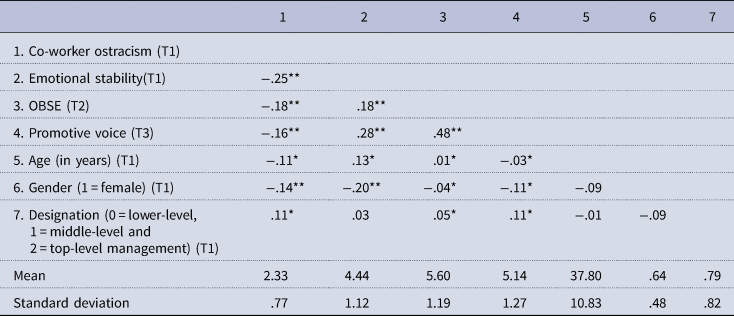
We present the descriptive statistics, bivariate correlations, and reliability estimates for all measures in Table 2. Applying SPSS 23.0 to run our bivariate correlation analysis between the focal variables, we find that co-worker ostracism is negatively associated with the mediator, OBSE (r = −.18, p < .01), and the outcome variable, promotive voice (r = −.16, p < .01). OBSE is strongly positively correlated with the dependent variable, promotive voice (r = .48, p < .01).
Correlation table and descriptive statistics

n, 344; OBSE, organization-based self-esteem; control variables, age, gender and designation.
T1 = Time 1; T2 = Time 2; T3 = Time 3.
*p < .05; **p < .01.
Next, we analyzed alternative models to compare the results of model fit. First, we tested our full mediation model, which incorporated indirect paths between co-worker ostracism and employees' promotive voice, through OBSE. Then, we tested a partial mediation model indicating direct and indirect paths between co-worker ostracism and employees' promotive voice. Finally, we tested a direct effects model which evaluated a direct path from co-worker ostracism and OBSE to employees' promotive voice. The results signified that the partial mediation model provided the best model fit results (χ2 = 212.61, df = 138, χ2/df = 1.54, CFI = .98, NFI = .95, TLI = .98, SRMR = .06, and RMSEA = .04) as compared to other models (Table 3).
Fit of different models

n, 344; χ2, model chi-square; df, degrees of freedom; CFI, comparative fit index; GFI, goodness of fit index; NFI, normed fit index; TLI, Tucker–Lewis index; SRMR, standardized root mean square residual; RMSEA, root mean square error of approximation.
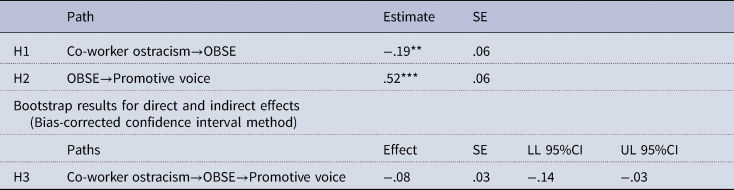
Our first hypothesis H1 predicted a direct and negative association between co-worker ostracism and OBSE (β = −.19, p < .01). The second hypothesis H2 predicted a positive connection between OBSE and employees' promotive voice. The results provide strong support for this hypothesis (β = .52, p < .001). After analyzing the direct paths from co-worker ostracism to OBSE and OBSE to employees' promotive voice, we tested mediation hypotheses using the indirect effect bootstrapping confidence interval method using ‘PROCESS’ (Hayes, Reference Hayes2013). Hypothesis 3 projected that OBSE mediates between co-worker ostracism and employees' promotive voice. The results of the bootstrapping bias-corrected 95% confidence interval indicate that indirect effects are significant through OBSE (−.08, CI [−.14, −.03]).
Hypothesis 4 proposed a moderating role of emotional stability between co-worker ostracism and promotive voice. We assessed multicollinearity between predictors through tolerance statistics (Tabachnick, Fidell, & Ullman, Reference Tabachnick, Fidell and Ullman2007) and variance inflation factor (VIF) scores (Hair, Black, Babin, Anderson, & Tatham, Reference Hair, Black, Babin, Anderson and Tatham1998). We found that the VIF scores came out to be less than 2 (tolerance >.7) in all analyses, confirming that multicollinearity was not an issue for the moderation analysis. We used the bias-corrected 95% bootstrapping confidence interval method using model 1 of ‘PROCESS’.
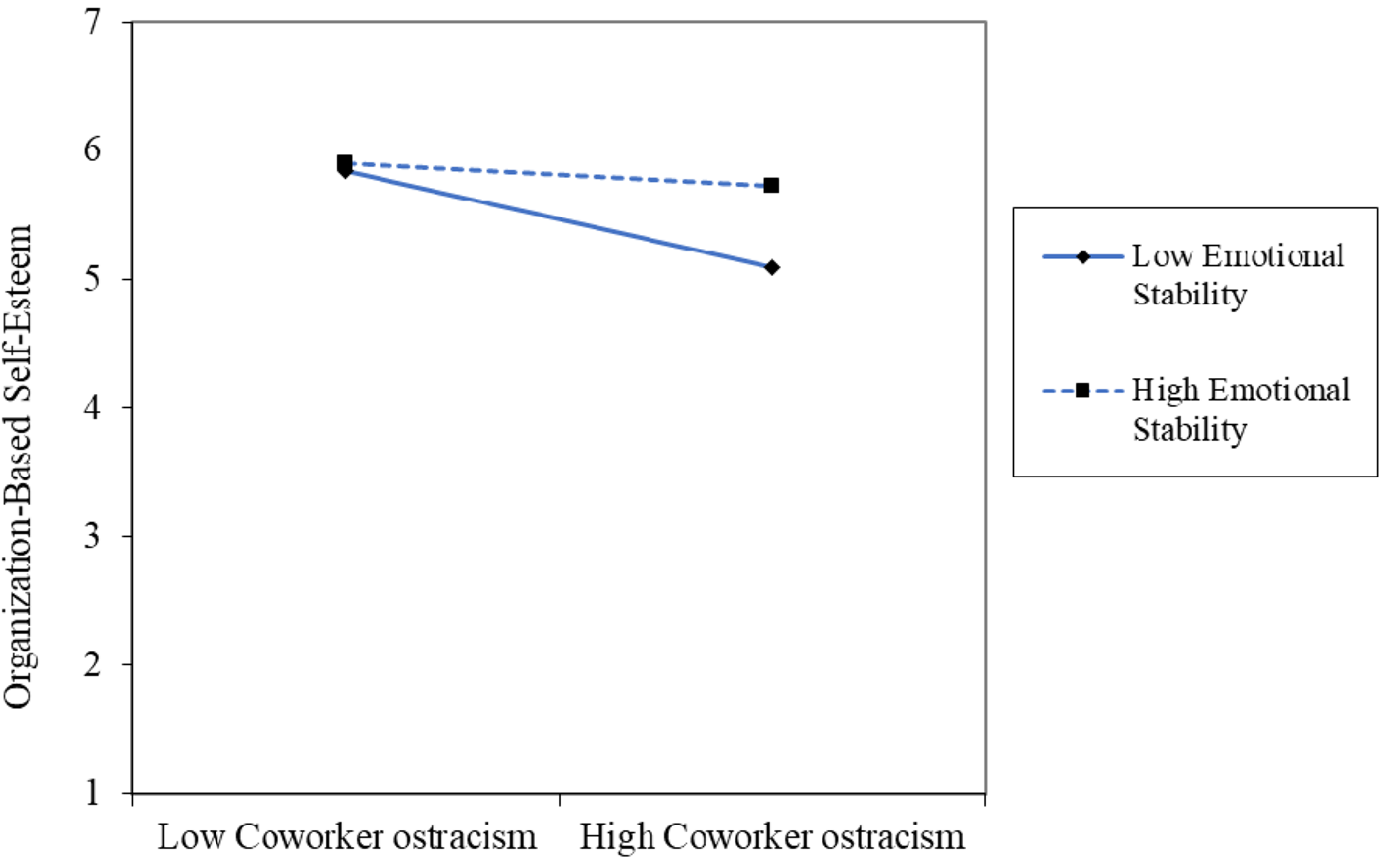
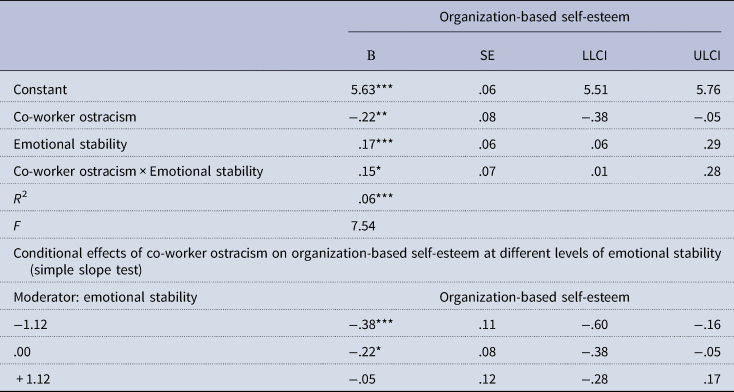
The results revealed that emotional stability significantly moderated the positive relationship between co-worker ostracism and promotive voice (β = .15, p < .05, CI [.01, .28], R 2 = .06, p < .001). The slope test has shown that at + , −1 SD, the β values were in the proposed direction as given in Table 4. All moderation results were based on mean-centered variables. In the case of OBSE, the slope test has shown that at low values (−1 SD) of emotional stability, a solid negative association occurs between co-worker ostracism and OBSE (β = −.38, p < .001, CI lacks 0 [−.60, −.16]), while this connection is not significant at high levels ( + 1 SD) of emotional stability (β = −.05, p > .05, CI includes 0 [−.28, .17]). The importance of this interaction term is additionally shown by the Johnson–Neyman method, with a moderator value (.31) that has 38% data above and 62% data placed below the region. This result has been plotted in Figure 2 and Table 5.
Moderating effect of emotional stability on the relationship between co-worker exclusion and organization-based self-esteem.

Result for partial mediation model

OBSE, organization-based self-esteem; SE, standard error; LL, lower limit; CI, confidence interval; UL, upper limit.
n = 344; ***p < .001, **p < .01.
Unstandardized regression coefficients are reported. Bootstrap sample size = 5,000. 95% confidence interval.
Moderation analysis

LL, lower limit; CI, confidence interval; UL, upper limit.
n = 344; *p < .05; **p < .01; ***p < .001.
Unstandardized regression coefficients are reported. Bootstrap sample size = 5,000. 95% confidence interval.
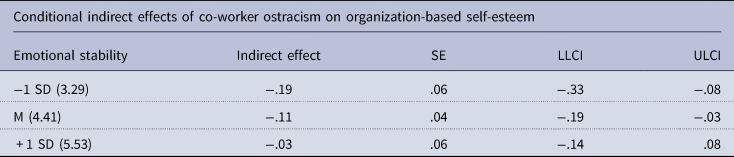
The moderated mediation analyses outcomes indicated that the conditional indirect effect of co-worker ostracism on employees' promotive voice through OBSE was significant at the medium (mean) and low levels (−1SD) of the moderator ([−.19, −.03] and [−.33, −.08], respectively). However, it contained zero ([−.14, .08]) at a high ( + 1SD) level of emotional stabilityFootnote 1. We also assessed moderated mediation directly, by observing the index of moderated mediation and its matching confidence interval (Hayes, Reference Hayes2015). This index equaled .07 and its confidence interval excluded 0 ([.04; .16]). Overall, these results indicate that emotional stability mitigates the negative indirect effect of perceived co-worker exclusion on promotive voice, through OBSE, confirming Hypothesis 5 and the study's theoretical structure (Table 6).
Moderated mediation results across levels of emotional stability

LL, lower limit; CI, confidence interval; UL, upper limit.
n = 344; Unstandardized regression coefficients are reported. Bootstrap sample size = 5,000.
Discussion
This study promotes existing research by evaluating how employees' perception of co-worker ostracism hinders their promotive voice, with a particular emphasis on an indeterminate factor that influences this process. Despite some consideration being given to how social exclusion by co-workers might hamper voice (Burris, Detert, & Chiaburu, Reference Burris, Detert and Chiaburu2008), there are relatively few studies on why employees' perception of co-worker exclusion might hinder promotive voice, let alone the critical role of OBSE in this regard. To address these knowledge gaps, we have drawn from self-consistency motivational theory (Korman, Reference Korman, Erez, Kleinbeck and Thierry2001) to suggest that (1) the possibility of hindered promotive voice in response to co-worker exclusion might surface because employees perceive a threat to their self-esteem pertinent to the organization (Scott et al., Reference Scott, Zagenczyk, Schippers, Purvis and Cruz2014), and (2) their emotional stability mitigates this association. Our empirical outcomes generally prove these theoretical estimates.
This study therefore offers the unique perspective that an important reason why employees who perceive co-worker exclusion become more likely to avoid promotive voice is that they undervalue their adequacy as an organizational member (Gardner, Van Dyne, & Pierce, Reference Gardner, Van Dyne and Pierce2004). Co-worker ostracism is defined as employees' perception of being excluded by their colleagues when they face silent behavior, feel left out of discussions, or feel excluded from group events (Hitlan, Cliffton, & DeSoto, Reference Hitlan, Cliffton and DeSoto2006). It signals that some employees are not valued or respected by other members of the organization. Thus, employees who experience being ostracized by colleagues – that is, ignored in crucial email chains, excluded from social outings, or denied eye contact in meetings (Robinson, O'Reilly, & Wang, Reference Robinson, O'Reilly and Wang2013) – are likely to perceive reduced self-worth in an organizational context, captured through OBSE (Lin et al., Reference Lin, Chen, Ashford, Lee and Qian2018).
Moreover, employees' threat to OBSE in response to co-worker ostracism is mitigated by their emotional stability, defined as a dispositional trait that helps them control emotions, manage impulses, and handle life's trials (Ho, Cheung, You, Kam, Zhang, & Kliewer, Reference Ho, Cheung, You, Kam, Zhang and Kliewer2013). According to self-consistency motivational theory, the threatened self-evaluation drawn from unfavorable work situations is mitigated by employees' emotional stability (Henle & Gross, Reference Henle and Gross2014). Thus, the degree to which employees who feel excluded by colleagues can draw from their propensity to show self-assurance, flexibility, resilience, forbearance, and positive affect, serves as a protective mechanism that diminishes the threat to their OBSE. When employees are emotionally stable, the adverse effect of co-worker exclusion on promotive voice through endangered OBSE is attenuated (Johnson et al., Reference Johnson, Rogers, Stewart, David and Witt2017). Further, emotionally stable employees who perceive themselves as appreciated and capable (Judge et al., Reference Judge, Erez, Bono and Thoresen2002) may feel valued in adverse work situations as the personality trait might reduce the perceived threat to their organization-based self-worth.
Ultimately, the buffering impact of emotional stability on the association between co-worker exclusion and employees' perceived self-worth is distinctly intuitive when contemplated with the mediating effect of OBSE. As our investigation into the presence of moderated mediation revealed (Preacher, Rucker, & Hayes, Reference Preacher, Rucker and Hayes2007), the power of the indirect effect of co-worker ostracism on promotive voice through employees' OBSE is contingent on their emotional stability. Put simply, the disappointment that stems from co-worker rejection transmutes less potently into diminished promotive voice, through OBSE, to the extent that employees are emotionally stable and hence less anxious (Zhao, Reference Zhao2011).
We understand that emotionally stable employees may be drawn toward promotive voice for instrumental as well as relational reasons. For instance, such employees may be not only convinced about their capacity to make useful contributions but also satisfied with such opportunities (Avery, Reference Avery2003). The second reason is that emotionally stable individuals are calm and stable (Johnson et al., Reference Johnson, Rogers, Stewart, David and Witt2017), often expressing positive attitudes toward colleagues and having collegial dealings with them. Their high job satisfaction could predispose them to offer ideas for constructive change in their organization (LePine & Van Dyne, Reference LePine and Van Dyne2001).
In sum, this research offers a more inclusive awareness of the factors that report the linkage between co-worker exclusion and promotive voice. We broaden existing research by revealing how (1) OBSE or employees' self-perceived value as an organizational fellow (Wu, Ferris, Kwan, Chiang, Snape, & Liang, Reference Wu, Ferris, Kwan, Chiang, Snape and Liang2018) serves as a crucial mechanism that connects this source of professional hardship with promotive voice, and (2) employees' emotional stability helps to contain this process. In this way, the results expand on previous research into the direct beneficial effect of employees' emotional stability on job satisfaction and job performance (Judge & Bono, Reference Judge and Bono2001), group leadership, job self-efficacy, and commitment (Li & Ahlstrom, Reference Li and Ahlstrom2016). In particular, the benefits of emotional stability, as demonstrated in this research, may also be more indirect in that employees who have superior emotional regulation skills are better able to handle an unfavorable work situation, such as co-worker ostracism. In general, we contend that the damaging effect of ostracism by co-workers in hindering promotive voice, through threatened OBSE, can be better contained by employees' emotional stability that counters their rejection by colleagues.
Limitations and future research
We recognize that this investigation is not without its shortcomings, which in turn indicates the potential for further research avenues. First, we acknowledge that our method of data collection, i.e. three-wave time-lagged data, is different from longitudinal data as it only allows for time-separation between different data, collected from the same participants. Second, we focused on OBSE as an essential expounding mechanism that underlines the detrimental effect of co-worker exclusion on promotive voice, responding to requests for specific inquiries into why this kind of workplace adversity might engender harmful behaviors (Wu et al., Reference Wu, Qu, Zhang, Hao, Tang, Zhao and Si2019). It would be exciting to investigate other unmapped mediators, namely psychological safety, social support, organizational identification, detachment (Chamberlin, Newton, & Lepine, Reference Chamberlin, Newton and Lepine2017), and disengagement (Leary, Koch, & Hechenbleikner, Reference Leary, Koch, Hechenbleikner and Leary2001). In a related manner, we did not directly gauge the hypothesized mechanism that links employees' perceptions of co-worker exclusion and OBSE, namely the loss of self-perceived value. Even though this mechanism is anchored in the well-recognized self-consistency motivational theory, according to which employees who suffer from workplace adversity may try to guard their self-worth by altering their OBSE, further investigations could measure this mechanism directly.
Third, our investigation of emotional stability as the central contingency feature that mitigates the indirect association between co-worker exclusion and promotive voice might be expanded by considering additional dispositional traits. For instance, personal influences, namely psychological capital (Luthans, Avolio, Avey, & Norman, Reference Luthans, Avolio, Avey and Norman2007), relational self-concept (Jian, Kwan, Qiu, Liu, & Yim, Reference Jian, Kwan, Qiu, Liu and Yim2012), core self-evaluation (Judge, Locke, & Durham, Reference Judge, Locke and Durham1997), and mindfulness (Glomb, Duffy, Bono, & Yang, Reference Glomb, Duffy, Bono and Yang2011), might safeguard against the conversion of perceived co-worker exclusion into reduced OBSE and subsequent promotive voice too. Also, organizational features that offer positive context, such as supervisory support, may avert the dissatisfaction felt by the experience of co-worker ostracism from hindering promotive voice (Lee, Reference Lee2003).
Finally, our results are based on organizations that operate in North America. Accordingly, it would be useful to conduct cross-country assessments that measure the significance of co-worker exclusion in threatening OBSE and the consequential effect on promotive voice, along with the usefulness of basic moderators, in social settings that differ from North America. These contrasts may help describe the influence of cultural features on the central variables of this study.
Practical implications
This analysis offers numerous pragmatic suggestions. The perception of co-worker exclusion – which includes some co-workers facing silent behavior, getting excluded from conversations, or feeling removed from group events (Hitlan, Cliffton, & DeSoto, Reference Hitlan, Cliffton and DeSoto2006) – creates reduced self-worth in employees and discourages promotive voice; as a consequence, organizations must facilitate critical preventative measures. For instance, firms may pair new employees with buddy mentors who could brief them on task-associated proficiencies and professional opportunities (Treadway, Ferris, Duke, Adams, & Thatcher, Reference Treadway, Ferris, Duke, Adams and Thatcher2007). Moreover, administrators could alter job designs to initiate highly interdependent procedures, encouraging employees to seek cooperative targets (Li, Xin, Tsui, & Hambrick, Reference Li, Xin, Tsui and Hambrick1999). Lastly, organizations may train employees in conflict management proficiencies to ensure that they avoid using social exclusion to resolve conflict (Wu et al., Reference Wu, Yim, Kwan and Zhang2015).
Perhaps this research is most insightful for companies that cannot ignore the perception of social exclusion. In particular, emotionally stable employees are better suited to handle the perception of social exclusion by co-workers. That is, emotional stability reflects a critical disposition that organizations can leverage to fortify threatened OBSE and improve subsequent promotive voice when co-worker exclusion is unavoidable. Organizations that can count on employees' emotional stability are better prepared to protect themselves against employees' threatened sense of OBSE when they perceive co-worker ostracism, so their associated need to utilize promotive voice is hindered. Thus, the employment and retention of employees who score high on the emotional stability scale offer enormous benefits to firms that cannot wholly eliminate situations in which employees recognize they are being socially rejected by their colleagues (Bailey & Gulko, Reference Bailey and Gulko2014).
In addition to hiring and retaining employees with an emotionally stable personality, organizations affected by the perception of co-worker exclusion could also benefit from investigating ways that could help employees nurture a propensity to remain self-confident, composed, and free from vacillating and troubling emotions. For example, research has shown that employees are more likely to improve their emotional stability in two ways. First, organizations could encourage employees to participate in mindfulness training programs (Glomb et al., Reference Glomb, Duffy, Bono and Yang2011). Second, they could offer employee assistance programs in order to provide professional counseling. Such options may be especially helpful for employees who experience the negative spillover of emotions from their personal to professional lives.
Conclusion
This research has sought to expand previous inquiries into co-worker exclusion by analyzing the influence of employees' experience of this hostile job situation on their promotive voice, along with the roles of OBSE and emotional stability. Employees' perceived threat to OBSE signifies a critical reason why beliefs about co-worker exclusion reduce promotive voice. Still, the effectiveness of this clarifying process is weaker when employees have emotional stability. We foresee that this study will help encourage more research into how companies can escape the damaging effects of co-worker ostracism in the workplace.
Acknowledgement
This research was supported by Memorial university startup funds, reference number: 20192995.