INTRODUCTION
Hand hygiene (HH) adherence remains suboptimal and challenges exist worldwide for effective strategies to promote sustainable healthcare worker (HCW) HH practices.Reference Pittet, Allegranzi and Boyce 1 – 2 Factors associated with HH adherence include HCW characteristics, units of work, number of HH opportunities per hour of patient care, and facility factors.Reference Pittet, Allegranzi and Boyce 1 – Reference Eiamsitrakoon, Apisarnthanarak, Nuallaong, Khawcharoenporn and Mundy 4 Barriers associated with successful HH interventions include HCW knowledge and attitude toward HH after patient contact, perceived control over HH behavior, and awareness of being observed, as well as facility factors such as lack of soap, paper towels, or handwashing agents; irritation and dryness of hands after HH; and sink access.Reference Pittet, Allegranzi and Boyce 1 – Reference Sax, Uçkay, Richet, Allegranzi and Pittet 5
Effective behavioral-based HH strategies have been reported across a variety of settings. Reference Marra, Guastelli and de Araújo 6 – Reference Marra and Edmond 9 A recent study of HCW HH reported correlation between observed HH adherence and self-reported commitment to HH using the stages of change construct from the Transtheoretical Model of Health Behavioral Change (TTM).Reference Eiamsitrakoon, Apisarnthanarak, Nuallaong, Khawcharoenporn and Mundy 4 The construct focuses on categorical stages of HH commitment as the adoption of a healthy behavior stratified on the basis of the TTM stage of changes (eg, Pre-contemplation, Contemplation, Preparation, Action, Maintenance).Reference Eiamsitrakoon, Apisarnthanarak, Nuallaong, Khawcharoenporn and Mundy 4 The purpose of this study was to compare 3 HH intervention strategies stratified by HCWs’ self-reported baseline stage of behavioral commitment to HH adherence at a Thai tertiary care center.
METHODS
Setting
The study was conducted at 6 intensive care units (ICUs) at Thammasat University Hospital in central Thailand. There was an average of 45 admissions per month to each ICU, with a mean patient-to-nurse ratio of 2.5:1 per ICU. Each unit was equipped with 1 alcohol-based handrub canister at each bedside and sink; each nurses’ station had 2 alcohol-based handrub canisters and a sink with soap and paper towels. Education on the World Health Organization’s (WHO) Five Moments for Hand Hygiene (5MHH) was provided to all HCWs every 3 months as a routine infection control policy.Reference Eiamsitrakoon, Apisarnthanarak, Nuallaong, Khawcharoenporn and Mundy 4 The study was approved by the Human Research Ethics Committee of Thammasat University, Pathumthani, Thailand.
Study Design and Data Collection
To evaluate the utility of TTM-based behavioral theory to improve HH, a 2-year quasi-experimental study was performed with preintervention period (P1) from January 1, 2012, through December 31, 2012, and postintervention period (P2) from January 1, 2013, to December 31, 2013. Computer-generated randomization of 6 ICUs was to 1 of 3 strategies: HH education by the infection control division every 3 months (S1; n=2 units); intensified HH interventions by the study investigators (S2; n=2 units); or intensified HH interventions together with increased availability of alcohol-based handrub at all bedsides, nursing stations, physician working stations, and procedure stations (S3; n=2 units). Intensified HH education included monthly education that emphasized HH adherence and impact on patient safety, as well as weekly workgroup discussions exploring reasons for not performing HH among HCWs with different behaviors. These discussions aimed to promote incremental commitment to the 5MHH. Observed 5MHH performances among HCWs were based on the WHO 5MHH recommendations, and the data-gathering instrument was adapted from these recommendations to record patients’ characteristics such as isolation status, infection status, and underlying diseases.Reference Sax, Allegranzi, Chraïti, Boyce, Larson and Pittet 10 The outcomes of this study included the overall HH adherence and the HH adherence stratified by HCWs’ baseline TTM stages of commitment. To minimize the Hawthorne effect, 1 study investigator (T.E.) who was not involved in routine infection control practice conducted the HH observations and collected the study data. During the 24-month study period, the staff of all ICUs were not involved in the design of the study intervention or aware of comparative interventions in other ICUs.
Behavioral-Based Theories: TTM Stages of Change
In TTM, the 5 main stages of change are Pre-contemplation, Contemplation, Preparation, Action, and Maintenance. Pre-contemplation was defined as an HCW not intending to change commitment to 5MHH in the next 6 months based on agreement with “I do not comply with HH at each healthcare encounter that is required because I won't” or “I do not comply with HH at each healthcare encounter that is required because I can't.” Contemplation was defined as an HCW who self-reported awareness of potential commitment to HH and potential intention to commit to the behavior in the next 6 months based on agreement with the statement, “I may comply with HH at each health care encounter that is required and I plan on doing so within the next 90 days.” Preparation was defined as an HCW who intended to practice 5MHH within the next month based on agreement with the statement, “I may comply with HH at each health care encounter that is required and I plan on doing so within the next 30 days.” Action was defined as an HCW who had committed to 5MHH within the past 6 months based on agreement with the statement, “I comply with HH in each healthcare encounter that it is required and I have been doing so for less than 6 months.” Maintenance was defined as an HCW who continued to commit to the 5MHH and was working to prevent relapse in an interval of at least 6 months based on agreement with the statement, “I comply with HH in each healthcare encounter that is required and I have been doing so for more than 6 months.”
Each ICU HCW was informed of the study and consented to participate in the study. The interview guide for data collection included the HCW demographic profile, self-report of the stage of commitment to 5MHH, and any reported obstacles for noncompliance with 5MHH. Questionnaires were tested for reliability and internal validity as previously reported.Reference Eiamsitrakoon, Apisarnthanarak, Nuallaong, Khawcharoenporn and Mundy 4
Statistical Analysis
We divided the number of HH observed adherent events by the number of HH expected adherent events and multiplied by 100 to compute the 5MHH compliance.Reference Sax, Allegranzi, Chraïti, Boyce, Larson and Pittet 10 There were 1,872 total HH observations (936 opportunities in each period) estimated as a sample size with 80% power to detect differences in HH adherence. All analyses were performed using SPSS, version 16 (SPSS). The χ2 or Fisher exact test was used to compare categorical data as appropriate. Normally distributed continuous variables were expressed as means and SDs. The t test was used to compare continuous variables. A trend analysis was performed to evaluate the overall pattern of changes on HH as well as HH stratified by baseline stage of the TTM construct using interrupted time series with segmented regression analysis. Adjusted odd ratios and 95% CIs were calculated. All P values were 2-tailed; P<.05 was considered statistically significant.
RESULTS
Study Populations
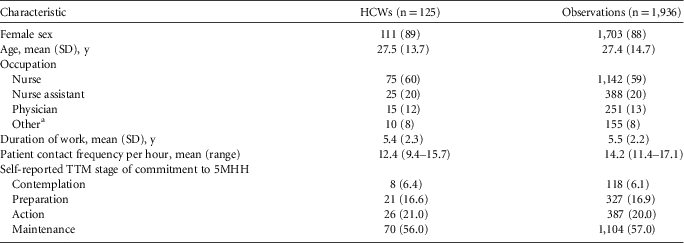
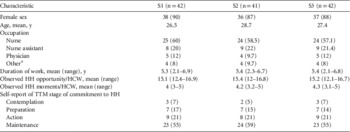
There were 125 HCWs from 6 ICUs: 42 in S1, 41 in S2, and 42 in S3. There was no change in the HCW staff or ICU staff assignments during the 2-year study period. Details for participant enrollment, assignment, allocation, follow-up, and analysis are summarized in Figure 1. Among 1,936 HH observations, 968 (50%) were in P1 and 968 (50%) were in P2. The majority of participants (111 [89%]) were female, the mean age was 27.5 years (range, 22.1–34.7 years), most were either nurses (75 [60%]) or nurse assistants (25 [20%]), and the mean work experience was 5.4 years (range, 2.3–6.9 years) (Table 1). During baseline assessment at enrollment in P1, 70 HCWs (56%) self-reported HH Maintenance, 26 HCWs (21%) reported HH Action, and 29 HCWs (23%) reported lower HH stages of commitment as Preparation or Contemplation (Table 2).
Flow of 125 healthcare worker (HCW) participants in 6 intensive care units (ICUs). HH, hand hygiene.

Demographic and Behavioral Characteristics of 125 Healthcare Workers (HCWs) Participating in a Quasi-experimental Study of Commitment to Five Moments for Hand Hygiene (5MHH)

NOTE. Data are no. (%), unless otherwise indicated. TTM, Transtheoretical Model of Health Behavior Change.
a Housekeeper, radiology technician, laboratory technician.
Comparison of Demographic and Behavioral Characteristics of 3 Groups of Intensive Care Units With Healthcare Workers (HCWs) Assigned to a Group Intervention in Five Moments for Hand Hygiene

NOTE. Data are no. (%), unless otherwise indicated. HH, hand hygiene; TTM, Transtheoretical Model of Health Behavior Change.
a Housekeeper, radiology technician, laboratory technician.
HH Compliance
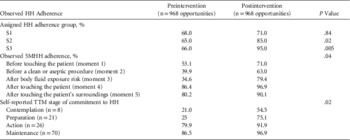
There was a mean of 15.4 (range, 12.9–17.8) HH observations for each HCW, of which there were 4.2 (range, 3.2–5) mean observed moments per HCW encounter. For 5MHH moment 1 there were 687 observations (35.5%), for moment 2 there were 232 (12%), for moment 3 there were 290 (15%), for moment 4 there were 534 (27.5%), and for moment 5 there were 193 (10%). In P1, overall 5MHH compliance by direct observation was 60.2% (583/968 opportunities), of which moment 4 (86.4%; 222/257) and moment 5 (80.2%; 73/91) had higher HCW adherence than moment 1 (53.1%; 198/373), moment 2 (39.6%; 36/91), and moment 3 (34.6%; 54/156). The P2 5MHH adherence observations are summarized in Table 3.
Observed Adherence to Five Moments for Hand Hygiene (5MHH) Among Intensive Care Unit Healthcare Workers

NOTE. Data are no. (%), unless otherwise indicated. HH, hand hygiene; TTM, Transtheoretical Model of Health Behavior Change.
Overall HH observed adherence in P2, compared with P1, was higher among HCWs in S2 (65% vs 85%; P=.02) and S3 (66% vs 95%; P=.005) for all 5MHH, but not among HCWs in S1 (68% vs 71%; P=.84). HH adherence partitioned by study intervention and then by TTM stage of commitment to HH revealed significant differences (Table 3). Improvement in HH adherence, defined as greater observed adherence during P2 compared with P1, occurred among HCWs who reported lower baseline stages of commitment to HH at P1 in S2 (21% vs 84%; P<.001) and S3 (24% vs 89%; P<.001), as well as HCWs who self-reported baseline HH Action and Maintenance stages of commitment in S3 (78% vs 96%; P<.001). From a qualitative perspective, the 6 top-ranked stated reasons by HCWs for nonadherence to 5MHH were I hurry/ emergent patient conditions (60/125; 48%); I’m busy / too many patients (21/125; 16.8%); There was not enough alcohol gel in my unit (15/125; 12%); I wear gloves, not directly contact to patients (6/125; 4.8%); There is side effect of soap / cleanser (6/125; 4.8%); It wastes the time (5/125; 4%); and My hands are clean (3/125; 2.4%).
DISCUSSION
The 5MHH provide a measureable practice framework for the promotion and monitoring of safe and healthy HCW HH behavior during patient care encounters. The major finding of this study was the improvement in observed commitment to HH among ICU HCWs in the units randomized to intensified HH interventions (S2) and intensified HH interventions plus increased access to alcohol-based handrub (S3). There was no change in observed HH adherence in the standard-of-care group for P1 versus P2 (68% vs 71%, P=.84). For the S2 group, overall observed HH adherence increased from 65% (P1) to 85% (P2) (P=.02), while for the S3 group the observed rates increased from 66% (P1) to 95% (P2) (P=.005). Additionally, the HCW baseline self-report of HH by the stages of behavioral commitment revealed a distribution of stages from Contemplation to Action on all 6 units. Such findings suggest that stage-matched HH interventions may be a potential strategy to promote tailored interventions for sustained HH adherence, as has been noted in other studies of behavior-based change.Reference Marra, Guastelli and de Araújo 6 – Reference Marra and Edmond 9 , Reference Marra, Noritomi and Westheimer Cavalcante 11 Furthermore, our findings suggest that routine educational intervention without further intensification efforts may not enhance HCW HH compliance.
To our knowledge, this is the first study to demonstrate the association of baseline TTM stages of commitment to HH with forward movement in stages of commitment based on specific HH interventions. Prior reports of effective HH adherence include positive deviance, feedback intervention together with personalized HCW action plans, and technology-based HH reminders.Reference Marra, Guastelli and de Araújo 6 – Reference Marra and Edmond 9 , Reference Marra, Noritomi and Westheimer Cavalcante 11 In a meta-analysis of HH care bundles, bundles specifically associated with improvement in HH adherence included education, feedback, reminders, access to alcohol-based handrub, and administrative support.Reference Schweizer, Reisinger and Ohl 12 Our findings suggest that stage-based HCW HH interventions may offer another strategy that has potential for sustained change in ICU HCW behaviors.Reference Eiamsitrakoon, Apisarnthanarak, Nuallaong, Khawcharoenporn and Mundy 4 , Reference Al-Tawfiq and Pittet 13 Additionally, our study supports a multimodel approach to improve HH adherence, aligned with the findings of prior meta-analysis.Reference Schweizer, Reisinger and Ohl 12
There are some recognized limitations to be acknowledged for this study. First, the study was conducted at a single center with high staff retention over the 2-year study period. The findings may not be generalizable to other units or hospitals. Second, use of a quasi-experimental study design may have resulted in findings biased by both the maturation and Hawthorne effects.Reference Harris, Bradham, Baumgarten, Zuckerman, Fink and Perencevich 14 In this study, one investigator who was not involved in routine infection control practice was responsible for monitored HH observations and data collection. Although the HH observations were discrete and there was no HCW transition from one unit to another, some intervention carry-over effects may have occurred. Third, the small sample size limited analyses of each individual stage of changes and HH. Fourth, the majority of participants were nurses or nursing assistants, and our results may not be generalizable to physicians and other HCW groups. Nonetheless, our data represent the first pilot study to explore the use of the TTM-based stage of change construct to assess and promote HH adherence.
In conclusion, our findings suggest that targeted HH behavior using theory-based behavioral assessments of HCW commitment may improve 5MHH among HCWs in ICU settings and offer a potential method to further promote HCW HH as a healthy behavior.
Acknowledgments
Financial support. National Research University Project of the Thailand Office of Higher Education Commission (to A.A.).
Potential conflicts of interest. L.M.M. reports that she is an employee of GlaxoSmithKline and this work was conducted pro bono and independently of them. All other authors report no conflicts of interest relevant to this article.