Introduction
Shrimps belonging to the Infraorder Caridea are the second most common group of decapod crustaceans found inhabiting all aquatic habitats throughout the world, from deep sea to shallow tropical and subtropical benthic habitats, to brackish and freshwater systems (De Grave et al., Reference De Grave, Smith, Adeler, Allen, Alvarez, Anker and Page2015a; Horka et al., Reference Horka, De Grave, Fransen C, Petrusek and Duris2016). Caridean shrimps continue to dominate the coral-reef shrimp fauna (Bruce, Reference Bruce1976). In particular, the families, including Palaemonidae, Alpheidae, Hippolytidae, Thoridae, Lysmatidae and Gnathophyllidae have established either temporary or lifelong symbiotic associations with other invertebrates and fishes (Calado et al., Reference Calado, Lin, Rhyne, Araujo and Narciso2003; Bauer, Reference Bauer2004; Prakash et al., Reference Prakash, Babu, Gopi, Ajith Kumar and Balasubramanian2011, Reference Prakash, Ajith Kumar and Subramoniam2015; Baeza, Reference Baeza, Watling and Thiel2015; Horka et al., Reference Horka, De Grave, Fransen C, Petrusek and Duris2016; Prakash & Marimuthu, Reference Prakash and Marimuthu2020).
Many studies have considered caridean shrimps as a suitable model organism to study different habitat/hosts (Bauer, Reference Bauer2004), host use patterns (Fautin et al., Reference Fautin, Guo and Hwang1995; Levitt-Barmats & Shenkar, Reference Levitt-Barmats and Shenkar2018), sexual biology (Baeza & Bauer, Reference Baeza and Bauer2004; Prakash et al., Reference Prakash, Ajith Kumar, Subramoniam and Baeza2017a; Dickson et al., Reference Dickson, Behringer and Baeza2020), mating behaviour (Baeza & Thiel, Reference Baeza, Thiel, Duffy and Thiel2007; Zhang et al., Reference Zhang, Rhyne and Lin2007; Prakash et al., Reference Prakash, Ajith Kumar, Bauer, Thiel and Subramoniam2016), phylogenetic relationships (Baeza, Reference Baeza2010, Reference Baeza2013; De Grave et al., Reference De Grave, Fransen and Page2015b; Horka et al., Reference Horka, De Grave, Fransen C, Petrusek and Duris2016), cryptic species complexes (Titus et al., Reference Titus, Daly, Hamilton, Berumen and Baeza2018; Baeza & Prakash, Reference Baeza and Prakash2019) and eusociality (Duffy, Reference Duffy1996). Apart from being a potential model for various studies, caridean shrimps from coral reef areas are also commercially exploited to meet the demand of the global marine aquarium trade (Calado et al., Reference Calado, Lin, Rhyne, Araujo and Narciso2003; Rhyne et al., Reference Rhyne, Rotjan, Bruckner and Tlusty2009; Baeza & Behringer, Reference Baeza and Behringer2017; Prakash et al., Reference Prakash, Ajith Kumar, Raghavan, Rhyne, Tlusty and Subramoniam2017b). The family Palaemonidae, which is the largest next to Alpheidae, contains more than 900 species and is well known for its morphological and ecological diversity (Horka et al., Reference Horka, De Grave, Fransen C, Petrusek and Duris2016). Marine free-living palaemonids are generally large-bodied shrimps and are mostly micro browsers or scavengers, while symbiotic palaemonids are mostly smaller in size and have adopted cryptic lifestyle adaptations (Horka et al., Reference Horka, De Grave, Fransen C, Petrusek and Duris2016).
Knowledge of the population dynamics and life history traits of symbiotic palaemonids, such as growth, moulting and individual-level reproductive parameters, forms the fundamental basis for reliable fisheries management of species at risk (Calado, Reference Calado2008; Dee et al., Reference Dee, Horii and Thornhill2014; Gilpin & Chadwick, Reference Gilpin and Chadwick2017). Most of the studies on symbiotic palaemonids have focused on their sexual and mating behaviour (Baeza et al., Reference Baeza, Hemphill and Ritson-Williams2015, Reference Baeza, Simpson, Ambrosio, Guéron and Mora2016, Reference Baeza, Barros-Alves, Lucena, Lima and Alves2017), however, information on population structure and reproductive performance are still lacking. The population structure is mainly influenced by seasonality and oscillating sex ratios as documented in other decapod crustaceans (Naylor et al., Reference Naylor, Adams and Greenwood1988). The above two factors are mostly driven by differential growth patterns, breeding migrations, sex reversal, and mortality in males and females (Wenner, Reference Wenner1972; Simoes et al., Reference Simoes, D'Incao, Fransozo, Leão Castilho and Costa2013). More than the above factors (Diaz et al., Reference Diaz, Sousa, Cuartas and Petriella2003), food and the symbiotic hosts play a vital role in shaping the population and breeding patterns in symbiotic palaemonids (Fautin et al., Reference Fautin, Guo and Hwang1995).
The present study focuses on one such palaemonid shrimp, Ancylocaris brevicarpalis, which is an obligate symbiont of sea anemones found throughout the Indo-Pacific (Bruce & Svoboda, Reference Bruce and Svoboda1983; Fautin & Allen, Reference Fautin and Allen1992). Although detailed studies on the socio-behavioural aspects of A. brevicarpalis are still lacking, this species is presumed to inhabit sea anemones in adult pairs along with a few conspecific juveniles (Bruce & Svoboda, Reference Bruce and Svoboda1983; personal observation). Most of the time, the female hides under the tentacles of sea anemones, whereas the males frequently roam on the top of the anemones' oral surface (Bruce & Svoboda, Reference Bruce and Svoboda1983). When disturbed, females also move out and occupy the anemones' surface (personal observation). In contrast, the association between sea anemones and shrimps have been often called parasitic, as the shrimp mainly feed on the tentacles of sea anemones (Suzuki & Hayashi, Reference Suzuki and Hayashi1977; Bruce & Svoboda, Reference Bruce and Svoboda1983). In India, A. brevicarpalis is distributed throughout the major coral-reef regions such as the Gulf of Mannar, Andaman and Nicobar Islands, the Gulf of Kutch and Lakshadweep (Kemp, Reference Kemp1922; Tikader et al., Reference Tikader, Daniel and Subbarao1986; Unmesh & Prakash, Reference Unmesh and Prakash2011; Prakash et al., Reference Prakash, Ajith Kumar and Subramoniam2015). A particular concern was highlighted by a recent study that revealed A. brevicarpalis along with its host sea anemones are being targeted for commercial purposes and supplied to the domestic marine aquarium trade (Prakash et al., Reference Prakash, Ajith Kumar, Raghavan, Rhyne, Tlusty and Subramoniam2017b). Notably, the ornamental fishery in the Gulf of Mannar is not organized or well managed to educate the fishers about catch targets (i.e. total allowable catch or maximum sustainable yield) which are necessary for natural stock sustainability (Bolker et al., Reference Bolker BM, Mary, Osenberg, Schmitt and Holbrook2002). Prakash et al. (Reference Prakash, Ajith Kumar, Subramoniam and Baeza2017a) have produced a snapshot on sexual dimorphism based on secondary sexual characters in A. brevicarpalis but did not include details of the population structure (seasonally) and individual-level reproductive parameters. Therefore, the primary objective of this study is to provide first-of-its-kind information on the population structure, growth and moulting, sex-ratio, fecundity, embryo volume and reproductive output at the individual level.
Methodology
Collection and maintenance of the shrimps
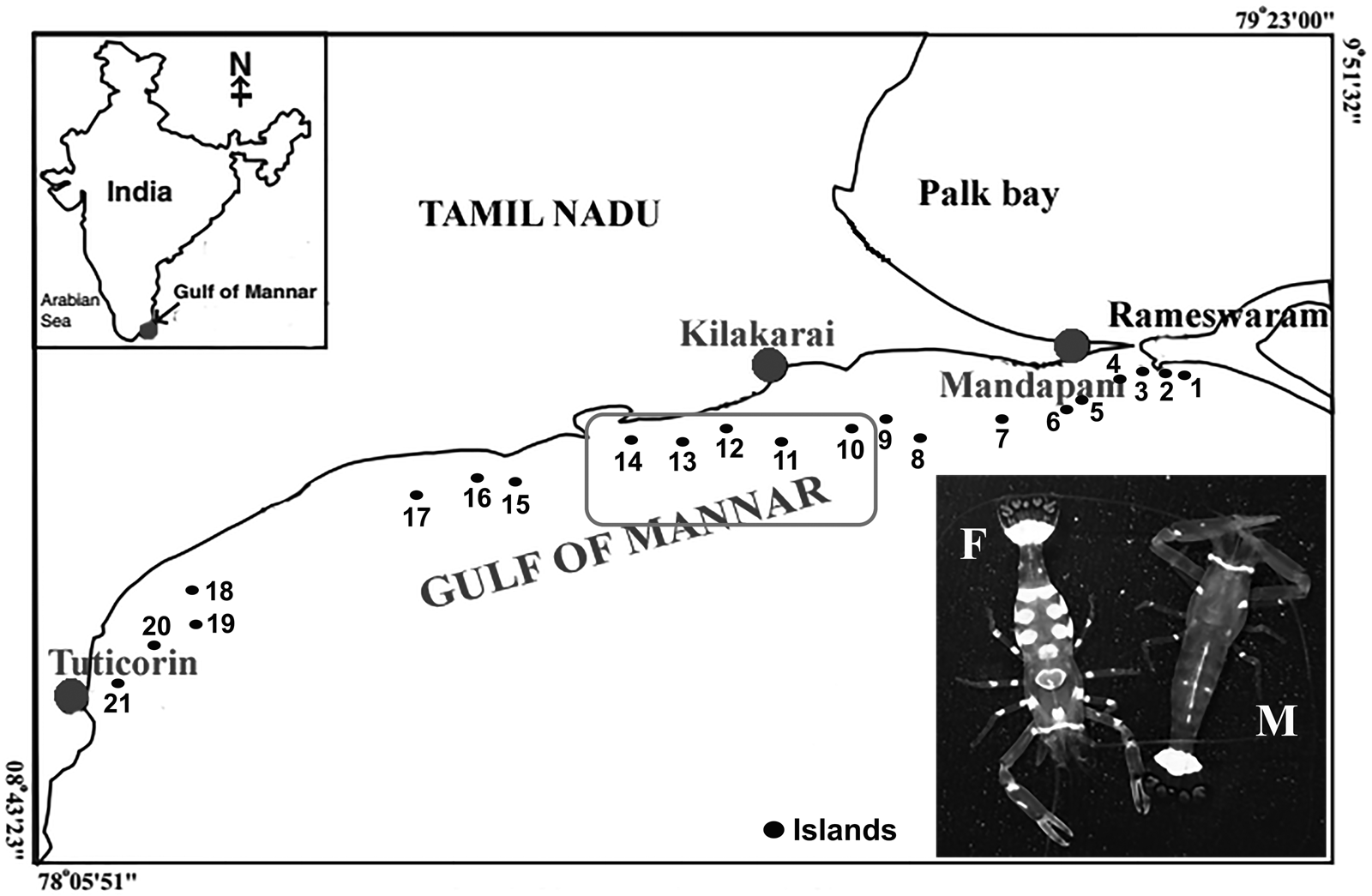
Individuals of the sea anemone associated shrimp Ancyclocaris brevicarpalis were collected from the shallow coastal waters of Kilakarai region, Gulf of Mannar (08°30′N 78°12′E–09°45′N 79°30′E), Tamil Nadu, India between February 2017 and July 2018. The Gulf of Mannar (GOM) lies between the coastal cities of Rameswaram and Tuticorin and was declared as the first marine biosphere reserve in the South-east Asia (ENVIS, 2015) (Figure 1). There are 21 islands that run parallel to the coast that are surrounded by the coral reefs in a discontinuous manner for about 140 km (SAC, 2012) and are exceptionally rich in coastal and marine biodiversity (Venkataraman & Wafar, Reference Venkataraman and Wafar2005).
Map showing the study area: Kilakarai region, Gulf of Mannar, Tamil Nadu, India (rectangle indicates the sampling location). On the bottom right, a pair of Ancylocaris brevicarpalis Schenkel, Reference Schenkel1902, female (F) and male (M) (photo: S. Prakash).

Individuals of the sea anemone shrimp A. brevicarpalis were collected using scoop nets by gently disturbing the tentacles of Haddon's carpet sea anemone Stichodactyla haddoni Saville-Kent. After collection, most of the shrimps were immediately preserved in 95% ethanol and a few live individuals were packed using oxygen-filled polyethylene bags with seawater and transported to the Center for Climate Change Studies at Sathyabama Institute of Science and Technology, Chennai. Upon arrival at the laboratory, the shrimps were acclimatized to laboratory conditions for 3–4 h and shifted to 54 l glass tanks fitted with biological filters and aerators. The tanks were illuminated with artificial lighting via 12:12 h light: dark cycle. Optimal conditions such as salinity 35, pH 8.1, temperature 27°C were maintained. A mixture of boiled egg whites, commercial pellets and frozen adult Artemia was fed thrice a day. Uneaten food was removed from the tanks before feeding. The tanks were observed every morning for the presence of moults before exchanging water.
Population structure
For the present study, shrimps were collected in different seasons: pre-monsoon (July–September), monsoon (October–December), and post monsoon (January–March) and summer (April–June). Collections were performed for more than one year (February 2017–July 2018) to cover all four seasons. The total number of shrimps transported to the laboratory was 574 individuals (pre-monsoon, N = 112; monsoon, N = 184; post monsoon, N = 219; summer, N = 59).
To understand the population structure, the total number of shrimps collected, their sex and the carapace length were recorded. The sex of A. brevicarpalis was determined from the preserved specimens by looking for the presence of an appendix masculinae (present only in males) on the endopod of the second pleopod (Prakash et al., Reference Prakash, Ajith Kumar, Subramoniam and Baeza2017a). Additionally, sex was determined on live shrimps by the presence of bright white ovaries which are clearly visible in dorsal view and a white spot in the hepatic region of the carapace and white pleural patches in females (which is completely absent in males) (Bruce & Svoboda, Reference Bruce and Svoboda1983). Small-sized shrimps with poorly developed secondary sexual characteristics were classified as ‘indeterminate’. The carapace length (CL in mm) was measured from the post-orbital region to the posterior margin of the carapace using a stereomicroscope (Motic-SMZ168) fitted with a graduated ocular micrometer to the nearest 0.01 mm. Data were grouped into 2.0 mm CL size classes and analysed with respect to their frequency distribution. Individuals that were considered too small and indeterminate (neither male nor female) were not included in the size-frequency distribution data.
Sex ratio
The gender of individuals was identified based on morphological characters. To determine whether the sex ratio differed from the 1 male: 1 female based on seasons, we applied the χ2 test (P < 0.05) (Sokal & Rohlf, Reference Sokal and Rohlf1981).
Reproductive performance
Females carrying embryos in their abdomen were sorted from the non-ovigerous females. The embryos of the ovigerous females were gently removed from the pleopods using fine forceps and preserved in 100% ethanol until further analysis. We recorded three different individual-level reproductive performance parameters in A. brevicarpalis: fecundity, embryo volume and reproductive output (RO).
Fecundity
Fecundity is defined as the number of embryos brooded under the abdomen of a female. All the embryos of the A. brevicarpalis were stripped, counted manually, and categorized into four embryonic developmental stages as previously documented for A. brevicarpalis: Stage 1, newly spawned embryos bright green in colour with no visible blastoderm; Stage 2, blastoderm distinct with no eye development; Stage 3, embryos containing 2/3 of the original yolk with visible eye spots and appendages with small orange spots; Stage 4, completely developed embryos, translucent white in colour, yolk nearly depleted, eyes prominent and abdomen free from the cephalothorax (Prakash et al., Reference Prakash, Ajith Kumar, Subramoniam and Baeza2017a). All the observations were performed under a stereomicroscope (Olympus-CX21l). Here, we tested the effect of female body size (CL in mm) and egg stage on the fecundity using independent analyses of covariance (ANCOVA) (Sokal & Rohlf, 1981). The female body size (CL, in mm) was used as a covariate, fecundity as the dependent factor, and egg stages (early and late) as an independent factor using JMP pro 12.2.0 (SAS, 2015). The variables used in the analysis were log-log transformed and outliers (2 nos., see results section for details) were removed during final analysis.
Embryo volume
Likewise, embryo volume was measured in all ovigerous females, by randomly selecting 10 eggs from each female. The major (d 1) and minor axis (d 2) (lengths along the long and short axis) of each selected embryo were measured under an optical microscope fitted with an ocular meter with an accuracy of 0.01 mm. Embryo volume was calculated with the formula for the volume of ellipsoid V = π (d 1) × (d 2)2/6 (Turner & Lawrence, Reference Turner and Lawrence1979). The effect of female body size (CL in mm) was used as a covariate, egg stages (early and late) as an independent factor, and egg volume as the dependent factor to test for ANCOVA (Sokal & Rohlf, 1981) using JMP Pro 12.2.0. The variables used in the analysis were after log-log transformation.
Reproductive output
Reproductive output (RO) was estimated between dry weight of early embryos and their corresponding females. RO represents the amount of energy that is invested during reproduction by females (Baeza, Reference Baeza2006). Females and their egg masses were dried at 60°C for 48 h in a hot-air oven. The dried egg mass and female were weighed separately using a Shimadzu analytical balance (precision 0.0001 g). The reproductive output was calculated using the formula: RO = Dry weight of total egg mass/dry weight of total body mass of the female (Hines, Reference Hines1988; Echeverría-Sáenz & Wehrtmann, Reference Echeverría-Sáenz and Wehrtmann2011). To test whether linear (isometric) relationships exist between female body mass and embryo dry mass, we used the allometric model y = axb (Hartnoll, Reference Hartnoll1978, Reference Hartnoll, Bliss and Abele1982). The slope b of the log-log least squares linear regression characterizes the degree of exponential decrease (b < 1) or increase (b > 1) of the reproductive investment in brooding females. Lastly, a Student t-test was performed to estimate whether the slope b deviated from the expected slope of unity. The assumptions of normality and homogeneity of variances were checked and found to be satisfactory before conducting the test (Zar, Reference Zar1996).
Results
Population structure
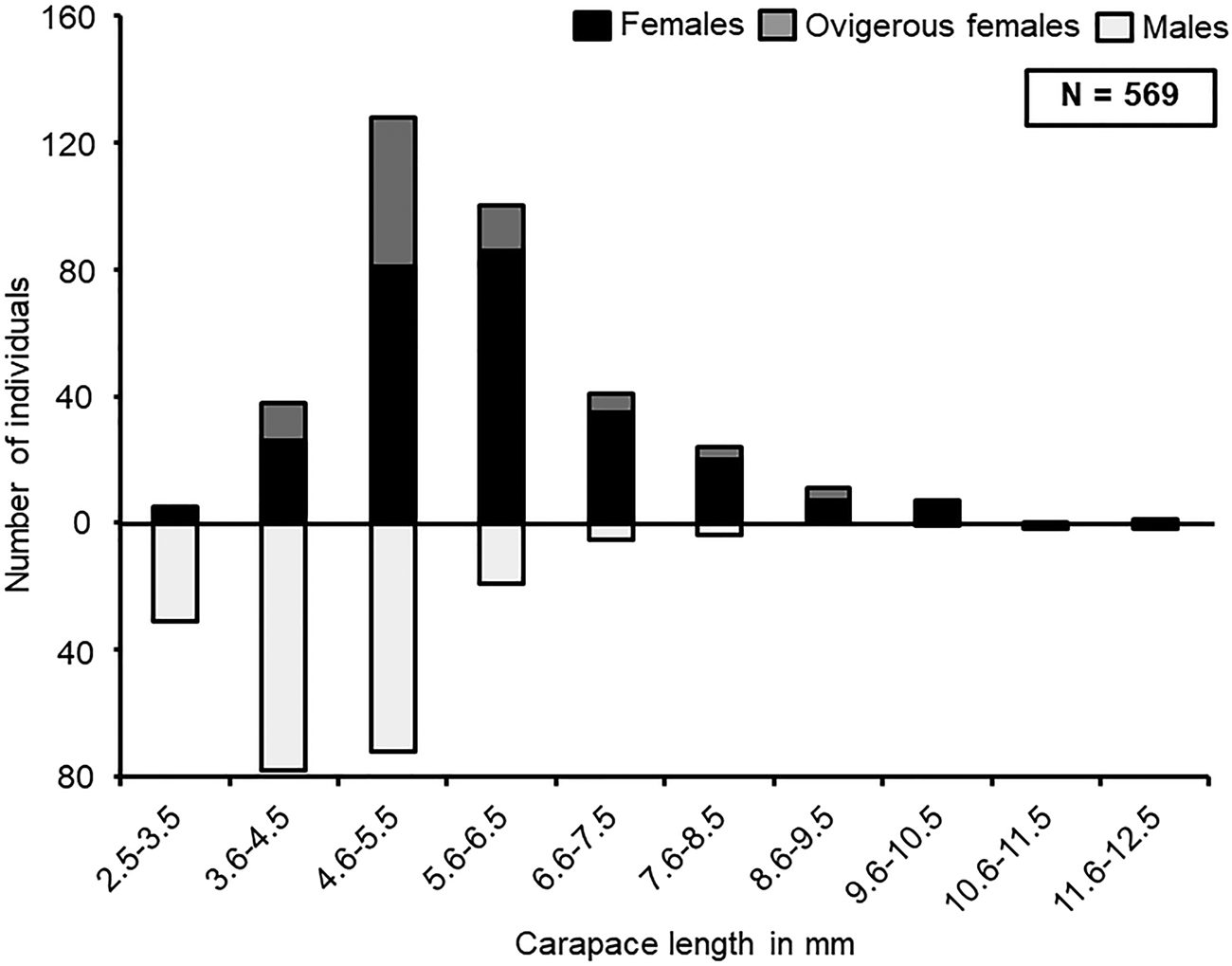
During the present study, a total of 574 individuals of Ancylocaris brevicarpalis were analysed for carapace length (CL), gender and seasonal availability. Out of 574 individuals collected, 214 were males (37.28%), 355 were females (61.84%) (267 were non-ovigerous and 88 were ovigerous) and only 5 were juveniles (0.87%). The mean CLs (mean ± SD) were: females 6.00 ± 1.37 mm CL (3.08–12.03 mm), ovigerous females 5.63 ± 1.29 mm CL (3.66–10.37 mm) and males 4.74 ± 1.43 mm CL (2.52–11.79 mm) (Figure 2) respectively. The CL of juveniles was 1.18 ± 0.05 mm CL (1.05–1.33 mm) (individuals with <2.5 mm CL that are unable to discriminate based on the gender) and was not included in the final representation. Overall, the body size (CL) of the females was larger compared with males.
Size frequency distribution of body size (carapace length, CL in mm) in A. brevicarpalis (N = 569; 5 juveniles were not included in the graph).

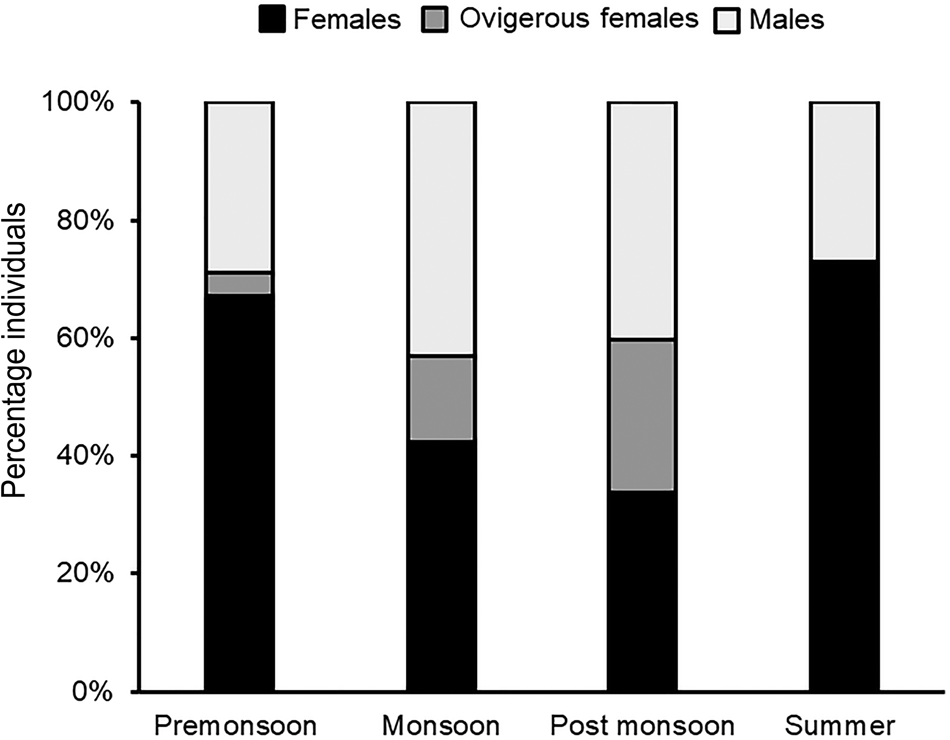
Furthermore, comparing all four seasons, the highest number of individuals were observed in the post-monsoon season (38.10%) followed by the monsoon (34.85%), pre-monsoon (15.02%) and summer seasons (12.01%) (Figure 3). Females were found to predominate in all four seasons, accounting for 61.84% of the total collection. There was a continuous availability of egg-bearing individuals throughout the study period, except in summer. The population of ovigerous females was found to be higher in the post-monsoon season (44.9%) followed by monsoon (32%) and pre-monsoon seasons (23.1%). Unfortunately, no egg-bearing females were observed from samples during the summer season.
Cumulative distribution of A. brevicarpalis (% individuals) based on seasons.

Sex ratio
During the study period, we collected a total of 214 males and 355 females. An overall mean sex ratio of 0.55♂: 1♀ was observed. Female-biased sex ratios (male: female) were evident in all the seasons. For instance, the sex ratio in pre-monsoon season was 0.41♂: 1♀; monsoon season, 0.75♂: 1♀; post-monsoon season, 0.67♂: 1♀; and summer season, 0.37♂: 1♀. However, the number of females to males did not show significant difference in relation to the seasons (χ2 = 3.0; P = 0.391).
Reproductive performance
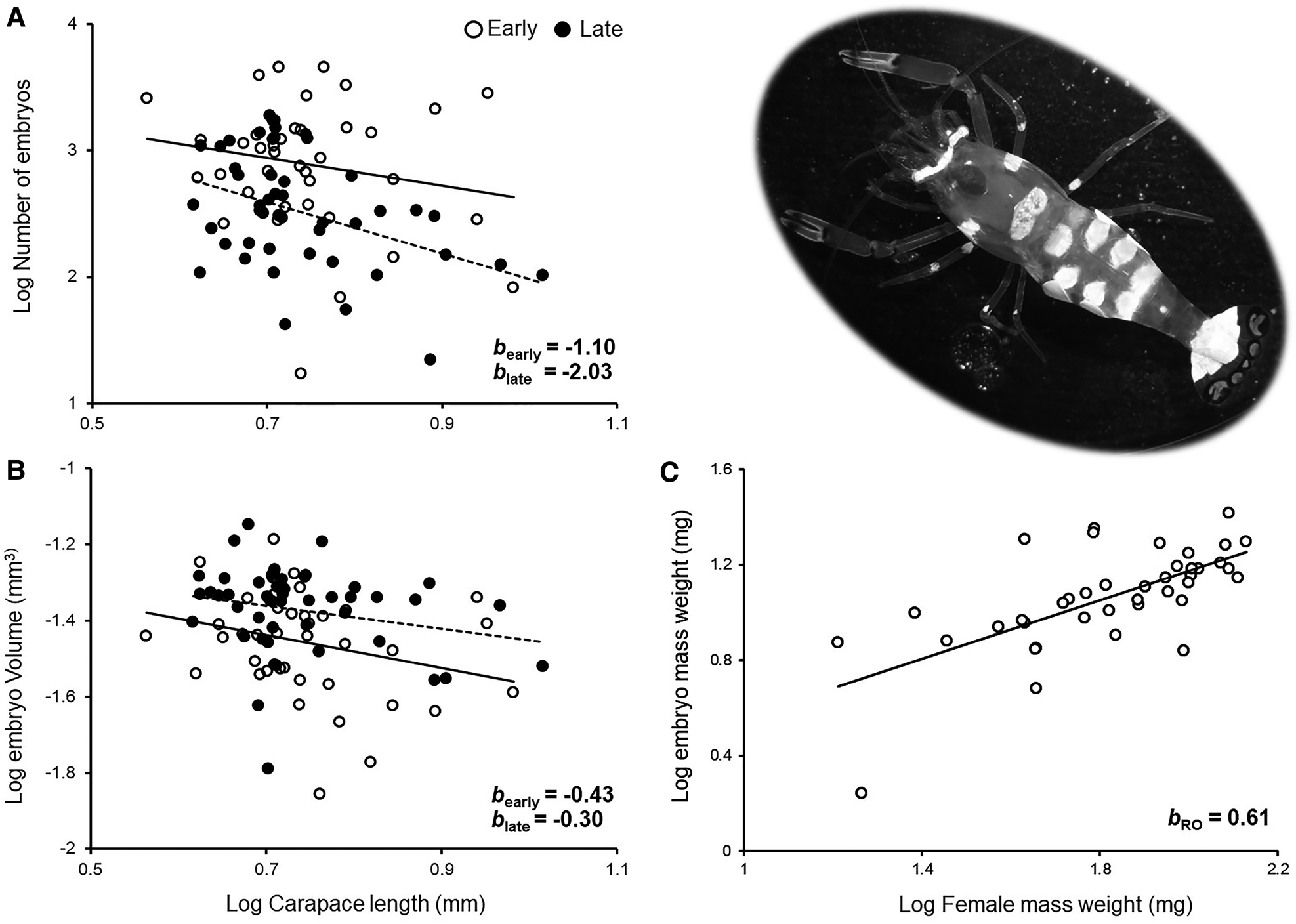
A total of 88 ovigerous females of A. brevicarpalis were analysed for reproductive performance. Of these, 42 and 46 females were carrying early- (stage 1 and stage 2) and late-stage embryos (stage 3 and stage 4), respectively. Carapace length (CL in mm) ranged from 3.66–9.59 mm (mean body size ± SD, 5.68 ± 1.24 mm CL) in individuals carrying early-stage embryos compared with 4.14–10.37 mm (5.61 ± 1.30 mm) in individuals carrying late-stage embryos. The mean number of embryos in early stage was 1276.2 ± 1164.9 (minimum 17 to maximum 4549) (N = 40), compared with late-stage embryos, 516.02 ± 487.65 (minimum 22 to maximum 1892) (N = 46) (Figure 4A). Additionally, two individuals with CL 5.37 mm and 5.18 mm carrying 8148 and 7776 early-stage embryos were considered as outliers and were not included in the final representation. An ANCOVA demonstrated the effect of embryo stage (early vs late) (F = 15.202; df = 1.85; P = 0.002) and CL (F = 7.617; df = 1.85; P = 0.0071) on the fecundity. However, the interaction term of ANCOVA was not significant (F = 0.676; df = 1.85; P = 0.413). Overall, the mean fecundity was found to be higher in individuals bearing early-stage embryos compared with individuals bearing late-stage embryos. This indicates the possibility of significant egg loss in females during embryonic development. Furthermore, the effect of female body size on fecundity was surprisingly small with increased CL irrespective of the embryonic stages (Figure 4A). This might be due to the loss of eggs during handling or shipping of individuals.
Reproductive investments in Ancylocaris brevicarpalis. (A) Fecundity, relationship between female body size CL (log CL) and embryo number (Log fecundity) in females carrying early-stage and late-stage embryos. Black line represents linear regression for early-stage and dotted line for late-stage embryos; (B) Embryo volume, relationship between female body size CL (log CL) and embryo volume (mm3) (Log embryo volume) in females carrying early- and late-stage embryos. Black line represents linear regression for early-stage and dotted line for late-stage embryos; (C) Reproductive output (RO), relationship between female body weight (dry) and embryos mass weight (dry) after log-log transformation in females carrying early-stage embryos. The slope of the line (average ± SD) describing the relationship between these two variables after log-log transformation is shown. Photo on the top right, Ancyclocaris brevicarpalis female (photo: S. Prakash).

The mean diameter (length and width) of the individual embryos varies from 0.45 ± 0.076 mm and 0.37 ± 0.051 mm in the early-stage and 0.51 ± 0.059 mm and 0.39 ± 0.057 mm in the late-stage embryos. The embryo volume in females carrying embryos varies from 0.013–0.064 mm3 with a mean ± SD of 0.036 ± 0.010 for early stages and 0.016–0.071 mm3 with a mean ± SD of 0.044 ± 0.009 for late stages respectively (Figure 4B). The mean body size, CL of females did not show much variation between the individuals carrying early- and late-stage embryos. An ANCOVA demonstrated a significant effect of the embryo stage (early vs late) (F = 9.615; df = 1.85; P = 0.0026) and CL (F = 5.659; df = 1.85; P = 0.019) on the embryo volume. In turn, the interaction term of the ANCOVA was not significant (F = 0.180; df = 1.85; P = 0.672). In general, the embryo volume of females carrying late-stage embryos was found to be higher compared with females carrying early-stage embryos. Similar to fecundity, the embryo volume also followed a decreasing pattern with increase in CL in the early as well as late embryonic stages.
Reproductive output in females carrying early-stage embryos varies from 0.02–47.14% with a mean ± SD of 0.18 ± 0.10 of shrimp body weight. The mean dry body weight of females varies from 1.212–2.13 with a mean ± SE of 1.822 ± 0.036 (after log transformation) and the mean dry weight of egg mass varies from 0.24–1.417 with a mean ± SE of 1.065 ± 0.033 (after log transformation). The reproductive output increased with body weight, however it exhibited negative allometry as the slope (b = 0.61; SEb = 0.112) of the line describing the relationship between the two variables (female dry body mass vs egg dry mass, after log-log transformation) was significantly lower than the unity (t-test: t = −3.4654; t (1, 38) = 2.021; P < 0.05) (Figure 4C).
Discussion
Population structure
Ancylocaris brevicarpalis is an obligate symbiont of sea anemones, which are found throughout the Indo-Pacific (Bruce & Svoboda, Reference Bruce and Svoboda1983; Fautin & Allen, Reference Fautin and Allen1992). In this study, A. brevicarpalis possesses seasonal variation in population structure based on the studied individuals. Males and females were found throughout the year with a greater number of individuals observed in the monsoon (N = 184) and post-monsoon seasons (N = 219). This seasonal pattern is typically followed by other shallow-water caridean shrimps, for example Alpheus euphrosyne in Indian waters (Harikrishnan et al., Reference Harikrishnan, Unnikrishnan, Maju, Reena Greeshma and Kurup2010). Our study indicated that A. brevicarpalis females were more predominant than males in all four seasons, which could be due to a few reasons: First, the body size of the females was larger than the males, which is evident from the present study and from previous literature (Prakash et al., Reference Prakash, Ajith Kumar, Subramoniam and Baeza2017a). Second, females have attractive body colouration compared with males, which are mostly transparent (Figure 1, inset picture). Third, females are more vulnerable to capture because they spend more time over sea anemones for feeding in order to fulfil a higher metabolic demand as observed in its closest congener Ancylomenes pedersoni (Gilpin & Chadwick, Reference Gilpin and Chadwick2017). The above information regarding the relatively high prevalence of females in all seasons is in concordance with the population structure of a few other free-living carideans such as Plesionika spinipes, P. martia (Rajool et al., Reference Rajool, Akhilesh, Manjebrayakath, Ganga and Pillai2012) and P. edwardsii (Possenti et al., Reference Possenti, Sartor and De Ranieri2007) and the symbiotic caridean Gnathophylloides mineri (Patton et al., Reference Patton, Patton and Barnes1985).
In the present study, we observed large-sized females (>9 mm CL) in all seasons with the highest percentage of ovigerous females in post-monsoon (44.9%) followed by monsoon (32%) and pre-monsoon (23.1%) seasons, except summer. We believe that reproduction in A. brevicarpalis may occur all year round, as with other tropical caridean shrimps (Bauer, Reference Bauer1989; Levitt-Barmats & Shenkar, Reference Levitt-Barmats and Shenkar2018). Perhaps reproduction in A. brevicarpalis is seasonal but extended for 9 months if this species is an exception. The lack of brooding females in summer in this study may be compared with the breeding season of another palaemonid shrimp, Palaemon gravieri, an inhabitant of temperate coastal waters of Korea, which is constrained by temperature as well as the release of larvae coinciding with the plankton bloom (Kim & Hong, Reference Kim and Hong2004). Therefore, we argue in favour of additional sampling during the summer season, to fully reveal the population dynamics of A. brevicarpalis.
Sex ratio
The female-skewed sex ratio of A. brevicarpalis is comparable to other closely related shrimps that live in symbiotic association with sea anemones (Nizinski, Reference Nizinski1989; Baeza & Piantoni, Reference Baeza and Piantoni2010; Gilpin & Chadwick, Reference Gilpin and Chadwick2017). The female-skewed sex ratio suggests that A. brevicarpalis might not be monogamous. Frequent movement of males between host individuals in search of receptive female partners might occur in this species, as previously observed in other symbiotic shrimps, for example Athanas kominatoensis (Nakashima, Reference Nakashima1987) and Ascidonia maculata (Baeza & Diaz-Valdes, Reference Baeza and Diaz-Valdes2011). A previous study of the sexual dimorphism of A. brevicarpalis also supports the notion above, that the body and claw size of males and females exhibit negative allometry (Prakash et al., Reference Prakash, Ajith Kumar, Subramoniam and Baeza2017a). This is indicative of pure-search mating as observed for other caridean shrimps (Correa & Thiel, Reference Correa and Thiel2003; Bauer, Reference Bauer2004), where males may use exploitative tactics such as roaming (Baeza & Hernaez, Reference Baeza and Hernaez2015) and compete with other males to find receptive females among the different host anemones. However, the above assumptions, regarding whether males of A. brevicarpalis do move among different sea anemones in search of receptive female partners, still remain to be verified experimentally.
Reproductive performance
In this study, we found that the average fecundity of A. brevicarpalis is more than that of several other closely related species. For instance, Ancylomenes pedersoni produce 33–221 eggs per clutch (Spotte, Reference Spotte1999), 10–35 in Periclimenes patae (Heard & Spotte, Reference Heard and Spotte1991), 67–259 in P. pandionis (Corey & Reid, Reference Corey and Reid1991), 12–333 in P. yucatanicus (Spotte, Reference Spotte1997), 23–141 in P. siankaanensis (Martínez-Mayén & Román-Contreras, Reference Martínez-Mayén and Román-Contreras2009), 80–605 in P. rathbunae (Azofeifa-Solano et al., Reference Azofeifa-Solano, Elizondo-Coto and Wehrtmann2014) and 10–1000 in Actinimenes ornatus (Omori et al., Reference Omori, Yanagisawa and Hori1994) respectively.
Fecundity in A. brevicarpalis is maximum in the body size range between 4–6 mm CL showing a higher number of eggs in the early egg stage which decreased with advancing late egg stage. Furthermore, the effect of female body size on fecundity was surprisingly lower with increased CL irrespective of the embryonic stages. This might be due to the older females being less fecund due to variation in nutritional availability or physiological differences (Alon & Stancyk, Reference Alon and Stancyk1982; Bauer, Reference Bauer1991). Also, in a few instances, small-sized females of A. brevicarpalis carried a greater number of eggs than the larger females. This agrees with the prediction of Clark (Reference Clark1993) that the young females with a favourable physiological condition may be highly fecund compared with older ones by allocating greater energy for egg production. In contrast, embryo loss in crustaceans was observed as a common phenomenon during the course of incubation. Loss of embryos could be due to diverse physical and biological factors such as mechanical stress during transportation or handling, increase of egg volume during development and the occurrence of parasites (Balasundaram & Pandian, Reference Balasundaram and Pandian1982; Kuris, Reference Kuris, Wenner and Kuris1991; Oh & Hartnoll, Reference Oh and Hartnoll1999). The biological cause of embryo loss due to parasites was not evident in A. brevicarpalis or other caridean shrimps (Balasundaram & Pandian, Reference Balasundaram and Pandian1982), but mechanical stress during handling/sampling and weak embryo cohesion during development, as observed for Palaemon graveri (Kim & Hong, Reference Kim and Hong2004), could be one of the possible reasons in A. brevicarpalis. Interestingly, the excessive number of embryos produced by smaller sized females (4–6 mm CL) of A. brevicarpalis is also an advantage to compensate for embryo loss during development, thereby maximizing the number of larvae hatched (Corey & Reid, Reference Corey and Reid1991).
Average embryo volume was 0.040 mm3 in A. brevicarpalis compared with other closely related shrimps where volumes were 0.05 mm3 in Periclimenes pandionis (Corey & Reid, Reference Corey and Reid1991); 0.056 mm3 in P. siankaanensis (Martínez-Mayén & Román-Contreras, Reference Martínez-Mayén and Román-Contreras2009), 0.038 mm3 P. rathbunae (Azofeifa-Solano et al., Reference Azofeifa-Solano, Elizondo-Coto and Wehrtmann2014) and 0.05–0.11 mm3 in Ancylomenes pedersoni (Spotte, Reference Spotte1999). The increase in the embryo volume from early to late stage in A. brevicarpalis can be directly correlated with the oxygen consumption rates and sufficient physical space available for embryos to grow until hatching as documented in its congeneric species (Fernandez et al., Reference Fernandez, Pardo and Baeza2002; Azofeifa-Solano et al., Reference Azofeifa-Solano, Elizondo-Coto and Wehrtmann2014). However, the decreasing pattern of embryo volume with the advancing late stage could be directly linked with the embryo loss due to mechanical stress. We believe that the ultimate development of embryos might be halted because of the physical disturbance or weak cohesion of embryos during development as mentioned earlier. Another possible explanation would be that limited space available for embryo attachment could limit embryo volume, making it unlikely that few/more of the embryos would be crowded-out or lost during development, as observed in several hippolytid, alpheid, palaemonid shrimps and some crayfish species (Corey, Reference Corey1987; Corey & Reid, Reference Corey and Reid1991; Oliveira et al., Reference Oliveira, Costa-Souza, Mariano and Almeida2018).
Reproductive output, which indicates energy allocation in offspring production could increase linearly (isometrically) with the female body weight. However, the RO of A. brevicarpalis is negatively allometric indicating that the allocation of space for the brood mass may not be sufficient with advancing embryonic development and maintaining the clutch until hatching, as documented in the closely related species Percilimenes rathbunae (Azofeifa-Solano et al., Reference Azofeifa-Solano, Elizondo-Coto and Wehrtmann2014). Contrastingly, the association of A. brevicarpalis with sea anemones followed by active parental care could provide reasonable conditions to progress embryonic development, thus minimizing brood loss during embryogenesis. Nevertheless, the above assumption should be experimentally addressed. The RO of A. brevicarpalis was not nearly isometric with an increasing female body weight, which is in contrast with other symbiotic and free-living carideans such as P. rathbunae (Azofeifa-Solano et al., Reference Azofeifa-Solano, Elizondo-Coto and Wehrtmann2014), Palaemon northorpi (Anger & Moreira, Reference Anger and Moreira1998), Heterocarpus vicarius (Echeverría-Sáenz & Wehrtmann, Reference Echeverría-Sáenz and Wehrtmann2011) and Lysmata boggessi (Dickson et al., Reference Dickson, Behringer and Baeza2020). This might indicate that limitations on space availability for yolk accumulation in the body cavity of A. brevicarpalis is the main factor constraining brood size, as studied in several other crustaceans (Hines, Reference Hines1991; Bolaños et al., Reference Bolaños, Baeza, Hernandez, Lira and López2012; Baeza & Hernaez, Reference Baeza and Hernaez2015). Therefore, comparative studies will be helpful to understand the effects of host ecology and biology driving the energy allocation in brood production of A. brevicarpalis.
Conclusion
From the results of the current study, it can be concluded that the highest number of individuals were observed in the post-monsoon season. The lack of brooding females in summer could be an exception suggesting that A. brevicarpalis could be seasonal brooders. The overall sex ratio was skewed towards females, an indication of a pure-search sexual system as observed for other caridean shrimps. Among the reproductive performance of A. brevicarpalis, fecundity was higher in females carrying early-stage embryos and loss of embryos was observed in the late stages/during development. The mean embryo volume did increase, but not proportionately from early to late stages. The RO was not nearly isometric, indicating that the allocation of space for the brood production may not be enough. Therefore, we recommend that future studies should compare the differences in reproductive performance of A. brevicarpalis by keeping host ecology and biology in mind to obtain accurate information on the life history traits of symbiotic shrimps. Lastly, an integrated approach involving different stakeholders (collectors, wholesalers, retailers, scientists, aquaculturists and fisheries extension officials) is necessary to establish species management plans to ensure the resource sustainability of ornamental shrimps and associated hosts.
Acknowledgements
The authors are grateful to the authorities of Sathyabama Institute of Science and Technology for the facilities. We are thankful to the Science and Engineering Research Board (SERB), Department of Science and Technology (DST), Government of India for the Early Career Research (ECR) award to SP (grant number: ECR/2015/000213). SP is thankful to Vatsala, PM for improving the English language of the manuscript. We also thank the anonymous reviewers and the associate editor for their constructive comments which greatly improved the final version of the manuscript.