INTRODUCTION
Teamwork is generally considered as something inherently positive (Finn, Learmonth, & Reedy, Reference Finn, Learmonth and Reedy2010). It is believed to increase job satisfaction, professional accountability, innovation, support, and improved coordination and communication (Opie & Buchanan, Reference Opie and Buchanan1997; Mathieu, Goodwin, Heffner, Salas, & Cannon-Bowers, Reference Mathieu, Goodwin, Heffner, Salas and Cannon-Bowers2000; Mathieu, Maynard, Rapp, & Gilson, Reference Mathieu, Maynard, Rapp and Gilson2008). Especially, in today's health care context, team effectiveness is considered important in dealing with financial pressure, increasing health care consumption and an increasing shortage of health care workers (Heinemann & Zeiss, Reference Heinemann and Zeiss2002; Kozlowski & Ilgen, Reference Kozlowski and Ilgen2006; Algesheimer, Dholakia, & Gurău, Reference Algesheimer, Dholakia and Gurău2011). Although teamwork has the potential to contribute to organizational success, substantial challenges, such as power sharing and decision making, often hinder this potential (Opie & Buchanan, Reference Opie and Buchanan1997; Finn, Reference Finn2008).
When determining if a team is effective or not, it should be clear from the start what goals the team is expected to accomplish and how. The operationalization of an ‘effective’ team is, in essence, a culturally based concept. Different organizations have differing notions of what is ‘effective’ (Benders & Van Hootegem, Reference Benders and Van Hootegem1999). Hence, the formulation of a definition for team effectiveness resides neither in one individual nor can it be defined definitely irrespective of context. The aim of this paper is to evaluate the Delphi Technique as a method for explicating context-specific definitions and illustrate its use in a context-specific definition of ‘an effective health care team’.
Many researchers (Opie & Buchanan, Reference Opie and Buchanan1997; Vliet Vlieland & Hazes, Reference Vliet Vlieland and Hazes1997; Millward & Jeffries, Reference Millward and Jeffries2001) have sought to bring clarity and consistency to the definition of a team and to operationalize the multiple dimensions of teams and team effectiveness. The difficulty in doing so is that conceptualizations can vary widely according to membership, organizational context, tasks and interactions (Lemieux-Charles & McGuire, Reference Lemieux-Charles and McGuire2006), leading to a diversity of definitions and teamwork frameworks (Cohen & Bailey, Reference Cohen and Bailey1997; Millward & Jeffries, Reference Millward and Jeffries2001; Rousseau, Aubé, & Savoie, Reference Rousseau, Aubé and Savoie2006; Salas, Stagl, Burke, & Goodwin, Reference Salas, Stagl, Burke and Goodwin2007; Rosen et al., Reference Rosen, Salas, Wilson, King, Salisbury, Augenstein and Birnbach2008).
Given the complexity of team dynamics and the particular organizational setting in which teams operate, it is unlikely that a single, overarching model of team effectiveness is able to fit each and every specific context. Take, for example, the Integrated (Healthcare) Team Effectiveness Model (Lemieux-Charles & McGuire, Reference Lemieux-Charles and McGuire2006), that illustrates the interplay between the composition, capabilities, traits and outcomes of teamwork. The transferability of this model to different health care organizations is limited, as it does not contain sufficient details regarding organizational context, care delivery settings or care delivery strategies (Lemieux-Charles & McGuire, Reference Lemieux-Charles and McGuire2006). A set of universal indicators in a general definition does not have to be wrong, but it does not mean that such a description is meaningful for all organizations or all organization members (Sundstrom, McIntyre, Halfhill, & Richards, Reference Sundstrom, McIntyre, Halfhill and Richards2000; Devine, Reference Devine2002).
While the majority of studies on team effectiveness does not address characteristics pertaining to organizational context (Lemieux-Charles & McGuire, Reference Lemieux-Charles and McGuire2006), these contextual characteristics are essential for two reasons. First, they are essential for outsiders to understand the team. Several field studies have shown that specific context variables, such as organizational culture and structure, influence team outcomes (Bower, Campbell, Bojke, & Sibbald, Reference Bower, Campbell, Bojke and Sibbald2003; Lemieux-Charles & McGuire, Reference Lemieux-Charles and McGuire2006). Poor attention to this context will lead to shallow understanding of the team dynamics. Second, a contextual definition is helpful for the members themselves in order to make their actions explicit (Eppler, Reference Eppler2006; Eggins, O'Brien, Reynolds, Haslam, & Crocker, Reference Eggins, O'Brien, Reynolds, Haslam and Crocker2008). The reflection on the way people define the situations they encounter can facilitate organizational learning and avoid conflicts (Daft & Weick, Reference Daft and Weick1984; Tekleab, Quigley, & Tesluk, Reference Tekleab, Quigley and Tesluk2009; Hovey & Craig, Reference Hovey and Craig2011). Therefore, a context-specific definition helps to create consistency in the interpretation of team effectiveness for both insiders and outsiders.
DELPHI TECHNIQUE
Since the meaning of ‘team effectiveness’ is constructed in a social context, an organizational context-specific definition should be developed using the input of organization members. The Delphi Technique is designed to elicit and collect expert opinions about a complex problem, in a structured and multi-stage procedure that involves building from individual perspectives to reach an eventual overall group consensus (Linstone & Turoff, Reference Linstone and Turoff1975; Whitman, Reference Whitman1990; McKenna, Reference McKenna1994). It has been widely used in organziational contexts (Linstone & Turoff, Reference Linstone and Turoff1975; Reid, Pease, & Taylor, Reference Reid, Pease and Taylor1990) and is considered an ideal method for the refinement of views (Rowe & Wright, Reference Rowe and Wright2001).
The technique is characterized by four key features. Anonymity is achieved through the use of questionnaires (Rowe & Wright, Reference Rowe and Wright1999) and is important to avoid effects of group dominance and individual inhibition (Beech, Reference Beech1991). Next, iteration refers to the multi-round process, which allow people to change or refine their opinions between the rounds (McKenna, Reference McKenna1994). Controlled feedback is the exchange of information between the experts carried out by a facilitator, in such a way that all irrelevant information is discarded (Landeta, Reference Landeta2006). Statistical group response refers to the quantitative and statistical processing of the group's responses, so that the average group judgment can be presented as the final answer (Jones & Hunter, Reference Jones and Hunter1995).
Compared to similar decision-making methods, such as the Interacting Group Method (Loo, Reference Loo2002), Nominal Group Technique (Rowe & Wright, Reference Rowe and Wright1999) and committee meetings (Beech, Reference Beech1991; Rowe & Wright, Reference Rowe and Wright1999; Loo, Reference Loo2002), Delphi has three major advantages. First, as Delphi participants never actually meet, group pressure and communication problems are avoided. Second, because of its non-interacting nature, individual responses and changes are both central and measurable, providing insight into the different and shared beliefs and perspectives of individual participants. A third advantage is the efficiency of the method in collecting and processing information, as travel costs and coordination problems in getting all participants together do not arise (Clayton, Reference Clayton1997). On the other hand, some scholars argue that extensive time commitment is needed, considering its multiple rounds, and due to the use of open questions, manual collection, and processing of questionnaires and sample fatigue (Duffield, Reference Duffield1993; Keeney, Hasson, & McKenna, Reference Keeney, Hasson and McKenna2001; Hsu & Sandford, Reference Hsu and Sandford2007).
Besides its advantages, some limitations are also identified. As no universal guidelines exist and judgments are involved, the Delphi Technique has been criticized in relation to its reliability and validity (Walker & Selfe, Reference Walker and Selfe1996; Rowe & Wright, Reference Rowe and Wright1999; Loo, Reference Loo2002). This critique includes the difficulty of checking the method's accuracy and reliability (Rowe & Wright, Reference Rowe and Wright1999), the limitation of the interaction (Landeta, Reference Landeta2006) and its sometimes deficient application, such as poorly formulated questions and a poor selection of experts. However, several studies have demonstrated the opportunities and usefulness of the technique when well designed and well conducted (Kirkwood, Wales, & Wilson, Reference Kirkwood, Wales and Wilson2003; Landeta, Reference Landeta2006; Wiener, Chacko, Brown, Cron, & Cohen, Reference Wiener, Chacko, Brown, Cron and Cohen2009). A careful selection of participants and a strict implementation of the process will help to increase the validity, accuracy and reliability of the study results (Goodman, Reference Goodman1987; Williams & Webb, Reference Williams and Webb1994; Rowe & Wright, Reference Rowe and Wright1999; Hasson, Keeney, & McKenna, Reference Hasson, Keeney and McKenna2000; Landeta, Reference Landeta2006). Taking these possibilities, advantages and limitations of the Delphi Technique into account, we consider the Delphi Technique as a powerful method in the formulation of a context-specific definition. We will use the features of Delphi as outlined in this section as a guide for our evaluation process of the method.
METHOD
Research context
To investigate whether context variables are reflected in a context-specific definition, we choose a specific health care organization with a strong organizational culture for the accomplishment of this study. Such a narrow research approach is necessary to guarantee context specificity, as context-specific characteristics tend to be less visible in organizations with a more implicit organizational culture (Eisenhardt, Reference Eisenhardt1989). In accordance with this requirement, the study was conducted within a solution-focused health care organization for mentally disabled people. It delivers residential care and work coaching to 2,300 clients in about 90 different locations in the east of the Netherlands. At each location, one or more teams operate to provide comprehensive health care services. The solution-focused work approach (De Shazer, Reference De Shazer1985; McAllister, Reference McAllister2003) was actively implemented in 2005 by means of trainings, workshops and video interaction guidance. This future-oriented and pragmatic approach is characterized by a focus on best practices and ‘doing what works,’ using the strong qualities of people (De Shazer, Reference De Shazer1985).
Participants
A multi-disciplinary expert panel of 13 potential participants was invited for participation. It consisted of three region managers, three office heads, three team managers and four team members. Based on their expected knowledge and overview of the operation of various teams in the organization, we invited all region managers and office heads working in the organization (Loo, Reference Loo2002). Team managers and team members were involved to provide detailed and practical input related to teamwork. As they are part of the area being studied, they can be considered as experts based on their team experiences, regardless of their educational level or role. Therefore, no strict demographical selection criteria were used for the inclusion of team members and team managers on the panel. Hence, they were selected based on earlier contact with the facilitator (first author) during introduction days in random teams in the organization. An emotional or professional link with the researcher can help to commit people more to the research (McKenna, Reference McKenna1994; Landeta, Reference Landeta2006). The potential panel existed of five women and eight men.
Eight of the 13 invited professionals participated in the study, a response rate of 62%. The active panel consisted of three region managers, two office heads, one team manager and two team members working as health care professionals; seven of them were male and one female. Reasons for non-response were three absences due to holidays, and two are unknown. Of these unknown, one member at least reacted enthusiastic on the invitation for participation, but did not respond in the first round of the study. This indicates a typical example of passive non-response, referring to people who may have wanted to return the questionnaire, but because of circumstances, they could or did not (Rogelberg & Stanton, Reference Rogelberg and Stanton2007). The response rate over the rounds was very good; all eight participants successfully completed all three rounds.
Procedure
The process included three e-mail-based rounds including written questions coordinated by the facilitator (first author). Beforehand, the participants were informed about the aim, procedure and time schedule of the study. Participants were guaranteed quasi-anonymity, meaning that their contributions would remain strictly anonymous, but respondents knew who else was involved in the exercise (McKenna, Reference McKenna1994). E-mails to the participants were sent in a group mail and responses were returned directly to the facilitator. To avoid drop-outs, rounds took place every successive week. The panel was given two days to respond on every e-mail round. Reminders were sent after four days after the due date.
A qualitative first-round approach was employed, consisting of three open questions. This allowed the participants free scope to identify – and generate ideas on – characteristics they consider important for an effective health care team. Round two served to extract the most important characteristics for inclusion in a concept definition, based on priority scores assigned to every characteristic. Round three served to improve the concept definition into a definitive definition. Between each round, qualitative feedback was provided to inform the group members about the anonymous opinions of their colleagues. No statistical feedback was supplied. No items were added during analysis and the wording used by the participants was used as much as possible in successive rounds (Hasson, Keeney, & McKenna, Reference Hasson, Keeney and McKenna2000).
Data collection and analysis
Round one
On August 18, 2010, the first questionnaire was sent to the panel. It consisted of three open questions about participants’ experiences with – and practical knowledge about – team effectiveness (Wiener et al., Reference Wiener, Chacko, Brown, Cron and Cohen2009). They were asked: (1) to describe an effective health care team within their organization; (2) to mention characteristics typical of an effective team and typical of an ineffective team based on their experiences in the organization; and (3) to describe how to distinguish between effective and ineffective teams in terms of characteristics, expressions, behavior and processes. A reminder was sent on August 24.
The facilitator analyzed the responses and developed a list with all the characteristics assigned to an effective team. Overlapping terms were both included in the list. The characteristics assigned to ineffective teams were used to gain insight into more important or any conflicting characteristics. To create a clear overview of the type of characteristics, the list was clustered in the four categories team composition and capabilities, team processes, team outcomes and group experiences (Hasson, Keeney, & McKenna, Reference Hasson, Keeney and McKenna2000; Wageman, Hackman, & Lehman, Reference Wageman, Hackman and Lehman2005; Lemieux-Charles & McGuire, Reference Lemieux-Charles and McGuire2006). Also, the frequency of each characteristic was included.
Round two
The second e-mail was sent on August 25, 2010. It contained an explanatory letter and the list with characteristics as derived in the first round. The panel was asked to rate the characteristics for relevance using a 5-point Likert scale (1 = ‘very irrelevant,’ 5 = ‘very relevant’). In addition, participants were invited to add comments on each characteristic.
The facilitator analyzed the responses on median and inter-quartile range (IQR) in order to help develop a concept definition (Jones & Hunter, Reference Jones and Hunter1995; Rudy, Reference Rudy1996). The median scores the agreement on the relevance of each item for the development of the definition. The IQR scores the dispersion of agreement between experts about the scored relevance. Characteristics with an IQR of ≤1.5 can be considered as good consensus, an IQR of 0 indicates perfect consensus (Jenkins & Smith, Reference Jenkins and Smith1994; Jones & Hunter, Reference Jones and Hunter1995; Rudy, Reference Rudy1996). To develop a consensus-based definition, all characteristics with a median score of 4 and 5 with an IQR ≤ 1.5 were included.
The comments related to the inserted characteristics served as input for the design and formulation of a proper definition. The definition was formulated according to the following criteria: it should be comprehensible and relevant to the context in which it is offered (Sundstrom et al., Reference Sundstrom, McIntyre, Halfhill and Richards2000; Devine, Reference Devine2002) relevant and accessible for use (Davenport & Prusak, Reference Davenport and Prusak2000) and consistent, both internally and in comparison with other established definitions (Davenport & Prusak, Reference Davenport and Prusak2000; Eppler, Reference Eppler2006). Because of the complexity of the concept, an enumerative definition was chosen as an obvious design.
Round three
The third e-mail was sent on September 1, 2010. In this round, the participants were asked to review – and comment on – the formulated concept definition. The comments were taken into account for a reformulation of the concept definition. Consensus was considered when at least 80% of the participants agreed with the final definition (Green, Jones, Hughes, & Williams, Reference Green, Jones, Hughes and Williams1999). A final e-mail included a presentation of the final definition, an invitation for any questions arising from the study result and an acknowledgment for contribution and commitment to the study.
RESULTS
Round one
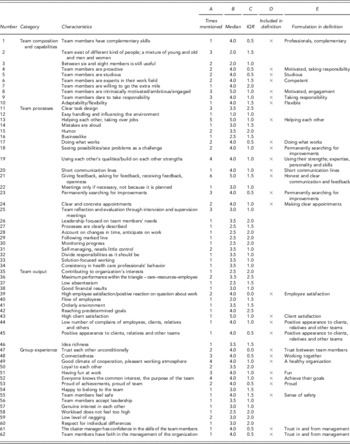
From the answers given in the first round, 62 characteristics assigned to an effective health care team were extracted (see Table 1, column A). Ten characteristics were related to team composition and capabilities, 24 to team processes, 12 to team outcomes and 16 to group experiences. Characteristics in the dimension ‘team outcomes’ were primarily mentioned by the region managers and characteristics in the dimension ‘group experiences’ by the team members and team manager. Characteristics in the dimensions ‘team composition and capabilities’ and ‘team processes’ were equally mentioned by all participants. The most cited characteristic in the first round was about feedback and openness.
Characteristics assigned to effective healthcare teams

IQR = inter-quartile range.
Round two
In the second round, four of the 62 characteristics were rated as ‘very relevant’ based on the median and had an IQR ≤ 1.5 (see characteristics 8, 13, 21 and 43 in Table 1, columns B and C). A total of 26 characteristics were rated as ‘relevant’ and 24 of these characteristics had an IQR ≤ 1.5. Comments on the characteristics included explanations of and questions about the interpretation of words and the emphasis on the relevance of certain characteristics. Some examples of comments were: ‘What is nagging? Nagging can have a good function. Is being critical the same as nagging?’; ‘Trust I will give a 5 (very relevant), unconditionally trust is tricky, that's not how the world works’; ‘Not every team member has to be businesslike, balance is the key word’; ‘I think self-managing capabilities are more important than leadership’.
The formulation of the concept definition was based on the clustering of all the relevant-scored characteristics with an IQR ≤ 1.5. These characteristics were interpreted by the facilitator and second author (Table 1, column E), who suggested a concept definition clustered in five categories.
Round three
Seven of the eight participants agreed with the concept definition, illustrated in reactions such as: ‘Nice, huh?’; ‘Thanks for your e-mail, nice definition, nice terms’; ‘It is logical and complete what you have defined’. One of the participants was missing a characteristic representing ‘development,’ related to one of the organization's viewpoints: ‘I develop myself’ and a professional/personal quality, such as courage, being different, innovative. Based on these comments, the facilitator decided to add the characteristics ‘continuous personal development’ and ‘innovative,’ because it would not cause a significant difference in the meaning of the definition. ‘Continuous personal development’ can be considered as a result of being ‘studious’ and ‘innovative’ that can be interpreted as a quality that corresponds with ‘seeing possibilities/see problems as a challenge’ and ‘permanently searching for improvements.’ The following definition was brought forward as the final definition for an effective health care team:
Professionals (1), working together (2), using their strengths (3), to achieve their goals (4) in a healthy organization (5)
1. Motivated, competent, innovative, taking responsibility, flexible, studious, complementary
2. Helping each other, honest and clear communication and feedback, permanently searching for improvements, clear appointments, doing what works, short communication lines
3. Expertise, personality and skills
4. Client satisfaction, employee satisfaction, positive appearance to clients, relatives and other teams, continuous personal development
5. Trust between team members, fun, engagement, pride, trust in and from management, sense of safety
No questions or comments were received after the final definition was sent to the participants.
Judgment changes over rounds
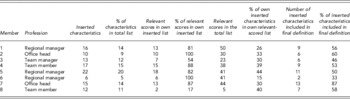
The individual input and judgments over the rounds offer a clear picture of the consensus building process and the personal contribution of the participants. In the first round, the participants inserted 6–22 characteristics assigned to an effective team. In the second round, six of the eight participants scored 81–100% of their own inserted characteristics as ‘relevant’ or ‘very relevant.’ The other two participants scored 54 and 17% of their own inserted characteristics as relevant or very relevant, which was still 30–40% of their complete list of relevant characteristics. Overall, 15–44% of the participants’ relevant list included own inserted characteristics. The complete list of relevant and very relevant characteristics included 33–87% of participants’ own inserted characteristics. Panel member eight scored aberrant compared with the other participants (see Table 2). However, the participant's contribution to the final definition was still substantial; 58% of this member's inserted characteristics were included in the final definition. In the third round, seven of the eight participants agreed with the concept definition right away, a 87% consensus rate. This consensus was reached on 45% of the total inserted characteristics.
Individual input and judgments over rounds

DISCUSSION
The aim of this paper is to evaluate the Delphi Technique as a method for explicating context-specific definitions and illustrate its use in a context-specific definition of ‘an effective health care team.’ Here, we discuss the formulated definition, the strengths and limitations of the Delphi Technique, and the theoretical and practical implications of this study.
Definition
Strikingly, the formulated definition of ‘an effective health care team’ seems at first sight more general than context specific. It shows evident overlap with prior definitions and operationalizations in the literature (Lemieux-Charles & McGuire, Reference Lemieux-Charles and McGuire2006). Like most teamwork models, the definition is based on the input-process-output approach (Hackman, Reference Hackman1987) and includes behavioral, cognitive and affective phenomena (Rousseau et al., Reference Rousseau, Aubé and Savoie2006). Although most characteristics identified by the participants are not new in teamwork literature, the context specificity can be recognized in the emphasis of certain characteristics and the omission of others. It demonstrates the prioritization and experiences of the organization's members.
First, the characteristics ‘doing what works’ and ‘using everybody's strengths’ are typical for a solution-focused approach. Second, the low priority scores on ‘processes are clearly described,’ ‘following the marked line’ and ‘monitoring processes,’ indicate a promotion for flexibility and a pragmatic approach in work structures, which meets the solution-focused principle to search for exceptions to discover what works (De Shazer, Reference De Shazer1985; McAllister, Reference McAllister2003). Third, the limited role of leadership assigned to an effective team is in line with a solution-focused management approach of not knowing and leading from one step behind (McAllister, Reference McAllister2003), with a focus on self-management and personal responsibility. As earlier research indicate the importance of leadership for health care team effectiveness (Corrigan, Garman, Lam, & Leary, Reference Corrigan, Garman, Lam and Leary1998; Outhwaite, Reference Outhwaite2003), it is striking that the participants of this study gave no priority to leadership as characteristic of an effective team.
In conclusion, the context-specific definition shows the influence of the organization's solution-focused work approach, especially in the categories ‘team processes’ and ‘group experience.’ Although the final definition offers little specificity regarding the meaning of general characteristics such as ‘motivated,’ it offers a useful starting point for further research on team effectiveness. It provides clear accents for the team and organization to focus on, which is shown in its use in the research organization, where the definition is used for organizational presentations and to guide policy making.
Delphi Technique
The use of the Delphi Technique showed a number of advantages for the aim of this study. First, the combination of its non-interacting nature and the qualitative approach in the first round provided valuable information about differences in focus, use of terms and perspectives between the participants. The open questions enabled us to detect individual differences in perspectives, and to identify common language and unique context-specific characteristics.
Second, the Delphi Technique gave insights into the level of agreement between the individual members. The results of round two showed that every participant's priority list comprised more than half of characteristics introduced by others. Considering the diversity of answers given in round one, this outcome supports the use of a multi-disciplinary panel to avoid a unilateral focus. At the same time, the overall low IQR scores indicated a shared understanding of the concept.
Third, the process of the Delphi method joined up with the solution-focused principle to use everybody's strengths. A major advantage of assigning people an expert position and involve them in decision-making tasks, is that they are more likely to commit themselves to the outcomes that emerge (Beech, Reference Beech1999; Wiener et al., Reference Wiener, Chacko, Brown, Cron and Cohen2009). We argue that the above average response rate in the first round (Baruch & Holtom, Reference Baruch and Holtom2008) and the 100% response rate over the rounds might be a result of the inclusion of participants of the same organization. As colleague participants work on a joint product that can yield direct profit for their own work field and they know who else is involved in an exercise, their motivation is likely to be higher.
Finally, although some criticisms maintain that the Delphi Technique is time-consuming (Duffield, Reference Duffield1993; Keeney, Hasson, & McKenna, Reference Keeney, Hasson and McKenna2001; Hsu & Sandford, Reference Hsu and Sandford2007), our implementation showed that a Delphi study can be conducted within 3 weeks, using a strict time schedule and process, and including a qualitative first round.
Limitations
There are also some limitations that need to be addressed. First, the active panel may have been small. However, given that the aim of this project was to generate new information on a topic that is generally understood but not specifically defined, a small panel is generally accepted (Rowe & Wright, Reference Rowe and Wright2001). While larger groups provide more intellectual resources, panels comprising of 5–20 members are practically suggested (Armstrong, Reference Armstrong1985; Rowe & Wright, Reference Rowe and Wright2001). Large panels do have a higher risk of member drop-out. The eight participants in this study were very committed to the process, which resulted in a 100% response rate over the rounds and no incompletely answered questions. This is important for an unbiased analysis and consensus process.
Second, the representation of team members and team managers in the active panel was relatively small due to (passive) non-response. The secondary criteria to select panel members based on earlier contact with the researcher, in order to commit them more to the research (Landeta, Reference Landeta2006), did not result in a significantly higher response in the first round. Also, the 100% response rate over the rounds cannot be attributed to this earlier contact, as the region managers and office heads committed comparable over the rounds. Therefore, we cannot make any statements about the value of these selection criteria in this study. Still, the response rate in the first round falls well within the norm, as the benchmark average is around 50% (Baruch & Holtom, Reference Baruch and Holtom2008).
Third, the male–female ratio in the response group was not equally distributed. The underrepresentation of women in management positions does play a part in this outcome, as well as the distribution of the response. The underrepresentation of women is not necessarily problematic, as the representation of at least one participant of each organization layer in combination with passive non-respondents, give no strong reasons for non-response bias (Rogelberg & Stanton, Reference Rogelberg and Stanton2007).
A final question refers to the inclusion of managers rather than team members. We considered team managers to be experts of teamwork, and good spokespersons for their teams. To indicate differences of expertise or accuracy among the panel members, we relied on an analysis of the individuals’ judgment changes over the rounds. Earlier studies have shown panel experts ‘holding-out,’ while less-expert panelists ‘swing’ toward the group average (Rowe & Wright, Reference Rowe and Wright1999). We found an equal degree of change of judgments over the rounds between the different disciplines, which suggests high face validity in terms of an appropriate selection of panel members (Williams & Webb, Reference Williams and Webb1994). Furthermore, the overlap with characteristics outlined in literature also indicate a certain degree of credibility (Devers, Reference Devers1999).
On the whole, the heterogeneity of the expert group, the excellent response rate between the rounds and the high level of consensus achieved suggest that this study demonstrated concurrent validity (Williams & Webb, Reference Williams and Webb1994). However, in future research employing the Delphi Technique, it is recommended to include more panel members of different layers of the organization to prevent underrepresentation of gender or discipline.
Theoretical and practical implications
In this paper, we highlighted the value of a refreshing look at implicit assumptions. The divergent assumptions of what is meant with ‘team effectiveness’ indicate the importance of a better understanding of organizational sense making. Definitions can be arbitrary and usually provide political advantage for some group, and can easily produce blinders as insight (Deetz, Reference Deetz2001). Therefore, the attempt to define team effectiveness within a specific context is not to enhance the analytical precision of the concept, but to understand different and similar interpretations among organizational contexts. This is valuable in extending the present overarching models on the context level by further deepening into context-specific meanings of team effectiveness.
A practical implication for organizations and managers is to make explicit what they are doing and to develop definitions as means for understanding and discussing the complex and dynamic aspects of teamwork. It is a way to check whether people agree about their implicit understanding of core concepts like team effectiveness. The presented definition of an effective health care team shows that interpretation processes differ among organization members and are influenced by organizational context. Almost every organizational activity or outcome is in some way contingent on interpretation (Daft & Weick, Reference Daft and Weick1984). Therefore, organizations should be clear about their expectations of teamwork and interpretations of the different aspects of teamwork to realize teamwork and organizational benefits. Managers may have a tendency to make interpretations spontaneously and intuitively, but it is important that they realize their role in defining the work environment for other participants. By detecting, sharing and prioritizing practitioners’ understanding of team effectiveness or other organizational concepts, team members are better able to give direction to their actions. The Delphi Technique is a useful and efficient method to extract, identify and share context-related information.
CONCLUSION
The Delphi Technique was successfully used to formulate a context-specific definition of an effective health care team. The definition shows the influence of context-specific interpretations of team effectiveness and priorities in teamwork characteristics. Where frameworks and overarching models lack specificity regarding what teams are expected to be effective at doing and fail in distinguishing between team types and work processes, a context-specific definition provides more specific information about teamwork expectations and purposes. Although considerably more research is necessary, the findings highlight the importance of more context-specific research to improve our theoretical understanding of social constructions in organizations.
Acknowledgements
This research was funded by Tameij (Synonym for Dutch health care organization for mentally disabled people), Borne, the Netherlands.