Introduction
Elevated levels of pro-inflammatory cytokines, such as interleukin-6 (IL-6), have been associated with the development of common mental disorders, such as depression and psychological distress (Dantzer et al. Reference Dantzer, O'Connor, Freund, Johnson and Kelley2008; Howren et al. Reference Howren, Lamkin and Suls2009; Miller et al. Reference Miller, Maletic and Raison2009; Dowlati et al. Reference Dowlati, Herrmann, Swardfager, Liu, Sham, Reim and Lanctot2010; Cattaneo et al. Reference Cattaneo, Gennarelli, Uher, Breen, Farmer, Aitchison, Craig, Anacker, Zunsztain, McGuffin and Pariante2013; Raison & Miller, Reference Raison and Miller2013; Valkanova et al. Reference Valkanova, Ebmeier and Allan2013; Kivimaki et al. Reference Kivimaki, Shipley, Batty, Hamer, Akbaraly, Kumari, Jokela, Virtanen, Lowe, Ebmeier, Brunner and Singh-Manoux2014). However, whether IL-6 is implicated in the prognosis of these disorders is unclear. Previous small-scale studies of depressed patients suggest that IL-6 levels might decrease amongst those who recover following antidepressant treatment (Janssen et al. Reference Janssen, Caniato, Verster and Baune2010; Hannestad et al. Reference Hannestad, DellaGioia and Bloch2011; Hiles et al. Reference Hiles, Baker, de Malmanche and Attia2012; Cattaneo et al. Reference Cattaneo, Gennarelli, Uher, Breen, Farmer, Aitchison, Craig, Anacker, Zunsztain, McGuffin and Pariante2013; Yang et al. Reference Yang, Wang, Yang, Shi, Yu and Hashimoto2015). These studies did not examine whether the baseline IL-6 levels predicted recovery from depressive symptoms. Studies were also small in scale (a maximum of 350 patients across all identified studies) and of short duration (⩽5 months) (Hiles et al. Reference Hiles, Baker, de Malmanche and Attia2012), therefore offering little statistical power and limiting insights into the long-term impact of IL-6. In addition, previous evidence is limited to patient groups; as far as we know, the extent to which inflammatory markers have prognostic utility within the non-clinical population has not been studied.
In this study, for the first time to our knowledge, we examined the association between IL-6 and subsequent symptom resolution in a non-clinical population reporting psychological distress symptoms at baseline. We also investigated whether symptom resolution was associated with changing IL-6 levels. We hypothesized that lower and declining IL-6 levels would be associated with increased probability of symptom resolution.
Method
Participants and study design
The population was a sample of 2419 Whitehall II Study participants (1599 men, 820 women) aged 39–72 years, with symptoms of psychological distress at baseline. Ethical approval for the Whitehall II Study was obtained from the University College London Medical School committee on the ethics of human research; all participants provided written informed consent. Psychological distress was determined using the 30-item General Health Questionnaire (GHQ-30) caseness definition (Head et al. Reference Head, Stansfeld, Ebmeier, Geddes, Allan, Lewis and Kivimäki2013). The sample selection procedure is presented in online Supplementary Fig. S1. We selected GHQ cases at each measurement of IL-6 and included those GHQ cases for whom data were also available from at least one subsequent GHQ survey to determine possible symptom resolution. Based on self-reported prevalence of long-standing illnesses, the data did not include any cases of severe mental disorders (schizophrenia or dementia).
IL-6
IL-6 was measured using a high-sensitivity enzyme-linked immunosorbent assay (ELISA) assay (R&D Systems, UK) in clinical examinations carried out in 1991–1993, 1997–1999 and 2002–2004. At each examination, serum samples were collected between 08.00 and 13.00 hours, stored at −80 °C and were not thawed or refrozen during storage. Values below the detection limit (0.08 pg/ml) were assigned a value equal to half the detection limit. To measure short-term biological variation and laboratory error, a repeat sample was taken from a subset of 241 participants [average elapsed time between samples was 32 (s.d. = 10.5) days]. Intra- and inter-assay coefficients of variation were 7.5% and 8.9%, respectively, and reliability between samples assessed with Pearson's correlation coefficients was r = 0.61.
Psychological distress
Participants responded to the self-administered GHQ-30 (Goldberg, Reference Goldberg1972; Goldberg & Williams, Reference Goldberg and Williams1988; Head et al. Reference Head, Stansfeld, Ebmeier, Geddes, Allan, Lewis and Kivimäki2013) at each IL-6 baseline examination (1991–1993, 1997–1999 and 2002–2004) and at one or two subsequent phases (1997–1999, 2001, 2002–2004, 2006, 2007–2009) (see online Supplementary Fig. S1). The GHQ-30 is a screening instrument designed to detect psychiatric morbidity. Widely used in population-based surveys and trials, it assesses a range of neurotic symptoms, in particular depression and anxiety, while avoiding those that might reflect physical illness by design. Using psychiatric interview as the ‘gold standard’, in the present cohort study the sensitivity and specificity of the 30-item GHQ to detect depressive disorder were 78% and 83%, respectively (Head et al. Reference Head, Stansfeld, Ebmeier, Geddes, Allan, Lewis and Kivimäki2013). Each questionnaire item enquires about a specific symptom; response categories are scored as either 1 or 0 to indicate presence of the symptom. A total score of 5 or more led to individuals being defined as GHQ ‘cases’ and scores 0–4 as ‘non-cases’ (Head et al. Reference Head, Stansfeld, Ebmeier, Geddes, Allan, Lewis and Kivimäki2013; Kivimaki et al. Reference Kivimaki, Shipley, Batty, Hamer, Akbaraly, Kumari, Jokela, Virtanen, Lowe, Ebmeier, Brunner and Singh-Manoux2014). At follow-up the participant was indicated as ‘symptom-free’ if he/she was a non-case at the last available survey. The baseline GHQ-30 score was further divided into four groups of equal size, based on the distribution of scores, to indicate the number of symptoms (5–6, 7–9, 10–14, and 15–30 points) to be used as a covariate.
Other characteristics
To control for the effect of confounding and mediating factors (Duivis et al. Reference Duivis, de Jonge, Penninx, Na, Cohen and Whooley2011; Kivimaki et al. Reference Kivimaki, Shipley, Batty, Hamer, Akbaraly, Kumari, Jokela, Virtanen, Lowe, Ebmeier, Brunner and Singh-Manoux2014) we adjusted the models for physical illness (cardiovascular disease, i.e. a history of myocardial infarction, angina, or stroke; diabetes mellitus; and cancer at each baseline assessment). A history of angina was identified via a questionnaire and was corroborated with medical records, abnormalities in a resting electrocardiogram (ECG), an exercise ECG, or a coronary angiogram. Non-fatal myocardial infarction was defined following the World Health Organization MONICA (Multinational Monitoring of Trends and Determinants in Cardiovascular Disease) criteria (Tunstall-Pedoe et al. Reference Tunstall-Pedoe, Kuulasmaa, Amouyel, Arveiler, Rajakangas and Pajak1994) and ascertained using data from medical examinations, hospital records of ECGs and use of cardiac enzymes. A history of stroke or transient ischaemic attack was ascertained by self-reports (‘Have you ever been told by a doctor that you have had a stroke or transient ischaemic attack?’ Yes/no). Diabetes was defined as fasting glucose ⩾7.0 mmol/l or a 2-h post-load glucose ⩾11.1 mmol/l during the oral glucose tolerance test performed at the Whitehall screening, as physician-diagnosed diabetes or use of diabetes medication (Tabak et al. Reference Tabak, Jokela, Akbaraly, Brunner, Kivimäki and Witte2009). Cancers were ascertained through the National Health Service cancer registry, as previously (Kivimaki et al. Reference Kivimaki, Shipley, Batty, Hamer, Akbaraly, Kumari, Jokela, Virtanen, Lowe, Ebmeier, Brunner and Singh-Manoux2014).
The following characteristics assessed at baseline were also used as covariates: age, sex, body mass index (BMI), acute inflammation and medication use. BMI was defined as weight (in kg)/height squared (in m2), obesity as BMI ⩾ 30 kg/m2 and acute inflammation as a C-reactive protein level >10 mg/l (based on high-sensitivity immunonephelometric assay in a BN ProSpec nephelometer; Dade Behring, UK). At medical examination, participants provided details of current medications use (generic name, brand name, or both); these were subsequently coded using the British National Formulary to determine the use of anti-inflammatory medication, antidepressants, oral contraceptives and hormone replacement therapy. Smoking (yes/no) was based on survey responses.
Statistical analysis
This study design of repeat measures of 2419 participants produced a total of 3289 person-observations with a mean follow-up of 6.5 (s.d. = 1.8) years (online Supplementary Fig. S1). Three clinical study waves (1991–1993, 1997–1999 and 2002–2004) were used as the baseline of this study. There were 2735 baseline person-observations with two follow-up measurements of the GHQ-30 and 554 person-observations with data on one measurement of the two follow-up surveys. At each baseline, we divided the distribution of IL-6 into three categories: ⩽1.0 pg/ml (low), >1.0–2.0 pg/ml (average) and >2.0 pg/ml (high), as outlined previously (Kivimaki et al. Reference Kivimaki, Shipley, Batty, Hamer, Akbaraly, Kumari, Jokela, Virtanen, Lowe, Ebmeier, Brunner and Singh-Manoux2014). In the symptomatic participants, symptom resolution at subsequent phases was common (58.5% were symptom-free at follow-up). We therefore used log-binomial regression to estimate risk ratios (RRs) rather than odds ratios to examine the associations between IL-6 category and symptom resolution. The trend was tested by entering the IL-6 variable in the models as a continuous variable. The basic models were adjusted for age and sex to study the association and further serial adjustment was performed to examine the contribution of covariates on the association. To examine the robustness of the association we re-ran the analysis restricting the sample to those participants (n = 2735 person-observations) with data on symptoms of psychological distress at both of the two subsequent surveys. We restricted the data to the 2003 person-observations with IL-6 data available both at baseline and follow-up and examined whether repeated high IL-6 versus repeated low IL-6 was associated with symptom resolution (other combinations formed the group ‘other’). We examined change in IL-6 among symptomatic participants with high levels of IL-6 at baseline and with follow-up data on IL-6 (n = 505). Change score was calculated as a difference in IL-6 between follow-up and baseline and multivariate analysis of variance was used to compare the change score in IL-6 between symptomatic participants with symptom resolution and those with persistent or repeated symptoms. All data analyses were performed with SAS version 9.4 (USA).
Results
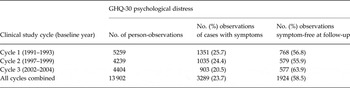
The distribution of psychological distress (GHQ caseness) across the three clinical study cycles, and at each cycle, is shown in Table 1. The average proportion of individuals who were identified as GHQ-30 cases across the three cycles was 23.7%, which decreased from cycle 1 to cycle 3 (20.5% cases in cycle 3). Of the cases, an average of 58.5% were symptom-free at their last follow-up observation and the symptom resolution rate at follow-up was higher in cycle 3 (63.9%).
GHQ-30-identified psychological distress at baseline and follow-up based on observations across the three clinical study cycles

GHQ-30, 30-Item General Health Questionnaire.
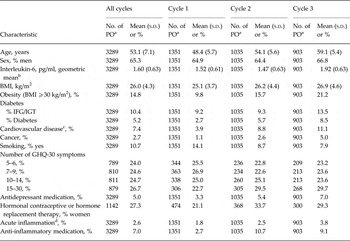
Table 2 presents characteristics of the symptomatic participants at baseline (GHQ cases) across the cycles and at each study cycle. With increasing age over the cycles, the prevalence of chronic diseases increased as well as IL-6 levels, obesity and medication use. Among the GHQ cases, baseline GHQ score was higher at later cycles, indicating that at later baseline examinations the symptomatic participants had more symptoms or more severe symptoms than at the earlier baseline examinations.
Baseline characteristics of GHQ-30 identified cases of psychological distress based on observations at each clinical study cycle

GHQ-30, 30-Item General Health Questionnaire; PO, person-observations; s.d., standard deviation; BMI, body mass index; IFG, impaired fasting glucose; IGT, impaired glucose tolerance.
a No. of PO refers to the sum of person-observations.
b The interleukin-6 values are the geometric mean and the s.d. of the log(interleukin-6) distribution.
c Cardiovascular disease refers to history of coronary heart disease or stroke.
d Acute inflammation corresponds to C-reactive protein of >10 mg/l.
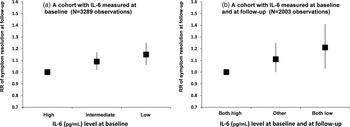
GHQ cases with low levels of IL-6 at baseline were more likely to be symptom-free at follow-up [age-, sex- and antidepressant medication-adjusted RR = 1.15, 95% confidence interval (CI) 1.06–1.25, p for trend < 0.001] than GHQ cases with high IL-6 at baseline (Fig. 1a ). Further adjustments for covariates reduced the estimate approximately by a third but the RR remained statistically significant (RR = 1.10, 95% CI 1.01–1.19; Table 3). This association was not dependent on sex (p sex interaction = 0.90) or antidepressant use (p antidepressant interaction = 0.22). We replicated the findings in sensitivity analyses in which the sample included only participants with data on GHQ at baseline and both of the two subsequent surveys (n = 2735 person-observations; online Supplementary Table S1).
(a) Interleukin 6 (IL-6) as a prognostic factor for being symptom-free at follow-up among symptomatic participants with 30-item General Health Questionnaire-identified psychological distress at baseline. (b) Association between the level of IL-6 at baseline and at follow-up and symptom resolution at follow-up. Values are risk ratios (RR), with 95% confidence intervals represented by vertical bars. Models are adjusted for age, sex and antidepressant medication.

Multivariable adjusted association between baseline level of interleukin-6 and probability of being symptom-free at follow-up among symptomatic participants with GHQ-30 psychological distress at baseline

GHQ-30, 30-Item General Health Questionnaire; RR, risk ratio; CI, confidence interval.
a Model 1 is adjusted for age, sex and antidepressant medication (subsequent adjustments are cumulative).
b Model 2 is additionally adjusted for obesity and diabetes.
c Model 3 is additionally adjusted for cardiovascular disease, cancer and smoking.
d Model 4 is additionally adjusted for number of mental symptoms and hormonal contraceptive/hormone replacement therapy.
e Model 5 is additionally adjusted for acute inflammation and anti-inflammatory medication.
When data were restricted to the 2003 person-observations with IL-6 data available both at baseline and follow-up (Fig. 1 b), we found that those with repeated low IL-6 were more likely to be symptom-free at follow-up compared with those with repeated high IL-6 (age-, sex- and antidepressant medication-adjusted RR = 1.21, 95% CI 1.03–1.41; p for trend = 0.017).
We further confirmed the findings by comparing mean IL-6 levels between participants with and without symptom resolution (data not shown): age-, sex- and antidepressant medication-adjusted geometric baseline mean of IL-6 was 1.60 pg/ml among those who were symptom-free at follow-up, and 1.71 pg/ml among those who had symptoms at follow-up (p for difference = 0.003). We calculated a mean of baseline and follow-up IL-6 in a subgroup of 2003 participants with IL-6 data available also at follow-up. For participants with symptom resolution at follow-up, the age-, sex- and antidepressant medication-adjusted geometric mean across the two measurements of IL-6 was 1.65 pg/ml and for those with persistent or repeated symptoms it was 1.75 pg/ml (p for difference = 0.015).
In a subgroup of symptomatic participants (n = 505 person-observations) with elevated IL-6 at baseline (>2.0 pg/ml), the age-, sex- and antidepressant medication-adjusted mean change in IL-6 between baseline and follow-up was −1.00 pg/ml among those who became symptom-free and −0.16 pg/ml among those who remained symptomatic at follow-up (p for difference = 0.002; data not shown).
Discussion
We examined the associations between IL-6 and psychological distress symptom resolution in a non-clinical cohort reporting psychological distress symptoms at study baseline. We found that IL-6 levels was lower at baseline and follow-up amongst those who were symptom-free at follow-up, compared with those who still had symptoms. In addition, we found that psychological distress resolution among symptomatic participants with high IL-6 at baseline was associated with a decrease in the levels of IL-6. With a follow-up period of 6 years, our study provides new evidence of the potential role of IL-6 on the long-term prognosis of persons who have symptoms of mental ill health.
The present findings are consistent with the evidence from pharmacological and biomedical studies. Treating cancer patients with human cytokines, for example, was associated with a substantial increase of depressive symptoms as a ‘side-effect’ (Dantzer et al. Reference Dantzer, O'Connor, Freund, Johnson and Kelley2008; Miller et al. Reference Miller, Maletic and Raison2009). In addition, circulating levels of IL-6 have been associated with the efficacy of antidepressant therapy, with lower IL-6 being linked to more favourable treatment effects (Janssen et al. Reference Janssen, Caniato, Verster and Baune2010; Hannestad et al. Reference Hannestad, DellaGioia and Bloch2011; Hiles et al. Reference Hiles, Baker, de Malmanche and Attia2012; Cattaneo et al. Reference Cattaneo, Gennarelli, Uher, Breen, Farmer, Aitchison, Craig, Anacker, Zunsztain, McGuffin and Pariante2013), and high IL-6 levels to refraction to antidepressants (Lanquillon et al. Reference Lanquillon, Krieg, Bening-Abu-Shach and Vedder2000; O'Brien et al. Reference O'Brien, Scully, Fitzgerald, Scott and Dinan2007; Yoshimura et al. Reference Yoshimura, Hori, Ikenouchi-Sugita, Umene-Nakano, Ueda and Nakamura2009). We add to the existing evidence by reporting findings among a large non-clinical cohort of participants followed on average for 6 years. We found that lower IL-6 levels were associated with symptom resolution after adjusting the models for a variety of potential confounding and mediating factors at baseline, including acute inflammation and use of antidepressants and anti-inflammatory drugs.
Because IL-6 crosses the blood–brain barrier, activation of an inflammatory process by increased IL-6 secretion has potential in the pathology of depression. This hypothesis has been supported by several reviews and meta-analyses (Dantzer et al. Reference Dantzer, O'Connor, Freund, Johnson and Kelley2008; Howren et al. Reference Howren, Lamkin and Suls2009; Dowlati et al. Reference Dowlati, Herrmann, Swardfager, Liu, Sham, Reim and Lanctot2010; Valkanova et al. Reference Valkanova, Ebmeier and Allan2013). Biological changes associated with depression include changes in the availability of the neurotransmitters serotonin and glutamate, hypothalamic–pituitary–adrenal (HPA) axis overactivation and impaired function of glucocorticoid receptors and increased production of neurotoxic catabolites (Dantzer et al. Reference Dantzer, O'Connor, Freund, Johnson and Kelley2008; Miller et al. Reference Miller, Maletic and Raison2009; Maes et al. Reference Maes, Leonard, Myint, Kubera and Verkerk2011; Myint et al. Reference Myint, Schwarz and Muller2012; Anderson et al. Reference Anderson, Kubera, Duda, Lason, Berk and Maes2013; Raison & Miller, Reference Raison and Miller2013; Muller, Reference Muller2014). In earlier aetiological analyses of the present cohort, high IL-6 levels predicted onset of GHQ caseness among participants free from symptoms at baseline (Kivimaki et al. Reference Kivimaki, Shipley, Batty, Hamer, Akbaraly, Kumari, Jokela, Virtanen, Lowe, Ebmeier, Brunner and Singh-Manoux2014). The present study adds evidence to the earlier research by showing that IL-6 levels also contribute to the prognosis amongst those who already are symptomatic (i.e. GHQ cases at baseline). In these individuals, low, repeatedly low and declining levels of IL-6 were associated with greater symptom resolution at follow-up.
Our finding that IL-6 reduced along with symptom reduction is in agreement with some but not all previous studies. Earlier studies have focused on the effect of antidepressant treatment on change in the levels of inflammatory markers amongst patients with depressive symptoms (Janssen et al. Reference Janssen, Caniato, Verster and Baune2010; Hannestad et al. Reference Hannestad, DellaGioia and Bloch2011; Hiles et al. Reference Hiles, Baker, de Malmanche and Attia2012; Cattaneo et al. Reference Cattaneo, Gennarelli, Uher, Breen, Farmer, Aitchison, Craig, Anacker, Zunsztain, McGuffin and Pariante2013). One meta-analysis of about 300 patients suggested reduced IL-6 levels among patients who were treated with antidepressants (Hiles et al. Reference Hiles, Baker, de Malmanche and Attia2012) while another meta-analysis with less than 300 patients suggested there was no such association (Hannestad et al. Reference Hannestad, DellaGioia and Bloch2011).
There are limitations in our study. We used the GHQ-30, which does not provide a clinical diagnosis of depression. However, the GHQ-30 assesses symptoms of depression, anxiety, insomnia and social dysfunction and it has been shown to have high sensitivity (78%) and specificity (83%) for depression in the present cohort (Head et al. Reference Head, Stansfeld, Ebmeier, Geddes, Allan, Lewis and Kivimäki2013). Using the 60-item version of the original GHQ, the 30-item version was created in order to eliminate distress explicitly ascribed to physical illness. Thus, confounding by measured symptoms of physical illness is unlikely in our study. Additionally, we also controlled for severe chronic somatic illnesses, acute inflammation and medication use in our study.
The Whitehall II participants, although representing a relatively healthy, non-clinical sample, were mainly white-collar civil servants, therefore limiting the generalizability of our finding to the wider British population. Furthermore, we did not have data on the use of antidepressants for the whole follow-up period. Further research is needed to examine the role of these drugs in long-term recovery in detail. The main strengths of this study were a longitudinal design with repeat measures of IL-6 and GHQ-30 which enabled accurate assessment of change.
Conclusions
In conclusion, our findings suggest that IL-6 levels may be involved in the potential pathological mechanisms underlying the prognosis of common mental health problems, such as depression. Further studies are needed to examine these mechanisms and to confirm the findings in relation to clinical depression.
Supplementary material
For supplementary material accompanying this paper visit http://dx.doi.org/10.1017/S0033291715000070
Acknowledgements
The Whitehall II Study is supported by grants from the Medical Research Council (K013351); British Heart Foundation; National Heart Blood and Lung Institute, National Institutes of Health (NIH), USA (R01HL036310); and the National Institute of Aging, NIH, USA (R01AG013196 and R01AG034454). M.V. is supported by the Academy of Finland (258598, 265174). M.J.S. and M.H. are supported by the British Heart Foundation. G.D.B. is a member of the University of Edinburgh Centre for Cognitive Ageing and Cognitive Epidemiology, part of the cross-council Lifelong Health and Wellbeing Initiative (G0700704/84698) and a Wellcome Trust Fellow during the preparation of this manuscript. K.P.E. is supported by the Medical Research Council (G1001354), T.N.A. by the National Heart Lung and Blood Institute (R01HL036310) and by the Languedoc-Roussillon Region (Chercheur d'avenir grant 2011), A.S.-M. by the National Institute of Aging, NIH, USA (R01AG013196 and R01AG034454) and C.L.A by OHSRC/NOF/BRU/OUCAGS. M.K. is supported by the Medical Research Council, the NIH, USA (R01HL036310, R01AG034454) and a professorial fellowship from the Economic and Social Research Council.
Declaration of Interest
None.