Congenitally corrected transposition of the great arteries is a rare condition. The basic abnormality in congenitally corrected transposition of the great arteries is the presence of atrioventricular and ventriculoarterial discordance. Therefore, the morphologically right ventricle and the tricuspid valve support the systemic circulation. Long-term follow-up of these patients has shown a high incidence of heart failure most probably due to associated abnormalities, tricuspid regurgitation, or systemic right ventricular failure.Reference Graham, Bernard and Mellen 1
Tricuspid regurgitation is frequently associated with anatomical abnormalities of the valve or is ascribed to increased pressure load on the valve. The cause-and-effect relationship between tricuspid regurgitation and systemic right ventricular dysfunction remains to be determined.
Recent long-term follow-up studies have dealt with children, populations with specific concomitant anomalies, and patients after the double-switch procedure, but have focussed less on the natural history of patients with congenitally corrected transposition of the great arteries.Reference Mongeon, Connolly, Dearani, Li and Warnes 2 , Reference Rutledge, Nihill, Frazer, Smith and Bezold 3
Therefore, the aims of the present study were as follows:
-
∙ to assess the development of heart failure in patients with congenitally corrected transposition of the great arteries in a medium-term follow-up study;
-
∙ to identify the impact of tricuspid regurgitation on the development of heart failure; and
-
∙ to determine the most reliable marker for recognising systemic right ventricular dysfunction in adult patients with congenitally corrected transposition of the great arteries.
Materials and methods
Patients
The present study included all consecutive patients with congenitally corrected transposition of the great arteries (n=19) entered since 2006 into the database of adult patients with CHD of the University Medical Centre Ljubljana, the only centre for adult CHD in Slovenia. The prospective study included 17 survivors, including nine women, from 20 to 56 years of age, with a mean age of 39.5±11.0 years.Reference Kozelj, Prokselj and Berden 4 All diagnostic procedures were carried out in the context of regular clinical check-ups.
Clinical investigation
The patients underwent detailed clinical evaluation including review of medical history and physical examination, 12-lead electrocardiograms, trans-thoracic echocardiography, exercise testing, MRI or multi-slice CT, and determination of N-terminal pro-hormone brain natriuretic peptide levels at baseline and 6 years after the first evaluation. The data were collected on regular follow-up examinations at yearly intervals, as recommended by the European Society of Cardiology guidelines for the management of adult patients with CHD.Reference Baumgartner, Bonhoeffer, De Groot, de Haan, Deanfield and Galie 5 The collected data included the patients’ NYHA functional class.
Exercise testing
Exercise stress testing was performed on a bicycle ergometer according to the modified Bruce protocol with increments of 30 W/3 minutes.Reference Bruce, Blackmon, Jones and Strait 6 The test was performed within 1 week of echocardiographic study in all patients.
Echocardiography
Trans-thoracic two-dimensional echocardiography, echo-Doppler studies, and tissue Doppler echocardiography were carried out using an Aloka alfa 10 echocardiographic machine. Two-dimensional, M-mode, conventional and tissue Doppler were performed according to the American Society of Echocardiography guidelines.Reference Lang, Bierig, Devereux, Flachskampf, Foster and Pellikka 7
Systemic right ventricular systolic function was assessed semi-quantitatively and categorised as normal or mildly, moderately, or severely impaired. The severity of tricuspid regurgitation was quantified on a similar scale as normal, mild, moderate, or severe. Diastolic systemic right ventricular function was assessed by measuring flow velocities through the tricuspid valve and the right upper pulmonary vein. The following diastolic parameters were measured: ratio of early diastolic transtricuspid velocity to late diastolic transtricuspid velocity, pulmonary vein systolic and diastolic, atrial reversal wave velocities, and duration of late diastolic transtricuspid velocity wave seen on the transtricuspid flow pattern and on the pulmonary venous flow. The ratio of the duration of late diastolic transtricuspid velocity and duration of atrial reversal wave was calculated.Reference Alam, Wardell, Andersson, Samad and Nordlander 8
Pulsed tissue Doppler echocardiographic images were recorded from the apical 4-chamber view. Maximum systolic, early and late diastolic peak velocities were measured. For assessing the velocity of longitudinal ventricular wall excursions, a sample volume was placed at the tricuspid annulus of the free right ventricular wall to assess peak tricuspid systolic annular velocity, peak tricuspid early diastolic annular velocity, and peak tricuspid late diastolic annular velocity, and at the basal segment of the inter-ventricular septum to assess peak systolic velocity at the basal inter-ventricular septum, peak early diastolic velocity at the basal inter-ventricular septum, and peak late diastolic velocity at the basal inter-ventricular septum. For each patient, at least three consecutive cardiac cycles were analysed and averaged.Reference Alam, Wardell, Andersson, Samad and Nordlander 8 , Reference Suty-Selton, Mock, Piquemal, Vancon, Nippert and Juilliere 9
N-terminal pro-hormone brain natriuretic peptide levels
Blood samples were obtained from the antecubital vein in all patients. Blood was collected into chilled tubes containing ethylene diamine tetra-acetic acid, promptly centrifuged, and stored at −70°C until final analysis.
Serum N-terminal pro-hormone brain natriuretic peptide level was measured by the electrochemiluminiscence immunoassay “ELCIA” using the Roche Elecsys immunoassay analyser (Roche Diagnostics, GmbH, Mannheim, Germany). The measuring range of 5 to 35.000 ng/L was defined by the lower detection limit and the maximum of the master curve. The cut-off value for normality was 125 ng/L.Reference Gustafsson, Badskjaer, Stensgaard, Poulsen and Hildebrandt 10
MRI and multi-slice CT
MRI was carried out in seven patients using a 3 Tesla scanner with high power gradients (Trio Tim, Siemens, Erlangen, Germany). Imaging sessions were initiated by scout images followed by electrocardiogram-triggered Tl-weighted spin echo series of axial images (minimum TE, flip angle 150°, slice thickness 7 mm, spacing 1.0 mm, nex 2, matrix 256×28).
Based on these images, we performed breath-hold cine sequences in the short axis of the systemic ventricle from the base to the apex, in order to obtain a stack of 12 to 14 contiguous images, 8-mm thick, with no gap between slices. The repetition time was based on the R-R interval, the echo time was 1.45 ms and the flip angle was 50°.
Cardiac multi-slice CT imaging was performed in 10 patients with a pacemaker. They were studied with multi-slice CT using a 64-slice scanner Somatom Definition Dual source 64 (Siemens). The scan parameters were as follows: 120 kV, 500 eff mAs, and tube rotation time was 0.33 seconds; slice width was 0.6 mm and collimation 19.2×0.6 mm; reconstruction increment was 0.6 mm and kernel B26 medium smooth. The scan was performed over the whole cardiac cycle with retrospective electrocardiogram gating. The heart was covered from the base to the apex, table feed/rotation was 6.9 seconds and scan time was 5–10 seconds. A bolus of 55–65 ml non-ionic contrast medium (400 mg I/ml) was injected through an 18-gauge catheter placed into the antecubital vein at a flow rate of 5 ml/second, followed by a 50 ml saline chaser bolus at the same flow rate. Scanning started automatically after the density of contrast media in the ascending aorta reached 120 HU.
This was followed by post-processing on the workstation. Short-axis multi-planer re-formatting images of the systemic ventricle from the base to the apex were reconstructed in end-diastole and end-systole, typically at 80 and 20% of R-R interval, to get a stack of 8-mm-thick images. Mass (Medis, Leiden, The Netherlands) image analysis software was used for processing multi-slice, multiphase images provided by cardiac MRI and multi-slice CT. Ejection fraction was determined by the manual outlining of the endocardial contours of end-diastolic and end-systolic frames. Papillary muscles and trabeculations were not included in the calculation of ventricular volumes. Ejection fraction was calculated as follows: 100× (end-diastolic volume-end-systolic volume/end-diastolic volume). A right ventricular end-diastolic volume of >58 ml for men and >48 ml for women and an ejection fraction of >48% for men and >50% for women were all defined as normal.Reference Lorenz 11 – Reference Maffei, Messalli and Martini 13 Systemic right ventricles were most often dilated with significantly larger end-diastolic and end-systolic volumes, but there were no standard values.Reference Grewal, Crean and Garceau 14 , Reference Bonello and Kilner 15
Statistical analysis
The Kolmogorov–Smirnov test was used to verify normal distribution of data. Normally distributed continuous variables were expressed as means and standard deviations. In non normally distributed continuous variables, data were expressed as median and 25th and 75th percentiles – inter-quartile range. Categorical data were summarised as frequencies and percentages. For comparisons of continuous variables, the paired Student t-test was used for normally distributed variables and the Wilcoxon matched-pair test for non normally distributed variables. The data for categorical variables were analysed by the Fisher exact test. Pearson’s (r) and Spearman’s rank (ρ) correlation coefficients were used to identify the relationships between the parameters. A two-tailed p value of ⩽0.05 was considered statistically significant in all tests. Data were analysed using SPSS 16 for Windows (SPSS Inc, Chicago, Illinois).
Results
Demographic and clinical data
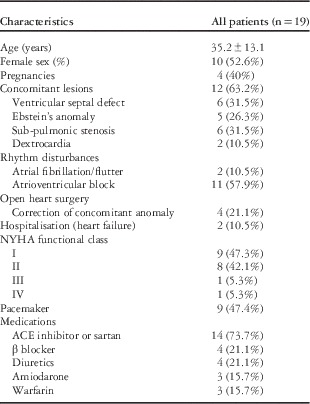
Baseline patient demographic and clinical characteristics are listed in Table 1.
Baseline clinical characteristics of congenitally corrected transposition of the great arteries patients.

ACE=angiotensin-converting enzyme inhibitor
During the 6-year follow-up period, two patients died (10.5%) due to heart failure. The older patient was a 69-year-old woman with associated Ebstein’s anomaly, severe tricuspid regurgitation, and dextrocardia. The course of the disease was complicated by chronic pulmonary embolisms. The other patient was a 32-year-old man with concomitant Ebstein’s anomaly, residual ventricular septal defect following surgery, and atrial fibrillation with complete atrioventricular block and implanted pacemaker.
The NYHA functional class did not change significantly during the 6-year observation period (NYHA I/II/III/IV: 9/8/0/0 versus 7/8/2/0, p=0.834). Even when the two patients who died during follow-up were included in the worst functional class, no significant progression over time was observed (NYHA I/II/III/IV: 9/8/2/0 versus 7/8/2/2, p=0.916).
Severe tricuspid regurgitation required tricuspid valve replacement in two patients during follow-up.
Pacemaker implantation was indicated in two patients who developed complete atrioventricular block; one of them received cardiac re-synchronisation therapy due to heart failure after tricuspid valve replacement. There was no significant increase in the incidence of atrial fibrillation or flutter during follow-up.
The majority of patients (76.47%) were treated with angiotensin-converting enzyme inhibitors or sartans.
Among all, five women had given birth, one of them twice.
Exercise testing
During the 6 years of follow-up, a statistically significant decline in exercise capacity occurred (7.65±2.44 versus 6.33±1.70 MET, p=0.002).
Echocardiographic parameters
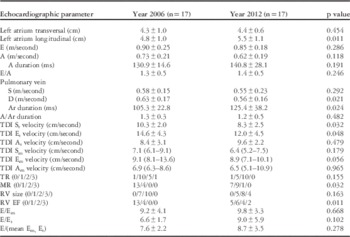
Table 2 summarises the echocardiographic indices at 6-year follow-up. The left atrial size increased significantly (4.8±1.0 versus 5.5±1.1 cm, p=0.011). The conventional Doppler parameters identifying diastolic function of the systemic right ventricle did not change significantly. Nevertheless, there was a significant decrease in the pulmonary venous diastolic velocity (0.63±0.17 versus 0.56±0.16 m/second, p=0.02), and a significant increase in the duration of the atrial reversal wave (105.3±22.8 versus 125.4±38.2 ms, p=0.024). The change in duration of the atrial reversal wave correlated positively with the change in N-terminal pro-hormone brain natriuretic peptide plasma levels (ρ=0.673, p=0.033). The ratio of the duration of late diastolic transtricuspid velocity and duration of atrial reversal wave remained unchanged.
Echocardiographic parameters.

A=late diastolic transtricuspid velocity; A/Ar=ratio of the duration of late diastolic transtricuspid velocity and duration of atrial reversal wave; TR, MR=tricuspid, mitral regurgitation: 0/1/2/3=none, mild, moderate, severe; Am=peak late diastolic velocity at the basal inter-ventricular septum; Ar=atrial reversal wave; At=peak tricuspid late diastolic annular velocity (lateral side); D=diastolic pulmonary vein velocity; E=early diastolic transtricuspid velocity; E/A=early diastolic transtricuspid velocity/late diastolic transtricuspid velocity ratio; E/Em=ratio of transtricuspid early RV filling velocity to early diastolic Doppler tissue imaging velocity of the tricuspid annulus at the septal position; E/Et=ratio of transtricuspid early right ventricular filling velocity to early diastolic Doppler tissue imaging velocity of the tricuspid annulus at the lateral position; EF=ejection fraction; Em=peak early diastolic velocity at the basal inter-ventricular septum; E/(mean Em, Et)=ratio of transtricuspid early right ventricular filling velocity to early diastolic Doppler tissue imaging mean velocities of the tricuspid annulus at the septal and lateral position; Et=peak tricuspid early diastolic annular velocity (lateral side); RV=right ventricle; RV EF=right ventricular ejection fraction; RV size=right ventricular size/function: 0/1/2/3=normal, mildly, moderately, severely enlarged, impaired; S=systolic pulmonary vein velocity; Sm=peak systolic velocity at the basal inter-ventricular septum; St=peak tricuspid systolic annular velocity (lateral side); TDI=tissue Doppler imaging
Tissue Doppler imaging showed a significant decrease of peak tricuspid systolic annular velocity (10.3±2.0 versus 8.3±2.5 cm/second, p=0.032) and peak tricuspid early diastolic annular velocity (14.6±4.3 versus 12.0±4.5 cm/second, p=0.048) at the lateral side of the tricuspid annulus. The tissue Doppler velocities at the septal side of the tricuspid annulus showed a trend towards a decrease only for the peak early diastolic velocity at the basal inter-ventricular septum (9.1 cm/second(8.1–13.6) versus 8.9 cm/second (7.1–10.1), p=0.056).
The severity of tricuspid regurgitation did not increase significantly over the 6 years.
Semi-quantitative assessment of the systolic function of the systemic right ventricle revealed its significant impairment (p=0.011).
The prevalence of regurgitation of the atrioventricular valve of the sub-pulmonary ventricle – mitral regurgitation – increased significantly (p=0.032) in all patients. Mitral regurgitation did not occur more frequently in patients with implanted pacemaker or in those with atrial fibrillation.
In two patients who died during follow-up period, the echocardiographic control studies were not performed because they died before planned echocardiography.
N-terminal pro-hormone brain natriuretic peptide levels
Plasma N-terminal pro-hormone brain natriuretic peptide level increased significantly during the 6-year follow-up (127.0 ng/L(82.3–305.8) versus 226.0 ng/L(112.5–753.0), p=0.022). The difference in N-terminal pro-hormone brain natriuretic peptide levels correlated positively with the difference in systemic right ventricular function assessed by echocardiography (ρ=0.52, p=0.032).
Global systemic right ventricular systolic function
The systemic right ventricular ejection fraction measured by MRI or multi-slice CT was significantly lower after 6 years of follow-up (48.3±13.7 versus 42.7±12.7%, p=0.001).
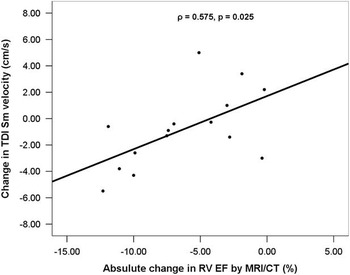
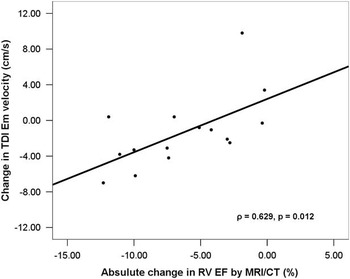
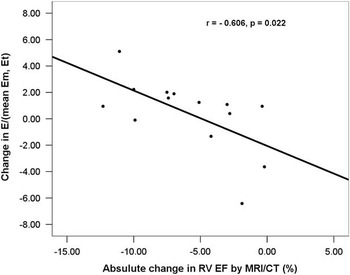
The change in systemic right ventricular ejection fraction evaluated by MRI/multi-slice CT correlated positively with the change in the ratio of early diastolic transtricuspid velocity to late diastolic transtricuspid velocity (r=0.635, p=0.036) and the change in tissue Doppler velocities at the septal side of the tricuspid annulus: peak systolic velocity at the basal inter-ventricular septum (ρ=0.575, p=0.025) (Fig 1) and peak early diastolic velocity at the basal inter-ventricular septum (ρ=0.629, p=0.012) (Fig 2). This change in systemic right ventricular ejection fraction was negatively correlated with the change in the ratio of transtricuspid early right ventricular filling velocity to early diastolic Doppler tissue imaging velocity of the tricuspid annulus at the septal position (r=−0.560, p=0.037) and the change in the average ratio of transtricuspid early right ventricular filling velocity to early diastolic Doppler tissue imaging mean velocities of the tricuspid annulus at the septal and lateral positions (r=−0.606, p=0.022) (Fig 3).
Correlation between the change in systolic tissue Doppler velocities at the septal side of the tricuspid annulus (Sm) and the change in systemic right ventricular ejection fraction as assessed by MRI/multi-slice CT (ρ=0.575, p=0.025).

Correlation between the change in diastolic tissue Doppler velocities at the septal side of the tricuspid annulus (Em) and the change in systemic right ventricular ejection fraction determined by MRI/multi-slice CT (ρ=0.629, p=0.012).

Correlation between the change in the average E/(mean Em, Et) ratio and the change in systemic right ventricular ejection fraction assessed by MRI/multi-slice CT (r=−0.606, p=0.022).

The changes in the septal and average ratio in tissue Doppler parameters – ratio of transtricuspid early right ventricular filling velocity to early diastolic Doppler tissue imaging velocity of the tricuspid annulus at the septal position and ratio of transtricuspid early right ventricular filling velocity to early diastolic Doppler tissue imaging mean velocities of the tricuspid annulus at the septal and lateral position – correlated negatively with the change in the ratio of the duration of late diastolic transtricuspid velocity and duration of atrial reversal wave (r=−0.657, p=0.039; r=−0.768, p=0.009).
Discussion
The occurrence and mechanism of heart failure in adult congenitally corrected transposition of the great arteries patients are not clearly defined. Multi-centric studies have demonstrated an increasing incidence of cardiac failure with advancing age and with the presence of associated cardiac anomalies.Reference Graham, Bernard and Mellen 1 , Reference Dimas, Moodie, Sterba and Gill 16 We prospectively collected 6-year follow-up data to evaluate our patients for suspected gradual cardiac deterioration, which was suggested by objective heart failure indicators on regular annual monitoring. The main conclusion of the present study is that the objective parameters of systemic right ventricular dysfunction and exercise tolerance in adult patients with congenitally corrected transposition of the great arteries significantly worsen as early as at the follow-up of 6 years. There have been long-term follow-up clinical studies regarding the mortality and late complications of the anomaly; however, all of them are retrospective.Reference Rutledge, Nihill, Frazer, Smith and Bezold 3 , Reference Dobson, Danton, Nicola and Hamish 17 In contrast, there is a dearth of studies investigating early markers of heart failure in congenitally corrected transposition of the great arteries patients, despite their importance in the management of these patients.
During the 6-year follow-up period, two patients in our group died due to heart failure. Both of them had concomitant Ebstein’s anomaly that probably contributed to the development of severe heart failure. The impact of medical treatment of chronic heart failure would be difficult to comment on, because heart failure had already been treated at the beginning of the study in the majority of our patients. It is also difficult to comment on the potential impact of pregnancy on the deterioration of the heart because of the small number of pregnancies in the studied group.
NYHA class did not change significantly during the follow-up; however, stress testing showed a significant decrease in exercise tolerance. In contrast, objective indicators clearly demonstrated gradual worsening of systemic ventricular function. It is well-known that clinical assessment of symptoms of heart failure in adults with CHD is unreliable because of the patients’ gradual adaptation of physical activity levels to their exercise capacity.Reference Diller, Dimopoulos and Okonko 18 This finding was further confirmed by the significant increase in plasma N-terminal pro-hormone brain natriuretic peptide levels over a period of 6 years. A negative correlation between the change in plasma N-terminal pro-hormone brain natriuretic peptide levels and the change in systolic function of the systemic right ventricle as assessed by echocardiography additionally supports the notion that the signs of systemic ventricular dysfunction develop in a relatively short period of time.
Echocardiographic variables may provide adequate estimation of sub-pulmonary right ventricular function, but their applicability to the sub-aortic right ventricle is not straightforward. In our study, echocardiography revealed an increase in the left atrium size, which may reflect systemic right ventricular dysfunction or increase in the severity of tricuspid regurgitation. Semi-quantitative assessment of the systemic right ventricular function showed that a significant worsening occurred over a 6-year period. This finding was further confirmed by MRI or multi-slice CT demonstrating a significant reduction in systemic right ventricular ejection fraction. There was no significant increase, however, in the severity of tricuspid regurgitation during the follow-up period. The change in the severity of tricuspid regurgitation correlated neither with any parameter of the systemic right ventricular function studied nor with the change in the plasma N-terminal pro-hormone brain natriuretic peptide levels. The findings of our study seem to suggest that heart failure in congenitally corrected transposition of the great arteries patients is due to the deterioration of systemic right ventricular function itself rather than due to progressive tricuspid regurgitation as reported by some authors.Reference Prieto, Hordof, Secic, Rosembaum and Gersony 19 , Reference Lewis, Ginns and Rosenbaum 20 The functional anatomy of tricuspid regurgitation in systemic right ventricles has not yet been described and several potential mechanisms of this anomaly have been proposed. Further studies are needed to assess the impact of the functional anatomy of systemic tricuspid valve regurgitation.Reference Szymański, Klisiewicz and Lubiszewska 21
Not only systolic but also diastolic right ventricular dysfunction was revealed by conventional Doppler echocardiographic parameters – pulmonary vein blood flow velocities. The tissue Doppler velocities – peak tricuspid systolic annular velocity and peak tricuspid early diastolic annular velocity – were significantly lower after 6 years, a finding indicating a decrease in systemic right ventricular systolic and diastolic function; however, the systemic right ventricular filling pressures assessed by tissue Doppler parameters – ratio of transtricuspid early right ventricular filling velocity to early diastolic Doppler tissue imaging velocity of the tricuspid annulus at the lateral position and ratio of transtricuspid early right ventricular filling velocity to early diastolic Doppler tissue imaging mean velocities of the tricuspid annulus at the septal and lateral positions – did not increase significantly. A strong correlation was found between the change in ratio of transtricuspid early right ventricular filling velocity to early diastolic Doppler tissue imaging velocity of the tricuspid annulus at the lateral position, the ratio of transtricuspid early right ventricular filling velocity to early diastolic Doppler tissue imaging mean velocities of the tricuspid annulus at the septal and lateral positions and the ratio of the duration of late diastolic transtricuspid velocity and duration of atrial reversal wave, two markers of the systemic right ventricular filling pressures. Limited information is available on the systemic right ventricular diastolic function.Reference Kozelj, Prokselj and Berden 4 , Reference Tay, Frogoudaki and Inuzuka 22
It is interesting to note that mitral regurgitation appeared or increased in severity during follow-up, despite the fact that the size and function of the sub-pulmonary ventricle did not change. It could be speculated that the cause of mitral regurgitation is the altered geometry of the sub-pulmonary ventricle because of the shift of the inter-ventricular septum towards the left ventricle or inter-ventricular dysynchrony.
According to the correlation between the change in the systemic right ventricular ejection fraction evaluated by MRI/multi-slice CT and different tissue Doppler parameters, tissue Doppler measurements could be an easily usable parameter for evaluating right ventricular systolic and diastolic function in patients with congenitally corrected transposition in everyday practice.
Limitations
Several limitations to this study deserve comments. Congenitally corrected transposition is an uncommon disorder, and the small number of patients available limited the power to detect substantial differences between the observed parameters during the 6-year period. The group was heterogeneous regarding surgical treatment, pacing, and pregnancy. Nevertheless, it is difficult to avoid these effects because of the small number of patients. Exercise stress testing was performed on a bicycle ergometer according to the Bruce protocol. Spiroergometry could have provided more accurate data on exercise capacity.
Conclusions
The progress of systemic right ventricular dysfunction in adult patients with congenitally corrected transposition of the great arteries is detected as early as at 6 years follow-up, mainly by echocardiography, MRI/multi-slice CT, and determination of plasma N-terminal pro-hormone brain natriuretic peptide levels. Clinical assessment is a less reliable tool. The findings of our study suggest that plasma N-terminal pro-hormone brain natriuretic peptide levels and selective tissue Doppler parameters are potentially predictive of systemic right ventricular dysfunction in congenitally corrected transposition of the great arteries patients before clinical decompensation is evident. We propose that these markers should be included in regular monitoring of adult congenitally corrected transposition of the great arteries patients, thereby decreasing the need for frequent MRI/multi-slice CT.
Based on the results of this study, we could speculate that tricuspid regurgitation may lead to systemic right ventricular dysfunction in patients with congenitally corrected transposition; however, tricuspid regurgitation may not be the only cause of systemic right ventricular deterioration. Longitudinal studies involving a larger number of patients will be needed to provide stronger evidence for this conclusion.
Acknowledgements
None.
Financial Support
This research received no specific grant from any funding agency, commercial or not-for-profit sectors.
Conflicts of Interest
None.
Ethical Standards
All diagnostic procedures were carried out in the context of regular clinical check-ups that have been initially approved by the local medical ethics committee and it conforms to the principles outlined in the Declaration of Helsinki.