I. Moral Evolution: Biological and Social
In the last two decades immense strides have been made in understanding the evolutionary foundations of morality. The evolutionary origins of biological altruism, social norms, normative guidance, and norm enforcement were once deep puzzles. Early models stressed genetic relatedness as driving “hard core,” true altruism, while tit-for-tat-like reciprocation — which was ultimately conceived as a form of “selfishness” — explained helping behavior among non-kin.Footnote 1 These early accounts had great difficulty explaining the large-scale, intense, sociality of humans; like the social insects, we are “eusocial” (or truly social) creatures, but unlike them it is very hard to understand how any version of kin-altruism can explain this.Footnote 2 More recent analyses have shown the plausibility and power of multilevel (a.k.a. “group”) selectionFootnote 3 and, perhaps, “social selection”Footnote 4 models.
In addition to these advances made in understanding the evolution of the biological bases of altruistic behavior and normative guidance, tremendous progress has been made in modeling cultural evolution, including the evolution of moral norms. The groundbreaking work was that of Peter J. Richerson and Robert Boyd, who developed sophisticated models of the coevolution of genes and culture.Footnote 5 More generally, the Humean understanding of social and moral norms as adaptive responses to a society's milieu has gained traction as an important line of research in the social sciences.Footnote 6 In many ways a fundamental element of F. A. Hayek's research program has been vindicated. From the 1950s through to the 1980s, when most social theorists condemned the very idea of social evolution as a reactionary, if not downright fascist, ideology, Hayek developed sophisticated analyses of social rules as selective adaptations that enable one group to gain advantages over its competitors. Today, much of the line of inquiry for which Hayek was condemned is core social science.Footnote 7
A recurring conclusion of these analyses — especially those focusing on the biological evolution of cooperation — is the fundamental egalitarianism of our species. For much of our history as a species we have lived in highly egalitarian social and political groups based on an “egalitarian ethos.”Footnote 8 Many of our fundamental moral sentiments were formed in this highly egalitarian environment; in many ways social orders expressing this ethos are especially congenial to our evolved sentiments. In this essay, I examine some of the implications of this recurring finding of the egalitarian roots of our species for our understanding of morality. Section II briefly considers some preliminary matters concerning the relevance of evolutionary facts for moral inquiry; my aim is not to defend, but simply to present, two assumptions on which the rest of the analysis rests. Taken together, we shall see in Section III that these assumptions provide the basis for what I shall call “Hayek's Worry”: the concern that our evolved moral sentiments are in deep conflict with the impersonal order of what Hayek calls the “Great Society.” The fundamental aim of this essay is to largely, but not entirely, assuage Hayek's Worry. Section IV sketches what I take to be the “egalitarian ethos” characteristic of our species. I rely here on a number of recent studies from formal modeling, primatology, archeology, ethnography, as well as experimental and evolutionary psychology. I believe that the claims made in this section, while certainly not uncontroversial, are well founded, and accord with the view of a number of scholars. Section V then returns to Hayek's Worry, and considers whether, given our present best estimates, the fundamental features of the egalitarian ethos are compatible with a large-scale, rule-based order of free individuals. Section VI concludes with some remarks about the deep truth, and error, underlying Hayek's Worry.
II. Two Desiderata for Evaluating Social Moralities
A. Social morality as a technology of cooperation
In the present context I shall presuppose a certain naturalistic account of what, following Kurt Baier and Peter Strawson, I have called our “social morality” — the framework of social rules and norms that regulates our cooperative social life.Footnote 9 In particular, as does Philip Kitcher, I shall suppose that our social morality is a type of evolved technology for human cooperation that is, perhaps, the innovation that made humans the eusocial creatures we are.Footnote 10 On this view, morality has a point or function; it is an invention, perhaps the definitive innovation of our species, that enables us to be the types of intensely social creatures we are.Footnote 11 Like Darwin, I “fully subscribe to the judgment of those writers who maintain that of all the differences between man and the lower animals, the moral sense or conscience is by far the most important.”Footnote 12 Morality is the supreme human adaptation. On this view, if we were a very different species — rather than a somewhat odd primate who lives in intensive social groupings with non-kin — human morality would be a very different thing. As Darwin observed, if “men were reared under precisely the same conditions as hive-bees, there can hardly be a doubt that our unmarried females would, like the worker-bees, think it a sacred duty to kill their brothers, and mothers would strive to kill their fertile daughters; and no one would think of interfering.”Footnote 13
I realize that most moral philosophers reject this view:Footnote 14 even if no one ever believed, or acted upon, the conviction that we have a moral duty to φ — indeed apparently even if humans were a very different sort of species so that no one ever would φ — it is often asserted that it could nonetheless be our moral duty to φ. This more orthodox view denies that morality is, at bottom, a human innovation that was, and continues to be, a solution to a fundamental problem of social living among primates like us. To a philosopher of this ilk, morality just is, and it prescribes to us. The glory of morality is that at its most basic level it is pointless.
In contrast, then, I suppose that morality is an evolved technology for social living for beings with certain sentiments and capacities. In evaluating moralities, we must ask whether, given our natures, a moral rule (or code) can serve as an effective technology of social cooperation for us. Let us call this:
The Functional Desideratum: A social morality (or a moral code) is normatively acceptable only if it provides an efficient technology for social cooperation.
This is to not to embrace what Kitcher calls “crude evolutionary reductionism” — that whatever morality has evolved is simply the correct morality.Footnote 15 We can get a critical distance from our evolved morality and ask whether, by our own lights, it is normatively acceptable.Footnote 16 But this evaluation is always constrained by the recognition that an acceptable social morality must serve the function of facilitating efficient social cooperation, though of course it may serve many other functions as well. This idea is broadly consonant with Kitcher's thesis that the fundamental and original function of morality is to solve “altruism failures” — cases in which our lack of altruistic responses to the desires of others impairs social cooperation.Footnote 17
B. The moral relevance of the moral sentiments
My second assumption is modest but by no means uncontroversial:
The Moral Sentiments Desideratum: A moral technology of cooperation should reasonably cohere with our morally relevant sentiments.
Rawls endorsed something like The Moral Sentiments Desideratum. What he called “moral theory” — the term he used at one point to describe his own project — investigates “an aspect of human psychology, the structure of our moral sensibility.” As Rawls saw it, moral theory is necessarily concerned with the feasibility of the sort of society a moral conception instructs us to seek, and a crucial element of this feasibility is its relation to our moral psychology, of people's “moral conceptions and attitudes.”Footnote 18 The Moral Sentiments Desideratum by no means commits us to a full-blown moral sentimentalist theory; it does, however, require that any overall evaluation of the normative acceptability of a scheme of social cooperation seriously consider whether the scheme coheres with sentiments that are typically invoked in moral reflection.Footnote 19 If it does not, the technology of social cooperation is apt to be unstable. Those living under such a scheme will be confronted with moral requirements and permissions that offend their deep sentiments; they will find it difficult, if not impossible, to internalize those requirements and permissions.Footnote 20 At best they will be torn between the demands of their system of social cooperation and what strikes them as an acceptable way of living.
III. Hayek's Worry
A. Can cultural evolution clash with evolved egalitarian sentiments?
We now can readily state Hayek's Worry: the moral system that has evolved so as to satisfy the Functional Desideratum cannot also meet the Moral Sentiments Desideratum. In the Epilogue to Law, Legislation and Liberty, Hayek stresses the fundamental importance of social evolution to the development of what he called the “open” society or the “Great Society” — a large-scale system of cooperation among far-flung strangers. Because social evolution “differs from genetic evolution by relying on the transmission of acquired properties,” he writes, “it is very fast, and once it dominates swamps genetic evolution.”Footnote 21 Thus it can quickly lead to an order ill-suited to much of our genetically-evolved nature:
The transition from the small band to the settled community and finally the open society and with it to civilization was due to men learning to obey the same abstract rules instead of being guided by innate instincts to pursue common perceived goals. The innate natural longings were appropriate to the condition of life of the small band during which man had developed the neural structure which is still characteristic of Homo sapiens. These innate structures built into man's organization in the course of perhaps 50,000 generations were adapted to a wholly different life from that he has made for himself during the last 500, or for most of us only 100, generations or so. It would probably be more correct to equate these “natural” instincts with “animal” rather than with characteristically human or good instincts. Indeed, the general use of “natural” as a term of praise is becoming very misleading, because one of the main functions of the rules learned later was to restrain the innate or natural instincts in the manner required to make the Great Society possible.Footnote 22
This claim that our evolved sentiments and instincts may be at odds with large-scale society is by no means unique to Hayek; E. O. Wilson called “pure, hard-core altruism based on kin-selection . . . the enemy of civilization.”Footnote 23 But for Hayek it was a central theme: he understood socialism as catering to atavistic egalitarian sentiments that ultimately would block satisfaction of the Functional Desideratum.Footnote 24
We cannot dismiss Hayek's concerns. To be sure, Hayek may well have underestimated the speed at which genetic evolution occurs; a thousand generations (or twenty-five thousand years in humans) seems sufficient for major biological changes; some developments, such as lactose tolerance, have evolved very recently, with the advent of dairy farming in different parts of the world. Lactose tolerance is especially important as a clear case of gene-culture coevolution, a phenomenon that was not much appreciated when Hayek was thinking about evolution.Footnote 25 Cultural forms (such as having herds of mammals) provided the framework for natural selection of lactose tolerance (and, in turn, genetic evolution provides the framework for further cultural selection).
Nevertheless, Hayek's two core claims remain at the heart of contemporary analysis of moral and social evolution. First, cultural evolution is, relatively speaking, very rapid. Just how rapid depends on the mechanisms of social evolution (more on that anon). Cultural evolution that proceeds by more successful groups displacing groups characterized by less beneficial traits probably takes something on the order of five hundred to one thousand years.Footnote 26 However, group-beneficial norms can spread much more quickly within a group via copying or imitation; major cultural changes can occur in two hundred years (or indeed considerably less).Footnote 27Second, as we shall see more fully in Section IV, current best estimates indicate that critical egalitarian sentiments were developing in humans around two hundred thousand years ago or earlier; there is good reason to suppose that by forty-five thousand years ago modern humans and their egalitarian sentiments had arisen. This yields, conservatively, six- to eight thousand generations for the biological evolution of egalitarian sentiments, well within what is plausible for major biological changes.Footnote 28 Thus, the crux of Hayek's worry remains: egalitarian sentiments had sufficient time to develop by natural selection, while the cultural evolution of rules of the Great Society has been much more rapid, and successful cultures have perhaps hit upon cultural forms that radically clash with evolved sentiments.
If Hayek's Worry is sound, the large-scale system of cooperation that he calls the Great Society may well be unstable at its core. If, as Hayek thinks — and as seems to be the case — deeply ingrained egalitarian sentiments evolved through natural selection in relatively small hunter-gatherer groups, and if, in addition, these sentiments are fundamentally at odds with the working of large-scale systems of cooperation (to oversimplify: treating their complex outcomes as if they were a shared hunt), then the Great Society will always be one in which we are, given our sentiments, ill at ease. Given this, we can understand why Hayek was so worried about theories of social justice and, at times, almost any moral evaluation of the workings of this complex order. When we reflect on the moral acceptability of our socially evolved complex order, we are apt to draw on the “collectivist” sentiments of “the savage,” which “rebel against the morals and institutions that capitalism requires.”Footnote 29 Scorn has been heaped on Hayek for stressing this worry, but for anyone who takes both the biological and social evolution of morality seriously, it must be real and pressing.
B. Is social evolution strongly selective of moral rules?
Perhaps, then, Hayek's worry can be avoided simply by dismissing one or the other form of evolution. In Section IV, I shall argue that the evidence for the biological evolution of egalitarian sentiments is very strong, and simply cannot be dismissed. Given this, it would seem that we can avoid the problem of a clash between the biological and cultural evolutionary selection pressures on morality by denying the latter: that is, by claiming that our morality is not independently shaped by cultural evolutionary forces, or at least not significantly so. And there is indeed a tendency in evolutionary accounts of our morality to see it as a quite straightforwardly egalitarian project, rooted in natural selection.Footnote 30 Moreover, Hayek’s thesis that our conception of an acceptable morality has been shaped by group competition, in which “better” moralities (qua cultural traits) displaced less adaptive ones, is often adamantly resisted.Footnote 31
Some things are, I think, quite clear at this point. Social or cultural evolution is a strong force on the evolution of norms, and it can lead to results that are crucially at odds with natural selection and biological adaptation. Indeed, as Richerson and Boyd bluntly put it, “culture is maladaptive.”Footnote 32 Obvious examples of cultural norms that oppose biologically evolved, adaptive, inclinations abound: the celibacy norm of the Catholic priesthood, for example, is directly opposed to, let us say, rather strong evolutionary dispositions; likewise, the norm of most of this essay's readers places far more importance on the length of their curricula vitae than the size of their families.Footnote 33
More importantly, there is sound reason to conclude that social evolutionary selection will systematically favor systems that do better on the Functional Desideratum. Following Hayek, we can distinguish two loci of social selection, macro and micro.Footnote 34 At the macro level, “the selection process of evolution will operate on the order as a whole”; what is selected, Hayek argues, is an “order of actions” that arises from numerous interacting rules, other elements of the social system, and the wider environment.Footnote 35 At the macro level, selection pressures operate directly on “the order of actions of a group.”Footnote 36 This distinction between a set of rules and the order of actions to which it gives rise is a fundamental insight of Hayek's that allows us to distinguish in our analysis the focus of selective pressure from the underlying rules, which are transmitted. On Hayek's analysis, a group of individuals living under a set of social rules R, composed of rules {r 1 . . . r n}, will give rise to a certain abstract pattern of social interactions, O, on which macro selection operates.Footnote 37 Hayek advanced a rather strong emergentist relation between R and O, seeing R as a complex system with O as an emergent property.Footnote 38 We need not follow him quite that far. What is fundamental to the analysis is that a specific order O X is an abstract pattern of a large number of human interactions that does not arise from any specific rule r, or the aggregated effects of a set of independent rules, but from a set of interacting rules in an environment E.
On Hayek's analysis, macro social evolution is based on a form of group selection. “The rules of conduct have . . . evolved because the groups who practiced them were more successful and displaced others.”Footnote 39 Just what is meant by “group selection” is a vexed issue; models with very different dynamics are often categorized under this rather vague term.Footnote 40 Leaving nomenclature aside, a crucial Hayekean claim is that if society S 1, characterized by order of actions O 1, is more productive than S 2 based on O 2, society S 1 will tend to win conflicts with S 2, a mechanism akin to natural selection.Footnote 41 But perhaps more importantly, the members of S 2, seeing the better-off participants in S 1 characterized by O 1, may either immigrate to S 1, or seek to copy its underlying rules, thus inducing differential rates of reproduction between the two sets of underlying rules.Footnote 42 The aspect of our social morality that provides a technology of cooperation will be especially salient in such selection: groups with more efficient cooperative schemes will tend to displace, or be copied by, competing groups. Insofar as the technology of cooperation is critical in determining group success, we can expect that social selection toward it will be strong.
Although in some statements Hayek seems to suggest that all selection occurs at this macro level, his more nuanced view is that, while the macro level is the primary locus of selection, rule selection also takes place in the form of competition between rules within a society.Footnote 43 For a rule r to be selected, it must be contributory to a selected order, O, but it must also attract allegiance within the group of individuals who coordinate via r. Individuals are constantly testing rules to determine whether conformity suits their overall concerns; “it is, in fact, desirable that the rules should be observed only in most instances and that the individual should be able to transgress them when it seems to him worthwhile to incur the odium this will cause. . . . It is this flexibility of voluntary rules which in the field of morals makes gradual evolution and spontaneous growth possible, which allows further modifications and improvements.”Footnote 44
Now as we have seen (Section III.A), group-beneficial rules can quickly spread within a group, and norms that improve the technology of social cooperation within the group are quintessential cases. So, once again, we should expect strong social selection pressures on the Functional Desideratum. However, here we confront a complexity. Although Hayek himself disparaged rule selection based on how well a rule conformed to one's sentiments or moral ideals,Footnote 45 any plausible account of the selection of moral rules within a group must accord weight to how well those rules conform with the moral sense and judgment of the individuals composing the group. One of the factors that determine the within-group fitness of a moral rule is its ability to secure allegiance and to be taught to the next generation. This is a case of what Boyd and Richerson call “content bias”: rules that accord with people's moral sensibilities are more apt to be learned and transmitted.Footnote 46 Hayek was certainly right to model microevolution into his account, but he was needlessly restrictive of the factors that affect cultural success and transmission. Thus, we must acknowledge that there will be significant social selection pressure in favor of the Moral Sentiments Desideratum.
If this selection pressure is sufficiently strong, the rules favored within the group will cohere with the social sentiments, and Hayek's Worry will at least be mitigated.Footnote 47 If, however, the combined effects of macro- and micro-selection strongly favor the Functional Desideratum, and this swamps selection toward the Moral Sentiments Desideratum, Hayek's Worry will persist. Perhaps the most striking instance of this swamping was the rise of agricultural civilization. As we shall see, our egalitarian sentiments arose during the late Pleistocene era. This was generally a time of abrupt climatic variations; it was generally arid with high carbon dioxide levels.Footnote 48 The current Holocene era, characterized by stable climates favorable to agriculture, arose around 10,000 years ago. Agriculture itself apparently was independently discovered about eight times, starting from around 9,000 years ago.Footnote 49 One of the great mysteries of cultural evolution was the extraordinarily rapid displacement over most of the world of small-scale egalitarian culture with agricultural-based states and empires that were hierarchically organized.Footnote 50 This political development almost reversed, in the blink of an eye, the egalitarian culture in which humans evolved.Footnote 51 One hypothesis certainly seems compelling: that social evolution, especially macroevolution, strongly selected social norms on the Functional Desideratum, largely swamping the Moral Sentiments Desideratum.
IV. The Egalitarian Ethos
A. The rise of egalitarian hunters
In many ways, Homo sapiens are surprising candidates for an egalitarian-inclined, intensely social species. On what seems the most plausible reconstruction of our lineage, we evolved from a fairly standard primate, living in small but not intensely social groups, characterized by strong hierarchy, especially among males.Footnote 52 If we look at the primates closest to humans, we uncover strong dominance hierarchies, with alpha males at the top, dominating subordinates. In near-relatives such as chimpanzees, for example, a good deal of social life concerns the politics of dominance: what male dominates, whom his allies are, and what counter-coalition might form. In Boehm's words they are “despotic societies,” intently focused on dominance and submission.Footnote 53 But while social, such primates are not intensely social; group hunting is limited, and forms a small part of overall caloric intake. As Mary Stiner observes, “in stark contrast to modern nonhuman primates, humans and many carnivores frequently (a) cooperate in the care and stashing of infants, (b) transport food over long distances, (c) cache food, (d) share food well beyond the boundaries of propinquity, and (e) systematically process large bones for the soft tissues they enclose.”Footnote 54
Just when, and why, our human ancestors became intensely social is disputed; it is clear that humans have long been engaged in cooperative hunting. Stiner and her colleagues discovered distinctive differences in the bones of the carcasses of human kills between 400,000 and 200,000 years ago at Qesem Cave in Israel. Bones from carcasses from 400,000 years ago demonstrate that human hunters employed tools to cut the meat, but the cut marks indicate the presence of a number of different cutting implements employed at different angles. Evidence from this earlier period suggests that
meat distribution systems were less staged or canalized than those typical of Middle Paleolithic, Upper Paleolithic, and later humans. The evidence for procedural interruptions and diverse positions while cutting flesh at Qesem Cave may reflect, for example, more hands (including less experienced hands) removing meat from any given limb bone, rather than receiving shares through the butchering work of one skilled person. Several individuals may have cut pieces of meat from a bone for themselves, or the same individual may have returned to the food item many times. Either way, the feeding pattern from shared resources may have been highly individualized, with little or no formal apportioning of meat.Footnote 55
Kills from 200,000 years ago display much more uniform cut marks, indicating a single cutter, who cut and distributed the kill. A very plausible hypothesis is that by this time humans were, or were well on their way to becoming, distinctly egalitarian hunters. Distribution of the kill does not seem, as in the earlier case, determined by competition among the hunters (where we can suppose the more dominant took the best, first), but by a designated cutter allocating shares of the kill. To be a bit more speculative, it looks as if the socialized primate carnivores of 400,000 years ago were becoming egalitarian hunters by 200,000 years ago. It is very difficult not to conclude that egalitarian sentiments had already taken root by this period. Thus, the earlier conclusion is supported: assuming modern humans had appeared by 45,000 to 40,000 years ago, there were 6 to 8,000 generations for egalitarian sentiments to evolve from what we can infer was their first appearance, somewhere between 250,000 and 200,000 years ago.
B. Late-Pleistocene-appropriate foraging societies
We have good reason to conclude that modern, late-Pleistocene, humans lived in groups of between twenty-five and one hundred fifty people,Footnote 56 obtained a high percentage of their calories from hunting or fishing, and engaged in egalitarian meat sharing. If, however, we wish to make much richer inferences about their social organization we must make an additional assumption: that some contemporary hunter-forager societies approximate the social orders characteristic of the late-Pleistocene era. In his important study of contemporary late-Pleistocene-appropriate (“LPA”) foraging societies, Boehm eliminated from consideration societies that have been heavily influenced by Western and market societies, those with some agriculture, those that trade with agricultural groups, those that rely on domesticated horses, and so on, ultimately identifying one hundred fifty (of which a third have been more minutely analyzed) contemporary forager societies whose way of life corresponds to what we know of late-Pleistocene hunter-gatherer bands. The critical assumption is that detailed analysis of these LPA societies allows us to make inferences about the social norms and core social concerns of our late-Pleistocene ancestors.Footnote 57
This assumption is certainly not uncontroversial. Contemporary LPA foraging societies exist in the Holocene era of milder climates and arguably greater ease, or at least less uncertainty, in obtaining food. In the harsh late-Pleistocene climate, it could well have been far less rare for groups to have faced such dire circumstances that sharing broke down, leading to the group splintering into family-sized, rather than band-sized units, with very different evolutionary dynamics.Footnote 58 Nevertheless, the social organization of these societies corresponds to much of what we know about late-Pleistocene bands — they are mobile, stress sharing rather than storing meat, combine hunting with foraging and live in core bands of twenty to thirty persons.Footnote 59 With care, we can draw useful inferences from the organization of LPA societies to form a richer idea of life in the sorts of bands in which humans evolved.
C. The egalitarian ethos of LPA societies
A central feature of LPA societies is certainly equalized meat sharing. In these societies meat is typically a highly prized and precious good, the distribution of which has great impact on the well-being of members. In some groups and in some cooperative activities, something like strict equality of meat sharing holds; however, departures from equality in distribution are also observed (for example, kin-bias, departures on the basis of past behavior, and so on) as well as work effort.Footnote 60 More generally, it is plausible to understand egalitarian meat sharing norms as having two core social functions. First, and most obviously, they serve as a means of variance reduction in food intake. Hunting is a rather hit and miss affair; sometimes hunters come home with more than enough, other times not quite enough, and other times nothing at all. Managing this variance is a general problem for all carnivores — other social carnivores typically handle it through dominance hierarchies; those at the top leave meat for others after taking their share. Only in humans, however, does variation reduction take place via equalization.Footnote 61 It may well be that the second function is critical here: suppression of assertions of dominance. As Boehm describes them, the truly fundamental feature of LPA societies is resolute and sustained suppression of would-be dominant members, and this most definitely includes would-be dominant hunters. Nomadic foragers, Boehm concludes, are universally “and all but obsessively” concerned with resisting would-be dominators and bullies. Thus, he concludes, foragers are not concerned with absolute equality of outcomes, but equalization of shares as a way of resisting all attempts by would-be dominant members to push them into a subordinate role.Footnote 62 “Minimally, this means that all the active hunters (generally the adult males) insist on being seen as equal and that among themselves they tolerate no serious domination — be this in hogging vital food resources or in bossing others around.”Footnote 63
Social sanctions are applied to those who cannot resist attempting to bully or subordinate their fellows, or even those who go too far in self-praise. Consider the report of Richard Borshay Lee's !Kung informant:
Say that a man has been hunting. He must not come home and announce like a braggart, “I have killed one in the bush.” He must first sit down in silence until someone comes up to his fire and asks. “What did you see today?” He replies quietly, “Ah, I'm not good for hunting. I saw nothing at all . . . maybe just a tiny one.” Then I smile to myself because I now know that he has caught something big.
As another member of the group says:
When a young man kills much meat, he comes to think of himself as a chief or a big man, and he thinks of the rest of us as his servants or his inferiors. We can't accept that. We refuse one who boasts, for someday his pride will make him kill somebody. So we always speak as if his meat is worthless. In this way we cool his heart and make him gentle.Footnote 64
As Boehm conceives of it, the egalitarian ethos constitutes a “reverse dominance hierarchy” — the rest of the group acts to subordinate would-be alpha bullies.Footnote 65 Those who cannot control their dominating tendencies are subjected to a scale of increasing sanctions, from criticism, to ridicule, to ignoring their “orders.” And if that is not enough to control would-be bosses,
Ostracism (taken in a restricted sense as the silent treatment) is one way of putting a deviant on notice, and at the same time of gaining enough distance so that others can be insulated from the aberrant behaviors. . . . [M]ild ostracism can allow a political upstart to stay with the group, hopefully to experience some behavioral modifications and gain social reentry. Permanent expulsion from the group, or the group’s quietly moving way, carries the distancing still further and suggests that redemption possibilities have been set aside.Footnote 66
And, as a last resort, would-be bullies have been executed by either the entire group, or selected members.Footnote 67 However, it would be a great mistake to suppose that would-be authoritarians are simply held in check by external sanctions. As Darwin suggested, a definitive development in the moral sense of humans was the development of conscience or, more accurately, internalized normative guidance.Footnote 68 Individuals do not only see the rules of morality as external guidelines as to how they are expected to behave; they adopt the guidelines as internal demands they make upon themselves, and feel guilt and shame when they fail to conform. Indeed, unless a creature can regulate his behavior through internalized prescriptions addressed to himself, it is doubtful that we would say that he is a moral agent.Footnote 69 A plausible interpretation of the report of the !Kung hunter is that he had internalized the norms of over-modesty about his kill, such that he policed his own behavior.
D. LPA egalitarianism and freedom
If we think back to our initial puzzle — How did a primate species, with its strong tendencies to hierarchy and dominance evolve into an egalitarian, cooperative species? — things are now a bit clearer. It is not as if humans were once hierarchical, dominance-submission inclined primates and were transformed into an egalitarian species: our egalitarianism appears to be best understood as a direct control mechanism, where the rest of the group seeks to neutralize would-be dominators.Footnote 70 But then we see, as ethnographers such as Boehm and Lee have argued, that the egalitarian ethos is not at bottom a “collectivist” ethic of the group subordinating the individual, but one in which the group subordinates those individuals who would control others. As Lee observed:
Egalitarianism is not simply the absence of a headman and other authority figures, but a positive insistence on the essential equality of all people and a refusal to bow to the authority of others, a sentiment expressed in the statement: “. . . each of us is headman over himself.” Leaders do exist, but their influence is subtle and indirect. They never order or make demands of others, and their accumulation of material goods is never more, and often much less, than the average accumulation of the other households in the camp.Footnote 71
We thus arrive at Boehm's important hypothesis about LPA societies:
. . . such people are guided by a love of personal freedom. For that reason they manage to make egalitarianism happen, and do so in spite of competitiveness — in spite of human tendencies to dominance and submission that easily lead to the formation of social dominance hierarchies. People can arrest this process by reacting collectively, often preemptively, to curb individuals who show signs of wanting to dominate their fellows. Their reaction involves fear (of domination), angry defiance, and a collective commitment to dominate, which is based on a fear of being individually dominated.Footnote 72
Thus, in Boehm's view, LPA societies are characterized by a near-obsession of resisting the authority of would-be dominators. Indeed, it is widely recognized by ethnographers that forager societies tend to put great stress on preserving personal autonomy.Footnote 73 “Among foragers and others who are described as pursuing individual autonomy, certain cultural features show up again and again: pressure on children for self-reliance, independence, and individual achievement; individual decision making in matters having to do with family, power, property, ritual, etc.; extreme egalitarianism, including extreme gender egalitarianism; techniques for prestige avoidance and social leveling; absence of leaders. . . .”Footnote 74 Diamond Jenness, writing in 1922, summed up the views of the Alaskan Eskimos thus: “Every man in his eyes has the same rights and the same privileges as every other man in the community. One may be a better hunter, or a more skillful dancer, or have greater control over the spiritual world, but this does not make him more than one member of a group in which all are theoretically free and equal.”Footnote 75
E. LPA egalitarianism is no camping trip
The “egalitarian ethos” examined by ethnographers is not the same as the ideal popularized by G. A. Cohen under the same moniker. In his final little pamphlet, Why Not Socialism? Cohen sketched his egalitarian ideal in terms of a camping trip, in which all cooperate for the common good. There are interesting similarities, and fundamental differences, between LPA egalitarianism and Cohen's campers.
You and I and a whole bunch of other people go on a camping trip. There is no hierarchy among us, our common aim is that each of us should have a good time doing, as far as possible, the things he or she likes the best. . . . We have facilities with which to carry out our enterprise. . . . And, as usual on camping trips, we avail ourselves of those facilities collectively; even if they are privately owned things, they are under collective control. . . .
In these contexts most people, even the most anti-egalitarian, accept, indeed, take for granted, norms of equality and reciprocity. So deeply do most people take these norms for granted that no one on such trips questions them: to question them would be to contradict the spirit of the trip. . . .
. . . Communal reciprocity is the antimarket principle according to which I serve you not because of what I can get in return by doing so but because you need or want my service, and you, for the same reason, serve me. Communal reciprocity is not the same thing as market reciprocity, since the market motivates productive contribution not on the basis of commitment to one's fellow human beings and a desire to serve them while being served by them, but on the basis of cash reward.Footnote 76
Like Cohen's campers, our LPA egalitarians are certainly opposed to hierarchy; and they certainly do strongly tend to assist each other when in need. Equality and reciprocity are indeed fundamental principles. Thus far Cohen's camping trip seems to accord well with the egalitarian groups in which we evolved. But LPA egalitarians are always worried about shirkers — those who would reap the benefits of social cooperation without contributing — and teach norms against shirking as well as applying external sanctions to free riders.Footnote 77 While they do indeed share, their sharing often leads to quarrels and arguments about relative shares and contributions.Footnote 78 And so far from no one questioning the egalitarian norms, would-be authoritarians always need to be kept in check. LPA egalitarianism is deeply rooted in human ambivalence, between the urge to dominate and to resist domination; egalitarianism is not only a commitment, but, crucially, a strategy in resisting authoritarianism. Equality is not the absence of social control so that all can live for others as well as themselves; it is a tool of social control in which the group prevents some from ruling them. But perhaps most importantly, LPA egalitarians are not generally devoted to serving others or being served; they are devoted to their personal autonomy and, in surprising ways, are adamant individualists, concerned with their own freedom, independence, and individual achievement.
V. Reevaluating Hayek's Worry
A. Two hypotheses about egalitarian sentiments
Recall our analysis of Hayek's Worry: social evolution, selecting for the Functional Desideratum — leading to market societies governed by abstract rules — fundamentally conflicts with our egalitarian sentiments that evolved biologically in small-scale societies. In many ways, Hayek seems to think that we evolved in Cohen-like camping groups, where everything was shared and each works for all. But leaving aside understandable mischaracterizations, there remains the core Hayekean worry that we might persist in a late-Pleistocene taste for material equality, and it is this sentiment that is not only fundamentally at odds with the socially evolved market order, but which gives rise to a yearning for the sort of socialist community, expressing material equality, that Cohen praises.
We are confronted with two rival hypotheses:
(1) The Traditional Collectivist View: Humans have a taste for equal distributions.
(2) The Revisionist View: Humans have a tendency to adopt and enforce moral rules that resist bullying or being taken advantage of by would-be dominators.
Now it cannot be denied that the Traditional Collectivist View has significant support, and captures a part of the truth. LPA egalitarianism reduces variance in food intake through a considerable degree of material egalitarianism.Footnote 79 Schemes that protect citizens from the vicissitudes of market life no doubt fit well with these sentiments.Footnote 80 Moreover, when little context or additional information is provided, contemporary moral reasoners easily hit upon equality as the default principle for distribution.Footnote 81 Consider further the widely replicated results in the Ultimatum Game. An Ultimatum Game is a single-play game between two anonymous subjects, Proposer and Responder, who have X amount of some good (say, money) to distribute between them. In the simplest version of the game, Proposer makes the first move, and gives an offer of the form, “I will take n percent of X, leaving you with 100–n percent.” If Responder accepts, each gets what Proposer offers; if Responder rejects, each receives nothing. If players cared only about the amount of X that they received, it would be rational for Proposer to, say, take 99 percent, offering Responder one percent. Responder would be faced with a choice between one percent of X and nothing; if the Responder only cares about maximizing her amount of X, she will accept the offer. Since Proposer knows this, and since Proposer also will not choose less over more, Proposer will make the “selfish” 99:1 offer. This is not the observed outcome. In the United States and many other countries, one-shot ultimatum games result in median offers of Proposers to Responders of between 50 percent and 40 percent with mean offers being 30 percent to 40 percent. Responders refuse offers of less than 20 percent about half the time.Footnote 82 This is normally taken to show that most individuals are not simply acting as purely instrumentally rational agents. A responder who rejects an offer of 30 percent in a one-shot game seems to be choosing less rather than more: she goes away with nothing rather than 30 percent of the good. This has led many to suppose that players have a taste for equality and, further, one might conjecture that this taste, like so many others, formed during our long history in small hunter-gatherer groups.
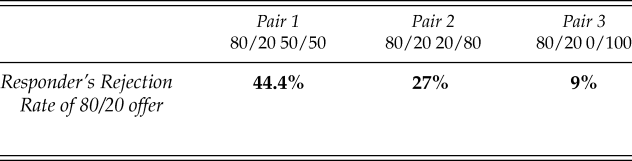
There are, however, serious problems with this interpretation as the main explanation of the data. In variations of the game in which the choice of Proposers is constrained — for example players’ options are restricted to either 80/20 (80 percent for themselves and 20 percent for Responders) or the reverse, 20/80, Responders accept a high percentage of 20/80 offers, as Table 1 shows.Footnote 83
Rejection Rates in Constrained Ultimatum Games

As Bicchieri and others have effectively argued, Responders seem to be expressing less a taste for equal material outcomes than a taste for fair transactions, in the sense that Proposers do not take undo advantage of their position. Thus, when the Proposer's only options are either taking a small amount for himself or giving a small amount to the Responder, Responders do not appear to view the 80/20 offer as taking advantage of them (fairness does not require such self-sacrifice on the part of Proposers). We might conjecture that in this case an offer of 20 percent is not seen as a bullying offer.
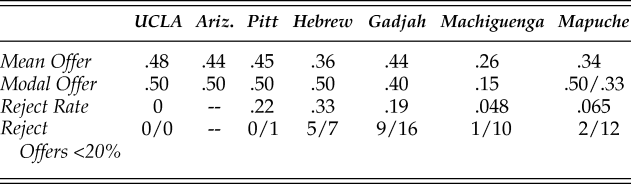
This last point is especially important. To the extent that the egalitarian sentiments of Responders in market societies are expressed through norms of fair transactional treatment, egalitarian sentiments are entirely consistent with large-scale societies based on abstract rules. Strikingly, while those in market societies throughout the world play Ultimatum Games in the ways I have described, there is much more variance in small-scale, nonmarket, societies such as our LPA societies. Indeed, in some small-scale societies (the Machiguenga of the Peruvian Amazon and the Mapuche of southern Chile) the game is played in the relentlessly “selfish” way, as Table 2 indicates.Footnote 84
Ultimatum Game Results in Market and Nonmarket Societies
The Machiguenga are essentially without markets; the Mapuche have limited acquaintance with markets. Note that “egalitarian” play in the Ultimatum Game seems characteristic of market, but not nonmarket, societies. A plausible hypothesis is that egalitarianism is less often expressed as a generalized taste for an equal distribution than as a moral norm of fair dealing. The Machiguenga, for example, do not seem to have norms regulating anonymous transactions with strangers, and thus do not see anything unfair about “selfish” Proposer offers.Footnote 85
It is, then, plausible to conclude that abstract rule-based behavior is far more consistent with the Moral Sentiments Desideratum than Hayek supposed. Recall that Hayek underestimated the importance of micro-selection in the evolution of social rules on the basis of whether the rules are attractive to the sentiments of those whose behavior is to be guided by them (Section III. B). And it is here that we should expect our egalitarian sentiments to have considerable influence: while macro-selection will focus on the Functional Desideratum, within the group rules and norms will tend to be selected that not only increase in-group benefits, but that cohere with the consciences of participants.Footnote 86 The overall system of moral rules will, on this view, be a vector of both selection pressures. To be sure, macro could swamp the micro, but there is no reason to suppose that the core of the problem is an inevitable conflict between the social evolution of rules and egalitarianism's direct pursuit of material equality, for it is not material equality that is at the heart of the egalitarian ethos.
B. Markets, freedom, and equality
If our fundamental sentiments were formed over a 200,000-year Cohen-like camping trip, then indeed we might well be worried that they are in fundamental tension with large-scale market orders (that is, the Traditional Collectivist View may be the best understanding of our egalitarian nature). Market orders, Cohen stresses, treat people instrumentally as means to the satisfaction of a person's ends and put great emphasis on the “right to make personal choices, even if the result is inequality and/or instrumental treatment of people.”Footnote 87 We should, I think, resist this conception of markets as simply treating others “instrumentally.” Market relations are embedded in a system of rules that relies on our innate ability to be guided by norms and imperatives.Footnote 88 To treat people purely instrumentally would be to prefer to play “snatch” rather than “exchange” with them — I would prefer to snatch and run rather than exchange my good for theirs.Footnote 89 However, as Richerson and Boyd stress, we have evolved — through both biological and cultural evolution — to be rule-following conditional cooperators.Footnote 90 “Conditional cooperation and the existence of social rules, to which we more or less readily conform, constitute the moral hidden hand.”Footnote 91 Market exchange is embedded in a system of norms that conform to demands of fairness.
Because we are primates that did not evolve on the camping trip, our cooperative sentiments are always mixed with a large dose of concern for self. “Humans have evolved a social psychology that mixes a strong element of cooperative dispositions . . . with an equally strong selfish element deriving from our more ancient primate dispositions.”Footnote 92 As we have seen, LPA foragers are not wholeheartedly communal creatures involved in a communal project: they are individualists, deeply sensitive to their status, who collectively resist the attempts by some to boss them around. And because of this, we have seen (in Section IV.D), the egalitarian sentiments focus first and foremost on resisting hierarchy and maintaining personal autonomy. As Boehm stresses, the fundamental concern is that of an individual that he not be subordinated to the would-be boss, and he enlists the group in helping to secure his equal status.
Market relations suit conditionally cooperative creatures, ready to follow rules and insisting on fair treatment while also benefiting themselves. As we better understand the culture of markets, I believe, we will find no stark opposition between it and the true egalitarian ethos.Footnote 93 To be sure, extreme disparities in outcomes may well cause alarm bells to ring; when others are many, many times richer than you, the threat of being bossed and dominated is real. Classic and contemporary “republicans” have a genuine insight; personal autonomy can be endangered by extreme inequalities.Footnote 94 This is by no means to say that freedom requires the will-o’-the-wisp of equal power, and it certainly does not mean that the state and the law are not themselves threats to autonomy. But classical liberals should not delude themselves that there can never be sensible reservations about Paretian gains in wealth or income.
D. The firm and hierarchies
As I read the evolutionary evidence, market relations are not themselves in tension with the egalitarian ethos. The feature of modern capitalism that does seem deeply at odds with this ethos is the great hierarchical organization that populates market societies: the firm.Footnote 95 As Coase taught us, firms are not mini-markets; they are islands of hierarchy in a sea of conditional cooperation among autonomous agents.Footnote 96 Whereas market exchange is regulated by contracts between independent parties who cooperate through the price mechanism, firms are organized hierarchically, the role of contract is much reduced, and the price mechanism does not regulate the internal coordination of the firm. As Coase understood it, the “master and servant” relation is fundamental to the firm. This authority relation, Coase argued, reduces transaction costs. Transactions organized through the price mechanism entail negotiating costs; the firm is a way to decrease these costs in some circumstances. In this sense, the firm is efficient, but it is based on hierarchy and bosses.
John Stuart Mill expressed the unease that many liberals feel about the hierarchical firm. In an important passage, Mill writes:
if public spirit, generous sentiments, or “true” justice and equality are desired, association, not isolation, of interests, is the school in which these excellences are nurtured. The aim of improvement should be not solely to place human beings in a condition in which they will be able to do without one another, but to enable them to work with or for one another in relations not involving dependence. Hitherto there has been no alternative for those who lived by their labour, but that of labouring either each for himself alone, or for a master. But the civilizing and improving influences of association, and the efficiency and economy of production on a large scale, may be obtained without dividing the producers into two parties with hostile interests and feelings, the many who do the work being mere servants under the command of the one who supplies the funds, and having no interest of their own in the enterprise except to earn their wages with as little labour as possible. . . . [T]here can be little doubt that the status of hired labourers will gradually tend to confine itself to the description of workpeople whose low moral qualities render them unfit for anything more independent: and that the relation of masters and workpeople will be gradually superseded by partnership, in one of two forms: in some cases, association of the labourers with the capitalist; in others, and perhaps finally in all, association of labourers among themselves.Footnote 97
Notice how Mill stresses that the value of nondependence, which is so central to the egalitarian ethos, is undermined by the hierarchical, capitalist, firm.
Hayek's Worry thus cannot be entirely assuaged. The critical problem is not, however, that rule-based market orders are opposed to “atavistic” egalitarian sentiments, but that the values of conditional cooperation among autonomous persons within a framework of rules that prevent bullying — values at the core of the egalitarian ethos and the market — sit uneasily with the values on which the hierarchical firm rests. Indeed, as Hayek suggested, there is something distinctively socialistic in the character of the hierarchical firm: plans are devised, and participants are often ordered to do their part, and are rewarded according the judgments of superiors as to the worth of their effort and contribution.Footnote 98 Organization through this bossy device has done very well on the Functional Desideratum for a long span of time. To be sure, some are always attracted to bossing (as they are to politics) and some to be being bossed; the majority, though, are apt to feel some resentment of life as servants. Since the dawn of agriculture, the demands of efficient hierarchical organization have run counter the core elements of the egalitarian ethos. Mill's prediction that these organizational forms would be displaced by less hierarchical ones proved, at best, premature; whether recent, more collaborative, forms of enterprise turn out to be developments that occupy only a well-defined niche in certain highly innovative fields, or whether they expand to a more wide-ranging role, may help determine whether our egalitarian sentiments will better cohere with the norms of our innovative and wealthy societies.Footnote 99
VI. The Ambivalent Species
We are certainly the egalitarian species: the evolution of humanity is to a surprising extent the tale of developing egalitarian social orders. To be sure, with the advent of civilization it is also a tale of successful social orders suppressing the egalitarian ethos, often through the use of great force by the now-resurgent bosses. Even deeper than our egalitarianism, however, is our ambivalent nature. We are primates who tend to domination and submission and yet are also egalitarian cooperators who band together to suppress domination. We are the product of both biological and cultural evolution; while these often coevolve, Hayek was entirely right that they can, and sometimes do, run in contrary directions. We are egalitarians who spend most of our lives in hierarchical organizations; we evolved to put down the boss, who can now often fire us for us for speaking up. And, despite our best efforts to gain mastery over them, we are still under the thumbs of the members of the political alpha class; we cycle among finding this efficient, outrageous, and comforting. Hayek was entirely right to stress our ambivalent nature,Footnote 100 but I believe he was manifestly wrong — as, interestingly, are many contemporary socialists — that our deepest evolved sentiments oppose life under fair rules among independent, conditional, cooperators who insist on their equal status. On this fundamental matter, we are not nearly so deeply ambivalent as many have supposed.
However, while a social morality fundamentally opposed to our egalitarian sentiments may well be unjustifiable to us, we must remember that these egalitarian sentiments are just one part of most people's overall normative perspective, and as we have seen, it is stronger in some than in others. Hierarchies, both commercial and political, can certainly be justified (think of the Functional Desideratum), as can be innumerable social norms that allow various types of inequalities. It is certainly a mistake, as some socialists are wont to think, that a society conforming to a relatively specific egalitarian ethos is the ideal for twenty-first century humanity. A political philosophy that truly takes the egalitarian ethos to heart is one that itself does not claim a bullying authority over others — even one that insists that they be egalitarians — but which respects all as free and equal persons, who make their own trade-offs between the many sentiments and values that can comprise satisfying lives for our diverse species.