

In the wake of Ann Laura Stoler’s now-classic works on the power relations structuring intimate relationships in imperial contexts, published more than twenty years ago, numerous studies have sought to rethink the exercise of colonial domination from the perspective of the private sphere.Footnote 1 At the intersection of gender, race, and class relations, this literature examines conjugal and familial relationships—as manifested in sexuality, sentiments, domestic arrangements, household economic practices, or the education of children—as political sites where the question of the difference between the colonizer and the colonized is crystallized.Footnote 2 If the distinction between these two categories, reflecting the supposed superiority of Europeans to “natives,” was the basis of colonial hierarchies and legitimized the imperial undertaking, it was never an impermeable edifice. On the contrary, it was always threatened by the risk of too great a social proximity—sexual, emotional, domestic, or familial—between people on either side of the colonial frontier. In these conditions, preserving the colonial order implied constructing and reproducing this line of demarcation at the very heart of daily intimate life, to a degree and in forms that have varied greatly from place to place and from period to period.Footnote 3
The wealth of historiography on this theme is directly tied to the vast quantities of ink devoted to questions of interracial intimacy during the colonial period itself. In the case of France’s second colonial empire, which is our main focus here, soldiers and missionaries, doctors and anthropologists, journalists and writers, magistrates and lawyers, administrators and jurists, elected representatives and colonial notables all took up the pen in the nineteenth and twentieth centuries to discuss the correct distance to maintain so as to preserve the “prestige” and “dignity” of the French colonizer in the eyes of “natives.”Footnote 4 Worried especially by the uncertain position of children born to European and “native” parents, they built up and fueled a long-running debate on the empire’s “métis problem”; a social question but also and above all a juridical one, since the issue was whether métis (or which métis) had the legal status of French citizens or were “native subjects” without citizenship.Footnote 5 These thinkers, promoters, and agents of colonization (almost exclusively white men) produced a multitude of texts on interracial relations and métissage—letters, pamphlets, articles, manuals, books, reports, reviews of debates, judicial decisions, decrees, and laws—which have since become sources for the history of the construction and deployment of colonial categories at all levels of society, right down to the private sphere.Footnote 6
Recent research on colonial intimacy has seen a shift in this historiography, with less emphasis on the dynamics of imperial power and an increased focus on the social experiences of those subjects of colonial discourse who, in one way or another, brought these norms and categories into question. The aim, according to Chelsea Schields and Dagmar Herzog, is to consider “colonized experiences and evasions of power and the imaginaries and practices of selfhood, care, kinship, survival, and eroticism that persisted nonetheless”; or, in the words of Pascale Barthélémy, the “limits of state intervention in intimate lives.”Footnote 7 As Bastien Bosa has argued, the social construction of racial categories is of less interest to these studies than the way in which the persons concerned were affected by them.Footnote 8 Methodologically, this perspective entails reading the colonial archive not “along the grain” but “against” it, so as to place at the center of the analysis the traditional “voiceless” of colonial studies (low-status whites, women, métis, “natives”) engaged in these kinds of intimate transactions.Footnote 9 The most revealing documents, and therefore the ones most often used by historians, are those which relate to disputes or conflicts brought to the attention of the administration or the courts, in particular when individuals claimed, for themselves or their children, a legal status or rights that the colonial state denied them. Investigations, grievances, petitions, complaints, trials, and judgments all gave rise to more or less voluminous writings, which enable historians to grasp how far the lives of certain subalterns were affected by colonial categorizations and the room for maneuver (or agency) available to these individuals.Footnote 10
Despite these efforts, however, the “mixed couples” and “mixed-race” families who had no specific interaction with the authorities remain in the historiographical shadows. Existing under the administrative radar, these individuals and groups are virtually invisible in colonial archives. It is only by reducing the focus of analysis to the micro-social scale, by looking at individuals, families, and social relationships within local contexts of interaction, that configurations of interracial intimacy and métissage operating below the institutional level can be examined. At the crossroads of ethnography and oral history, field research provides a privileged method for unearthing this type of trajectory, which has generally remained beyond the reach of the colonial state’s archives.Footnote 11 Biographical accounts and family histories also offer important interpretive keys, lending a concrete social dimension to individual life courses.Footnote 12 The history that we examine in this article—that of a household formed by a French settler, an Indigenous Kanak woman, and their descendants in colonial New Caledonia—is the result of an inquiry of this kind.Footnote 13
From a theoretical point of view, such cases are useful to “think with" because they shed light on little-known social realities that need to be taken into account if we are to avoid “flattening the complex lives of people living in colonies.”Footnote 14 The challenge is to capture the complex conjugal, family, and local configurations that developed “at ground level” and out of sight of the colonial administration, configurations that may challenge received understandings of interracial intimacy and the experiences of mixed-race persons. In the French colony of Madagascar, for instance, attention to familial networks—as grasped through the état civil (the register of births, deaths, and marriages) and life histories—has underscored the insertion of certain métis within European and Madagascan society rather than their supposed isolation: “in the depths of intimacy, European and Madagascan networks come together, enabling individuals to be both mobile and territorially anchored.”Footnote 15 In a similar fashion, attention to the diverse motivations for not recognizing legally the paternity of mixed-race children may help us to better understand broader strategies for social integration or the maintenance of social respectability involving mixed-race persons and their parents in particular colonial situations.Footnote 16 Ultimately, the distance of these couples and families from institutions and even from the law raises questions: Why and how did people live so “discreetly” in this kind of mixed household? What social forces explain their “non-encounters” with the colonial authorities and their absence from the colonial archive? What does this reveal about the scope and limits of colonial domination?
To address these questions, we explore a case that is something of an enigma in relation to the historiography of New Caledonia. Although this particular mixed-race household remained largely “invisible” to the colonial state, it was nevertheless well known in a local context and endured for over fifty years. What follows will trace the principal stages in its history and explore how it has been remembered and recounted by various actors, including, of course, during the research that led to this article.
A Historiographical Enigma: The “Henriot-Napoaréa” Case
In the early 2000s, one of the present article’s authors, Benoît Trépied, undertook a doctoral thesis in anthropology, examining the social dynamics of political engagement in the rural municipality of Koné, situated on the west coast of the Grande Terre, the main island of the South Pacific archipelago known as New Caledonia. To do this, he lived and investigated on site for two years.Footnote 17 In the course of ethnographic interviews devoted to Koné’s former municipal leaders, both Kanak and European interviewees evoked the direct familial connection between Auguste Louis Henriot (1874–1958), originally from metropolitan France and mayor of Koné in 1919–1925 and 1935–1946, and Paul Napoaréa (1938–1994), Koné’s Kanak mayor in 1970–1988 and 1993–1994. Most notable was the following exchange with Maria Napoaréa, Paul’s widow:
Maria: But don’t you know? You see, the old man [Paul], his father was a métis. The grandfather of my old man is Auguste Henriot. …
Benoît: But did everyone know that?
Maria: Yes, it’s well known. The old man’s father was the son of Henriot. But he was not recognized as [a] Henriot; it was his mother who recognized him, the old man’s mother, Paul’s grandmother.Footnote 18
Elderly European men from Koné mentioned Auguste’s relations with Kanak women in a more ironic fashion, without however naming them or their descendants:
Roger: He lived at BacoFootnote 19; he lived with a girl from Baco and he had a small coffee plantation, but that’s all. … We knew that at Baco, … me, if I went there tomorrow I could tell you: “that’s Henriot’s son, that’s his descendant,” but [in an ironic tone] the old man Henriot never went with a native woman.Footnote 20
Léon: He had about twenty hectares. He made some coffee and then he made children with the native women. There was no television in those days!Footnote 21
In 2002, Trépied eventually met a ninety-two-year-old woman, Suzanne, who affirmed that her biological father was Auguste Henriot and her mother was a Kanak woman called Marcelle Neniko (1887–1971). Suzanne was then living in the Koniambo tribu (reserve), at the home of her Kanak daughter and son-in-law.Footnote 22 Dressed in a “mission robe,” the typical dress of Kanak women of her generation, she spoke Paicî (a local Kanak language) fluently and French with more difficulty. Accompanied by Sonia Grochain, a fellow doctoral student working on the history of labor in Koné, Trépied was only able to conduct a short interview of around thirty minutes with Suzanne, due to her advanced age. In addition, the topic of the interviewers’ research at the time meant that their questions primarily concerned what Suzanne could remember of Auguste’s political and professional activities, rather than the private lives of her parents or the family home in which she herself had grown up.Footnote 23
In his doctoral thesis, Trépied did not dwell on this singular family history as it did not appear to have played any significant role in the municipal careers of either Auguste Henriot or Paul Napoaréa.Footnote 24 He only returned to it in the 2010s—and after the passing of Suzanne in 2006—when he began a new research project on métissage in collaboration with the historian Adrian Muckle, another specialist on the region of Koné and coauthor of this paper.Footnote 25 In 2014 we published an article on the transformations of the “métis question” in New Caledonia, from the beginning of French colonization until 2009.Footnote 26 We then narrowed our focus to Koné and reinvestigated Auguste’s marital and family history by conducting new archival research and fieldwork, as well as revisiting material gleaned from our earlier investigations, including the 2002 interview with Suzanne.
To understand the originality of this particular case, it is important to briefly review the findings of the literature on multiracial unions and métissage in colonial New Caledonia. These phenomena were tied closely to the specific settlement project that the French state defined for this territory, which was colonized from 1853 onwards. While the country received the usual white, male colonial adventurers (soldiers, administrators, missionaries, traders, etc.), the authorities also attempted to build a new French society by organizing the permanent installation of “penal settlers” (convicts from the penal colony) from the 1860s, then “free settlers” from the 1880s and 1890s onwards. Most of these migrants came from metropolitan France and both groups included women. Their arrival led the Kanak people to be dispossessed on a vast scale. By 1901, there were 12,253 free settlers and 5,323 penal settlers in New Caledonia, while the estimated Kanak population of just under 30,000 people had been confined to reserves covering well under 20 percent of the archipelago’s land area.Footnote 27
Métissage developed apace with French settlement. The sporadic unions between Kanak women and European traders and adventurers that had existed since the 1840s gave way, from the 1860s onwards, to more intense mixing with soldiers, cattle farmers, and penal settlers.Footnote 28 By the early 1900s, however, when there was no longer an absolute penury of “respectable” white women in the colony, matrimonial relationships between European men and Kanak women came to be strongly disapproved of within the social milieu of the free settlers to which Auguste Henriot belonged.Footnote 29 As for relations between Kanak men and white women, they were literally unthinkable and socially proscribed.Footnote 30 These new social norms in New Caledonia corresponded with a wider imperial discourse in vogue at the beginning of the twentieth century, according to which the founding of “French families” was indispensable to the success of the colonial project. In this context, relations with Indigenous women came to be perceived as degrading for white men, and in particular for those who were not transient but who intended to establish themselves permanently in the colonies.Footnote 31
The fate of the children born from such relationships did not, however, raise the same colonial anxieties as in other parts of the French empire. Whereas mixed-race children presented a significant “problem” in the eyes of colonial authorities in Indochina and to a lesser extent Madagascar and West Africa, such debates as there were in New Caledonia were seldom driven by social concerns.Footnote 32 Indeed, the scholarship has generally stressed the absence of métis as a separate social category in this settler colony.Footnote 33 According to these works, métis children were automatically integrated from the youngest age into one or other of the societies in question. In other words, they were either legally recognized by the father and raised in the European world as his heirs and French citizens, or they were raised as “natives” and colonial subjects within the maternal family, with their Indigenous patrilineal line being established through adoption by a male relative.Footnote 34 In 1948, the colony’s governor summarized the situation in these terms:
In New Caledonia, the fate of the métis is decided quite naturally on the basis of the environment in which they grow up. … Because they are dispersed in many different settings in which they are perfectly assimilated, it is impossible to count them both for practical reasons and out of respect for privacy.Footnote 35
Our study of Auguste Henriot, Marcelle Neniko, and their descendants does not however fit with these conventional historiographical analyses of interracial relations and métissage in colonial New Caledonia. The originality of this case lies in its timing and duration as well as the fact that it remained “below the radar” of the administration: to the best of our knowledge, no historical actor ever approached colonial authorities to formalize or challenge this de facto family configuration.
This raises two related sets of questions. One concerns the relationship and household that Auguste maintained with Marcelle, a Kanak woman and “native subject,” for over fifty years while also becoming a minor colonial dignitary. What exactly were the circumstances in which they lived together unmarried for so long? To what extent did Auguste actually deviate from the prevailing social norms enjoining sexual and social distancing? And how did he sustain this situation without apparent damage to his status? The other set of questions relates to evidence that Auguste raised to adulthood at least two children—Louis or “Loulou” (1901–1976) and Suzanne (1910–2006)—but did not legally recognize or acknowledge them. Upon leaving his household at the ages of twenty-two and eighteen, respectively, they were adopted into the Kanak Napoaréa family, but there is compelling evidence that the mixed family remained bound by biological ties and lived or “everyday kinship.”Footnote 36 This leads us to ask why Auguste’s relationship with his children differed so markedly from what is otherwise known about the supposedly full integration of métis, from childhood, into either Kanak or French society.
To address these questions we attempt to trace the history of this family over the long term, beyond the colonial cut-off point of 1946, the date when New Caledonia became an overseas territory and Kanak obtained French citizenship. We seek to apprehend where possible the lived social experiences of its members while also attending to the story’s aftermath and postcolonial legacy. To these ends we mobilize published histories concerning the locality of Koné and archival sources—including the various états civils (registers of births, deaths, and marriages), church and property records, newspapers, photographs, and municipal and territorial records—as well as family histories and ethnographic interviews with descendants and witnesses from the period. Together, these anthropological and historical sources and methodologies help construct a history from both sides of the racial and colonial divide. We begin by exploring Auguste and Marcelle’s family histories and how they came to live together in the early 1900s. We then consider the politics of colonial respectability and the conditions under which Auguste neither married Marcelle nor recognized his children yet maintained a household with them and sustained their familial ties until his death. Finally, we examine the silencing of this shared history over the decades that followed.
The Meeting of Auguste and Marcelle
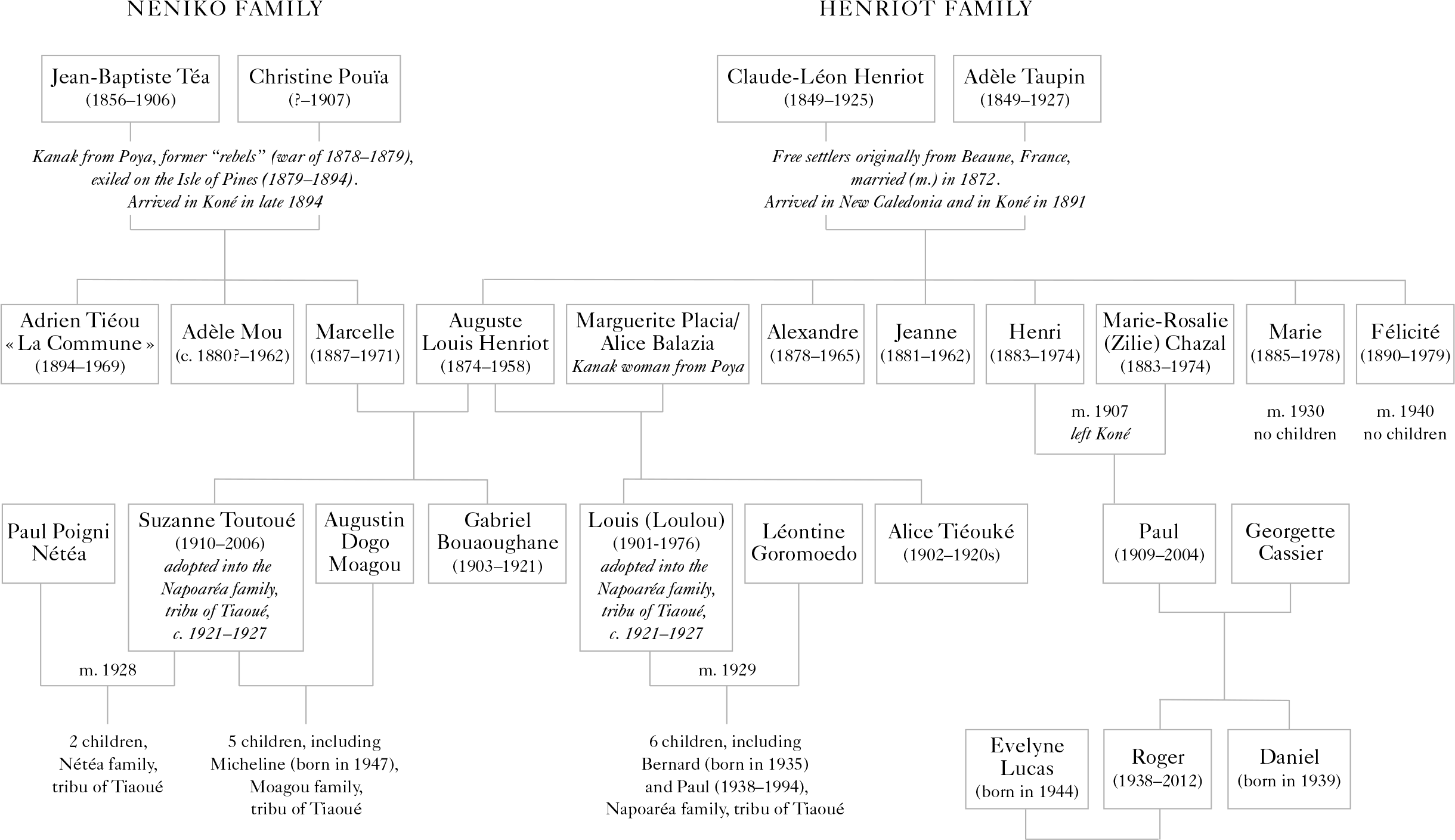
The principal starting point for this history is Suzanne’s testimony pointing to the existence of a particular mixed-race household during the early twentieth century in the subdivision of Baco, near Koné. In her 2002 interview, Suzanne related that she was the youngest of four siblings (fig. 1) and that her mother, Marcelle Neniko, lived with Auguste Henriot until shortly before his death. What is striking in Suzanne’s recollection is not her Kanak mother’s relationship with a settler or her own “mixed” heritage, but rather her account of the relationship’s longevity and the fact that she and her siblings grew to adulthood in the same household as their father:
Suzanne: I stayed there at Baco with my father. I was born at Baco, I grew up at Baco. … My brother, my big brother, is Loulou. … But the other brother [Gabriel] he died before he could marry. And my sister [Alice], too, that’s how she was, my sister.
Benoît: And so you lived at Baco, was that in the tribu or on a property?
Suzanne: No, it was on a property, at my father’s, because he had the coffee plantation and all that.
In answer to further questions, Suzanne clarified that her parents never married and that when her mother came to live with her father, “she stayed there with him and never returned to her tribu. She only went back when there was a celebration.” Asked if she knew her paternal grandfather, Suzanne replied, “Yes, I knew him, but not the surname; yes, it’s Henriot. Auguste Henriot, he’s my father.”
Simplified family tree of the Neniko, Napoaréa, and Henriot families (c. 1850–c. 1950)
Note: Due to evangelization, Kanak generally had a Christian first name and a Kanak middle name.

Establishing the circumstances in which the relationship between Auguste and Marcelle began has required careful reconstruction from fragmented family histories and archival materials. Neither Suzanne nor her own daughter, Micheline Moagou, could say precisely how Marcelle came to live with Auguste. In 1987, the anthropologist Alban Bensa recorded a genealogy of the Kanak Napoaréa family which showed their adoption of Suzanne but identified her mother only as an unnamed “woman from Poya,” a region fifty kilometers south of Koné (fig. 2).Footnote 37 The “Henriot Saga,” the family history told in 1998 by its “white” descendants, Roger Henriot and his wife Évelyne, for a newspaper series on New Caledonia’s “pioneers,” refers only to Auguste’s “liaison with two Melanesian women” and the existence of two unnamed children.Footnote 38
Auguste’s family arrived at Koné in 1891 from Beaune in the Côte-d’Or département of France, as assisted migrants. At that time, French authorities hoped that the installation of respectable free settlers would help “regenerate” New Caledonian colonial society, which was mainly penal. The family comprised artisan locksmith Claude-Léon, his wife Adèle, their eldest son Auguste, and five younger siblings: Alexandre, Jeanne, Henri, Marie, and Félicité. Auguste, who was seventeen at the time, had, like his brother Alexandre, completed his primary schooling (an achievement that would later distinguish them in rural New Caledonia, where literacy levels, even among settlers, were low). The administration financed their voyage and installation, but to receive the title to their concessions they were required to develop their property within five years.Footnote 39
The Henriots’ initial prospects were poor. An 1895 report described Claude-Léon as a “lazy” and indifferent agriculturalist with “mediocre” land who would never become a “good settler.” He was living “miserably and so [was] his family.”Footnote 40 In this regard the Henriots were typical of assisted migrants to New Caledonia. Established in 1879, Koné had a meager European population of just 141 persons by 1891. For families with limited capital and no knowledge of tropical agriculture, the challenges were often insurmountable and more than half of those who had arrived before 1888 abandoned their concessions.Footnote 41 Yet, despite these odds, Claude-Léon obtained the definitive title to his village, garden, agricultural, and grazing concessions in 1896, and in 1901–1902 Auguste and Alexandre purchased two village sections alongside their parents in what is today Auguste Henriot Street.Footnote 42 At about the same time, the brothers began developing their own concessions in the new rural subdivision of Baco, some four kilometers from Koné.Footnote 43
While their economic situation remained modest, the Henriot family is ultimately an example of colonial “success,” in that the first generation managed to make a living and chose to remain where they had settled. They exemplify the observation that, for settlers with limited means, the mobilization and diversification of family resources were key to their survival and implantation.Footnote 44 Having secured his concessions, Claude-Léon entrusted the coffee plantation to his sons and turned to blacksmithing, while his wife and daughters ran a pension, oversaw the garden, and commercialized the coffee harvest. Only after their parents’ deaths did Marie and Félicité marry, while Jeanne remained single. None of the sisters would have any children. Their great-nephew Roger describes “a poor family where everyone had to bring their own money home. That’s why the girls were slow to get married.”Footnote 45
The two eldest sons, Auguste and Alexandre, also never married and devoted themselves to the family’s wider interests. In 1896 Auguste traveled to France to perform his military service as a French citizen, but was released after only four months due to poor health. Upon his return to Koné, he took over the family coffee business, assisted by Alexandre. Once established, the brothers deployed their educational capital in Koné’s municipal commission (which would later become the mairie). First elected to the commission in 1908, Auguste served as its president or mayor from 1919 to 1925 and again from 1935 to 1946. Alexandre was its secretary, and one of its few permanent employees, from 1919 until 1962.Footnote 46
Center-north of Grande Terre, New Caledonia
Source: Map by Pascal Dumas, University of New Caledonia, 2010.

Only the youngest brother, Henri, established a “recognized” family. After entering the postal service, in 1907 he married Marie-Rosalie (Zilie) Chazal, daughter of Denis-Auguste Chazal, a warden at the nearby penal settlement in Pouembout (fig. 2). Paul, their only child and the only recognized Henriot child of his generation, was born in 1909.Footnote 47 Henri’s career took him away from Koné, but property records show that he remained involved in the family’s affairs—a point that will become crucial to this history given that Paul would ultimately inherit from all the siblings.Footnote 48
While Marcelle’s descendants are unsure how she came to Koné, our research indicates that she was born not at Poya but on the Isle of Pines, to the south of the Grande Terre, to one of the hundreds of families exiled from Poya and other regions following the largest uprising against French authority in New Caledonia, the war of 1878–1879. By cross-referencing an 1894 Catholic census of these exiles with other church records, we have been able to identify Marcelle as part of a family group together with her parents, Jean-Baptiste Téa and Christine Pouïa, and two siblings.Footnote 49 Of their lives on the Isle of Pines we know little except that they were among the few exiles to have been baptized.Footnote 50
In 1894, when Marcelle was about seven, the Service of Native Affairs advised “mine owners and agriculturalists” that two hundred men, women, and children of all ages had been recruited as laborers from among the exiles for a period of five years.Footnote 51 Of these, about fifty people originally from Poya, including Marcelle’s family, were sent to Koné. This choice was conditioned not only by the region’s demand for labor but also by an undertaking to the exiles that after five years they would be resettled near their original homes, and by a promise to the Catholic mission that Christians would be placed in rural centers near established missions.Footnote 52
At Koné the exiles formed a precarious community subject to the harsh conditions of indentured servitude. While some of the men were employed in nearby mines, the majority, including women and children, were set to work on coffee plantations belonging to one of the region’s largest landholders, Sylvestre Leconte. Attentive to their fate, the priest Xavier Chaboissier noted in 1895 that Leconte’s “Catholic natives” struggled to attend Sunday worship as their only free time was in the evening, but also because “the poor children are in rags and dare not show themselves alongside the well-dressed small whites.”Footnote 53 A photograph taken at around this time of Kanak, Javanese, and New Hebridean (Ni-Vanuatu) laborers on Leconte’s estate portrays them as marginalized figures living in poverty (fig. 3). When one exile murdered a settler, the press painted them darkly as vengeful former insurgents who had “more or less eaten whites,” who trafficked in rum with the penal settlers, and whose women “sell their favors to all comers.”Footnote 54 This last comment points to the vulnerability of the exiled women, portrayed as available to the local sex trade.
Workers on the Leconte plantation at Koné in the late 1890s
Source: Nouméa, Archives de la Nouvelle-Calédonie, Serge Kakou collection (Charles Nething photographs), 148 Fi 22-1.

When their indenture ended in December 1899, the administration assigned the “former insurgents” to residence in the tribu of Tiaoué, some twelve kilometers from Koné.Footnote 55 With strong linguistic and extended family ties to the Poya region, and deemed “loyal” due to its alliance with the French in 1878, Tiaoué was a logical destination for the exiles. The decision fulfilled the administrative requirement that Kanak live within designated tribus under an administrative petit chef unless indentured or granted “free residence.” It also coincided with renewed efforts at the turn of the century to define and record reserve boundaries, to clear land for Koné’s settlers, and to ensure them a supply of labor.
Circumstance, timing, and geography thus point to the Henriots’ need for labor and Marcelle’s position as an exile and subject of the Tiaoué petit chef as probable factors in her passage from indenture on Leconte’s plantation to life with Auguste, sometime between 1899 and the birth of their first child in 1903. After five years of indenture, Marcelle would have been an experienced plantation worker, and by 1900 the coffee the Henriots had planted five to eight years earlier would have begun to require regular harvest labor, with production at Baco—the subdivision where Auguste established his home adjacent to the tribu of the same name—perhaps beginning by 1905. Manuals for New Caledonia’s planters made clear that most would have to rely upon their own family resources; convict labor was unreliable and immigrant indentured labor was expensive. Kanak were characterized as having little motivation to work, but settlers were told that those who cultivated good relations with local chiefs might obtain a rotating labor supply.Footnote 56 There may well have been an alliance of sorts between Auguste and successive Tiaoué petits chefs in which Marcelle and later his children helped to sustain an informal contract that brought harvest workers from Tiaoué to his plantation over the following half-century. At the very least, Auguste was one of “those settlers who negotiated with and accommodated Kanak demands and expectations”—a key attribute of planters who succeeded in recruiting Kanak when needed.Footnote 57 As will be discussed below, he was also one of the few settlers with some ability to converse in the Paicî language spoken in Tiaoué.
Auguste may have been mindful of the advice given to French emigrants in Gustave Gallet’s 1884 Notice sur la Nouvelle-Calédonie—the most recent manual at the time of his family’s emigration—which suggested that relations with Kanak women were beneficial to the colony and portrayed métis children in positive terms, while warning that the abandonment of women “without justification” was an unforgivable offense that would endanger wider colonial relations.Footnote 58 By the early 1900s, attitudes towards Kanak women and the growing numbers of métis had hardened, and another handbook published in 1894 fell silent on such matters.Footnote 59 Auguste nevertheless seems to have taken the earlier advice to heart—he would not abandon either Marcelle or his children until the very last years of his life.
Geography also favored the establishment of Auguste’s unconventional household. Situated at a point where the social and administrative boundaries separating Kanak and settlers converged, the settler subdivision of Baco stood at a crossroads between Koné village (four kilometers to its west) and the tribus of the interior (notably Tiaoué some seven kilometers to its northeast), directly abutting the main block of the tribu of Baco. Whereas Koné was separated from the reserves by several kilometers, Auguste and his neighbors at Baco were in daily contact with Kanak; his principal Baco section was only a short distance from the reserve boundary.
The region of Koné during the interwar period
Source: Map by Pascal Dumas, University of New Caledonia, 2010.

Between 1901 and 1910, Auguste had four children. The first two, Louis (“Loulou”) and Alice Tiéouké, were born in 1901 and 1902 to a woman later identified on their Catholic baptismal records as Marguerite Placia and on Loulou’s military record and his entry in the Kanak état civil as Alice Balazia.Footnote 60 All that is known of her is that she was, like Marcelle, “from Poya.”Footnote 61 By the time Auguste had his two children with Marcelle—Gabriel Bouaoughane in 1903 and Suzanne Toutoué in 1910—Marguerite/Alice had evidently either departed or died, as Loulou is known to have been raised by Marcelle. Indeed, the need for someone to care for his children may also have been a catalyst for Auguste bringing Marcelle into his household. At the time of Gabriel’s birth, Marcelle would have been about sixteen and Auguste twenty-nine. As none of the children were registered in the French état civil, and as no such register existed for Koné’s Kanak population until 1934, these details are from the earliest extant records of their existence: the Catholic records of the baptisms that took place between 1920 and 1927, when they were on the verge of adulthood.Footnote 62
On Auguste Not Marrying Marcelle
In terms of the Koné region’s social history, Auguste and Marcelle’s relationship was almost but not quite anomalous. Auguste’s social peers, the free settlers who arrived in the 1880s and 1890s, colonized a region inhabited for millennia by Kanak but marked since the 1870s by the social world of the cattle stations and the nearby penal settlements at Pouembout and Koniambo, founded in 1883 and 1885.Footnote 63 They set themselves apart, building on migratory circuits, marital alliances, and shared aspirations of social improvement to protect their social capital of respectability as pioneers and construct a rural French village at Koné.Footnote 64 Within this group, to recognize children with Kanak or to take a Kanak wife was unheard of. Of 101 marriages registered in the French état civil for Koné between 1880 and 1920, only five involved Kanak women; without exception the husbands were ex-convicts.Footnote 65 And while twenty-one métis children were registered at Koné from 1880 to 1907, the parents’ profiles reflect the social world of the cattle stations, with the fathers being mostly stockmen linked to the penal settlements.Footnote 66
Seen in this light, it is unremarkable that Auguste did not marry Marcelle. It may be read as evidence that he respected the social boundaries imposed by his family and peers as well as the economic interests of the close-knit Henriot siblings, embodied since 1909 in Henri’s son Paul. Nevertheless, in relation to the social boundaries by which free settlers distinguished themselves from Kanak and penal settlers, his cohabitation with Marcelle and their household was still unusual and even risqué. As noted in a study of “coffee colonialism,” “while there may have been toleration of rural romance in isolated communities, long-term relationships were frowned upon.”Footnote 67
The respectability that Auguste upheld by not marrying Marcelle and maintaining her at a distance from Koné was perhaps what allowed the relationship itself to survive despite disapproval and possibly in defiance of the regulations requiring Kanak to reside within tribus. Unless she were married to a non-Kanak, indentured, or granted “free residence,” it was forbidden for a Kanak woman to live on European property. Marcelle’s presence in Auguste’s Baco residence was thus a contravention for which they both could have been punished. Less reputable settlers were prosecuted in similar circumstances. In 1907, ex-convict Rocco Lopresti was fined fifteen francs under the indenture regulations for sheltering the unindentured Kanak woman whom he later married—an offense referred to in court records as “embezzlement of a native.”Footnote 68 If Marcelle was neither indentured nor a free resident, Auguste’s status as a free settler as well as his concession’s proximity to the tribu may have afforded him protection. Colony-wide debates show that authorities turned a blind eye to the mobility of female Kanak domestic laborers, who were more likely than men to be granted free residence.Footnote 69 However, as no nominative records of free residents or indentured laborers survive, we cannot exclude the possibility that Marcelle fell into one of these categories. The 1921 and 1926 censuses record just two Kanak women living outside of the tribus in the Koné region; if one was Marcelle then her position was genuinely exceptional.Footnote 70
One piece of evidence that allows us to speculate on the cost to Auguste of his relationship with Marcelle is the statement in the “Henriot Saga” that Auguste remained “single out of spite” after being denied the hand of his brother Henri’s sister-in-law, Célina Chazal, whose father deemed her too young to marry.Footnote 71 The “Saga” implies that Auguste’s “liaison with two Melanesian women” followed this disappointment, but there is no doubt that his Baco household existed before this event. Born only in 1896, Célina would not have reached the legal marriage age of fifteen until 1911, by which time all Auguste’s children had been born. The anecdote nevertheless suggests that Auguste intended to establish a European family and that his relationships with Marguerite/Alice and Marcelle may initially have been seen as only passing ones. It is not difficult to imagine, however, that the existence of his Baco household counted against him in the respectability stakes and provided another reason, in addition to the age difference, for Denis-Auguste Chazal to forbid the marriage.
For Auguste to have established a “recognized” household at this stage of his life would have been consistent with the evidence that planters who maintained alliances with Indigenous women in the early years of settlement often sought a return to “civilization” through a “respectable” marriage.Footnote 72 European women were providers of heirs, preferably male, to whom a planter could transmit his landed heritage, enabling him to put down roots with dignity and establish a French lineage. Such marriages brought respectability once a property had become established and the assistance of Indigenous women in terms of agricultural and domestic work, the recruitment of labor, or access to land was no longer crucial.Footnote 73 Seen in this light, the rebuttal of a proposal may have been a significant blow, leading Auguste to perpetuate a cohabitation that he perhaps thought of as expedient, if not temporary, and which was tolerated on those terms by his family and the wider colonial community.
We do not know whether Marcelle herself desired or opposed marriage to Auguste. There is no evidence in her descendants’ recollections that she sought to cultivate respectability in European eyes or to assimilate culturally, other than through her church and her facility with French. Marriage to Auguste would have entailed accession to French citizenship (as women took their husband’s nationality and status upon marriage) and freedom from the indigénat (the regulations that applied to “natives”), while also removing her customary civil law status.Footnote 74 As noted above, such marriages were rare but not unknown, and in 1911 authorities confirmed that a Kanak widow could retain her status as a French citizen.Footnote 75 Under French civil law, any wife of Auguste would also have had some right to his estate upon his death.
Auguste’s Double Life and the Tensions of Colonial Respectability
Cohabitation with Marcelle and his unacknowledged children provided no discernible barrier to the growth of Auguste’s local stature. He was propelled into the limelight by the war of 1917–1918—a conflict centered on the Koné region which pitted the French army against Kanak “rebels” for almost a year—when he helped thwart what settlers believed to be a surprise attack on Koné village.Footnote 76 His first term as mayor lasted from 1919 to 1925 and was followed by a second from 1935 to 1946. In 1922 he was elected to New Caledonia’s Chamber of Agriculture, where he served until 1946. After the colony rallied to the Free French movement in 1940, he was appointed to its wartime Administrative Council.
In his public roles, Auguste was a forthright advocate for his fellow settlers, expressing views typical of an era in which efforts to mobilize Kanak labor increased markedly. When the governor Henri d’Arboussier-Monplaisir visited Koné in 1924, Auguste publicly “requested that the natives be ‘obliged’ to work.”Footnote 77 Seven years later, when the Chamber of Agriculture debated policies which threatened the supply of harvest labor by compelling Kanak to develop their own coffee plantations, Auguste again made himself heard. He stated his conviction that the administration would help settlers procure the cheapest labor possible, and denounced the obligation placed on Kanak to cultivate their own coffee—imposed by authorities in the name of a “new native policy”—which in his view undermined their willingness to work for planters.Footnote 78 These positions were consistent with his dependence on Kanak labor as a coffee producer and reinforce the hypothesis that his conjugal life stemmed from relationships formed within this economy.
Auguste’s status was sustained by his involvement in community social events and organizations linked to Koné’s horticultural industry—the agricultural union, the cooperative, and the Racing Club of which he was a founding member. Auguste and his siblings also gained a reputation for their contributions to the coffee industry. In 1931, the “Henriot family” won a gold medal for their coffee at the International Colonial Exhibition in Paris.Footnote 79 In the 1930s, agronomist Jean Risbec cited Auguste and Alexandre as valuable sources of information on coffee and cotton planting.Footnote 80 Shared with Alexandre and the wider family, this notability may have helped insulate Auguste from any opprobrium concerning his domestic arrangements. In a context of generalized interconnectedness among Koné’s free settler families, the Henriot brothers’ municipal careers strengthened their local status.
While Auguste’s social and political functions conferred a certain status, his private life remained at odds with the norms that structured the world of Koné’s free settlers. It is by returning to Suzanne’s recollections and the family history recounted by her last surviving daughter, Micheline (born in 1947), that we can gain a better idea of everyday life in the household where Loulou and Suzanne lived with their parents until each left—Loulou by 1921–1923 and Suzanne in 1928, at the moment of her first marriage. Small details provide crucial insights into their domestic and familial intimacy. Although Auguste did not legally recognize his children, Suzanne’s account makes clear that he assumed a paternal role in her daily life: she uses terms of affection such as “my papa,” and describes trips together to the seaside and his anecdotes about life in France: “He said, ‘It’s too hot! [Laughing] In France, my friend, we always put on things [warm clothes] because it’s too cold’ [Laughing again].” On Saturdays or Sundays they went together to Koné, but always returned to “our house at Baco, the old man’s place, papa’s.”
In Suzanne’s recollections, Baco’s geographical and social distance from Koné is evident. Neither Suzanne nor Loulou attended the Koné village school, and while this was not exceptional, their absence from the one institution which would have marked them as French rather than “native” is telling.Footnote 81 Nor did Auguste take the more radical step of sending them to Catholic boarding school to further their assimilation, as was sometimes the case for métis children who had been recognized. Suzanne’s childhood, like so many others at that time, involved labor: “I didn’t go to school, I stayed like that, hanging around, working.” Asked if she attended church while at Baco, Suzanne affirmed, “Yes … [we went] to the mass at Koné. It’s Catholic. At Baco it’s the Protestants.” She presumably went with Marcelle rather than Auguste, who was politically anti-clerical. At church they would have rubbed shoulders with other settlers and indentured laborers, but not with most of the region’s Kanak Catholics, who worshipped in their tribus. In the microcosm of Koné village, there can be little doubt that everyone knew who this Kanak woman and her daughter were in relation to Auguste, even if they did not know them by name.
For the most part, however, Suzanne’s visits to Koné were infrequent and she apparently was not socialized to the “white” world:
Benoît: And when you were a child, when you were still at Baco, did you have little European friends or little Kanak friends?
Suzanne: Little Kanak friends.
Benoît: But did you frequent the Europeans a bit?
Suzanne: Oh, no.
While in Suzanne’s recollections her older half brother Loulou no longer lived on the property, Micheline understands that Loulou too had been part of the household and spent his childhood with his father:
Benoît: We think that when a settler has a child with a Kanak woman, it’s just like that, but that she’s going to raise them alone. But in this case he raises them …?
Micheline: Yes, well, uncle Loulou, he’s the one who looked after the horse that pulled the [cart] to take the coffee. [Grandfather] said, “Loulou, go and get the horse, … we’re going down to Koné, we’ll take [it] with us.” That’s what my mother always used to say, “He told your uncle to bring the horse.” …
Benoît: And then, do you know if they went to Koné together?
Micheline: Yes! He always went with grandfather afterwards, to do the shopping or to carry things.Footnote 82
Further evidence of Auguste’s “other” life can be found in the traces of his social proximity to the Kanak world, which set him apart from his European family and social peers but which were not necessarily stigmatizing. There is ample evidence for instance of Auguste’s familiarity with key Kanak figures from the region. Suzanne recalls that “there were whites who came to talk with him, there were Kanak.” The statement that Auguste provided to judicial authorities following the war in 1917–1918 revealed him to be on speaking terms with Kanak notables who visited his home, including Ferdinand Tiéou Nétéa (Céu Nätéa), a son of the Tiaoué petit chef.Footnote 83 A later Kanak account remembers “Monsieur Ario” as the Baco resident who authorized the felling of a tree needed to build a canoe in about 1920.Footnote 84 While some of this familiarity no doubt reflected the specific geography of Baco, which facilitated social relations between Kanak and settlers, some of it appears to have been due to his relationship with Marcelle and her ties to Tiaoué. Significantly, when Suzanne first married in 1928, it was to Paul Poigni Nétéa, a son of the aforementioned Ferdinand. Once again, this may have helped sustain Auguste’s relations with Tiaoué as a principal source of labor.
What is more, Auguste had a certain level of competence in the Paicî language spoken by Suzanne and Marcelle:
Suzanne: My papa, we spoke “in language” to him, and he, he spoke French. [Laughs]
Benoît: But did he speak the language?
Suzanne: Yes! [Laughs]
Benoît: So, at home the two of them spoke French and Paicî …
Suzanne: Yes, Paicî! [Laughs]
Being able to converse with some Kanak in their own language set Auguste apart from many settlers, who made it a point of honor to ignore everything Kanak.Footnote 85 Except in the pastoral hinterland, where this type of linguistic familiarity was well established, we have found only two similar cases among Auguste’s peers; like Auguste, both men had arrived as adolescents in the 1890s and in adulthood established concessions at Baco and Koniambo.Footnote 86
On Auguste Not Recognizing His Children
Over the course of the 1920s, Auguste’s children departed his Baco household. Gabriel died in 1921 and Alice soon afterwards, both after being isolated with leprosy.Footnote 87 In 1921–1923, Loulou attained adulthood and left the household, followed by Suzanne in 1928. At this juncture, Auguste’s non-recognition of his children became all but definitive, as each in turn integrated the Kanak world. Just like his non-marriage to Marcelle, Auguste’s non-recognition of his children shaped their status, ultimately determining their adult identities as “native” colonial subjects. Their departure from his household thus represents another tipping point, further underscoring the limits to his acceptance of his mixed-race family.
For both of Auguste’s children, a key public moment in their non-recognition was their baptism in the Catholic chapel in the Tiaoué tribu—Loulou in 1921 at the age of twenty and Suzanne in 1927 at the age of seventeen. While French citizens and colonial subjects appeared on the same parish register, maintained by the priest, the location in which their baptism took place—Tiaoué, not Koné—marked both Loulou and Suzanne as “native.” That Loulou was assigned only the given name Louis (Auguste’s middle name) and not, as was the norm in the Catholic tribus, a second Kanak given name, suggests that he was not fully integrated within the Kanak world at this time and that Auguste had perhaps envisaged that his first-born son might one day be his heir. In contrast, the Kanak given names of Auguste’s other children anchored them clearly to their maternal Kanak side: Alice Balazia, Gabriel Bouaoughane, Suzanne Toutoué. A further point of classification came for Loulou with his voluntary military service as a “native rifleman” in 1923–1926, and for Suzanne with her marriage to Paul Poigni Nétéa at Tiaoué in 1928.
Another less public but equally key moment of non-recognition was the adoption of both Loulou and Suzanne into the Napoaréa family, as the children of Patrice Oué Napoaréa (1889–1961). We cannot establish the precise date or circumstances of this adoption, but it is most likely that it too occurred around the time of their baptisms and integration into Tiaoué, and prior to their respective marriages.Footnote 88 While no historical study of Kanak customary adoption practices exists, anthropological research on the wider Paicî linguistic region in the late twentieth century shows that adoptions or transfers within and between families are commonplace.Footnote 89 As well as providing heirs to one of the Napoaréa family lineages, the adoption of Loulou and Suzanne was necessary to establish their Kanak paternal line and in turn facilitate their customary marriages. Such adoptions do not involve severing ties with one’s biological family, with whom one continues to use relationship terms corresponding to one’s former position. This widespread practice often occurs at birth, but adoptions in adulthood are not uncommon. Insofar as adoption may also serve to maintain past alliances between families, there is a strong probability that both Loulou’s and Suzanne’s incorporation into the Napoaréa lineage in particular was somehow connected to the largely unknown ancestry of Marguerite/Alice (Loulou’s biological mother) and/or Marcelle (Suzanne’s biological mother).Footnote 90
As Loulou and Suzanne approached adulthood, the implications of not being recognized by Auguste grew more significant and the room to avoid identification as “native” diminished. In 1915 the colony defined as “native” “any person of either Melanesian or Polynesian race, or of mixed race, originating from New Caledonia or its dependencies or from the archipelago of Wallis and Futuna, who does not enjoy the rights attached to the quality of French citizen or who, according to their personal status, does not qualify as a citizen and subject of a foreign power.”Footnote 91 Everyone so defined was subject to the indigénat and the regulations it underpinned, including a head tax imposed on all men over sixteen (the age of majority under the colonial regulations); the requisitioning of men as laborers for public services for up to twelve months, usually between the ages of eighteen and twenty-two; and the obligation to reside within a tribu. French citizens, on the other hand, did not reach majority until the age of twenty-one and were not subject to any personal taxation, though for men military service became compulsory at the age of twenty.Footnote 92
While Suzanne had a greater margin of maneuver, in that women were not subject to formal labor requirements, Loulou would have had little room to evade the indigénat once he approached the crucial age between sixteen and twenty in 1917–1921. Much would have depended on the discretion of the agent for the Service of Native Affairs, the all-powerful gendarme.Footnote 93 Authorities may have turned a blind eye to Loulou’s existence during his childhood, but this would have been difficult once he matured physically and reached the age at which a French youth would have to enroll for military service. On the other hand, if he was registered at Tiaoué, on the nominative list used for the head tax and labor requisitions, then the pressure from his petit chef to assume his obligations as a Kanak male under the indigénat may have been considerable.
Without recognition by a European or foreign parent, it was rare for a métis to escape categorization as “native.” Were Loulou and Suzanne to have tried, their lack of formal schooling would have told against them. In recorded instances of “passing”—which more typically occurred in localities with long-established patterns of mixing and where, unlike Koné, there had been little free settlement—an individual’s French education and culture were critical.Footnote 94 A case in point concerns one Philippe Auguste Katevineca, whose right to be an elector and member of the municipal commission at Ouégoa in New Caledonia’s north was challenged in 1917. An inquiry established that Philippe’s parents were indeed probably both Kanak, but that since he had been raised and educated as a European by the Catholic mission, married first the daughter of an “unrecognized” métis and then a French woman (with whom he had several children), had registered for military service, and exercised a recognized profession as a merchant or shopkeeper, he could be deemed to possess a French état.Footnote 95
Later in adulthood, there remained a distant possibility that Loulou might have been “recognized” by his father. In 1929, the Koné settler Jean Médard applied to recognize his adult son, “the native Ty Charles.” “Ty Charles,” the municipal commission explained, “is of mixed race and it is common knowledge that he is the son of Jean Médard and the late Pouaoué, a native woman from the tribu of Baco. As this child was not recognized at birth by his father and his mother died shortly afterwards, he was adopted by Poata Louis, a petit chef from Baco.”Footnote 96 “Ty Charley Médard” was subsequently “recognized as a French citizen” and left the tribu.Footnote 97 In Loulou’s case, however, once he had married at Tiaoué and had children of his own, such a scenario was far less likely.
For Suzanne, the path to evading classification as a “native” was potentially more straightforward. In principle, by marrying a European or a person of another recognized nationality such as Japanese (relatively numerous in New Caledonia since the 1890s) she would have gained her husband’s status and been liberated from the indigénat.Footnote 98 As noted above, however, only five such marriages involving Kanak women occurred at Koné prior to 1920. In the years up to 1946 there were only three more—and in all cases the husbands were Japanese.Footnote 99
Ultimately, we can only speculate as to why Auguste did not recognize Loulou or Suzanne, but protecting his own and the Henriot family’s status is likely to have been an important factor. While technically it was not too late to recognize them once they had reached adulthood, the risk of opprobrium was greater given their only partial assimilation. Also significant was the unusual configuration of the wider Henriot family, which remained largely undivided by marriage. By not recognizing his children, Auguste protected the Henriots’ collective economic interests—which, since Paul’s birth in 1909, had been expected to revert in their entirety to the siblings’ sole legal heir. Just like marriage to Marcelle, recognition of his children would have entailed rights to Auguste’s property. Whether Loulou or Suzanne themselves sought recognition is not known, but its desirability may not have been self-evident. When questioned on the pros and cons of French citizenship in 1919, a group of Kanak Catholic school boys were unanimous in preferring the status quo; while citizenship offered mobility, as well as access to firearms, alcohol, and credit, it also entailed compulsory military service and a loss of valuable protections (including exposure to debt collection and loss of land).Footnote 100
Auguste’s Kanak family therefore remained invisible to French civil law, but the existence of his children, notably Loulou, did not go unremarked in Koné society. In 1927, Loulou was indentured by the Catholic mission at Koné. The priest Jules Halbert recorded that “as coachman we have a good mixed-race boy. Loulou H. … (not to name him). He was a soldier in Nouméa for three years and was coachman to the commandant.”Footnote 101 Auguste’s Kanak family was thus local if not official knowledge, and a subject of irony for Halbert due to the anti-clerical sentiments held by Auguste and his father Claude-Léon. By the time Loulou’s third child, Bernard, was born in 1935, a Kanak état civil had been established and births, deaths, and marriages were being recorded in a register maintained by a gendarme. The entry for Bernard’s birth recorded his father as “Loulou called ‘Henriot,’” noting that he was the son of “Auguste Henriot.”Footnote 102 Auguste’s relationship with Loulou was thus clearly stated on the official birth record of one of his grandsons. At the same time, the structures of marriage, parenthood, and family into which Loulou’s own children were integrated strongly identified them as “native” and as belonging to the tribu of Tiaoué rather than the settler subdivision of Baco.
Towards the End of a “Mixed” History
In 1945, Auguste turned seventy-one while Marcelle was about fifty-eight. The immediate postwar period marked the end of Auguste’s political career, including his position on the Administrative Council and his elected positions in the Koné municipal commission and the Chamber of Agriculture, which he left in 1946. These years also saw the extension of French citizenship to all Kanak and, with the end of the indigénat, the end of restrictions on residence. Importantly, however, Kanak retained their customary status in matters of civil law.Footnote 103
Until the mid-1950s, Auguste focused his energies on his plantation at Marcelle’s side. Together they continued to call on local Kanak for seasonal labor, mobilizing interpersonal and family ties formed over the previous decades, but no longer aided by the colonial labor system which had been abolished in 1946. Gathélia Wabéalo, who was born in the early 1940s and who spent his adolescence in the tribu of Baco in the 1950s, recalls that Auguste’s workers came from Tiaoué and Baco:
From Baco there were maybe … my mother, she always went, every time, because she [Marcelle], she went through my mother. And my mother, she calls the women, maybe five. Then they send to Tiaoué and the others come down, five, so that makes perhaps ten. Or sometimes it’s five or six. And after, to help with the hulling, they each take turns. One lot, once they’ve finished, they’ll lend a hand, then they come back here. But the ones from Tiaoué they continue, because they sleep there, she [Marcelle] cooks for them.Footnote 104
Gathélia’s memory reflects a longer standing set of practices in which Marcelle played a key role as an intermediary in recruiting labor for the Henriot plantation—and especially the female labor on which coffee planters so heavily relied. Despite reports in the postwar period that relations between plantation owners and local Kanak women were falling away due to deteriorating labor conditions, “the settlers who provided good food, paid the going rate, … and refrained from demanding sexual relations from the women they employed found labor. The others did not.”Footnote 105
Auguste and Marcelle also received visits from Loulou, Suzanne, and their children. Their departure from Baco in the 1920s had not meant separation; Suzanne recalled that Auguste attended her first wedding at Tiaoué in 1928, employed one of her husbands for odd jobs for the municipality, and sometimes came to Tiaoué with presents for his grandchildren. The recollections of Micheline, Suzanne’s youngest daughter, testify to the affective ties that had endured despite the mixed family’s socially and legally illegitimate status:
Micheline: I used to go down when we went to see old Henriot down there at Toono [Baco]. Because around the house, there are a lot of custard apples, we always came to pick them up. … When he was at Toono, well, we were little, but I remember him. … Each time we always went with him to [be at his side], and so on, and then grandmother said, “Hey, stop bothering your grandfather!” … And then because he was white, well you know [laughs quietly], there was a bit of pride in having a grandfather … a white grandfather!
Benoît: And did you call him “ao” [grandfather] and all that?
Micheline: Yes! … When it was the holidays we said, “Let’s go down to Baco, to see guè [grandmother] and ao.”
Benoît: And when you went to Baco did you all eat together?
Micheline: Yes.
Benoît: He didn’t set himself apart because one was Kanak or white?
Micheline: No.
Micheline recalls an affectionate grandfather who took his grandchildren in his arms and who set aside custard apples and other fruit for the Tiaoué family: “He always had something to give us when we came! We didn’t ask for more, but there you go.”
A little while before his death in 1958, Auguste, whose health was declining, returned to live with his sisters at Koné. Marcelle too moved to Koné, but she could not follow Auguste to the Henriots’ family home in the village. Instead, she lodged nearby with her own sister, Adèle. It was at this moment, probably after 1955, that the Baco household ceased to exist. To visit the ailing patriarch, Marcelle and Auguste’s descendants now had to confront the hostility of Auguste’s sisters:
Micheline: That was their house down below, the family house. We went to see them there, because afterwards he went to stay down there, there were his sisters, but … His sisters, they weren’t easy to get along with … [Speaking of one of them] my mother [Suzanne] said, “Don’t pay any attention.” Even my grandfather [Auguste] said, “Don’t pay any attention to her. She yells, let her.” … I don’t know if she doesn’t like us, but there you go. We came to see grandfather, and that’s it.
Benoît: And so you’re saying that old Auguste’s sisters weren’t too welcoming?
Micheline: Yes, the one called Félicité. Yes, oh, from the church when you were up there you could hear her shouting down below, she was always in a bad mood. I wonder if she didn’t like Kanak, or, I don’t know, but there you go.
The sisters’ hostility illustrates that Auguste’s “mixed” conjugal and family life was only tolerated while confined to Baco. It would have been scandalous to them that Marcelle and her illegitimate métis children might enter their home—their private space, but also the symbolic foundation of the Henriot family in New Caledonia. To have seen under their very noses the affective ties linking their brother to Marcelle and the Kanak who called him “papa” or “ao” (grandfather) would likely have been an intolerable affront.
Marcelle’s dependence on Auguste was now exposed. By not marrying Marcelle, he had delivered her to a precarious future from the moment that he himself was no longer able to look out for her. Indeed, his sisters’ behavior foreshadowed the fate awaiting her at the hands of the Henriot family once Auguste had died: non-recognition, dispossession, and abandonment. With Auguste’s death on July 8, 1958, the ties between the Kanak and white families were definitively severed; each group set about effacing this troubling past and presenting an ethnically pure and “respectable” vision of themselves, without the “stain” of métissage, within their respective social words. This dynamic of rupture and turning inwards coincided with the decline of the coffee industry, the sector of agricultural activity which had played a structuring role in the familial, domestic, and economic life of the household at Baco.Footnote 106
Auguste’s funeral provided the first act of this rift between the European and Kanak lines. According to Suzanne and Micheline—then forty-eight and eleven years old—his Kanak family was neither informed of his death nor invited to his funeral. Suzanne related, “My father died at Koné. The others at Koné [the Henriots], who I don’t know, they didn’t tell us.” Micheline spent time with Auguste before he died, “But I don’t think that we went to his burial. Because mum, she didn’t get on with old Henriot’s sisters.” This attitude was probably not surprising to Marcelle, Loulou, or Suzanne given the hostility shown by the sisters prior to Auguste’s death.
After the funeral, Auguste’s decision to not legally formalize his relationship with Marcelle or his children had a significant impact on their lives. His deed of succession transferred his entire estate—his property at Baco, his shares in a local business, and his share of his parents’ estate—to his five surviving brothers and sisters “in the absence of descendants and ascendants,” to use the formal legal wording, which itself speaks volumes.Footnote 107 His illegitimate Kanak family received nothing. Micheline does not recall any item belonging to her grandfather being given to her mother or grandmother. Aged seventy-one at the time of Auguste’s death, Marcelle did not return to Baco. One can only imagine the upheaval that she experienced at the passing of the man with whom she had shared most of her life, followed swiftly by the disappearance of their domestic space. After living for a time with her sister, she was taken in by her daughter Suzanne at Tiaoué. When Marcelle died in 1971, she was not reunited with Auguste in the Koné cemetery, but buried alongside her sister Adèle in Koniambo.
The death of the three eldest Henriot siblings (Auguste in 1958, Jeanne in 1962, and Alexandre in 1965) marked the end of the family’s presence at Koné. The Baco property was subsequently sold to a cattle farmer who converted the plantation into grazing land. The remaining siblings, who now resided in Nouméa (Henri and Félicité) and Bourail (Marie), seldom visited Koné in the time before their own deaths between 1974 and 1979. The house and land in Koné itself were rented out until they were sold by Paul, Henri’s son and the family’s sole legitimate heir, in the early 1980s.
The non-dit
Between 1900 and 1958, Auguste’s parents, siblings, and nephew had been forced to make accommodations with his “mixed” household. While Marcelle and the children do not appear in the surviving family photographs taken between the 1920s and 1950s (fig. 5, for example), and although they were unwelcome at Koné, the family’s existence was known to all the Henriots and to most of the residents of the village. Henri had left Koné in the early 1900s, but he visited regularly throughout the 1920s and 1930s in the company of his wife Zilie and son Paul, and it is unlikely that they had neither seen nor heard of Marcelle, Loulou, and Suzanne. Auguste’s death was an opportunity for the surviving Henriots to erase an embarrassing episode by securing the non-transmission of its memory—in other words, by ensuring that it was forgotten. This meant not only cutting off relations with Marcelle, Loulou, Suzanne, and their descendants, but also saying nothing of them to the next generation, Paul’s sons Roger and Daniel, born in 1938 and 1939 respectively.
The “white” Henriot family in 1938
Rear: Auguste, Félicité, Alexandre. Front: Marie-Rosalie (Zilie), Henri, Georgette (Paul’s wife), Jeanne, Paul. Not present: Marie. Courtesy of Évelyne Henriot.

This mechanism of silencing, or the non-dit, played out to perfection.Footnote 108 Neither Roger nor Daniel became aware of the secret until the late 1980s, when Roger and his wife Évelyne learned of it from a chance conversation with an elderly Koné resident named Reuillard. When questioned by Roger, Paul (then aged eighty) pleaded ignorance; in Évelyne’s words, “my father-in-law didn’t know … or he didn’t want to say.”Footnote 109 This suggests that Roger and Daniel’s grandparents and great-aunts and uncles never spoke of Auguste’s Kanak family—including Auguste himself, who lived until his great-nephews reached adulthood. While they did not grow up in Koné, Paul’s children certainly visited during their childhood and adolescence for family holidays, and frequented their wider family sufficiently for Roger to be able to provide portraits of them for the “Henriot Saga” in 1998. Moreover, in 1964, two years before his marriage to Évelyne, Roger, who had trained as a teacher, was assigned to the public school in Koné. Alexandre was still alive and Roger spent time with him: “I knew my great-uncle well. He was a great guy, charming.”Footnote 110 However, it seems that at no time did Alexandre mention his elder brother’s Kanak family. The pact of family silence was maintained and each remaining sibling would carry the secret with them to the grave over the course of the 1960s and 1970s.
On the Kanak side of the family a similar dynamic of silencing was at play, especially on the part of Loulou and his descendants. As one Tiaoué resident recalled, Loulou “never talked about Henriot. … Some said that name, ‘Henriot,’ but for us he was just a Napoaréa, ‘Papa Loulou.’ We considered him to be a Napoaréa. He didn’t say it was his father.”Footnote 111 This silence is also captured by one of Roger’s experiences at Koné in 1964, as recounted by his wife Évelyne:
Benoît: And you wrote to me that your husband knew Loulou when he was at Koné.
Évelyne: Yes, he was friends [with him] when he was young, without knowing. My husband taught there, and then, well, he was single, so where did he go in the evening? He said, “To have friends you have to go to the bar,” so he went to the bar, so he knew him, he was friends with Loulou. He saw that they called him Loulou Henriot, but without knowing why. And he didn’t really ask himself the question. Because at that time it often happened, for example, that a cleaning lady who worked for a Henriot, let’s say, had a child, and she called him Henriot. You see, it was common. So he didn’t question it any further. It’s when I did the genealogy that we got involved, that Reuillard talked about it [at the end of the 1980s], that he said, “But damn, I knew him well, Loulou! He was a fine chap! I was good friends with him! Without knowing anything!” And the other one never said anything!Footnote 112
Suzanne maintained a similar stance to Loulou; she knew who Roger was, but did not approach him during his time in Koné. Micheline, who was seventeen at the time, remembers the teacher Roger Henriot, but mistakes his place in the genealogy by referring to him as Paul, son of Henri, rather than Roger, son of Paul (and grandson of Henri), a misunderstanding indicative of the distance created by the family’s silence:
Micheline: Paul [sic], he was a teacher later at Koné, and then after he left I never heard anything more about him. I think he’s the son of, what was he called, Henri?
Benoît: Right. And Paul, did you know him as well?
Micheline: Yes, I saw him because he was a teacher, but I didn’t …
Benoît: There was no contact.
Micheline: That’s it. It was mum who said, “Well, you see him there, he’s an elder brother, an uncle to those on your side.” Yes, we didn’t know his father, Henri [sic].
Loulou, Suzanne, and their children kept Auguste in their memories, but by the 1960s their families were fully immersed in the Kanak world. Loulou had established his own household at Tiaoué, where he had been adopted into the Napoaréa family and where he had married in 1929. As they became adults, his own children took Kanak partners and married under Kanak customary law. By the time he passed away in 1976, Loulou was patriarch to an extensive Kanak family, including his third son, Paul Napoaréa, then mayor of Koné.
Suzanne too had been established in Tiaoué since her first marriage in 1928. After the death of her second husband, Augustin Dogo Moagou, in 1965, she remained there along with most of her surviving children and her mother, Marcelle (until the latter’s death in 1971). Only in the last years of her life did Suzanne leave Tiaoué to live with her daughter Micheline at Koniambo. She died in 2006, at ninety-six years of age, the matriarch of large Kanak family with many descendants.
The extant photographic record underscores the apparent separation of the families and visualizes the non-dit surrounding their shared history. As mentioned above, photographs of the Henriot family, from Évelyne’s collection, show no trace of Marcelle or of Auguste’s children. The only photographs known to us of Loulou and Suzanne prior to 1950 are from the archives of the Catholic mission and locate them within the tribu of Tiaoué. Both figure prominently in the photographs taken by the Marist priest Pierre Guéneau to document everyday life and Catholic rituals at Tiaoué in the 1930s and 1940s (figs. 6 and 7). This suggests that the church played a key role in their integration into Kanak society, as does the fact that each was baptized shortly before leaving the house at Baco. While we do not know whether any of the photographs in which they feature appeared with captions in mission publications, it would seem that Loulou and Suzanne were in no way singled out as being anything other than Kanak.
Loulou demonstrating the hulling of beans during Tiaoué’s coffee harvest (c. 1935–1945)
Source: Nouméa, Archives de la Nouvelle-Calédonie, collection Archives des pères maristes, Album Père Guéneau, 1 Num 35, 1833.

Suzanne at Tiaoué with two children (c. 1935–1945)
Source: Nouméa, Archives de la Nouvelle-Calédonie, collection Archives des pères maristes, Album Père Guéneau, 1 Num 35, 2121.

Loulou and Suzanne’s part-European heritage did not raise the same issues for each of their families. The patrilineal logics of Kanak social organization placed Loulou and his descendants in a more vulnerable position. In the event of conflict over land or politics, their “foreign” ascendancy could be mobilized against them, as was—and still is—common practice within the Kanak world. Suzanne’s situation was different; as a daughter and wife, her “customary” role was not to establish a family line but to integrate that of her spouse. The children from her respective marriages received from their fathers a familial identity and a social position perceived as legitimate in terms of the social imperative of patrilineality. It is probable that this different relationship to their European descent, as a function of gender, has also shaped the transmission of memory concerning the family’s genealogy—the narrative appears to be more taboo for Loulou and his family line than for Suzanne and her descendants.
The parallels in the logics of social respectability among Europeans and Kanak at Koné are striking. In both the European village and the Kanak tribus, social propriety forbade public evocations of the genealogical ties between the Henriot and Napoaréa families, as if they had always lived separately from each other, as “pure” Europeans or “pure” Kanak. Yet, while no one spoke of it openly, “everyone” knew this history, which in Koné, with its widespread familiarity and physical proximity between Europeans and Kanak, could hardly be concealed.
Auguste’s and Marcelle’s family was invisible to French civil law and the colonial administration, just as it has been invisible to the historiography of interracial intimacy and métissage. There is no question, however, that it existed in terms of biological ties and everyday expressions of kinship, as revealed in the recollections of their daughter Suzanne and their granddaughter Micheline. Conducting our inquiry on the scale of lived experiences, and extending its reach beyond the official end of colonization in 1946, has made it possible to move beyond the dichotomies that have marked the study of New Caledonia. Sketching out this one family’s history suggests a way to bridge the gap between the world of Koné village, more generally the focus of historical studies of settler “whites” (including recognized métis), and the world of the tribus, most often treated in anthropological studies of Kanak society (including “light-skinned” Kanak).Footnote 113 As such, it has enabled us to grasp a more complex colonial situation, in which the distance between the two worlds fluctuates, sometimes widening but often narrowing, sometimes ambiguously, though never completely disappearing. As Martha Hodes has noted in another context, “the scrutiny of day-to-day lives demonstrates not only the mutability of race but also, and with equal force, the abiding power of race in local settings. Neither malleability nor instability … necessarily diminishes the potency of race to circumscribe people’s daily lives.”Footnote 114 In the same fashion, our study highlights the fundamentally ambiguous nature of the colonial frontier, in constant tension between rigidity and porosity, which the inhabitants of New Caledonia (and no doubt many other colonies) experienced on a daily basis, far from the clear-cut categories of official imperial discourse. But the history of this mixed-race household also highlights the fact that the relative porosity of this frontier in practice in no way diminished its discriminatory power.
That this family remained “under the colonial radar” seems to us to have two significations that are both complementary and opposed. On the one hand, the very existence of this mixed-race household between the early 1900s and the 1950s suggests that, for whatever reason, it was more compelling for Auguste and Marcelle than the dominant social norms of colonial respectability, which condemned this type of family configuration on principle. On the other hand, if this household remained out of sight of the authorities, and if its memory was actively effaced after the fact, this was because these same norms lost none of their force and in fact continued to weigh on the couple and their descendants.
In terms of the first point, the empirical details gathered during this inquiry have led us to center our analysis in large part on questions of the gendered division of labor, resources, and capital in the political economy of intimate domestic relations, as well as the margins of maneuver and the power and agency available to Indigenous women in situations usually characterized in terms of the success of male colonial “pioneers.”Footnote 115 Concretely, we have only been able to surmise the circumstances, structural factors, and power relations that created and then sustained the conditions for Auguste’s and Marcelle’s relationship: a coffee planter’s demand for labor, the precarious position of the Kanak exiles at Tiaoué, and the specific geography of Baco. It is unlikely, however, that the relationship was purely a matter of individual or mutual agency on the part of Auguste and Marcelle. In so far as it was linked to the supply of labor, including that of Marcelle, it probably depended at least initially on an arrangement with Tiaoué’s administrative chief. This may well have been central to the successful running of the Henriots’ plantation and in turn to Auguste’s career as a local notable.
As to the question of why the household remained hidden, unfortunately we only have access to Auguste’s perspective. Living with Marcelle for more than fifty years, and raising his illegitimate children to adulthood, placed Auguste in a borderline situation with regard to the social norms of the free settler community. In this “white” world, social proximity to Kanak was generally perceived as encanaquement—a form of “going native.” Auguste’s interracial intimacy brought him dangerously close to this social stigma and made him the subject of quiet mockery. It did not however prevent him from becoming a minor colonial dignitary and representative of his peers at a time when only Europeans had the right to vote. This means that other social logics of political mobilization and municipal engagement were stronger than the scandal of his private encanaquement. Auguste’s educational capital was a part of this, as was his tight bond with his siblings, probably also a key factor in limiting the likelihood of his marrying Marcelle or recognizing his children. Just as importantly, in his political activities he was never perceived as an advocate for Kanak; to the contrary, he defended settler access to cheap Kanak labor. In short, Auguste’s private, sexual, conjugal, and family life seems to have had no impact on his public character.
We cannot judge at this point how representative this case is in the context of New Caledonia. But even if it was exceptional, it highlights particularly well the tensions at the root of the colonial distinction between colonizer and colonized.Footnote 116 Confronted with contradictory injunctions and torn between different moral, social, economic, affective, and symbolic imperatives, the subjects of this history experienced significant social displacement along and even across the colonial frontier. All involved—not just Auguste—lived simultaneous or successive double lives. From her birth on the Isle of Pines among the Kanak exiles of 1878 until her death at Tiaoué, with her adult life spent on Auguste’s property in Baco, Marcelle was intimately familiar with colonial mobility and social upheavals that are hard to imagine today. As for Loulou and Suzanne, the evidence indicates that they only “became” Kanak in adulthood after a childhood on their European father’s property. For them, crossing the colonial frontier (in the opposite direction from Marcelle) seems to have been definitive. This singular situation raises a question that we have only touched on in this article, that of the primary and secondary “racial socializations” with which the children (Loulou and Suzanne), but also the parents (Auguste and Marcelle), were confronted.Footnote 117 While we lack the empirical details on this precise case, future ethnographical and microhistorical inquiries would do well to consider other cases of racial and colonial mobility in the New Caledonian context, seeking to better understand how people learned to live with a spouse of another “race,” and how one learned to be white, Kanak, or métis.Footnote 118
Finally, for all our efforts, there is little that we can say about the subjectivity of Auguste and Marcelle; few traces remain of their ideas, sentiments, intentions, or desires. While something of Auguste’s subjectivity and voice can be gleaned from his public life, Marcelle remains silenced by the colonial archival record. That our ethnographic approach has not been able to remedy this is in part because the events are too far back in time. Marcelle’s children and grandchildren can say nothing about the way she apprehended her situation, either because of our own blind spots (when Suzanne was interviewed in 2002, the inquiry had a different focus), or because they themselves knew nothing about it due to the enduring power of the non-dit. As a result, this remains above all the story of a white man and his relationship to colonial notability. To imagine scenarios where Marcelle is the central actor we need to investigate other cases, armed with a different historical imaginary, to gather the point of view of women with similar trajectories.