Implications
Weaning contributes to the appearance of digestive disorders in piglets, which are the main cause of the decrease in growth performance and use of antibiotics. Microalgae have been studied in humans and rodents for their beneficial effects on health and could represent an alternative to antibiotic use to ensure gut health after weaning.
Introduction
Weaning is a critical period in pig production because of social, environmental and dietary changes that result from the separation of piglets from the sow, mixing of litters and the transition from a liquid to solid feed. During this stage, piglets may exhibit post-weaning diarrhoea and lower growth performance leading to the use of antibiotics to control digestive disorders. There is an increasing interest and need to reduce the use of antibiotics and to look for alternatives to manage disorders caused by weaning. Cyanobacteria Spirulina platensis and freshwater microalga Chlorella vulgaris are frequently referenced in human nutrition for their physicochemical properties with a potential benefit on gut health, such as antioxidant, anti-inflammatory and antimicrobial activities (Kitada et al., Reference Kitada, Machmudah, Sasaki, Goto, Nakashima, Kumamoto and Hasegawa2009; Hoseini et al., Reference Hoseini, Khosravi-Darani and Mozafari2013). In pigs, Spirulina and Chlorella could help maintaining digestive function after weaning by limiting intestinal damage caused by immune and inflammatory responses to dietary transition and oxidative stress (Lallès et al., Reference Lallès, Boudry, Favier, Le Floc’h, Luron, Montagne, Oswald, Pié, Piel and Sève2004; Zhu et al., Reference Zhu, Zhao, Chen and Xu2012). Dietary supplementation with Spirulina and Chlorella has been considered for their nutritional value (Lipstein and Hurwitz, Reference Lipstein and Hurwitz1980; Yap et al., Reference Yap, Wu, Pond and Krook1982), but few studies considered Spirulina and Chlorella as functional ingredients (Janczyk et al., Reference Janczyk, Halle and Souffrant2009). Besides, information on their effect on digestive health and function during the early stages of growth in piglets is scarce. The objective of this study is to determine the ability of dietary supplementation of Spirulina and Chlorella to alleviate digestive disorders after weaning, by evaluating their effects on growth performance and gut structure and function in piglets.
Material and methods
The protocol for the experiments was performed in accordance with French law on animal experimentation under the supervision of E.L. and J.v.M. (agreement nos 35 to 110 and 7704, respectively).
Experimental design
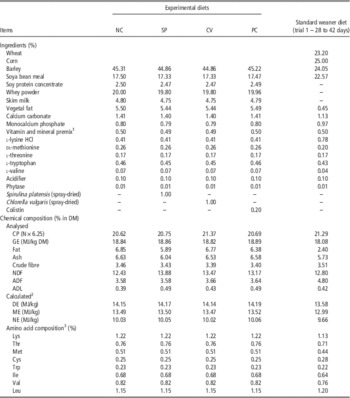
Two trials were conducted simultaneously in 96 piglets ((Large White×Landrace)×Piétrain, initial BW=9.1±1.1 kg) weaned at 28 days of age from the experimental herd of INRA, Saint-Gilles, France. Blocks of four pigs each from the same litter, with the same sex, and with a similar BW were created, resulting in 12 blocks of barrows and 12 blocks of females. Piglets within a block were allocated to one of four dietary treatments (Table 1): (i) a negative control (NC) standard weaner diet without antibiotics, formulated to meet the requirements for 10 to 20 kg pigs; (ii) a supplementation with S. platensis (SP), corresponding to 99% of NC+1% of spray-dried S.; (iii) a supplementation with C. vulgaris (CV), corresponding to 99% of NC+1% of spray-dried C. vulgaris; (iv) a positive control (PC) corresponding to 99.8% of NC+0.2% colistin sulphate (Acti Coli B, Biove, France ; 106 IU/g). The spray-dried S. platensis and C. vulgaris powders were obtained from Setalg©, Pleubian, France.
Composition of experimental diets

NC=pigs in the negative control group were fed a basal diet; SP=pigs were fed basal diet+1% spray-dried Spirulina; CV=pigs were fed basal diet+1% spray-dried Chlorella; PC=pigs in the positive control group were fed a basal diet supplemented with 0.2% colistin; DM=dry matter; DE=digestible energy; ME=metabolisable energy; NE=net energy; GE=gross energy.
1 Supplied the following per kilogram of diet: vitamin A, 10 000 IU; vitamin D3, 2000 IU; vitamin E, 20 mg; vitamin C, 40 mg; vitamin B1, 2 mg; vitamin B2, 5 mg; calcium panthoneate, 10.85 mg; niacin, 20 mg; vitamin B12, 0.03; vitamin B6, 5 mg; vitamin K3, 2 mg; folic acid, 1 mg; biotin, 0.2 mg; choline chloride, 600 mg; Fe, 103.75 mg; Cu, 20 mg; Zn, 99.3 mg; Mn, 40 mg; I, 0.6 mg; Co, 1 mg; Se, 0.3 mg.
2 Calculations for DE, NE and ME have been performed using EvaPig® software. Calculations are based on tabular values (Sauvant et al., 2004). DE/GE=82.7; ME/DE=95.3; NE/ME=74.4.
3 Standardized ileal digestible values.
Trial 1
The first trial aimed to determine the effects of Spirulina and Chlorella supplementation on growth performance and their potential to prevent or limit digestive disorders. In total, 72 piglets (nine blocks of males and nine blocks of females; 18 pigs for each treatment) were housed individually in cages (0.6×0.8 m) in an environmentally controlled facility until 56 days of age and were provided with ad libitum access to feed and water. Ambient temperature of housing was maintained at 28°C and decreased by 1°C each week until 25°C at the end of the experiment. From 28 to 42 days of age, piglets received one of the four experimental diets according to the treatment they were assigned to. From 42 to 56 days of age, all pigs received a standard weaner diet (23% wheat, 25% corn, 24% barley and 23% soya bean meal) without antibiotics.
Trial 2
The second trial was performed to determine digestibility coefficients of nutrients and energy of the experimental diets and to explore the intestinal health status of piglets after having received the experimental diets for 14 days. In all, 24 piglets (three blocks of males and three blocks of females; six pigs for each treatment) were housed individually in cages (0.6×0.8 m) equipped with a grid and a slurry pit under a slatted floor for faeces and urine collection and were provided with ad libitum access to feed and water until 42 days of age. Ambient temperature of housing was maintained at 28°C. Piglets were stunned electrically and killed by exsanguination at the end of the experiment for blood and tissue sampling.
Measurements and sampling
Trial 1
Pig weights were recorded at 28, 35, 42, 49 and 56 days of age without fasting. Offered feed was weighed each day individually and a sample of daily distribution of the experimental diets (from 28 to 42 days) and of the standard weaner diet (from 43 to 56 days) was stored at 4°C. A first set of aliquots for each daily sample was used to measure dry matter (DM) after drying at 103°C for 24 h. A second set of aliquots for daily samples of each experimental diet and of the weaner diet was pooled for the respective periods of distribution excluding transitory feeding for three days, from 42 to 44 days between experimental and weaner diet. Then, pools were ground in a hammer mill equipped with a 1 mm grid for further laboratory analyses. Feed refusals were collected individually each day and dried at 103°C for 24 h before weighing. Diarrhoea score of each pig was assessed visually for each day of the experiment with a score ranging from 0 to 3 according to the description of Whelan et al. (Reference Whelan, Judd and Taylor2004): 0=hard and formed corresponding to normal faeces, 1=soft and formed corresponding to moist faeces, 2=loose and unformed corresponding to mild diarrhoea and 3=liquid or severe diarrhoea. Diarrhoea incidence was calculated for each treatment according to the formula reported by Huang et al. (Reference Huang, Qiao, Li, Piao and Ren2004): diarrhoea incidence (%)=(number of diarrhoea recorded)/(number of pigs by treatment×total experimental days)×100, where the number of diarrhoea recorded was the sum of the number of pigs with diarrhoea observed each day for the total experimental period.
Trial 2
Pig weights were recorded at 28, 35 and 42 days of age. Offered feed was weighed every day for each animal and a sample was collected daily. Offered feed and refused feed were weighed and analysed as described for trial 1. Faeces and urine were collected during two 1-week periods: from 28 to 34 days and from 35 to 41 days of age. Faeces were collected daily and stored at 4°C. Urine was collected daily, acidified with a 10% sulphuric acid solution to maintain pH below 2, and stored at 4°C. Faeces and urine were pooled for a 1-week period of collection and weighed. After homogenisation of pooled urine and faeces, one urine sample and three faeces samples were weighed and stored at −20°C for further laboratory analyses. DM was measured on two samples of faeces after drying at 103°C for 24 h. The third sample of faeces was freeze-dried and then ground in a hammer mill equipped with a 1 mm grid for further laboratory analyses.
Blood samples were collected immediately after slaughter in heparinized tubes and stored at 0°C. Blood samples were then centrifuged for 15 min at 3000×g at 4°C for plasma collection. Plasma samples were stored at −20°C for further measurement of haptoglobin concentration. Three centimetre segments were collected from the exact middle of the small intestine, which was considered as the jejunum and at 10 cm from the ileo–caecal junction, which was considered as the ileum, flushed with a 0.9% NaCl solution, fixed with a 4% formaldehyde–phosphate buffer, and stored at 4°C for microscopic assessment of mucosal morphology.
Laboratory analyses
Pools of offered feed from trials 1 and 2 and faeces from trial 2 were dried for 24 h at 103°C for DM determination. Pools of offered feed and collected faeces were analysed for ash, gross energy (GE), nitrogen (N), crude fibre and the fibre fractions NDF, ADF and ADL. Ash was determined after ignition at 550°C for 6 h according to the Association of Official Analytical Chemists (AOAC) method (1990) and organic matter was calculated as the difference between DM and ash. The GE content was measured using an adiabatic bomb calorimeter (IKA, Staufen, Germany) with the method described by the International Organization for Standardisation (ISO 9831:1998; ISO methods, http://www.iso.org). The Dumas method was used for determination of N content using a Rapid N analyser (Elementar, Lyon, France) according to the AOAC (1990). The NDF, ADF and ADL fractions were analysed as described by Van Soest et al. (Reference Van Soest, Robertson and Lewis1991). Urine samples were analysed for N content using the Dumas method on liquid samples. GE in the urine was analysed in an adiabatic bomb calorimeter (IKA) after freeze-drying 30 ml in polyethylene bags of known GE content (ISO 9831:1998).
Plasma concentration of haptoglobin was analysed using a colorimetric method (Phase Haptoglobin Assay T801; Tridelta Ltd, Maynooth, Ireland) with an automatic analyser (Konelab 20i; Thermo Scientific, Courtaboeuf, France).
The fixed intestinal tissues were embedded in paraffin, sectioned at a 7 µm thickness and stained with hematoxylin and eosin. Villus height and crypt depth were measured at 40× magnification using an Eclipse E400 microscope (Nikon, Champigny-sur-Marne, France) and NIS-Elements AR v3.0 software for numeric image acquisition. In all, 15 straight and complete villi and 10 crypts were selected from each sample for mucosal morphometry for the jejunum and ileum.
Calculations
The average daily gain (ADG) was calculated for each piglet per period in trial 1 (from 28 to 41 days, from 42 to 56 days and total period) and trial 2 (from 28 to 34 days, from 35 to 42 days and total period). The DM intake was calculated as follows:
 $$\eqalignno{ & {\rm Dry}\,{\rm matter}\,{\rm intake\,{\equals}\,daily}\,{\rm offered}\,{\rm feed}\,\left( {\rm g} \right){\times}{\rm percentage}\,{\rm of}\,{\rm DM}\,\cr &\quad{\rm of}\,{\rm daily}\,{\rm offered}\,{\rm sample} \,{\rm -\,daily}\,{\rm dried}\,{\rm refusal}\,\left( {\rm g} \right) $$
The average daily feed intake (ADFI) was calculated per period in trial 1 (from 28 to 41 days, from 42 to 56 days and total period) and trial 2 (from 28 to 34 days, from 35 to 42 days and total period) by meaning daily feed intake adjusted for 87% DM.
The gain : feed ratio (G : F) was calculated as follows:
 $${\rm G}\:{\rm \,\colon\,}\:{\rm F\,{\equals}\,Average}\,{\rm daily}\,{\rm gain}\,\left( {\rm g} \right){\rm \!/\! Average}\,{\rm daily}\,{\rm feed}\,{\rm intake}\,\left( {\rm g} \right)$$
Digestibility coefficients were calculated for DM, GE, N, crude fibre, NDF, ADF and ADL as the difference between amounts ingested and excreted in faeces and expressed in percentage of ingested quantity. Nitrogen retained and metabolisable energy were calculated as the difference between ingested and excreted in faeces and urine. Nitrogen retained is expressed in percentage of ingested quantity and metabolisable energy is expressed in percentage of digested quantity.
Statistical analyses
Growth performance, total tract digestibility, haptoglobin concentration and intestinal morphology were analysed using the Proc Mixed of SAS (SAS Institute Inc., Cary, NC, USA). The pig was considered as the experimental unit. The statistical model included the fixed effects of diet and block. Weaning weight was added as a covariable for growth performance analysis. The Shapiro–Wilk’s normality test was performed on the residuals for each trait. Data for G : F from 28 to 42 days were transformed logarithmically before the statistical analysis to validate this assumption. Diarrhoea incidence was analysed by a χ 2 contingency test using the Proc Freq of SAS (SAS Institute. Inc.). Probability values under 0.05 were considered to be significant and probability values under 0.10 were considered as a trend.
Results
Trial 1
An unforeseen drop in ambient temperature from 28°C to 22°C during 4 h occurred in pigs’ housing at 32 days of age. As a consequence, digestive disorders appeared so that 94% of animals had at least 1 day of diarrhoea during the first phase of the experiment. Nevertheless, only four piglets, one from each experimental group, had a drastic decrease of feed intake and vitality requiring an antibiotic treatment. Measurements performed on these animals were excluded from the statistical analysis.
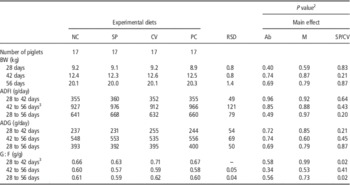
There was no difference between treatments for ADFI and ADG of piglets during the experiment (P>0.10; Table 2). Piglet BW increased from 9.1 kg at 28 days of age to 20.1 kg at 56 days of age, resulting in an ADG of 394±63 g/day for the total duration of the experiment. Statistical analysis with contrasts showed a significant improvement in G : F in CV pigs compared with SP pigs from 28 to 42 days and for the total period (P<0.05), but no overall effect of supplementation with microalgae was observed, compared with NC and PC pigs (P>0.10). Colistin supplementation did not affect G : F ratio compared with NC (P>0.10).
Effect of dietary supplementation with Spirulina and Chlorella on BW, average daily feed intake (ADFI), average daily gain (ADG), and gain : feed (G : F) ratio in weaned piglets (trial 1)Footnote 1

1 Data are presented as least-squares means of 17 individually housed piglets. NC=pigs in the negative control group were fed a basal diet; SP=pigs were fed 99% basal diet+1% spray-dried Spirulina; CV=pigs were fed 99% basal diet+1% spray-dried Chlorella; PC=pigs in the positive control group were fed a basal diet supplemented with 0.2% colistin.
2 ANOVA performed on BW, ADFI, ADG and G : F ratio using MIXED model (SAS Institute Inc., Cary, NC, USA) including the effects of dietary treatment and block, considering the effects of antibiotic supplementation compared with NC (Ab), microalgae supplementation compared with NC and PC (M) and pairwise comparison between SP and CV (SP/CV) by application of orthogonal contrasts.
3 Logarithmic transformations were previously performed on G : F 28 to 42 days data to assess the statistical analysis. Values are presented in table as means of the estimated data from the MIXED model after exponential transformation. SD=0.07.
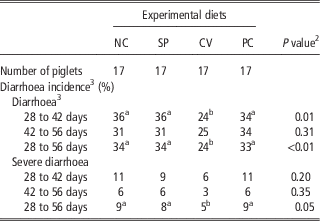
The percentage of piglets having at least 1 day of diarrhoea after weaning (Figure 1) increased quickly until 33 days of age and attained 88% after 1 week. From weaning until the end of the experiment, 94% of piglets had diarrhoea and 60% exhibited severe diarrhoea. The incidence of diarrhoea (Table 3) decreased in CV pigs compared with NC, PC and SP pigs, for the period of experimental diet distribution (P=0.01) and also for the total period (P<0.01). Severe diarrhoea was also reduced in CV pigs compared with NC, PC and SP pigs for the total period (P<0.05).
Percentage of piglets in trial 1 that exhibited mild or severe diarrhoea during the first phase of the experiment, considering the maximal severity recorded since weaning.

Effect of dietary supplementation with Spirulina and Chlorella on diarrhoea incidence in weaned piglets (trial 1)Footnote 1

a,bValues within a row with different superscripts differ significantly at P<0.05.
1 Incidence was calculated by treatment with 17 piglets in each as follows: diarrhoea incidence (%)=(number of diarrhoea recorded)/(number of pigs by treatment×total experimental days)×100, where the number of diarrhoea recorded was the sum of the number of pigs with diarrhoea observed each day for the experimental period. NC=pigs in the negative control group were fed a basal diet; SP=pigs were fed basal diet+1% spray-dried Spirulina; CV=pigs were fed basal diet+1% spray-dried Chlorella; PC=pigs in the positive control group were fed a basal diet supplemented with 0.2% colistin.
2 Statistical analysis was conducted by χ2-test on diarrhoea incidences. P=effect of dietary treatment.
3 Diarrhoea=number of pig days with diarrhoea score ⩾2. Severe diarrhoea=number of pig days with diarrhoea score ⩾3. Diarrhoea score=0, normal faeces; 1, moist faeces; 2, mild diarrhoea; 3, severe diarrhoea.
Trial 2
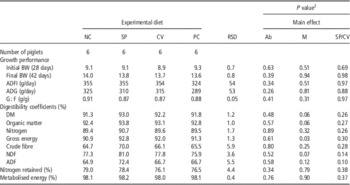
Growth performance was similar for NC, PC, CV and SP pigs (P>0.10; Table 3). Total tract digestibilities of DM, organic matter, N, GE, crude fibre, NDF and ADF were similar between NC and PC pigs and between SP and CV pigs (P>0.10; Table 4). Digestibility of GE was significantly greater in SP and CV piglets compared with NC and PC piglets (P<0.05; Table 4). Dietary supplementation with Spirulina and Chlorella tended to improve DM, organic matter and NDF digestibilities compared with NC and PC diets (P<0.10; Table 4). Metabolised energy and nitrogen retained did not differ between dietary treatments (P>0.10).
Effect of dietary supplementation with Spirulina and Chlorella on total tract digestibility in weaned piglets from 28 to 42 days of age (trial 2)Footnote 1

1 Data are presented as least-squares means of six individually caged pigs. NC=pigs in the negative control group were fed a basal diet; SP=pigs were fed basal diet+1% spray-dried Spirulina; CV=pigs were fed basal diet+1% spray-dried Chlorella; PC=pigs in the positive control group were fed a basal diet supplemented with 0.2% colistin.
2 ANOVA performed on BW, ADFI, ADG, G : F ratio and digestibility coefficients using MIXED model (SAS Institute Inc., Cary, NC, USA) including the effects of dietary treatment and block, considering the effects of antibiotic supplementation compared with NC (Ab), microalgae supplementation compared with NC and PC (M) and pairwise comparison between SP and CV (SP/CV) by application of orthogonal contrasts.
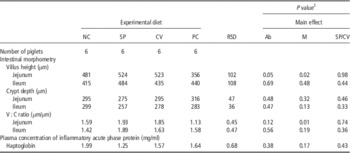
The plasma haptoglobin concentration at the end of the experiment was not affected by the dietary treatment (P>0.10; Table 5). At the end of the distribution period, villus height at the jejunum was reduced in PC pigs compared with NC pigs (356 v. 481 µm) (P<0.04; Table 5). The CV and SP pigs had higher villus height and V : C ratio at jejunum site compared with NC and PC pigs (P<0.05; Table 5). The dietary treatment did not affect crypt depth at the jejunum (P>0.10). Mucosal morphometry did not differ between the experimental diets at the ileum (P>0.10).
Effect of dietary supplementation with Spirulina and Chlorella on intestinal morphology and inflammatory status in weaned piglets at 42 days of age (trial 2)Footnote 1

1 Data are presented as least-squares means of six individually caged pigs. NC=pigs in the negative control group were fed a basal diet; SP=pigs were fed basal diet+1% spray-dried Spirulina; CV=pigs were fed basal diet+1% spray-dried Chlorella; PC=pigs in the positive control group were fed a basal diet supplemented with 0.2% colistin.
2 ANOVA performed on villus height, crypt depth, V : C ratio and plasma concentration of haptoglobin using MIXED model (SAS Institute Inc., Cary, NC, USA) including the effects of dietary treatment and block, considering the effects of antibiotic supplementation compared with NC (Ab), microalgae supplementation compared with NC and PC (M) and pairwise comparison between SP and CV (SP/CV) by application of orthogonal contrasts.
Discussion
The objective of this study was to determine the effects of Spirulina and Chlorella on growth performance and intestinal morphology in weaned piglets. To our knowledge, there is no information about the effects of these microalgae on the digestive tract in pigs. Nutritional properties of Spirulina and Chlorella have been evaluated in pigs (Yap et al., Reference Yap, Wu, Pond and Krook1982), poultry (Lipstein and Hurwitz, Reference Lipstein and Hurwitz1980) and rabbits (Peiretti and Meneiri, Reference Peiretti and Meineri2008) because of their high content in proteins, polyunsaturated fatty acids, vitamins and minerals (Tokuşoglu and Ünal, Reference Tokuşoglu and Ünal2003), but these studies reported contradictory results on their bioavailability. Some authors observed a growth depression in animals receiving diets supplemented with Spirulina and Chlorella in relation with increasing levels of inclusion and suggested a low bioavailability of nutrients from microalgae (Lipstein and Hurwitz, Reference Lipstein and Hurwitz1980; Yap et al., Reference Yap, Wu, Pond and Krook1982). This hypothesis was confirmed by Peiretti and Meneiri (Reference Peiretti and Meineri2008) who reported a decrease in nutrient digestibility in rabbits supplemented with 15% of Spirulina in the diet. Our experiment was performed with a low level of inclusion to minimise the potential deleterious effect of Spirulina and Chlorella on growth performance. Pigs receiving diets supplemented with 1% Spirulina or Chlorella did not show a lower nutrient digestibility than control pigs.
To consider the effects of Spirulina and Chlorella supplementation on gut health, the occurrence of diarrhoea was chosen as a criterion to describe digestive disorders. Montagne et al. (Reference Montagne, Cavaney, Hampson, Lallès and Pluske2004) assessed clinical disorders in piglets on the basis of a daily frequency of diarrhoea. In our experiment, this method was not satisfactory because of the high variability in individual responses. Alternatively, the calculation of a global diarrhoea incidence for the total period was used in our study, as described by Huang et al. (Reference Huang, Qiao, Li, Piao and Ren2004).
Health status
The first trial was conducted with piglets weaned at 28 days of age and housed individually in a clean barn. Almost 90% of piglets exhibited moderate or severe diarrhoea during the 1st week post-weaning, which is much greater than in a study of Montagne et al. (Reference Montagne, Le Floc’h, Arturo-Schaan, Foret, Urdaci and Le Gall2012; 29% of piglets with diarrhoea) in the same facilities. The maximal frequency of pigs with diarrhoea recorded in our experiment occurred at 33 days of age, which is 24 h after the decrease in ambient temperature from 28°C to 22°C during 4 h. Le Dividich (Reference Le Dividich1981) indicated that piglets under fluctuating temperatures may be more susceptible to diarrhoea because of an altered thermoregulation during the 1st days after weaning and an activation of neuroendocrine function by thermal stress, increasing gastrointestinal disturbances. Considering the negative effect of fluctuations in ambient temperature on digestive health in newly weaned piglets, the high diarrhoea occurrence in trial 1 is likely the result from the unforeseen drop in ambient temperature 4 days after weaning.
Despite a high occurrence of digestive disorders in trial 1, growth and feed intake were similar or higher than those reported in previous studies (Bikker et al., Reference Bikker, Dirkzwager, Fledderus, Trevisi, Le Huërou-Luron, Lallès and Awati2006; Le Floc’h et al., Reference Le Floc’h, Le Bellego, Matte, Melchior and Sève2006; Montagne et al., Reference Montagne, Le Floc’h, Arturo-Schaan, Foret, Urdaci and Le Gall2012). Especially, growth performance was similar or higher than those reported by Le Floc’h et al. (Reference Le Floc’h, Le Bellego, Matte, Melchior and Sève2006) and Montagne et al. (Reference Montagne, Le Floc’h, Arturo-Schaan, Foret, Urdaci and Le Gall2012) in piglets weaned at 28 days of age with a similar BW and raised in the same facilities (with good sanitary conditions). In our first trial, the colistin supplementation in PC pigs did not affect growth performance or the incidence of diarrhoea. Colistin sulphate is an antibiotic commonly used against gram-negative bacilli including Escherichia coli (Lamb, Reference Lamb1968). It is known that colistin enhances growth performance in weaned piglets infected by enterotoxigenic E. coli (Torrallardona et al., Reference Torrallardona, Conde, Badiola, Polo and Brufau2003). The absence of effect of colistin supplementation on growth performance and incidence of diarrhoea in piglets in trial 1 suggests that piglets did not suffer from digestive disorders caused by enterotoxigenic E. coli infections. Due to the good sanitary conditions during the experiment, the unforeseen thermal stress induced only mild digestive troubles without involving colibacillosis. High faecal scores observed during trial 1 may result essentially from post-weaning destabilisation of microbial populations in the digestive tract and the inability of piglets to regulate immune and inflammatory responses involved in dietary transition from a liquid to a solid feed (Lallès et al., Reference Lallès, Boudry, Favier, Le Floc’h, Luron, Montagne, Oswald, Pié, Piel and Sève2004), which was degraded further by the thermal stress (Le Dividich, Reference Le Dividich1981).
The occurrence of diarrhoea in trial 2 was lower than in trial 1, because of an appropriate control of ambient temperature and the daily collection of faeces and urine, which enhanced the good sanitary conditions. The incidence of diarrhoea for trial 2 was not analysed statistically because of the low number of piglets. A total of 14 piglets out of 24 (i.e. 58%) had diarrhoea during the 1st week, but only five piglets had diarrhoea for >2 days on the total period. Digestive disorders in trial 2 essentially occurred during the 1st week and did not have a negative impact on total tract digestibility during the 2nd week. Consequently, growth and feed efficiency in trial 2 were higher than in the first trial.
Plasma concentration of haptoglobin was used to assess the inflammatory status of piglets after weaning. Haptoglobin is produced in the liver and released after activation by the pro-inflammatory cytokine Interleukin 6 (Wassell, Reference Wassell2000). Haptoglobin is considered as a good indicator for infections or acute inflammations (Eckersall and Bell, Reference Eckersall and Bell2010). Plasma concentration of haptoglobin did not differ between dietary treatments in our study, and the observed concentrations were similar to those reported by Pastorelli et al. (Reference Pastorelli, Floc’h, Merlot, Meunier-Salaün, Van Milgen and Montagne2012), but higher than those reported by Le Floc’h et al. (Reference Le Floc’h, Jondreville, Matte and Sève2009) in piglets raised in good sanitary conditions. However, the low plasma concentrations of haptoglobin in the study of Le Floc’h et al. (Reference Le Floc’h, Jondreville, Matte and Sève2009) may have been due to the in-feed administration of avilamycin, an antibiotic against gram-positive germs. Weaning is associated with a rapid increase in local expression of IL-6 in the intestine of piglets, but this increase is limited in time since the IL-6 expression returns to a basal level in the 2 days after weaning (Pié et al., Reference Pié, Lallès, Blazy, Laffitte, Sève and Oswald2004). In our study, plasma concentration of haptoglobin was determined 2 weeks after weaning in piglets without enterotoxigenic E. coli diarrhoea and it is not representative of the local inflammatory response in the intestine. Considering these points, the plasma haptoglobin concentration may not have been a valuable criterion to determine the inflammatory response to weaning stress in our experiment.
No effect of colistin supplementation was observed on growth performance and nutrient digestibility in trial 2. However, colistin supplementation decreased villus height in the jejunum, which may be indicative for a reduction in absorption capacity (Pluske et al., Reference Pluske, Hampson and Williams1997). This result is in contradiction with that of Barton (Reference Barton2000), who reported that chronic in-feed supplementation with antibiotics positively affects animal growth, due to a wide range of actions such as reducing the number of pathogens and bacterial toxins in the gut, a decreased nutrient use by bacteria and improving nutrient absorption. Other studies demonstrated that colistin supplementation in piglets infected by enterotoxigenic E. coli resulted in higher villus height compared with diets without antibiotics (Torrallardona et al., Reference Torrallardona, Conde, Badiola, Polo and Brufau2003; Wu et al., Reference Wu, Zhang, Huang, Liu, Xie, Zhang, Thacker and Qiao2012). Piglets receiving colistin in our experiment had a lower jejunal villus height than those in the aforementioned studies. However, the villus heights observed by Torrallardona et al. (Reference Torrallardona, Conde, Badiola, Polo and Brufau2003) and Wu et al. (Reference Wu, Zhang, Huang, Liu, Xie, Zhang, Thacker and Qiao2012) illustrate that mucosal morphometry is a highly variable criterion between studies due to factors such as rearing conditions, genetics or diet. Colistin supplementation is recognised for its damaging effect on E. coli strains (Lamb, Reference Lamb1968). The alteration of intestinal morphology due to colistin supplementation could also be associated with a deleterious effect on commensal bacteria playing a role in gut development (Sommer and Bäckhed, Reference Sommer and Bäckhed2013). Yin et al. (Reference Yin, Yin, Kong, Liu, He, Li, Huang, Hou, Shu and Tan2008) reported that colistin supplementation during the 2 weeks after weaning altered the E. coli population in the jejunum and ileum, but also that of Lactobacilli colonies, which are recognised for their beneficial effect on the mucosal structure of the intestine (Mao et al., Reference Mao, Gu, Hu, Tang, Chen, Yu, He, Yu, Luo and Tian2016). The observed reduction of villus height in the jejunum of non-infected piglets supplemented with colistin may be explained by an alteration of microbial populations in the intestine, with a deleterious effect on mucosal development after weaning. The increase in microbial concentrations and diversity in the lower parts of the intestine (Sommer and Bäckhed, Reference Sommer and Bäckhed2013) could explain a limited effect of colistin supplementation on mucosal morphology of the ileum.
Effect of dietary supplementation with Spirulina and Chlorella on growth performance and gut health
Our experiment showed that piglets receiving diet supplemented with Spirulina and Chlorella had higher villus heights in the jejunum with no impact on crypt depth compared with control pigs. Compared with control pigs, the total tract energy digestibility was greater in pigs receiving diets supplemented with Spirulina or Chlorella and the digestibility tended to be greater for DM, organic matter and NDF. The dietary transition at weaning involves an intestinal release of free radicals responsible for oxidative stress (Zhu et al., Reference Zhu, Zhao, Chen and Xu2012) and an increased expression of pro-inflammatory cytokines (Pié et al., Reference Pié, Lallès, Blazy, Laffitte, Sève and Oswald2004). These cytokines are supposed to be responsible for the alteration in mucosal structure (Pluske et al., Reference Pluske, Hampson and Williams1997), with a drastic decrease in villus height and brush border enzyme activities during the first 5 days after weaning (Pluske et al., Reference Pluske, Hampson and Williams1997; Lallès et al., Reference Lallès, Boudry, Favier, Le Floc’h, Luron, Montagne, Oswald, Pié, Piel and Sève2004), reducing nutrient absorption and growth performance (Lallès et al., Reference Lallès, Boudry, Favier, Le Floc’h, Luron, Montagne, Oswald, Pié, Piel and Sève2004). These mechanisms may be responsible for the results observed in trial 2, since we observed a lower DM digestibility in the 1st week after weaning compared with the 2nd week (DM digestibility of 89% in the 1st week v. 92% in the 2nd week). Lallès et al. (Reference Lallès, Boudry, Favier, Le Floc’h, Luron, Montagne, Oswald, Pié, Piel and Sève2004) reported that mucosal integrity is progressively restored to reach a steady state 2 weeks after weaning. The increased nutrient digestibility from 35 to 42 days of age in our trial may be the consequence of an early restoration of mucosal integrity and function, probably due to the good health status of the piglets. The increased nutrient digestibility from 35 to 42 days in pigs receiving diets supplemented with microalgae may be explained by an earlier or a greater restoration of intestinal structure and function. This is confirmed by the increased villus height in the jejunum at 42 days of age, which reflects an enhancement of absorptive function, especially because villus height is considered to be strongly linked with activities of brush border enzymes (Pluske et al., Reference Pluske, Hampson and Williams1997). These results suggest a positive effect of Spirulina and Chlorella supplementation on mucosal restoration or development after weaning.
Antioxidant and anti-inflammatory properties from Spirulina and Chlorella compounds have been highlighted by in vitro and in vivo studies (Vijayavel et al., Reference Vijayavel, Anbuselvam and Balasubramanian2007; Cherng et al., Reference Cherng, Liu, Shen, Lin and Shih2010; Pak et al., Reference Pak, Takayama, Mine, Nakamoto, Kodo, Mankura, Egashira, Kawasaki and Mori2012). A greater villus height in the jejunum of pigs receiving diets supplemented with Spirulina and Chlorella could result from a reduction in mucosal damage caused by oxidative stress (Zhu et al., Reference Zhu, Zhao, Chen and Xu2012) or local inflammation (Pié et al., Reference Pié, Lallès, Blazy, Laffitte, Sève and Oswald2004) after weaning, and explain the increased nutrient digestibility in trial 2. However, the beneficial effect of Spirulina supplementation on intestinal morphology and function seems to be observed only in healthy piglets without diarrhoea. Indeed, Spirulina supplementation in piglets from trial 1 showed no effect on diarrhoea incidence compared with NC and PC pigs. In comparison with CV pigs, piglets receiving Spirulina had a lower G : F in the 1st week after weaning. However, this result must be considered as mostly due to the high G : F ratio recorded in CV pigs. C-phycocyanin is one of the bioactive compounds from Spirulina with antioxidant and anti-inflammatory properties, but is also known for its high sensitivity to thermal processing (Chaiklahan et al., Reference Chaiklahan, Chirasuwan and Bunnag2012). Using spray-dried Spirulina in our study may not have been the best technological process to benefit from the actions of Spirulina on oxidative stress and local inflammation.
Morphological and functional changes in the gut are related to a significant decrease in diarrhoea incidence in piglets supplemented with Chlorella. Janczyk et al. (Reference Janczyk, Halle and Souffrant2009) reported a higher microbial diversity in laying hens receiving 0.5% Chlorella, especially for Lactobacilli strains. Post-weaning diarrhoea is partially caused by a destabilisation in gut microbiota (Lallès et al., Reference Lallès, Boudry, Favier, Le Floc’h, Luron, Montagne, Oswald, Pié, Piel and Sève2004). Huang et al. (Reference Huang, Qiao, Li, Piao and Ren2004) reported that Lactobacilli improved microbial balance in the digestive tract of piglets during the first 2 weeks after weaning and resulted in fewer cases of diarrhoea and an increase in growth. Lactobacilli strains also play a role in improving the mucosal barrier function and reducing mucosal injury caused by pathogenic microorganisms (Mao et al., Reference Mao, Gu, Hu, Tang, Chen, Yu, He, Yu, Luo and Tian2016). Therefore, a reduced incidence of diarrhoea, enhancement of intestinal morphology and a trend to increased nutrient digestibility in Chlorella supplemented pigs may result from a decrease in oxidative stress and local inflammation, but also from a positive effect on microbial balance in the gut.
This study provides information on the effects of Spirulina and Chlorella supplementation on gut structure, and function in piglets after weaning. Spirulina and Chlorella supplementation improved mucosal architecture from the intestine and as a consequence, nutrient digestibility. Chlorella supplementation also seems to impact the regulation of digestive disorders after weaning. However, the beneficial effects of microalgae supplementation remain slight and further investigation is necessary to determine their potential in the management of digestive disorders in pigs after weaning and to understand the associated mechanisms. Moreover, as our study was performed with piglets that experienced non enterotoxigenic E. coli diarrhoea, further studies in pigs with a lower health status would be necessary to determine the potential of Spirulina and Chlorella as an alternative to antibiotic use to prevent diarrhoea.
Acknowledgements
The authors thank M. Alix, G. Guillemois, Y. Jaguelin-Peyraud, J. Liger, A. Marchais, V. Piedvache, J. F. Rouaud and P. Touanel for skilful technical assistance in animal care and laboratory analyses. This study was financially supported by Cooperl Arc Atlantique (Lamballe, France).