Introduction
Culex pipiens sensu lato is one of the primary vectors of West Nile Virus (WNV) in the USA and Continental Europe (Hubalek & Halouzka, Reference Hubalek and Halouzka1999; Fonseca et al., Reference Fonseca, Keyghobadi, Malcolm, Mehmet, Schaffner, Mogi, Fleischer and Wilkerson2004). Continued sporadic outbreaks of WNV in Europe have drawn attention to the potential for disease transmission in the UK. Reviews of possible vector species in the UK suggest that both Culex modestus and Cx. pipiens molestus could act as bridge vectors biting both birds and humans however their limited distributions diminish their importance (Medlock et al., Reference Medlock, Snow and Leach2005; Vaux et al., Reference Vaux, Gibson, Hernandez-Triana, Cheke, McCracken, Jeffries, Horton, Springate, Johnson, Fooks, Leach and Medlock2015). The ornithophagic (bird biting) habit of the typical form Cx. pipiens pipiens limits its potential as a bridge vector but seasonal abundance and other eco-behavioural characteristics predispose this species to serve as a potential enzootic vector of WNV, capable of maintaining cycles among bird populations, in the UK (Medlock et al., Reference Medlock, Snow and Leach2005). Populations of this species are expected to increase with future changes to the landscape and climate, and it has been suggested that towns and cities represent some of the highest risk areas for potential transmission of bird-related mosquito borne disease (Snow & Medlock, Reference Snow and Medlock2006). Therefore this study aims to fill a gap in the knowledge about the current distribution, seasonality and reproductive activity of adult Culex mosquitoes in urbanised areas in light of these potential changes.
There are four Culex species present in Britain; Cx. modestus, Culex territans, Culex torrentium and the two biotypes of Cx. pipiens (Cx. p. pipiens form and Cx. p. molestus form). Cx. modestus has recently been rediscovered, after 65 years, in significant populations in a few locations in South East England (Golding et al., Reference Golding, Nunn, Medlock, Purse, Vaux and Schäfer2012; Medlock et al., Reference Medlock, Vaux, Gibson, Hawkes and Cheke2014; Vaux et al., Reference Vaux, Gibson, Hernandez-Triana, Cheke, McCracken, Jeffries, Horton, Springate, Johnson, Fooks, Leach and Medlock2015). Cx. torrentium, a sibling species to Cx. pipiens s.l., appears to be patchily abundant and perhaps lacking from urban areas, however its distribution and occurrence with Cx. pipiens is not fully understood. Cx. p. pipiens and Cx. p. molestus are morphologically indistinguishable but differ physiologically (Medlock et al., Reference Medlock, Snow and Leach2005). The molestus form of Cx. pipiens is autogenous and stenogamous, readily bites humans and is largely restricted to underground habitats in the built urban environment. Cx. p. pipiens (hereon referred to as Cx. pipiens) is the ‘typical’ form and is widespread and abundant in the UK (Cranston et al., Reference Cranston, Ramsdale, Snow and White1987). This form has high ecological flexibility and colonizes a wide range of larval habitats including stagnant water in natural pools and various artificial containers above ground (Medlock et al., Reference Medlock, Snow and Leach2005). Their ability to adapt and exploit modified landscapes means they are commonly associated with human populations in urban areas.
Larval surveys are commonly used to monitor changes in abundance, distribution, composition and seasonality of mosquito populations across various habitat types (e.g., Townroe & Callaghan, Reference Townroe and Callaghan2014). The adult traits of size and fecundity, along with longevity, mating success and vectorial capacity, are a product of the conditions experienced by larvae during their growth phase (Juliano et al., Reference Juliano, Sylvestre Ribeiro, Maciel-de-Freitas, Castro, Codeço, Lourenco-de-Oliveira and Lounibos2014). Any spatial or seasonal variability in the quality of larval habitats is therefore likely to be reflected in changes to the adult population (Reisen et al., Reference Reisen, Milby and Bock1984; Chaves et al., Reference Chaves, Keogh, Nguyen, Decker, Vazquez-Prokopec and Kitron2010). Larval density is known to impact adult size and fecundity (Juliano et al., Reference Juliano, Sylvestre Ribeiro, Maciel-de-Freitas, Castro, Codeço, Lourenco-de-Oliveira and Lounibos2014). Therefore if adults have originated from urban larval populations, we might expect that urban adults are smaller than their rural counterparts, since larval abundance is significantly higher in urban water butts (Townroe & Callaghan, Reference Townroe and Callaghan2014). Cx. pipiens populations are expected to increase in future and since they are a potential vector of disease, surveillance of the adult as well as larval population gives the best chance of understanding their ecology, and identifying any changes or increases in risk of nuisance or potential disease transmission.
The Reiter modified gravid box trap specifically targets parous gravid adult female Culex mosquitoes (Reiter, Reference Reiter1987). These females have successfully mated, fed on a host and developed eggs through to oviposition and are therefore considered some of the most important individuals in a population (Williams & Gingrich, Reference Williams and Gingrich2007). If allowed to oviposit then the number of eggs per raft can be measured and in the case of Cx. pipiens and Cx. torrentium the next generation of males may be reared for identification to species by male terminalia. Reiter gravid traps are commonly used in the USA for targeted surveillance of Culex populations in the studies of species composition, species hybridization, blood meal hosts and arbovirus detection. We have found no published evidence of their use in the UK. They have the potential to be used as a surveillance method, to complement larval dipping, to provide more detailed information of adult Culex populations in the UK.
Here we report the use of modified Reiter gravid box traps for targeted collections of female Culex mosquitoes in England to test two hypotheses: (1) reproductively active adult female Cx. pipiens are more abundant in urban than rural gardens, in line with previously recorded higher larval abundances of this species in urban gardens (Townroe & Callaghan, Reference Townroe and Callaghan2014) and (2) wing characteristic traits and egg raft size of female Cx. pipiens are influenced by the different environmental conditions of urban and rural locations and seasonal variations. Consideration of trapping habitat and morphology of individuals is a standard method for identifying Cx. pipiens, however the presence of Cx. molestus individuals or hybrids of the two biotypes cannot be completely ruled out. Phenotypes such as wing size are influenced by the local conditions experienced by larvae during their growth phase (Juliano et al., Reference Juliano, Sylvestre Ribeiro, Maciel-de-Freitas, Castro, Codeço, Lourenco-de-Oliveira and Lounibos2014). Mosquito wing size is regularly used as a measure of overall body size and is often correlated with egg raft size, thereby providing a measure of individual fitness and fecundity (Nasci, Reference Nasci1990). Therefore it may be expected that female Culex wing size and egg raft size varies by location or season in line with differences in larval conditions.
Materials and methods
Study sites and sample design
The study was undertaken in Berkshire and Oxfordshire, England, during May, July and September 2013. Two land use types were selected for the study; urban residential gardens and rural residential gardens. Sites in the urban land use type were located in the town of Reading within 4 km of the town centre (51″27919.99″N, 0″58917.89″W, total town area 55.35 km2, human population 232,662). Sites in the rural land use type were located in gardens in villages, hamlets or isolated dwellings where settlement types were sparse and of a distance greater than 1 km from suburb limits.
Gravid traps
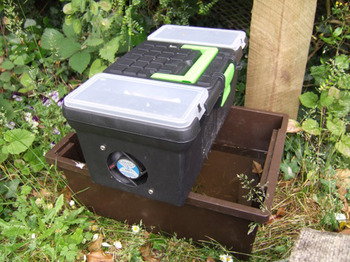
Traps were a modified version of the Reiter gravid box trap design (Reiter, Reference Reiter1987). The trap consists of two parts; the upper part is a plastic tool box containing a motor, fan and battery which when running creates a constant air vacuum to draw mosquitoes up through a collecting duct and into a specimen container (fig. 1). The lower part is a tray containing attractant bait on which the upper part sits. Three litres of liquid bait solution was poured into the tray beneath the trap to attract female mosquitoes seeking oviposition sites. The bait was a fermented liquid that consisted of 40 litres of tap water, 200 g hay, 200 g freshly cut grass clippings and 2.5 g of brewer's yeast mixed in a large dustbin and then sealed and left in a sunny position for 5 days, stirring occasionally. The majority of the hay and grass was removed directly before use and the mixture stirred before decanting into jerry cans for use. Fresh bait was used for each trapping night.
Gravid box trap based on Reiter gravid box trap design (Reiter, Reference Reiter1987).

Trapping was carried out over 11 nights; four nights in May and July and three nights in September 2013. Traps were run concurrently at five urban sites and five rural sites on each trapping night and different sites were used for every trapping event; totalling 110 sites. Traps were run for approximately 20 h overnight. Females drawn up into the trap were maintained alive within a collection chamber until trap collection the following day.
Processing of specimens
Specimens caught in traps were initially sorted into Culicidae and non-Culicidae by-catch. Culicidae were further sorted by genus (Culex and non-Culex). At least ten gravid female Culex mosquitoes, where possible, per trap were selected at random and allowed to lay eggs. The females were individually placed in net covered plastic containers approximately 15 × 10 cm2 that contained a small dish of liquid bait solution in which they could oviposit. Once each female had oviposited they were placed in a plastic tube, labelled to correspond with the egg raft they produced, and stored in the freezer at −20°C. Some females died before laying eggs and these were stored at −20°C. Non-Culex and excess Culex females were counted and transferred directly from traps to labelled plastic tubes and stored at −20°C.
Egg rafts were individually reared through to adults. Larvae were fed crushed rabbit food pellets during development. At least five males from each egg raft were reared to imago, frozen at −20°C to kill and identified using a dissection microscope. Males were identified as either Cx. pipiens or Cx. torrentium based on the morphological differences of the hypopygia (Cranston et al., Reference Cranston, Ramsdale, Snow and White1987) to confirm the species of the mother.
Morphological and fecundity measures of female Culex pipiens
Measurement of number of eggs per egg raft
A subsample of 60 egg rafts was processed to measure number of eggs per egg raft. The subsample consisted of Cx pipiens females (identification confirmed by male progeny) that were caught during three sampling nights (3rd, 9th and 13th) in September 2013. An image of each egg raft was captured using a stereo microscope with digital camera setup (Leica MZ9.5). Egg rafts were then transferred to a larger container for rearing to adults and identification of males, as detailed above. Images of egg rafts were analyzed using zoom and cell counter functions in Image J software (version 1.47). Egg raft counts were repeated three times without reference to previous measurements.
Dissection and measurement of wing morphological characters
A subsample of 185 female Cx. pipiens mosquitoes (identified by their male progeny), caught in urban and rural sites in all 3 months, were processed for measurements of wing morphological characteristics.
Under a 40x stereo microscope (Leica MZ9.5) the wings of each individual were excised at the point of attachment to the thorax using fine tweezers and a fine dissecting blade. Wings were mounted as a pair from one individual on a glass microscope slide and covered with a coverslip secured with sellotape.
An image of each slide was captured under a 12.5x stereo microscope (Leica MZ9.5) with digital camera setup. All measurements were calibrated using a micrometre that was stored with each image. Image J software (US National Institutes of Health, version 1.47) was used to measure three wing morphological characters. These characters were: wing length (WL, measured as the linear distance from the distal end of the alula to the peripheral tip of the R3 vein); D2 (the linear distance from the junction of the radio-cubital cross-vein and the cubitus 1 (Cu1) vein to the peripheral tip of the Cu2 vein) and D8 (the linear distance from the junction of the radio-medial cross-vein and the medial vein to the peripheral tip of the R2 vein). WL was used as an index for body size, D8 was a measure of partial WL and D2 was considered a measure of wing width. Measurements of each character were repeated three times per wing with each repeat measure completed on a different day.
Data analysis
Gravid trap collections
Analysis was performed on Culex abundance data per trap (this included individuals identified as both Cx. pipiens and Cx. torrentium and individuals for which Culex genera was confirmed but species was not). The relationships between mean mosquito abundance per trap and the factors location (urban and rural) and month (May, July and September) were analyzed using generalized linear models (GLMs). A ‘quasipoisson’ error family was specified to account for over dispersion in the model (as assessed by the residual deviance and residual degrees of freedom). We followed Crawley (Reference Crawley2009) and carried out Akaike's Information Criterion (AIC) model reduction and model checking to achieve the best fit model.
Egg raft measurements
Analysis was carried out on a subsample of 60 egg rafts (30 urban and 30 rural) laid by Cx. pipiens females that were caught in traps in September. Number of eggs per raft is defined as the mean of the three repeated counts per raft. Data on number of eggs per raft had constant variances and normally distributed errors therefore, a Student t-test was used to assess the differences in means between locations urban and rural. Average (human measurement) error between the three repeated measurements per raft was low (±0.7 eggs).
Wing morphological characters
Character size was calculated as the mean size of the left (L i ) and right (R i ) of each character (|L i + R i |/2). The relationships between character size and the factors location and month were analyzed using GLMs. Analyses were carried out on the size of characters D2, D8 and WL, using the mean of the three measurements per character. Where data deviated from the assumptions of constant variances and normally distributed errors a ‘Gamma’ family was specified within the model. We followed Crawley (Reference Crawley2009) and carried out AIC model reduction and model checking to achieve the best fit model. All analyses were carried out in R version 2.15.2 (R-Core-Team, 2012). Means and standard errors are reported throughout and significance was assigned at the 5% level.
Results
Gravid trap collections
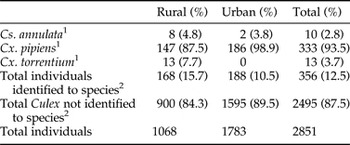
A total of 2851 female mosquitoes were collected throughout the trapping period in 2013 (table 1). Overall 356 individuals were identified comprising 10 Culiseta annulata (2.8%), 333 Cx. pipiens (93.5%) and 13 Cx. torrentium (3.7%). 1783 individuals were caught at urban sites. 188 of these were identified as either Cx. pipiens (98.9%) or Cs. annulata (3.8%). Cx. torrentium was not found at urban sites. 1068 individuals were collected at rural sites with 168 identified as Cx. pipiens (88%), Cx. torrentium (7.7%) or Cs. annulata (4.8%).
Female mosquito species totals caught in gravid traps in urban and rural sites.

1 % of total individuals identified to species.
2 % of total individuals caught.
Culex mean abundance per trap was 25.8 ± 3.7 (table 2). Mean abundance was significantly greater in traps from urban sites than rural sites (t (109,106) = 2.715, P < 0.01). The month also had an effect on mean abundance with significantly higher abundances collected in July than in May or September (t (109,106) = −6.198, P < 0.001). While both location and month influenced abundance there was no significant interaction effect of these factors.
Mean averages (±SE) for abundance per trap, egg raft size (number of eggs per raft), and length of wing characters (mm) for female Culex mosquitoes collected in gravid traps in urban and rural sites in 2013.

WL, wing length.
1 Egg raft size was measured for females collected in September only.
Bold type denotes means significant at the 5% level.
Egg raft measurements
The subsample of 60 egg rafts had a mean of 213.9 ± 8.7 eggs per raft (table 2). Egg rafts of rural caught females contained on average more eggs (227.9 ± 12.5) than their urban counterparts (200 ± 12.2) but the difference was not significant (F (1,58) = 2.551, P = 0.1). The minimum number of eggs recorded per raft was lower for urban females (49) than for rural females (91) and the maximum number of eggs per raft was higher for rural females (372) than for urban females (320).
Wing morphological characters
Of the subsample of 185 Cx. pipiens females, the average lengths of wing characters were: WL = 3.94 ± 0.04 mm; D2 = 0.79 ± 0.01 mm; D8 = 1.72 ± 0.02 mm (table 2). The standard (human) error of measurements for the three independent measures of each character per individual was on average low and repeatability was high (D2 = 0.009 mm, P < 0.01; D8 = 0.009 mm, P < 0.01; WL = 0.01 mm, P < 0.01).
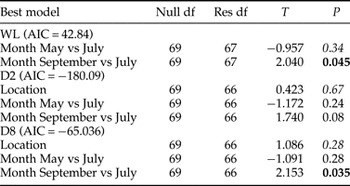
All characters were on average larger for rural caught females than their urban counterparts (table 2). However, the effect of location was not significant for any of the characters (table 3). The maximum lengths recorded for characters D2 (1.05 mm), D8 (2.23 mm) and WL (4.99 mm) were from rural caught females. While the minimum lengths recorded for D2 (0.58 mm), D8 (1.3 mm) and WL (2.76 mm) were from urban caught females.
Results of best fit Generalized linear models for main effects of ‘location’ and ‘month’ on length of wing characters, D2, D8 and WL, for Cx. pipiens females collected by gravid trap in May, July and September, 2013.

AIC, Akaike's Information Criterion; WL, wing length.
Bold type denotes significance at the 5% level.
Average lengths of each character decreased with successive months, May–September (table 2). This effect of month was significant for characters WL and D8, considered as measures of WLs, with each smaller in September than in either May or July (table 3). D2, a measure of wing width, was also smaller in September than the other months, although this was not significant.
Discussion
The three mosquito species (Cs. annulata, Cx. pipiens s.l. and Cx. torrentium) caught in gravid traps in this study are all common to the South East of England (Cranston et al., Reference Cranston, Ramsdale, Snow and White1987). Identification to species level of a subsample of Culex indicated that Cx. torrentium were absent from urban sites and represent a very low proportion of the rural Culex community. Failure to find Cx. torrentium at urban sites supports the current knowledge of their distribution across landscape types (Snow & Medlock, Reference Snow and Medlock2008; Townroe & Callaghan, Reference Townroe and Callaghan2014). Their abundance in rural sites around Reading (8%) is lower than has previously been found for larvae in rural UK garden water butts (31%) (Townroe & Callaghan, Reference Townroe and Callaghan2014) and also lower than in nationwide surveys in Germany where Cx. torrentium comprise up to 60% of the Cx. pipiens/Cx. torrentium population (Rudolph et al., Reference Rudolph, Czajka, Borstler, Melaun, Jost, von Thien, Badusche, Becker, Schmidt-Chanasit, Kruger, Tannich and Becker2013).
Our results do not reflect true species composition but rather show the high selectivity of the gravid trap in attracting Cx. pipiens. There is the potential that differences in laboratory rearing success between species may have influenced results, although the extent of this is unknown. The mean number of Culex caught per trap per night (25.8) is broadly comparable with results from gravid traps used in the USA (15.8) (Williams & Gingrich, Reference Williams and Gingrich2007) but far higher than achieved in the Rhone Delta in France (0.1) (L'Ambert et al., Reference L'Ambert, Ferré, Schaffner and Fontenille2012). The differences in the various attributes of gravid traps (e.g., fan power, size and colour of tray, attractant bait composition) impact the efficacy of the traps for Culex spp. (Allan & Kline, Reference Allan and Kline2004) and make comparisons with other studies difficult. However this does mean that alterations to traps may improve catch rates further. The traps in this study were considered easy to use and did not suffer any mechanical failures, interference or negative effects from weather conditions during the course of the study. We therefore recommend the use of gravid traps for surveillance of Cx. pipiens in the UK but suggest them to be of limited use for Cx. torrentium or Cs. annulata.
Our traps caught significantly more Culex mosquitoes in urban than rural sites supporting our previous finding that Culex is thriving in urban gardens due to increased habitat availability and urban heat island effects (Townroe & Callaghan, Reference Townroe and Callaghan2014). The higher densities caught in July compared with other months follows what is known about population growth of these mosquitoes in the summer months (Cranston et al., Reference Cranston, Ramsdale, Snow and White1987) and may be due to larval habitats, such as garden water butts, being highly productive in the middle of the season with favourable conditions at this time, including warm temperatures and available blood meal hosts such as nestling birds, promoting gonotrophic activity. The proportion of individuals identified to species was relatively small in this study and future work would benefit from identification of larger sample sizes to provide clearer trends.
Using wing size as a proxy measure for body size and hence individual fitness (Nasci, Reference Nasci1990), we found that females caught at the end of the season are smaller than those caught earlier in the season. The positive effect of body size on mosquito fecundity has been well documented in many species (Briegel & Timmermann, Reference Briegel and Timmermann2001; Armbruster & Hutchinson, Reference Armbruster and Hutchinson2002; Styer et al., Reference Styer, Meola and Kramer2007). It would therefore be expected that these smaller females collected later in the season would produce smaller egg rafts. More data of egg raft sizes earlier in this season are needed to confirm this trend.
The WL differences between months suggest developmental plasticity in response to environmental conditions. The adult traits of size and fecundity, along with longevity, mating success and vectorial capacity, are a product of the conditions experienced by larvae during their growth phase (Juliano et al., Reference Juliano, Sylvestre Ribeiro, Maciel-de-Freitas, Castro, Codeço, Lourenco-de-Oliveira and Lounibos2014). It has previously been demonstrated in field strains of Cx. pipiens from urban Reading that size of wing morphological traits varies with controlled rearing temperature, decreasing in size with increasing temperatures (Mpho et al., Reference Mpho, Callaghan and Holloway2002). Larval density and competition also reduce female wing size (Agnew et al., Reference Agnew, Haussy and Michalakis2000). Our results support that the seasonal increase in temperature and larval densities, that have been shown to exist in common Culex larval habitats such as garden water butts, influences the morphology and therefore individual fitness of emerging adult females.
Our results also show a general trend that urban females are smaller than their rural counterparts and that smaller egg rafts are produced by these urban females. This suggests that some aspects of the urban environment may impact negatively on Culex female size and fecundity while paradoxically supporting larger populations than in rural areas. It may be that the factors that benefit urban Culex populations, such as lower inter-specific competition, greater availability of potentially superior resources (larval habitats, hosts for blood meals), lower mortality and a longer breeding season (Patz et al., Reference Patz, Graczyk, Geller and Vittor2000; Leisnham et al., Reference Leisnham, Lester, Slaney and Weinstein2006; Reisen et al., Reference Reisen, Thiemann, Barker, Lu, Carroll, Fang and Lothrop2010; Townroe & Callaghan, Reference Townroe and Callaghan2014), increase population densities which, in turn, impact negatively on female size and fecundity. However, the effects of location on size and fecundity traits were not significant and therefore more data are needed to confirm these trends. Furthermore genetic differences may also play a role although the extent of this is unknown.
Overall, the data presented here support the use of gravid trapping in the UK for surveillance of adult female Cx. pipiens mosquitoes. This method has allowed differences in abundances between urban and rural Culex larval populations to be confirmed to also exist in the adult female population. Females were caught in good enough condition for the study of wing morphology and fecundity and here we have shown that differences exist in WLs across the season and suggest that potential differences in morphology and fecundity between urban and rural populations should be explored further. The gravid trap could be further trialled in areas, such as North Kent marshes, where Culex species, Cx. pipiens and Cx. modestus, co-exist. The gravid trap may become an increasingly valuable surveillance tool in the future if mosquito-borne diseases emerge in the UK.
Acknowledgements
We would like to thank volunteering members of the public for allowing access to their gardens for sampling. We are grateful to the anonymous reviews who provided helpful comments on the paper. This work was funded by a NERC studentship, number DTG 2010-14.