

Introduction: the water people
My place is where my body is
(Ricouer Reference Ricouer2007, 157)
As well as the famous stilt villages of the circum-Alpine region (Bleicher & Harb Reference Bleicher and Harb2018), such settlements also existed in the lowlands of South America. They are located in the Brazilian state of Maranhão, in the easternmost portion of the Amazon. The name of the sites derived from the wooden posts that supported the villages built in the lakes of the estuarine region of Baixada Maranhense, in order to avoid contact with the waters (Alves de Moraes et al. Reference Alves de Moraes, Lima da Costa, Navarro, da Silva Meneses, Ayres Negrão, Pöllmann and Behling2021; Gonçalves et al. Reference Gonçalves, Navarro, Nisgoski and Sonsin-Oliveira2021; Navarro Reference Navarro2018a,Reference Navarrob; Navarro et al. Reference Navarro, Costa, Silva, Angélica, Rodrigues and Gouveia Neto2017).
When we think of the Amazon, the largest tropical forest in the world immediately comes to mind. However, in this rich and diverse biome, many pre-Columbian civilizations also made their home.
In the 1950s, Betty J. Meggers penetrated the Amazonian tropical forest together with her husband Clifford Evans, placing the Amazon in the spotlight of South American archaeology (Meggers Reference Meggers1954; Meggers & Evans Reference Meggers and Evans1957). Due to their orientations in ecological determinism, the researchers explained that the known vestiges of complex societies, mainly those found on Marajo Island in the estuary of the Amazon River, derived from peoples coming from the Andes. Their argument was that the acid ground of the Amazonian region, created by abundant rains, removed the minerals, thus disabling the success of agriculture that, at that time, was considered the main cultural factor in the development of civilization. In this interpretation, it was impossible that a civilization could have evolved in this inhospitable environment. The Amazon was, therefore, the illusion of a paradise, an epithet that even became the title of one of Meggers's books (Reference Meggers1987).
At the beginning of the 1980s, archaeologist Anna C. Roosevelt changed the route of this history, internationalizing archaeological research in Amazon (Roosevelt Reference Roosevelt1980). From experience acquired in the region of the Orinoco River, Venezuela, this researcher demonstrated, mainly in her excavations in Marajó Island, that the societies that had established in the estuary of the Amazon River, as well as those that settled along the margins, and up the river, were of local origin (Roosevelt Reference Roosevelt1991; Reference Roosevelt1994; Reference Roosevelt, Barnett and Hoopes1995; Reference Roosevelt1997). Although the Amazonian high ground really is barren, it has many alluvial foodplains and there is a man-made soil known as black earth; it was in these types of earth that such Amazonian societies gained much of their economic sustenance. In this sense, according to Roosevelt, Amazonian societies developed from the culture of maize and manioc in these anthropocentric lands, and this would explain the emergence of complex societies in the Amazonian basin. The Indians lived in large settlements that were linked to cultural and political territories ruled by overlords they believed were of divine origin. They developed complex earthworks, by modifying the environment, such as the mound buildings in Marajó Island; they were sometimes bellicose and expansionist societies. In this way, the Amazon Basin studies by Roosevelt restored its status of an abundant paradise, not an illusion as pointed out by Meggers, corroborated by subsequent fieldwork.
The Baixada Maranhense is an area equivalent to almost 20,000 sq. km (Farias Filho Reference Farias Filho and Navarro2019) in Brazilian Amazonia. It is characterized by a rigid rainfall regime marked by rains in the first half of the year and by drought in the second; a clear Amazonian floodplain environment (Franco Reference Franco2012). Due to its recent Quaternary geological formation, constituted by a palaeo regional coastal system with fluviomarine deposits, the Baixada Maranhense comprises a rosary of waters, hydrographic basins and lakes that are formed during the cessation of rains (Ab'Sáber Reference Ab'Sáber2006).
The stilt villages are located in three hydrographic basins in Baixada Maranhense: at Turiaçu, in the north of the Baixada, where the Boca do Rio, Cabeludo, Armindio and Caboclo sites are located; at Pericumã, in the central portion of Baixada, where the Encantado stilt village is situated; and at Pindaré-Mearim, further south, where Cacaria, Trizidela, Capivari and Formoso are found (Fig. 1).
Distribution of stilt villages in the Baixada Maranhense. (Photograph: LARQ-UFMA.)

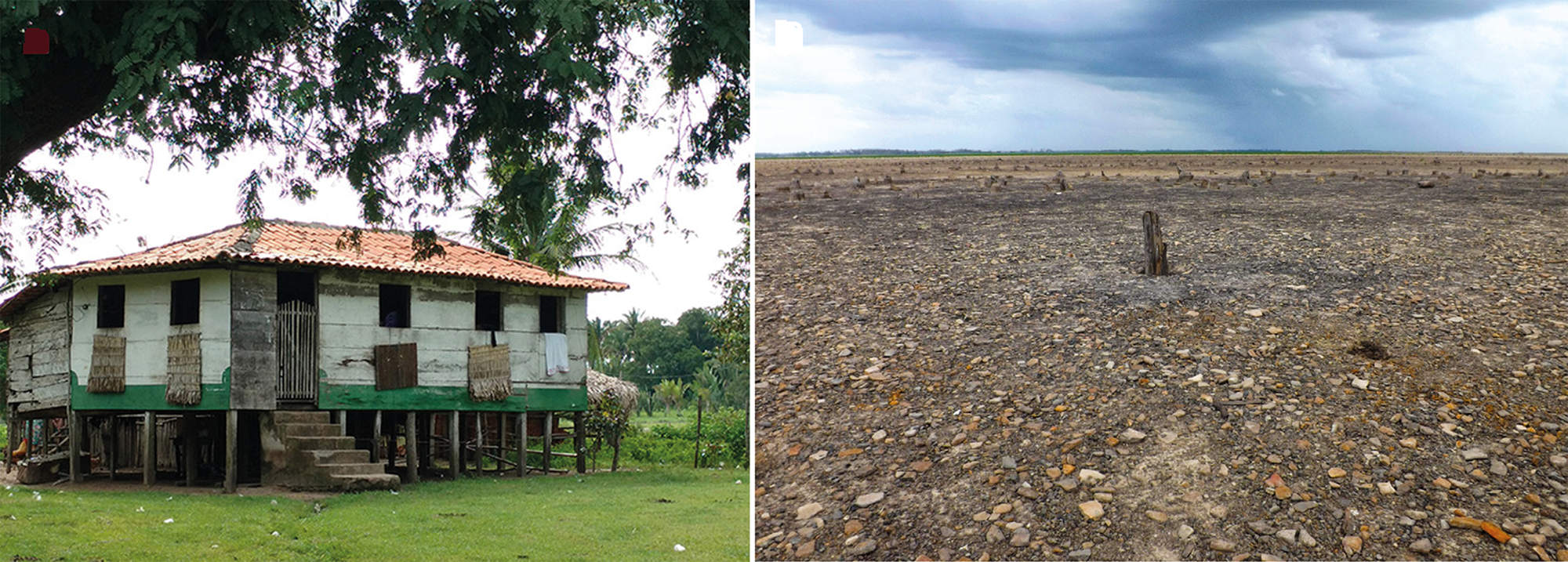
Houses on stilts are still built today in the Amazon floodplain. Oral reports from the region's inhabitants and the literature of travellers and chroniclers from the seventeenth and eighteenth centuriesconfirm the importance of these residences as a long-term history, whose strategy is to facilitate the capture of fish, the main source of riverine populations (D'Abbeville [1614] Reference d'Abbeville2008; D’Évreux [1614] 2007; Daniel [1774–1776] Reference Daniel2004) (Fig. 2).
Stilt villages today and in pre-colonial times. (Photograph: LARQ-UFMA.)
Radiocarbon dating indicates that most villages were built between ad 800 and 1100, thus corresponding to the late period of pre-colonial Amazonian occupation (Navarro Reference Navarro2018a,b). However, at least one stilt village belongs to the Formative, being dated between the years ad 1 and 200 (Navarro & Roosevelt Reference Navarro and Roosevelt2021.
The advance in the study of stilt villages in Brazil focuses mainly on the mapping of villages (Navarro Reference Navarro2018a,b) (Figs 3, 4, 5). These, in general, were formed by residential malocas connected by bridges to a larger main space, i.e. a square, constituting a large linear village. The archaeological material is hierarchically distributed within the site, and the concentration of artifacts with polychrome painting, figurines and greenstone ornaments (muiraquitãs) occurs prominently in the collective space. Within an ethnological and archaeological context, these villages resemble both those large linear settlements found along the Amazon River by travellers such as Carvajal and which so impressed the Spaniards (Porro Reference Porro1993; Reference Porro2017) and those excavated by Roosevelt (Reference Roosevelt1991) on the island of Marajó.
Formoso Lake and the stilt village. (Photograph: LARQ-UFMA.)

Formoso stilt village being mapped. (Photograph: LARQ-UFMA.)

Formoso stilt village mapped. (Photograph: LARQ-UFMA.)

The ontological turn and the ‘new materialisms’
In 2015, archaeologist Julian Thomas published an important article in which he questioned what the future held for archaeology. According to the researcher, archaeological science was heading towards radical ontological changes, similar to those that occurred in three decades in New Archaeology and Post-processual archaeology. The conclusion was that the study of material culture ‘was now fully engaged in the philosophical debates of the humanities’ (Thomas Reference Thomas2015, 1287).
Called ‘new materialisms’, these archaeologies would be an extension of the Post-processual movement that criticized the ecological functionalism of the New Archaeology in favour of an interpretation of the past focused on materiality as evidence of power negotiations, in which studies on gender and social classes were in the midst of discussions about the artifact (Gomes Reference Gomes2019). Conceived as ‘material symbols’ (Hodder Reference Hodder1982), the artifacts were read as texts and the human being occupied a central position as a social agent.
The ‘new materialisms’ began to discredit anthropocentrism and reject the supremacy of the human being to the detriment of other beings, such as animals and spiritual beings (Rae Reference Rae2013). Thus, animals, until then considered as mere symbols by Geertz's (Reference Geertz1989) interpretive anthropology, become agents of their own social actions and builders of their own histories, and inanimate beings begin to be endowed with agency (Overton & Hamilakis Reference Overton and Hamilakis2013). Hodder himself (Reference Hodder2012) increased his theories and developed arguments in favour of the fact that things are ‘entangled’, in the sense that human beings increasingly depend on their material creations. In this way, there is a symbiotic relationship between all the components involved, i.e. people and objects, acting socially with each other.
Thus, Thomas (Reference Thomas2015) and Alberti (Reference Alberti, Alberti, Jones and Pollard2013) argue that the new ontologies propose a diversity of worlds, inhabited or not by humans, tangible or not by them. In anthropology, there is a return to the study of material culture, understood from a non-representational approach in which artifacts are no longer seen as the identity of a society, but rather as a reflection of a world with its own meaning, often intangible for the scholar (Gomes Reference Gomes2016; Reference Gomes2019; Henare et al. Reference Henare, Holbraad, Wastell, Henare, Holbraad and Wastell2007).
Within this context, the world is, therefore, heterogeneous, formed by humans, non-humans and various other entities and spirits (Gell Reference Gell2018; Latour Reference Latour2005). This new theoretical position leads to thinking about worlds in which there is not only human consciousness, as argued by Niemoczynski (Reference Niemoczynski2013). Theoretical approaches begin to review the Amerindian cosmologies of South America, and less anthropomorphic conceptions of culture begin to stand out in anthropology, also influencing archaeologists.
Water everywhere, people of all kinds
The study of material culture gained visibility in the ‘new materialisms’ precisely because indigenous cosmologies were shaped in artifacts. Likewise, the relationships between humans, non-humans and spirits can be evidenced by the production of objects by different indigenous cultures. In this sense, the body gains fundamental importance in these relationships, because in it the cultural traits between these different beings were systematized. As pointed out by Seeger et al. (Reference Seeger, da Matta and Viveiros de Castro1979, 11), bodies are unstable, transformational, brokered, therefore, they are manufactured. The body, in this context, is constituted as a tangible diversity of material and immaterial life in which the physical body ‘is not the totality of the body; nor the body the totality of the person’. The body is therefore the place of social experience.
Superficial collections of abundant archaeological material from the mapping of the stilt villages made it possible to organize typologies of the pottery, which are composed of artifacts that carry important information about the way of life of the peoples in terms of their cosmologies (Navarro Reference Navarro2020a,Reference Navarro and Mikkolab). In this sense, the zoomorphic and anthropomorphic appliqués, in addition to the iconographic painting of the bowls, are indispensable sources for the understanding of the life of the people of the stilt villages. In this work, the focus will be on appliqués of the pottery, that is, ornaments or sculptures of animals or human beings that decorate the external walls of the bowls. Since the painting of bowls has already been considered in other articles, it will not be discussed in this work.
Of the set of appliqués on pottery in the stilt villages, those from the Formoso site carry more information about the proposed discussion of this article. Formoso stilt village is located 30 km from the municipality of Penalva, within the Amazon, under coordinates 23M 0457079 UTM 9640305 and on the lake of the same name. Its waters are fed by the Pindaré River, whose hydrographic basin covers an area of 40,000 km2. This river is 720 km long, starts in the Serra do Gurupi and flows into the Golfão Maranhense (Costa et al. Reference Costa, Bezerra, Costa, Sousa, Martins and Oliveira2011).
To develop the ideas of the text better, the artifacts are divided into four categories previously defined by the researcher, namely: (1) appliqués that show the transformation of the figurative body; (2) appliqués depicting human bodies (body-artifact) or human beings emerging from the bowl; (3) anthropozoomorphic appliqués depicting jaguars and humans; (4) appliques that allow the contemplation of a change in perspective. Pottery analysis was performed based on the classification of technological attributes, such as the rims and lips, in Shepard (Reference Shepard1956) and Arnold (Reference Arnold1985). For the reconstitution of the bowl, as well as the variability of the forms that indicate different functions, such as storage, transfer of liquids and cooking, the modal analyses of Rice (Reference Rice1987) and Raymond (Reference Raymond and Stahl1995) were used.
All appliqués studied here have the same technology in terms of manufacturing, including the addition of ground grog, mineral and cauixi (spicule of water sponges) as tempers, the first being the most common. As for the plastic decoration, this is modelled and uses incision (eyes and mouth of the figures) and punctate (nostrils/noses and eyes) techniques. In the first group, this is made up of artifacts that depict human beings who are undergoing body transformation processes, either as individuals or merging with animals, with the exception of jaguars, shown in the first group (Fig. 6). Image 6a is a patterned appliqué that has human features, but with ears possibly depicting another animal. The pronounced incisions of the nostrils and the short arms of the character stand out. The character of example 6b is a human who figures in a hemispherical vessel and appears to be emerging from it. Small bulges in the vessel seem to simulate the character's spine. Exemplar 6c is a figurine that has a central depression, possibly used for serving. A hole that features at shoulder height indicate its suspended use. The arms are depicted at the sides of the body and the character's downturned feet draw attention. The 6d appliqué figures a complex character. It depicts a human being with a penetrating facial expression, one eye being formed by a large incision and the other by a circular button. This, if seen from the side, composes the head of a bird whose beak also forms the character's disproportionate ear. Next to the other eye, a deep incision was made that reaches the mouth, resembling a scarification or a corporal deformation. Its position in the bulge of the vessel has some peculiar characteristics, as if it were in a stationary posture common to the animal or simulating a jump. Its hands are pinned to the lip of the bowl. Its body is skeletal and these characteristics seem to be highlighted by the discreet presence of the bones of the spine and shoulders, or these protuberances could be body deformations like those that seem to come out of his forearm. As in the figurine, the feet of the specimen are facing backwards.
Appliqués that show the transformation of the figurative body. (Photograph: LARQ-UFMA.)

The second group of pieces is formed by body artifacts that simulate human beings seeming to emerge from the vessels or even form wings as if they were enveloping the bowl (Fig. 7). These make up a particular group of spherical vessels, generally used to serve food, since they do not have any cooking marks on their external surface. Example 7a depicts a human being with simian features whose arms form two wings on the lip of the vessel, as if it were enveloping the entire bowl. Specimen 7b is formed by a vessel whose lip is modelled in the shape of a human head. The impression that he is lying down is accentuated by observing the rim and rounded lip that simulate the character's shoulders. The inner surface of the vessel is painted, possibly a body painting of the figured human being. Specimen 7c is formed by a vessel with a model depicting a human being with a head that also seems to be elongated by the cranial deformation technique. This head extends from the lip to the bulge of the vessel; its arms form wings attached to the bulge of the artifact. Finally, image 7d shows a human being with simian features that seems to emerge from the bottom of the bottleneck-type vessel.
Appliqués depicting human bodies. (Photograph: LARQ-UFMA.)

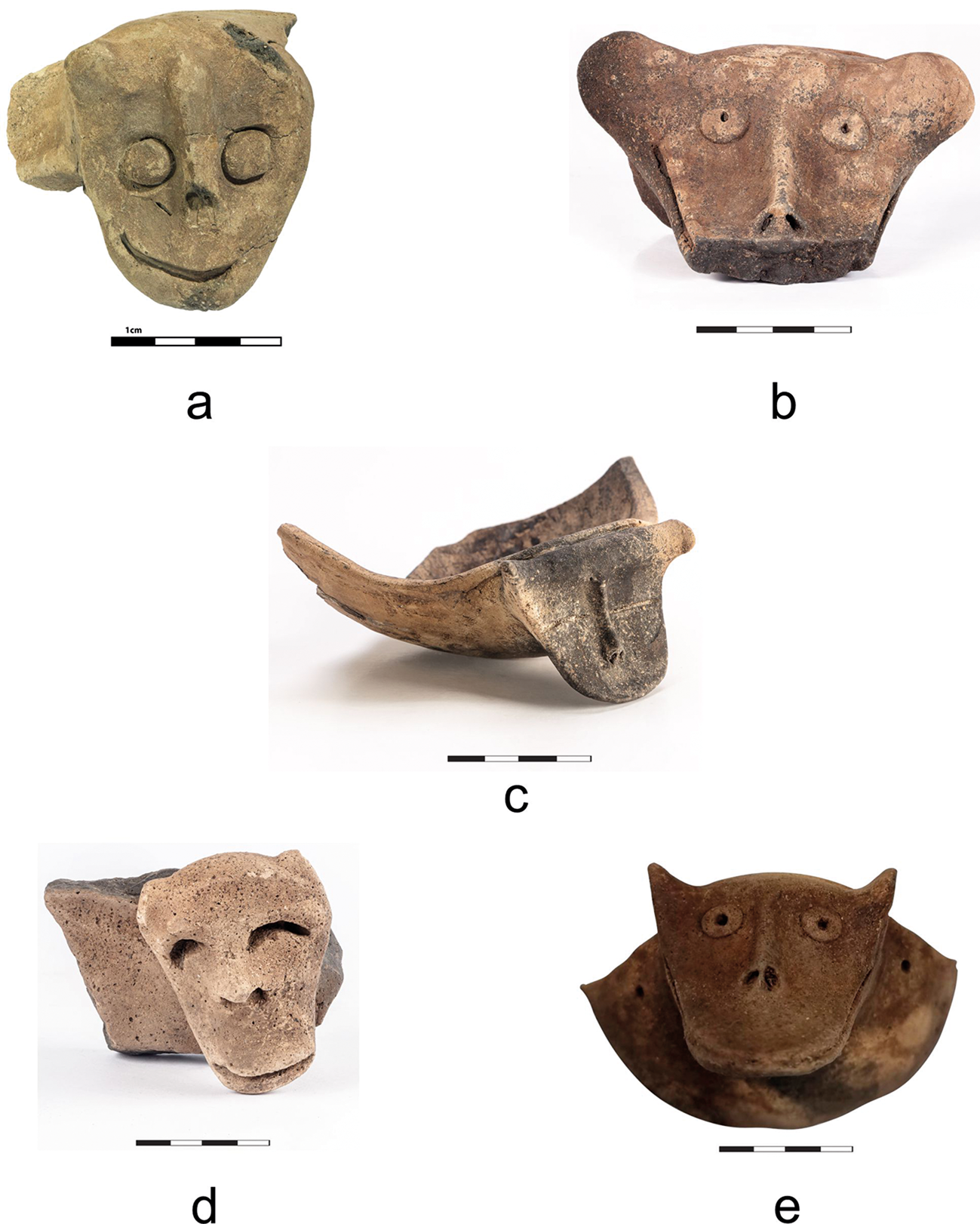
As for the third group (Fig. 8), this comprises vessels with appliqués mixing possible feline and human characteristics, the mouth being an element that stands out in the iconographic composition, sometimes being of exaggerated proportions as in examples 8b, 8c and 8e, at times provoking a curious facial expression, as if he were smiling ironically, as is the case in object 8a. Piece 8d has a human figure with the appearance of old age.
Anthropozoomorphic appliqués depicting possible jaguars and humans. (Photograph: LARQ-UFMA.)
The last group is formed by artifacts that simulate the change of perspective of the figurations involved in this visual process (Fig. 9). In this set, two artifacts stand out. Figure 9a is an anthropozoomorphic figure, possibly a mammal. Specimen 9b is a zoomorphic appliqué that composes a hemispherical vessel, with cooking marks, since it is covered by soot on its external face. Exemplar 9c comprises a fragment of an anthropozoomorphic figurine, with human and simian features. The ears are pierced and possibly the specimen had some ear adornment. A large orifice located in the chest region stands out, simulating, perhaps, a mouth and may also have some other function, such as the passage of some perishable material for the suspension of the object or transfer of liquids.
Artifacts that simulate the change of perspective. (Photograph: LARQ-UFMA.)

Discussion: the deep world of waters
The pottery of the Formoso stilt village shows that the artifacts are embodied images in which art is not a reflection of social organization, whose main function would be the representation of entities, but the metaphor of the notion of transformation, one of the essential concepts of the agency of artifacts in the ‘new materialisms’ (Lagrou Reference Lagrou and Santos Granero2009; Thomas Reference Thomas2015).
This transformation that artifacts carry through their embodiment belongs to the world of shamanism. There is an extensive bibliography on the subject and the shamanic institution has been defined in different ways, with a predominant idea ‘of a multilevel universe, where the visible reality always presupposes an invisible one’ (Langdon Reference Langdon1996, 27). The interest here is in the transformative implication of shamanism in material culture, in which beings metamorphose into others, such as animals into humans, humans into animals, humans into spirits (Seeger et al. Reference Seeger, da Matta and Viveiros de Castro1979).
Reichel-Dolmatoff (Reference Reichel-Dolmatoff1988, 23) has pointed out that shamanism is a ‘coherent system of religious beliefs and practices, which tries to organize and explain the interrelationships between the cosmos, the natural and the man’. The shaman is, therefore, the possessor of sensitive knowledge that combines nature and human practices in the mythological traditions of the group, acting as a mediator of the cosmos through ritual actions such as dances, speeches, intonations and songs. Ultimately, the shaman consecrates and perpetuates the social memory of the group he represents through the experimentation of his experiences.
Shamanism has found fertile ground to develop from Amerindian perspectivism, in which animals play a leading role, especially predators, since these are auxiliary beings of the shaman. In this sense, shamanism is a cosmological institution, since the shaman is the mediator of different possible worlds, acting in them in a plural and fluid way (Viveiros de Castro Reference Viveiros de Castro1996; Reference Viveiros de Castro2002). According to this author, shamanism is, therefore, the institution of transformation and metamorphosis per se, since ‘spirits, the dead and shamans assume the forms of animals, animals that become other animals, humans that are inadvertently changed into animals’ (Viveiros de Castro Reference Viveiros de Castro2002, 351).
As far as archaeology is concerned, artifacts have been interpreted as the materialization of cosmologies based on shamanism. Gomes (Reference Gomes2012) argued that the statuettes from Santarém (1200–1600 ad), which sometimes depict men sitting on benches, sometimes carrying maracas [rattle], represent shamans. Using Amerindian perspectivism, this author argues that the zoomorphic ceramic appliqués of some specific types of vessels, such as bottlenecks and caryatids, evidence processes of bodily transformation experienced by shamans. Schaan (Reference Schaan2001) discussed the role of women shamans among the Marajoara, and Barreto (Reference Barreto, Barreto, Lima and Betancourt2016) has shown that shamanic objects were distributed in stylistic flows involving different regions in the pre-colonial Amazon.
These transformation processes occur in line with the bodily exchanges between humans and animals. Here, an important discussion that has been little discussed by archaeologists and that becomes fundamental in this article is the concept of Master of Animals. The shaman is in connection with the Master of Animals, that is, a spiritual being who commands all animals. According to Reichel-Dolmatoff (Reference Reichel-Dolmatoff1996), this entity belongs to Amazonian societies that gave importance to a sacred geography of the landscape, as in the case of the Tukano, manifested in two favourable spaces: mountains and lakes, both present in the Vaupés region, in Colombia. In them would live the ancestors and all sorts of fish, anacondas and other aquatic creatures. Also according to Reichel-Dolmatoff (Reference Reichel-Dolmatoff1996), building malocas [residences] near these lakes was an important symbolic strategy, since these ancestral aquatic creatures would protect their inhabitants. The Animal Master himself would live in a maloca, called the House of Ancestors, which could be in the lake or on its shore. The house would be filled with animals and plants invisible to ordinary humans, but visible to the shaman's eyes. To access these primordial houses, people would need to be adorned, painted and bathed.
Reichel-Dolmatoff (Reference Reichel-Dolmatoff1996) postulates ecological conditions for the existence of the Master of Animals. This one would not be presented to a large group of people, but to small groups of people or individuals when they were performing daily tasks such as hunting and fishing, protecting preyed animals. Finding the Master of Animals in the woods or in lakes and rivers involved a tense and dangerous situation. Thus, the entity would be present to those ‘who themselves are acutely aware of ecological problems, people who are actively involved in environmental disturbances, who have consciously or unknowingly violated the norms’ (Reichel-Dolmatoff Reference Reichel-Dolmatoff1996, 84). But the Master of Animals can also appear in dreams and hallucinations to the person who has broken some norm. And since this apparition generates emotional problems for the victim, consultation with the shaman becomes necessary. This form of animism would thus be what Reichel-Dolmatoff (Reference Reichel-Dolmatoff1996, 85), called the ‘projection of human consciousness’, since the offender is aware of the violation he has committed. In this way, the Master of Animals would be a guardian of nature that imposes punishments on human beings for disturbing it. The way in which the shaman acts to counteract a punitive action by the Master of Animals is to ask permission to enter his sacred abode during his hallucinogenic trances, and try to convince him that the breaking of the norm will no longer occur. Negotiations take place between the parties involved, ranging from the offering of food to the animals to the delivery of the soul of the violator of nature after their death.
Roosevelt (Reference Roosevelt1997) also noted these ecological issues, proposing that the animals depicted in pottery vessels are those connected to both shamanic rituals and the restrictions imposed by taboo. For this, the author uses Amazonian ethnography to explain that powerful people in the spiritual plane can communicate with beings from other planes through the use of hallucinogens, as is the case of the Master of Animals, this possessor of punitive power over human health, fertility and food abundance. The combination of physical aspects of the animal mixed with that of humans reveals, therefore, the power of shamanic transformation, whose shaman needs the help of animals to communicate with ancestral spirits.
The Master of Animals appears to have an alter ego, a human form, which in the Amazon is generally known as Kurupira, Curupira, Currupira or Boráro to the Tukano (Reichel-Dolmatoff Reference Reichel-Dolmatoff1996, 97). Mentioned by travellers, missionaries and chroniclers as a forest demon, anthropologists have collected much information and local variations on this entity, describing it as having a large penis, red or fiery eyes, large ears, no knees, and especially twisted feet facing backwards. Although they lived in the dense forest, especially in those where the buriti (Mauritia flexuosa) and the babassu (Attalea speciosa) predominate, the Curupira always walked through the flooded environment, swampy regions or with waterfalls, since their favourite food, the crab, lives in these aquatic landscapes.
According to Reichel-Dolmatoff (Reference Reichel-Dolmatoff1996, 98), the Curupira seems to be ‘a cannibalistic monster feared by all’, while the Master of Animals would be a more benevolent entity, being more scolding or reparative than destructive. Figure 6d, found in Lake Formoso, seems to refer to this entity. His left foot is clearly twisted backwards; the body seems flexible and the joints and knees do not seem to exist; he also has big ears. The possibility of changing perspective that the artifact offers makes the left eye, together with this large ear, transform into a bird, thus revealing its protective aspect of these animals that live in trees. Its different eyes, represented materially by an incision that leaves the right eyeball and goes to the mouth and by a button-shaped appliqué on the left eye, may be associated with some variety of facial aspects that may have regional manifestations. In the Formoso appliqué some body protuberances that resemble bones, such as those located in the region of the shoulder blade, or some type of body deformation or even some dermatological alteration draws attention. Body features such as the short arms of Figure 6a, and evidence of the vertebral column of specimen 6b, may also be attributes of Curupira.
One of the definitions of the word Curupira offered by Ferreira (Reference Ferreira1986, 513) is of Tupi origin, with kuru'pir meaning ‘covered with pustules’. The referred protuberances of the specimen of Formoso could well be these wounds or pustules spread over the body. Câmara Cascudo (Reference Câmara Cascudo1998) also discusses the difficulty of the Curupira to remain standing, due to the absence of knee joints, and that, once lying down, it is difficult for it to return to an upright posture; Figure 6d seems to have no knees, and, leaning on the lip of the container, shows a posture that is not very erect, a bit awkward, one might say. Reichel-Dolmatoff (Reference Reichel-Dolmatoff1996) reported that the shaman's way of accessing the Master of Animals is through the use of hallucinogens. The statuette of Formoso 6b has a depression in the region of the abdomen that could have been used for inhalation of hallucinogenic substances by the shaman. The figure's twisted feet further reinforce its association with the Curupira entity. This is similar to the drawing of the entity collected by Reichel-Dolmatoff (Reference Reichel-Dolmatoff1996) in a maloca among the Tukano (Fig. 6e). Both figures have a blackened appearance and large abdomens. The association of the black colour with the entity is recurrent in folkloric literature, as, for example, in the passage by Campos (Reference Campos1939) in which the Curupira is ‘black like the devil, hairy like a monkey, mounted on a very thin, very bony pig, wielding a long stinger.’
Curupira was studied more from a folkloric point of view, such as the classic studies by Câmara Cascudo, including Dicionário do Folclore Brasileiro, in which he defines the entity as ‘one of the most amazing and popular entities of the Brazilian forests’, describing it as ‘a dwarf, red hair, feet backwards, heels forward’ (Câmara Cascudo Reference Câmara Cascudo1998, 332). Under the influence of colonial religious writings, Câmara Cascudo (Reference Câmara Cascudo1998, 332) still attributes the following epithets to Curupira: ‘forest demon, explainer of mysterious rumours, disappearance of hunters, forgetting of paths, sudden, inexplicable terrors’. Such assertions can be observed in this fragment of Anchieta ([1560] Reference Anchieta1997, 34):
It is a well-known thing and everyone knows that there are certain demons, which the Brazilians call corupira, that attack the Indians many times in the forest, give them whips, hurt them and kill them. The witnesses of this are our brothers, who have sometimes seen those killed for them. For this reason, the Indians usually leave on a certain path, which through rough brush leads to the interior of the lands, on the top of the highest mountain, when they pass by, bird feathers, fans, arrows and other similar things as a kind of oblation, fervently begging the Curupiras not to harm them
It is evident, in this report, that the Curupira has the function of controlling an ecological balance caused by human disturbance. Even without discussing the entity Master of Animals, Câmara Cascudo (Reference Câmara Cascudo1998, 333) recognizes the importance of the Curupira as an ecological regulatory entity by attributing to it the function of ‘directing the hunt’, ‘protector of trees’ and, mainly, ‘master of animals’. It seems clear, therefore, that the Curupira is associated with the Master of Animals and his controlling powers over nature against the misfortunes caused by humans.
Some Formoso appliqués feature possible felines with human traits. The association between shamans and jaguars is linked to the consumption of hallucinogenic plants and this practice is well documented in the lowlands of South America, especially in the Amazon (Métraux Reference Métraux1932; Reichel-Dolmatoff Reference Reichel-Dolmatoff1978a,Reference Reichel-Dolmatoffb; Wright Reference Wright2013). It is not the objective of this work to review this literature, but rather to present some guiding concepts to corroborate the association of these felines with the long-term application of pottery vessels from Formoso stilt village.
The jaguar is a shamanic animal per se. According to Reichel-Dolmatoff (Reference Reichel-Dolmatoff1978b), the jaguar is associated with shamanism due to the inherent qualities of the animal: size, ferocity, strength, agility and dexterity. The Guahibo shamans of Colombia, for example, after consuming snuff, say: ‘We are jaguars, we dance like jaguars; our arrows are like the jaguar's fangs; we are ferocious as jaguars’ (Reichel-Dolmatoff Reference Reichel-Dolmatoff1978b, 52). Thus, the jaguar would assume a fundamental role in the Amazonian indigenous cosmologies, being present both in rituals in which its sound and fast movements learned by the dances are used, as well as in the material culture itself, with the feline figured in benches, masks, in pottery appliqués and in the shaman's clothing composed of the animal's skin (Gebhardt-Sayer Reference Gebhardt-Sayer1986; Gow Reference Gow1988; Roe Reference Roe1989).
Among the Tukano, jaguars are the animals that communicate with the shaman and are recurrently represented in hallucinogen artifacts. In addition to being a magical animal among this group, the jaguar is also associated with natural phenomena such as lightning, thunder and fire. For Reichel-Dolmatoff (Reference Reichel-Dolmatoff1978b), the feline is the preferred form of manifestation of the Master of Animals. Even shamans, after their death, would transform into these animals. For the Baniwa, an Arawak group from the northwest of the Amazon, the shamans are considered the ‘wise men’ or prophets of this people; the felines are those who reveal the preserved memories of the elders, such as ancestral chants, mythical dances, communication with deities and curing diseases (Wright Reference Wright2013).
Some pottery appliqués from Formoso could well be associated with the shaman for all the qualities of the jaguar discussed here. Those that convey disguised smiles, such as exemplar 7a, could involve rituals of initiation into shamanism such as Pudali among the Baniwa, socialization parties and marriage arrangements with lots of music. In these ceremonies, future shamans are also trained by the elder shamans through traditional dances, the use of specific adornments and body painting practices. According to Wright (Reference Wright2013, 52), these parties are watered with fermented drinks that produce ‘much fun and laughs’. Could it be the hidden laughter of the possible jaguar shamans of Formoso provoked by the transforming action of those who are under the influence of fermented drinks, as shown in Figure 7a? Would these hidden smiles be those caused by the consumption of alcoholic beverages or the narcotic trance?
Attention is drawn to the very bulging eyes of these ceramic appliqués, such as examples 7b and 7e, which could be associated with the use of hallucinogenic properties such as those described by Reichel-Dolmatoff (Reference Reichel-Dolmatoff1971), since they increase the user's visual perception. In these stories, shamans play a fundamental role, being those who see beyond the layman: they have eyes that see everything. The 7d appliqué is emblematic in this discussion for its elder characteristics, and it may be the figuration of one of these elder shamans whose purpose is to initiate neophytes.
The mediation between the tangible and non-tangible worlds takes place through so-called shamanic flights (Carneiro da Cunha Reference Carneiro da Cunha1998; Chaumeil Reference Chaumeil1983; Hugh-Jones Reference Hugh-Jones, Thomas and Humphrey1996; Reichel-Dolmatoff Reference Reichel-Dolmatoff1978a,Reference Reichel-Dolmatoffb; Reference Reichel-Dolmatoff1988).These flights have been widely described by anthropologists: ‘displacements in the invisible paths that cut through the entire cosmic space’ among the Waiãpi of Amapá (Gallois Reference Gallois1988, 42; Reference Gallois and Langdon1996); among the Baniwa shamans of the upper Rio Negro, on the border between Brazil, Colombia and Venezuela, who travel to ‘the highest levels of the cosmos where they meet the Master of Disease’ (Wright Reference Wright and Langdon1996, 80); among the Yanomami whose shamans travel to communicate with the spirits in a place above the sky, ‘near the house of ghosts’ (Taylor Reference Taylor and Langdon1996, 132) or the shamanic prophetic tones of the destruction of the world at the ‘fall of the sky’ (Kopenawa & Albert Reference Kopenawa and Albert2016); among the Asurini shamans who travel with the spirits who live in ‘dwellings in other cosmic spheres’ (Müller Reference Müller and Langdon1996, 154; among the Marúbo of the Amazon, in which the shamans’ journey consists of a visit to the maloca of the ‘benevolent singing and dancing spirits’ (Montagner Reference Montagner and Langdon1996, 175) or the journey of the spirits that inhabit the singing pots among the Wauja of the Xingu (Barcelos Neto Reference Barcelos Neto2011); among the Kanixawa of Acre whose shaman is taken to heaven by the king vulture (Lagrou Reference Lagrou and Santos Granero2009, 201; Reference Lagrou2013) and returns to teach his people what he saw there, and among the Palikur of Amapá the long journeys of the shamans through their dreams were described (Arnaud Reference Arnaud and Langdon1996).
The Formoso vessels with plastic decoration depicting human beings that seem to emerge from the bottom of these vessels can refer to shamanic flights inside rivers and lakes. In this sense, these figurations are the shamans themselves who are returning to earth after their underground, aquatic journey, as pointed out by Reichel-Dolmatoff (Reference Reichel-Dolmatoff1996) with the Masters of Animals’ journeys to the aquatic world, also populated by a variety of creatures. The vessel in Figure 8d is emblematic in this discussion for the realism that the scene evokes: the character that uses the bulge of the vessel as support for its emergence is exhausted by the movements of its arms. With great arms outstretched, the character uses the wall of the vessel itself to climb its way up from its depths. Could this character be returning from the aquatic underworld, from the subterranean world?
Figure 8c, on the other hand, also seems to emerge from the watery entrails, not through the interior of the vessel, but along the rim of it, as if it were bordering an aquifer, perhaps a river or lake. The character's curious expression, looking up, seems to evoke that he is emerging from the bottom of the vessel; the flexed arms ratify this posture. Figure 8b shows a serene character, with anaconda body paint (Navarro Reference Navarro2020a), a shamanic Amazonian animal. This head is elongated, resembling a cranial deformation, and the incised eyes are closed, giving the impression that the human is dead. Could this be the figure of the anaconda shaman resting under its transmutational corporeal form of this great reptile, or even the representation of the shaman, painted in the colours of the anaconda, Mother of Fish, on her deathbed? The possible cranial deformation indicates his prominent position in the status of the society to which he belonged.
Sometimes, these metamorphosed animals form so-called doubles, that is, animals superimposed on one another, as in the case of Konduri vessels (Gomes Reference Gomes2012; Reference Gomes2022). At other times, depending on the angle of observation, different possibilities of reading the figuration of the artifact are possible, creating perspectives of dual figures such as those observed by Gomes (Reference Gomes2016) in the Santarém and Konduri vessels. This concept was defined by Lagrou (Reference Lagrou2013, 8) as an abstract chimera, that is, ‘constitutive tension between what is and what is not visible’, a mental game in which abstract art can be seen to transform into figurative, a complex of tangles of drawings that produce a perception of the transformation of iconography into multiple rather than individualized possibilities. According to the authors, this is an art of the ‘between-two’, in which there is a complementary relationship between the agents involved, which can be an animal and a human being, or a human being and a spirit.
Three Formoso pieces can fit into this concept. The artifact in Figure 9a shows a possible mammal with prominent ears. If the piece is viewed turned through 90°, a human figure is formed with an elongated head and the animal's ears become a facial adornment. The two dots in the human form that appear on the top of the head could be used as a support for some kind of headdress; already in animal form, the punctates become its nostrils. Figure 9b is even more emblematic, because you can see a bird in which the sharp beak, eyes applied with an incision and crest stand out. Viewed from the opposite profile, the figure seen is that of a reptile with prominent eyes and scales, which in the aviform version corresponds to the crest; the dual transformation is clear in this case. On the other hand, piece 9b presents two important notions of body transformation: the first reveals that, if seen in profile, the ears and the small circular appliqués of the eyes of the piece become the head of a bird; the second concerns the hollow hole that represents the mouth of the figurative being. The orifice works, at the same time, both as a passage for the insertion of some instrument and can also be a metaphor for the shaman's voice, sound or speech. As mentioned earlier, speech is a phenomenon of shamanic bodily transformation (Santos-Granero Reference Santos-Granero and Santos-Granero2009). For example, according to d’Évreux ([1614] Reference d’Évreux2008, 237) regarding the shamans in colonial Maranhão during the indigenous conversion, ‘their instrument is only the voice, so strange to those who are not used to it’. The chronicler revealed that healing power is given, among other means, by the shaman's speech.
Conclusion
From the end of the first decade of the twenty-first century, new theoretical approaches to material culture began to emerge in archaeology. These, in general, stopped focusing on an artifact as a text, a premise rooted in Post-processual archaeology, and began to rescue philosophical principles of the human sciences. Anthropocentrism began to lose strength and more dynamic interpretations of culture, less linked to Geertz's symbolic anthropology, took over the register of material culture. Known as ‘new materialisms’, a variety of study possibilities focused on the new potentialities of material culture were advocated. Archaeology became even more linked to anthropology, and anthropology, in turn, began to dialogue more with archaeology.
The artifact is thus evidence of a world that is entangled by different beings in their various possible relationships. One of the most latent discussions within these new approaches to material culture is the concept of metamorphosis or transformation of the body implied by shamanism. Human beings with animal characteristics, or vice versa, or even mixed with spiritual aspects, touch an invisible world that materializes in the artifact. The artifact is, therefore, the material experience of these different cosmological manifestations.
This article has focused on these agentive capacities of bodily transformation among the people of the eastern Amazonia stilt villages. The archaeological materials analysed in this article are in line with analyses of shamanism carried out by other archaeologists among the Marajoara, the Santarém and the Konduri cultures. Among these aspects, the ones that draw most attention are the anthropozoomorphic beings that figure humans and felines, those that stimulate a change of perspective when viewed from different angles and beings that seem to emerge from the watery depths.
All these pottery appliqués discussed here operate, according to Lagrou (Reference Lagrou and Santos Granero2009, 68), an art that takes place through the ‘passage between the visible and the invisible in an Amerindian world characterized by the interchangeability of forms’. In this way, ceramic appliqués can be considered ‘perceptive instruments that imply specific mental operations supported by an ontology in which the transformability of shapes and bodies occupies a central place’ (Lagrou Reference Lagrou2002, 68).
The artifactual variability of shamanic practices in the stilt villages appears to have been extensive. According to the technological description of the appliqués in this study, they accompany hemispherical vessels, used to serve food, semi-spherical vessels that were taken to the fire because they have cooking marks and vessels for the transfer of liquids, as appears to be the case with the figurine 9c which has a hole at the location of its mouth. Figurine 6c appears to have been a hallucinogen spray device; others have hollow holes indicating their suspended use. Thus, ritual paraphernalia required the use of different types of artifacts, each with a specific function.
This work has also wished to associate the beings figured in the pottery appliqués of Formoso with the Master of Animals and the processes of shamanic flights, themes already established in anthropology, but that have been little discussed by archaeologists in Brazil. Although the examples offered in the text refer to societies geographically distant, such as the Tukano or the Baniwa, they offer an important spectrum in terms of Amazonian ethnographic comparisons, taking into account that the peoples who lived in the stilt villages are also Amazonians and, therefore, their characteristics were perpetuated in the long term.
This article also gave voice to a topic still little explored by Brazilian anthropologists, since it was more linked to folkloristic studies, namely, the Curupira entity. The presence of two artifacts with the typical backwards-facing feet could be evidence of the existence of this character in pre-colonial times, since the people of the stilt villages lived between the years 800 and 1000 ad. Father Anchieta's own record ([1560] Reference Anchieta1997) indicates a temporally extensive existence for the Curupira. It would also be necessary to review the archaeological collections to find out if other specimens are waiting to be discovered by some scholar.
Today the Amazon suffers from constant fires and lack of supervision by Brazilian public power. Indigenous peoples are left to their own devices, as gold mining grows by giant strides in their territories. Its waters are contaminated with mercury. Still, most indigenous societies persist and preserve their cultures, and their knowledge is passed on from generation to generation. Its ancient traditions show that human beings need the forest to continue to exist and that it can be preserved in line with modern agricultural practices. It is not necessary to destroy it, therefore. Thus, archaeology helps us to understand that life in the rainforest can be balanced just as it was in the pre-Columbian past.
Acknowledgements
I would like to thank Professor Anna C. Roosevelt, University of Illinois Chicago, for her encouragement in writing this article. I thank the National Historic and Artistic Heritage Institute (IPHAN) for authorizing and renewing archaeological permission through process 01494.000442/2013-37; the Fulbright Commission for the Visiting Professor Award at the University of Illinois at Chicago; the institutions where I researched: Smithsonian Institution (Washington), Penn Museum (Philadelphia) and American Museum of Natural History (New York); the Foundation for Support to Research and Scientific and Technological Development of the State of Maranhão (FAPEMA) and the National Council for the Scientific and Technological Development (CNPq) for the funding (Process number 303620/2021-8). This study was also financed in part by the Coordenação de Aperfeiçoamento de Pessoal de Nível Superior - Brasil (CAPES) - Finance Code 001 and Fundação de Amparo à Pesquisa e ao Desenvolvimento Tecnológico do Estado do Maranhão (FAPEMA, Processes CACD-02856/20 and UNIVERSAL-06209/22). Thanks to Mayara Rocha for making the drawings.



