The origins and process of plant domestication in the Andes have been the subject of long-standing debates. For many years, research on prehispanic agriculture has focused on maize, considered to have been one of the principal staples of ancient American peoples (Kroll Reference Kroll1999; McClung de Tapia Reference McClung de Tapia, Wesley Cowan and Watson1992; Oliszewski Reference Oliszewski2004; Staller et al. Reference Staller, Tykot and Benz2006). More recently, tubers and pseudocereals have begun to be recognized as other important components of the diets at the time when food was first processed (Fernández Reference Fernández1969–1970; Korstanje Reference Korstanje2005; Korstanje and Würschmidt Reference Korstanje, Würschmidt, Aschero, Alejandra Korstanje and Vuoto1999). In Northwest Argentina (NWA), although evidence of cultivation and consumption of maize has been found in domestic and productive contexts of the first millennium AD (e.g., Calo Reference Calo2010; Lema Reference Lema2014; Miante Alzogaray and Cámara Hernández Reference Miante Alzogaray and Cámara Hernández1996; Oliszewski Reference Oliszewski2004; Pochettino and Scattolin Reference Pochettino and Cristina Scattolin1991), analyses of plant macro- and microfossils and of crop-processing artifacts have shown that the earliest production of food was probably centered on other starch-rich resources—roots, tubers (e.g., potatoes, ulluco, oca, manioc), and pseudocereals (e.g., quinoa, amaranth, cañiwa)—and other freeze- and drought-resistant crops (Babot Reference Babot2004; Korstanje Reference Korstanje2005). According to these analyses, C3-type plants (e.g., quinoa, beans, tubers) and a few pertaining to the Crassulacean Acid Metabolism (CAM) type (e.g., tuna and pasacana) constituted an essential part of the diet of ancient NWA people.
Although archaeobotanical and zooarchaeological analyses provide indirect evidence of production and food consumption, isotopic analysis, mainly of carbon and nitrogen, of human remains has contributed in fundamental ways to the study of past lifestyles, providing direct information on the actual intake of specific types of food. The analysis of carbon isotopic composition gives insight into the relative proportion of vegetal resources with C3, C4, and CAM photosynthetic pathways in the diets by comparing archaeological samples against reference isotopic values for each plant group (Ambrose and DeNiro Reference Ambrose and De Niro1986; Burger and van der Merwe Reference Burger and van der Merwe1990; deFrance et al. Reference deFrance, Keegan, Newson, Reitz, Newson and Scuder1996; Hastorf and DeNiro Reference Hastorf and De Niro1985; Larsen et al. Reference Larsen, Kelly, Ruff, Shoeninger, Hutchinson, Reitz, Newson and Scuder1996; Norr Reference Norr and Sthal1995; Schoeninger Reference Schoeninger1995; Schoeninger and DeNiro Reference Schoeninger and DeNiro1984). In addition, the analysis of stable isotope values of nitrogen reveals the place occupied by the individuals in the trophic chain and therefore makes it possible to infer the importance of meat resources in human nutrition (Schoeninger and DeNiro Reference Schoeninger and DeNiro1984). Differences in the values of δ15N can also be attributed to ecological factors linked to aridity and soils (Szpak Reference Szpak2014).
Even though the number of paleodietary studies based on isotopic evidence has been increasing steadily over the last few years in NWA (Amman et al. Reference Ammann, Mendonça, Merlo, Bordach and Tykot2014; Fuchs et al. Reference Fuchs, Cocilovo and Varela2015; Gheggi et al. Reference Gheggi, Williams and Cremonte2018; Gordillo and Killian Galván Reference Gordillo and Killian Galván2017; Killian Galván Reference Killian Galván2015, Reference Killian Galván2018; Lynch Ianniello et al. Reference Lynch Ianniello, Mendonça, Arrieta, Bernardi and Asunción Bordach2018; Ortiz and Killian Galván Reference Ortiz and Alconini2016), there is still little information available with which to understand the process and regional particularities of the consolidation of agropastoral economies. Indeed, information on many areas of NWA is still lacking. This article's main objective is to determine diet composition through stable isotope analysis of populations that inhabited the Cajón Valley (Catamarca Province, Southern Calchaquíes valleys) at different moments in time between 3600 and 1300 BP, thereby contributing to a broader regional and temporal understanding of the problem under study. We are interested in observing changes in the diets through time and, in particular, the extent to which maize was incorporated in the diet of these first agricultural communities. Analysis of stable isotopes of carbon (13C/12C) and nitrogen (15N/14N) on a sample of human bone material from 10 adult individuals provides the data for studying paleodietary patterns. We analyzed this information using a Bayesian mixing model, FRUITS (Food Reconstruction Using Isotopic Transferred Signals; Fernandes et al. Reference Fernandes, Millard, Brabec, Nadeau and Grootes2014), to introduce a hierarchy of the most consumed food resources during the period of initial experimentation and consolidation of agriculture. Although the sample is small, it is the only one available for the whole Cajón Valley region. It contributes to filling in the evidentiary gaps in our knowledge of the dietary composition of prehispanic societies and to the long-standing debates on the introduction of agriculture during the Formative period in NWA.
Study Area
The earliest evidence for the peopling of NWA goes back to 11,000 BP, indicating that the first hunter-gatherer groups inhabited this area during the Late Pleistocene and Early Holocene (Martínez Reference Martínez, Ricardo Grau, Judith Babot, Izquierdo and Grau2018). The oldest occupation—from about 10,800 to 8000 BP—is restricted to caves and rock shelters in dry puna environments in the high plateau between northern Chile and Argentina (López et al. Reference López, Coloca and Orsi2009). In high-altitude valleys, the register of human occupation dates back to about 7820–7420 BP (Martínez et al. Reference Martínez, Eduardo P, Mauri, Caria and Oliszewski2013). In NWA, the transition from the specialized hunter-gatherers of the Archaic period to the early farming villages of the Formative period occurred during the second millennium BC (Aschero and Hocsman Reference Aschero and Hocsman2011).
The pastoralist and agricultural lifestyle, made possible by subsistence diversification through the introduction of plant cultivation and animal domestication, was consolidated during the Formative period (ca. 1500 BC–AD 1000; Núñez Regueiro Reference Núñez Regueiro1974; Olivera Reference Olivera, Berberián and Nielsen2001; Scattolin Reference Scattolin2006; Tarragó Reference Tarragó and Ledergerber-Crespo1992). Although mostly self-sufficient, these communities were also involved in dynamic social interactions oriented to the distribution and exchange of local products on a regional scale, which included different ecological areas of NWA and northern Chile; this exchange was possibly enhanced by the introduction of llama caravans (Albeck Reference Albeck1994; Browman Reference Browman1980; Dillehay and Núñez Reference Dillehay, Núñez, Saunders and Montmollin1988).
The end of the Formative period was characterized by significant social changes. In the following Late or Regional Developments period (ca. AD 1000–1450), a time of fully agricultural societies, there was consolidation of highly hierarchical social systems with clear-cut territorial boundaries maintained through the political control of other ecological areas, agglomerated settlements, and warfare. These developments probably occurred in response to a cycle of severe droughts that triggered conflicts over the control of stable water sources for irrigation (Nielsen Reference Nielsen1996). Toward the middle of the fifteenth century AD, with the incorporation of NWA into the Inca Empire, local groups were displaced and reorganized, and Inca craft styles and architectural patterns were transferred to the conquered areas as one form of control and domination (Cremonte and Williams Reference Cremonte, Williams, Nielsen, Rivolta, Seldes, Magdalena Vázquez and Mercolli2007). Soon after, the Europeans colonized the area, leading to massive changes in local culture.
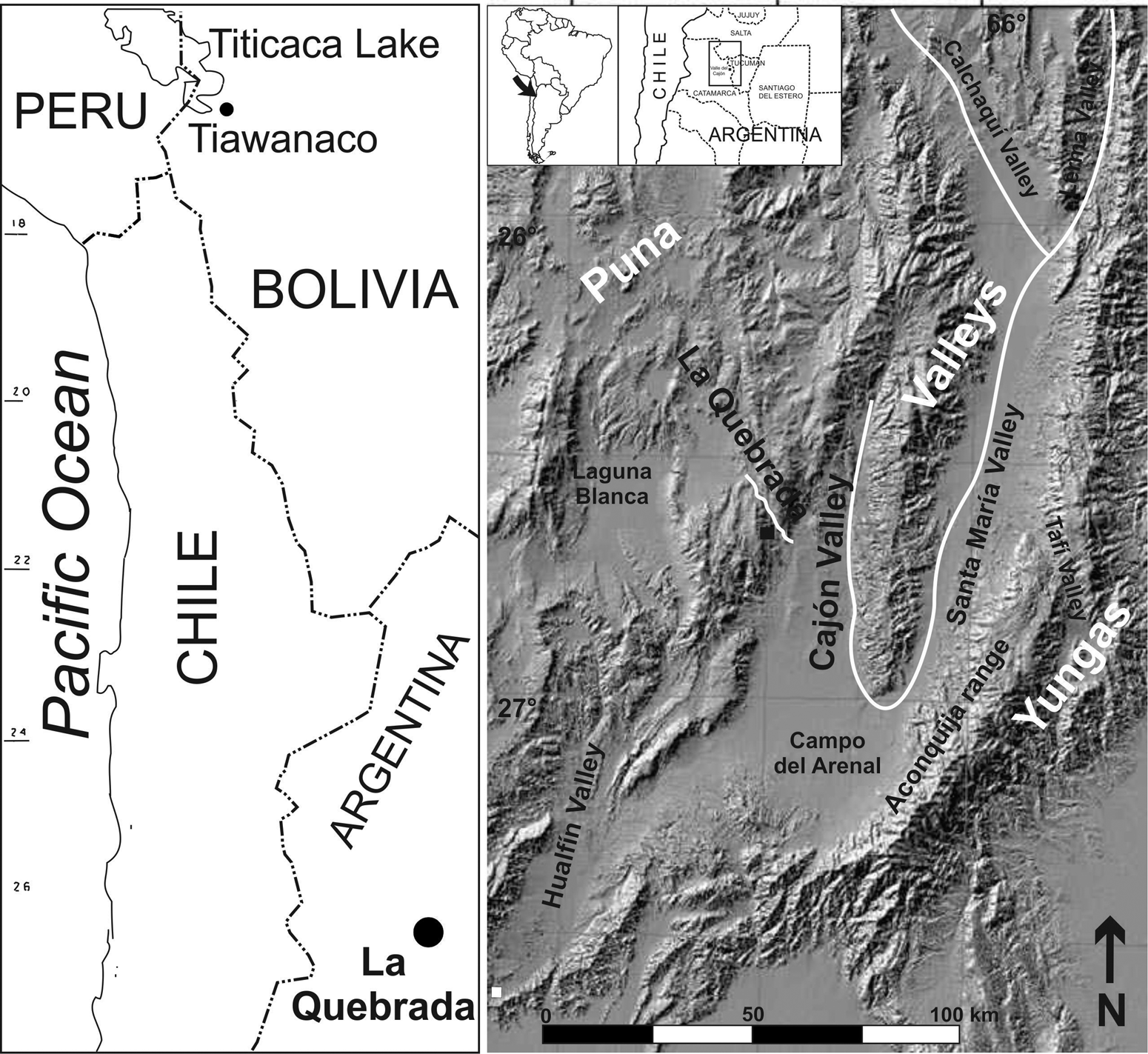
This periodization has regional particularities because of the varied forms of social organization systems throughout the large, diverse territory of NWA. One micro-region that has started to show evidence of a long human occupation is the Cajón Valley. Located in the Southern Calchaquí valleys (Catamarca Province), the Cajón Valley extends north–south along 90 km between W66°00′ 66°30′ and S26°10′ 27°00′ (Figure 1). It is one of the great semiarid valleys of NWA reaching 3,200 m asl in its western slope. It has a semiarid climate, with great thermal amplitude and summer rains. Most importantly, the Cajón Valley occupies a strategic point in the landscape with environmental transitional characteristics, constituting an intermediate step between the puna, the mesothermal valleys, and the yungas (the humid eastern slope of the Andes). This geographical emplacement should have been of fundamental importance for exchange networks in the past, connecting people and resources from different ecosystems (Scattolin et al. Reference Scattolin, Cortés, Bugliani, Calo, Domingorena, Izeta and Lazzari2009, Reference Scattolin, Bugliani, Domingorena, Cortés, Lazzari, Izeta, Marilín Calo, Korstanje, Lazzari, Basile, Fabiana Bugliani, Lema, Domingorena and Quesada2015). As a result, the Cajón Valley constitutes a particularly relevant area to study the introduction of maize and plant domestication in NWA.
Location of the Cajón Valley in Northwest Argentina, Southern Andes.

Although at the moment there are no local data for paleoclimatic reconstruction, studies of pollen and edaphic profiles conducted in different basins of NWA valleys allow us to infer a period of higher humidity and warmer temperatures from around 2500 BP until 1000 BP (Carbonelli and Collantes Reference Carbonelli, Collantes, Collantes, Perucca, Niz and Rabassa2020; Caria and Sayago Reference Caria and Sayago2008; Gómez Augier and Caria Reference Gómez Auguier and Caria2012; Sampietro Reference Sampietro2002). The period from 2100 BP to 1470 BP has been characterized as particularly humid for the Santa María Valley (Strecker Reference Strecker1987) and the Abra del Infiernillo (Garalla Reference Garalla2003), both areas bordering the Cajón Valley. Analyses of plant macro-rests in Ambato Valley, south of the Cajón Valley, have shown that toward the end of the first millennium AD the area went through a period of marked aridity (Marconetto Reference Marconetto2009), which coincides with that proposed for other basins of NWA valleys (Gómez Augier and Caria Reference Gómez Auguier and Caria2012; Sayago et al. Reference Sayago and Collantes2010) where exceptionally warm and dry conditions were linked to the Medieval Climate Anomaly.
The La Quebrada locality in the Cajón Valley, from where we derived our samples, links four phytogeographic regions: altoandina (3,700 m asl), puna (3,100–3,200 m asl), pre-puna, and monte (below 2,000 m asl). Within these environments, four types of plant communities could be identified: grass steppe (pajonal), wetlands (vegas), woodlands (monte), and shrublands (arbustal). The highest areas are covered by shrublands composed mainly of plants of the Poaceae family. Several species of Cyperaceae and Caryophyllaceae, as well as some species of Baccharis and Parastrephia (Asteraceae), are abundant in the circumscribed zones of wetlands. The foothills and ravines contain patches of woodland vegetation formed by species of Prosopis (algarrobo) and Acacia visco, along with species of Bromelia (chaguar). Finally, there is sparse shrubland with several deciduous species spread over the cones and the alluvial fans of the piedmont areas (Calo Reference Calo2010).
Archaeological research in the La Quebrada locality has provided a large amount of evidence on the lifestyles of the first agricultural communities of the Formative period. Cardonal and Bordo Marcial, two settlement sites, were assigned by radiocarbon dating to the first centuries AD (ca. 1800–1900 BP; Scattolin et al. Reference Scattolin, Cortés, Bugliani, Calo, Domingorena, Izeta and Lazzari2009, Reference Scattolin, Bugliani, Domingorena, Cortés, Lazzari, Izeta, Marilín Calo, Korstanje, Lazzari, Basile, Fabiana Bugliani, Lema, Domingorena and Quesada2015). Chance finds of human remains have proved that the occupation of this region goes back to at least 6000 BP and extends to at least 1300 BP (Cortés Reference Cortés2011, Reference Cortés2013).
Archaeobotanical studies carried out in Cardonal Nucleus 1, a residential compound of five attached circular structures, resulted in the recovery of several plant remains identified as Zea mays grains (maize), Phaseolus vulgaris var. vulgaris seeds (domesticated bean), P. V. var. aborigineus seeds (wild bean), Geoffroea decorticans fruits (chañar), Prosopis sp. seeds (algarrobo), Chenopodium sp. achenes (quinoa), and other seeds of the Solanoideae, Caesalpinoideae, and Mimosoideae subfamilies and Malvaceae family. These vestiges of edible wild and domesticated plants suggest consumption and processing of several plant species, as well as the likely cultivation of some of them at Cardonal at the beginnings of the first millennium AD (Calo Reference Calo2010, Reference Calo2014).
It is important to note the overwhelming number of milling instruments of different types (almost 400 were registered in Nucleus 1 alone), some of them totally worn out and the great majority used for secondary purposes (e.g., constructive materials) found in both Cardonal and Bordo Marcial. In addition, these first villages were surrounded by large stone structures that were probably used as corrals or fields for crops, as well as simple irrigation systems.
Zooarchaeological analysis carried out in Cardonal and Bordo Marcial households identified several Camelidae remains with evidence of primary and secondary processing and burning, some of them located near milling instruments, fragmented vessels, ashes, and carbonized soil (Calo et al. Reference Calo, Fabiana Bugliani, Cristina Scattolin, Pilar Babot, Marschoff and Pazzarelli2012). Ten specimens were the subject of isotopic analyses (Srur et al. Reference Srur, Gabriela, Izeta and Scattolin2012; Supplemental Table 1). Studies carried out at the neighboring site of Yutopian (8 km north of Cardonal and Bordo Marcial) revealed that the family Camelidae was the first taxon represented within Formative period deposits, including the species llama (Lama glama), guanaco (Lama guanicoe), vicuña (Vicugna vicugna), and, to a lesser extent, other faunal resources such as quirquinchos (Choenophractus vellerosus), rodents, carnivores, cervids, and birds (Izeta Reference Izeta2007).
The evidence provided by archaeobotanical and zooarchaeological analyses of food processing and consumption at the time during which Cardonal and Bordo Marcial were occupied, around 2000 BP, can now be contrasted with the results of isotopic analyses of human remains with statistically contemporaneous radiocarbon dates. Moreover, the sample we analyzed also includes individuals dated to earlier (3600–3000 BP) and later moments (1300 BP), which allows us to build a diachronic reconstruction of the changes in food consumption in the area.
Materials and Methods
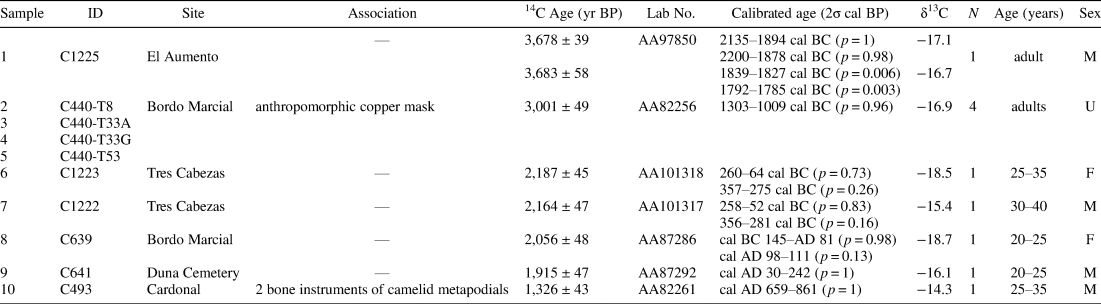
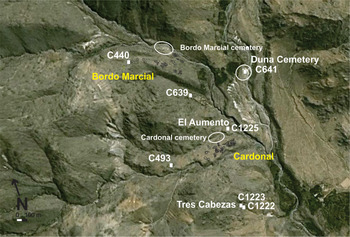
Twelve funerary contexts have been recovered in La Quebrada, including a minimum number of 20 individuals, both adults and subadults of different ages and sexes. The sample selected for this analysis comprises 10 individuals—both male and female and with estimated ages between 25 and 40 years—belonging to nine burial contexts (Figure 2; Table 1).
Characteristics of Samples Analyzed in the Present Study.

Notes: M: male, F: female, U: undetermined. Calibrations were performed with Calib-Radiocarbon Calibration Program (Stuiver and Reimer 1986–2017, Calib Version 7.0.4, http://calib.org) with the Southern Hemisphere calibration curve (SHCal13). Sex and age estimations were made following standard bioarchaeological methods described in Cortés (Reference Cortés2011).
Location of sites and analyzed contexts in La Quebrada locality, Cajón Valley.

Individual C1225, from the El Aumento site on the north flank of the Cardonal village, is the oldest one, with two coincident AMS dates of 3678 ± 39 BP and 3683 ± 58 BP (AA97850; human bone; δ13C = −17.1 and −16.7, respectively; Cortés Reference Cortés2013:218). This adult male was placed directly in the ground in a flexed position without any structures or associated materials. The four individuals from context C440 (C440-T8, C440-T33A, C440-T33G, and C440-T53), all adults of undetermined sex and age, were part of a collective burial of at least 14 individuals including both female and male adults and children of different ages. These human remains were disarticulated, commingled, fragmented, and in a very poor state of preservation. The samples selected corresponded to four 3rd left metacarpals to rule out the possibility of testing the same individual. To the west, the tomb was delimited by a single concave row of flat stones. Dated to 3001 ± 49 BP (AA82256; human bone; δ13C = −16.9; Cortés Reference Cortés2013:218), this context stands out because the human remains were associated with an anthropomorphic mask, which is so far, the oldest known, intentionally shaped copper object from the Andes (Cortés and Scattolin Reference Cortés and Cristina Scattolin2017; Scattolin et al. Reference Scattolin, Bugliani, Cortés, Domingorena and Marilín Calo2010). Individuals C1223, C1222, C639, and C641 are dated between about 2100 and 1900 BP; that is, they are statistically contemporaneous to the occupation of the nearby villages of Cardonal and Bordo Marcial. Individual C1222 (2164 ± 47 BP [AA101317; human bone; δ13C = −15.4]; Scattolin et al. Reference Scattolin, Bugliani, Domingorena, Cortés, Lazzari, Izeta, Marilín Calo, Korstanje, Lazzari, Basile, Fabiana Bugliani, Lema, Domingorena and Quesada2015:431), an adult male of 30–40 years of age, was buried in a hyperflexed position within a clearly delimited pit dug in the ground. A few meters away, the disarticulated and scattered remains of C1223, a 25- to 35-year-old woman, were recovered and dated to 2187 ± 45 BP (AA101318; human bone; δ13C = −18.5). Individual C639, a female, was found in a partially destroyed burial context consisting of a pit dug in the ground and a few stones standing on top. She was 20–25 years of age, and the small bones of an infant of approximately nine lunar months around her abdominal area indicated that she was probably pregnant at the time of death or buried with her newborn. Her remains were dated to 2056 ± 48 BP (AA87286; human bone; δ13C = −18.7; Cortés Reference Cortés2013:300). Individual C641 is an adult male whose body had also been placed in a hyperflexed position. He was found in a site known as Duna Cemetery, a large dune of fine white sand located a very short distance from the sites of Cardonal and Bordo Marcial. The radiocarbon date of this individual, 1915 ± 47 BP (AA87292; human bone; δ13C = −16.1; Cortés Reference Cortés2013:300) indicates that the use of this cemetery was contemporaneous with the occupation of the villages. Finally, the last sample, C493, is an adult man of 25−35 years of age who was disposed of on the top of the Cardonal site. Dating to 1326 ± 43 BP (AA82261; human bone; δ13C = −17.8; Cortés Reference Cortés2013:300), this burial postdates the occupation of Cardonal and Bordo Marcial by several centuries. The body was disposed with his legs partially flexed, covered by a few stones (including a mortar); on top of this first structure, another larger accumulation of stones formed a shallow mound that is clearly distinguishable on the surface. The skeleton was perfectly articulated, but his skull and the first cervical vertebrae were absent. The fact that there were no signs of reopening of the funerary structure indicated that this is a primary burial. Two bone instruments made on camelid metapodials were placed on his abdominal area.
Isotopic δ13C (collagen) and δ15N measurements were carried out at INGEIS Biogeochemistry Laboratory (CONICET-UBA, Argentina). The procedure to extract bone collagen required two phases: demineralization and elimination of postdepositional particles (Tykot Reference Tykot, Martini, Milazzo and Piacentini2004; see also Killian Galván [Reference Killian Galván2015] for more details). δ13C (apatite) measurements were carried out at SIRFER Laboratory (Stable Isotope Ratio Facility for Environmental Research) at the University of Utah, following standard protocols described by Cook and colleagues (Reference Cook, Erkkila, Chakraborty, Tipple, Cerling and Ehleringer2017). For pretreatment of the inorganic fraction, approximately 100 mg of powdered whole bone was soaked for 24 hours in 3% hydrogen peroxide to remove organic materials, then rinsed three times, and dried. The sample was then soaked 30 minutes in 0.1 m buffered acetic acid to remove labile carbonates, rinsed three times, and dried. Measurements of δ13C and δ15N values of each sample were made using a Carlo Erba Elemental Analyzer (CHONS), coupled to a Finnigan MAT Delta V continuous-flow isotope ratio mass spectrometer (CF-IRMS), through a Thermo ConFlo IV interface using internal standards. For carbon isotopic composition analyses of carbonates, we used a Thermo Finnigan GasBench II connected to a Thermo Finnigan MAT 253 via Conflo IV. All stable isotope ratios are expressed relative to Vienna Pee Dee Belemnite (VPDB) and atmospheric N2 (air), respectively.
The Bayesian mixing model FRUITS was used for the quantitative reconstruction of the diets of the individuals, because it allows for estimating probability distributions of source contributions. It permits handling different uncertainties, such as isotopic signals of potential food groups, diet-to-tissue isotopic offsets, and dietary routing (Fernandes Reference Fernandes2015; Fernandes et al. Reference Fernandes, Millard, Brabec, Nadeau and Grootes2014). FRUITS also provides the possibility of introducing preexisting information, such as results from physiological or metabolic studies (Fernandes et al. Reference Fernandes, Millard, Brabec, Nadeau and Grootes2014). Therefore, this is a valuable tool for understanding the relationship between the contribution of macronutrients and the dietary proxy signals measured in the consumer (Fernandes et al. Reference Fernandes, Millard, Brabec, Nadeau and Grootes2014). Like any other statistical model, however, FRUITS has its limitations and requirements. First, it must have a baseline definition of the nutrient and isotopic composition of food groups. Second, it needs to use enough dietary proxies (up to three). Third, there must be a quantification of diet-to-tissue isotopic offsets and dietary routing. Nevertheless, the model is capable of handling uncertainties associated with all these parameters while allowing the user to input diverse forms of preexisting information (Fernandes Reference Fernandes2015).
The model considered three main food groups—terrestrial C3 plants (n = 4, δ13C −23.7 ± 2.0; δ15N +7.6 ± 1.3), C4 cereals (n = 2, δ13C −10.4 ± 0.6; δ15N +9.1 ± 7.0), and meat from terrestrial animals (camelids: probably L. glama and V. vicugna; n = 9, δ13C −16.5 ± 2.6; δ15N +4.3 ± 0.5)—using previous studies on carbon and nitrogen isotopic composition (Gheggi and Williams Reference Gheggi and Verónica2013; Srur et al. Reference Srur, Gabriela, Izeta and Scattolin2012; Supplemental Tables 1 and 2). Within the food group Camelidae, a sample of 10 camelids from the Cardonal and Bordo Marcial sites was considered with diets that included pastures located up to 3,000 m asl (Srur et al. Reference Srur, Gabriela, Izeta and Scattolin2012). These show a variation in isotopic values that corresponds to grazing along a long latitudinal gradient. Probably, as in other ecoregions of NWA, such as puna, there is a relationship between altitude and the distribution of plants with C3 and C4 photosynthetic pathways. As Srur and colleagues (Reference Srur, Gabriela, Izeta and Scattolin2012) have pointed out, the values show a mixed type of diet different from that resulting from dietary habits subject to strict human management. Some authors have established the hypothesis of systematic feeding with maize-based fodder, which would explain the high percentage of camelids with high δ13C values in other mesothermal valley sites of NWA (Dantas and Figueroa Reference Dantas and Figueroa2009; Figueroa et al. Reference Figueroa, Dantas and Laguens2010). We consider it appropriate to use this sample despite its small size, because values from other areas or time periods may not reflect the predominant local isotopic composition of this animal genus.
Altitude, rainfall amount, and CO2 concentration in the atmosphere are among the environmental variables that can generate variation in δ13C values in modern plants (Tieszen Reference Tieszen1991). Water availability, using annual rainfall as an indicator, has been identified as a variable linked to obtained δ15N values (Hartman Reference Hartman2011) because of the higher content of nitrate and ammonium in saline soils that is characteristic of arid environments (Pate Reference Pate1994). However, in agricultural environments, animal fertilizer should be considered an important source of variation, given its high content of 15N caused by the preferential loss of 14N in volatile gaseous ammonium (Szpak Reference Szpak2014). The effect occurs when nitrate converted from the enriched ammonium is involved in the synthesis of plant amino acids (Choi et al. Reference Choi, Lee, Ro, Kim and Yoo2002). Taking this into account, we used a study of modern vegetables grown in the locality of Animaná, Salta Province, in this model, because it is probably more relevant than other similar studies in NWA given the geographical proximity to the Cajón Valley (Gheggi and Williams Reference Gheggi and Verónica2013; Supplemental Table 2).
Food nutrient content (protein, carbohydrates, and lipids) are expressed as dry weight carbon content (wtC %), with carbohydrates and lipids combined into a single fraction. For the estimation of the macronutrient composition of foods, we used Supporting Information File 2—Table 1 as published in Fernandes (Reference Fernandes2015; FAOSTAT 2009).
Isotope values of terrestrial animals were estimated from bone collagen values, relying on previously reported offsets between macronutrient and collagen isotopic values for these organisms (Fernandes Reference Fernandes2015). Chosen offsets for terrestrial animals were δ13Cprotein-collagen − 2‰, δ13Clipids-collagen − 8‰, and δ15Nprotein-collagen + 2‰, with an uncertainty of 1‰. Because δ13Capatite is a dietary proxy that signals the carbon of the dietary mix, the δ13C signal of each food group was that of the bulk carbon. In contrast, terrestrial animals δ13C bulk values were estimated as a weighted mean (in accordance with the nutrient composition) of lipid and protein δ13C values. Modern plant values were adjusted for the isotope Suess effect (+1.5‰; Craig Reference Craig1957), and bulk isotope plant values were adjusted for isotope offsets between bulk δ13C values and protein (−2‰), and between bulk δ13C values and carbohydrates (ca. +0.5‰; Fernandes Reference Fernandes2015; Tieszen Reference Tieszen1991). Diet-to-collagen and diet-to-apatite δ13C isotope offsets were based on the work of Fernandes and colleagues (Reference Fernandes, Nadeau and Grootes2012): an offset of 4.8 ± 0.2‰ for the former, and an offset of 10.1 ± 0.2‰ for the latter, with a conservative uncertainty (0.5‰) to account for the possible effect of body size (Passey et al. Reference Passey, Robinson, Ayliffe, Cerling, Sponheimer, Denise Dearing, Roeder and Ehleringer2005). In addition, collagen carbon was routed from 74 ± 4% dietary protein carbon, and the remaining 26% from carbohydrates and lipids (as shown by Fernandes et al. Reference Fernandes, Nadeau and Grootes2012). We used a value of 5.5 ± 0.5‰ for the human δ15N diet-to-collagen isotope offset (Fernandes Reference Fernandes2015). Finally, based on previous studies we considered the acceptable level of dietary protein intake to be between 5% and 45% of protein carbon contribution (Fernandes et al. Reference Fernandes, Millard, Brabec, Nadeau and Grootes2014; Otten et al. Reference Otten, Helliwig and Meyers2006).
Results
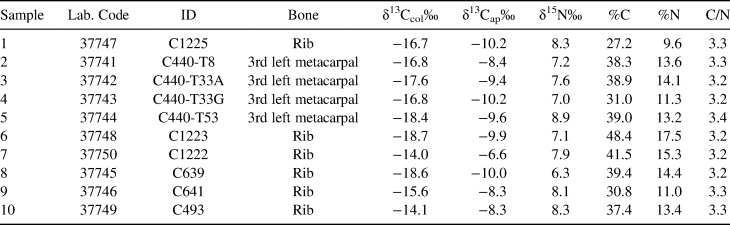
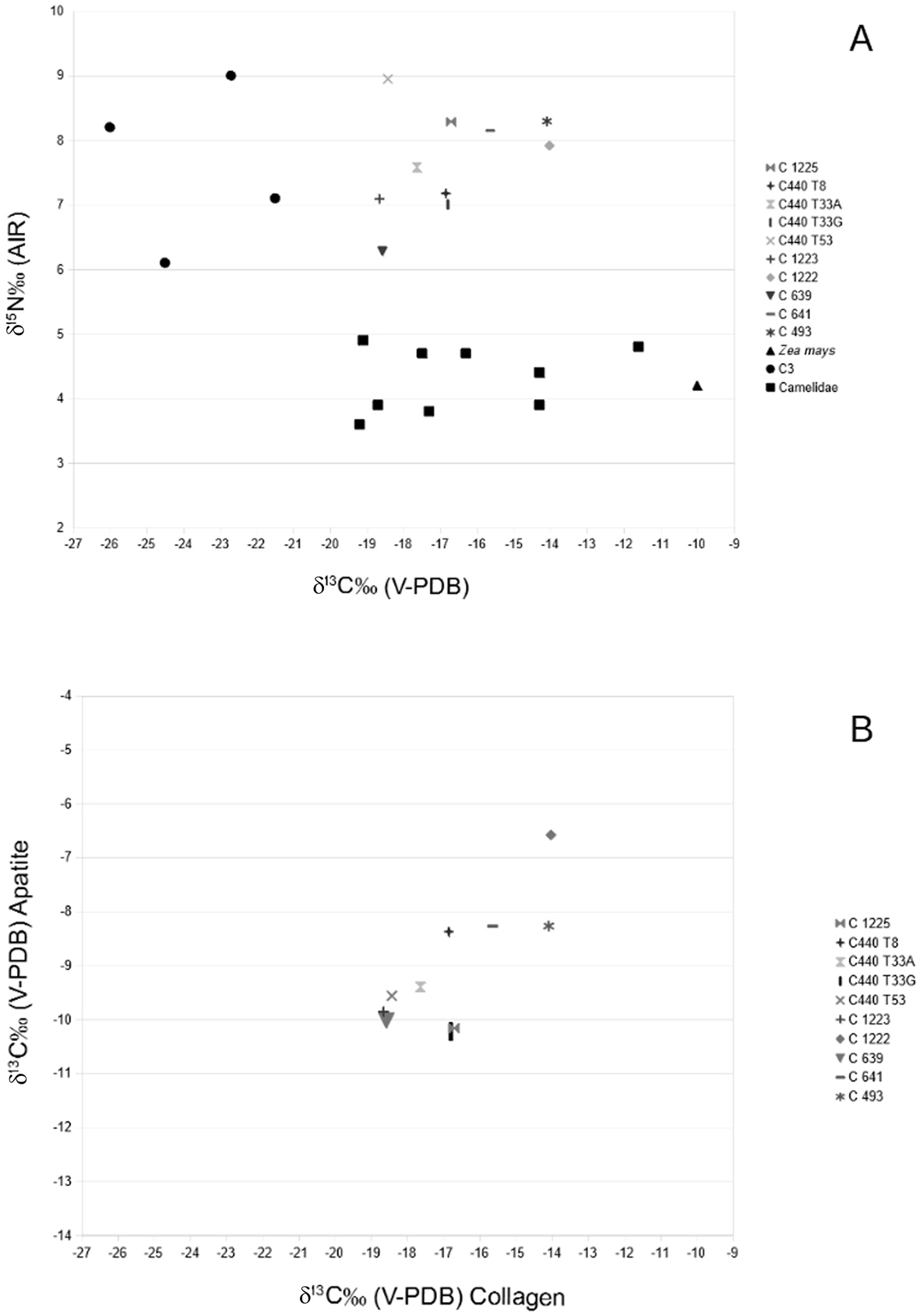
Carbon-to-nitrogen ratios are available for all analyzed samples (Table 2), and all samples fall within the acceptable range (2.9–3.6; DeNiro Reference DeNiro1985). As a whole, the set shows average values of δ13Cco −16.7 ± 1.7‰, δ13Cap −9.1 ± 1.1‰, and δ15N +7.7 ± 0.7‰. As for the organic fraction, the carbon values in the mineral fraction allows us to infer that the energy and protein components of the individuals’ diet do not follow a single photosynthetic pathway. The values show a high variation in the three isotopic systems, which is related to the variation found in the Camelidae specimens from Cardonal and Bordo Marcial sites (Figure 3a and b). However, such variation is not consistent with a linear temporal trend in any of the isotopic systems, as would be expected in a scenario of progressive replacement of resources consumed by maize. The variation is probably related to the temporal range investigated: important changes occurred in local environmental conditions that caused changes in vegetation and in the availability of resources for both humans and fauna.
Carbon (δ13C) and Nitrogen (δ15N) Isotopic Values for the Human Sample from the Cajón Valley.

Bivariate plots showing (A) δ13C (collagen) and δ15N values and (B) δ13C (collagen and apatite) values of human individuals from the Cajón Valley.

It should be noted, however, that the isotopic values of the vegetables available for the Calchaquí valleys do not seem to explain those found in all humans. It is also important to highlight that the vegetable reference values we used come from modern crop plots grown in agrochemical-free contexts (Gheggi and Williams Reference Gheggi and Verónica2013). As expected for agricultural contexts, they have very high isotopic nitrogen values, even equal to those present in humans.
Application of the Bayesian Mixing Model FRUITS
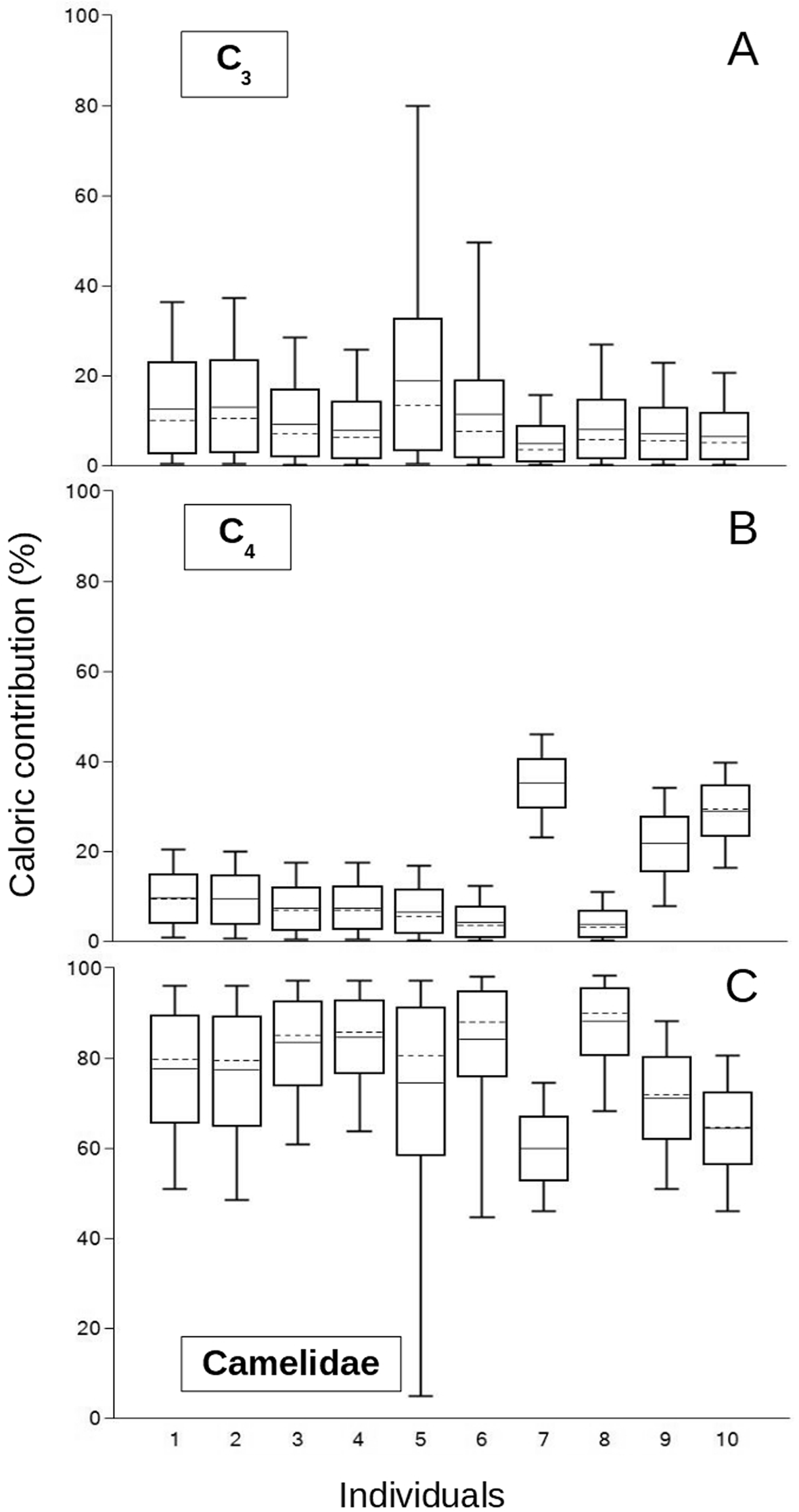
Supplemental Table 3 summarizes the caloric percentages of each group of resources at the individual level. If we consider the average values of the distributions (Figure 4; Supplemental Figures 1 and 2), only three individuals seem to have a relevant contribution of maize in their diet (7, 9, and 10), although in no case does maize constitute more than 40% of it. C3 plant resources seem to be of little relevance in general, whereas the Camelidae resource seems to be the most consumed, contributing at least 60% of dietary calories in every sample. This dominance of the animal component in the diet inferred from the application of FRUITS is due to the high δ15N values of the vegetables included in it—in particular, those belonging to C3 vegetable specimens, which contrasts with the relatively low δ15N values found in humans.
Model estimates of calorie intake for the isotope mean of the Cajón Valley individuals. Boxes represent a 68% credible interval (corresponding to the 16th and 84th percentiles), whereas the whiskers represent a 95% credible interval (corresponding to the 2.5th and 97.5th percentiles). The horizontal continuous line represents the estimated mean, whereas the horizontal discontinuous line represents the estimated median (50th percentile).

A diachronic examination of the results shows that for the 3600–3000 BP range (Supplemental Table 3), five sampled individuals (1–5) show approximately 70% and 80% of meat resource in their diets considering mean values. With regard to the four individuals from context C440 (3000 BP), another aspect to consider is the low internal variability within this burial: differences between the four sampled individuals (2–5) are less than 2‰ in all the isotopic systems considered. It is noteworthy that given the isotopic characteristics of the resource groups, where camelids have relatively low isotopic nitrogen values with respect to those expected, we do not find a coherent relationship between individual 5 who has the highest value and the proportion of Camelidae in the intake estimated by the model. We also cannot rule out the possibility that the high proportion of animal protein for individual 5 could be related to the consumption of other resources not included in the model. For the 2000 BP range—that is, the time of occupation of the villages of Cardonal and Bordo Marcial—individuals 6, 7, 8, and 9 also have meat as the main component in their diets (between 60% and 80%). It is interesting to note that individuals 6 and 8, both females, have the highest percentages (80%) for the Camelidae resource, whereas C4 values do not exceed 4% and 3% of the whole diet component. The two contemporary males (individuals 7 and 9) show less preponderance of meat in their diets (around 60% and 70%) and a higher value for C4 resources (approximately 35% and 20%). Finally, individual 10, the latest in the sample, dated to around 1300 BP, shows the second lowest value for meat and a mean of nearly 30% of C4 resources in his diet.
Discussion
Our results increase our knowledge of the various ways in which maize was incorporated into the diets of NWA Formative period societies. As noted by Lema (Reference Lema2014), around 3,500 years ago changes in the relationship between human populations and plant resources began to occur, resulting in the coexistence of practices—rather than discontinuities—in the ways of production and consumption. During the early years of the time of experimentation with the domestication of plants and animals, the technology associated with agricultural practices could have been simple, making the findings more elusive. It is during that time period that an indirect but independent methodology such as paleodietary reconstruction by stable isotope analysis becomes particularly relevant.
Isotopic evidence for the Formative period in NWA is still scarce, however. There are only 30 individuals with at least one isotopic measure, and only 14 have the three measurements considered in this research (Supplemental Table 4; Supplemental Figures 4 and 5). The picture of regional variability in the modes of production and consumption of wild and domesticated resources remains incomplete. Previous studies indicate that at Antofagasta de la Sierra (ca. 2000–1300 BP; puna of Catamarca Province) diets were dominated by animal and C3 plant resources (Killian Galván Reference Killian Galván2018). In contrast, at the La Rinconada site (ca. 1400–800 BP), in the Ambato Valley to the south of our study area, a predominance of maize in the diet was evinced (Gordillo and Killian Galván Reference Gordillo and Killian Galván2017). Early occupations in the San Francisco region on the humid western flank of the Andes (Jujuy Province, ca. 2800–1500 BP) show that, although some individuals have an undoubtedly significant amount of maize in their diet, the consumption of a much wider variety of foods, including river fish, can be assumed based on their presence in the archaeological record (Ortiz and Killian Galván Reference Ortiz and Alconini2016). Finally, in Quebrada de Humahuaca (Jujuy Province, Argentina), maize seems to have occupied a leading place in the diet since the consolidation of producing economies around 1500–1100 BP (Killian Galván et al. Reference Galván, Violeta, Seldes, Mercolli, Nielsen, Olivera, Panarello, Otero, Rivolta, Mamaní, Seldes and Gheggi2014; Lynch Ianniello et al. Reference Lynch Ianniello, Mendonça, Arrieta, Bernardi and Asunción Bordach2018). Thus, although evidence is still meager, the introduction of maize in the diet of prehispanic societies of NWA presents itself with different rhythms and tempos. Within this scenario, results from the Cajón Valley become especially relevant to fill in the many information gaps in NWA.
Variability in the composition of diets in the southern Cajón Valley was expected because the analyzed individuals cover a 2,300-year range, a period in which climatic fluctuations were recorded, corresponding to changes in available plant cover. Different productive and consumption strategies might have been employed over such an extended period of time, which was precisely the moment of experimentation and introduction of subsistence economies that would eventually have developed into the consolidation of practices of domestication and cultivation of vegetables.
As a whole, the high proportion of Camelidae in the diet of the individuals of the Cajón Valley is shown by the coherence among the isotopic values of the local archaeological fauna and human specimens and by the surprisingly high nitrogen values of current edible plants. Therefore, the absence of vegetable data in the area is problematic, because plant values currently available for the Calchaquí valleys may be insufficient for the model. The model thus underestimates the C4 vegetable component in the diet and, to a lesser extent, that of C3 plants, mainly due to the nitrogen isotopic values. These values are higher than in camelids, which generates a stronger correspondence between the estimated human diets and the available meat resource.
In this sense, the distribution of values in humans seems to reflect the variation of values found in camelids from Cardonal and Bordo Marcial, which showed a mixed diet composed of C3 and C4 resources. As a result, the observed variation in the analyzed samples could be a response either to the same isotopic variability present in the resources consumed or to the relative incidence of these groups and resources in the paleodietary patterns. Srur and colleagues (Reference Srur, Gabriela, Izeta and Scattolin2012) suggested that the camelids of these villages would have had a mixed diet, which does not reflect, as will happen at later times, to a diet controlled by humans: a fattening strategy using maize. Instead, camelids do not show uniformity in their diet. In a sample of nine individuals, their diets included between 9% and 61% of C4 pastures (Supplemental Figure 1). Because we do not have local isotopic ecology studies on primary producers, we can only speculate about the existence of a maize-fattening strategy in the specimen that has the most positive carbon value (δ13C −11.6‰). Moreover, this diachronic interpretation may have a bias, because there are no camelid specimens from later time periods in Cardonal, which means that we do not know whether a mixed feeding strategy is due to ecological conditions or human management decisions. According to Srur and colleagues (Reference Srur, Gabriela, Izeta and Scattolin2012) there are 38 plants available for foraging, 15 of which have a C3 photosynthetic pathway, 4 a C4 photosynthetic pathway, and 17 have an undetermined pathway. C4 plants were found at altitudes between 3,100 and 3,700 m asl; therefore, it is possible that the difference in the composition of the camelids diet is due to the use of a large altitudinal gradient by wild and domesticated camelids.
As mentioned, from the application of the Bayesian mixing model, the meat component seems to be the most relevant in human paleodiets of the Cajón Valley. The dominance of the animal resource in the diets of the individuals dated to around 2000 BP (6, 7, 8, and 9)—contemporaneous with the villages of Cardonal and Bordo Marcial—was unexpected, because the very large number of active and passive milling instruments and archaeobotanical remains suggested the major importance of plant resources in their diets.
A possible scenario is that resources other than maize were processed in the milling instruments. As Calo (Reference Calo2010) has argued, plant remains recovered from Cardonal could correspond to weedy forms that were not necessarily domesticated; our model might be insensitive to the importance of Chenopodium sp. specimens, as well as other plants with a C3 photosynthetic pattern as proposed by archaeobotanical analysis (Calo Reference Calo2010; Lema Reference Lema2014). Another issue to consider is that high isotopic values in plants can be the result of multiple variables. For example, in agricultural environments, fertilizers and soil removal techniques are the main causes for high δ15N values (Szpak Reference Szpak2014). Thus, a local study in organic farming environments, which do not use agrochemicals that could alter isotopic values, would be necessary to build a more realistic predictive model. In addition, a specific study of legumes that have been registered in Cardonal would be important (Calo Reference Calo2010). The presence of legumes, which are nitrogen-fixing plants in agricultural environments, should be linked not only to consumption but also to ways of guaranteeing soil nutrition, thereby increasing the economic yields of crops. This technology could have formed part of the repertoire of strategies of these incipient farmers. However, legumes in the archaeological record cannot be ruled out as products for direct consumption by humans, alerting us to the need to include the isotopic analysis of these resources because they usually have lower δ15N values compared to the rest of the plants.
As for individuals with earlier dates (ca. 3600–3000 BP), no evidence of dwelling places or archaeological remains of food processing are available so far, hampering more detailed analyses of the hierarchy of resources consumed and their modes of subsistence. As discussed earlier, groups that based their food consumption on camelids, whether by hunting or domestication, complemented by a technologically simple horticulture, could have left few or no indicators traditionally associated with sedentary societies and consolidated agriculture.
Yet, even if a large component of maize in the diet of individuals appears associated with more sedentary contexts—that is, those with dates contemporaneous with the Cardonal and Bordo Marcial sites and later—it is nevertheless the case that some individuals show consumption habits similar to previous periods. In other words, although the caloric contribution of C3 plant resources is probably underestimated in the present model, there is now more certainty about the lesser importance of maize in individuals of the Cajón Valley area in relation to meat resources.
To improve the model, a greater number of individuals will be necessary to test any hypothesis of changes in the paleodietary patterns during the first millennium AD. We hope to conduct specific isotopic studies on plants in the Cajón Valley and the Southern Calchaquíes valleys, which would include not only the analysis of domesticated specimens, controlling for the influence of human manipulation on the isotopic relationships of plants, but also of all wild species that are still present in the area and that were probably part of the horticultural complex that preceded the intensive and extensive agriculture typical of the societies of the second millennium AD.
Conclusions
Stable isotope analysis applied to the reconstruction of past human diets has become an invaluable tool in the investigations of Andean prehispanic societies. These analyses help elucidate the variability and relative importance of consumed foods in a robust and independent way. They acquire particular relevance in discussions about the rhythms of the incorporation of maize in agricultural societies until it became the main dietary resource.
As several authors have pointed out, debates about the domestication process and the origins of agriculture in Andean populations during the Formative period took maize as the main indicator of these processes. It is now known, however, that there was a greater variability of diets and strategies during this period. In NWA, a macro-region that is characterized by a great diversity of environments, it is clear that the introduction of maize does not follow a unique pattern.
Before this study, the corpus of information available from the Southern Cajón Valley that could be used to infer the production and consumption of food resources came from technological, archaeobotanical, and zooarchaeological sources from the Cardonal, Bordo Marcial, and Yutopian settlements. From this evidence it was possible to identify an incipient agriculture associated with the first agricultural villages, in which a vast repertoire of wild and cultivated plant resources was combined with the exploitation of animals, the genus Camelidae being its main source. The first results obtained by isotopic analysis show that, contrary to previous expectations, meat resources were even more relevant than plants in the diets of individuals with dates contemporaneous with these villages. In fact, maize contributed no more than 40% of their diet. Later populations of the mesothermal valleys were the ones to use maize as a predominant resource, either for direct consumption or as a fattening strategy for herds. These results destabilize previous archaeological expectations, given the ubiquity of milling instruments and associated technologies in Cardonal and Bordo Marcial. In sum, stable isotope research carried out on human bone remains from the Cajón Valley support the argument that the inhabitants of this valley consumed a variety of food resources and did not base their food on the consumption of maize as the main staple.
Author contributions
All authors contributed equally to this work.
Acknowledgments
This research was based on several projects funded by the National Agency for the Promotion of Science and Technology, Argentina (ANPCyT): BID PICT RAÍCES 633 and 116; the National Council for Scientific and Technological Investigations (CONICET): PIP 486 and 256; and Fulbright–Ministerio de Educación y Deporte Scholarship (Argentina). We appreciate the guidance of Estela Ducós and Nazareno Piperizza (INGEIS), James Ehleringer (University of Utah), SIRFER, and laboratory crew members. Excavation and analysis of archaeological human remains were carried out by permission of the Dirección de Antropología de Catamarca, Argentina. Fieldwork in the area was conducted with the permission of the Ingamana Indigenous community. We thank Gabriela Srur and Soledad Gheggi for sharing unpublished material and Celeste Samec and Juan Pablo Carbonelli for bibliographic recommendations. We would like to give our special thanks to all the people of La Quebrada for their hospitality and constant support during our field trips and to all those who collaborated in the archaeological campaigns. We are grateful to the three anonymous reviewers and the journal editors who provided extremely helpful advice for improving the final version of the article.
Data Availability Statement
All relevant data are available within the manuscript, as well as the Supplemental Materials.
Supplemental Materials
For supplemental material accompanying this article, visit www.journals.cambridge.org/ https://doi.org/10.1017/laq.2020.101.
Supplemental Figure 1. Distribution of the Probability of Consumption of Resource Sets by Each Human Individual Analyzed (from A to J).
Supplemental Figure 2. Human Collagen δ13C, Apatite δ13C Values, and C4 (Zea mays) Contribution Percentage from Valle del Cajón Plotted against Uncalibrated Radiocarbon Years BP.
Supplemental Figure 3. Human Collagen δ13C and δ15N Values from Various NWA Formative Sites.
Supplemental Figure 4. Human Collagen and Apatite δ13C Values from Various NWA Formative Sites.
Supplemental Table 1. Carbon (δ13C) and Nitrogen (δ15N) Isotopic Values for the Camelidae Sample from Cajón Valley.
Supplemental Table 2. Carbon (δ13C) and Nitrogen (δ15N) Isotopic Values for the Plant Sample from Calchaquí Valley.
Supplemental Table 3. Descriptive Statistics of Caloric Contribution Rates of Each Resource in the Individuals Analyzed.
Supplemental Table 4. Stable Isotope Values from Various NWA Formative Human Samples.