Introduction
Diversifying species cultivated over time and space and designing multispecies cropping systems is a powerful way to improve agro-ecosystem multifunctionality and sustainability (Gaba et al., Reference Gaba, Lescourret, Boudsocq, Enjalbert, Hinsinger, Journet, Navas, Wery, Louarn, Malézieux, Pelzer, Prudent and Ozier-Lafontaine2015). Many features (e.g. availability of soil mineral elements, plant health and pollination) may be improved by cultivating a wide range of harvested and non-harvested species at field scale. These species can be grown in intercropping, or by relay- or sequential cropping, with the possibility of sowing some species directly under a living mulch (Malézieux et al., Reference Malézieux, Crozat, Dupraz, Laurans, Makowski, Ozier-Lafontaine, Rapidel, de Tourdonnet and Valantin-Morison2009). In most of these situations, seedling establishment is a very sensitive period determining the direction and intensity of competition interactions between the cultivated species (and between these species and weeds) and the performance of these multispecies cropping systems (Fayaud et al., Reference Fayaud, Coste, Corre-Hellou, Gardarin and Dürr2014). Seedling establishment depends strongly on soil climate and structure, and the responses of individual species to these environmental factors are highly variable. Modelling is, therefore, a potentially useful tool for improving our understanding of the functioning of species mixtures and the services they deliver.
These effects of abiotic factors on crop establishment are described by the SIMPLE model (SIMulation of PLant Emergence, Dürr et al., Reference Dürr, Aubertot, Richard, Dubrulle, Duval and Boiffin2001). This model distinguishes three processes: seed germination, pre-emergence seedling growth and seedling losses due to soil obstacles. The germination time course calculated according to hydrothermal time (Finch-Savage et al., Reference Finch-Savage, Phelps, Peach, Steckel, Black, Bradford and Vázquez-Ramos2000; Alvarado and Bradford, Reference Alvarado and Bradford2002) is affected by soil environment, species base temperature (defined as the temperature below which the rate of germination becomes nil; Gummerson, Reference Gummerson1986) and base water potential (i.e. the substrate water potential below which the rate of germination becomes nil). For seeds that have germinated, the model describes shoot growth within a three-dimensional soil aggregate matrix, from the initial depth of the seed in the soil to the soil surface, according to seedling elongation characteristics. Finally, the proportion of shoots emerging is calculated from the distribution of clod sizes and their spatial organization (at the surface and within the seedbed) and from the probability of the seedling being blocked as a function of clod size. This model has already been parameterized and evaluated for several crops and adapted for weed species (e.g. Dorsainvil et al., Reference Dorsainvil, Dürr, Justes and Carrera2005; Colbach et al., Reference Colbach, Busset, Yamada, Dürr and Caneill2006).
For each species the measurement of seed and seedling responses to soil temperature, water potential and emergence rate requires time-consuming laboratory experiments. These parameters may differ considerably among species and the range of species and cultivars to be studied is much wider for studies of multispecies low-input agricultural systems or in a context of adaptation to climate change. The individual characterization of species or cultivars, with the measurement of a set of parameters for each, remains time consuming. A functional approach, based on plant traits, would make it easier to study a large range of species by providing more general results extending beyond individual species. Such an approach would improve our understanding of the effects of plant traits (as defined by Violle et al., Reference Violle, Navas, Vile, Kazakou, Fortunel, Hummel and Garnier2007) on seedling establishment in response to environmental factors (Larson et al., Reference Larson, Sheley, Hardegree, Doescher and James2015). In this paper, several correlations between germination and emergence parameters and species traits such as seed mass and seed composition, were investigated (Fig. 1). Variables such as base temperature, base water potential and maximal shoot length are considered here both as model parameters and seed or seedling traits: in the literature, they have been initially defined as parameters, but they can also be used as traits to characterize species germination and emergence strategies.
Representation of the main relationships investigated between crop species traits and germination and emergence parameters. Relationships were also studied among some traits and among some parameters. We also studied relationships between the geographical origin of the domesticated species and base temperatures (not shown).

Germination rate (number of seeds germinating per unit time) has been shown to be related to several variables, and various hypotheses have been put forward to explain these relationships. This is the case of seed mass, where the time from seed imbibition to germination increased with the seed mass of wild herbaceous species and tropical trees (large seeds have a low area/mass ratio, and thus a low imbibition rate), but results were not always consistent for crop species (Grime et al., Reference Grime, Mason, Curtis, Rodman, Band, Mowforth, Neal and Shaw1981; Shipley and Parent, Reference Shipley and Parent1991; Soltani et al., Reference Soltani, Galeshi, Zeinali and Latifi2002; Norden et al., Reference Norden, Daws, Antoine, Gonzalez, Garwood and Chave2009). Seed reserve location (Hoyle et al., Reference Hoyle, Steadman, Good, McIntosh, Galea and Nicotra2015) affects reserve transfer to the embryo (Ritchie et al., Reference Ritchie, Swanson and Gilroy2000), which may slow down the germination of endospermic and perispermic seeds. The nature of seed reserves is also thought to affect germination, in particular lipid content in diverse crop and weed species (Al-Ani et al., Reference Al-Ani, Bruzau, Raymond, Saint-Ges, Leblanc and Pradet1985; Gardarin et al., Reference Gardarin, Dürr and Colbach2011). Time to mid-germination was found to decrease with increasing base temperature for germination T b,germ (Dürr et al., Reference Dürr, Dickie, Yang and Pritchard2015). A similar correlation with T b,germ has been reported for the time to plant emergence (Angus et al., Reference Angus, Cunningham, Moncur and Mackenzie1981; Gardarin et al., Reference Gardarin, Guillemin, Munier-Jolain and Colbach2010b) and also the growth of different kinds of organisms (e.g. insects, arachnids; Trudgill et al., Reference Trudgill, Honek, Li and Van Straalen2005).
Seed lipid content, especially the proportion of saturated and unsaturated fatty acids, may also be related to the response of seed germination to temperature, where seeds with more unsaturated fatty acids seem to be more adapted to germinate at the low temperatures found at high latitudes (Linder, Reference Linder2000). While data were not available to test for any relationship between the fatty acid profile and T b,germ, we only studied the effect of species origin on T b,germ. Indeed, germination response to temperature differed for species of tropical origin compared with species of north-temperate origins (Parent and Tardieu, Reference Parent and Tardieu2012). Regarding base water potential for germination, a positive correlation with T b,germ has already been suggested for weed and crop species (Gardarin et al., Reference Gardarin, Guillemin, Munier-Jolain and Colbach2010b; Dürr et al., Reference Dürr, Dickie, Yang and Pritchard2015).
Maximum shoot length and elongation rate during pre-emergence growth in the soil have been shown to increase seed mass in both weeds (Gardarin et al., Reference Gardarin, Dürr and Colbach2010a) and wild species (Bond et al., Reference Bond, Honig and Maze1999) because seed mass may be related to the amount of seed reserves available, or on embryo size. The base temperature for elongation has been found to be higher than that for germination in several legume species (Brunel et al., Reference Brunel, Teulat-Merah, Wagner, Huguet, Prosperi and Dürr2009), but few studies have been performed on a larger range of species to decipher general relationships between these two processes (except Parent and Tardieu, Reference Parent and Tardieu2012). In weed species, a positive correlation has been observed between shoot elongation rate and maximum shoot length, and large-seeded species displayed higher elongation rates than small-seeded ones (Gardarin et al., Reference Gardarin, Dürr and Colbach2010a). As for germination, shoot elongation rate may increase with the base temperature for elongation (Angus et al., Reference Angus, Cunningham, Moncur and Mackenzie1981).
Most pre-emergence seedling losses not due to disease result from the seedlings remaining blocked under soil obstacles. First, the fate of seedlings coming up against obstacles depends on their emergence force, which is positively correlated with seed mass (Souty and Rode, Reference Souty and Rode1993), and was found to be strongly related to the seedling shoot diameter in weed species (Gardarin et al., Reference Gardarin, Dürr and Colbach2010a). Second, seedling mortality depends on the risk of entrapment in small clod cavities, which depends on the morphology of the seedling shoot tip (Dürr and Aubertot, Reference Dürr and Aubertot2000). Species with epigeal germination form a hook-shaped seedling, whereas those with hypogeal germination generally produce a sharp seedling extremity (e.g. epicotyl). Seedlings with hook-shaped tips may be more likely to remain blocked under soil obstacles.
Several of the correlations described above have already been described for some crop, wild or weed species, or only suggested. However, often such results cannot be used to predict model parameters. To facilitate the parameterization of germination and emergence models, the objective of this study was therefore to test the various hypotheses summarized in Fig. 1 for a crop species dataset and, if possible, to establish trait–parameter relationships. Values for the parameters of the SIMPLE model were obtained by measurements and from published studies to constitute a dataset for 18 genotypes belonging to 14 species. Even if this number of species remains limited, such a dataset containing parameters for isolated processes involved in germination and emergence and obtained in similar experimental conditions, is rare. These parameters were then compared, and relations with seed and seedling traits were investigated.
Materials and methods
Plant material
Germination and pre-emergence growth parameters were measured for seven crop species and cultivars: Triticum turgidum subsp. durum, two cultivars of Linum usitatissimum, two cultivars of Brassica napus, Festuca arundinacea and Medicago lupulina. We added previously published results obtained with analogous protocols for Pisum sativum (three cultivars), Phaseolus vulgaris, Beta vulgaris, Daucus carota, Triticum aestivum, Zea mays, Sinapis alba, Lolium multiflorum and Medicago truncatula to the dataset. If any data were missing in the published studies on these species, additional experiments were carried out to complete the dataset. The final dataset covered a total of 18 combinations of species and cultivars (Table 2). These species encompassed a wide range of seed masses and types of seedling emergence (epi- or hypogeal). We used commercial seed lots with a final germination percentage of more than 92% in optimal germination conditions. Seed dry mass for each species or cultivar was measured individually on at least 100 seeds from a subsample of each seed lot after drying at 80°C for 48 h. All experimental protocols and data analysis methods described below have already been described in detail by Gardarin et al. (Reference Gardarin, Dürr and Colbach2010a) and Raveneau et al. (Reference Raveneau, Coste, Moreau-Valancogne, Lejeune-Henaut and Durr2011) and are simply summarized here.
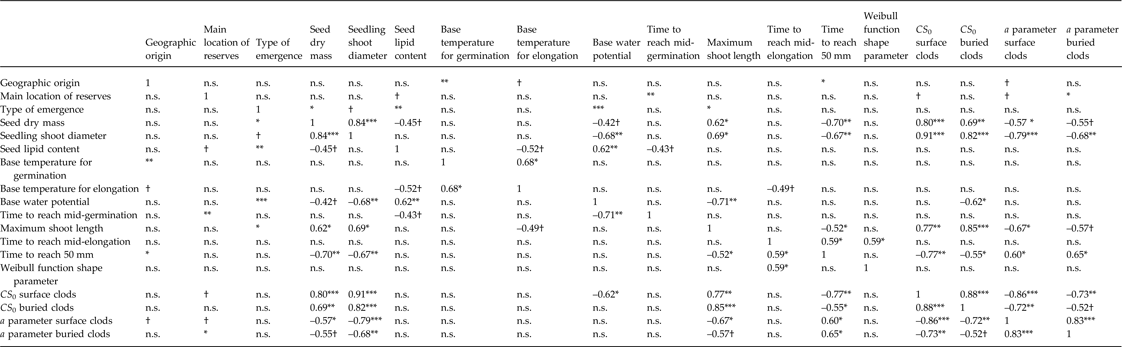
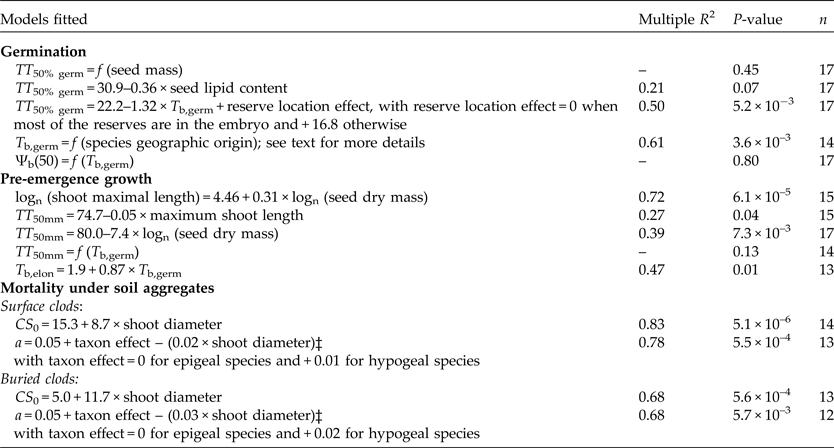
Correlation matrix between the studied seed traits and germination and emergence parameters. P-values are results of Pearson correlation tests between quantitative variables (correlation coefficients are given), of ANOVA between quantitative and qualitative variables, and of chi-squared tests between qualitative variables

n.s., not significant; †0.05 < P < 0.1; *P < 0.05; **P < 0.01; ***P < 0.001.
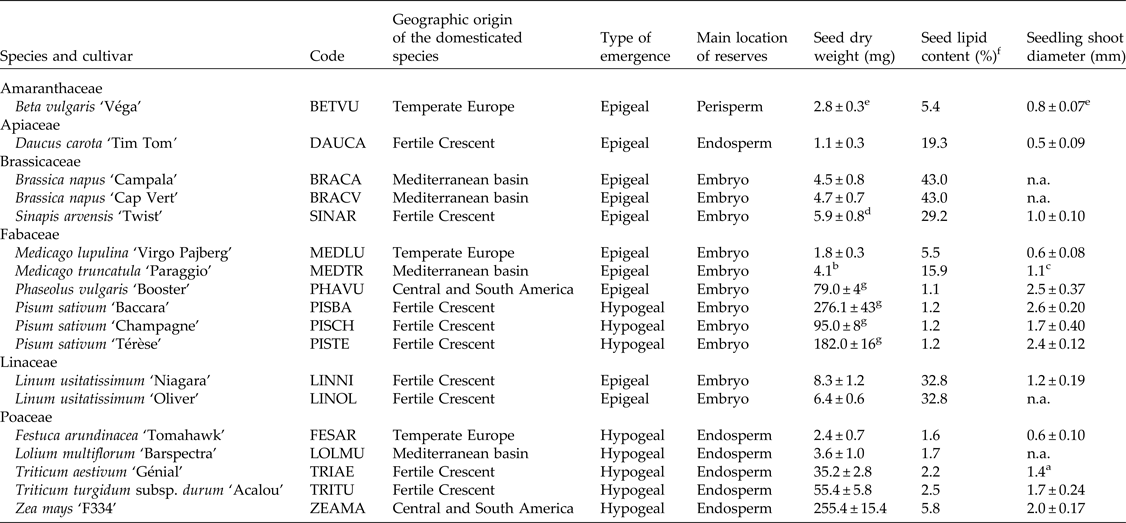
List of seed and seedling botanical, physical and chemical traits for the species and cultivars studied

Sources: aBouaziz and Bruckler (Reference Bouaziz and Bruckler1989b); bBrunel et al. (Reference Brunel, Teulat-Merah, Wagner, Huguet, Prosperi and Dürr2009); cDias et al. (Reference Dias, Brunel-Muguet, Dürr, Huguet, Demilly, Wagner and Teulat-Merah2011); dDorsainvil et al. (Reference Dorsainvil, Dürr, Justes and Carrera2005); eDürr and Boiffin (Reference Dürr and Boiffin1995); fFlynn et al. (Reference Flynn, Turner and Stuppy2006); gRaveneau et al. (Reference Raveneau, Coste, Moreau-Valancogne, Lejeune-Henaut and Durr2011). Seed weight and seedling diameter values are means ± SD; n.a., not available.
Seed germination
Germination was recorded at constant temperatures, at intervals of 4 to 5°C, between 5 and 25°C. We sowed four replicates in plastic boxes (18 × 12 × 5.5 cm; 1 box = 1 replicate) of 50 seeds on pleated filter paper imbibed with 40 ml or 80 ml (T. turgidum, P. sativum) deionized water. We also recorded germination at four water potentials at 20°C (–0.2, –0.5, –1.0 and –1.5 MPa) obtained by imbibing a layer of cotton wool with polyethylene glycol (PEG 8000) solutions (not verified with an osmometer), as described by Michel & Radcliffe (Reference Michel and Radcliffe1995). Seeds were placed on the cotton wool, in a plastic box (16 × 11 × 8 cm), and the box was incubated in the dark. Plastic boxes were sealed to prevent water evaporation. Seed germination was assessed regularly until no further germination was observed. Germinated seeds were then removed from the boxes.
The base temperature for germination (T b,germ) was determined for each replicate by the repeated logit method (Dahal and Bradford, Reference Dahal and Bradford1994). The cumulative proportion of germinated seeds G[i] was calculated as the number of seeds that had germinated by day i divided by the total number of seeds sown. In order to calculate the time to mid-germination (TT 50%germ), a Gompertz equation was fitted to G[i], with thermal time TT[i] (calculated according to the base temperature for each species) for all the germination time courses obtained at the different temperatures:
 $$G\left[ i \right] = Germ_{{\rm max}} \times {\rm e}^{{\rm - ln\; (2 \times Germ}_{\bf max}) \times {\rm e}^{{\rm b}\left( {{\rm T}{\rm T}_{{\rm 50\% germ}}{\rm \; - \; }TT\left[ i \right]} \right)}}$$
where Germ max is the final proportion of the seeds sown that germinated; TT 50% germ is the time to mid-germination (degree-days: °C d), the thermal time required for the germination of half the total germinated seeds; and b is a shape parameter (°C–1 d–1) related to the germination rate at mid-germination. Base water potential for the median fraction of the population (ψbgerm50, MPa) was determined for each replicate by the same reiterative logit method as for base temperature.
Seedling shoot elongation
Pre-emergence seedling (heterotrophic) growth consisted of the elongation of a hypocotyl for the dicotyledons (e.g. B. napus, D. carota, M. lupulina) or a coleoptile followed by the first leaves for the monocotyledons. Shoot elongation was recorded at intervals of 4 to 5°C, between 5 and 25°C. Four replicates of ten (homogeneous cultivars) or 20 (population varieties, for D. carota and F. arundinacea) seeds were sown at a depth of 2 cm in white sand (particles of 150 µm in diameter) watered with a nutrient solution (Saglio and Pradet, Reference Saglio and Pradet1980; concentration of 0.20 g·g−1). Pots were wrapped in opaque plastic bags to mimic growth in the dark. Using a ruler, non-destructive measurements of the distance between the soil surface and the seedling tip (the exact sowing depth measured at the end of the experiment was added to this distance) were carried out every 2–15 days, under a green safelight (Colbach et al., Reference Colbach, Chauvel, Dürr and Richard2002) for which we previously checked the absence of any effect on shoot elongation (authors’ unpublished results). Shoot elongation was measured until the lengths reached plateau values. At the end of the experiment, shoot diameter was measured midway along the hypocotyl or coleoptile.
The base temperature for seedling elongation, T b,elon, was determined by the same method as described in the Seed germination section. In order to estimate the time to reach mid-elongation (TT 50%elon), and the final length of the shoot, a Weibull equation was fitted to shoot length as a function of thermal time TT[i] for each day i and for all the seedling elongation measurements obtained at the various temperatures used:
 $${\rm Length}\left[ i \right] = \; m\left[ {1 - e^{ - ln2\; {\left( {\displaystyle{{TT\left[ i \right]} \over {TT_{50\% elon}}}} \right)}^C}} \right],$$
where m is the final length of the studied part of the seedling (in millimetres), TT 50% elon is the time required to reach 50% of the final length (°C d), and c is a dimensionless curve shape parameter. Thermal time was calculated at the seed lot level from seed germination onwards (when 80% of the final germination rate was reached), using base temperature for elongation of each species. The time taken to reach 50 mm (TT 50 mm, °C d) was deduced from Eqn 2:
 $$TT_{50{\rm mm}} = {\bi \;} TT_{50\% {\rm elon}}{\bi \;} \root c \of { - \displaystyle{{ln\left( {1 - \displaystyle{{50} \over m}} \right)} \over {\ln 2}}.}$$
Seedling mortality under soil clods
Trays (42 × 30 × 10 cm) were filled with 40 mm of sieved soil (aggregates < 5 mm). The soil used had a water potential above –0.4 MPa. We sowed 24 seeds of the same species in each tray, at a depth of 20 mm, and we then placed clods directly above each seed. For each species, we used clods of three different sizes, defined according to the length of their longest axis. Three clod sizes were chosen: 20.3 ± 1.69, 30.1 ± 1.91 and 40.4 ± 1.77 mm for small-seeded species; and 50.6 ± 1.78, 55.9 ± 1.92 and 67.2 ± 2.51 mm for large-seeded species (here, Pisum sativum, Phaseolus vulgaris and Zea mays). Clod sizes were chosen after preliminary experiments to obtain a range of mortality values in order to be able to estimate the parameters of Eqn [4] below. Clods were either placed on the soil surface (i.e. on top of the 2 cm layer of soil covering the seeds) or were covered by fine soil to bury them. Each treatment (i.e. clod size × clod position) was replicated three times, in three trays. The trays were covered with plastic bags to prevent water loss and placed in growth chambers at 20°C, in the dark. The trays were removed from the bags 20 days later, and the seedlings were observed and recorded as either blocked under a clod or as having emerged.
The percentage (P) of blocked seedlings was plotted against clod size (CS, in mm) and the following equation was fitted for each species and clod position (as described by Dürr and Aubertot, Reference Dürr and Aubertot2000):
 $$P = 0\,\,{\rm if}\,CS \lt CS_0$$
 $$P = 100 \,\left[ {1-{\rm e}^{- a(CS -CSo)}} \right]\,\,{\rm if}\,CS \ge CS_0,$$
where CS 0 is the aggregate size (in millimetres) below which no seedlings remained blocked and a (mm–1) is the slope of the curve. Low values of a indicate a low sensitivity of seedlings to increasing clod size. All the non-linear models (1, 2 and 4) were fitted to the data and parameters were estimated with GraphPad Prism 5.02 for Windows (GraphPad Software, San Diego, CA, USA).
Relationships between parameters and seed and seedling parameters
To explore all the possible relationships among our parameters and traits, Pearson correlation coefficients were calculated between all traits and parameters. Relationships between qualitative and quantitative variables were tested using analyses of variance, and chi-squared tests were used to test relationships between qualitative variables. Based on hypotheses put forward in previously published studies (Fig. 1), we used linear models and ANOVA to search for relationships (1) between measured parameters of seed germination and emergence, and (2) between these parameters and seed or seedling traits. The traits studied were seed dry mass, the location of reserves in the seed, seed lipid content, seedling shoot diameter, and emergence type (epigeal or hypogeal). Base temperatures for germination and elongation, base water potential for germination and maximum shoot length were also considered as traits. The seed lipid content for each species was obtained from the Seed Information Database (Flynn et al., Reference Flynn, Turner and Stuppy2006).
In a preliminary approach, we performed multiple regressions in which all possible explanative variables were introduced. Then a backward stepwise procedure was used to eliminate at each step the variable having the highest P-value (the least significant one), until only significant variables remained. This approach gave inconsistent results and was not adapted to our dataset containing many collinear explanatory variables. We therefore preferred focusing our analysis on testing only the hypotheses identified from the literature analysis (Fig. 1).
Analyses of the relationships between traits and parameters were based on raw data or logn-transformed variables, with the functions lm and aov of the Stats package in R 3.1.3 (R Development Core Team, 2015). We checked and confirmed the homoscedasticity and normality of the residuals, by plotting residuals against predicted values and using normal probability plots, respectively. The linearity of the effects was verified by checking that there was no general pattern in the plots of residuals against independent variables.
Results
The presentation of the results is focused on between-species comparisons of the parameters and their relationships with species characteristics. The effects of temperature and water potential on seed germination rates and seedling elongation over time, and the effects of clod size on seedling mortality have been widely reported elsewhere (e.g. Brunel et al., Reference Brunel, Teulat-Merah, Wagner, Huguet, Prosperi and Dürr2009) and are not presented here.
Correlation matrix between all traits and parameters
A first view of all the possible correlations suggests that seed dry weight and shoot diameter are correlated with many other traits (both traits were also strongly correlated, r = 0.84) and germination, elongation and mortality parameters. Seed lipid content, being low in Poaceae, was associated with seeds having their reserves in the endosperm and with hypogeal emergence. Seed lipid content was poorly correlated with germination parameters, with only one correlation with base water potential (r = 0.62). Base temperature for germination was only related to base temperature for elongation (r = 0.68), and base water potential seemed to be mainly related with seed traits and maximum shoot length. A majority of seedling elongation parameters and mortality parameters were also significantly correlated together, perhaps because most of them are also related to seed mass. While most of these correlations could be expected from our hypotheses, some of them are unexpected (e.g. between base water potential and seedling shoot diameter or their mortality under buried clods) and may be fortuitous. In the subsequent section, we therefore deepened our analysis only to the correlations consistent with our hypotheses (Fig. 1).
Germination
The range of base temperatures tended to be lower for species originating from the Fertile Crescent (below 2.2°C) than for those originating from Central and South America (above 6°C), with most species originating from the Mediterranean basin and temperate Europe having intermediate values (Table 3). Geographic origin had a significant effect on the base temperature for germination (P-value = 3.6 × 10⁻³, d.f. = 14), with the two species from Central and South America having a significantly higher base temperature than species from the Fertile Crescent or Mediterranean basin, while no significant difference was found among the other origins.
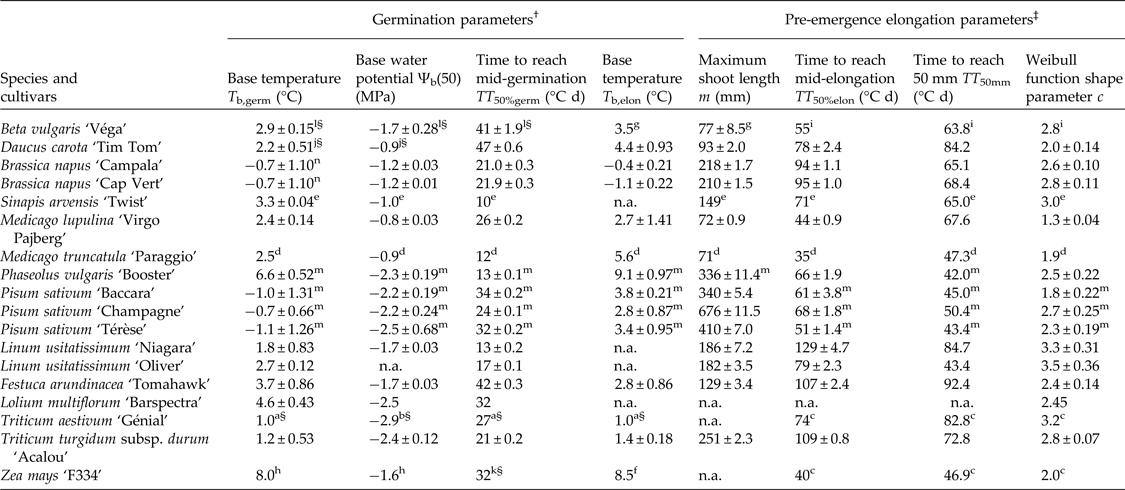
Parameters for seed germination and pre-emergence seeding growth

†Parameters estimated with a Gompertz equation fitted to the observations for seed germination; ‡parameters estimated with a Weibull equation fitted to the observations for shoot elongation; §parameter values obtained for a cultivar other than that mentioned in the first column.
For base temperature and base water potential, values are means ± SD; for time to reach mid-germination, maximum shoot length, time to reach mid-elongation, time to reach 50 mm and Weibull function shape parameter, values are means ± SEM; n.a., not available.
Sources: aAddae and Pearson (Reference Addae and Pearson1992); bBouaziz and Bruckler (Reference Bouaziz and Bruckler1989b); cBrisson et al. (Reference Brisson, Mary, Ripoche, Jeuffroy, Ruget, Nicoullaud, Gate, Devienne-Barret, Antonioletti, Dürr, Richard, Beaudoin, Recous, Tayot, Plenet, Cellier, Machet, Meynard and Delecolle1998); dBrunel et al. (Reference Brunel, Teulat-Merah, Wagner, Huguet, Prosperi and Dürr2009); eDorsainvil et al. (Reference Dorsainvil, Dürr, Justes and Carrera2005); fDürr et al. (Reference Dürr, Boiffin and Boizard1990); gDürr and Boiffin (Reference Dürr and Boiffin1995); hDürr (Reference Dürr2002); iDürr et al. (Reference Dürr, Aubertot, Richard, Dubrulle, Duval and Boiffin2001); jFinch-Savage et al. (Reference Finch-Savage, Steckel and Phelps1998); kFinch-Savage et al. (Reference Finch-Savage, Rowse and Dent2005); lGummerson (Reference Gummerson1986); mRaveneau et al. (Reference Raveneau, Coste, Moreau-Valancogne, Lejeune-Henaut and Durr2011); nSquire et al. (Reference Squire, Marshall, Dunlop and Wright1997).
Base water potentials varied from –0.8 MPa (M. lupulina) to –2.9 MPa (T. aestivum). Seven species had a base water potential below –2 MPa, indicating a very low sensitivity to drought during germination (Table 3). Conversely, Medicago spp. and D. carota were the most sensitive species, with base water potentials between –0.6 and –0.9 MPa. Brassicaceae species displayed intermediate levels of sensitivity, with base water potentials of –1 to –1.2 MPa. Base water potential was not related to base temperature for germination.
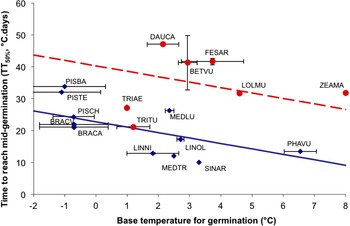
For each species and cultivar, we fitted Eqn [1] to cumulative germination percentages with determination coefficients (R 2) systematically higher than 0.80. With the fitting of this equation, time to mid-germination varied from about 10°C d for S. arvensis to 47°C d for D. carota (Table 3). Time to mid-germination decreased significantly with base temperature for germination, with an additional effect of the location of the seed reserves: germination was faster for seeds with reserves in the cotyledons and slower for seeds with reserves in the endosperm and perisperm (Table 4, Fig. 2). Up to 50% of the variance in time to mid-germination observed in our dataset was explained when these variables were taken into account. There was a weak, non-significant negative correlation between time to mid-germination and seed lipid content (low TT 50% germ for lipid-rich seeds from Brassicaceae and Linaceae, Table 4), but this trait did not account for any more of the variance than the previous relationship. No relationship was found between time to mid-germination and seed mass.
Relationship between base temperature and thermal time required to reach mid-germination. Linear regression lines are shown (see Table 4 for details) for species with different principal locations of seed reserves ( —— in the embryo;
 — — in the endosperm or perisperm). For abbreviations, see Table 2.


Heterotrophic shoot elongation
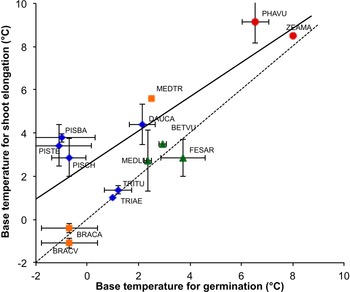
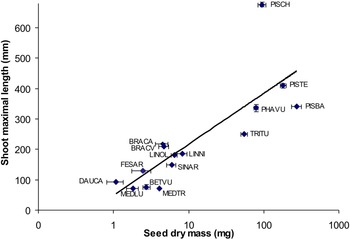
Base temperatures for shoot elongation were lowest for B. napus (–1.1 and –0.4°C for both cultivars) and highest for the species from Central and South America, Z. mays and P. vulgaris (8.5 and 9.1°C, respectively; Table 3). Base temperatures for shoot elongation were equal to or slightly higher than those for germination and were strongly and positively related (Table 4, Fig. 3). Eqn [2] was fitted for all species elongation data, and the R 2 values for all species were systematically higher than 0.90. Maximum shoot length varied from about 71 mm for Medicago spp. to 676 ± 11.5 mm for P. sativum ‘Champagne’ (Table 3). Maximum shoot length increased exponentially with seed dry mass (Fig. 4, Table 4), which accounted for a large proportion of the variance of shoot length (R 2 = 0.72).
Comparison of estimated base temperatures for seed germination and shoot elongation before emergence. The continuous line is the regression line (see Table 4 for details), and the dotted line is the 1:1 relationship. The species studied originated from the Fertile Crescent ( ), temperate Europe (
 ), the Mediterranean basin (
 ) or Central and South America (
 ). For abbreviations, see Table 2.


The species and cultivars also differed in their shoot elongation rates (Table 3). As maximum shoot length differed considerably between species, considerable variability was also observed for time to mid-elongation (TT 50% elon). For comparisons of species on the basis of their elongation rates, we therefore focused on analyses of differences in the time required to reach a length of 50 mm (TT 50mm). TT 50mm ranged from 40 to 50°C d for several species and cultivars from Fabaceae to up to 70–90°C d for Triticum species and F. arundinacea. TT 50mm increased significantly with maximum shoot length and decreased with increasing seed dry mass. Thus seedlings of species with large seeds tended to elongate more rapidly than those of species with small seeds, but the R 2 values for these relationships were only 0.27 and 0.39, respectively (Table 4). The base temperature for elongation was not significantly related to TT 50mm.
Seedling mortality due to soil clods
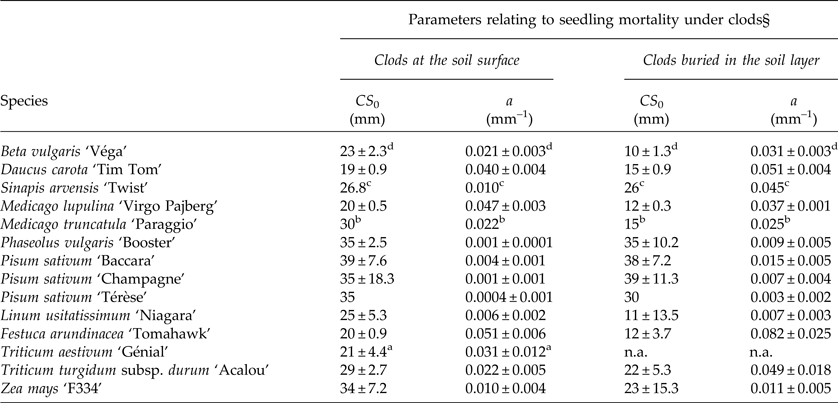
The proportion of seedlings blocked under clods increased with clod size for each species and was larger for buried clods than for those placed on the soil surface. We fitted Eqn [4] to the relationship between the percentage of blocked seedlings and clod size (Table 5). The average R 2 of these fittings reached 74%: it was over 90%, except for Pisum sativum ‘Champagne’ where it fell at 0.24 and 0.36 for surface and buried clods, respectively. This cultivar was therefore excluded from the search of relationships between these mortality parameters and seed and seedling traits.
Parameter values calculated from the seedling mortality experiments

§Parameters were estimated with Eqn [4] fitted to the relationship between percentages of blocked seedlings and clod size. Values are means ± SEM; n.a., not available. CS 0 (mm), aggregate size below which no seedlings remained blocked; a (mm–1) was related to the slope of the curve: low values of a indicate a low sensitivity of seedlings to increasing clod size. Sources: aBouaziz and Bruckler (Reference Bouaziz and Bruckler1989b); bBrunel et al. (Reference Brunel, Aubertot and Dürr2011); cDorsainvil et al. (Reference Dorsainvil, Dürr, Justes and Carrera2005); dDürr and Aubertot (Reference Dürr and Aubertot2000).
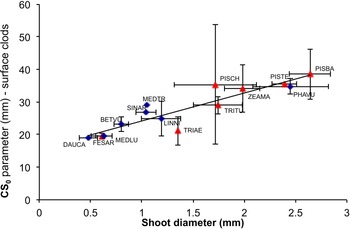
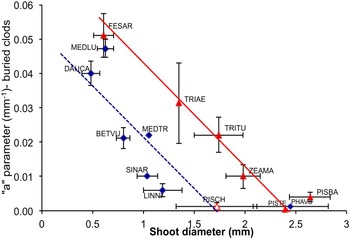
The parameters of Eqn [4] are indicators of the sensitivity of a given species to clod size: this sensitivity decreases with increasing CS 0 (i.e. the maximum clod size under which there is no blocked seedlings) and increases with increasing a (i.e. the slope of the mortality vs clod size relationship). CS 0 increased linearly with shoot diameter, for both surface and buried clods (Fig. 5, Table 4). The value of a decreased significantly with increasing shoot diameter (Fig. 6, Table 4). This negative relationship differed between hypogeal and epigeal species, with higher mortality observed for hypogeal than for epigeal species. In these relationships, seedling shoot diameter and the type of emergence accounted for 68–83% of the between-species variability for parameters relating to mortality under soil aggregates. As seed mass and seedling diameter are highly correlated (Table 1), we tried to substitute these traits in the relationships for the a and CS 0 parameters. The resulting models were still significant, but their goodness of fit was lowered by 10–20% (results not shown).
Relationship between the CS
0 parameter (threshold of aggregate size below which seedlings do not remain blocked) and species shoot diameter for clods placed at the soil surface. Symbols: for species with epigeal germination, and  for species with hypogeal germination. The continuous line is the regression line (see Table 4 for details). For abbreviations, see Table 2.

Relationship between parameter a (slope of Eqn [4] relating variation in seedling mortality with increasing clod size) for clods placed at the soil surface and species shoot diameter. Symbols: for species with epigeal germination, and for species with hypogeal germination. The regression lines are shown (see Table 4 for details). Pisum sativum ‘Champagne’ was not considered in this analysis. For abbreviations, see Table 2.

Discussion
This collection of experimental results provides an original dataset for germination, pre-emergence growth and seedling mortality parameters, for a set of 14 crop species with contrasting behaviours and seed traits. The collection of such data is rare and is useful for between-species comparisons to analyse the sources of variation in these values. The aim of this study was to relate these key parameters for germination and emergence to several species traits and other characteristics. The data and relationships examined here have applications for not only seed and crop scientists or modellers, but for basic and applied ecologists looking to explore plant regeneration as well.
Species with high base temperatures germinated more rapidly than those with low base temperatures. Similar correlations have already been reported for the germination of weeds (Gardarin et al., Reference Gardarin, Guillemin, Munier-Jolain and Colbach2010b) and for a large range of species (Dürr et al., Reference Dürr, Dickie, Yang and Pritchard2015). At medium and high temperatures, this trade-off indicates that the different species germinate over reasonably similar time intervals in terms of chronological time, regardless of their temperature requirements. An interesting result was that germination was faster for species storing most of their seed reserves in the embryo than for those storing reserves principally in the endosperm or perisperm. The slower germination of endospermic and perispermic seeds probably results from the need to transfer seed reserves to the embryo before germination. There is also evidence of endosperm-limited germination in Apiaceae, Amaranthaceae and Poaceae species (Finch-Savage and Leubner-Metzger, Reference Finch-Savage and Leubner-Metzger2006). The emergence of the radicle from the seed requires the weakening and rupture of the surrounding endosperm, and this may also delay germination. Much of the variance in time to mid-germination remains unexplained, highlighting the importance of other processes in determining the speed of germination (Nonogaki et al., Reference Nonogaki, Bassel and Bewley2010). The most important of these processes includes the hydrolysis of seed reserves (although seed lipid content had no significant effect) and their use for metabolism, root cell elongation and testa rupture. Finally, time to mid-germination was not correlated with seed mass. Such a correlation was often suggested, but results were not always consistent among studies, probably because several other traits, such as seed coat thickness and permeability, influence imbibition and germination (Gardarin et al., Reference Gardarin, Guillemin, Munier-Jolain and Colbach2010b).
The base temperatures for germination varied little between cultivars or species within a genus and they did not differ between species from temperate Europe, from the Fertile Crescent and from the Mediterranean basin. Only species of tropical origin had a significantly higher base temperature. This origin was represented by only two species, which questions the reliability of our result, but this result was consistent with suggestions from previous studies (Parent and Tardieu, Reference Parent and Tardieu2012; Dürr et al., Reference Dürr, Dickie, Yang and Pritchard2015). Base temperatures for elongation were slightly higher than base temperatures for germination. While Parent and Tardieu (Reference Parent and Tardieu2012) found on numerous crop species that response curves to temperatures were common between several developmental processes, base temperatures for elongation were here slightly higher than base temperatures for germination. This discrepancy may be explained by some methodological differences between the two studies and also by the relative small size of our dataset.
Base water potentials were not related to base temperatures in our study, perhaps because of an insufficient number of species. Indeed, a clear relationship between these parameters has been reported among 17 weed species (Gardarin et al., Reference Gardarin, Guillemin, Munier-Jolain and Colbach2010b). When both datasets where analysed altogether (supplementary analyses not shown), a positive correlation was again found between the base temperature and base water potential (P-value = 9.62 × 10⁻⁴, R 2 = 0.31, n = 37). This positive relationship was also found by Dürr et al. (Reference Dürr, Dickie, Yang and Pritchard2015) and could be explained, from an adaptive point of view, by the contrast between species originating from tropical areas, requiring both high temperatures and high water potentials for germination, and species from temperate areas, adapted to lower temperatures and soil water potentials. This may also explain why no correlation between these two parameters was found in Larson et al. (Reference Larson, Sheley, Hardegree, Doescher and James2016), with another dataset comprising a larger number but less diverse species (only Poaceae mostly from a single geographical area).
As already observed for wild and weed species, maximum shoot length increased with seed dry mass. Maximum shoot length is directly related to the amount of seed reserves but is generally non-limiting for crop emergence in field conditions, unless species are sown at depths exceeding 5–10 cm, depending on the crop and cropping area concerned (for instance, very dry lands; Bouaziz and Bruckler, Reference Bouaziz and Bruckler1989a). The time taken for the seedling to reach a length of 50 mm decreased with increasing shoot length and, thus, with increasing seed mass. Contrary to our results for germination and expectations based on published findings, the time taken for the shoot to reach a length of 50 mm did not decrease significantly with increasing base temperature for shoot elongation.
The percentage of seedlings remaining blocked under soil obstacles decreased with increasing seedling shoot diameter. These parameters of seedling mortality were also related to seed mass, which was itself related to seedling diameter. Seed mass was thus a good proxy for emergence success, but not a better predictor than shoot diameter (lower R 2). These results for crop species are consistent with observations for weeds (Gardarin et al., Reference Gardarin, Dürr and Colbach2010a), and indicate that, despite selection, crop species emergence is still constrained by their traits. Seedlings with large shoot diameters have a large emergence force (Sinha and Ghildyal, Reference Sinha and Ghildyal1979), and can therefore lift and bypass clods, particularly those located on the soil surface. When clods are buried, the seedlings cannot move them, and they remain blocked if the shoot tip becomes trapped in a small cavity in the clod (Dürr and Aubertot, Reference Dürr and Aubertot2000). This may occur more frequently for seedlings with a small shoot diameter than for those with a larger shoot diameter. Furthermore, regardless of the position of the clod, the proportion of blocked seedlings was higher for species with epigeal emergence than for species with hypogeal emergence. The coleoptiles and epicotyls of these species had a sharper end and were more easily trapped in clod cavities than the hook-shaped hypocotyl of most of the dicotyledons studied. These relationships between seedling mortality and traits are consistent with the findings of Larson et al. (Reference Larson, Sheley, Hardegree, Doescher and James2015), who reported a negative effect of coleoptile tissue density on emergence, a trait potentially related to seedling emergence force. Despite studying a smaller number of species, we obtained higher, more significant R 2 values, probably thanks to our mechanistic approach distinguishing more precisely between the different processes leading to seedling emergence. While such traits may be good predictors of isolated processes, they would not be useful predictors of emergence overall (e.g. in the field), when multiple processes are likely to interact, making essential the use of models.
The large number of significant and highly explanatory relationships established between plant traits on the one hand, and germination and emergence processes on the other, confirms the relevance of this approach for the identification of generic patterns and constraints limiting early plant establishment, even in crop species in which such trade-offs may have been modified by selection. Besides the known effects of seed mass on seedling establishment success or of species origin on temperature requirements, these findings show that seed reserve location, seedling shoot diameter and shape also influence germination rate and emergence success. Our results, obtained with 18 genotypes (14 species), may however be contingent to our dataset and must be taken with care. We accounted for this constraint by testing only a few hypotheses for which there was a biological explanation.
These improvements in our understanding of the determinants of the effects of the environment on plant establishment success can be used for predictive purposes (to facilitate the estimation of parameters from traits), particularly when modelling the effects of changing climate conditions or of reduced tillage techniques, such as direct-drilling, which has a major impact on soil structure. Going beyond the modelling of interactions between plants and abiotic factors, the next step will be to elucidate and to represent the role of seed and seedling traits in biotic interactions, with soil micro- and macro-organisms (beneficial microbes and pathogens), for example, or in below-ground interactions between plants. Improvements in our understanding of biotic interactions are urgently required for the development of farming systems relying more on biological processes than on external inputs.
Acknowledgements
Some of the experiments were carried out at GEVES-Station Nationale d'Essai de Semences. We would like to thank Christine Goyer, Lydie Ledroit, Anthony Machet, Vincent Moreau, Vincent Oury and Solange Renaud for technical assistance and Fruck Dorsainvil, Romain Davière, Mélanie Delmas, Nicolas Denoyer and David Gouzy for their contributions to the experimental work; we also thank the reviewers for their helpful comments that improved the manuscript.
Financial support
This work was funded by ANR project Systerra-PerfCom (ANR-08-STRA-11), the French Ministry of Agriculture, the Regional Councils of Picardy, Champagne-Ardenne and Pays-de la Loire (Project Novanol and Project COSAVE).
Conflicts of interest
None.