Act I
I first saw MINEFIELD/CAMPO MINADO at the Royal Court Theatre, as part of the LIFT festival in London on 4 June 2016. The venue was crowded. Still, the traditional red velvet curtains, impressive high ceilings and cosy seats helped to generate a sense of intimacy within the multitude. Although originally only three performances of the show had been scheduled at the Royal Court, they eventually turned into nine, each receiving a standing ovation. At the end of the year, numerous British critics would highlight MINEFIELD as one of the best shows of the season.Footnote 1
That night, however, I remember feeling nervous: a team of veteran soldiers, three from the UK (including a putatively vicious veteran Gurkha from the British Army born in Nepal) and three from Argentina, my home country, recalling a neglected war that took place almost at the end of the world, and directed by an upstart compatriot of mine, at one of the most exclusive venues in London? Being myself from the same generation as director Lola Arias, and having worked as a cultural journalist in Argentina, I have closely followed her rising career.Footnote 2 In many senses, the 1982 war also marked my childhood, shaping my own fragmented recollections about living under a military regime that vanished 30,000 lives, the infamous ‘Disappeared’. Yet, again, that night at the Royal Court, I wondered whether the theatre's reputation – not only for eccentric and quirky new directors but also as a leading space for well-known performers – could be threatened by Arias's latest production. In fact, there was almost nothing onstage that could be called traditional theatre: no scenography, no actors, not even anything that could firmly be defined as fiction. In sum, no mise en scène to speak of; instead, there were former soldiers telling the stories of their real lives onstage. For the first time, as Arias told me later, the Royal Court had agreed to host a team of non-professional performers, a feat that is even more daring considering that the group was composed of six former enemies on the battlefield. From the proverbial ‘theatre of war’, the team was brought back to the stage with the hope of finding a new place of commonality. As Marcelo Vallejo, a fifty-four-year-old Argentine veteran, humbly put it during a public interview, ‘The first time I went to the theatre – and I was onstage’.Footnote 3
Arias's production indeed hinged upon a high-risk, highly exposed public encounter. Somehow, it suggested the possibility of a total change of perspectives, not only for the ex-soldiers involved but also for the spectators who bought their tickets to bear witness to their experiences from the darkness. Watching former soldiers revealing closely guarded intimacies of the war from the stage was a new experience even for seasoned theatre-goers. MINEFIELD is full of surprises of this kind, which confront conventional expectations about theatre. To complicate easy claims about the performers being just ‘amateurs’, over sixty auditions were conducted both in Buenos Aires and in London to find the ‘right’ candidates. The selection did not rely on acting skills but rather on personal experiences and recollections of the war and its aftermaths. And more than that: ‘It was not enough to have good stories; it was necessary to find the people who could commit to the project’, Arias told me.Footnote 4 The initiative proved to be demanding: endless hours of rehearsals in disparate locations and adventurous touring around the world, let alone the pains of digging into tough personal memories, and the inevitable feeling of being exposed, if not naked, before anonymous audiences.Footnote 5
From the outset, the piece had to be conceived as bilingual. Two languages both protect the two teams and set them apart. If the veterans struggled to understand each other, Arias managed to transform that concern into the material basis of a creative encounter. At each venue, large screens were placed on top of the stage to feature the surtitles.Footnote 6 Thus the stage not only emerged as an unstable territory of misunderstandings, but also of encounter, empathy and compassion. There, an alternative language had to be found.
Act II
Arias has been keen to consider her latest pieces of documentary work as ‘social experiments’, which she likens to organic and ‘living creatures’ that tend to assume the extraordinary shape of affective installations.Footnote 7 Onstage, conflicting social processes are assessed and contested, mainly through real-life experiences. This was particularly palpable in Arias's trilogy of productions in which she dealt with the contemporary aftermath of Argentina's and Chile's dictatorships and their impact on her own generation. If Mi vida después (My Life After (2009)) showed how a pile of clothes from the 1970s could become a perfect medium for Argentina's post-memory generation to travel in time and rewrite their parents’ legacies, in El año en que nací (The Year I Was Born (2012)), Arias staged twelve Chilean youngsters from different political factions to demonstrate how traumatic pasts are constantly under revision. Lastly, in Melancolía y sus manifestaciones (Melancholy and Demonstrations (2012)), an initiative that Arias confessed she will never dare to try again, the director put herself on stage alongside her own depressive mother to show the extent to which the personal and the political intertwine. All these productions have functioned as ‘time machines’, to use Arias's expression, theatrical platforms for the transmission of trauma in which the past can be touched again.Footnote 8
As far as I could witness in London, MINEFIELD proposed a different kind of time machine, arguably a more complex and transnational one. Similarly to other productions, MINEFIELD was not only made of bodies and testimonies. It also provided a subtle unfolding of archival footage, films, pictures, charged objects, costumes, documentary material, old letters, war toys and live irruptions of pop and punk music. These procedures also enabled the spectators to glimpse how former soldiers might have looked in their early twenties. In fact, the opening scene offered a re-enactment of the auditions, which were depicted as a military recruitment. In this way, the process of rehearsals was incorporated into the production as a living, open and organic process that could be observed by the audience. Members of the ensemble interviewed their fellow performers in front of a camera: Age? Rank? Role? First shots of the veterans’ responses were projected live on the screen. While in Argentina military service was mandatory until 1997, the two British soldiers and Sukrim, the Nepalese Ghurkha, joined the army voluntarily. Regardless of their nationality, the veterans trembled under the spotlights. ‘I wrote this diary during the rehearsals’, said Vallejos in one of the first lines. ‘The war lasted seventy-four days, from 2 April to 14 June 1982. The rehearsals for this performance lasted a little longer’. That night in London, gleeful giggling rippled through the audience immediately, as if recognizing that theatre-making – especially under particular conditions – might sometimes also look like an alternative kind of war. At the same time, it became clear that the local public was mostly dealing with a neglected conflict, which had left no vivid marks on their personal lives. Moreover, the war appeared to have taken place in some mysterious islands that barely anyone would be able to locate on a map. The performance enabled them to discover not only how the conflict helped to delay the fall of the most appalling regime of forced disappearances in Argentina; it also contributed to refashion the power of the Conservative Party, notably through the decaying figure of Margaret Thatcher, who, thanks to the conflict, re-emerged within months as a highly popular prime minister. Even so, the public felt free to laugh, somewhat shamelessly, at some quotidian outcomes of the war, such as former British soldier and now psychologist David Jackson's ability to ‘still shit, shave, shower and shampoo in under three minutes’. Later in the play, Jackson would demonstrate that his war skills also included dressing as a woman for his fellow soldiers to perform a spectacular dance to the disco hit ‘Don't You Want Me’ (1981) in the trenches and eventually becoming even a drag re-enactment of Thatcher's bellicose war speech.Footnote 9
At some point, I got the feeling that, as spectators, we were all transported in time, trapped in a time machine of fantasies, projections and footage. Within this transparent, almost hectic machine, we could see the young soldiers joining the military, coming back home after war, and then returning to the islands to recover something they had left there, as if trying to make sense of those days that marked their lives forever. The more I looked at those bodies onstage, so different from each other, and coming from such disparate ethnic and educational backgrounds, the more I thought about them as a team. Yet, as Arias said, ‘Unexpected things happen when you put people onstage – people who used to be enemies’.Footnote 10 They do indeed. Somehow, it occurred to me that the veterans might help us to envisage an expanded form of citizenship.
Interval
That night after the performance, I followed an exultant crew of veterans, director and friends of friends as they walked across the city looking for a place to eat. I thought of one of the scenes in the play in which Rubén Otero, a skinny Argentine former conscript veteran, sat in front of the drums. He now plays in the Get Back Trio, a Beatles tribute band, and wears a T-shirt with the Argentine flag covering the islands for the shows. In the scene, he recalled how he had survived the bombing and sinking of the Belgrano cruiser, a ferocious episode in which 323 Argentine soldiers died. The scene finished with him playing a drum solo. Anger seemed to have melted into some unruly music enhanced by red lighting, as if covered by blood. The scene reminded me so much of a similar sequence in Mi vida después. There, Carla Crespo, the daughter of a guerrilla activist assassinated by the military, confessed onstage that, as much she could come to terms with the fact that her father's arms had been posthumously cut off, she could not stand the thought of having grown older than her dead father. There as well, Carla played the drummer in such a powerful way that the venue seemed to quiver in a frenzy of affect and memory.
It occurred to me that MINEFIELD could sound like a simple reiteration of the director's previous success. In both cases, music would take the place of the emotions, as if the neutral, almost distant tone that Arias wanted to impress upon her performers could somehow be transfigured into sound. On both occasions, drums became poignant knives. Yet I thought that there was something that had been activated through MINEFIELD’s particular type of time machine, something that was almost unspeakable, and more related to the tangible power of music and its effect on the spectators’ bodies, something that resonated beyond words.
Walking across London that night and watching the veterans joking with each other, I suddenly realized that Arias had managed to surpass herself again: she had created a new form of ‘social experiment’, a high-risk, organic ‘living creature’ – to use her own words – to cope with the disparate resonances of a war, this time in two different countries.Footnote 11 In this gripping – albeit still playful – theatrical machine, real lives, fantasies about the war and fiction had become indistinguishable.
Act III
The second time I saw CAMPO MINADO/MINEFIELD was on 17 November 2016 in Buenos Aires, my home town. The venue was not a real theatre, but a university auditorium filled with stadium-like stalls and plastic white chairs. There were no curtains, not even a proper stage, just an improvised platform built inside the Center of Experimental Arts, which belongs to the Universidad Nacional de San Martín (UNSaM).Footnote 12 As entry was free but booking was required, a long queue of people waited each night at the entrance in case there were some further spaces available to see the show. The public looked diverse. Arias's typical intellectual audience – mostly middle-class young people who seemed overly conscious of their artistic and sophisticated looks – mingled with veterans dressed in camouflage T-shirts, politicians, intellectuals, middle-aged couples and activists, among others. There were sixteen performances in total: 220 spectators per day, plus a considerable group who had to be accommodated each night on the floor.
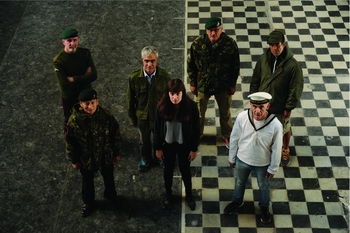
Universidad Nacional de San Martín's Center of Experimental Arts, the huge academic venue in which MINEFIELD/CAMPO MINADO was performed in Buenos Aires. Veterans Lou Armour, Sukrim Rai, Gabriel Sagastoume, David Jackson, Rubén Otero and Marcelo Vallejo (from left to right, with director Lola Arias in the middle). Photographer: Maxi Failla.

Funnily enough, a couple of months before, nobody had wanted to produce the play. As Arias later told me, CAMPO MINADO was supposed to be part of San Martín National Theatre's 2016 programme. However, the change of administration in December 2015 and the triumph of businessman Mauricio Macri as the head of a new right-wing cabinet dominated by executive leaders more interested in global business than in old-fashioned claims about sovereignty coincided with the mysterious disappearance of the play from all official schedules. Yet by the time the show was launched nationally, the British success had already raised expectations, and the local press were praising the spectacle as ‘invaluable’, and also ‘disturbing and cathartic’.Footnote 13
The first night I attended the performance, the air was tense. During the opening half-hour, an uneasy atmosphere radiated through the venue. There was no common ground on which to anticipate the piece. Arias was dealing with one of the country's most sensitive topics. Some thirty-five years after the end of the war, younger generations still sing the Malvinas anthem at primary school, learn geography from maps where the islands are part of the national territory, and repeat with nationalistic fervour a mantra that crosses generations: Las Malvinas son argentinas (‘The Malvinas are Argentine’). Seated in the darkness, and waiting for the performance to start, the girl I was in the 1980s muttered that we were about to see ‘the enemy’ right there, in the flesh.
The show performed in Buenos Aires was almost exactly the same as the one I attended in London. A local folkloric song, and some explicit references to the almost-taboo issue of how Argentine soldiers were tortured by their own superiors on the islands as a continuation of the dictatorship's repressive practices on the continent, had been included. Yet the performance felt totally different, uncanny, almost overwhelming. Whereas in London I was secretly amused by the simultaneous performance of the speeches by the British and Argentinian political figureheads, this time I found myself petrified in front of the drunk figure of Leopoldo Galtieri, the last head of the treacherous military junta, responsible for many of the ‘disappearances’ in the country. Footage of the multitude enthusiastically praising the war on the streets anticipated the disaster. ‘Si quieren venir que vengan, les presentaremos batalla’ (‘If they want to come, we'll fight them back’), was the closing line of his speech. I felt ashamed. I was suddenly back to a dark night of my childhood: my mother crying in front of the television.
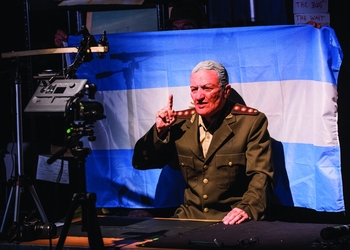
Impersonation of Leopoldo Galtieri, last head of perfidious military junta (1976–83), delivering his war speech after Argentina's brief reoccupation of the islands in April 1982, ‘Si quieren venir que vengan, les presentaremos batalla’ (‘If they want to come, we'll fight them back’), 10 May 1982. Photographer: Tristam Kemton.

The audience followed the performance as if watching an action film. Even if everybody already knew the ending, there was an extra feeling of expectation in learning about the ‘Others’, and hearing the story from the ‘other side’. At one point, the worst fantasies seemed to come true: the British soldiers re-enacted a song, seemingly popular in the trenches: ‘We're on a summer holiday and about to kill a spick or two’. The song and racial slur depicted the war as a sort of stimulating hunt for second-class Argentinian soldiers. An awkward silence inundated the auditorium. Yet astonishment was also around the corner. After all, Arias always seems to know how to decompress the tension through elegant, sometimes hilarious, irruptions. Thus the myth of the Ghurkha army butchering Argentine soldiers was played out onstage as if it were a reality show. There, the ex-hopeless conscript and now-triathlon champion Marcelo, who during the war feared his ears being cut off and eaten by the Ghurkhas, faced the small soldier Sukrim Rai and his kukri, the traditional Nepalese knife. Enchanting Lou Armour, the British soldier whose surrender to the Argentine forces in April 1982 was photographed and circulated around the world, officiated as the television host. Eventually, both sides would come together. ‘For a long time I imagined that if I found a Gurkha I would kill him. Now I would have a beer with him’, said Marcelo at the end of the scene.Footnote 14
Despite the mischievous mood, Arias's show did not necessarily imply any final agreement or reconciliation. Rather, confronting visions of the conflict persisted, like two opposing Wikipedia versions of the history of the Malvinas/Falklands, as enacted by the end of the performance. ‘You invaded the islands in 1833’, the Argentines shouted. ‘Nine generations of islanders have been living there’, the British replied. ‘You bombed the Belgrano outside the exclusion area’, ‘You were torturing your own troops!’, and so on and so forth. No unified narrative prevailed.
Another particular scene resonated differently in the local context. Drawing upon toy soldiers, a model boat and house props, Gabriel Sagastume, former conscript and now a lawyer and peacemaker, showed how a group of starving Argentine soldiers went on a mission to acquire some food during the conflict. On the way back, the team was caught in a minefield and all of the soldiers were blown to pieces. Gabriel recognized one of his mates’ legs from its striped football sock. He used his own blanket to carry his friend's body parts and then kept on using the blanket for the rest of the war. It was later discovered that the Argentine forces had been responsible for planting those mines. The story seemed not only to blow away any putative stability in binary categories such as victims/perpetrators, allies/enemies, and even actors/spectators, but also to shine new light on the title of the production: memory can also function as a minefield. Planted underneath, in treacherous terrain, those seemingly forgotten episodes might suddenly fire back and break present stability into pieces. Post-traumatic stress disorder of all kinds, suicide attempts, overdoses, divorces, solitude – all were recalled, and by both sides of the stage. Might Arias's production have the additional power to act as a form of collective healing?
As much as I could realize that night, the unfolding of the successive scenes showed how there were not only former soldiers giving an account of their most intimate war experiences, but a whole team collaborating to build those stories. The team was understandably affected by the stories’ vibrations and resonances. Not only would the former enemies help each other to manipulate pictures, outfits, war toys and cameras, but they would also borrow each other's bodies to enact remembrances, ultimately blurring the borders between one and another. Rather than staging veterans as war heroes, Arias's experiment exposed both teams on a common ground of fragility and vulnerability. On those grounds, the affective glue that bonded past and present together eventually allowed a novel perception of the war to emerge. In so doing, CAMPO MINADO suggested a more emphatic form of citizenship. It acted as a reminder that not only the veterans/performers but also we as spectators are always implicated in lives that are not our own, and inevitably exposed and given over to others in ways that cannot be mastered.Footnote 15
Farewell
After that first performance in Buenos Aires, I returned to the university venue many other nights. The UNSaM is not located in a particularly fancy area – mostly a dark street in one of the central districts of the city cornered by the railway – but it had suddenly become full of intensities. The venue had become a meeting point for an alluring assembly of bodies, thoughts and affections. Some friends and colleagues had come to town especially to attend the performance, and now were eager to gather for any public interview, debate or informal talk at the end of the show, usually continued over drinks or dinner during those summery nights in Buenos Aires. Each evening felt new. On one occasion, a local photographer who was seated in the audience discovered his picture portraying Lou during the 1982 short-lived rendition displayed on a big screen during the show. At the end of the performance, and thirty-five years after capturing the original image, he managed to shake the veteran's hand. Another night I could hear Alicia Castro, former Argentine ambassador to the UK, engaging in an animated discussion with Sukrim, only to learn that Gurkha soldiers would not get British citizenship until 2006. Attending CAMPO MINADO was not merely a ‘theatrical’ event but rather a fully social and political one.
Even so, after the great success of the productions in both countries, I wonder what was applauded at the end of each performance: the virtuosity of certain veterans suddenly becoming performers? Certain lives? The nerve of a female director who challenged normative and usually misogynist imaginaries of the war on both sides of the Atlantic? I suspect the iteration of the standing ovation was more related to the overwhelming feeling of being in front of a transnational team of performers who were brave enough to share their stories, stories that might have felt too private to be spoken aloud. The applause also pointed toward a certain exchange of energy between performers and spectators, which showed how the feeling of vulnerability could always circulate back and forth, to be suddenly on the side of the spectators.
Nicholas Ridout considers theatre a peculiar space where transmission of affect takes place. And it does so as a form of ‘vibratorium’, where contrasting ‘realities’ are experienced in the tremors of the spectatorial body.Footnote 16 In MINEFIELD/CAMPO MINADO, this emotional activity circulating on and off the stage was quite literal. The particular cohabitation of bodies and testimonies on the stage activated lines of intensity that were distinctive in both locations. The set of affects might be detonated by the recollection of a mine explosion, or through a punk song played live by an ad hoc band of veterans onstage. It was as if, at any moment, theatre could reveal its capacity to make bodies vibrate together in a public forum. Both in Buenos Aires and in London, the show brought a fleeting community to light. There were communities created in the space of performance. They had emerged at the threshold of representation. With similar, if not identical, theatrical elements, Arias's production mobilized distinctive resonances and imaginaries about the war. They were created on the basis not of consensus, but of difference. They responded to the vibratory power of a highlighted sense of fragility. If the sense of being exposed to others is constitutive of the condition of being spectators, MINEFIELD/CAMPO MINADO contributed to making that sense palpable. It created a particular sense of intimacy that ultimately revealed a way of being together in the darkness. As much as the veterans/performers had been pushed to explore their own limits, so the spectators also felt exposed, in both their uncertainties and their fears.
Once the performances finished at the Royal Court in London, the veterans would disappear into the dressing rooms. They might be spotted some minutes later, smartly dressed, and transformed into brand-new celebrities having a drink at the bar. One might dare to offer them another round. In contrast, the university auditorium in Buenos Aires offered no place to hide: there was no backstage, or outside the stage. When applause faded, the performers remained visible on a naked platform, creating an awkward moment with no clear end. Eventually, spectators would walk down the stairs and make their way out towards the exit. In some cases, some brave ones might also continue walking to meet the performers. Lola Arias told me that one night she remained in her seat after the performance.Footnote 17 For a minute or two, she watched the spectacle of the performers and the audience literally coming together, mixing and greeting each other. Later on, while recalling that unusual encounter, I thought about Jacques Rancière's argument that the true emancipation of the spectator only begins when the implicit hierarchies are shaken. It is then that ‘we challenge the opposition between viewing and acting’.Footnote 18 At Buenos Aires auditorium it was possible to see that exchange taking place almost every night, enabling the audience to grasp how the spectator also acts; how she participates in and refashions the performance in her own way.
In one of the last scenes of the show, Sukrim reads a poem in Nepalese. Unlike the rest of the scenes, the poem is not translated. Arguably, that scene positioned the Gurkha soldier as an irredeemable ‘Other’, a pervasive foreigner even within the British team, as Arias herself also accepted.Footnote 19 Moreover, theatre scholar Jean Graham Jones argued that ‘Sukrim's untranslatability, his untranslatable alterity, too, has a political dimension that troubles any assumed lack of agency on his part’.Footnote 20 Fair enough. Yet the poem also exposes us to the reminder that there will always be something that cannot be translated, the secret pains and pleasures of being lost in translation. That subtle line of flight also helps to delineate an alternative form of conviviality, a way of being together in difference. In a similar vein, the non-scripted end of Arias's performance, the final exchange between performers and audience, highlighted each night the exact moment in which the time machine started blurring away while gesturing towards an invitation to enact an expanded form of intimate power. This was not part of any kind of directorial intention, but rather, as Rancière argues, ‘the third thing that is owned by no one’.Footnote 21 Thus MINEFIELD/CAMPO MINADO can be thought of as an assemblage of technology, bodies and affect, in which the audience is invited to travel back and forth in time, while filling the gaps with their own fantasies, as if completing a poem that will never be translated.