INTRODUCTION
Cetaceans play an important role in the structure, function and productivity of marine ecosystems (Smetacek & Nicol, Reference Smetacek and Nicol2005; Baum & Worm, Reference Baum and Worm2009; Roman & McCarthy, Reference Roman and McCarthy2010). As top predators, cetaceans are highly vulnerable to numerous human activities (Lewison et al., Reference Lewison, Crowder, Read and Freeman2004; Reynolds et al., Reference Reynolds, Perrin, Reeves, Montgomery and Ragen2005; Estes et al., Reference Estes, Williams, Doak, DeMaster and Brownell2006), of which fisheries are the most important (Read Reference Read, Reynolds, Perrin, Reeves, Montgomery and Ragen2005; see also Plagányi & Butterworth, Reference Plagányi, Butterworth, Reynolds, Perrin, Reeves, Montgomery and Ragen2005). As a consequence, the conservation status of many species of cetaceans is of great concern. One in three species is known to be threatened, but the majority of species (45 species) is listed as data deficient (Schipper et al., Reference Schipper2008; IUCN, 2011). Inadequate information on their distribution is a major source of uncertainty, particularly in tropical regions (Reeves et al., Reference Reeves, Smith, Crespo and Notarbartolo di Sciara2003; Davidson et al., Reference Davidson, Boyer, Kim, Pompa-Mansilla, Hamilton, Costa, Ceballos and Brown2012). Therefore, it is important that gaps in knowledge about the distribution of marine mammals are identified and filled.
The Caribbean Sea supports a diverse cetacean fauna including at least 29 of the world's 87 species (Ward et al., Reference Ward, Moscrop and Carlson2001). However, knowledge about the cetaceans inhabiting the Caribbean Sea is fragmentary and the distribution and movement patterns of most of those species have not yet been described (Jefferson & Lynn, Reference Jefferson and Lynn1994; Ward et al., Reference Ward, Moscrop and Carlson2001). The poor state of knowledge on Caribbean cetaceans is largely due to the paucity of systematic surveys in the region (Tangley & Miller, Reference Tangley and Miller1998; Romero et al., Reference Romero, Agudo, Green and Notarbartolo-di-Sciara2001). A review in 2001 concluded that detailed research on species occurrence, abundance and status in the Caribbean should be a high priority, especially in poorly studied areas within the region (Ward et al., Reference Ward, Moscrop and Carlson2001).
Aruba is situated 27 km off the Venezuelan coast in the southern Caribbean. It is the third-most densely populated island in the Caribbean and more than 1.5 million tourists visit the island each year. The number of visitors will almost certainly grow during the next 2–4 decades (Cole & Razak, Reference Cole and Razak2009; CIA World Factbook, 2011). Aruban waters are used intensively for anchoring, transport, recreation, and deep-sea fishing (personal observation). Marine activities around Aruba may pose multiple threats to cetaceans, including habitat degradation, pollution, noise, disturbance and boat collisions (Lewison et al., Reference Lewison, Crowder, Read and Freeman2004; O'Hara & O'Shea, Reference O'Hara, O'Shea, Reynolds, Perrin, Reeves, Montgomery and Ragen2005; Estes et al., Reference Estes, Williams, Doak, DeMaster and Brownell2006; Read, Reference Read2008).
Scientific information on the occurrence of cetaceans in Aruban waters is limited to a small number of reports of sightings and strandings. Until recently, only three species had been documented for Aruba, each based on a single stranding (Debrot & Barros, Reference Debrot and Barros1994; Debrot et al., Reference Debrot1998). Luksenburg (Reference Luksenburg2011) documented three additional species and several other species have been reported but not verified (Agudo & Ponson, Reference Agudo and Ponson1996; Barros & Debrot, Reference Barros and Debrot2006; Debrot et al., Reference Debrot, Witte and Scheidat2011). In contrast, 15 species have been reported in the waters of Curaçao (Debrot, Reference Debrot1998; Debrot et al., Reference Debrot1998) and 24 off the coast of Venezuela (Romero et al., Reference Romero, Agudo, Green and Notarbartolo-di-Sciara2001; Bolaños & Villarroel-Marin, Reference Bolaños-Jiménez and Villarroel-Marin2003; Bermúdez-Villapol et al., Reference Bermúdez-Villapol, Sayegh and León2008a, Reference Bermúdez-Villapol, Sayegh, Rangel, Rosso and Verab).
In the light of the minimal number of studies of cetaceans in the southern Caribbean and to enhance understanding of cetaceans in Aruban waters, a 20-month field study was conducted to document their occurrence and distribution.
MATERIALS AND METHODS
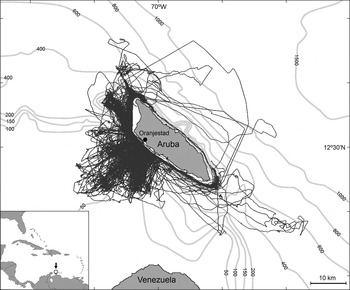
Aruba (12°30′N 69°58′W) is a small island located approximately 27 km north off the Paraguaná Peninsula of Venezuela and is part of the Leeward Antilles, southern Caribbean (Figure 1). Aruba is situated in the north-westward-flowing Caribbean current. It also is situated in the trade wind belt with prevailing easterly winds (Kohsiek et al., Reference Kohsiek, Holsbergen and Terwindt1987). Aruba has three major coastlines: a rocky north-east coast on the island's windward side and the leeward south-west and north-west coasts with white sand beaches, some sea grass beds, and some coral reef islands (Dorenbosch et al., Reference Dorenbosch, Grol, Nagelkerken and Van der Velde2006). Upwelling occurs along the north coast of South America (Colombia and Venezuela) (Miloslavich et al., Reference Miloslavich, Díaz, Klein, Alvarado, Díaz, Gobin, Escobar-Briones, Cruz-Motta, Weil, Cortés, Bastidas, Robertson, Zapata, Martín, Castillo, Kazandjian and Ortiz2010). Seawater temperature around the island varies between 25°C in February and 28°C in September (Van Vliet, Reference Van Vliet2006).
Location of the study area showing survey effort during 2010 and 2011 (dark lines) and depth contours (in metres).

Sighting data were collected from 9 April 2010 to 22 November 2011 on a near daily basis. Data were collected by the author during deep-sea fishing trips from boats chartered by tourists. The boats were designed for sport fishing; they ranged from 10.7 m to 16.5 m in length and were powered by inboard engines. Observations were made from a flying bridge deck approximately 4 m above sea level. Trips typically lasted four hours, at an average speed of 12 km/h. Data were collected in the morning (7.30–12.00) and/or the afternoon (12.30–16.30), up to 31 km offshore on all sides of the island.
While on watch, the author continuously scanned the area from the flying bridge with the naked eye and 10 × 42 binoculars (Leica). Throughout each trip, the boat position using a GPS recorder (Garmin Vista HCx), Beaufort sea state, and swell were monitored and recorded. For each sighting GPS position (when first sighted and when at or near the group), time, species, group size (minimum, maximum and best estimate), behaviour, direction of movement (at the start and end of the sighting), and the presence of calves and/or neonates were recorded. A group was defined as animals engaging in the same activity and interacting with one another over time scales sufficiently short that there were few or no changes in group membership (Karczmarski et al., Reference Karczmarski, Würsig, Gailey, Larson and Vanderlip2005). Three age-classes were distinguished: adults, calves and neonates. Calves were less than or equal to 75% of the total length of an adult individual and neonates less than or equal to 50% (Herzing, Reference Herzing1997). Behaviour was classified in five categories: socializing, resting, milling, traveling, and foraging (Degrati et al., Reference Degrati, Dans, Pedraza, Crespo and Garaffo2008). The group's behaviour was based on the behaviour of the majority of individuals in the group. Whenever possible, photographs were taken for species identification using a digital camera (Nikon D200) and a 70–300 mm zoom lens (Nikon 1:4.5–5.6 AF-S). Sightings that could not be identified as to species, either by observation at close range or from photographs, were recorded as ‘unidentified’.
Records of sightings and strandings from other sources were included if photographs or video material were available. Records of killer whales without photographic documentation were accepted only from observers with a demonstrated familiarity with the diagnostic characters of the species (size, colour pattern and dorsal fin shape). Records from third parties were excluded from statistical analyses because sampling effort was unknown.
The bottom depth at the sighting location was derived from the General Bathymetric Chart of the Oceans Digital Atlas system (GEBCO, 2012) at a resolution of 30 arcseconds. Distance from shore was obtained using the distance tool of Mapsource® software, taking the shortest distance to shore. For each species, the sighting rate was calculated as the number of sightings per 100 km survey effort. To measure species diversity, the Shannon–Wiener index was calculated using only sighting data from the surveys, as follows (Ricklefs, Reference Ricklefs2007):
 $$H = - \sum {P_i \log _e P_i }$$
where H is a measure of diversity and P i is the proportion of individuals belonging to species i.
RESULTS
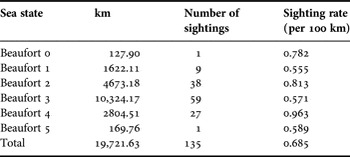
A total of 415 boat-based surveys were conducted in all months of the year, covering 19,721 km of trackline (2183 km2) in 1686.25 h of effort (Figure 1). All surveys were carried out in Beaufort sea state ≤5 (52.3% in Beaufort 3) (Table 1). Surveys were within 31 km from shore. Most surveys (316; 76.1%) were entirely on the north-west and south-west sides of the island, because weather conditions often precluded boat surveys on the north-east side (windward) of Aruba. The water depth covered by the surveys ranged between 6 m and 1200 m, with 15 surveys (3.6%) covering water depths >400 m. 291 surveys (70.1%) were conducted in the morning (7.30–11.30), 90 (21.7%) in the afternoon (12.30–16.30), and 34 (8.2%) surveys lasting from six to nine hours beginning in the morning and continuing into the afternoon.
Sighting rate in relation to sea state (Beaufort).

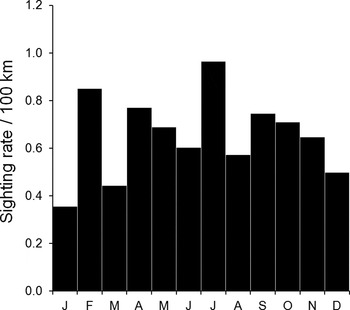
The surveys resulted in 135 sightings of cetaceans of eight identified species (Table 2). Sightings were made during 117 surveys (28.2%). Sighting rate was not related to sea state (Kruskal–Wallis test, n.s.) (Table 1). Sighting rate also did not differ significantly between months (Kruskal–Wallis test, n.s.) (Figure 2). All identified species were photographed. For 111 sightings (82.2%) photographs of the animals were taken either for confirmation of species identity or to identify individuals. In 120 sightings (88.9%), the animals responded to the vessel by approaching it (100; 83.3%), avoiding it (6; 5%) or first approaching the vessel and then actively avoiding it when the boat attempted to approach them (14; 11.7%). Five stranding events involving three species were recorded during the survey period (described below).
Sighting rate (number of sightings per 100 km) per month.

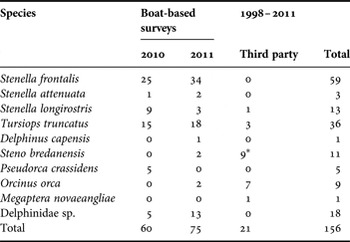
Number of sightings per species obtained from the boat-based surveys and from third parties.

*, excluding three live stranding events.
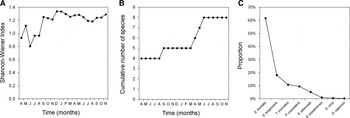
The Shannon–Wiener diversity index was 1.29. The Shannon–Wiener index stabilized at ~1.26 after six months of fieldwork (September 2010; corresponding to 35 sightings), whereas the final number of species observed at sea (8) was reached after 15 months of fieldwork (June 2011) (Figure 3). The Atlantic spotted dolphin Stenella frontalis was the dominant species, followed by the spinner dolphin Stenella longirostris and the bottlenose dolphin Tursiops truncatus (Figure 3).
(A) Cetacean diversity based on the cumulative number of individuals observed from April 2010 to November 2011 and estimated with the Shannon–Wiener index; (B) cumulative number of species observed during boat-based surveys from April 2010 to November 2011; (C) relative abundance of eight species in coastal waters off Aruba (proportion of all individuals observed).

An additional 21 sighting records were compiled based on photographic or video documentation provided by others (Table 2).
Atlantic spotted dolphin (Stenella frontalis)
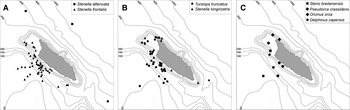
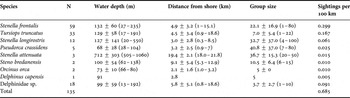
Atlantic spotted dolphins were sighted on 59 occasions (0.299 sightings/100 km) (Table 3; Figure 4A). Adult individuals were identified as Stenella frontalis based on the presence of a spinal blaze and clear white spots on the dorsal side (Mignucci-Giannoni et al., 2003). These dolphins were observed only along the island's north-west and south-west coasts in shallow waters (<250 m deep) close to shore: 38 (64.4%) within 5 km from shore, 16 (27.1%) between 5 and 10 km and five (8.5%) between 10 and 15 km (Table 3). This species was observed in all months of the year and groups including neonates (Figure 5) were observed in June (one sighting), July (three sightings), August (four sightings) and October (three sightings). Sighting rate was highest in February (0.47 sightings/100 km), June (0.50 sightings/100 km) and July (0.46 sightings/100 km) and lowest in January (0.12 sightings/100 km), September (0.14 sightings/100 km) and December (0.17 sightings/100 km). Behaviour for 45 sightings was determined; the most common were foraging (N = 22; 48.9%) and travelling (N = 20; 44.4%).
Sighting locations of (A) Stenella attenuata, Stenella frontalis; (B) Tursiops truncatus, Stenella longirostris; (C) Steno bredanensis, Pseudorca crassidens, Orcinus orca, and Delphinus capensis. Depth contours are in metres.

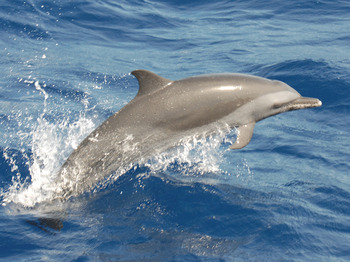
Pantropical spotted dolphin (Stenella attenuata), north-east of Aruba, 10 November 2011 (photograph by J.A. Luksenburg).

Water depth, distance from shore, group size, and sightings per unit effort of cetacean species sighted in 2010–2011 off Aruba. Values are mean ± SD (range).

Pantropical spotted dolphin (Stenella attenuata)
Pantropical spotted dolphins were observed on three occasions (0.015 sightings/100 km) (Table 3; Figure 4A). They were identified based on the absence of a spinal blaze and a subdivision of the peduncle into upper dark and lower light halves (Mignucci-Giannoni et al., 2003; Figure 5). The first group of about 40 animals was sighted on 25 September 2010 in waters 570 m deep and 18.0 km from the north coastline. The second group of about 20 animals, including two calves, was observed on 19 September 2011 in waters 505 m deep and 21.8 km from shore off the south-east coast. The third group of about 50 animals was observed on 10 November 2011 in waters 1060 m deep and 18.5 km from the north-east coast (Table 3). All three groups were travelling, but feeding behaviour was observed also in two cases.
Spinner dolphin (Stenella longirostris)
With 12 sightings, the spinner dolphin was the third most frequently recorded species (0.061 sightings/100 km) (Table 3; Figure 4B). The animals were identified based on their long, narrow beaks; their slightly falcate triangular or sub-triangular dorsal fins; and the absence of a ‘moustache’ mark on the dorsal part of the rostrum (Perrin, Reference Perrin1998; Jefferson et al., Reference Jefferson, Webber and Pitman2008). Eight of the sightings of this species were in waters ≤100 m deep. Sighting rate was lower during afternoons (0.019 sightings/100 km) than during mornings (0.075 sightings/100 km), but the difference was not statistically significant. This species was observed on all sides of the island but seven of the 12 sightings (58.3%) were off the north-east coast. Nine sightings (75%) were within 5 km from shore. Spinner dolphins were sighted in April, July, August, September, November and December, with the highest sighting rate in July (0.18 sightings/100 km) and lowest in April (0.05 sightings/100 km). Groups with calves or neonates were observed in July (one neonate), September (one calf, one neonate), November (one calf) and December (one calf). Travelling (N = 5) and feeding (N = 4) were the most frequently observed behaviours. Travelling animals were observed in larger groups (30–100 individuals) than feeding animals (4–15 individuals). An additional sighting was obtained with unknown group size on 25 June 2010 in waters 24 m deep and about 1.8 km off the north-west coast.
Striped dolphin (Stenella coeruleoalba)
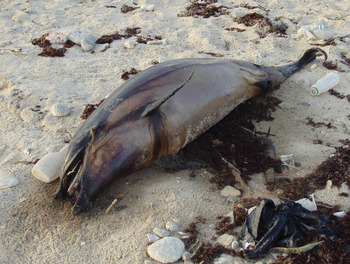
Details of a striped dolphin stranded on 3 September 2009 at the California sand dunes along the north-east coast were provided by A. Henriquez and E. van der Wal (in litt.; Diario 7 September 2009) (Figure 6). The animal was identified based on the dark stripe running laterally from its eye to the underside of its tail stock (eye-to-anus stripe), a thin streak behind the eye, and a moderately long beak (Jefferson et al., Reference Jefferson, Webber and Pitman2008; T.A. Jefferson, in litt.).
Striped dolphin (Stenella coeruleoalba), California Sand Dunes, Aruba, 8 September 2009 (photograph by E. van der Wal).

Bottlenose dolphin (Tursiops truncatus)
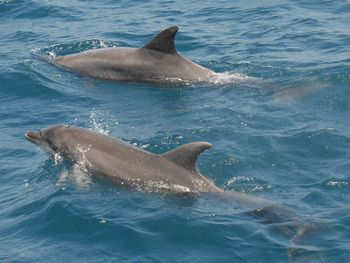
The bottlenose dolphin was the second most frequently observed species with 33 sightings (0.167 sightings/100 km) (Table 3; Figure 4B). These dolphins were identified based on their grey coloration, fairly short beak, rounded forehead, and robust body (Jefferson et al., Reference Jefferson, Webber and Pitman2008; Figure 7). Bottlenose dolphins were observed in shallow waters (<200 m deep) along all sides of the island (Table 3). The majority of sightings (N = 23 69.7%) were within 5 km from shore, 9 (27.3%) were between 5 and 10 km, and one sighting was 18.6 km. Bottlenose dolphins were observed in almost every month except June and December. Calves were seen on nine occasions (27.3%) during seven months of the year, with most observations in September (N = 3). Two neonates were positively observed during one sighting in October 2011. Sighting rate was highest in September (0.37 sightings/100 km) and lowest in August (0.06 sightings/100 km). All five behaviours were observed, with foraging (N = 6; 26.1%) and travelling (N = 13; 56.5%) the most common. Third parties provided three additional records of bottlenose dolphins along the north-east and south-west coasts. Group size for two of those sightings was estimated to be seven and 15 animals. All three sightings were made close to shore (0.3 km, 0.8 km, 1.9 km) in shallow water (16 m, 28 m, 80 m).
Bottlenose dolphin (Tursiops truncatus), south-west of Aruba, 10 September 2010 (photograph by J.A. Luksenburg).

Long-beaked common dolphin (Delphinus capensis)
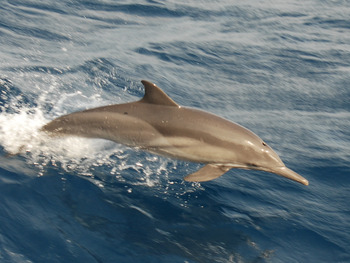
Long-beaked common dolphins were encountered on one occasion during the surveys. On 16 June 2011, a group of four to six animals was observed 2.8 km from the island's western coast in waters 90 m deep (Table 3; Figure 4C). They were identified based on their relatively long rostrum and the diagnostic characteristics in their colour pattern (Heyning & Perrin, Reference Heyning and Perrin1994; Figure 8). The group consisted of adults only and swam rapidly around the boat, surfacing only to breathe.
Long-beaked common dolphin (Delphinus capensis), north-west of Aruba, 16 June 2011 (photograph by J.A. Luksenburg).

Rough-toothed dolphin (Steno bredanensis)
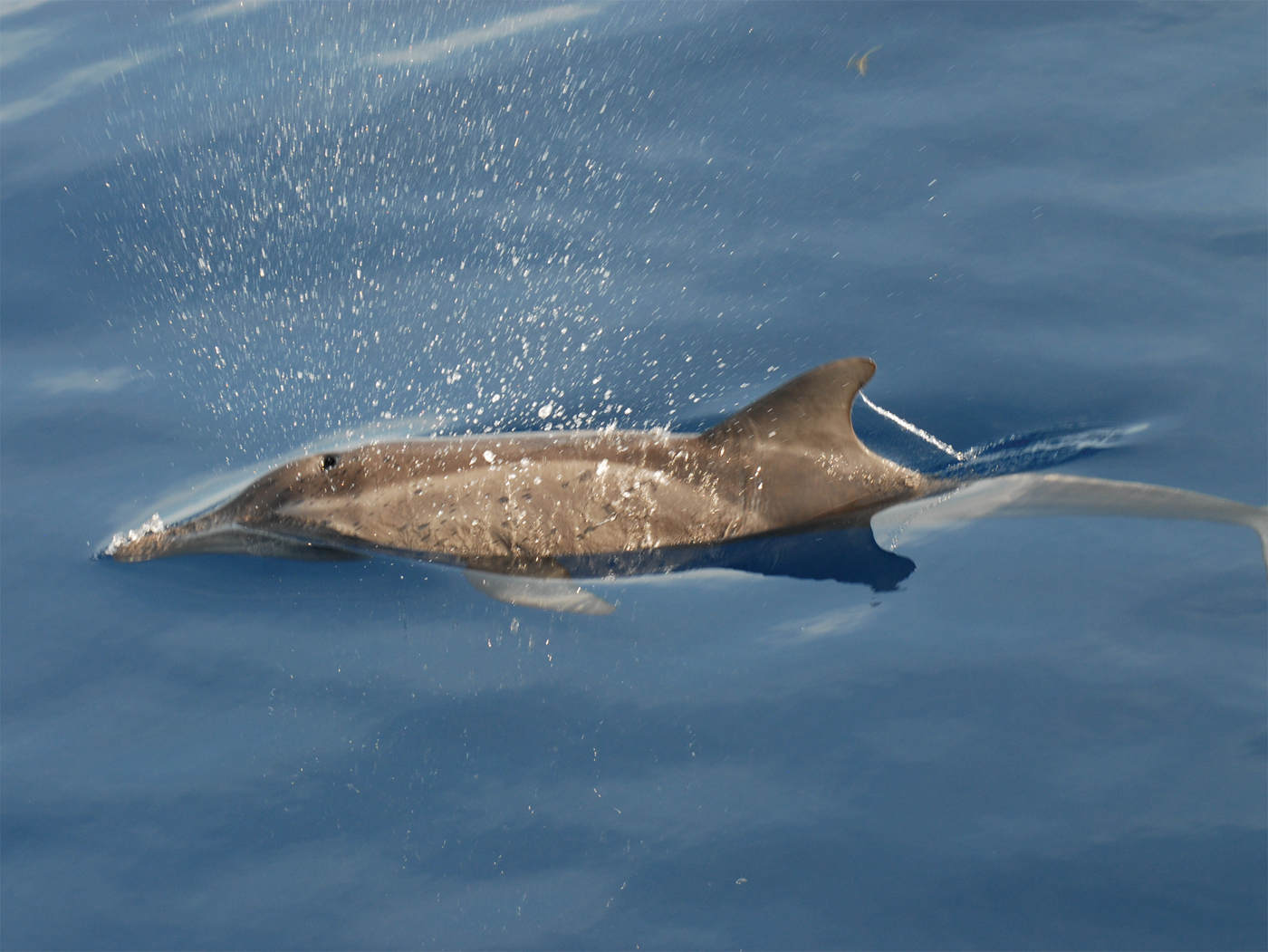
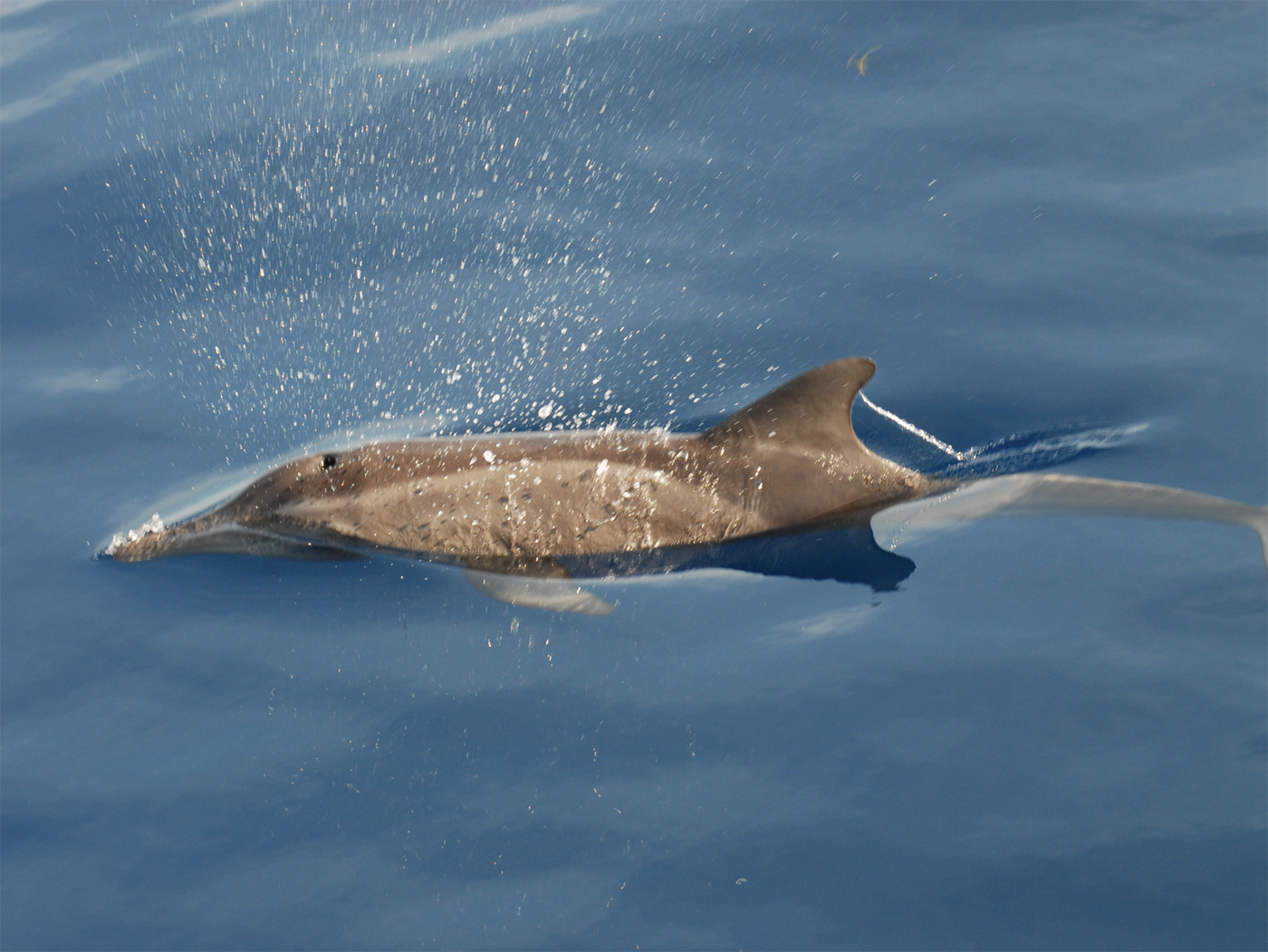
Rough-toothed dolphins were observed on two occasions (0.010 sightings/100 km) (Table 3; Figure 4C). They were identified based on their sloping melon and narrowed dorsal cape between the blowhole and dorsal fin (Jefferson, Reference Jefferson, Perrin, Würsig and Thewissen2002; Figure 9). On 27 May 2011, a group of about six individuals, including one calf, was observed hunting around an oil tanker anchored on the south-west side of the island 12.6 km from shore in waters 62 m deep. They took bait (ballyhoo Hemiramphus brasiliensis) off lines from the survey boat, which was used primarily for recreational fishing. On 13 September 2011, a group of about 15 individuals, including two calves, was observed at 5.3 km from the south-west coast in waters 138 m deep. This group exhibited hunting and social behaviours and slow travel.
Rough-toothed dolphin (Steno bredanensis), south-west of Aruba, 13 September 2011 (photograph by J.A. Luksenburg).
Third parties provided details of 12 additional sightings between 1998 and 2011. The sightings occurred in the months February, March, April, July, September, and October within 3 km of the north-west and south-west coasts. All the animals sighted were in water depths ranging from 4 to 80 m. Group size ranged from one to 50 individuals and included neonates in the months of September, October and March. Three of the 12 records involved individuals that died after stranding alive (September 1998, July 2000, September 2007). All these records are confirmed by using photographs and/or videos clearly revealing the diagnostic characteristics of rough-toothed dolphins.
False killer whale (Pseudorca crassidens)
False killer whales were observed on five occasions (0.025 sightings/100 km) (Table 3; Figure 4C). They were identified based on their overall black colour, lack of ‘white lips’, long head with a rounded beak, and large dorsal fin with a rounded tip (Jefferson et al., Reference Jefferson, Webber and Pitman2008). The sightings were all in shallow waters (28–104 m) close to shore (mean 3.2 km; Table 3). All sightings were along the north-west and south-west coasts. During four sightings the group consisted of several subgroups of 5–10 animals that were in close range (within 2 km reach) and exchanging individuals. The sightings were in April (N = 1), July (N = 2), and December (N = 2) of 2010. The groups included calves in April and December. In both July and December, false killer whales were observed twice on the same day. On both of those days several individuals were re-sighted during the day. Several individuals sighted in April were re-sighted in July and December, based on their identification using naturally occurring marks on the dorsal fin and bodies and the shape of the dorsal fin. Two behaviours for false killer whales were documented, hunting (N = 2) and travelling (N = 4). During hunting behaviour, a fish in a whale's mouth and food sharing between an adult and what appeared to be a juvenile were observed.
Killer whale (Orcinus orca)
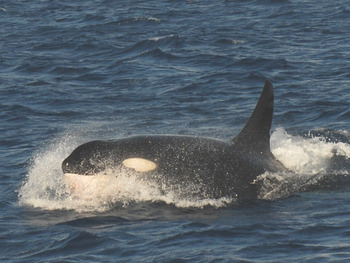
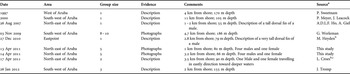
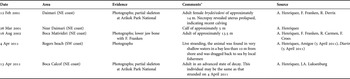
Killer whales were sighted on 13 and 14 April 2011 (0.010 sightings/100 km) off the north-east coast of Aruba near the island's northern tip (Table 3; Figures 4C & 10). On both days, a group of about five individuals—at least four males and one female—was observed in the morning in shallow (66–80 m) water close (1.0–3.2 km) offshore. The sightings almost certainly involved the same group although the poor quality of the 13 April photographs made it impossible to match individuals on the two dates. They appeared to be hunting on 14 April. Black-capped petrels (Pterodroma hasitata) were observed associating with them, flying as low as 10 cm over the animals when they surfaced. Flying fish (Exocoetidae), albacore tuna (Thunnus alalunga), and fish oil were observed on the surface near the sightings, which would be consistent with the observation that the killer whales were hunting. Local informants provided seven additional records of killer whales in Aruban waters (Table 4). Except for one of those records, the informants indicated that the killer whales were recorded within 5 km from shore in shallow waters. Their group size ranged from one to ten animals.
Killer whale (Orcinus orca), north-east of Aruba, 14 April 2011 (photograph by J.A. Luksenburg).

Killer whale sighting records in Aruban waters (1997–2012).
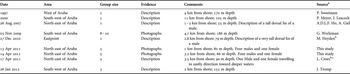
a, all observers are experienced fishermen; b, personal communication to J.A. Luksenburg; c, this sighting was in the same area as the sightings of 13 and 14 April 2011 and refers almost certainly to the same group of killer whales. The observer was present during the 13 and 14 April 2011 sightings.
Short-finned pilot whale (Globicephala macrorhynchus)
A. Henriquez (in litt.) provided details of two previously unreported strandings of short-finned pilot whales. They were identified based on their broad-based dorsal fin, rounded bulbous head, and long, slender sickle-shaped pectoral fins (Jefferson et al., Reference Jefferson, Webber and Pitman2008) (Figure 11). One was a juvenile found stranded at Colorado Point, along the south-east Aruba coast on 12 February 1998. The other was a female of approximately 3.7 m found drifting near Commandeurs Reef along the south-west coast on 23 May 2003. The female had severe bite marks, most probably from a killer whale (I. Visser, in litt.).
Short-finned pilot whale (Globicephala macrorhynchus). Dutch marine camp off Commandeurs Reef, Aruba, 23 May 2003 (photograph by A. Henriquez).

Risso's dolphin (Grampus griseus)
Agudo & Ponson (Reference Agudo and Ponson1996) published the only stranding record of a Risso's dolphin (Table 6). The stranding occurred on 13 November 1993 at Arashi beach along the north-west coast. The original identification is here corroborated based on two photographs published in the local newspapers Diario (15 November 1993) and Bon Dia Aruba (16 November 1993) and written documentation provided by the original observer (B. Boekhoudt, in litt.). The photographs reveal a very tall prominent dorsal fin with a rounded tip and a strong concave trailing edge, long pectoral fin, a rounded head without prominent beak, a relatively robust body and narrow tail stock, pale ventral coloration, a description indicating the animal was ‘grey to blackish all over the body, except for ventral areas which were light grayish and had sporadic whitish spots’. The typical vertical crease or cleft down the anterior surface of the melon and the body scarring are not visible on the photographs (Baird, Reference Baird, Perrin, Würsig and Thewissen2002; Jefferson et al., Reference Jefferson, Webber and Pitman2008), but the characteristics apparent in the photographs are consistent with the identification of G. grampus and sufficient to rule out all similar species (T.A. Jefferson, in litt.).
Unidentified beaked whale (Mesoplodon sp.)
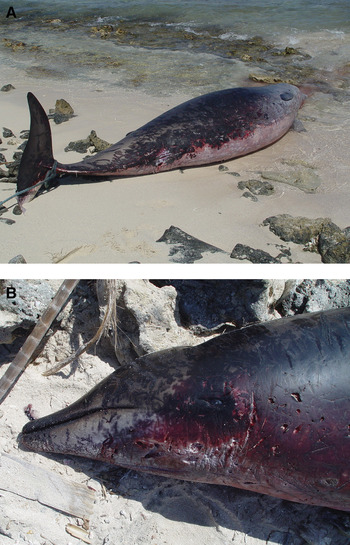
Park rangers from Arikok National Park at Rincon found two animals stranded on the north-east coast on 23 January 2004 (Figure 12). The animals were identified as females based on the presence of mammary slits (A.D.L.F. Ho, in litt.). No teeth were visible in either animal. Their length was estimated to be 4.40 m and 3.45 m (A.D.L.F. Ho, in litt.), indicating they were an adult and juvenile. Ziphius cavirostris and M. densirostris were ruled out based on the combination of a distinct, narrow beak, lack of a prominent arched contour of the lower jaw, and a dark patch around the eyes (Figure 12B). The main features visible on photographs are a small head with a pronounced but narrow rostrum, sloping forehead with a slightly bulging melon and indentation at blowhole, and mouth line arching downward at the proximal end. The dorsal side, lateral sides, patch around the eye, pectoral flippers, and upper jaw were darkly pigmented. The ventral side and lower jaw were lightly pigmented (perhaps whitish), with white blotches on the belly. Both animals had extensive scarring. External measurements of the specimens were provided by A.D.L.F. Ho (in litt.). Based on external measurements, they appeared to be an adult and a juvenile. Measurements for the adult female were as follows: total length 440 cm, length of the pectoral fin (anterior insertion to tip) 44 cm, snout to angle of mouth 44 cm, fluke width 103 cm, dorsal fin height 29 cm, girth 264 cm. Measurements for the juvenile were: total length 345 cm, length of the pectoral fin (anterior insertion to tip) 36 cm, snout to angle of mouth 31 cm, fluke width 70 cm, dorsal fin height 20 cm, girth 184 cm. These traits indicate that these animals were either Gervais' beaked whale M. europaeus or True's beaked whale M. mirus. Specific identification was not possible based on the photographic material (T.A. Jefferson, in litt.; J.G. Mead, in litt.).
Unidentified beaked whale (Mesoplodon sp. cf. M. europaeus), Rincon, north-east coast of Aruba, 23 January 2004 (photographs by A.D.L.F. Ho).

Humpback whale (Megaptera novaeangliae)
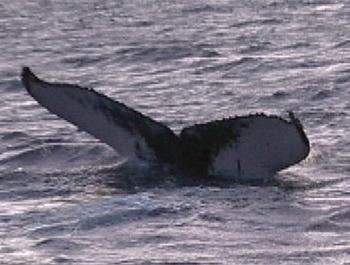
N. Thijssen observed four humpback whales close to the north-western shore of the island (within 6 km from shore) on 19 February 1999 (Table 2). Video documentation of one of the individuals (Figure 13.) provided a basis for identifying it as Megaptera novaeangliae based on the hump in front of the dorsal fin, the low, broad-based dorsal fin and fluke with S-shaped, knobbly trailing edge (Jefferson et al., Reference Jefferson, Webber and Pitman2008).
Humpback whale (Megaptera novaeangliae), north-west of Aruba, 19 February 1999 (video still by N. Thijssen).

Rorquals (Balaenoptera sp. and Balaenoptera brydei/edeni)
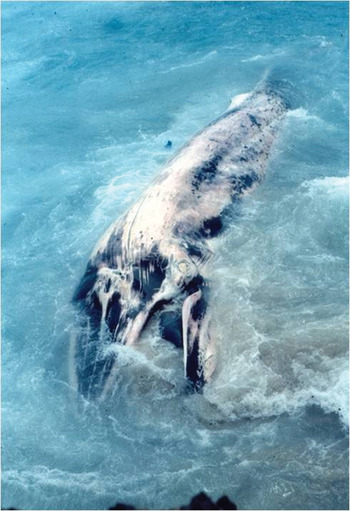
Five stranding events were recorded between 2001 and 2011, four of which occurred on the north-east coast (Table 5). Four of the events were documented by photographs, although most of the photographs lacked sufficient detail to identify the species. The animals were identified as Balaenoptera sp. based on a distinct, slender, erect dorsal fin sloping backwards, set at approximately 2/3 towards the back of the body, or the whitish or yellowish throat groves. Photographs of the individual that stranded on 12 February 2001 reveal the lateral ridges on the head that are diagnostic for the Bryde's/Eden's whale complex (Balaenoptera brydei/edeni) (Figure 14). Skin and bone samples were taken from three specimens for molecular analysis. The five strandings occurred during winter, spring, or summer. Four were adults, the fifth being an individual 5 m in length that stranded 42 days after an adult female (12 February 2001); it may have been her calf (A. Henriquez, personal communication).
Bryde's whale (Balaenoptera edeni/brydei), Daimari, north-east coast of Aruba, 12 February 2001 (photograph by R. Derrix).

Stranding records of Balaenoptera sp. in Aruba (1998–2011).

*, none of the strandings except the first could be identified to species.
Sperm whale (Physeter macrocephalus)
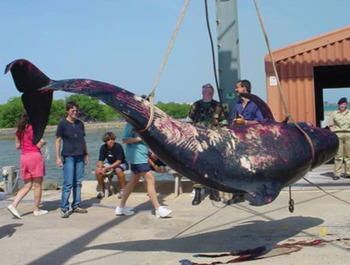
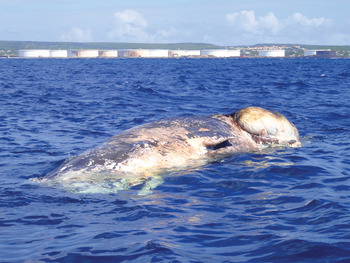
An adult sperm whale was found stranded on Santana di Cacho beach on the south-east coast on 30 March 2003. The whale was entangled in a fishing trawler line wrapped around its torso and right flipper (A. Henriquez, in litt.; F. Franken, in litt.). In addition, two dead sperm whales, an adult and a calf or subadult without teeth, were found drifting on 15 July 2010, 7 km off the south-west coast. Both individuals were entangled in a gill net with a mesh size of at least 10 × 10 cm. Gas formation and sloughing skin indicate that the two whales had been dead for approximately two to three days (F. Gulland, personal communication). Another dead adult sperm whale was found drifting off Cerro Colorado about 3 km off the south-east coast on 21 January 2011 (Figure 15). Its intestines were protruding through a large cut (approximately 1/5 of the animal's body length) on the left side of the body. The tongue was missing and several bite marks were visible on its back, left flank, the base of the left flipper and jaw (A. Henriquez, in litt.). Tissue samples were collected for future studies. All the animals were identified as sperm whales based on their large squarish head, small humplike dorsal fin and wrinkly skin (Jefferson et al., Reference Jefferson, Webber and Pitman2008). Photographs were taken of each stranded individual.
Sperm whale (Physeter macrocephalus), south-west coast of Aruba, 21 January 2011 (photograph by A. Henriquez).

DISCUSSION
Species richness and diversity
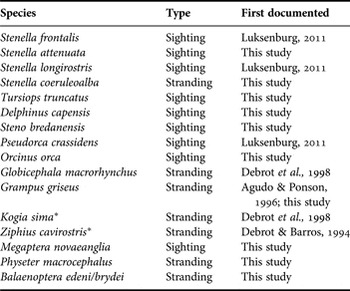
This report summarizes the first dedicated field study of cetaceans in Aruban waters. It documents the presence of fourteen species, eight that were identified at sea during the study period and six others that were identified from stranding incidents or reported by others. Together with two previously documented species for which no further records were obtained, this brings the total number of cetaceans documented in Aruban waters to 16 species (Table 6). This report authenticates nine of those species for the first time and three species were identified during this study and documented by Luksenburg (Reference Luksenburg2011) for the first time (Table 6).
Overview of cetacean species reliably documented for Aruba.

*, not documented in this study.
Of the 16 species documented for Aruba, nine are known only from sightings at sea whereas seven species are known only from strandings. Both types of data are useful for assessing cetacean species richness. Pyenson (Reference Pyenson2011) suggested that stranding records may provide a better basis for characterizing the cetacean species in an area than sighting data, provided that sampling extends across large latitudinal gradients (>2000 km) and for periods longer than 10 years. However, Aruba is a small island with only 68.5 km of coastline, which argues that stranding events are not particularly likely. This study added substantially to our understanding of cetacean diversity around Aruba, indicating that 20 years of stranding data (Debrot & Barros, Reference Debrot and Barros1994) are useful but not sufficient for that purpose.
The diversity of cetaceans in Aruba, as measured by the Shannon–Wiener index, was unstable during the first months of fieldwork but stabilized after six months (Figure 3A). This indicates that, even in a relatively small area, up to six months of intensive sampling may be required to obtain a robust estimate of cetacean species diversity. Various studies have used the Shannon–Wiener index to measure local diversity of Cetacea (Dulau-Drouot et al., Reference Dulau-Drouot, Boucaud and Rota2008; Gannier, Reference Gannier2009; Kizka et al., Reference Kizka, Ersts and Ridoux2010), but comparisons are hampered by differences in sampling effort among survey areas. I suggest that the trend of the cumulative diversity index over time may provide a means to evaluate the robustness of the final diversity index, and thus may help to assess whether sampling has been sufficient or insufficient. Further studies based on standardized methods (distance sampling techniques) are required to evaluate whether trends in the cumulatieve curve are indeed a reliable method to evaluate the robustness of the final diversity index.
Species accounts
Atlantic spotted dolphin, the most numerous and frequently encountered species in this study, was observed in all months of the year, indicating it is common in Aruban waters. It also is one of the most commonly encountered marine mammals in nearshore habitats in Colombia (Pardo & Palacios, Reference Pardo and Palacios2006; Fraija et al., 2009) and Venezuela (Bolaños-Jiménez et al., 2006, Reference Bolaños-Jiménez, Fertl and Iñíguez2009a) but it has not yet been reported for Curaçao and Bonaire (Debrot et al., 1998; Barros & Debrot, Reference Barros and Debrot2006). All adult individuals observed in Aruba were heavily spotted, consistent with coastal populations of this species in Central and South America (Perrin et al., Reference Perrin, Mitchell, Mead, Caldwell, Caldwell, van Bree and Dawbin1987).
Pantropical spotted dolphin was recorded only in relatively deep waters at distances greater than 15 km from shore. It may occur regularly in Aruban waters, given that the survey track rarely extended to waters deeper than 500 m. Pantropical spotted dolphins were never sighted in shallow waters (<490 m), whereas Atlantic spotted dolphins were never sighted in deeper waters (>250 m). Undoubtedly, ecological factors (habitat, prey, competitive exclusion) influence the local distributions of these species. Similar habitat use has been reported throughout the Caribbean (Mignucci-Giannoni et al., 2003). Pantropical spotted dolphins have been documented off Curaçao (LeDuc et al., Reference LeDuc, Perrin, Debrot, Barros and van Bree1997; Debrot et al., 1998), Colombia (Pardo & Palacios, Reference Pardo and Palacios2006; Pardo et al., Reference Pardo, Mejía-Fajardo, Beltrán-Pedreros, Trujillo, Kerr and Palacios2009a), and Venezuela (Bolaños-Jiménez et al., 2006; Oviedo, Reference Oviedo2007). The adults observed off Aruba had dark ventral spotting and light dorsal spotting, consistent with the offshore populations of this species worldwide (Jefferson et al., Reference Jefferson, Webber and Pitman2008).
Spinner dolphin was observed in all seasons, indicating residence in Aruban waters. It is common off Curaçao, Bonaire and Venezuela (Debrot et al., 1998; Romero et al., 2001) but only one sighting has been reported for Colombia (Pardo et al., Reference Pardo, Mejía-Fajardo, Beltrán-Pedreros, Trujillo, Kerr and Palacios2009a).
Bottlenose dolphin was observed in all months of the year except June and December. No seasonal variation was apparent from the sighting data. Its common occurrence in shallow waters near the coast is consistent with observations of this species in Colombia (Pardo & Palacios, Reference Pardo and Palacios2006; Fraija et al., 2009) and Venezuela (Oviedo & Silva, Reference Oviedo and Silva2005; Bolaños-Jiménez et al., Reference Bolaños-Jiménez, Fertl and Iñíguez2009a). Bottlenose dolphins are also common off both Curaçao and Bonaire (Debrot et al., 1998; Barros & Debrot, Reference Barros and Debrot2006).
The sighting of long-beaked common dolphins represents the first record of this species in Aruban waters and one of the few records this far west. Scientists have recorded it once in the Gulf of Venezuela (Ramírez Carroz & González-Fernández, Reference Ramírez Carroz and González-Fernández2004; Jefferson et al., Reference Jefferson, Fertl, Bolaños-Jiménez and Zerbini2009) and four times in the coastal waters off the Guajira Peninsula, northern Colombia (Palacios et al., Reference Palacios, Farías-Curtidor, Jiménez-Pinedo, Castellanos, Gärtner, Gómez-Salazar, Caicedoherrera and Trujillo2012). The single sighting in the current study during 20 months of fieldwork indicates long-beaked common dolphins are not a frequent visitor to Aruban waters. Because of the short geographical distance of Venezuela and Colombia to Aruba, the single sighting may have been of a wandering group from either the Venezuelan or the newly proposed Guajiran stock of the long-beaked common dolphin (Palacios et al., Reference Palacios, Farías-Curtidor, Jiménez-Pinedo, Castellanos, Gärtner, Gómez-Salazar, Caicedoherrera and Trujillo2012). The individuals photographed in Aruba appeared typical for D. capensis, but the taxonomic status of this population in the Caribbean is not clear (Esteves & Oviedo, Reference Esteves and Oviedo2007). For example, its external morphology has not been compared to other populations. However, the individuals in this study did not exhibit the mixture of features of D. capensis and D. delphinus observed in common dolphins in Angola (Weir & Coles, Reference Weir and Coles2007).
The single record of humpback whales in February is consistent with the presence of this species in Curaçao, Bonaire, Colombia, and Venezuela during January through to April (Debrot & Barros, Reference Debrot and Barros1994; Debrot et al., Reference Debrot, De Meyer and Dezentjé1998; Silva et al., Reference Silva, Prieto, Magalhaes, Seabra, Santos and Hammond2008; Fraija et al., Reference Fraija, Flórez-González and Jáuregui2009). Humpback whales are most likely observed in Aruba during January through to April during its winter breeding season in the eastern and southern Caribbean (Swartz et al., Reference Swartz, Cole, McDonald, Hildebrand, Oleson, Burks, Clapham, Barlow and Martinez2003).
The small number of observations of rough-toothed dolphins, false killer whales, and killer whales indicates that these species are not resident in coastal Aruban waters. The 12 records of rough-toothed dolphins in a 13-year period may suggest that this species use coastal waters of Aruba occasionally, perhaps for specific purposes including birthing. Although there are a few records of killer whales in the waters off Curaçao, no published records exist for rough-toothed dolphins and false killer whales in those waters (Debrot et al., 1998; Barros & Debrot, Reference Barros and Debrot2006). Records of these species in Colombia and Venezuela also are sparse (Álvarez-León Reference Álvarez-León2002; Pardo et al., Reference Pardo, Jiménez-Pinedo and Palacios2009b; Romero et al., 2001, Bolaños-Jiménez et al., Reference Bolaños-Jiménez, Bermúdez Villapol, Sayegh and Solé2006, Reference Bolaños-Jiménez, Villarroel-Marín and Oviedo2009b).
The occurrence of rorquals in Aruban waters remains unclear but only limited information is available for these species from the stranding records. Identification of whales of the Bryde's whale complex is difficult because the complex is thought to consist of three very similar species (Wada et al., 2003; Sasaki et al., Reference Sasaki, Nikaido, Wada, Yamada, Cao, Hasegawa and Okada2006). Lateral ridges are prominent in B. brydei, and probably also in B. edeni (Wada et al., 2003), and it is unclear if these two species can be separated in the field. That being the case, skull morphology (Wada et al., Reference Wada, Oishi and Yamada2003; Yamada et al., Reference Yamada, Chou, Chantrapornsyl, Adulyanukosol, Chakravarti, Oishi, Wada, Yao, Kakuda, Tajima, Arai, Umetani and Kurihara2006) and/or DNA analysis (e.g. Ross et al., Reference Ross, Lento, Dalebout, Goode, Ewing, McLaren, Rodrigo, Lavery and Baker2003) are essential for identifying stranded individuals. Attempts to do so are currently underway (J. Luksenburg & G. Sangster, in prepration). In the meantime, the single stranding in Aruba is best listed as B. brydei/edeni.
The seven species that are only known in Aruba from stranding records (Table 6) all prefer deeper waters (Ward et al., 2001). All seven species have been reported from neighbouring countries (Colombia, Venezuela, Curaçao and Bonaire) (Vidal, Reference Vidal1990; Debrot et al., Reference Debrot, De Meyer and Dezentjé1998; Romero et al., Reference Romero, Agudo, Green and Notarbartolo-di-Sciara2001; Bolaños-Jiménez et al., Reference Bolaños-Jiménez, Bermúdez Villapol, Sayegh and Solé2006; Pardo & Palacios, Reference Pardo and Palacios2006; Bermúdez-Villapol et al., Reference Bermúdez-Villapol, Sayegh and León2008a, Reference Bermúdez-Villapol, Sayegh, Rangel, Rosso and Verab). Offshore surveys and surveys on the eastern side of the island are needed to assess the occurrence, distribution and seasonal trends of species that prefer deeper waters.
Previous records
Eight species were previously reported in Aruban waters (Agudo & Ponson, Reference Agudo and Ponson1996; Debrot et al., Reference Debrot, De Meyer and Dezentjé1998; Barros & Debrot, Reference Barros and Debrot2006). The records include sightings and/or strandings of Atlantic spotted dolphins (November 1993, May 1995), bottlenose dolphins (August 1995), rough-toothed dolphins (possibly in 1998), Risso's dolphin (November 1993), short-finned pilot whale (April 1994), Cuvier's beaked whale (Ziphius cavirostris) (December 1991), dwarf sperm whale (Kogia sima) (May 1984), and Gervais' beaked whale (possibly in 1998, January 2004). Several of these records are either poorly documented or not documented at all.
The published records of Atlantic spotted dolphins, bottlenose dolphins, and rough-toothed dolphins (Agudo & Ponson, Reference Agudo and Ponson1996; Barros & Debrot, Reference Barros and Debrot2006) did not include descriptive information about diagnostic features or photographic documentation needed to verify these records. Because these species can be confused easily with other species (e.g. Mignucci-Giannoni et al., Reference Mignucci-Giannoni, Swartz, Martínez, Burks and Watkins2003), more evidence is necessary to verify these published records.
Three species, short-finned pilot whale, Cuvier's beaked whale, and dwarf sperm whale, have been documented by photographs or specimens (skulls) (Debrot & Barros, Reference Debrot and Barros1994; Debrot et al., Reference Debrot, De Meyer and Dezentjé1998). These records are here considered sufficient for verification. A record of a Risso's dolphin, which stranded in November 1993 (Agudo & Ponson, Reference Agudo and Ponson1996) has been listed as ‘unconfirmed’ (Debrot et al., 1998) or listed with a question mark (Barros & Debrot, Reference Barros and Debrot2006), perhaps because the initial publication lacked sufficient detail. However, examination of photographs and the field description by the original observer demonstrated that the animal was correctly identified (T.A. Jefferson, in litt.).
The record of a beaked whale (Mesoplodon) at Rincon in 2004 was previously reported as Gervais' beaked whale (Barros & Debrot, Reference Barros and Debrot2006) but the record is not sufficient to rule out the possibility that it was True's beaked whale (T.A. Jefferson, in litt.; J.G. Mead, in litt.). Females and juveniles of the two species may be distinguished on the basis of the relative length of the pectoral flippers, the degree of lateral rostral flattening and the shape of the beak and melon (Moore & Wood, Reference Moore and Wood1957; Leatherwood et al., Reference Leatherwood, Caldwell and Winn1976). Unfortunately, these features could not be measured reliably. Several records of Gervais' beaked whale are known for the Caribbean whereas no records of True's beaked whale have been documented from either the Gulf of Mexico or the Caribbean (Rosario-Delestre et al., Reference Rosario-Delestre, Rodríguez-López, Mignucci-Giannoni and Mead1999; MacLeod et al., Reference MacLeod, Perrin, Pitman, Barlow, Balance, D'Amico, Gerrodette, Joyce, Mullin, Palka and Waring2006). Based on present knowledge, Gervais' beaked whale is the most likely of the two species to occur in Aruba. However, knowledge about beaked whales in the Caribbean is poor and it is not possible to distinguish between inadequate data and true absence (MacLeod et al., Reference MacLeod, Perrin, Pitman, Barlow, Balance, D'Amico, Gerrodette, Joyce, Mullin, Palka and Waring2006). Barros & Debrot (Reference Barros and Debrot2006) reported a separate stranding of Gervais' beaked whale, possibly in 1998, but the supporting documentation was limited to a photograph in an unspecified newspaper. Thus, I conclude that Gervais' beaked whale has not yet been reliably documented in Aruban waters.
Conservation implications
This study documents the regular presence of several species and substantial numbers of cetaceans in Aruban waters. Assessing their conservation status and threats to them is important because of the intensity and increasing trend in human activities in Aruban waters, including tourism. This concern is underscored by: (1) the fact that all three stranding records of sperm whales in Aruba were caused by human activities (boat collision, entanglement in fishing gear); and (2) multiple observations of neonates of three species and feeding activity of seven species indicates that Aruban waters are breeding and feeding grounds for cetaceans.
ACKNOWLEDGEMENTS
I am very grateful to Angiolina Henriquez of the Aruba Marine Mammal Foundation for sharing her unpublished data, her help with logistics and getting the project started. Her enthusiasm for this project led to many fruitful discussions. I am indebted to Leo Croes, captain of the ‘Mahi Mahi’, for his generosity and enthusiasm for this project, and for sharing his knowledge. This project would not have been possible without the many fishermen who allowed me to carry out my fieldwork on their boats, including E. Balentina, G. Carvalhal, P. Creutzberg, K. Creutzberg, L. Croes, M. Heyden, A. Ho, G. Maduro, E. Pinzon, R. Rijpma and R. Tramp. I am grateful to the Aruba Coast Guard for allowing access to the sperm whales that stranded in July 2010 and January 2011. I would like to thank the following people for providing information and documentation about cetaceans in Aruban waters: I. Agudo, B. Boekhoudt, R. Carmen, F. Croes, L. Croes, R. Derrix, F. Franken, A. Giel, F. Gulland, A. Henriquez, M. Heyden, A. Ho, J. Leacock, P. Meyer, M. Ponson, P. Sweetnam, N. Thijssen, J. Tromp, G. Werleman, E. van der Werf and R. van der Werf. I am grateful to T.A. Jefferson and J.G. Mead for their help with species identifications and to R.W. Baird for answering inquiries. I am especially thankful to Ida and Henry Does for their interest, generosity and hospitality throughout the study period. This paper was greatly improved by comments of P. Balint, E.C.M. Parsons, T.J. Ragen, L.L. Rockwood, G. Sangster, M. Scheidat and an anonymous referee.
FINANCIAL SUPPORT
T.G. Damian and P. Portier provided assistance with obtaining funding. Fieldwork was supported by Prins Bernhard Culture Fund, George Mason University, Cetacean Society International, Society for Marine Mammalogy, Lerner-Gray fund of the American Museum of Natural History, Humane Society International, Aruban Department of Agriculture, Husbandry and Fisheries, and K.M. Luksenburg-Bouwmeester.