The study of achievement motivation has an extensive tradition within the field of psychology (Atkinson & Feather, Reference Atkinson and Feather1966; McClelland, Atkinson, Clark, & Lowell, Reference McClelland, Atkinson, Clark and Lowell1953). Recently, interest in its study has undergone a renewal (Byrne et al., Reference Byrne, Mueller-Hanson, Cardador, Thornton, Schuler, Frintrup and Fox2004), leading to a broad array of investigations related to educational, sports, work-organizational, and personality settings (Bipp, Steinmayr, & Spinath, Reference Bipp, Steinmayr and Spinath2008; Cecchini et al., Reference Cecchini, González, Méndez, Fernández-Rio, Contreras and Romero2008; Hart, Stasson, Mahoney, & Story, Reference Hart, Stasson, Mahoney and Story2007; Kleinbeck, Reference Kleinbeck and Fernández-Ballesteros2003; Langan-Fox & Roth, Reference Langan-Fox and Roth1995; Tempelaar, Gijselaers, Schim, & Nijhuis, Reference Tempelaar, Gijselaers, Schim and Nijhuis2007; Van den Berg & Feij, Reference Van den Berg and Feij2003; Wang, Slaney, & Rice, Reference Wang, Slaney and Rice2007). Achievement motivation is a construct whose definition varies as a function of its theoretical framework (e.g., explicit and implicit achievement motive) (Atkinson & Feather, Reference Atkinson and Feather1966; Bandura, Reference Bandura1986; Eccles et al., Reference Eccles, Adler, Futterman, Goff, Kaczala, Meece and Spence1983; McClelland, Koestner, & Weinberger, Reference McClelland, Koestner and Weinberger1989; Weiner, Reference Weiner1985; Wigfield & Eccles, Reference Wigfield and Eccles2000). Some authors have emphasized the lack of a general unifying theory (Manassero & Vázquez, Reference Manassero and Vázquez1998) that attempts to integrate the diverse theoretical models, as well as the scarce effort to produce an operational definition of the construct (Schunk, Reference Schunk2000). However, in recent work, various authors have proposed an operational definition of the construct. According to Byrne et al. (Reference Byrne, Mueller-Hanson, Cardador, Thornton, Schuler, Frintrup and Fox2004), achievement motivation can be understood as an individual’s tendency to desire and work toward accomplishing challenging personal and professional goals. For Baum, Frese, and Baron (Reference Baum, Frese and Baron2007), achievement motivation is the desire to attain standards of excellence, i.e., to achieve and improve goals. In turn, Carraher, Buchanan, and Puia (Reference Carraher, Buchanan and Puia2010) point out that behaviors related to achievement motivation involve certain expectations of self-improvement and perceptions of competence. The present work uses an eclectic approach that makes it possible to consider those aspects of achievement motivation most appropriate for the employment context studied. None of the scales developed in other contexts appeared adequate, so that it was decided to generate a new one which, following the tradition of the previous ones, was more suited to the employment context studied. It should be noted, for example, that some of the achievement motivation scales reviewed were developed in academic university settings, so that they were highly inappropriate for the labor context addressed in our research.
The assessment and measurement of achievement motivation can be carried out from different perspectives, including interviews, self-reports, behavioral indexes, etc. (Kleinbeck, Reference Kleinbeck and Fernández-Ballesteros2003), for which a series of instruments with adequate psychometric properties have been developed. The most prolific progress has been made using self-reports, of which there is currently a large, heterogeneous assortment (Amabile, Hill, Hennessey, & Tighe, Reference Amabile, Hill, Hennessey and Tighe1994; Byrne et al., Reference Byrne, Mueller-Hanson, Cardador, Thornton, Schuler, Frintrup and Fox2004; Cassidy & Lynn, Reference Cassidy and Lynn1989; Hermans, Reference Hermans1970; Lang & Fries, Reference Lang and Fries2006; Murray, Reference Murray1943; Schuler, Thornton, Frintrup, & Mueller-Hanson, Reference Schuler, Thornton, Frintrup and Mueller-Hanson2004). Other interesting techniques have also been developed for the appraisal of this aspect (Schmalt, Reference Schmalt1999; Zhou & Winne, Reference Zhou, Winne and Zhenh2009). For example, the following scales for use in the labor, organizational and business settings, among others: the Achievement Motivation Inventory (Byrne et al., Reference Byrne, Mueller-Hanson, Cardador, Thornton, Schuler, Frintrup and Fox2004; Schuler et al., Reference Schuler, Thornton, Frintrup and Mueller-Hanson2004; Woo, Gibbons, & Thornton III, Reference Woo, Gibbons and Thornton2007) , the Work Preference Inventory (Amabile et al., Reference Amabile, Hill, Hennessey and Tighe1994), or the Achievement Motive Scale (Hermans, Reference Hermans1970; Van den Berg & Feij, Reference Van den Berg and Feij2003). In the field of organizations and work, achievement motivation seems to play a predominant role (Collins, Hanges, & Locke, Reference Collins, Hanges and Locke2004; Gagné & Deci, Reference Gagné and Deci2005; Green, Reference Green1995; Kleinbeck, Reference Kleinbeck and Fernández-Ballesteros2003; Orten, Reference Orten1995; Van den Berg & Feij, Reference Van den Berg and Feij2003; Ward, Reference Ward1997; Woo et al., Reference Woo, Gibbons and Thornton2007). Various studies have shown that achievement motivation in workers appears to be different from that found in university students (Woo et al., Reference Woo, Gibbons and Thornton2007) and in business entrepreneurs (Dorer, Reference Dorer2001). Achievement motivation has been related to salary increase (Orten, Reference Orten1995), job performance (Campbell, McCloy, Oppler, & Sager, Reference Campbell, McCloy, Oppler, Sager, Schmitt and Borman1993), job satisfaction (Chen, Reference Chen2008; Gagné & Deci, Reference Gagné and Deci2005; Gamboa, Gracia, Ripoll, & Peiró, Reference Gamboa, Gracia, Ripoll and Peiró2009), entrepreneurship (Baum et al., Reference Baum, Frese and Baron2007; Llewelyn & Wilson, Reference Llewellyn and Wilson2003), and company attitudes and values (Bonavia, Prado, & Barberá, Reference Bonavia, Prado and Barberá2009; Collins et al., Reference Collins, Hanges and Locke2004; Hernández, Araya, García-Meneses, & González-Romá, Reference Hernández, Araya, García-Meneses and González-Romá2009; Langan-Fox & Roth, Reference Langan-Fox and Roth1995; Stewart & Roth, Reference Stewart and Roth2007). Here, we set out to explore the role played by achievement motivation in workers’ interest in continuing their training so as to improve their job.
If, as indicated above, achievement motivation implies planning and control in relation to the fulfillment of expectations, it will be essential for a person with high achievement motivation to perceive that their future depends on them, rather than on external contingencies. This is referred to as internal locus of control, and is defined as causal attribution whereby the consequences of a behavior depend on oneself. This generates an expectation that one can control the consequences of one’s behaviors, and to some extent also one’s destiny and future. In contrast, people with external locus of control will make causal attributions whereby their behavior is the result of external events, and will generate expectations that depend more on luck or coincidence than on themselves (Rotter, Reference Rotter1966; Baum et al., Reference Baum, Frese and Baron2007; Chell, Reference Chell2008). This is why on predicting the extent to which a person will strive to improve his or her job we take into account these two constructs, achievement motivation and locus of control. In sum, the triad of achievement motivation, locus of control and professional training constitutes the core of the present work.
Originally, locus of control was measured as a scale of internalism-externalism, that is, as though it were a single dimension with two complementary poles (Rotter, Reference Rotter1966). However, from the outset, locus of control has created some controversy with regard to its dimensionality. Thus, for example, Perez García (1984), using factorial techniques, concludes that Rotter’s (Reference Rotter1966) internalism-externalism scale is made up of four differentiated factors. More recent work within the organizational context show that the locus of control construct is not unidimensional. Sánchez García (2010), testing the construct by means of exploratory and confirmatory factor analysis, reports results with three inter-related dimensions: internal locus, external locus and luck. In conclusion, there appears to be a consensus within research on the organizational context insofar as locus of control is considered multidimensional – that is, internal locus of control and external locus of control as two different and interrelated dimensions (Rauch & Frese, Reference Rauch and Frese2007).
In the work setting, it is of the utmost importance to precisely understand the relevance of workers’ achievement motivation and its relation to their occupational task performance. Workers with adequate achievement motivation are expected to make an effort to attain their goals, concentrate on their work, and have positive expectations about how to perform their task. They are also expected to be committed to their co-workers when sharing responsibilities and tasks, to seek excellence and to make internal attributions—trusting their capacity, attributing their professional success to their personal capacity—and to improve their level of knowledge by attending professional qualification courses. Workers’ lack of interest in further training is a problem in the current labor market, as it is the basis of their professional qualification and, therefore, of their chances of improving their working conditions (Martínez, Orengo, & Zornoza, Reference Martínez, Orengo and Zornoza2012). Positive psychology is currently providing a different perspective for understanding the labor context, giving great importance to personal variables. In this regard, research focuses on which aspects of the worker and of the employment context affect the employee’s personal well-being, and how this translates into productivity for the organization. Thus, for example, Bakker, Rodríguez-Muñoz, and Derks (Reference Bakker, Rodríguez-Muñoz and Derks2012) reviewed the contribution of positive psychology to work, and developed three fundamental concepts: engagement (i.e., vigor, dedication and absorption), psychological capital (i.e., self-efficacy, hope, optimism and resilience) and job crafting (i.e., improvements in one’s particular job). In turn, Van den Broeck, Vander Elst, Dikkers, De Lange, and De Witte (Reference Van den Broeck, Vander Elst, Dikkers, De Lange and De Witte2012) highlight the positive role of humor in this context, finding negative relationships with burnout and positive ones with work engagement.
In this context, the present work sets out to respond to two basic questions: Which psychological factors have an influence on whether or not employees continue their job training?; and are there any differences in these factors depending on industrial sector? In order to respond to these questions we assessed achievement motivation, locus of control and qualification in workers from various industrial sectors. A new measurement instrument adapted to the context assessed was developed in order to assess these constructs. Furthermore, we studied the differences in achievement motivation, locus of control, and professional qualifications in terms of labor sector of the participants (services, catering sector, metal construction, and other).
Method
Participants
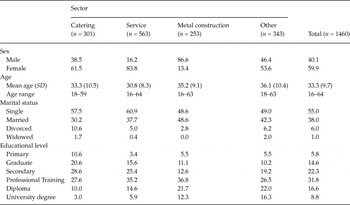
A sample of 1,460 workers, obtained through snowball sampling, from the services (n = 563), metal construction (n = 253) and catering sectors (n = 301), as well as various other sectors (n = 343) was used. Age ranged from 16 to 64 years, with a mean age of 33.3 years and a standard deviation of 9.7. Of the sample, 40.1% were male and 59.9% female. Table 1 shows the descriptive statistics of the total sample and by sectors as a function of sex, age, marital status and educational level.
Description of the sample: percentage of participants in each category

Measurement instruments
Achievement Motivation, Locus of Control and Professional Training Questionnaire (AmLcT-Q). The construction of the questionnaire was carried out according to the psychometric steps for the creation of measurement instruments (AERA, APA, NCME, 1999; Brennan, Reference Brennan2006; Downing, Reference Downing, Downing and Haladyna2006; Schmeiser & Welch, Reference Schmeiser, Welch and Brennan2006; Wilson, Reference Wilson2005). The original questionnaire had 32 items with a 5-point Likert-type response format, where 1 was “strongly disagree” and 5 was “strongly agree” (see Annex). On designing the AmLcT-Q items, we took into account the advances in the assessment of achievement motivation (Byrne et al., Reference Byrne, Mueller-Hanson, Cardador, Thornton, Schuler, Frintrup and Fox2004), diverse facets related to the benefits of and attitudes towards training courses, and attributions of success or failure. Nine items were selected from the Achievement Motivation Inventory (Byrne et al., Reference Byrne, Mueller-Hanson, Cardador, Thornton, Schuler, Frintrup and Fox2004; Schuler et al., Reference Schuler, Thornton, Frintrup and Mueller-Hanson2004) (Items 1, 5, 7, 8, 15, 19, 28, 30, and 31), which were translated into Spanish using the back-translation method, following the international guidelines for the translation and adaptation of tests (Balluerka, Gorostiaga, Alonso-Arbiol, & Haranburu, Reference Balluerka, Gorostiaga, Alonso-Arbiol and Haranburu2007; Hambleton, Merenda, & Spielberger, Reference Hambleton, Merenda and Spielberger2005; Muñiz & Bartram, Reference Muñiz and Bartram2007). The other 23 items were created by a group of experts trained by psychologists and experts in psychometrics. We took into account the previous perspectives already mentioned, especially those of Baum et al., (Reference Baum, Frese and Baron2007), Byrne et al. (Reference Byrne, Mueller-Hanson, Cardador, Thornton, Schuler, Frintrup and Fox2004), Chell (Reference Chell2008); McClelland (Reference McClellan1961), McClelland et al. (Reference McClelland, Atkinson, Clark and Lowell1953), Rauch and Frese (Reference Rauch and Frese2007) and Sánchez García (2010). The construction of the items was carried out according to the rules developed by Moreno and cols. for the construction of multiple-choice items (Moreno, Martínez, & Muñiz, Reference Moreno, Martínez and Muñiz2006). Before the administration of the AmLcT-Q to the final sample, a quantitative pilot study was carried out with a sample of 50 unemployed people, which allowed us to verify participants’ degree of comprehension of the items and the suitability of the items to the work setting.
Procedure
The questionnaire was administered individually, though in some cases where the company context allowed it, a small-group format was used. Participants were informed that their responses were confidential and about the voluntary nature of their participation. Likewise, the employees’ boss or supervisor signed a document allowing the workers to participate in the study and the researchers to collect the data. Participants did not receive any kind of compensation or reward for their participation in the study.
Data Analysis
Data were analyzed in two clearly differentiated sections. Firstly, a study of the psychometric properties of the questionnaire was carried out. Next, the total sample was divided randomly into two subsamples in order to perform a crossed validation (N1 = 649; N2 = 692). In the first of the subsamples, factor analysis with maximum likelihood method was carried out with subsequent Oblimin rotation. The number of factors extracted was determined according to their interpretability and based on the Kaiser criterion and the percentage of variance accounted for. Moreover, a Confirmatory Factor Analysis (CFA) was carried out on this first subsample to verify the factor structure proposed (i.e., three inter-related factors). The estimation method used is that of robust maximum likelihood, as that showing the best fit of the model to the data. At this step, the measurement errors were correlated with the aim of reflecting realistically the constructs being measured (Byrne, Reference Byrne2001). Finally, another CFA was carried out, but this time on the second sample, and without modifying at all the model proposed with the first sample. Evaluation of goodness-of-fit to the sample data was determined on the basis of multiple criteria: the Comparative Fit Index (CFI), the Tucker-Lewis Index (TLI), the Root Mean Square Error of Approximation (RMSEA) and Standardized Root Mean Square Residual (SRMR). Hu and Bentler (Reference Hu and Bentler1999) suggested that RMSEA should be .06 or less for a good model fit and CFI and TLI should be .95 or more, though any value over .90 tends to be considered acceptable. Internal consistency of the subscales was calculated by means of Cronbach’s alpha coefficient. Items with factor loadings or discrimination indexes lower than .25 were eliminated from the questionnaire.
Secondly, we studied the differences in the subscales resulting from the factor analysis of the questionnaire as a function of the participants’ sector. The subscales were developed taking into account the dimensions obtained from the factor analysis carried out. For this purpose, we verified that the parametric assumptions and the sphericity of the subscales were met, and we subsequently conducted univariate analysis of variance (ANOVA), using subscale as dependent variable and labor sector as independent variable. Post hoc comparisons were made with Tukey’s test. The data were analyzed with the SPSS 15.0 (SPSS, 2006), Mplus 5 (Muthén & Muthén, 1998–2007) and FACTOR programs (Lorenzo-Seva & Ferrando, Reference Lorenzo-Seva and Ferrando2006).
Results
Psychometric Properties of the Achievement Motivation, Locus of Control and Professional Training Questionnaire
Factor analysis of the items
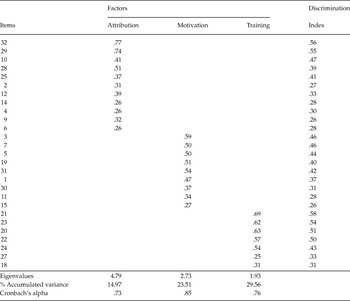
The mean Kaiser-Meyer-Olkin (KMO) sample adequacy index was .81, and Bartlett’s sphericity index was 4091.0 (p < .001). Factor analysis of the items with subsequent Oblimin rotation, extracting three components, accounted for 29.56% of the total variance. The Eigenvalues of the first three factors and the factor loadings are shown in Table 2. The first factor was called External Attribution, and it explained 14.97% of the total variance. This factor is made up of 11 items that refer to workers‘ explanations or attributions of their professional success. Attributions to external causes, such as luck or string-pulling, are external attributions, whereas attributions to one’s efforts and training are considered internal attributions. High scores on this dimension indicate an external attribution style. The second factor was called Achievement Motivation (explaining 8.54% of the total variance), and it comprised 9 items. This dimension refers to the degree of capacity, drive and personal effort in job involvement, and high scores on it indicate adequate achievement motivation in occupational tasks. The third factor was called Training (it accounted for 6.04 % of the total variance). This factor is made up of 7 items. This dimension refers to the relevance of taking training courses, their importance for the workers, and the workers’ attitudes towards them. High scores on this dimension mean that the workers consider training courses to be useful and beneficial. The following correlations between factors were obtained: r = −.077 between Achievement Motivation and External Attribution; r = .287 between Achievement Motivation and Training; and r = −.363 between External Attribution and Training.
Exploratory Factor Analysis of the Items of the Scale

Note:
The items with factor loadings or discrimination indexes lower than .25 were eliminated.
Confirmatory Factor Analysis
In the model, measurement errors were correlated with the aim of showing more realistically the relation between the dimensions studied. The reason for this is that, as Byrne (Reference Byrne2001) argues, in psychological and social research, items of the same dimensions or related dimensions tend to correlate, and it basically makes sense for these correlations to be included in the model. Assessment of the goodness of fit of the data for the two sample halves are shown in Table 3. As it can be seen, the CHI-2 index is statistically significant (probably due to the statistic’s sensitivity to sample size). Even so, following Byrne (Reference Byrne2001), if the CHI-2 value is divided by the degrees of freedom, χ2 = 529.9/298 = 1.78; χ2 = 755.19/298 = 2.53, the values obtained indicate good fit for the first sample (value lower than 2) and relatively acceptable fit for the second. On the other hand, the CFI and TLI indexes are close to .90, the RMSEA is lower than .05 and the SRMR is close to 0.08. In general terms, the CFA appears to indicate adequate fit of the model to the data and to provide reasonable confirmation of the factor structure of three inter-related dimensions.
Confirmatory Factor Analysis with cross-validation of the Items of the Achievement Motivation, Locus of Control and Professional Training Questionnaire

Study of the internal consistency of the subscales
The value of the internal consistency of the Achievement Motivation subscale was .85, External Attribution was .73 and Training was .76. The discrimination indexes of the items for each of the respective subscales were higher than .25. The data referring to Cronbach’s alpha are presented in Table 2.
Descriptive statistics of the items
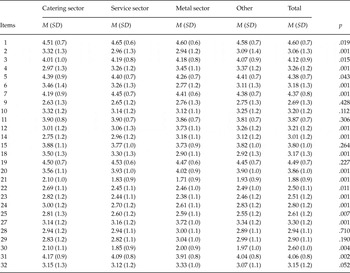
Table 4 shows the means and standard deviations of the items for each of the four sectors studied. As can be observed, most of the items presented statistically significant differences as a function of the labor sector.
Means and Standard Deviations of the Items of the Achievement Motivation, Locus of Control and Professional Training Questionnaire and Differences among the Labor Sectors

Note:
Items 8, 13, 16, 17, and 26 have been removed according to different psychometric criteria.
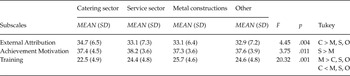
Comparison of the Means with ANOVA of each Subscale for the Labor Sectors Studied

Note:
S = Service sector; M = Metal construction sector; C = Catering sector; O = Other.
Study of the Differences as a Function of Labor Sector
The analysis of variance as a function of labor sector yielded statistically significant differences in all the subscales of the questionnaire. The results can be seen in Table 5. The catering sector scored higher than the rest of the sectors in the dimension External Attribution, F = 4, 45, p = .004. In the dimension Achievement Motivation, the service sector obtained higher levels than the metal construction sector, F = 3, 75, p = .011. Lastly, the metal construction sector scored higher than the rest of the sectors in the Training dimension. In contrast, the catering sector was the labor group with the lowest levels, F = 20, 32, p < .001, in comparison to the rest of the sectors.
Discussion
The study of achievement motivation and locus of control is relevant for increasing our knowledge of the variables that operate in work and organizational settings, thus allowing us to further our understanding of the nature of workers’ motivations and attitudes, and providing an opportunity to optimize the design of assessment strategies and intervention techniques and increase employee performance and productivity, as well as improving business organization (Kleinbeck, Reference Kleinbeck and Fernández-Ballesteros2003). The aim of this study was to assess achievement motivation, locus of control and qualifications in workers from various industrial sectors, using a measurement instrument especially designed for this purpose. Furthermore, we studied the differences in achievement motivation, locus of control and professional qualifications in terms of labor sector of the participants.
The questionnaire developed specifically for this study –the Achievement Motivation, Locus of Control and Professional Training Questionnaire (AmLcT-Q) – following the advances in psychological measurement (Downing, Reference Downing, Downing and Haladyna2006; Moreno et al., Reference Moreno, Martínez and Muñiz2006; Muñiz & Bartram, Reference Muñiz and Bartram2007) revealed adequate psychometric characteristics. This self-report instrument presented three core dimensions: Achievement Motivation, External Attribution, and the importance of attitudes towards Training. AmLcT-Q is a new instrument for the measurement of motivation and training in the business and organizational settings, which joins other instruments already available in this field of work (Amabile et al., Reference Amabile, Hill, Hennessey and Tighe1994; Kleinbeck, Reference Kleinbeck and Fernández-Ballesteros2003; Lang & Fries, Reference Lang and Fries2006; Schuler et al., Reference Schuler, Thornton, Frintrup and Mueller-Hanson2004).
Along the lines of previous studies, achievement motivation seems to behave differentially as a function of type of participant (Dorer, Reference Dorer2001; Woo et al., Reference Woo, Gibbons and Thornton2007). The data clearly show that workers from the catering, service, and metal construction sectors display differentiated behavioral patterns and attitudes, not only in achievement motivation, but also in locus of control and attitudes towards training activities. The catering sector presented higher levels of external attributions of success or failure in comparison to the remaining sectors. In achievement motivation, workers from the service sector presented higher levels than those from the catering sector and others, and the comparison with the metal construction sector was statistically significant. In the training dimension, large differences among the diverse sectors were found, especially in the metal construction and catering sectors. In comparison to the rest of the sectors, the metal construction workers consider training courses to be useful and beneficial. The lowest levels in this dimension were obtained by the workers from the catering sector. Various general conclusions can be drawn from the results obtained: a) all four labor sectors show satisfactory work motivation, obtaining scores well above the theoretical mean of the scale (3), though the service sector obtains the highest scores. The level of effort to avoid failure at work is high in the sectors studied, though the service sector stands out in comparison to the metal construction and catering sectors. b) The catering sector workers consider that no matter what they do, they have no chance of promotion in their corporations, whereas those in the service and metal construction sectors are much more confident about their likelihood of promotion linked to training. This subjective perception may have clear consequences for people’s behavior, because if they consider that, regardless of what they do, they cannot improve their job in the company, they will tend to avoid any training activities. As they perceive no chance of promotion, it is not worth their signing up for training. c) The desire to learn new things about one’s own work is much higher in the service and metal construction sectors than in the catering sector. d) For the metal construction and service sectors, the relation between training and salary level and promotion at work is clear, but the same cannot be said for the catering sector. e) In the catering sector, there is clearly a subjective feeling that training does not correspond to the position, and this does not occur in either the service or metal constructions sectors.
With regard to training courses, a substantial part of the workers consider them a waste of time. The time schedule of the training courses seems to be a significant factor with regard to their acceptance, especially in the service sector, where the number of people who were willing to participate in such courses decreased significantly if they took place out of working hours. In contrast, for the metal construction sector this did not seem to be as important. In the catering sector, the fact that the courses were outside of working hours made them even less attractive. There is more information about training courses in the metal construction sector in comparison to the service and catering sectors. It seems clear that if training is not highly valued by the workers from these sectors, they will not make an effort to seek information about it.
The results of this study should be interpreted in the light of the following limitations. Firstly, it would have been interesting to administer another type of measurement instrument that assesses achievement motivation or locus of control from a different perspective from that of the self-report – using interviews, or supervisors’ opinions, for example. Secondly, it would also have been pertinent to administer another psychological measurement such as personality (e.g., Big Five) to study the convergent-discriminant validity of the questionnaire and its relation to achievement motivation and training. And thirdly, we should stress the correlational nature of the study, so that possible cause-effect conclusions should be drawn with precaution.
Future research should continue to explore the role played by achievement motivation, attributional style and professional training in other labor sectors. The relation of achievement motivation and professional qualification to other psychological variables such as personality, an enterprising attitude, or beliefs associated with training courses, would allow us to further our understanding of some mechanisms that affect productivity and performance in corporations and organizations. Knowledge about the variables influencing better task performance by employees is relevant, with a view to implementing programs to modify attitudes and cognitions in firms and in state policy and potentially improve the productivity of workers and corporations.
APPENDIX Achievement Motivation, Locus of Control and Professional Training Questionnaire (AmLcT-Q)
-
1. I am willing to make an effort to avoid failing at work.
-
2. In my company, no matter what I do, I have no chance of promotion.
-
3. I make an effort to be one of the best at work.
-
4. My job corresponds to my level of knowledge.
-
5. When there are problems at work, I am confident that I can solve them and get on.
-
6. Improving job status does not depend on my level of training.
-
7. I try to learn new things about my job.
-
8. I like to organize work and direct other workers*.
-
9. People who are better trained for their job earn more money.
-
10. In my firm, the relation between professional preparation and promotion is null.
-
11. My co-workers consider me a good worker.
-
12. In my company, some people with less training than me earn more money than I do.
-
13. When I face a difficult task, I like to share the responsibility*.
-
14. I have sufficient information about the training courses that are offered.
-
15. My professional goals for the next 5 years are very clear to me.
-
16. If I were better trained, I could switch corporations and do some job I like better*.
-
17. If you are a good worker, you will be hired no matter how well trained you are*.
-
18. I have no time for training courses.
-
19. I feel proud when I manage to perform a difficult task at work.
-
20. Training courses are useful for my job.
-
21. Training courses are a waste of time.
-
22. Training courses are better for the company than for me.
-
23. The training courses I have attended did not help me in my company.
-
24. Training courses benefit me because of what I learn, but they do not help to improve work status.
-
25. I have not been lucky in my working life.
-
26. I would be willing to attend training courses if they were taught in working hours*.
-
27. I would be willing to attend training courses if they were taught out of working hours.
-
28. Professional success depends on luck.
-
29. Promotion in the company is achieved by string-pulling and not because of one’s own merits.
-
30. I put off for tomorrow what I should do today.
-
31. When I am determined to do something, I don’t stop until I achieve it.
-
32. Landing a good job depends more on “string-pulling” than on training.
Note: * Deleted following psychometric criteria