Commercially available since 1980, the Carpentier-Edwards pericardial (CEP) prostheses are the bioprostheses most used worldwide (Reference Arinaga, Fukunaga and Tomoeda1;Reference Puvimanasinghe, Takkenberg and Eijkemans2). The CEP prostheses are second-generation bioprostheses designed to minimize the rate of valve deterioration and the consequent need for reoperation, which is the main problem associated with the use of bioprostheses. The latest CEP models, such as the Magna Ease (Edwards Lifescience Corporation, Irvine, California, USA), are the result of improvements made to the Perimount model. Their manufacturer points the following advantages of latest CEP models over other bioprostheses: lower profile; contoured and compliant sewing rings; and larger effective orifice areas, which would result in easier insertion, higher coronary ostia clearance and lower transprosthetic gradients. Such lower gradients together with an anti-calcification technology are believed to increase the durability of CEP prostheses. However, clinical superiority of the CEP prostheses over other prostheses models still lacks confirmation.
We performed a systematic literature review with a meta-analysis to assess the clinical outcome after valve replacement using CEP against other prostheses, including porcine, stentless, pericardial and mechanical prostheses. The studied endpoints were operative mortality rate, overall mortality, and reoperation rate.
METHODS
Study Selection and Data Collection
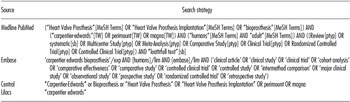
The study protocol was approved by the institutional review board of the Instituto Nacional de Cardiologia, Brazil, under number 18344613.0.0000.5272 on July 23, 2013. The literature survey had no language restrictions and was conducted on August 2013. The data sources were Medline, Embase, Lilacs, and Central databases and the filters used are described in Table 1. In addition, we manually reviewed reference and citation lists of all relevant publications found by our search.
Search Strategy

Two researchers screened titles, abstracts and extracted data. Disagreements were solved by consensus. Studies were included in this meta-analysis if they met the following criteria: (i) use of second-generation or later CEP prosthesis; (ii) adult participants; (iii) mitral or aortic implant; and (iv) type of study was a meta-analysis, systematic review, randomized or observational study. Additionally, only studies with a mean follow-up of at least 5 years were included in the analysis of overall mortality and valve reoperation. Noncontrolled studies and studies that included different types of heart valve prosthesis in the same group (e.g., pericardial and porcine prostheses grouped together) were considered for discussion but not included in meta-analysis. Randomized clinical trials were the first choice for meta-analysis whenever different types of studies were available in the same subgroup analysis.
The following data were extracted from each study: first author's name, year of publication, geographical location, follow-up duration, sex, age, heart prosthesis used, operative mortality rate, overall mortality, and reoperation rate. Operative mortality was defined as the mortality rate up to 30 days after surgery. Overall mortality was defined as mortality rate due to any cause during the total follow-up time of the study.
Statistical Analyses
Calculations were done using statistical software Review Manager version 5.2. and R version 2.15.1. Continuous data are reported as mean ± standard deviation. We used the odds ratio (95 percent CI) as the metric of choice for all outcomes. A two-sided value of p < .05 was considered statistically significant.
Between-study heterogeneity was evaluated with the I2 statistic and was explored by means of meta-regression analysis. The I2 statistic is independent of the number of studies and quantifies heterogeneity on a scale of 0 percent to 100 percent. Very large heterogeneity between studies is usually denoted by I2 values of 75 percent or more (Reference Higgins and Thompson3).
The odds ratio and CIs of comparable studies were illustrated with forest plots. Meta-analyses were performed according to each investigated outcome. Pooled estimates were calculated with a random effects model, which is preferable in the presence of between-study heterogeneity. The quality of the evidence was assessed using the GRADE scale, by means of the methodological quality criteria described in the Cochrane Handbook. For purposes of systematic reviews, the GRADE approach defines the quality of a body of evidence as the extent to which one can be confident that an estimate of effect or association is close to the quantity of specific interest. The GRADE system entails an assessment of the quality of a body of evidence for each individual outcome (Reference Guyatt, Oxman and Vist4). The following criteria were used to assess the risk of bias and methodological quality: study design, length of follow-up, loss to follow-up, directness of evidence, heterogeneity, and precision of effect estimates and risk of publication bias.
RESULTS
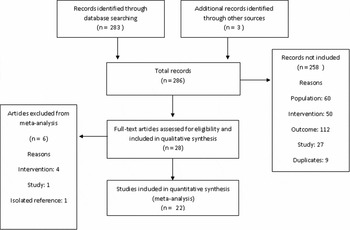
The initial search strategy selected 286 references. The study selection flowchart and the exclusion criteria are summarized in Figure 1. After applying inclusion criteria, one article was found in Lilacs, twenty-four articles in PubMed, and three in EMBASE.
Flowchart of article selection.

Of the twenty-eight articles that met the inclusion criteria, four were randomized (Reference Risteski, Martens and Rouhollahpour5–Reference Stassano, Di Tommaso and Monaco8), and twenty-four were observational studies (Reference Arinaga, Fukunaga and Tomoeda1;Reference Borger, Carson and Ivanov9–Reference Khan, Trento and DeRobertis31). Total number of patients was 19,615: 12,951 patients underwent CEP implants, and 6,664 underwent valve replacements using other kind of prostheses. For the purpose of comparative analysis, the studies were distributed into five groups, according to comparator: noncontrolled studies (eleven), porcine bioprostheses (four), stentless prostheses (four), other pericardial bioprostheses (one) and mechanical prostheses (eight). The list of the twenty-eight studies with first author name, year of publication, study design, number of centers involved, countries, inclusion and exclusion criteria, number of patients, mean age, gender, mean follow-up, and comments related to patients characteristics is available in Supplementary Table 1.
Some studies were considered for discussion but not included in meta-analysis. In the CEP versus porcine prostheses comparison, one study compared valve heart prosthesis of different generations (Reference Gao, Wu, Grunkemeier, Furnary and Starr30) was excluded from meta-analysis. In the CEP versus stentless prostheses comparison, we excluded Borger et al. (Reference Borger, Carson and Ivanov9) from meta-analysis as it was an observational study and performed the meta-analysis with three randomized trials (Reference Risteski, Martens and Rouhollahpour5–Reference Chambers, Rimington, Hodson, Rajani and Blauth7). Only one study (Reference Le Tourneau, Savoye and McFadden10) was available for the comparison between CEP and pericardial prostheses what precluded meta-analysis for this comparator. Regarding CEP versus mechanical prostheses comparison, three studies that grouped pericardial and porcine prostheses together (Reference Stassano, Di Tommaso and Monaco8;Reference Badhwar, Ofenloch, Rovin, van Gelder and Jacobs11;Reference Khan, Trento and DeRobertis31) were excluded from meta-analysis.
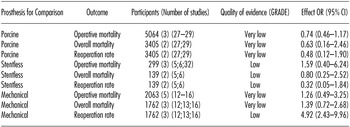
The results were summarized in Table 2 according to outcomes, considering type of prostheses, number of participants and studies, quality of evidence, risk of bias, odds ratio, and confidence interval. The GRADE criteria used is available in Supplementary Table 2.
Summary of Results According to Prosthesis Used for Comparison, Outcome, Quality Assessment, and Effect

Noncontrolled Studies
Eleven studies described the outcome after valve replacement using CEP prostheses without a control group (Reference Arinaga, Fukunaga and Tomoeda1;Reference Forcillo, Pellerin and Perrault17–Reference Poirer, Pelletier, Pellerin and Carrier26). Two such studies were conducted in the United States (Reference Frater, Salomon, Rainer, Cosgrove and Wickham18;Reference Banbury, Cosgrove and Lytle20), three in Canada (Reference Forcillo, Pellerin and Perrault17;Reference Dellgren, David and Raanani25;Reference Poirer, Pelletier, Pellerin and Carrier26), one in Japan (Reference Arinaga, Fukunaga and Tomoeda1) and five in Europe (Reference Ayegnon, Aupart and Bourguignon19;Reference Marchand, Aupart and Norton21–Reference Neville, Aupart and Diemont24). A total of 6,750 patients were followed during 5.9 ± 2.3 years. The operative mortality rate, overall mortality and reoperation rate were respectively 5 percent, 27 percent, and 4 percent. Heterogeneity was explored using meta-regression, and the length of follow-up accounted for 84 percent of the heterogeneity.
CEP versus Porcine Prostheses
Four studies compared the valve replacement outcome of CEP against porcine prostheses (Reference Jamieson, Germann and Aupart27–Reference Gao, Wu, Grunkemeier, Furnary and Starr30). One of these studies (Reference Gao, Wu, Grunkemeier, Furnary and Starr30) was excluded as it compared the second-generation Carpentier prosthesis against a first-generation porcine prosthesis implanted in different periods (1991 to 2002 and 1974 to 1996, respectively).
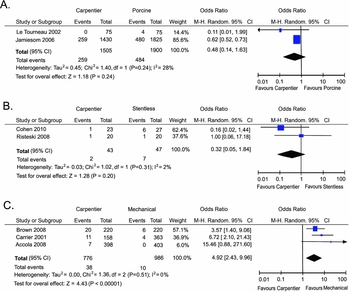
Two papers met the inclusion criteria for the meta-analysis of operative mortality, reoperation rate and overall mortality (Reference Jamieson, Germann and Aupart27;Reference Le Tourneau, Vincentelli and Fayad29), while a third study was only included in the analysis of operative mortality as the mean follow-up of the CEP group in this study was only 3.9 years (95 percent confidence interval, 3.7–4.1 years) (Reference Chan, Kulik and Tran28). The length of follow-up of the other two studies was: 6.5 ± 3.3 (Reference Le Tourneau, Vincentelli and Fayad29) and 5.4 ± 4.0 (Reference Jamieson, Germann and Aupart27) years. No significant differences were found between the two types of prostheses in any of outcomes: odds ratio for operative mortality was 0.74 (95 percent CI 0.46 to 1.17), odds ratio for overall mortality was 0.64 (95 percent CI 0.16 to 2.45) and odds ratio for reoperation was 0.48 (95 percent CI 0.14 to 1.6). The forest plot for reoperation rate is demonstrated in Figure 2A.
Meta-analysis of reoperation rate for Carpentier versus porcine (A), stentless (B), and mechanical prostheses (C). Forest plot shows ORs and 95% CIs for selected studies. The study authors and year of publication are indicated on the y axis. The box for each study is proportional to the inverse of variance; horizontal lines show the 95% CIs of the ORs. The pooled estimate is based on a random effects model shown by a vertical line and diamond (95% CI). There is no difference between reoperation rate for porcine (A) and stentless (B) prostheses. There is a significant advantage for mechanical prostheses in reoperation rate when comparing to Carpentier prostheses (C).

CEP versus Stentless Prostheses
Four studies conducted between 1995 and 2002 compared the valve replacement outcome of CEP against stentless prostheses: one was observational (Reference Borger, Carson and Ivanov9), and three were randomized (Reference Risteski, Martens and Rouhollahpour5–Reference Chambers, Rimington, Hodson, Rajani and Blauth7). The study by Risteski et al. (Reference Risteski, Martens and Rouhollahpour5) enrolled a small number of participants and did not find a difference in hemodynamic performance or clinical outcomes after 5 years. The study by Cohen et al. (Reference Cohen, Zagorski and Christakis6) was the only study with a follow-up longer than 10 years. The percentage of patients lost to follow-up was 18 percent, and there was no significant difference in reoperation or mortality rates between patients who underwent surgery using CEP or stentless prostheses. Chambers et al. (Reference Chambers, Rimington, Hodson, Rajani and Blauth7) reported results relative to only one year of follow-up, and they did not find significant difference relative to reoperation or mortality. The retrospective study by Borger et al. (Reference Borger, Carson and Ivanov9) included the largest number of patients. In addition to the CEP prosthesis, the Mosaic Medtronic prosthesis was also used in the intervention group. The control group was younger than the intervention group (65 ± 11 years vs 72 ± 8 years, respectively; p < .001). Based on multivariate analysis, the authors concluded that mortality was lower in the group with stentless prostheses after a 5-year follow-up.
Only the data from the randomized studies were included in the meta-analysis. Although their heterogeneity was not significant, the results were limited due to the small number of included patients and a low quality of evidence. The results did not indicate a significant difference between the types of prostheses for any of the studied outcomes: odds ratio for operative mortality was 1.59 (95 percent CI 0.40 to 6.24), odds ratio for overall mortality was 0.80 (95 percent CI 0.25 to 2.52) and odds ratio for reoperation was 0.32 (95 percent CI 0.05 to 1.84). The forest plot for reoperation rate is demonstrated in Figure 2B.
CEP versus other pericardial prostheses
Only one study compared different models of pericardial prostheses with a follow-up of less than 5 years. There was no significant difference in the operative mortality between the studied groups (Reference Le Tourneau, Savoye and McFadden10).
CEP versus Mechanical Prostheses
We found seven nonrandomized (Reference Badhwar, Ofenloch, Rovin, van Gelder and Jacobs11–Reference Accola, Scott and Palmer16;Reference Khan, Trento and DeRobertis31) and one randomized study (Reference Stassano, Di Tommaso and Monaco8). In the randomized study, the follow-up of 296 patients who underwent aortic valve replacement between 1995 and 2003 using either CEP or porcine bioprostheses and St. Jude Medical or CarboMedics (mechanical) was compared. After 8.8 ± 2.3 years of follow-up, the reoperation rate was significantly lower among patients who underwent aortic valve replacement using mechanical than bioprostheses (5.5 percent versus 20.4 percent; p = .0003). There was no difference in operative (2.6 percent for mechanical versus 3.9 percent for bioprostheses; p = .4) or overall mortality (27.5 percent for mechanical versus 30.6 percent for bioprostheses; p = .6) between the two groups. In the studies by Badhwar et al. (Reference Badhwar, Ofenloch, Rovin, van Gelder and Jacobs11) and Khan et al (Reference Khan, Trento and DeRobertis31), pericardial and porcine prostheses were assessed together, whereas in the remainder of the studies, only the CEP prosthesis was considered for interventions. Because the aim of the present review was to compare CEP against other prostheses, only the studies that included exclusively CEP prostheses in the biological prosthesis group were selected for outcome analysis against mechanical prostheses (Reference Brown, Schaff and Lahr12–Reference Accola, Scott and Palmer16). The pooled data of the five studies did not demonstrate differences in operative mortality between CEP and mechanical prostheses (odds ratio 1.26 [95 percent CI 0.49 to 3.25]). However, two (Reference Weber, Noureddine and Englberger14;Reference Sakamoto, Hashimoto and Okuyama15) of these five studies had a follow-up of less than 5 years and only three studies (Reference Brown, Schaff and Lahr12;Reference Carrier, Pellerin and Perrault13;Reference Accola, Scott and Palmer16) were selected for the analysis of reoperation rate and overall mortality between CEP and mechanical prostheses. The meta-analysis found a significantly higher reoperation rate when CEP prostheses were used: the odds ratio for reoperation was 4.92 (95 percent CI 2.43 to 9.96) (Figure 2C). On the other side, no difference was found between the two groups regarding overall mortality: odds ratio for overall mortality was 1.39 (95 percent CI, 0.72–2.68).
DISCUSSION
In the present study, we aimed to assess the clinical efficacy of CEP prostheses to justify the current widespread use of this kind of prostheses. Therefore, the studied outcomes were reoperation or mortality instead of the hemodynamic profile or LV regression mass.
The studies selected in this systematic review presented a large heterogeneity and there were few studies with a long follow-up. In fact, the follow-up length was the main variable associated with the heterogeneity of noncontrolled studies. Therefore, we arbitrarily chose a minimum of 5 years of follow-up for the analysis of the overall mortality and reoperation rates. We could not select a longer follow-up due to the scarcity of data.
Noncontrolled Studies
The lack of randomization and comparison between prostheses in noncontrolled studies precluded the homogenization of several possible confounding factors, such as periods of observation, countries, techniques, surgical staff, and lengths of follow-up. Thus, the results of the meta-analysis of those studies revealed a large heterogeneity with an I2 higher than 95 percent for the outcomes of reoperation rate and overall mortality, which limited the reliability of the results.
The length of follow-up is of utmost importance when comparing outcomes of different studies involving CEP prosthesis. Reoperation rate was as low as 0.2 percent during a short follow-up of 1.7 ± 1.7 years (Reference Torka, Salefsky and Hacker23) but reached 18 percent after 8.9 ± 3.1 years of follow-up (Reference Ayegnon, Aupart and Bourguignon19). The same held true for overall mortality which ranged from 11 percent in the study with the shortest follow-up (Reference Torka, Salefsky and Hacker23) to 51 percent after 8.8 ± 3.7 years of follow-up (Reference Banbury, Cosgrove and Lytle20). There were no studies with a mean follow-up over 10 years. However, the quality of the studies was limited and comparison to results obtained in other studies using other models of prostheses was hindered. Nevertheless, patients older than 65 years old undergoing aortic valve replacement with a porcine bioprosthesis presented a structural deterioration rate of less than 10 percent at 10 years (Reference Cohn, Collins and Rizzo32), which seems to be a better result than the described for CEP prosthesis in noncontrolled studies.
CEP versus Porcine Prostheses
Porcine and pericardial prostheses have been used for valve replacement since 1970. Second-generation prostheses were developed in the 1980s to reduce their structural deterioration and improve their hemodynamic profile. Despite the technological advances, the relative influence of the type of prosthesis on relevant outcomes, such as mortality and reoperation rates, by comparison pericardial to porcine prostheses cannot be yet assessed due to a lack of sufficient data, and no conclusion can be inferred regarding the superiority of one model over another (Reference Jamieson, Germann and Aupart27).
In the present review, the data of three studies (Reference Jamieson, Germann and Aupart27–Reference Le Tourneau, Vincentelli and Fayad29) were pooled for the comparison of operative mortality between CEP and porcine prostheses. However, one of these studies (Reference Chan, Kulik and Tran28) had a follow-up of less than 5 years and only two studies (Reference Jamieson, Germann and Aupart27;Reference Le Tourneau, Vincentelli and Fayad29) were selected for the analysis of reoperation rate and overall mortality between CEP and porcine prostheses. The meta-analysis did not reveal differences between the two types of prostheses in any of the studied outcomes. However, Jamieson et al. (Reference Jamieson, Germann and Aupart27), which included a larger number of patients than Le Tourneau et al. (Reference Le Tourneau, Vincentelli and Fayad29) (3,255 versus 150), found superiority of the CEP prostheses. On the other hand, the results of Jamieson et al. (Reference Jamieson, Germann and Aupart27) should be interpreted cautiously because the length of follow-up was different between the two studied groups. The patients who received the porcine prostheses were followed for a longer period than those who received CEP prostheses (7.9 ± 4.9 versus 5.4 ± 4.0 years), which may have increased the odds of events in the former and favored the latter. In addition, the number of patients subjected to previous (3 percent versus 1 percent; p < .001) or concomitant (43 percent versus 18 percent; p = .001) coronary artery bypass graft surgery were higher in the group who received porcine bioprostheses, which may have contributed to a higher mortality (Reference Jamieson, Germann and Aupart27).
CEP versus Stentless Prostheses
Stentless bioprostheses were developed to improve hemodynamic parameters by increasing the effective orifice area, which is achieved precisely because there is no metallic stent. Maximization of the effective orifice area is believed to be associated with lower transprosthetic gradients and greater left ventricle mass regression at the expense of a longer surgical duration and greater difficulties for reoperation (Reference Borger, Carson and Ivanov9).
Our results were limited because they were based only on three studies (Reference Risteski, Martens and Rouhollahpour5–Reference Chambers, Rimington, Hodson, Rajani and Blauth7) that, although randomized, exhibited a considerable number of cases lost to follow-up and included a small number of patients. Further studies are needed to compare the efficacy of these two models of prostheses.
CEP versus Mechanical Prostheses
A comparison between CEP and mechanical prostheses belongs to a wider-scoped debate on mechanical versus biological prostheses. In a recent publication, the American Association for Thoracic Surgery described a dramatic decrease in the use of mechanical prostheses (from 68 percent in 2000 to 37 percent in 2007) and a correspondent increase in the use of bioprostheses among 25,671 isolated mitral valve replacements (Reference Bacelar, Lopes and Fernandes33). Despite the broad consensus on the type of prosthesis that should be indicated in youths and in older adults, the choice of the best type for individuals aged 55 to 70 years old continues under debate.
The studies included in the present review had considerable limitations. The main limitation was the lack of randomization. The choice of the prosthesis used was made by surgeons, thus leading to a selection bias: younger patients received mechanical prostheses, while older patients received bioprostheses. In fact, there was a significant difference in the age between studied groups in half of the selected studies (Reference Badhwar, Ofenloch, Rovin, van Gelder and Jacobs11;Reference Weber, Noureddine and Englberger14;Reference Sakamoto, Hashimoto and Okuyama15;Reference Khan, Trento and DeRobertis31). Further selection biases may also have occurred, as indication of bioprosthesis instead of mechanical prostheses for patients in critical conditions to avoid the risk associated with anticoagulation. Nevertheless, meta-analysis of the included studies in this review demonstrated lower reoperation risk among patients who received mechanical prostheses. Therefore, despite the advances in bioprostheses, we did not find evidence to change the current recommendations to avoid their use in patients younger than 65 years old (Reference Bacelar, Lopes and Fernandes33).
Clinical Implications
Although current generation bioprostheses present improved hemodynamic profile (Reference Bacelar, Lopes and Fernandes33), we were not able to find enough data in the current literature to support their indication over other prostheses models. Therefore, the search for an ideal prosthetic valve that combines excellent hemodynamic profile, long-term durability, and low thromboembolic risk is still an ongoing process. We believe that robust, large-scale, multicenter, randomized trials comparing CEP bioprosthesis against other type of prostheses are necessary.
We ran a search on www.clinicaltrials.gov on March 28, 2014, using the term “Carpentier-Edwards” and we located only four studies using the latest CEP models. The “Carpentier-Edwards Perimount Magna Ease pericardial bioprosthesis, model 3300 TFX”, aims to demonstrate the long-term safety and efficacy of the Carpentier-Edwards Perimount Magna Ease in patients undergoing aortic valve replacement. The “Magna Mitral Pericardial Bioprostheses Post-Approval Study Protocol” aims to demonstrate the long-term safety and efficacy of Carpentier-Magna Perimount Magna Mitral valves in patients undergoing mitral valve replacement. The third trial was the “Randomized Sizing and Hemodynamic Study Mitroflow versus Magna” which compared implant sizing techniques and hemodynamics between the Mitroflow Pericardial Aortic Valve and the Edwards Magna Heart Valve. The last trial, “Magna Mitral – 23 mm” aims to obtain clinical data on the safety and effectiveness of the 23-mm Carpentier-Edwards Perimount Magna mitral pericardial valve, model 7000TFX. We believe that none of these studies will change the actual scenario due to lack of head-to-head studies.
Limitations
The main limitation of the present review was the lack of randomized and long-term studies. In fact, only four (Reference Risteski, Martens and Rouhollahpour5–Reference Stassano, Di Tommaso and Monaco8) of the 28 selected studies were randomized and most of the meta-analyses indicated poor quality of evidence and significant heterogeneity. The lack of detailed information in the selected studies precluded adjustments for confounders which increased the risk of bias. Therefore, we did a meta-regression that concluded that the follow-up was responsible for 84 percent of heterogeneity. Thus, we selected studies with at least 5 years of follow-up for the outcomes of overall mortality and reoperation rate to decrease the risk of bias due to confounders. Studies that used the latest CEP prostheses models were not included in this analysis as there was no study with a mean follow-up of at least 5 years.
Therefore, the low quality of the data and missing information regarding new generation CEP valves limit the conclusions of our systematic review, especially for long-term recommendations.
Conclusions
Based on the current meta-analysis, there is no evidence of clinical superiority of the CEP prostheses over other models of bioprostheses or mechanical prostheses. On the contrary, reoperation rate was lower among patients that received mechanical prostheses than CEP prostheses. However, there were significant limitations due to the lack of randomization, poor quality and high heterogeneity. Therefore, more large-scale, multicenter, randomized trials comparing CEP bioprostheses and other last generation bioprostheses against other type of prostheses are needed.
SUPPLEMENTARY MATERIAL
Supplementary Tables 1 and 2 http://dx.doi.org/10.1017/S0266462315000148
CONFLICTS OF INTEREST
The authors have no conflits of interest to declare.