Introduction
Miscanthus x giganteus has been studied and cultivated as a bioenergy crop in Europe and the USA (Hodkinson and Renvoize, Reference Hodkinson and Renvoize2001; Lewandowski et al., Reference Lewandowski, Scurlock, Lindvall and Christou2003). Due to its sterile triploid nature, reproduction in M. x giganteus is achieved through vegetative propagation, such as rhizome and tissue culture, resulting in high expenditure (Christian et al., Reference Christian, Yates and Riche2005). It is believed that M. x giganteus is an allotriploid hybrid (2n= 3x= 57) of Miscanthus sinensis (2n= 2x= 38) and Miscanthus sacchariflorus (2n= 4x= 76) (Hodkinson et al., Reference Hodkinson, Chase, Lledó, Salamin and Renvoize2002), indicating that M. sinensis and M. sacchariflorus are important sources for Miscanthus breeding. The study of genetic diversity in crop species has contributed to the conservation of genetic resources, broadening of the genetic bases, and practical applications in breeding programmes (Amini et al., Reference Amini, Saeidi and Arzani2008). To design a relevant breeding programme, it is important to know how much the phenotypic variation of a trait is heritable and diverse (Kearsey and Pooni, Reference Kearsey and Pooni1996).
Most of the Miscanthus species are native to Eastern or Southeastern Asia (Hodkinson et al., Reference Hodkinson, Chase, Lledó, Salamin and Renvoize2002). M. sinensis and M. sacchariflorus are native to East Asia including China and Korea, leading to the assumption that this region has high genetic diversity. Therefore, in this study, we collected Miscanthus germplasms in Korea and neighbouring East Asian countries including Primorsky Krai in Russia, a potential area for Miscanthus biomass production (Chung and Kim, Reference Chung and Kim2012), and evaluated their agronomic traits to investigate genetic diversity and to correlate their agronomic traits with biomass yield and geographical location of the collection sites.
Materials and methods
In May 2010, 66 Miscanthus accessions (consisting of 2 M. x giganteus, 22 M. sacchariflorus and 42 M. sinensis accessions) (Fig. S1, available online) were planted in a field at the experimental farm station of Seoul National University, Suwon (N 37° 16′ 12.05″ and E 126° 59′ 27.46″), Korea. A nitrogen fertilizer was applied at a dose of 60 kg N/ha/year in early June, and weed management was conducted manually and using a herbicide. All the accessions were planted at a density of 1 plant/m2 and grown for 3 years.
In the third year after planting, five agronomic traits such as heading date, plant height, number of stems, stem diameter and stem dry weight were assessed. Heading date was determined when a panicle emerged from the tip of the stem. At maturity in November 2012, plant height, the number of stems and stem diameter were measured before harvest. The stem diameter was measured at the mid-point of the second or third basal node using vernier callipers. The number of productive stems per plant was considered to be the number of stems. After oven-drying of the harvested stems at 80°C for 48 h, the stem dry weight was recorded. Biomass yield was then estimated based on plant dry weight and the number of plants at a planting space of 1.0 m × 0.75 m, equivalent to 13,300 plants/ha. Correlation analyses were conducted for the five agronomic traits, biomass yield and geographical latitudes. All statistical analyses were carried out using Genstat 5 (Genstat Committee, 1997).
Results and discussion
The range of variations in the five agronomic traits among the accessions is summarized in Table S1 and Fig. S2 (available online). Plant height ranged from 140.0 to 390.0 cm, with M. x giganteus being the tallest. Interestingly, accessions collected from Russia were shorter than those collected from other regions, suggesting that their short vegetative growth period due to differences in latitudes between Russia and Korea does not allow sufficient stem growth.
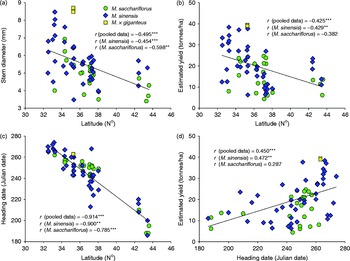
The stem diameter of M. sinensis (average = 5.7 mm) was thicker than that of M. sacchariflorus (average = 4.8 mm). This difference was associated with latitudes of the collection sites, with Miscanthus collected from southern regions having thicker stems than that collected from northern regions (Fig. 1(a)).
Relationships of stem diameter (a), estimated yield (b) and heading date (c) with the latitude of Miscanthus collection sites and the relationship between estimated yield and heading date (d), ** and ***indicate statistical significance at the 0.01 and 0.001 levels, respectively.

The stem dry weight of M. sinensis (average = 20.2 g) was also greater than that of M. sacchariflorus (average = 12.3 g). The number of stems ranged from 13 to 152 and 58 to 160 pieces per plant in M. sinensis and M. sacchariflorus, respectively. Unlike other traits, this was not associated with latitudes of the collection sites.
Biomass yields ranged from 4.3 to 39.5 tonnes/ha, with averages of 39.2, 20.3 and 15.2 tonnes/ha in M. x giganteus, M. sinensis and M. sacchariflorus, respectively. Most of the M. sinensis accessions exhibited inferior yield potential when compared with M. x giganteus, which is in agreement with the findings reported by Hotz et al. (Reference Hotz, Kuhn, Jodl, Chartier, Ferrero, Henius, Hultberg, Sachau and Winblad1996). However, one M. sinensis accession (SNU-M014) collected from Jeju produced 38.4 tonnes/ha of dry biomass, similar to M. x giganteus. Clifton-Brown et al. (Reference Clifton-Brown, Lewandowski, Andersson, Basch, Christian, Kjeldsen, Jørgensen, Mortensen, Riche, Schwarz, Tayebi and Teixeira2001) and Clifton-Brown and Lewandowski (Reference Clifton-Brown and Lewandowski2002) also reported that some M. sinensis accessions produce high biomass yields as M. x giganteus does. Most of the accessions collected from the southern part of Korea, Japan and Taiwan exhibited a higher biomass yield than those collected from the northern part of China and Russia (N 37° 16′ 12.05″). However, the range of variations in biomass yield among the accessions from the same latitude indicates high genetic diversity (Fig. 1(b)).
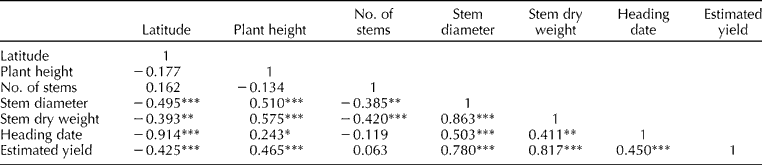
Overall, the range of variations in the five agronomic traits among the accessions was associated with biomass yield and latitudes of the collection sites (Table 1 and Fig. 1). Plant height (r= 0.465, P< 0.001), stem diameter (r= 0.780, P< 0.001), stem dry weight (r= 0.817, P< 0.001) and heading date (r= 0.450, P< 0.001) were significantly correlated with biomass yield. Interestingly, we found that stem diameter (r= − 0.495, P< 0.001), stem dry weight (r= − 0.393, P< 0.01), heading date (r= − 0.914, P< 0.001) and biomass yield (r= − 0.425, P< 0.001) exhibited a significantly negative correlation with latitudes of the collection sites (Table 1 and Fig. 1). The significant association between heading date and latitudes of the collection sites (Fig. 1(c)) indicates photoperiodic and thermal influences on heading date as reported by Jensen et al. (Reference Jensen, Farrar, Thomas-Jones, Hastings, Donnison and Clifton-Brown2011) and Zhao et al. (Reference Zhao, Wang, He, Yang, Pan, Sun and Peng2013). The wide range of heading dates among the M. sinensis accessions collected from a similar latitude of 37° indicates genetic diversity in their reproductive responses to the same environment. The widely scattered decrease in stem diameter and biomass yield with latitudes of the collection sites (Fig. 1(a) and 1(b)) resulted in a less significant association between biomass yield and heading date (Fig. 1(d)). This indicates that they are influenced by various factors other than photoperiod and Miscanthus accessions tested are genetically diverse. Delayed heading appeared to result in higher biomass but not always, suggesting that in some accessions, heading determines Miscanthus biomass yield as it controls the duration of vegetative growth. Clifton-Brown et al. (Reference Clifton-Brown, Lewandowski, Andersson, Basch, Christian, Kjeldsen, Jørgensen, Mortensen, Riche, Schwarz, Tayebi and Teixeira2001) also obtained a similar result indicating a significant association between biomass yields and flowering timing. In determining biomass yield, stem weight was the most significant contributor followed by stem diameter in both M. sinensis and M. sacchariflorus (Table S2, available online), suggesting that these two traits are target traits to be improved by breeding. The presence of a significant relationship between latitudes and agronomic traits suggests that accessions collected from different geographical latitudes will provide more genetically diverse materials with respect to agronomic traits for breeding efforts, such as controlling Miscanthus flowering timing for artificial cross and breeding Miscanthus varieties adapted to various locations.
Summary of correlation analyses carried out for the five agronomic traits, estimated biomass yield and latitude of Miscanthus collection sites

*, ** and *** indicate statistical significance at the 0.05, 0.01 and 0.001 levels, respectively.
In summary, we demonstrated that Miscanthus accessions collected in East Asia have a wide range of variations in each agronomic trait, exhibiting a close relationship between biomass yield and collection sites. This result will provide an opportunity to select proper parents for future breeding of Miscanthus species, aiming at high biomass yield with high regional adaptability.
Supplementary material
To view supplementary material for this article, please visit http://dx.doi.org/10.1017/S1479262114000604
Acknowledgements
This research was supported by iPET (Korea Institute of Planning and Evaluation for Technology in Food, Agriculture, Forestry and Fisheries), Ministry for Food, Agriculture, Forestry and Fisheries, Republic of Korea.