Nomenclature
-
 $\mathrm{S}_{\mathrm{A}}$
global coordinate system
-
$\mathrm{S}_{\mathrm{B}}$
moving coordinate system
-
$\varphi$
inclination angle of tool
-
$\omega$
rotational speed of tool
-
$k$
feed rate of tool
-
$h$
feed distance of tool
-
$_{B}^{A}\hspace{0pt}\boldsymbol{R}$
rotation matrix
-
$\boldsymbol{p}_{OB}$
position vector of point
$O_{B}$
in
$\mathrm{S}_{\mathrm{A}}$
-
$r_{B}$
radius of moving platform
-
$\theta _{Bi}$
center angle of moving platform joint
-
$d$
height of tool
-
$\boldsymbol{b}_{i}$
position vector of point
$B_{i}$
in
$\mathrm{S}_{\mathrm{A}}$
-
$\boldsymbol{a}_{i}$
position vector of point
$A_{i}$
in
$\mathrm{S}_{\mathrm{A}}$
-
$\theta _{Ai}$
center angle of fixed base joint
-
$l$
length of the link
-
$r_{A}$
distance between the initial position of the slider and the origin of
$\mathrm{S}_{\mathrm{A}}$
-
$s_{i}$
displacement of the slider
-
$\boldsymbol{v}_{Ai}$
velocity of the spherical joint on the fixed base
-
$\boldsymbol{v}_{Bi}$
velocity of the spherical joint on the moving platform
-
$\boldsymbol{l}_{i}$
unit vector along the link
-
$\boldsymbol{r}_{i}$
vector
$\overline{\boldsymbol{O}_{B}\boldsymbol{B}_{i}}$
in
$\mathrm{S}_{\mathrm{A}}$
.-
$v_{i}$
magnitude of velocity of the slider
-
$\boldsymbol{J}_{v}$
Velocity Jacobian matrix for 6-PSS PKM
-
$s_{\max },s_{\min }$
maximum and minimum values of slider displacement
-
$\theta _{\max }$
maximum value of the angle of the spherical joint
-
$\boldsymbol{f}$
forming force
-
$\boldsymbol{m}$
forming torque
-
$\Delta \boldsymbol{X}$
linear deformation
-
$\Delta \boldsymbol{\theta }$
angular deformation
-
$\boldsymbol{K}$
stiffness matrix
-
$f_{i}$
axial force of the link
-
$\Delta l_{i}$
deformation of the link
-
$k_{i}$
stiffness of the link
-
$A$
cross-section area of each link
-
$E$
elastic modulus of link material
-
$\boldsymbol{J}_{\boldsymbol{f}}$
link force transfer Jacobi matrix for 6-PSS PKM
-
$F_{z}$
magnitude of forming load
-
$R$
arm of forming load
-
$\mathbf{c}_{\mathbf{i}}$
position vector of point
$C_{i}$
in the tool-
$\Delta e$
deformation error of the PKM
-
$\lambda ^{s}$
workspace utilization rate considering deformation error
-
$\tau _{i}$
actuated force of the sliders
-
$n_{i}$
servo motor speed
-
$n_{\max }$
maximum speed of the servo motor
-
$h_{s}$
lead of the roller screw
-
$\eta$
transmission efficiency of roller screw
-
$T(n_{i})$
servo motor torque
-
$[T(n_{i})]$
maximum servo motor torque
-
$\lambda ^{m}$
workspace utilization rate considering motor loading performance
-
$\lambda ^{t}$
synthesized workspace utilization rate


1. Introduction
PKM is a closed-loop kinematic chain mechanism whose moving platform is connected to the fixed base by multiple independent kinematic chains [Reference Weck and Staimer1]. Due to their advantages of high stiffness, strong bearing capacity, and high motion accuracy, parallel kinematic machines (PKMs) are widely used in machining [Reference Katz and Li2–Reference Lian, Sun, Song, Jin and Price7], polishing [Reference Chong, Xie, Liu, Wang and Niu8, Reference Guo, Cheng, Wang and Li9], milling [Reference Le, Mills and Benhabib10], and transformation [Reference Du, Li, Wang, Ma, Li and Wu11, Reference Chablat, Michel, Bordure, Venkateswaran and Jha12]. Nowadays, to improve their application, researchers focus on various aspects such as kinematics, stiffness, dynamics, and control methods. Among these, the workspace of PKM is one of the most fundamental problems. The workspace of a PKM is the working area of the moving platform, serving as an important index for measuring the performance of the PKM. Currently, the commonly used methods for calculating workspaces include analytical methods and numerical methods.
The analytical method involves using the geometric relationships of PKMs to determine the boundaries of their workspaces. For instance, based on the inverse kinematics of a classical 6-degree of freedom (DoF) PKM, Gosselin [Reference Gosselin13] calculated the spherical region of joint intersection points and derived the positional workspace boundaries by considering the range limitations of the branch chains at the intersection points on the plane. For analyzing the workspace of complex PKMs, Saadatzi [Reference Saadatzi, Masouleh and Taghirad14] employed CAD tools to quantitatively describe and expedite the solution process. Stepanenko et al. [Reference Stepanenko, Bonev and Zlatanov15] utilized SolidWorks CAD software to determine the workspace of a 3T-1R PKM using geometric methods. The workspace of PKMs is constrained by factors such as mechanical joint limits, actuator ranges, and singular configurations [Reference Merlet16].
The numerical method utilizes kinematic theory to explore the workspace of mechanisms globally under various constraints. Li et al. [Reference Li, Wang, Chen and Zhang17] introduced a method for determining a prescribed flexible orientation workspace that considers initial orientation and rotation range. The workspace of a 3-RRR PKM was calculated using numerical methods, demonstrating its ability to mitigate irregularities. Li et al. [Reference Li, Zuo, Zhang, Dong, Zhang, Tao and Ji18] proposed a 2-UPS/RRR PKM for ankle rehabilitation, calculating its workspace using a numerical search method considering joint constraints of the parallel mechanism. Efficiency in search can be enhanced using methods such as the Monte Carlo approach [Reference Tian, Ma, Xia, Ma and Li19, Reference Chaudhury and Ghosal20]. Yan et al. [Reference Yan, Huang, Li and Zhou21] developed a novel 4PUS-PPPU PKM with redundant actuation, providing an analytical solution to its kinematic inverse problem and determining its workspace. Shen et al. [Reference Shen, Tang, Wu, Li, Li and Yang22] introduced a new 2T1R PKM and computed its reachable workspace through forward position solutions constrained by joint ranges. Badescu et al. [Reference Badescu and Mavroidis23] employed the Monte Carlo method to analyze the workspace of 3-UPU and 3-UPS PKMs, quantifying workspace volume as an optimization objective. Kuang et al. [Reference Kuang, Qu, Li, Wang and Guo24] proposed a reconfigurable parallel manipulator and computed its workspace using numerical methods based on inverse kinematics. He et al. [Reference He and Zhen25] used a point mapping method to solve the workspace of a planar parallel mechanism based on forward kinematics, analyzing limb length impacts on workspace to guide mechanism optimization. Hosseini et al. [Reference Hosseini and Daniali26] studied the Tricept parallel manipulator, solving its workspace based on inverse position solutions and analyzing singularities through condition numbers. Peng et al. [Reference Peng, Cheng, Che, Zheng and Cao27] introduced a new 1T2R PKM for hydraulic support loading tests, defining and calculating good transmission direction workspace, regular transmission direction workspace, and average transmission index within the regular workspace. Huang et al. [Reference Huang and Tsai28] proposed a general method to calculate the workspace of various 6-DoF PKMs by solving constraint equations related to spherical joint limits and link interactions. Su et al. [Reference Su, Yuan, Liang, Yan, Zhang, Jian, He and Zhao29] proposed a redundant PKM to expand the workspace of Stewart parallel mechanisms, calculating its workspace considering limb interference and length constraints. Dastjerdi et al. [Reference Dastjerdi, Sheikhi and Masouleh30] analyzed the analytical workspace solution for Delta parallel robots and optimized their dimensional design for a specified workspace. Jha et al. [Reference Jha, Chablat, Baron, Rouillier and Moroz31] employed the Cylindrical Algebraic Decomposition Algorithm to analyze workspace and joint space for delta parallel robots. Xu et al. [Reference Xu, Cheung, Li, Ho and Zhang32] derived joint sub-workspaces and intersected them to obtain the moving platform’s workspace for a 3-PSS PKM by analyzing kinematic restrictions and geometric relations of kinematic pairs.
In summary, the estimation of PKM workspaces typically relies on theoretical geometric calculations, which are effective under light load conditions. However, heavy loads can lead to excessive deformation in specific poses and may reduce PKM stiffness, thereby restricting practical workspace. Additionally, heavy loads can impact motor performance, potentially causing insufficient loading in certain poses, further limiting PKM workspace. Thus, beyond geometric constraints, practical workspace for heavy-load PKMs is influenced by both mechanical deformation and motor performance. It is essential to consider these factors simultaneously when estimating the workspace for heavy-load PKMs.
This paper aims to develop a new multi-DoF forming machine with a 6-PSS PKM designed for heavy loads, proposing a novel workspace estimation method that accounts for both mechanical deformation and motor loading performance. Initially, the geometric workspace of the machine is predicted based on its geometric configuration. Subsequently, workspaces considering mechanical deformation and motor loading performance are individually assessed and a new index of workspace utilization rate is proposed. Finally, comprehensive workspace estimation is synthesized by concurrently considering both mechanical deformation and motor loading performance.
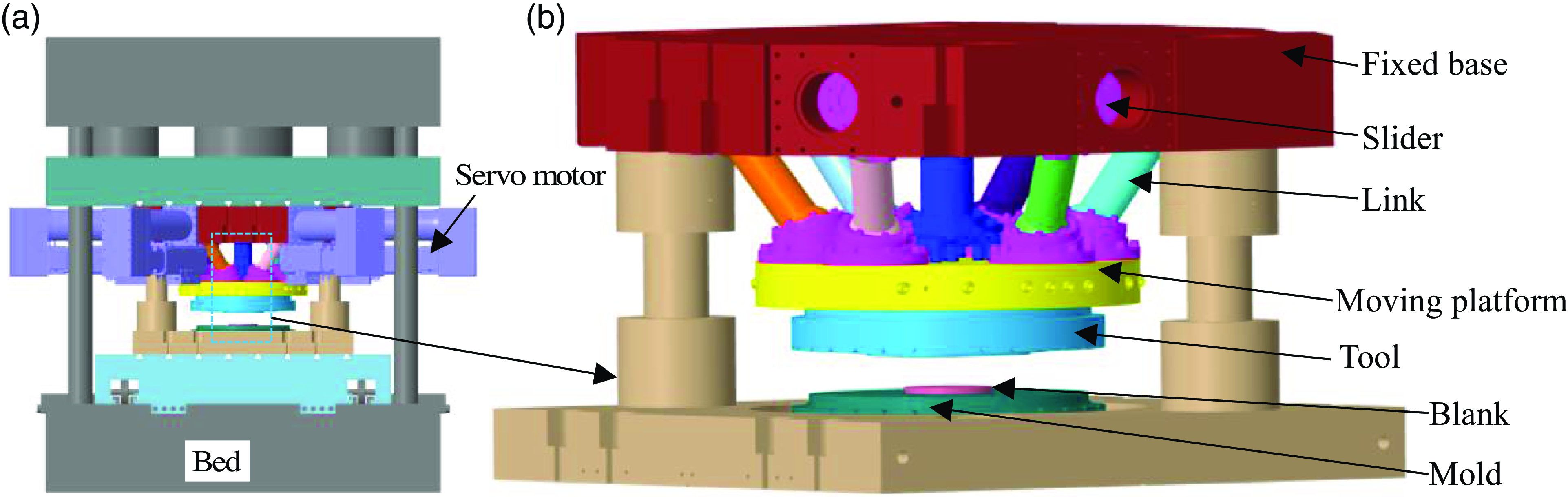
Three-dimensional model of multi-DoF forming machine and 6-PSS PKM. (a) 3D model of multi-DoF forming machine (b) 3D model of 6-PSS PKM.

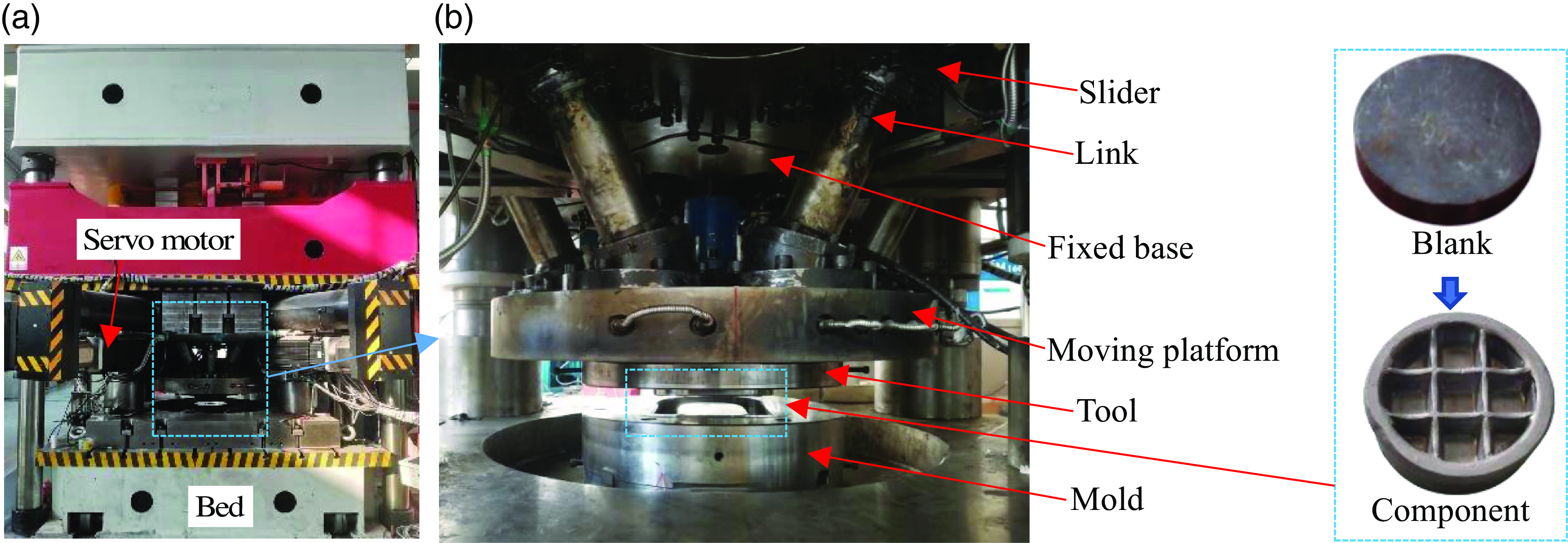
Protype of multi-DoF forming machine. (a) Multi-DoF forming machine (b) 6-PSS PKM.

2. Workspace of PKM with geometric constraint
2.1 Configuration of heavy load multi-DoF forming machine
In order to realize the multi-Dof forming, a heavy load multi-DoF forming machine with 6-PSS configuration has recently been developed. The overall configuration of the multi-DoF forming machine is shown in Figure 1, and the protoype is displayed in Figure 2. The machine mainly consists of a bed and a 6-PSS PKM system. The PKM consists of a moving platform, fixed base, and six links. Each link connects the slider to the moving platform by two spherical joints. The six sliders connect the fixed base by prismatic joints and are driven by six servo motors. The largest forming force of the machine with PKM can reach 6000 kN.
In order to bear such a heavy forming load, the following consideration is addressed in the configuration of the new PKM: (1) the sliders are set to move on the horizontal plane; (2) the vertical angles of links are set to be small and reduced along the feeding; (3) the high stiffness ball seat structure with sliding contact for S joint is used.
In the multi-DoF forming process, the six servo motors drive the sliders to move along the guider direction and make the links conduct spatial motion. Hence, the moving platform and the attached tool will realize the required multi-DoF motion driven by the six links together. The blank is placed in the fixed mold, which is attached to the bed of machine. With the multi-DoF loading of tool, the blank is forced to undergo incremental plastic deformation and the metal flows multidirectionally to fill the tool cavity until the target shape of complicated component is achieved. Compared to the common single DoF overall forming process, the technical advantages of multi-DoF local forming process include that the forming force is much smaller, the geometry shape of formed component is much more complicated, and the microstructure and mechanical properties are much better.
Besides, the proposed heavy load parallel kinematic machine works with relatively low motion speed (max to 1 r/s), and the dynamic influences are not remarkable, thus the statics of the manipulator can be used to analyze the actuator effort and deflection in this work.
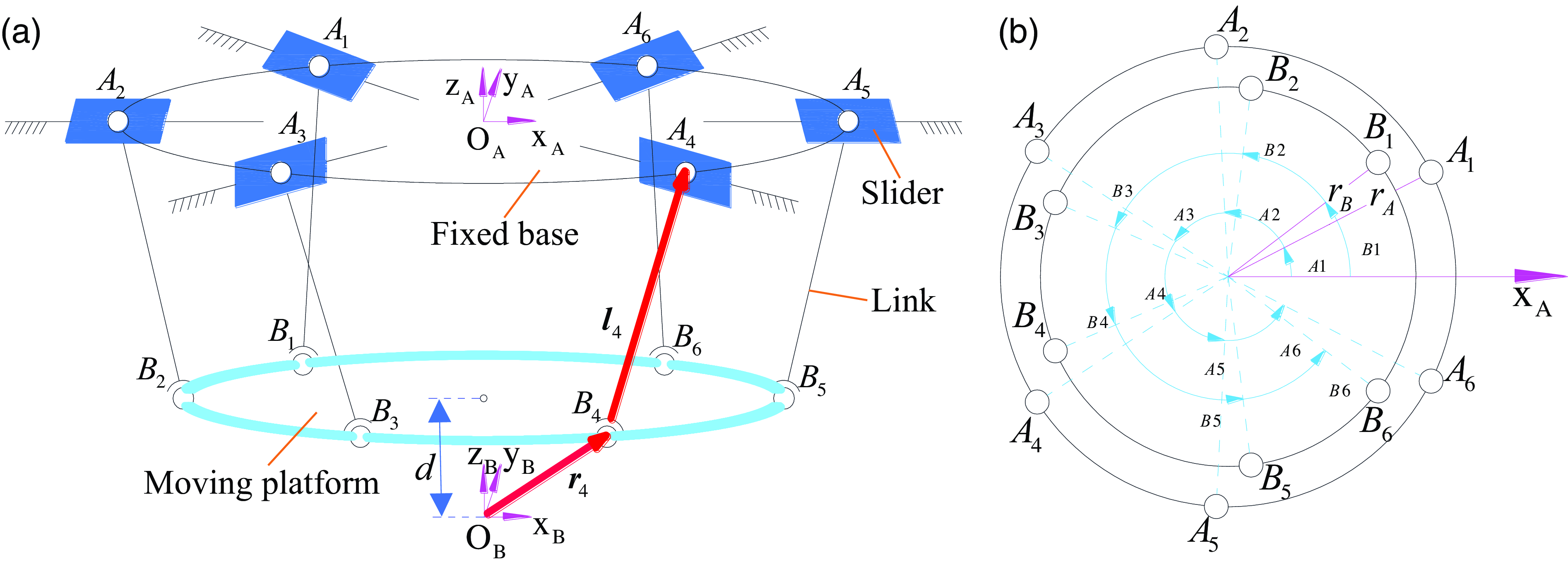
Schematic diagram of inverse kinematics of 6-PSS PKM and layout of spherical joints. (a) Schematic diagram of inverse kinematics of 6-PSS PKM (b) Layout of spherical joints.

2.2 Inverse kinematics of PKM
The kinematics of PKM can be divided into forward kinematics [Reference Bi and Lang33, Reference Gao and Wu34] and inverse kinematics [Reference Liping, Huayang and Liwen35, Reference Zhao, Qiu, Wang and Zhang36]. In this paper, the inverse kinematics of the PKM is discussed with the geometrical constraint of constant link length. As shown in Figure 3a, the global coordinate system
 $\mathrm{S}_{\mathrm{A}}(\mathrm{O}_{\mathrm{A}}-\mathrm{x}_{\mathrm{A}}\mathrm{y}_{\mathrm{A}}\mathrm{z}_{\mathrm{A}})$
is located at the center of the fixed base with the
 $\mathrm{z}_{\mathrm{A}}-$
axis normal to the fixed base. The distance between the origin of the moving coordinate system
 $\mathrm{S}_{\mathrm{B}}(\mathrm{O}_{\mathrm{B}}-\mathrm{x}_{\mathrm{B}}\mathrm{y}_{\mathrm{B}}\mathrm{z}_{\mathrm{B}})$
and the center of the moving platform is
 $d$
. The origin of
 $\mathrm{S}_{\mathrm{B}}$
and the origin of
 $\mathrm{S}_{\mathrm{A}}$
are located on the same vertical line. Point
 $A_{i}$
(
 $i$
=1–6) denotes the central point of the spherical joint on the fixed base in
 $\mathrm{S}_{\mathrm{A}}$
. Point
 $B_{i}$
(
 $i$
= 1–6) denotes the central point of the spherical joint on the moving platform in
 $\mathrm{S}_{\mathrm{A}}$
. The layout of spherical joints
 $A_{i}$
and
 $B_{i}$
is presented in Figure 3b.
 $\theta _{Ai}$
is the angle between the position vector of point
 $A_{i}$
and the x-axis in
 $\mathrm{S}_{\mathrm{A}}$
.
 $\theta _{Bi}$
is the angle between the position vector of point
 $B_{i}$
and the x-axis in
 $\mathrm{S}_{\mathrm{A}}$
.
In this paper, the motion of the moving platform can be represented by 6 parameters. Parameters
 $x, y, z$
represent the positional of the tool in three directions, and parameters
 $\alpha, \beta, \gamma$
represent the rotation angle of the tool in three directions. In multi-DoF forming process, they are expressed as follows:
 \begin{align} \left\{\begin{array}{l} \alpha =\varphi \cos \left(\omega t\right)\\[3pt] \begin{array}{l} \beta =\varphi \sin \left(\omega t\right)\\[3pt] \gamma =0\\[3pt] x=0\\[3pt] y=0\\[3pt] z=kt=h \end{array} \end{array}\right. \end{align}
where
 $\varphi$
is the inclination angle of tool,
 $\omega$
is the rotational speed of tool,
 $k$
is feed rate, and
 $h$
is feed distance.
The rotation matrix of
 $\mathrm{S}_{\mathrm{B}}$
relative to
 $\mathrm{S}_{\mathrm{A}}$
can be obtained:
 \begin{align} _{B}^{A}\hspace{0pt}\boldsymbol{R}=\left[\begin{array}{c@{\quad}c@{\quad}c} \cos \beta \cos \gamma & \sin \alpha\sin \beta \cos \gamma -\cos \alpha \sin \gamma & \sin \alpha \sin \gamma + \cos \alpha\sin \beta \cos \gamma \\[3pt] \cos \beta \sin \gamma & \sin \alpha\sin \beta \sin \gamma +\cos \alpha \cos \gamma & \cos \alpha\sin \beta \sin \gamma -\sin \alpha \cos \gamma \\[3pt] -\sin \beta & \sin \alpha \cos \beta & \cos \alpha \cos \beta \end{array}\right] \end{align}
Besides,
 $\boldsymbol{p}_{OB}$
denotes the position vector of point OB in
 $\mathrm{S}_{\mathrm{A}}$
, which is calculated as follows:
 \begin{align} \boldsymbol{p}_{OB}=\left[x,y,z+Z_{P}\right]^{T} \end{align}
where
 $Z_{P}$
is the height of the end of PKM relative to the fixed base.
 $\boldsymbol{b}_{i}^{\prime}$
is set as the position vector of point
 $B_{i}$
in
 $\mathrm{S}_{\mathrm{B}}$
, which is calculated as follows:
 \begin{align} \boldsymbol{b}_{i}^{\prime}=\left[r_{B}\cos \theta _{Bi},r_{B}\sin \theta _{Bi},d\right]^{T} \end{align}
where
 $r_{B}$
is radius of moving platform,
 $\theta _{Bi}$
is the polar angle for point, and
 $B_{i}, d$
is the distance between end of PKM and center of moving platform.
Hence, the position vector of point
 $B_{i}$
in
 $\mathrm{S}_{\mathrm{A}}$
can be calculated as follows:
 \begin{align} \boldsymbol{b}_{i}=_{B}^{A}\hspace{0pt}\boldsymbol{R}\boldsymbol{b}_{i}^{\prime}+\boldsymbol{p}_{OB} \end{align}
According to the position relationship between the moving platform, fixed base, and 6 links,
the position vector of point
 $A_{i}$
can be calculated as follows:
 \begin{align} \boldsymbol{a}_{i}\left(a_{ix}\right)=\left[a_{ix},a_{ix}\tan \theta _{Ai},0\right]^{\mathrm{T}} \end{align}
where
 $a_{ix}$
is the projection of the position vector
 $\boldsymbol{a}_{i}$
onto the
 $\mathrm{x}_{\mathrm{A}}-$
axis and
 $\theta _{Ai}$
is the polar angle for point
 $A_{i}$
.
Based on the geometric constraints of the fixed length of the link, the following equation can be obtained:
 \begin{align} \left| \boldsymbol{a}_{i}\left(a_{ix}\right)-\boldsymbol{b}_{i}\right| =\left| \boldsymbol{l}_{i}\right| =l \end{align}
where
 $l$
is the length of the link.
Based on Eqs. (5)-(7), the following equation can be obtained:
 \begin{align} a_{ix}=\frac{b_{ix}+\sqrt{l^{2}\tan {\theta _{Ai}}^{2}+l^{2}-\tan {\theta _{Ai}}^{2}{b_{ix}}^{2}-\tan {\theta _{Ai}}^{2}{b_{iz}}^{2}+2\tan \theta _{Ai}b_{ix}b_{iy}-{b_{iy}}^{2}-{b_{iz}}^{2}}+\tan \theta _{Ai}b_{iy}}{\tan {\theta _{Ai}}^{2}+1} \end{align}
where
 \begin{align*} \begin{array}{l} b_{ix}=d\left(\sin\! \alpha \sin\! \gamma +\cos\! \alpha \cos\! \gamma \sin\! \beta \right)-r_{B}\sin\! \theta _{Bi}\left(\cos\! \alpha \sin\! \gamma -\cos\! \gamma \sin\! \alpha \sin\! \beta \right)+r_{B}\cos\! \beta \cos\! \gamma \cos\! \theta _{Bi}\\[3pt] b_{iy}=r_{B}\sin\! \theta _{Bi}\left(\cos\! \alpha \cos\! \gamma +\sin\! \alpha \sin\! \beta \sin\! \gamma \right)-d\left(\cos\! \gamma \sin\! \alpha -\cos\! \alpha \sin\! \beta \sin\! \gamma \right)+r_{B}\cos\! \beta \sin\! \gamma \cos\! \theta _{Bi}\\[3pt] b_{iz}=h+Z_{P}-r_{B}\sin\! \beta \cos\! \theta _{Bi}+\cos\! \alpha \cos\! \beta d+r_{B}\cos\! \beta \sin\! \alpha \sin\! \theta _{Bi} \end{array} \end{align*}
Based on Eq. (8), the displacement of the slider can be expressed by Eq. (9).
 \begin{align} s_{i}=\sqrt{{a_{ix}}^{2}+\left(a_{ix}\tan \theta _{Ai}\right)^{2}}-r_{A} \end{align}
where
 $r_{A}$
is the distance between the initial position of the slider and the origin of
 $\mathrm{S}_{\mathrm{A}}$
.
According to the velocity projection theorem, the projections of the velocity of any two points on the same rigid body onto the line between these two points are equal [Reference Antonov and Glazunov37]. So the following equation can be obtained:
 \begin{align} \boldsymbol{v}_{Ai}\cdot \overline{\boldsymbol{l}}_{i}=\boldsymbol{v}_{Bi}\cdot \overline{\boldsymbol{l}}_{i} \end{align}
where
 $\boldsymbol{v}_{Ai}$
is the velocity of the spherical joint on the fixed base,
 $\boldsymbol{v}_{Bi}$
is the velocity of the spherical joint on the moving platform, and
 $\boldsymbol{l}_{i}$
is the unit vector along the link,
 $\overline{\boldsymbol{l}}_{i}=\boldsymbol{l}_{i}/l$
.
The velocity of the spherical joint on the moving platform is equal to the velocity of the moving platform at this point, so
 $\boldsymbol{v}_{Bi}$
can be expressed by:
 \begin{align} \boldsymbol{v}_{Bi}=\frac{\mathrm{d}\left[x,y,z\right]^{T}}{\mathrm{d}t}+\frac{\mathrm{d}\left[\alpha, \beta, \gamma \right]^{T}}{\mathrm{d}t}\times \boldsymbol{r}_{i} \end{align}
where
 $\boldsymbol{r}_{i}$
denotes the vector
 $\overline{\boldsymbol{O}_{B}\boldsymbol{B}_{i}}$
in
 $\mathrm{S}_{\mathrm{A}}$
.
Substitute Eq. (11) into Eq. (10), the following equation can be obtained:
 \begin{align} v_{i}\left[\cos \theta _{Ai},\sin \theta _{Ai},0\right]^{T}\cdot \overline{\boldsymbol{l}}_{i}=\overline{\boldsymbol{l}}_{i}\cdot \frac{\mathrm{d}\left[x,y,z\right]^{T}}{\mathrm{d}t}+\left(\boldsymbol{r}_{i}\times \overline{\boldsymbol{l}}_{i}\right)\cdot \frac{\mathrm{d}\left[\alpha, \beta, \gamma \right]^{T}}{\mathrm{d}t} \end{align}
where
 $v_{i}$
is the magnitude of velocity of the slider.
Eq. (12) can be expressed by:
 \begin{align} \boldsymbol{J}_{s}\left[v_{1},\cdots, v_{6}\right]^{T}=\boldsymbol{J}_{p}\left[\boldsymbol{v}_{p},\boldsymbol{\omega }_{p}\right]^{T} \end{align}
where
 $\boldsymbol{J}_{s}=\text{diag}([[\cos \theta _{A1},\sin \theta _{A1},0]^{T}\cdot \overline{\boldsymbol{l}}_{1},\cdots, [\cos \theta _{A6},\sin \theta _{A6},0]^{T}\cdot \overline{\boldsymbol{l}}_{6}]), \boldsymbol{J}_{p} = \left[\begin{array}{c@{\quad}c} {\overline{\boldsymbol{l}}_{1}}^{T} & (\boldsymbol{r}_{1}\times \overline{\boldsymbol{l}}_{1})^{T}\\[3pt] \vdots & \vdots \\[3pt] {\overline{\boldsymbol{l}}_{6}}^{T} & (\boldsymbol{r}_{6}\times \overline{\boldsymbol{l}}_{6})^{T} \end{array}\right],$
 $\overline{\boldsymbol{l}}_{i} = \left[\begin{array}{c} (b_{ix}-a_{ix})/l\\[3pt] (b_{iy}-a_{ix}\tan \theta _{Ai})/l\\[3pt] b_{iz}/l \end{array}\right],\boldsymbol{r}_{i}\times \overline{\boldsymbol{l}}_{i}=\left[\begin{array}{c} (b_{iy}b_{iz}+(a_{ix}\tan \theta _{Ai}-b_{iy})(b_{iz}-Z_{P}))/l\\[3pt] ({-}b_{ix}b_{iz}-(a_{ix}-b_{ix})(b_{iz}-Z_{P}))/l\\[3pt] (b_{iy}(a_{ix}-b_{ix})-b_{ix}(a_{ix}\tan \theta _{Ai}-b_{iy}))/l \end{array}\right]$
.
Multiply both sides of Eq. (13) by the inverse matrix of
 $\boldsymbol{J}_{s}$
, the speed of slider can be obtained:
 \begin{align} \left[v_{1},\cdots, v_{6}\right]^{T}=\boldsymbol{J}_{v}\left[\frac{\mathrm{d}\left[x,y,z\right]}{\mathrm{d}t},\frac{\mathrm{d}\left[\alpha, \beta, \gamma \right]}{\mathrm{d}t}\right]^{T} \end{align}
where
 $\boldsymbol{J}_{v} = \left[\begin{array}{l@{\quad}l} {\overline{\boldsymbol{l}}_{1}}^{T}/([\cos \theta _{A1},\sin \theta _{A1},0]^{T}\cdot \overline{\boldsymbol{l}}_{1}) & (\boldsymbol{r}_{1}\times \overline{\boldsymbol{l}}_{1})^{T}/([\cos \theta _{A1},\sin \theta _{A1},0]^{T}\cdot \overline{\boldsymbol{l}}_{1})\\[3pt] \vdots & \vdots \\[3pt] {\overline{\boldsymbol{l}}_{6}}^{T}/([\cos \theta _{A6},\sin \theta _{A6},0]^{T}\cdot \overline{\boldsymbol{l}}_{6}) & (\boldsymbol{r}_{6}\times \overline{\boldsymbol{l}}_{6})^{T}/([\cos \theta _{A6},\sin \theta _{A6},0]^{T}\cdot \overline{\boldsymbol{l}}_{6}) \end{array} \right]$
.
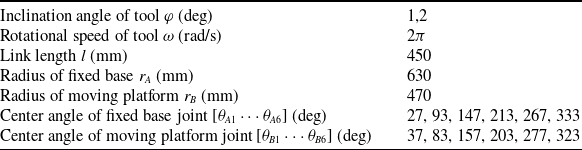
The configuration parameters of multi-DoF forming machine.

The configuration parameters of multi-DoF forming machine are shown in Table I. The feed rate
 $k=3$
mm/s, the process time
 $t=0\sim 5\mathrm{s}$
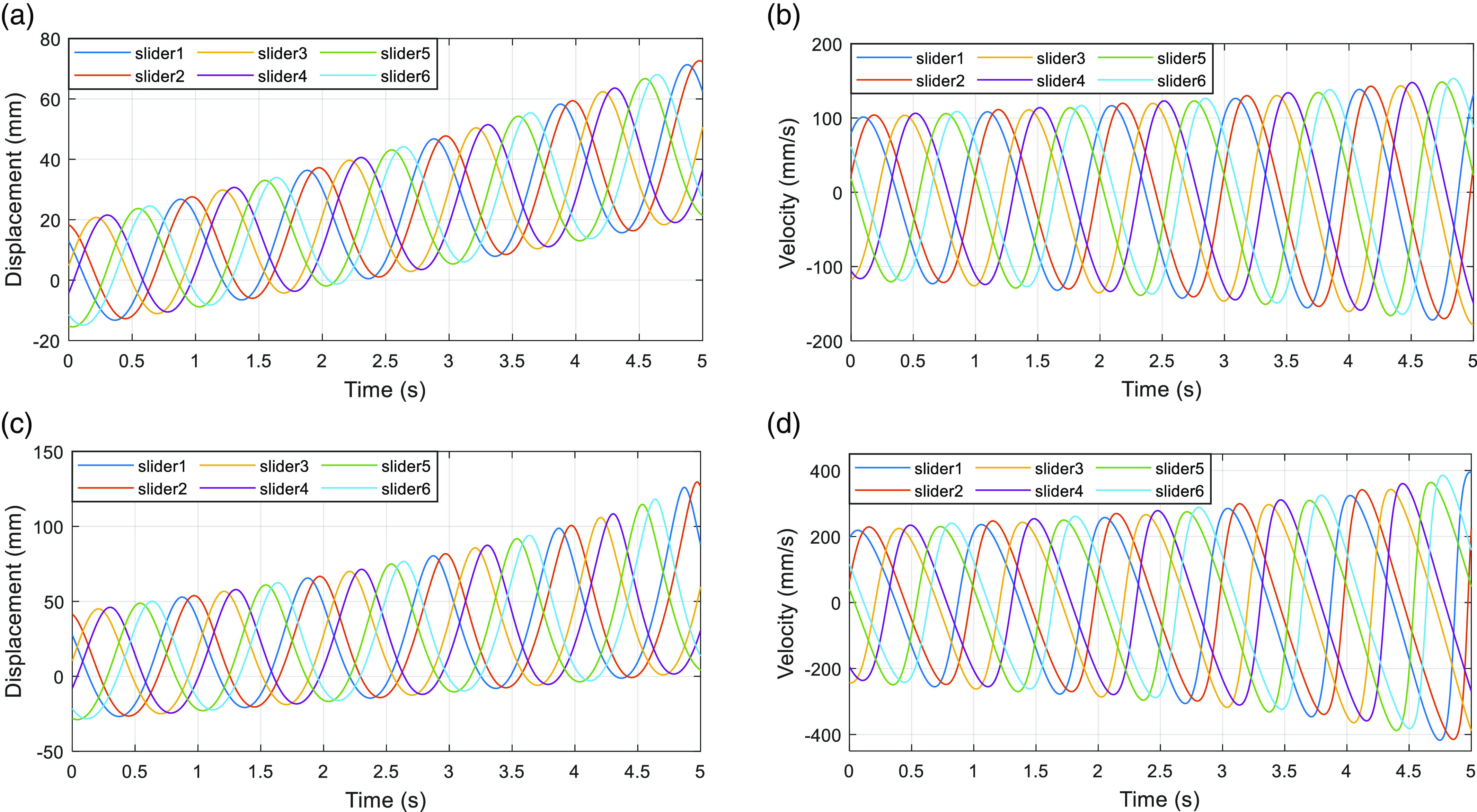
. The configuration change of PKM and multi-DoF forming motion in different process time is shown in Figure 4. The displacement of each slider is obtained based on Eq. (9), as shown in Figure 5a and b. It is found that the displacement curve of each slider is a shape of sin with different phase angles. The wave center increases with the increase of time, and the wave amplitude also increases with the increase of time. The wave center is the average value of the displacement curve of the slider in each movement period of the PKM. The velocity of each slider is also obtained by Eq. (14), as shown in Figure 5c and d. It is found that the velocity curve of each slider is also a shape of sin with different phase angles. The wave center remains unchanged with time increasing, and the wave amplitude increases with time increasing.
Illustration for the motion of multi-DoF forming. (a) t = 0.25 s (b) t = 0.5 s (c) t = 0.75s (d) t = 1 s.

Displacement and velocity of each slider with time. (a) Displacement of each slider with
 $\varphi$
= 1 (b) Velocity of each slider with
 $\varphi$
= 2 (d) Velocity curve of each slider with
 $\varphi$
= 1. (c) Displacement of each slider with
 $\varphi$
= 2 (d) Velocity curve of each slider with
 $\varphi$
= 2.

2.3 The geometric workspace
When the PKM is in some special postures during the motion, the multi-DoF forming machine will be out of control or suffer changes in DoF. The configuration of the machine at this time is called singular configuration. Singular configurations represent extreme cases of the postures of PKM, in which the machine does not work properly. In the singular pose, the PKM has the stiffest pose against the loadings along the axis; however the normal force is offset in operation, not applied to the center of the platform which will cause added torque, so the singular pose cannot be used for real work. Therefore, the singular configurations should be excluded when calculating the workspace of PKM. Based on the above analysis of slider velocity, it can be concluded that when the link is perpendicular to the guide rail, the determinant of
 $\boldsymbol{J}_{s}$
becomes zero, indicating that the PKM is in a singular configuration. At this time, the moving platform does not move, but the slider still has instantaneous motion. To ensure the kinematic stability, the determinant of
 $\boldsymbol{J}_{s}$
, namely
 $\det (\boldsymbol{J}_{s})$
should not equal zero. Besides, the factors that affect the workspace of PKM include the displacement of slider and the limitation of the angle of spherical joint. Due to the limitation of the length of the guideway of the PKM, the displacements of the sliders in their respective direction of movement can not exceed the permissible ranges. The maximum and minimum values of slider displacement are represented by
 $s_{\max }$
and
 $s_{\min }$
, respectively. The sliders and links as well as links and moving platform are connected by spherical joint, and the angle of the spherical joint is limited. The maximum value of the angle of the spherical joint is represented by
 $\theta _{\max }$
. Hence, the displacement of the
 $i$
th slider and the angle of spherical joint should meet the following conditions.
 \begin{align} \left\{\begin{array}{l} s_{\min }\leq s_{i}\leq s_{\max }\\[3pt] \theta _{ai}=\arccos \left(\overline{\boldsymbol{l}}_{i}\cdot \left[0,0,1\right]^{T}\right)\leq \theta _{\max }\\[3pt] \theta _{bi}=\arccos \left(\overline{\boldsymbol{l}}_{i}\cdot \boldsymbol{R}\left(\alpha, \beta, \gamma \right)\left[0,0,1\right]^{T}\right)\leq \theta _{\max }\\[3pt] \det \left(J_{s}\right)\neq 0 \end{array}\right. \end{align}
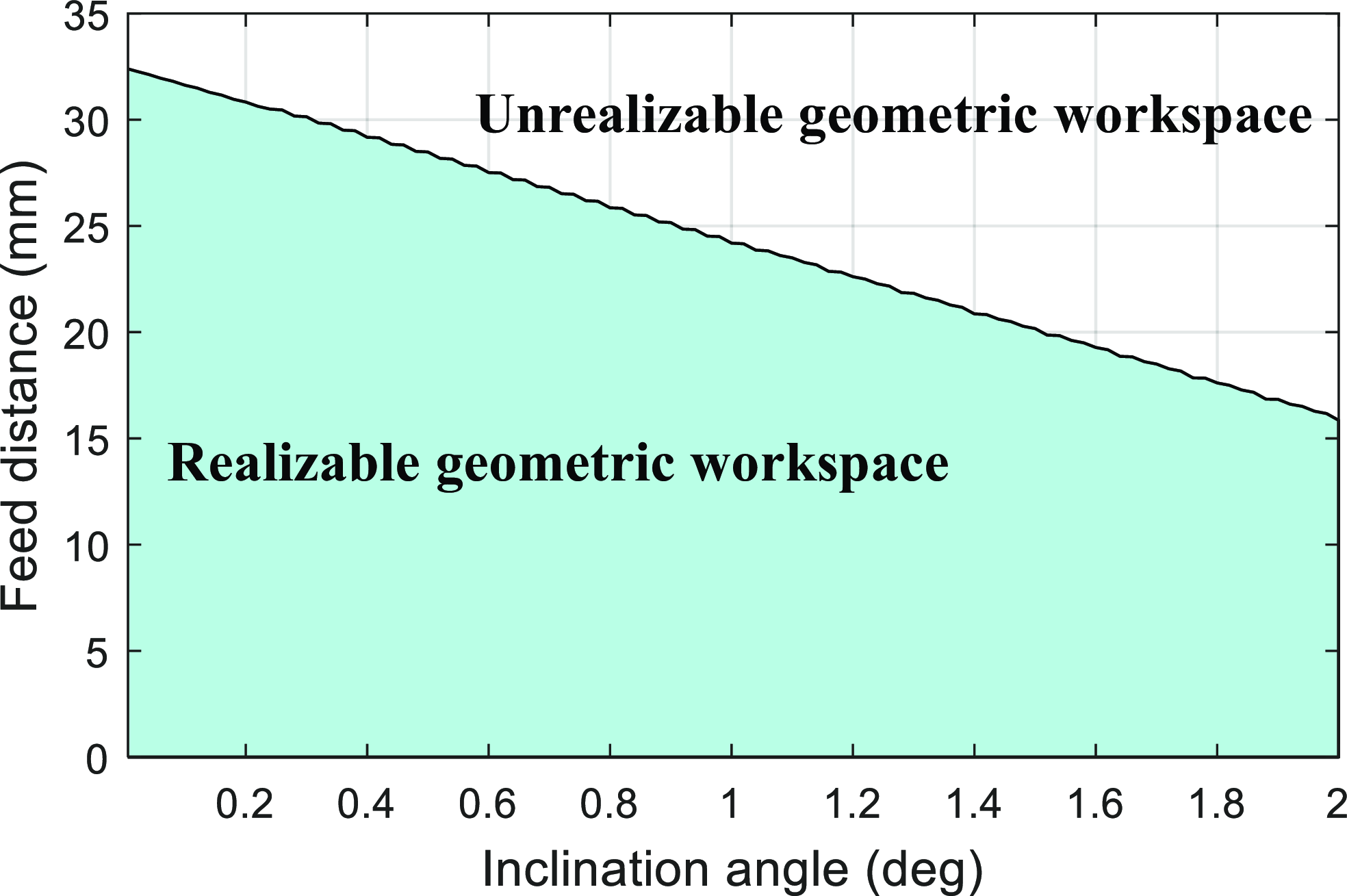
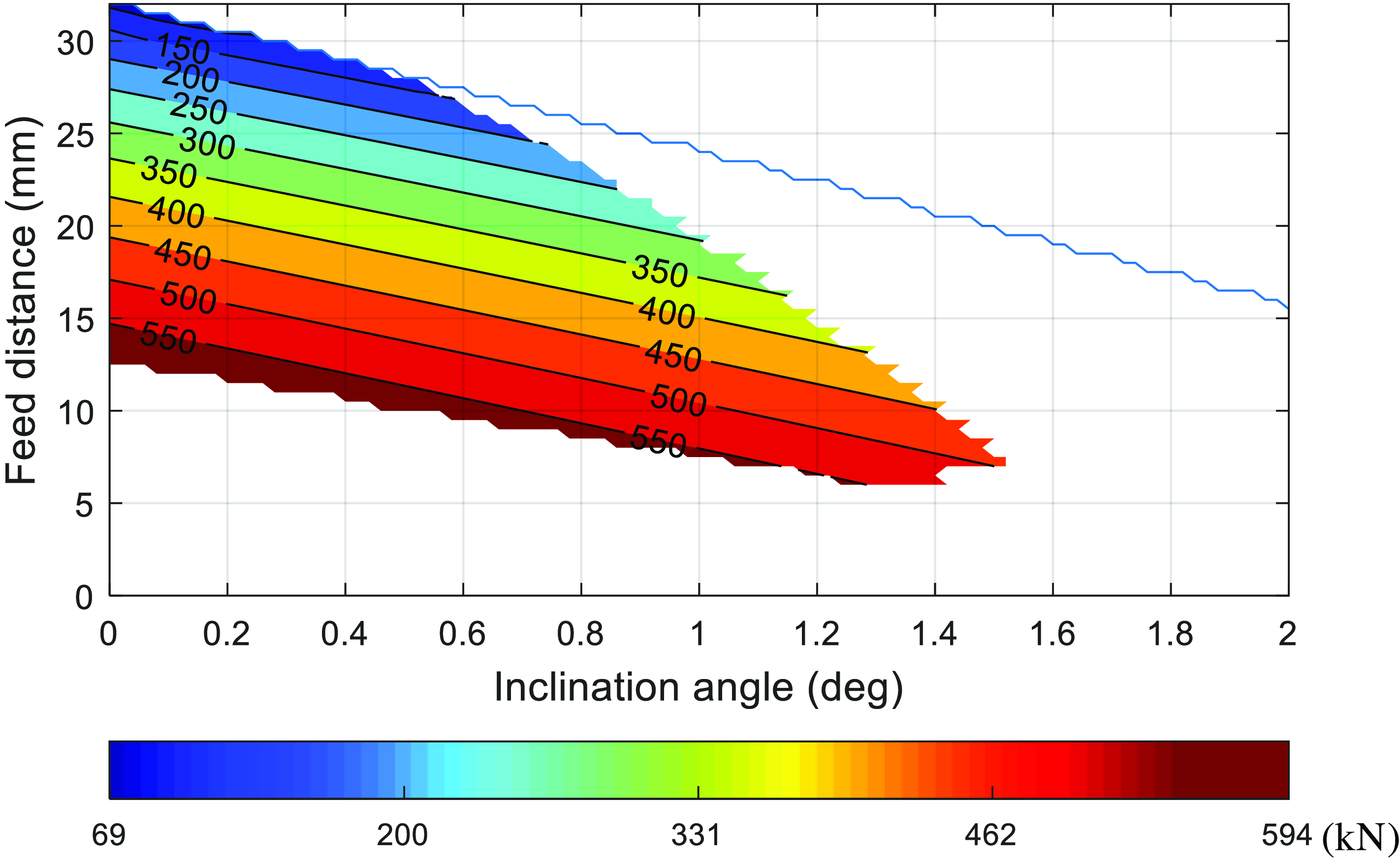
In this paper, the feed distance and inclination angle of the tool are chosen as the key processing parameters to express the workspace of PKM. Based on the constraints in Eq. (15), the range of each parameter can be calculated, namely the workspace of PKM. For the multi-DoF forming machine, the limit position of the slider is
 $s_{\min }=-50$
and
 $s_{\max }=150$
, and the maximum range of motion of the spherical joint is
 $\theta _{\max }=\pi /4$
. According to the motion condition of Eq. (1), the feed distance
 $h=[h_{\min }^{s},h_{\max }^{s}]$
can be solved with the inclination angle setting as
 $\varphi =[\varphi _{\min }^{g},\varphi _{\max }^{g}]$
, as shown in the Figure 6.
The geometric workspace of parallel kinematic machine.

According to Figure 5, when the inclination angle of tool increases, the wave amplitude of the slider displacement for each cycle increases. As the feed distance increases, the wave center of the slider displacement for each cycle increases. Therefore, to ensure that the slider does not exceed the travel limit, when the wave amplitude of the slider displacement for each cycle is larger, the wave center will necessarily be smaller, which means that the maximum feed distance of the PKM becomes smaller. Conversely, when the wave amplitude of the slider displacement for each cycle decreases, the maximum feed distance of the PKM increases. So it can be observed from Figure 6 that the maximum feed distance of the PKM gradually decreases as the inclination angle of tool increases. The feed distance can reach its maximum value of 32.4 mm. When the inclination angle of tool is 2°, the feed distance can reach its minimum value of 15.8 mm.
3. Workspace of PKM with mechanism deformation constraint
3.1 Stiffness modeling of PKM
The static stiffness of PKM reflects the posture error caused by elastic deformation of components between the fixed base and moving platform under external load. The main methods for static stiffness analysis of PKM are finite element analysis, structure matrix analysis, and so on [Reference Liu, Huang, Chetwynd and Kecskemethy38, Reference Tian, Ma, Xia, Ma and Li19]. The stiffness model considering axial deformation of links is established in this paper.
The forming load applied to the PKM is set as
 $(\boldsymbol{f},\boldsymbol{m})$
, where
 $\boldsymbol{f}$
is the forming force and
 $\boldsymbol{m}$
is the forming torque. The synthesized deformation of the moving platform is set as
 $(\Delta \boldsymbol{X},\Delta \boldsymbol{\theta })$
, where
 $\Delta \boldsymbol{X}$
is linear deformation along direction of x, y and z axis and
 $\Delta \boldsymbol{\theta }$
is angular deformation along direction of x, y and z axis. The relation between synthesized deformation and the forming load meets the following relationship:
 \begin{align} \left[\begin{array}{l} \boldsymbol{f}\\[3pt] \boldsymbol{m} \end{array}\right]=\boldsymbol{K}\left[\begin{array}{l} \Delta \boldsymbol{X}\\[3pt] \Delta \boldsymbol{\theta } \end{array}\right] \end{align}
where
 $\boldsymbol{K}$
is stiffness matrix.
As the multi-DoF forming machine is under heavy load, the links will produce axial deformation. The rigidity of the moving platform and the fixed base is much higher than that of link, which can be regarded as rigid bodies. The deformation of the moving platform hence can be regarded as that it is caused by the link deformation.
 $f_{i}, \Delta l_{i}$
and
 $k_{i}$
are set as the axial force, deformation and stiffness of the link. The axial force of link can be presented by:
 \begin{align} f_{i}=k_{i}\Delta l_{i}=\frac{EA}{L}\Delta l_{i}\left(i=1\cdots 6\right) \end{align}
where
 $A$
and
 $E$
represent the cross-section area of each link and elastic modulus of link material, respectively.
According to the principle of virtual work, the following equation can be obtained:
 \begin{align} \left[\boldsymbol{f}^{T},\boldsymbol{m}^{T}\right]\left[\begin{array}{l} \Delta \boldsymbol{X}\\[3pt] \Delta \boldsymbol{\theta } \end{array}\right]=\sum _{i=1}^{6}f_{i}\Delta l_{i}={\boldsymbol{F}_{l}}^{T}\Delta \boldsymbol{l} \end{align}
where
 $\boldsymbol{F}_{l}=[f_{1},f_{2},f_{3},f_{4},f_{5},f_{6}]^{T}, \Delta \boldsymbol{l}=[\Delta l_{1},\Delta l_{2},\Delta l_{3},\Delta l_{4},\Delta l_{5},\Delta l_{6}]^{T}$
and
 $\boldsymbol{F}_{l}=\text{diag}([k_{1}\cdots k_{6}])\Delta \boldsymbol{l}$
.
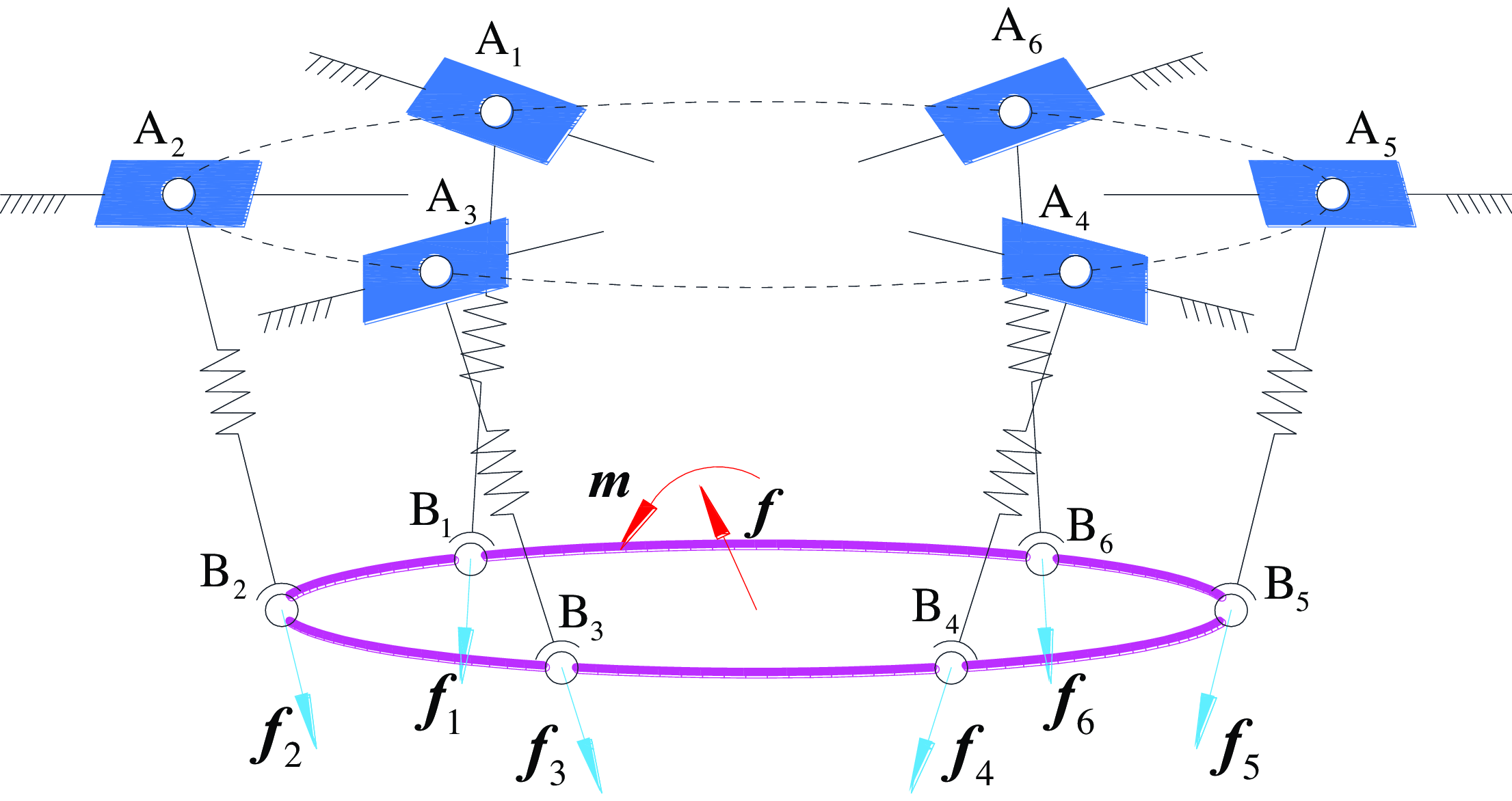
Force diagram of the moving platform.

As shown in Figure 7, the force balance condition of the moving platform can be obtained:
 \begin{align} \left[\begin{array}{l} \sum _{i=1}^{6}f_{i}\overline{\boldsymbol{l}}_{i}\\[3pt] \sum _{i=1}^{6}f_{i}\left(\boldsymbol{r}_{i}\times \overline{\boldsymbol{l}}_{i}\right) \end{array}\right]=\left[\begin{array}{l} \boldsymbol{f}\\[3pt] \boldsymbol{m} \end{array}\right]=\boldsymbol{J}_{f}\boldsymbol{F}_{l} \end{align}
where
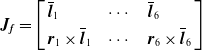 $\boldsymbol{J}_{\boldsymbol{f}} = \left[\begin{array}{l@{\quad}l@{\quad}l} \overline{\boldsymbol{l}}_{1} & \cdots & \overline{\boldsymbol{l}}_{6}\\[3pt] \boldsymbol{r}_{1}\times \overline{\boldsymbol{l}}_{1} & \cdots & \boldsymbol{r}_{6}\times \overline{\boldsymbol{l}}_{6} \end{array} \right]$
.
Based on Eq. (16), Eq. (18), and Eq. (19), the stiffness matrix can be obtained:
 \begin{align} \boldsymbol{K}=\boldsymbol{J}_{f}\text{diag}\left(\left[k_{1}\cdots k_{6}\right]\right){\boldsymbol{J}_{f}}^{T} \end{align}
Where the specific calculation method for
 $\boldsymbol{K}$
is given in the Appendix.
Based on Eq. (16) and Eq. (20), the deformation of PKM can be calculated by Eq. (21):
 \begin{align} \left[\begin{array}{l} \Delta \boldsymbol{X}\\[3pt] \Delta \boldsymbol{\theta } \end{array}\right]=\boldsymbol{K}^{-1}\left[\begin{array}{l} \boldsymbol{f}\\[3pt] \boldsymbol{m} \end{array}\right] \end{align}
When the multi-DoF forming machine is used for forming, the tool suffers the forming load of
 $\boldsymbol{f}=[0,0,F_{z}]^{T},\boldsymbol{m}=[F_{z}R\cos (2\pi t),F_{z}R\sin (2\pi t),0]^{T}$
, where
 $F_{z}$
is the magnitude of forming load and
 $R$
is the arm of forming load.
Set
 $\boldsymbol{f}=[0,0,5000]^{T}\mathrm{kN}$
and
 $\boldsymbol{m}=[750\cos (2\pi t),750\sin (2\pi t),0]^{T}\mathrm{kN}\cdot \mathrm{m}$
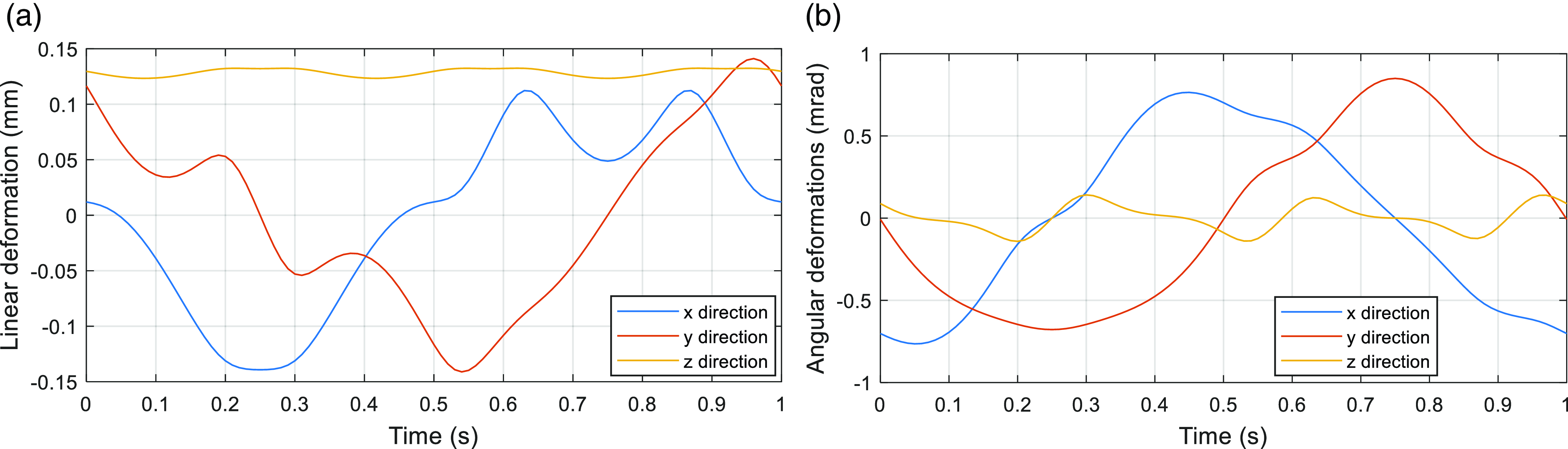
, the deformation of tool is presented in Figure 8. It is found that the linear deformation of tool is between 0.15 and –0.15 mm, and the deformation of tool in z direction is the largest. The angular deformation of tool is between 1 and –1 mrad, and the angular deformation of tool in z direction is the smallest. It indicates that the linear deformation along z axis and the angular deformation along x axis and y axis are the main factors of tool deformation.
The deformation of tool with time. (a) Linear deformation (b) Angular deformation.

3.2 Deformation error of the PKM
Illustration of the deformation error of the parallel kinematic machine.

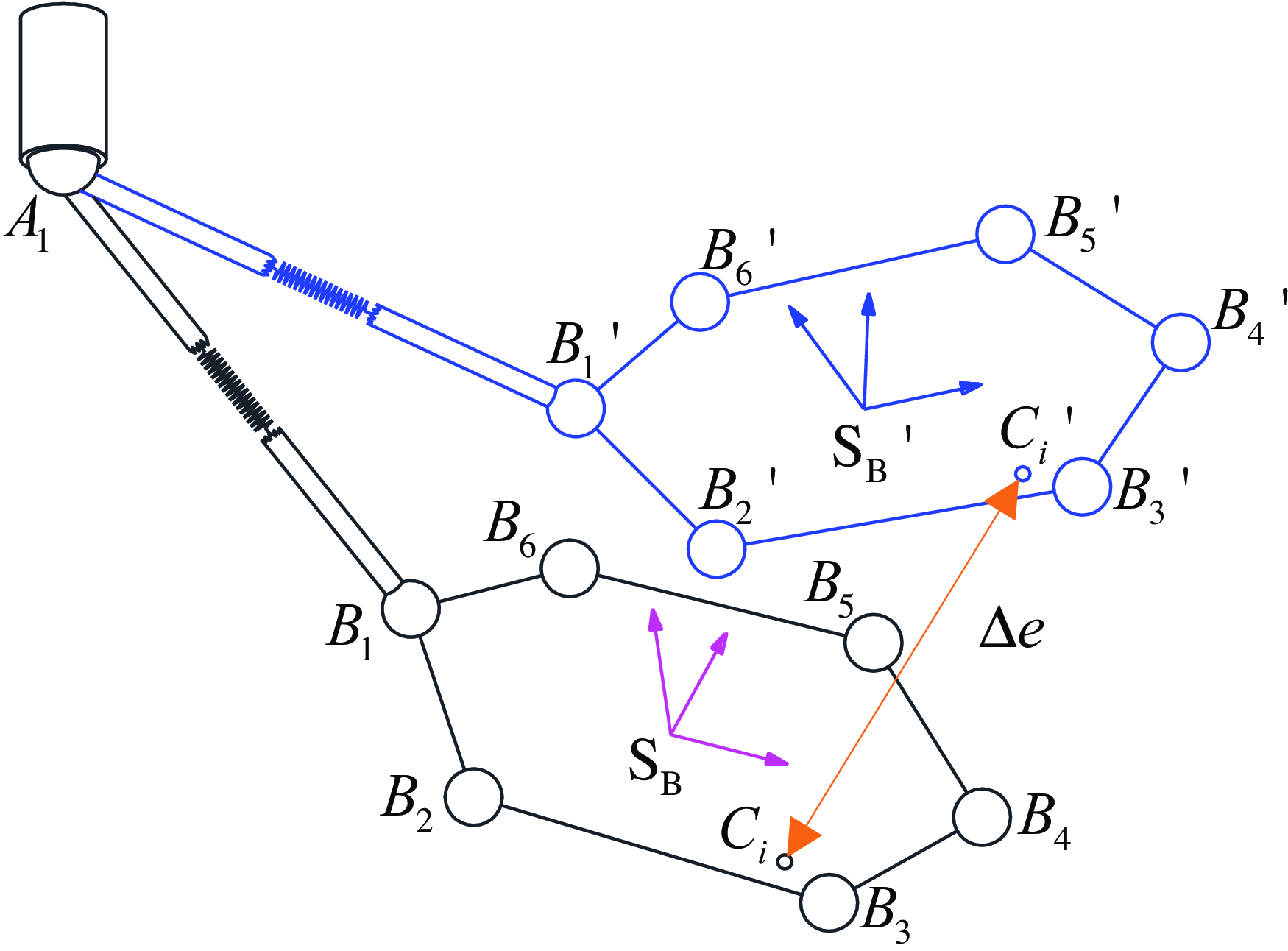
Since the multi-DoF forming machine works under heavy load conditions, the elastic links will produce large elastic deformation. Due to the relatively small deformation of the tool, it can be treated as rigid body. Therefore, the tool motion can deviate from the predetermined trajectory under the coordinated deformation of 6 links. As shown in Figure 9, the tool composed of spherical joint
 $B_{1}\cdots B_{6}$
represents the theoretical position without deformation error, and the tool composed of spherical joints
 $B_{1}^{\prime}\cdots B_{6}^{\prime}$
represents the real position with deformation error.
 $\mathrm{S}_{\mathrm{B}}$
is the coordinate system of the theoretical position of the tool and
 $\mathrm{S}_{\mathrm{B}}^{\prime}$
is fixed on the real position of tool. Therefore, deformation error of the PKM is the difference between the theoretical trajectory and the real trajectory of the reference point
 $C_{i}$
placed on the tool. According to the stiffness model of the PKM, the deformation error of the PKM can be expressed by:
 \begin{align} \Delta e=\left| \Delta \boldsymbol{X}+\left(\boldsymbol{R}\left(\alpha +\Delta \theta _{x},\beta +\Delta \theta _{y},\gamma +\Delta \theta _{z}\right)-\boldsymbol{R}\left(\alpha, \beta, \gamma \right)\right)\boldsymbol{c}_{i}\right| \end{align}
where
 $\mathbf{c}_{\mathbf{i}}=[r_{t}\cos \phi, r_{t}\sin \phi, 1](r=0\sim r_{t},\phi =0\sim 2\pi )$
is the position vector of point
 $C_{i}$
in the tool,
 $r_{t}$
is the radius of the tool and
 $\phi$
is the polar angle of point in the tool.
Set the feed rate
 $k=1$
mm/s, the magnitude of forming load
 $F_{z}=$
4000, 6000 kN, the arm of forming load
 $R=$
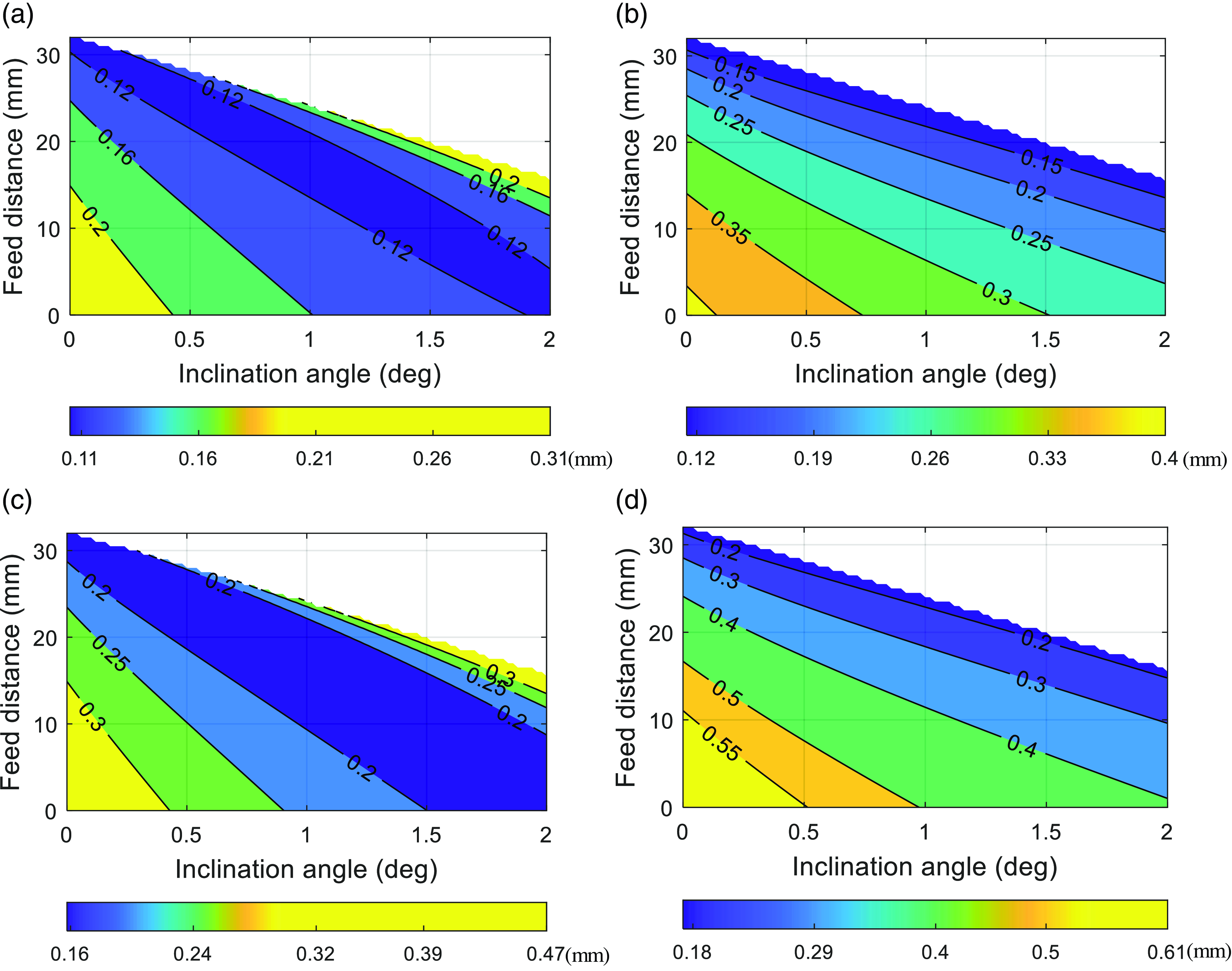
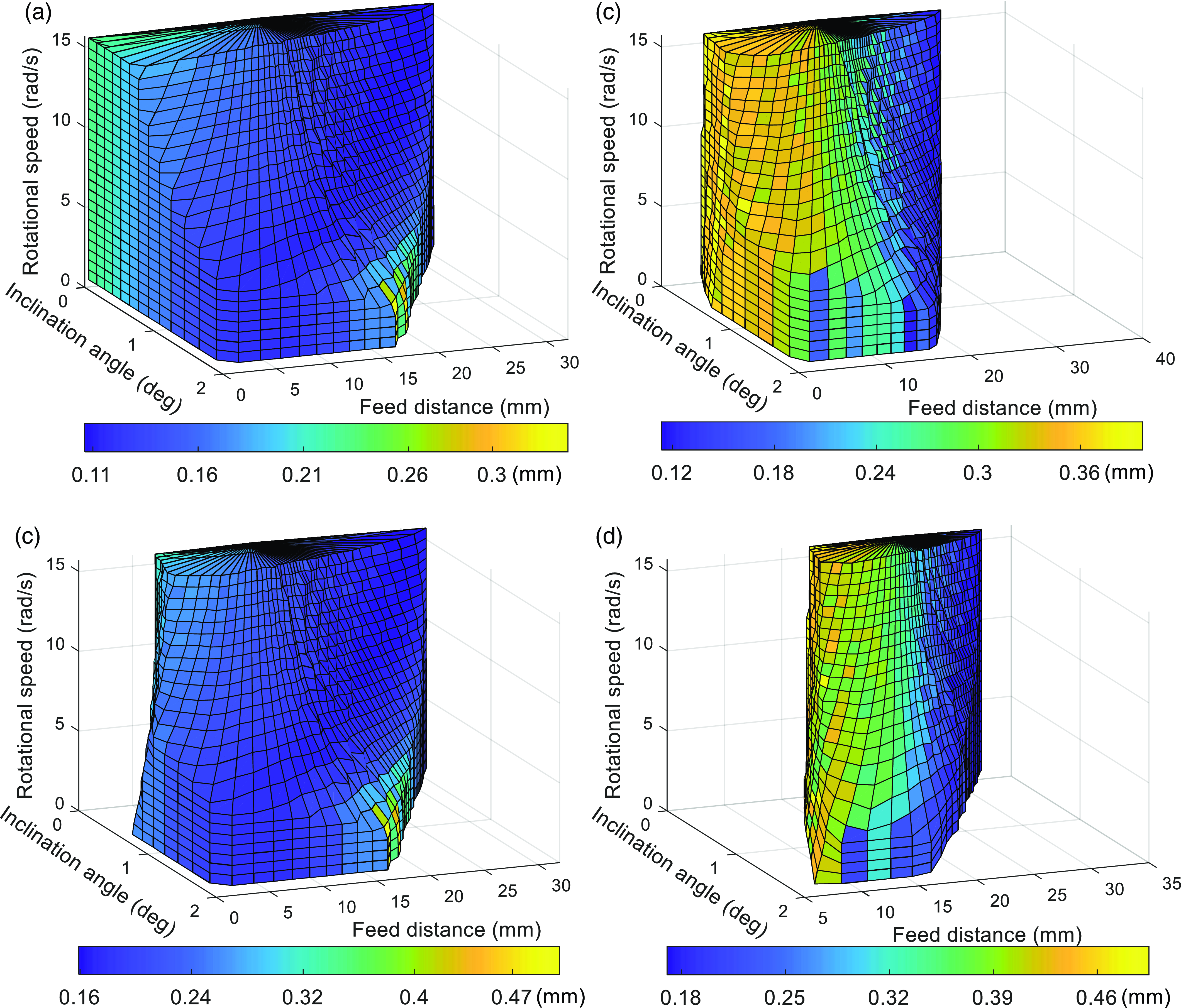
100,200 mm, the contours of the deformation error distribution of the PKM in the workspace are shown in Figure 10.
Distribution of deformation error of the PKM in the workspace. (a)
 $Fz=4000\mathrm{kN},{}R=100\mathrm{mm}$
(b)
 $Fz=4000\mathrm{kN},R=200\mathrm{mm}$
. (c)
 $Fz=6000\mathrm{kN},R=100\mathrm{mm}$
(d)
 $Fz=6000\mathrm{kN},{}R=200\mathrm{mm}$
.

As shown in Figure 10, it can be seen that the maximum value of deformation error is distributed in the region formed by smaller inclination angle and lower feed distance within the workspace. Moreover, as the magnitude of forming load or arm of forming load increases, the the maximum value of deformation error gradually increases.
Deformation error
 $\Delta e$
of the PKM is generally determined based on actual operational requirements. When the
 $\Delta e$
is large, the accuracy of the multi-DoF forming machine will decrease and it will not meet the processing technology requirements of multi-DoF forming. Thus, the deformation error of the PKM and geometric constraint of PKM should satisfy the following conditions.
 \begin{align} \left\{\begin{array}{l} s_{\min }\leq \sqrt{{a_{ix}}^{2}+\left(a_{ix}\tan \theta _{Ai}\right)^{2}}-r_{A}\leq s_{\max }\\[3pt] \arccos \left(\left(h+Z_{P}-r_{B}\sin \beta \cos \theta _{Bi}+\cos \alpha \cos \beta d+r_{B}\cos \beta \sin \alpha \sin \theta _{Bi}\right)/l\right)\leq \theta _{\max }\\[3pt] \arccos \left(\left(\cos \alpha \sin \beta \left(b_{ix}-a_{ix}\right)-\sin \alpha \left(b_{iy}-a_{ix}\tan \theta _{Ai}\right)+\cos \alpha \cos \beta b_{iz}\right)/l\right)\leq \theta _{\max }\\[3pt] \left(\left(b_{ix}-a_{ix}\right)\cos \theta _{Ai}+\left(b_{iy}-a_{ix}\tan \theta _{Ai}\right)\sin \theta _{Ai}\right)/l\neq 0\\[3pt] \Delta e\lt =0.35mm \end{array}\right. \end{align}
Based on the constraint in Eq. (23), the feed distance
 $h=[h_{\min }^{s},h_{\max }^{s}]$
can be calculated for different force conditions. The workspace utilization rate
 $\lambda ^{s}$
considering deformation error is the ratio of the workspace considering the mechanism deformation to the geometric workspace of the PKM. In order to quantitatively analyze the effect of forming load on workspace,
 $\lambda ^{s}$
is introduced as follows:
 \begin{align} \lambda ^{s}=\int _{\varphi _{\min }^{g}}^{\varphi _{\max }^{g}}\left(h_{\max }^{s}-h_{\min }^{s}\right)\mathrm{d}\varphi /\int _{\varphi _{\min }^{g}}^{\varphi _{\max }^{g}}\left(h_{\max }^{g}-h_{\min }^{g}\right)\mathrm{d}\varphi \end{align}
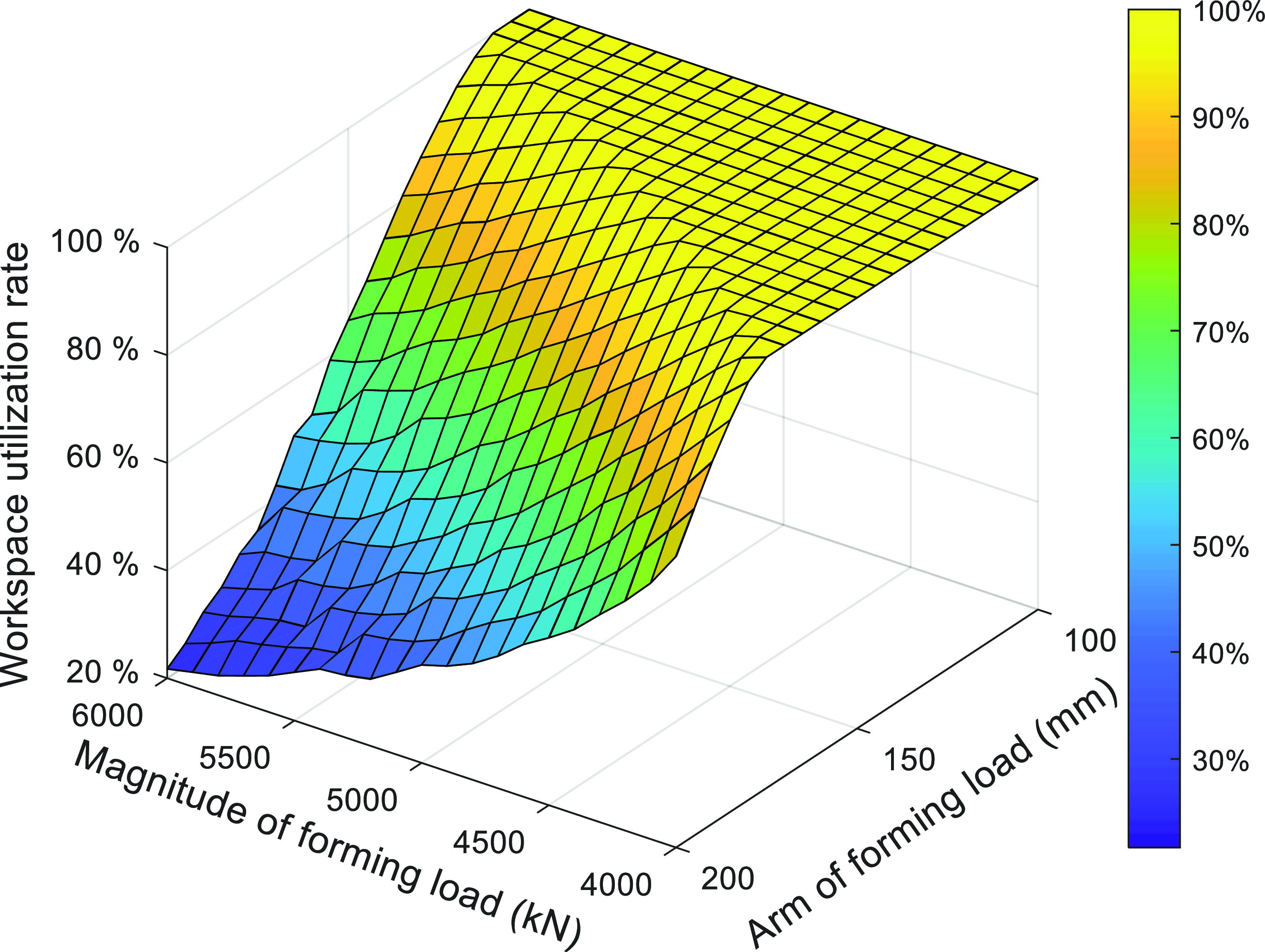
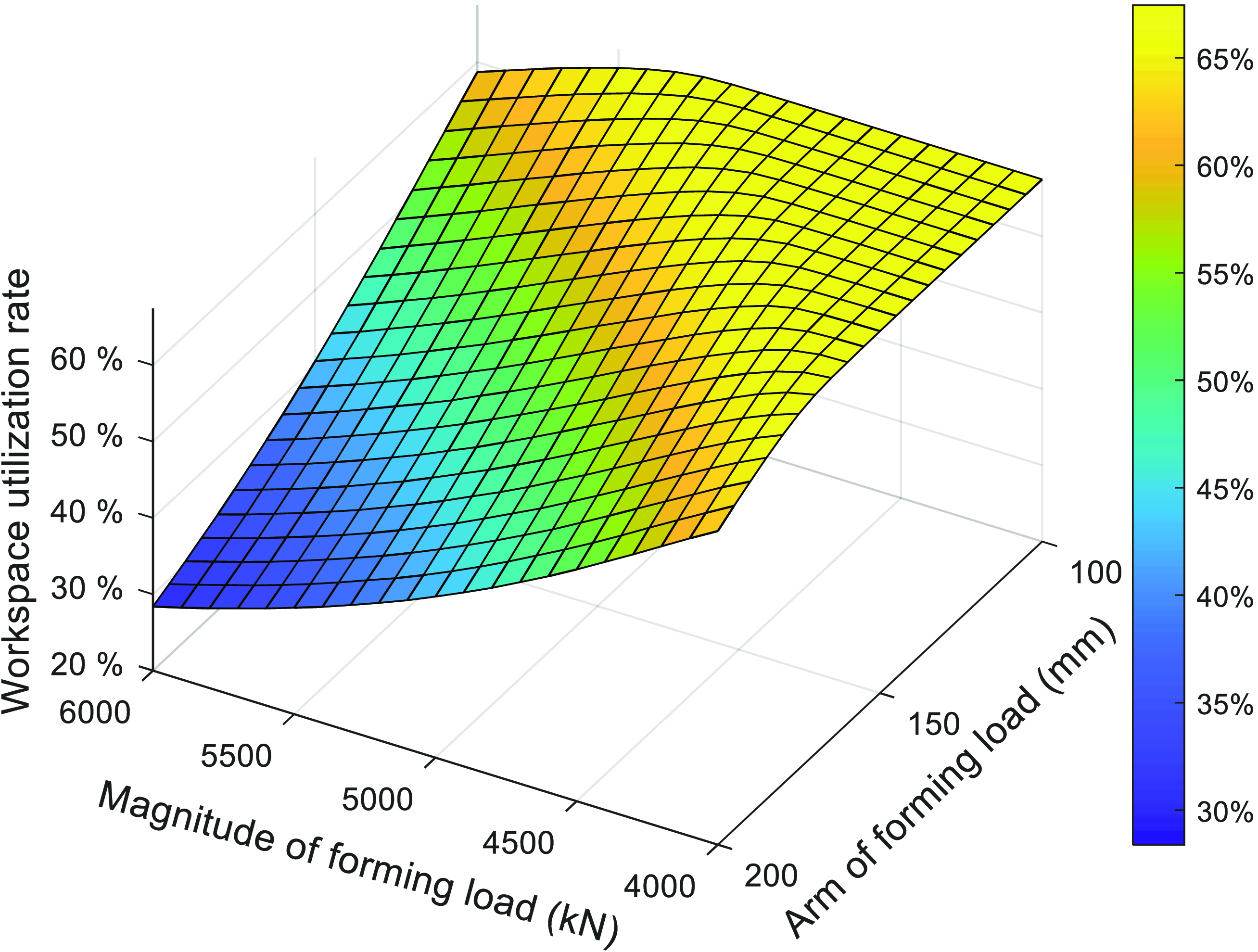
Take the magnitude of forming load as 3000 to 6000 kN and the arm of forming load as 100 to 200 mm, the workspace utilization rate
 $\lambda ^{s}$
is obtained and shown in Figure 11. It can be observed from Figure 11 that the workspace utilization rate decreases as the magnitude of forming load or arm of forming load increases. When the magnitude of forming load or arm of forming load is small, the workspace utilization rate can be up to 100%. When the magnitude of forming load is 6000 kN and arm of forming load is 200 mm, the workspace utilization rate can decrease up to 21.7 %. The results show that with the increase of forming load, the workspace of the PKM can decrease to 1/5 of the theoretical one.
Workspace utilization rate
 $\lambda ^{s}$
with deformation error constraint.

4. Workspace of PKM with motor loading performance constraint
The sliders of the PKM only conduct translation motion in the direction of the guideway, so its force balance condition can be expressed by:
 \begin{align} \tau _{i}=f_{i}\overline{\boldsymbol{l}}_{i}\cdot \left[\cos \theta _{Ai},\sin \theta _{Ai},0\right]^{T} \end{align}
where
 $f_{i}$
denotes axial force of the links and
 $\tau _{i}$
denotes actuated force of the sliders.
Based on the analysis of Section 3.1, the following equation can be obtained:
 \begin{align} \left[f_{1},\cdots, f_{6}\right]^{T}=\left[\boldsymbol{J}_{f}\right]^{-1}\left[\begin{array}{l} \boldsymbol{f}\\[3pt] \boldsymbol{m} \end{array}\right] \end{align}
Substitute Eq. (26) into Eq. (25), the following equation can be obtained:
 \begin{align} \left[\tau _{1},\cdots, \tau _{6}\right]^{T}=\text{diag}\left(\left[\left[\cos \theta _{A1},\sin \theta _{A1},0\right]^{T}\cdot \overline{\boldsymbol{l}}_{1},\cdots, \left[\cos \theta _{A6},\sin \theta _{A6},0\right]^{T}\cdot \overline{\boldsymbol{l}}_{6}\right]\right)\left[\boldsymbol{J}_{f}\right]^{-1}\left[\begin{array}{l} \boldsymbol{f}\\[3pt] \boldsymbol{m} \end{array}\right] \end{align}
When the tool suffers external load of
 $\boldsymbol{f}=$
[0,0,5000]
T
 $\mathrm{kN}, \boldsymbol{m}=$
[1000cos(2
 $ \pi$
t), 1000sin(2
 $ \pi$
t),0]
T
 $\mathrm{kN}\cdot \mathrm{m}$
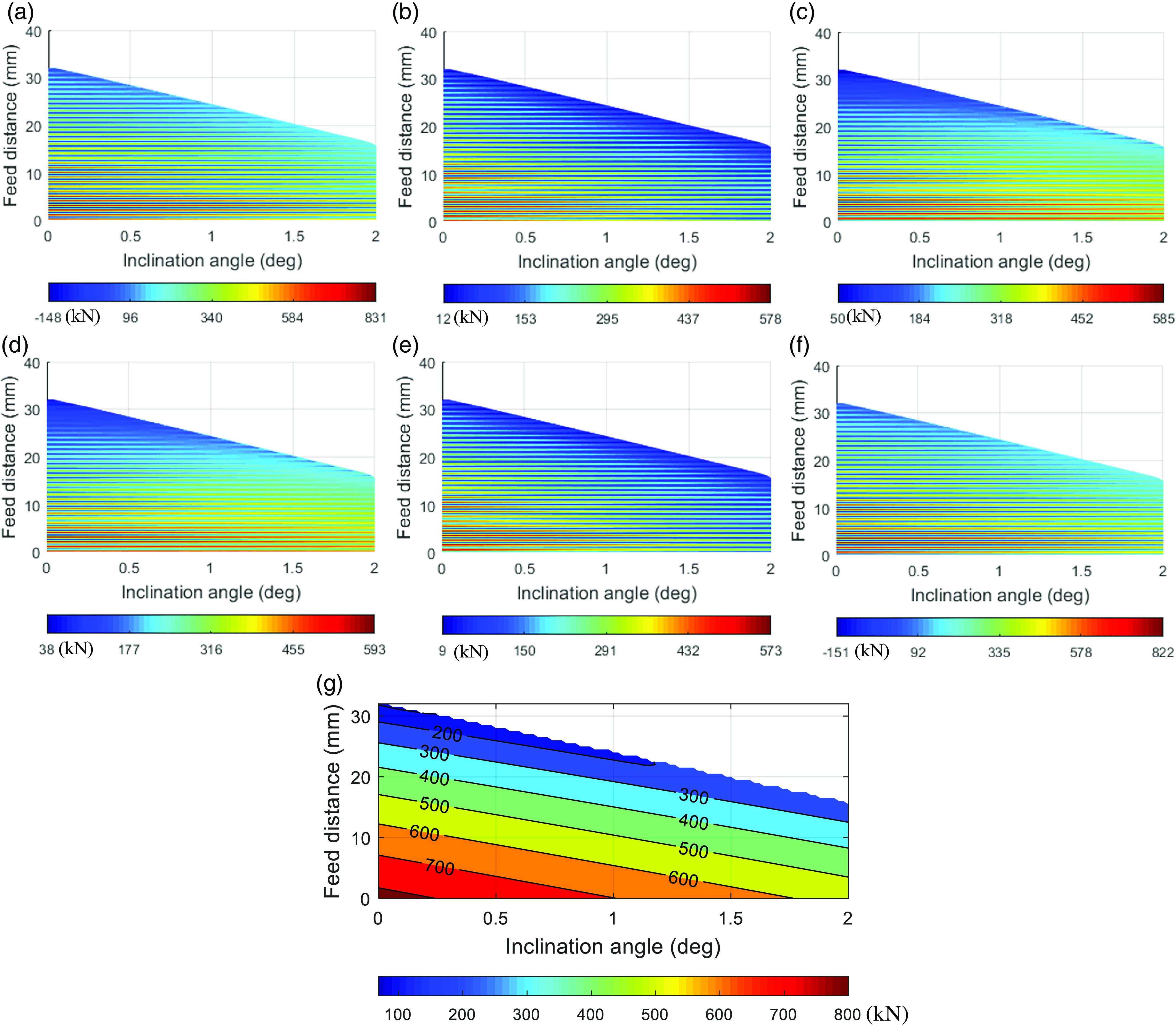
, the distribution of actuated force of each slider and the maximum actuated force of 6 sliders in the workspace are shown in Figure 12.
Distribution of actuated force of each slider and the maximum actuated force of six sliders in the workspace. (a) Actuated force of the 1st slider (b) Actuated force of the 2nd slider (c) Actuated force of the 3rd slider. (d) Actuated force of the 4th slider (e) Actuated force of the 5th slider (f) Actuated force of the 6th slider. (g) The maximum actuated force of six sliders.

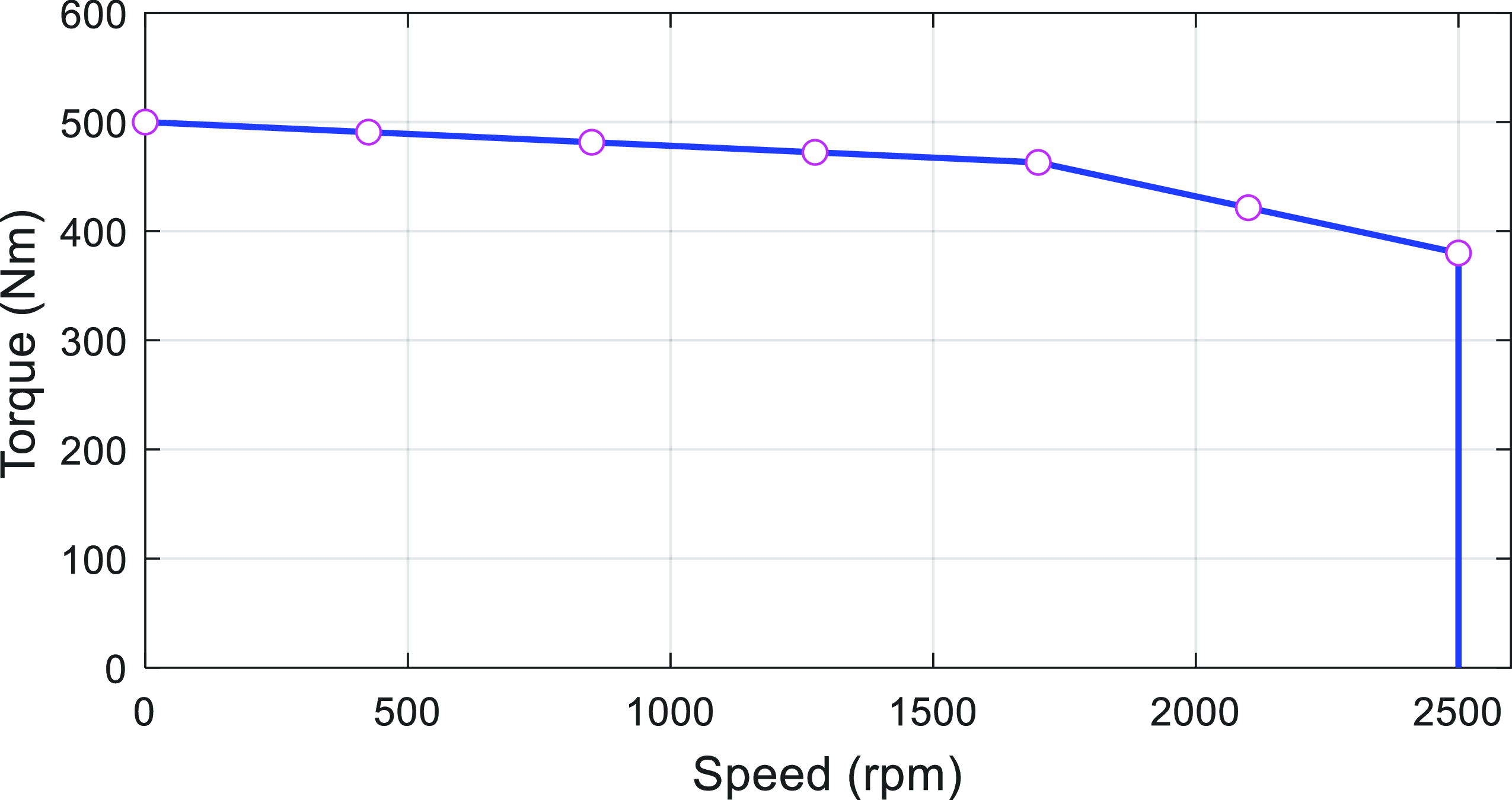
The relationship between the torque and the speed of the servo motor is expressed as a curve, and this curve is called the servo motor characteristic curve. The six sliders of multi-DoF forming machine are respectively driven by six servo motors, and the characteristic curve is shown in Figure 13. Among them, the maximum speed of the servo motor
 $n_{\max }$
is 2500 r/min, the rated speed of the servo motor is 1700 r/min and the peak torque is 500 Nm.
Servo motor characteristic curve.

When the multi-DoF forming machine works, the six servo motors drive the roller screw to rotate according to a certain motion relationship, and the roller screw drives the slider to move reciprocally. The relationship between the speed of the slider and the speed of the servo motor is expressed as follows:
 \begin{align} n_{i}=60v_{si}/h_{s} \end{align}
where
 $v_{si}$
is the speed of each slider,
 $n_{i}$
is the servo motor speed, and
 $h_{s}$
is the lead of the roller screw.
The relationship between the servo motor torque and the actuated force of the slider is expressed as follows:
 \begin{align} T_{i}=\tau _{i}h_{s}/\left(2\pi \eta \right) \end{align}
where
 $\tau _{i}$
is the actuated force of each slider,
 $\eta$
is the transmission efficiency of roller screw, and
 $T_{i}$
is the servo motor torque.
When the motion of the tool is determined, the speed of the slider can be calculated according to section 2.2. Substitute the speed of the slider into Eq. (28) to calculate the rotational speed of the servo motor, the maximum torque
 $[T(n_{i})]$
that the servo motor can output at the current rotational speed can be obtained from the servo motor characteristic curve. Based on the previous analysis, when the external load of the machine is known, the actuated force of each slider can be calculated, and the servo motor torque
 $T(n_{i})$
can be obtained by substituting actuated force of each slider into Eq. (29). Only when
 $T(n_{i})$
is less than
 $[T(n_{i})]$
, the multi-DoF forming machine can work normally. Therefore, the motor loading performance constraint and geometric constraint of PKM should satisfy Eq. (30). The actuated force of the sliders in the workspace with motor loading performance constraint is obtained, as shown in Figure 14.
Distribution of actuated force of sliders in the workspace.

The variation in the rotational speed of tool will result in the change in the speed of the sliders and consequently affect the servo motor speed. Therefore, with different rotational speeds of tool, the workspace that satisfies the constraint of motor loading performance is also different. Hence, the rotational speed of tool is considered as a parameter to assess the new workspace. Based on the constraint in Eq. (30), the feed distance
 $h=[h_{\min }^{m},h_{\max }^{m}]$
can be calculated for different force conditions. As shown in Figure 15, the workspace of PKM in different conditions (
 $F_{z}=$
4000, 6000 kN,
 $R=$
100, 200 mm) is presented. It can be observed that as the magnitude of forming load or arm of forming load increases, the workspace with motor loading performance constraint decreases. As the rotational speed of tool increases, the workspace with motor loading performance constraints also decreases.
 \begin{align} \left\{\begin{array}{l} s_{\min }\leq \sqrt{{a_{ix}}^{2}+\left(a_{ix}\tan \theta _{Ai}\right)^{2}}-r_{A}\leq s_{\max }\\[3pt] \arccos \left(\left(h+Z_{P}-r_{B}\sin \beta \cos \theta _{Bi}+\cos \alpha \cos \beta d+r_{B}\cos \beta \sin \alpha \sin \theta _{Bi}\right)/l\right)\leq \theta _{\max }\\[3pt] \arccos \left(\left(\cos \alpha \sin \beta \left(b_{ix}-a_{ix}\right)-\sin \alpha \left(b_{iy}-a_{ix}\tan \theta _{Ai}\right)+\cos \alpha \cos \beta b_{iz}\right)/l\right)\leq \theta _{\max }\\[3pt] \left(\left(b_{ix}-a_{ix}\right)\cos \theta _{Ai}+\left(b_{iy}-a_{ix}\tan \theta _{Ai}\right)\sin \theta _{Ai}\right)/l\neq 0\\[3pt] n_{i}\leq n_{\max }\\[3pt] T_{i}\left(n_{i}\right)\lt =\left[T\left(n_{i}\right)\right] \end{array}\right. \end{align}
Workspace of PKM with motor loading performance constraint. (a) Fz = 4000 kN, R = 100 mm (c) Fz = 4000 kN, R = 200 mm. (c) Fz = 6000 kN, R = 100 mm (d) Fz = 6000 kN, R = 200 mm.

The workspace utilization rate
 $\lambda ^{m}$
considering motor loading performance is the ratio of the workspace considering the motor loading performance to the geometric workspace of the PKM. In order to quantitatively analyze the effect of forming load on workspace,
 $\lambda ^{m}$
is calculated as follows:
 \begin{align} \lambda ^{m}=\int _{\omega _{\min }}^{\omega _{\max }}\int _{\varphi _{\min }^{g}}^{\varphi _{\max }^{g}}\left(h_{\max }^{s}-h_{\min }^{s}\right)\mathrm{d}\varphi \mathrm{d}\omega /\int _{\omega _{\min }}^{\omega _{\max }}\int _{\varphi _{\min }^{g}}^{\varphi _{\max }^{g}}\left(h_{\max }^{g}-h_{\min }^{g}\right)\mathrm{d}\varphi \mathrm{d}\omega \end{align}
Take the magnitude of forming load as 3000 to 6000 kN and the arm of forming load as 100 to 200 mm, the workspace utilization rate
 $\lambda ^{m}$
can be obtained and shown in Figure 15. It can be observed from Figure 15 that the workspace utilization rate decreases as the magnitude of forming load or arm of forming load increases. When the magnitude of forming load or arm of forming load is small, the workspace utilization rate can reach its maximum value of 67.4%. When the magnitude of forming load is 6000 kN and arm of forming load is 200 mm, the workspace utilization rate can decrease up to 28.3%. The results show that with the increase of forming load, the workspace of the PKM can decrease to 3/10 of the theoretical one.
Workspace utilization rate
 $\lambda ^{m}$
with motor loading performance constraint.

5. Synthesized workspace of PKM
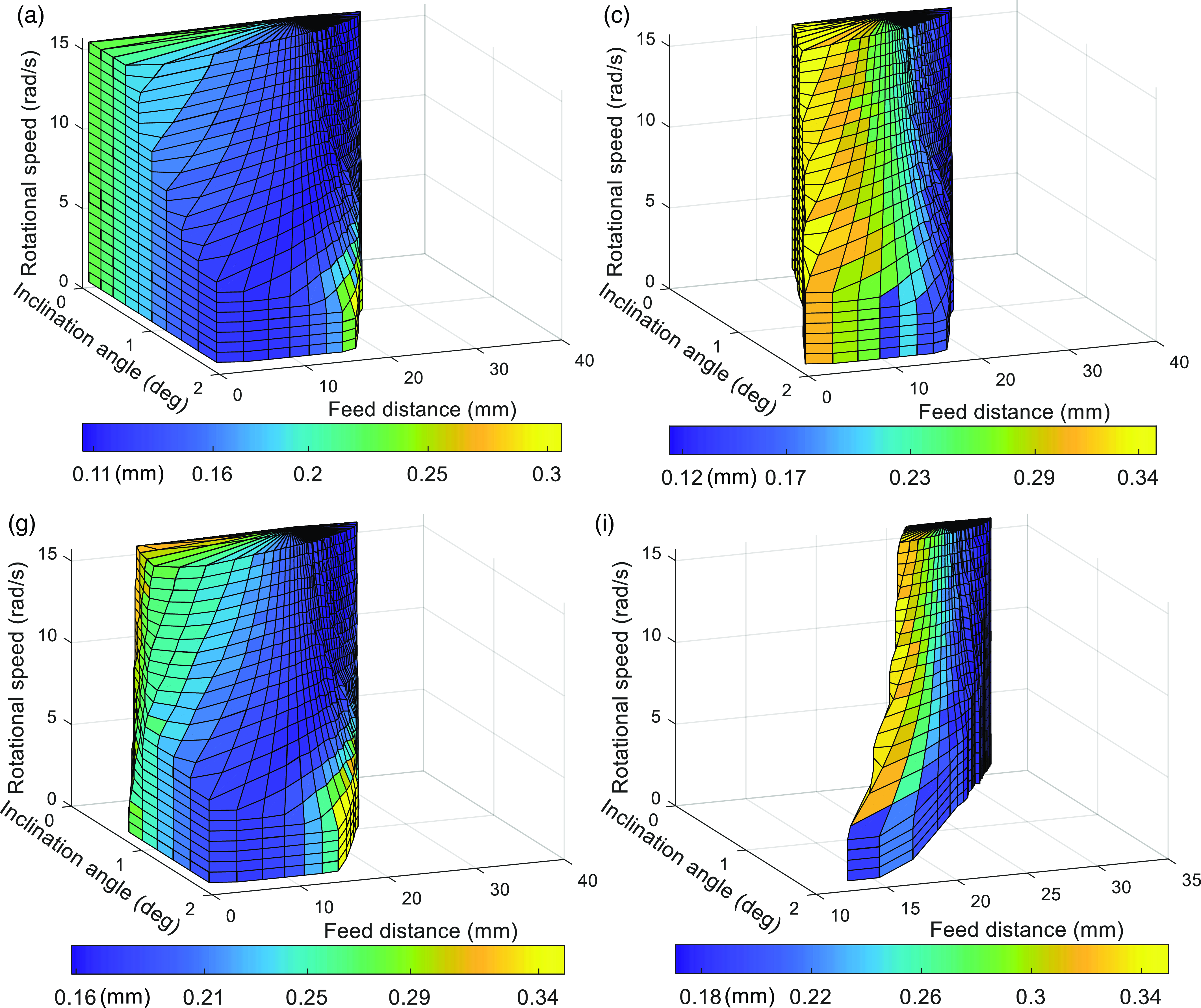
In summary, this paper aims to use the feed distance, inclination angle of tool, and rotational speed of tool to describe the synthesized workspace of the PKM. For the workspace of PKM with heavy load working condition, besides the geometric constraint, it is also constrained by the mechanism deformation and motor loading performance. Therefore, the synthesized workspace of the PKM should satisfy the following condition of Eq. (32). In other words, by removing the portions in the workspace with motor loading performance constraint of Figure 15 where the accuracy of the machine does not meet the requirements, the synthesized workspace of the PKM can be obtained.
 \begin{align} \left\{\begin{array}{l} s_{\min }\leq \sqrt{{a_{ix}}^{2}+\left(a_{ix}\tan \theta _{Ai}\right)^{2}}-r_{A}\leq s_{\max }\\[3pt] \arccos \left(\left(h+Z_{P}-r_{B}\sin \beta \cos \theta _{Bi}+\cos \alpha \cos \beta d+r_{B}\cos \beta \sin \alpha \sin \theta _{Bi}\right)/l\right)\leq \theta _{\max }\\[3pt] \arccos \left(\left(\cos \alpha \sin \beta \left(b_{ix}-a_{ix}\right)-\sin \alpha \left(b_{iy}-a_{ix}\tan \theta _{Ai}\right)+\cos \alpha \cos \beta b_{iz}\right)/l\right)\leq \theta _{\max }\\[3pt] \left(\left(b_{ix}-a_{ix}\right)\cos \theta _{Ai}+\left(b_{iy}-a_{ix}\tan \theta _{Ai}\right)\sin \theta _{Ai}\right)/l\neq 0\\[3pt] n_{i}\leq n_{\max }\\[3pt] T_{i}\left(n_{i}\right)\lt =\left[T\left(n_{i}\right)\right]\\[3pt] \Delta e\lt =0.35 \end{array}\right. \end{align}
As shown in Figure 17, the synthesized workspace of multi-DoF forming machine in different conditions (
 $F_{z}=$
4000, 6000 kN,
 $R=$
100, 200 mm) is presented. It can be observed that as the magnitude of forming load or arm of forming load increases, the synthesized workspace decreases. The discrepancy between the synthesized workspace and the geometric workspace primarily occurs when the feed distance is minimal. This is because when the feed distance of tool is minimal, the inclination of the links relative to the fixed base increases. Consequently, the links experience larger force, causing the servo motor torque to exceed the maximum torque and excessive deformation error. As the rotational speed of tool increases, the synthesized workspace decreases. This is because the increased rotational speed of tool leads to the increase in the servo motor speed. According to the servo motor characteristic curve, the motor torque decreases with the increase in rotational speed. When the motor torque becomes too small, it fails to satisfy the constraint.
Synthesized workspace of PKM. (a) Fz = 4000 kN, R = 100 mm (c) Fz = 4000 kN, R = 200mm. (g) Fz = 6000 kN, R = 100 mm (i) Fz = 6000 kN, R = 200 mm.

The synthesized workspace utilization rate
 $\lambda ^{t}$
is the ratio of the workspace considering the mechanism deformation and motor loading performance to the geometric workspace of the PKM. In order to quantitatively analyze the effect of forming load on the synthesized workspace,
 $\lambda ^{t}$
is introduced as follows:
 \begin{align} \lambda ^{t}=\int _{\omega _{\min }}^{\omega _{\max }}\int _{\varphi _{\min }^{g}}^{\varphi _{\max }^{g}}\left(h_{\max }^{t}-h_{\min }^{t}\right)\mathrm{d}\varphi \mathrm{d}\omega /\int _{\omega _{\min }}^{\omega _{\max }}\int _{\varphi _{\min }^{g}}^{\varphi _{\max }^{g}}\left(h_{\max }^{g}-h_{\min }^{g}\right)\mathrm{d}\varphi \mathrm{d}\omega \end{align}
Synthesized workspace utilization rate
 $\lambda ^{t}$
.

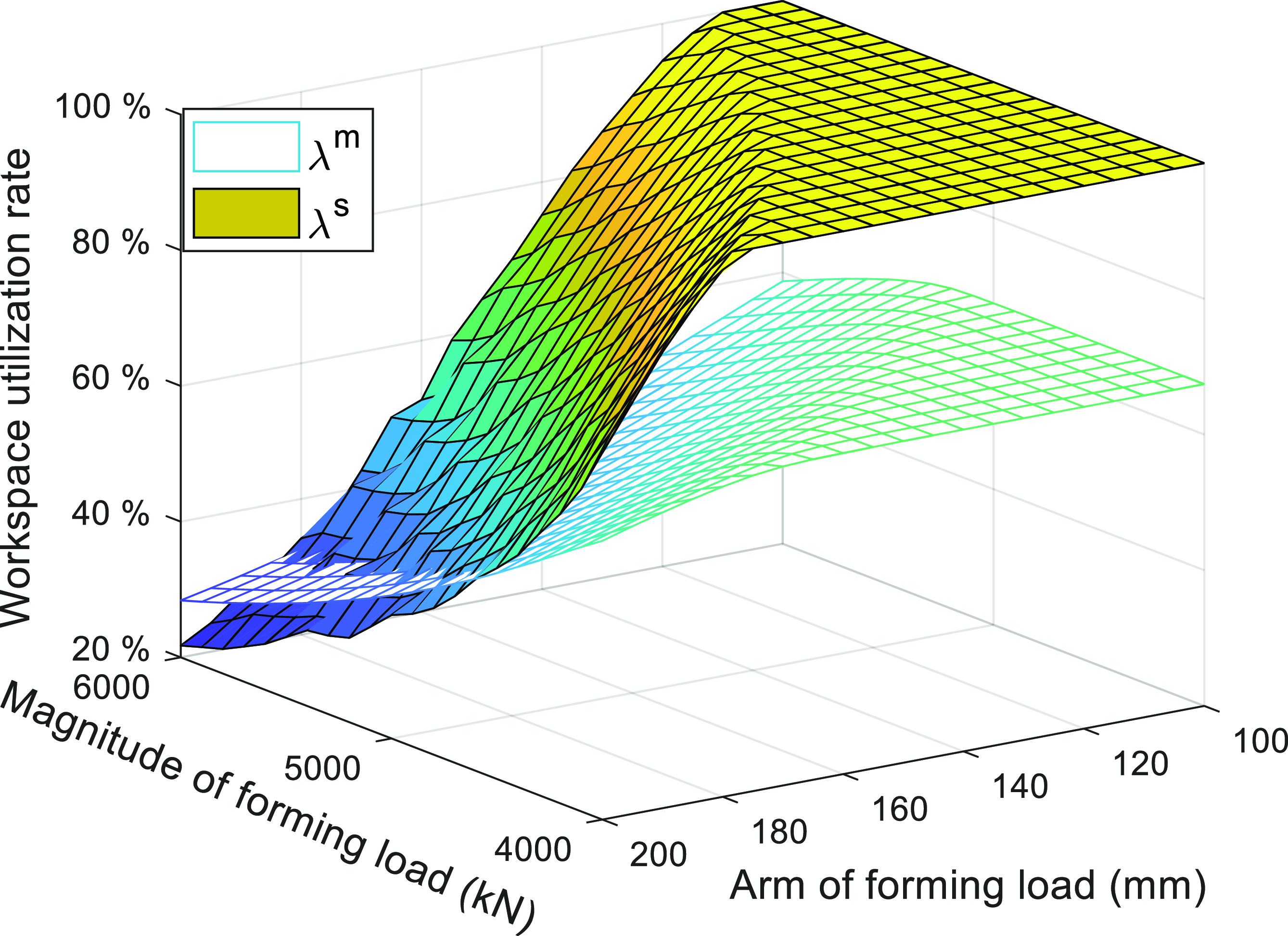
Comparison between workspace utilization rate with motor loading performance constraint
 $\lambda ^{m}$
and workspace utilization rate with deformation error constraint
 $\lambda^{s}$
.

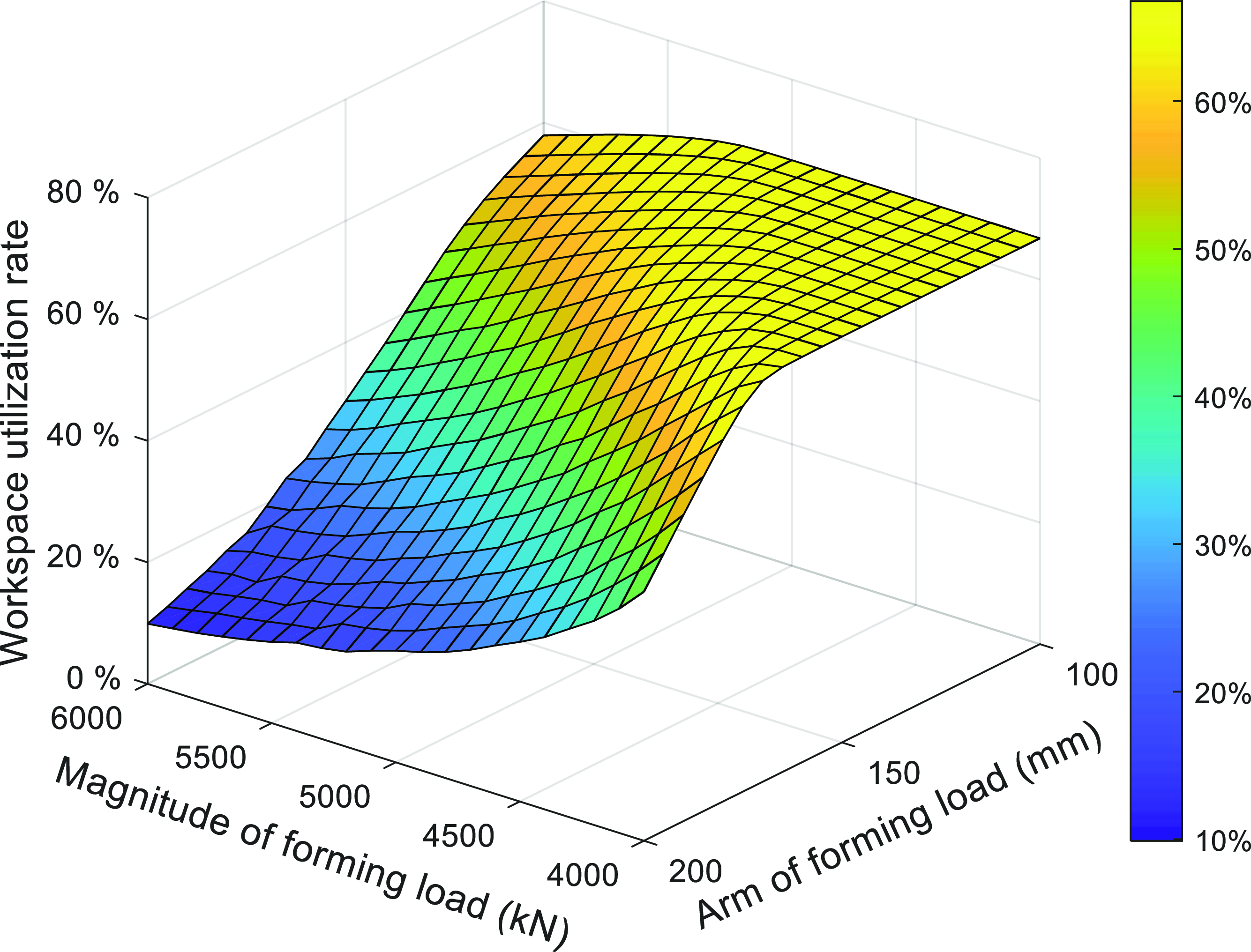
Take the magnitude of forming load as 3000 to 6000 kN and the arm of forming load as 100 to 200 mm, the synthesized workspace utilization rate of the PKM can be obtained and shown in Figure 18. It can be observed from Figure 18 that the synthesized workspace utilization rate decreases as the magnitude of forming load or arm of forming load increases. When the magnitude of forming load or arm of forming load is small, the synthesized workspace utilization rate can reach its maximum value of 67.4%. When the magnitude of forming load is 6000 kN and arm of forming load is 200mm, the synthesized workspace utilization rate can decrease up to 9.9%. The results show that with the increase of forming load, the workspace of the PKM can decrease to 1/10 of the theoretical one.
Further, by comparing the workspace utilization rate
 $\lambda ^{m}$
considering motor loading performance with the workspace utilization rate
 $\lambda ^{s}$
considering deformation error, this paper studies the contribution of
 $\lambda ^{m}$
or
 $\lambda ^{s}$
to the synthesized workspace utilization rate
 $\lambda ^{t}$
. It can be seen from Figure 19 that the minimum values of
 $\lambda ^{m}$
and
 $\lambda ^{s}$
both occurs in the same working condition that the magnitude of forming load is 6000 kN and the arm of forming load is 200 mm. In some working conditions formed by magnitude of forming load from 4600 to 6000 kN and arm of forming load from 180 to 200 mm,
 $\lambda ^{s}$
is smaller than
 $\lambda ^{m}$
. In most working conditions,
 $\lambda ^{m}$
is smaller than
 $\lambda ^{s}$
, indicating that for motor loading performance constraint, a smaller portion of the geometric workspace can be realized in practical compared to the deformation error constraint. In other words, when the forming load is smaller/larger, the workspace utilization rate
 $\lambda ^{m}$
considering motor loading performance influences the synthesized workspace more/less significantly than the workspace utilization rate
 $\lambda ^{s}$
considering deformation error.
6. Conclusions
This paper aims at developing a new heavy-load multi-DoF forming machine with 6-PSS PKM and proposing a new workspace estimation method considering mechanism deformation and motor loading performance. The following conclusions can be obtained:
-
1. A new heavy-load multi-DoF forming machine with 6-PSS PKM is developed to realize the incremental plastic forming of complicated components. In order to bear heavy forming load, S joints are adopted, the sliders are designed to move on the horizontal plane, and the vertical angles of links are designed to be small and gradually reduce with the feeding. The prototype of a multi-DoF forming machine with the heavy forming load of 6000 kN is manufactured.
-
2. The geometric workspace of the multi-DoF forming machine is predicted based on geometric configuration. Considering the geometric constraint, it is found that the maximum feed distance of tool decreases with the increase of the inclination angle of tool in the workspace.
-
3. The workspace considering mechanism deformation is predicted based on stiffness modeling of the PKM. The maximum deformation error is located in the region with smaller inclination angle of tool and smaller feed distance of tool. With the increase of forming load, the workspace with deformation error constraint gradually decreases. The workspace utilization rate with deformation error constraint can decrease up to 21.7% of the theoretical one, and the workspace with deformation error constraint can decrease to 1/5 of the theoretical one.
-
4. The workspace considering motor loading performance is predicted. With the increase of forming load or rotational speed of tool, the workspace with motor loading performance constraint gradually decreases. The workspace utilization rate with motor loading performance constraint can decrease up to 28.3% of the theoretical one, and the workspace with motor loading performance constraint can decrease to 3/10 of the theoretical one.
-
5. The synthesized workspace by simultaneously considering mechanism deformation and motor loading performance is predicted. With the increase of forming load, the synthesized workspace gradually decreases. The synthesized workspace utilization rate can decrease up to 9.9% of the theoretical one, and the synthesized workspace can decrease to 1/10 of the theoretical one. Moreover, when the forming load is smaller/larger, the workspace utilization rate considering motor loading performance influences the synthesized workspace more/less significantly than the workspace utilization rate considering deformation error.
Acknowledgments
The authors would like to thank the Natural Science Foundation of China (No. U21A20131 and No.52175361), Basic research Program of Major Special Project of China (No. 2019-VII-0017-0158) and Industry University-Research Cooperation.
Author contribution
Fangyan Zheng: conceptualization, investigation, writing – review & editing. Jingyu Liu: writing – original draft and writing – review & editing. Xinghui Han: writing – review & editing, supervision. Lin Hua: supervision. Shuai Xin: software. Wuhao Zhuang: resources.
Competing interests
The author(s) declare none.
Appendix
 \begin{align*} \boldsymbol{K}=\boldsymbol{J}_{f}\text{diag}\left(\left[k_{1}\cdots k_{6}\right]\right){\boldsymbol{J}_{f}}^{T}=\left[\begin{array}{l@{\quad}l@{\quad}l@{\quad}l@{\quad}l@{\quad}l} a_{11} & a_{12} & a_{13} & a_{14} & a_{15} & a_{16}\\[3pt] & a_{22} & a_{23} & a_{24} & a_{25} & a_{26}\\[3pt] & & a_{33} & a_{34} & a_{35} & a_{36}\\[3pt] & & & a_{44} & a_{45} & a_{46}\\[3pt] & & & & a_{55} & a_{56}\\[3pt] sym & & & & & a_{66} \end{array}\right] \end{align*}
where
 \begin{align*}a_{11} & = \sum _{i=1}^{6}(k_{i}(a_{ix}-b_{ix})^{2})/l^{2}\\ a_{12}& = \sum _{i=1}^{6}\left(k_{i}\left(a_{ix}-b_{ix}\right)\left(a_{ix}\tan \theta _{Ai}-b_{\mathrm{i}y}\right)\right)/l^{2}\\[4pt]a_{13} & = \sum _{i=1}^{6}\left(b_{iz}k_{i}\left(b_{ix}-a_{ix}\right)\right)/l^{2}\\[4pt]a_{14} & =\sum _{i=1}^{6}\left(k_{i}\left(b_{iy}b_{iz}+\left(a_{ix}\tan \theta _{Ai}-b_{iy}\right)\left(b_{iz}-Z_{P}\right)\right)\left(b_{ix}-a_{ix}\right)\right)/l^{2}\\[4pt]a_{15}& = \sum _{i=1}^{6}\left(k_{i}\left(b_{ix}b_{iz}+\left(a_{ix}-b_{ix}\right)\left(b_{iz}-Z_{P}\right)\right)\left(a_{ix}-b_{ix}\right)\right)/l^{2}\\[4pt]a_{16}& = \sum _{i=1}^{6}\left(k_{i}\left(b_{iy}\left(a_{ix}-b_{ix}\right)-b_{ix}\left(a_{ix}\tan \theta _{Ai}-b_{iy}\right)\right)\left(b_{ix}-a_{ix}\right)\right)/l^{2}\\[4pt]a_{22} & = \sum _{i=1}^{6}\left(k_{i}\left(a_{ix}\tan \theta _{Ai}-b_{iy}\right)^{2}\right)/l^{2}\\[4pt]a_{23} & = \sum _{i=1}^{6}\left(b_{iz}k_{i}\left(b_{iy}-a_{ix}\tan \theta _{Ai}\right)\right)/l^{2}\\[4pt]a_{24} & = \sum _{i=1}^{6}\left(k_{i}\left(b_{iy}b_{iz}+\left(a_{ix}\tan \theta _{Ai}-b_{iy}\right)\left(b_{iz}-Z_{P}\right)\right)\left(b_{iy}-a_{ix}\tan \theta _{Ai}\right)\right)/l^{2} \end{align*}
 \begin{align*}a_{25} & = \sum _{i=1}^{6}\left(k_{i}\left(b_{ix}b_{iz}+\left(a_{ix}-b_{ix}\right)\left(b_{iz}-Z_{P}\right)\right)\left(a_{ix}\tan \theta _{Ai}-b_{iy}\right)\right)/l^{2}\\[4pt]a_{26}& = \sum _{i=1}^{6}\left(k_{i}\left(b_{iy}\left(a_{ix}-b_{ix}\right)-b_{ix}\left(a_{ix}\tan \theta _{Ai}-b_{iy}\right)\right)\left(b_{iy}-a_{ix}\tan \theta _{Ai}\right)\right)/l^{2}\\[4pt]a_{33} & = \sum _{i=1}^{6}\left(k_{i}{b_{iz}}^{2}\right)/l^{2}\\[4pt]a_{34}& = \sum _{i=1}^{6}\left(b_{iz}k_{i}\left(b_{iy}b_{iz}+\left(a_{ix}\tan \theta _{Ai}-b_{iy}\right)\left(b_{iz}-Z_{P}\right)\right)\right)/l^{2}\\[4pt]a_{35}& = \sum _{i=1}^{6}-\left(b_{iz}k_{i}\left(b_{ix}b_{iz}+\left(a_{ix}-b_{ix}\right)\left(b_{iz}-Z_{P}\right)\right)\right)/l^{2}\\[4pt]a_{36} & = \sum _{i=1}^{6}\left(b_{iz}k_{i}\left(b_{iy}\left(a_{ix}-b_{ix}\right)-b_{ix}\left(a_{ix}\tan \theta _{Ai}-b_{iy}\right)\right)\right)/l^{2}\\[4pt]a_{44} & = \sum _{i=1}^{6}\left(k_{i}\left(b_{iy}b_{iz}+\left(a_{ix}\tan \theta _{Ai}-b_{iy}\right)\left(b_{iz}-Z_{P}\right)\right)^{2}\right)/l^{2}\\[4pt]a_{45} & = \sum _{i=1}^{6}-k_{i}\left(b_{ix}b_{iz}+\left(a_{ix}-b_{ix}\right)\left(b_{iz}-Z_{P}\right)\right)\left(b_{iy}b_{iz}+\left(a_{ix}\tan \theta _{Ai}-b_{iy}\right)\left(b_{iz}-Z_{P}\right)\right)/l^{2}\\[4pt]a_{46} & = \sum _{i=1}^{6}k_{i}\left(b_{iy}\left(a_{ix}-b_{ix}\right)-b_{ix}\left(a_{ix}\tan \theta _{Ai}-b_{iy}\right)\right)\left(b_{iy}b_{iz}+\left(a_{ix}\tan \theta _{Ai}-b_{iy}\right)\left(b_{iz}-Z_{P}\right)\right)/l^{2}\\[4pt]a_{55} & = \sum _{i=1}^{6}\left(k_{i}\left(b_{ix}b_{iz}+\left(a_{ix}-b_{ix}\right)\left(b_{iz}-Z_{P}\right)\right)^{2}\right)/l^{2}\\[4pt]a_{56} & = \sum _{i=1}^{6}-k_{i}\left(b_{iy}\left(a_{ix}-b_{ix}\right)-b_{ix}\left(a_{ix}\tan \theta _{Ai}-b_{iy}\right)\right)\left(b_{ix}b_{iz}+\left(a_{ix}-b_{ix}\right)\left(b_{iz}-Z_{P}\right)\right)/l^{2}\\[4pt]a_{66} & = \sum _{i=1}^{6}\left(k_{i}\left(b_{iy}\left(a_{ix}-b_{ix}\right)-b_{ix}\left(a_{ix}\tan \theta _{Ai}-b_{iy}\right)\right)^{2}\right)/l^{2} \end{align*}