BACKGROUND
The eastward-facing Thames Estuary varies in width from 27 km (16.7 miles) at its mouth to 3 km (1.86 miles) near Cliffe Marshes and once funnelled the great bulk of Roman trade from the Rhineland and North Gaul via the southern North Sea to its coastal ports, in particular London with its redistribution network.Footnote 1 The potential for discovering Roman wrecks amid the treacherous sand banks has long been recognised and the significance of this maritime zone has been highlighted through the research strategy published by the Greater Thames Estuary Archaeological Steering Committee.Footnote 2 This has reiterated the need for a coherent approach to research in this great European estuary (as advocated for other areas such as the Goodwin Sands).Footnote 3 Its archaeological potential is further outlined in the new maritime archaeological research agenda for England.Footnote 4
Prior to the Greater Thames Estuary Research Framework (a collaboration between English Heritage, Essex County Council, Kent County Council and the Thames Estuary Partnership), a voluntary body first set up in 1983 to undertake geophysical surveying and site evaluation on the Goodwin Sands (the ‘Goodwins Archaeological Survey’, GAS) turned its attention to the Thames Estuary. In 1985 it was renamed Marine Archaeological Surveys (MAS) to reflect this extension to a wider geographical area. In June 1985, surveying was undertaken on Pudding Pan Shoal, the Copperas Channel and Margate Sand using a combination of EG&G Mk 1b sidescan sonar, RO3 trisponder and Wimpey boomer, and for a short period Varian Proton Magnetometer. Data were gathered on the seabed state, known wreck sitesFootnote 5 and five modern sites. Drift dives were also undertaken in July 1985 in the Pan Sand area, but nothing Roman was found.
During this period, interviews with local fishermen and recreational divers, including Hugh Singer, gathered information on the location of net fastenings which was collated by the author and the late Fred Wall of Ramsgate, providing an indication of some fishing activity in the 1970s and 1980s through the recorded positions of uncharted seabed obstructions and net hazards (some shown as ‘X’ on fig. 7). This added over 500 fastenings to a register of submerged contacts previously gathered by GAS for the Goodwin Sands and Downs. During this data gathering, fishermen were asked whether they had recovered ceramics from the sea and where pottery had been retained, it was recorded in detail. Although precise findspots were rarely fixed by finders at the time of discovery, most likely locations were discussed and marked on charts.Footnote 6 This note reports on the Roman pottery that was recorded at the time, some of which has been summarily published by others.Footnote 7
THE POTTERY
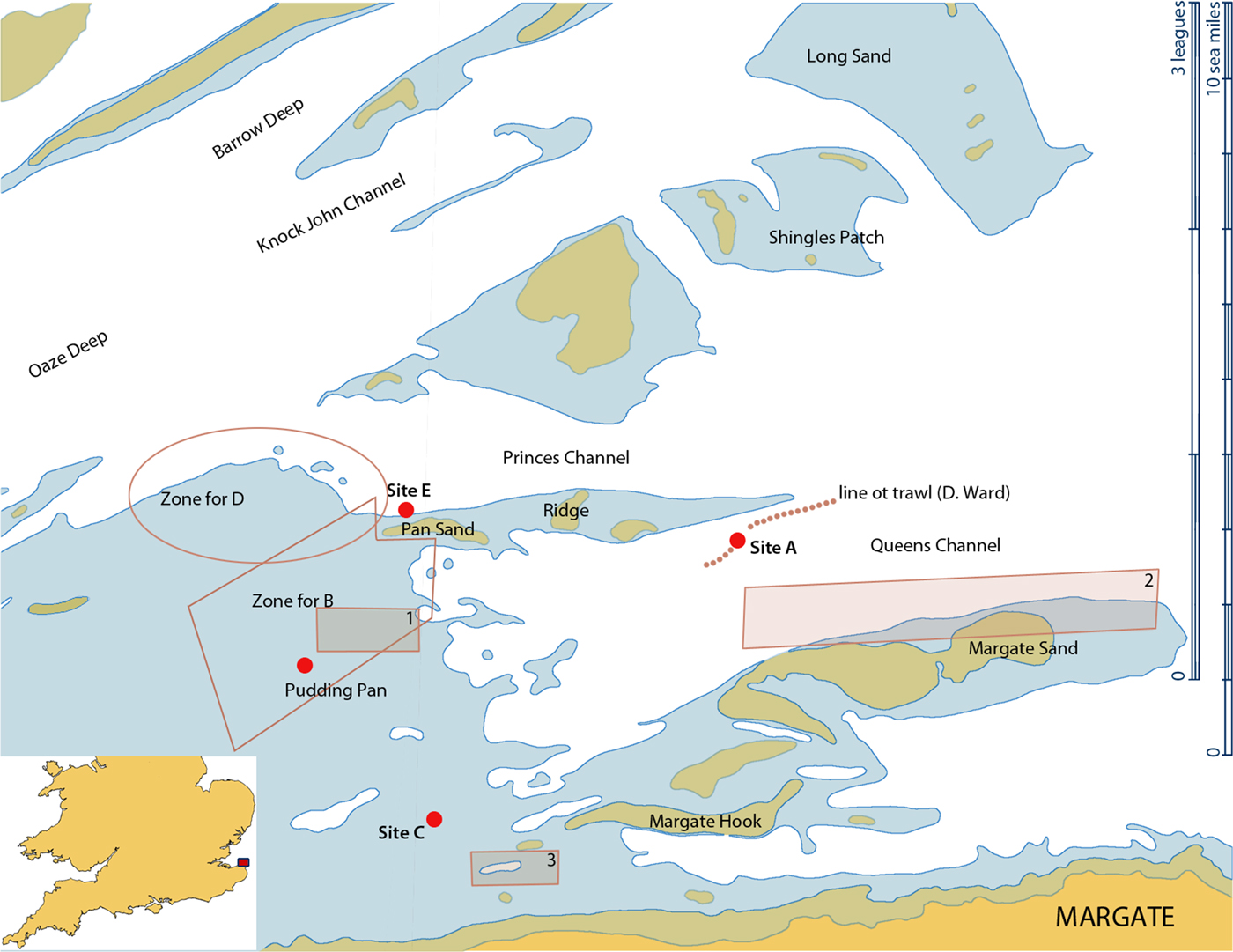
SITE A: ‘FROM A LINE OF TRAWL ALONG THE SOUTH OF RIDGE TONGUE TO THE NORTH OF RECULVER’ (FIG. 1, SITE A)
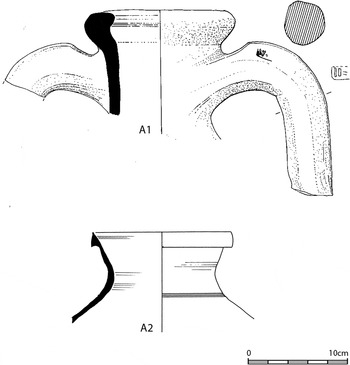
A1. Globular amphora Dressel 20 (Callender form 11, Beltrán V) (fig. 2, A1)
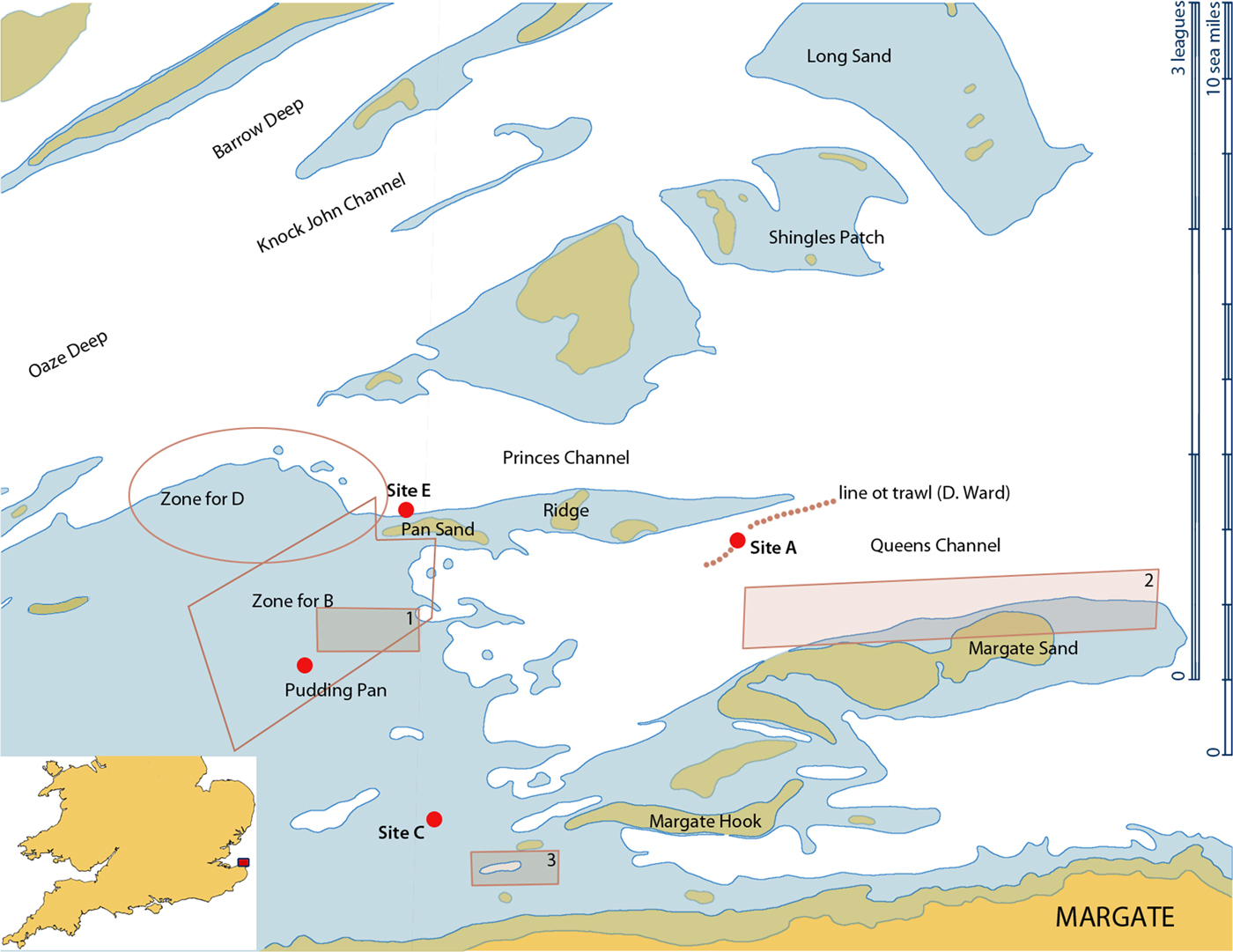
Southern Thames Estuary, showing approximate locations where Roman pottery has been recovered. Shaded rectangles 1–3 indicate areas of sidescan sonar survey by Marine Archaeological Surveys. (© National Museum of Wales) (colour online)
Roman pottery from Site A (scale 1:4). (© author)

Description: coarse sandy oxidised fabric. Upper part only, with two handles of circular cross-section and a thickened rounded rim profile. Internal rim diameter 90 mm; max. external diameter 150 mm; EVE = 1. One handle impressed with a barely legible stamp, II[…, …]II or …]LI.
Finder: D. Ward (recorded 1987).
Comments: such amphorae with large globular bodies and thick, sharply bent handles were made in the Guadalquivir/Baetis Valley region of Southern Spain (Roman province of Baetica) and were one of the most common and widely distributed types in the Western provinces. The principal content was olive oil, though they could also carry olive fruit.Footnote 8 In Britain, they occur from the first century to the early third century. This example is an early Dressel 20 belonging to Martin-Kilcher type 12 (mid- to late first century),Footnote 9 though there are some similarities with amphorae from the Port-Vendres B wreck, dated c. a.d. 42–8.Footnote 10 The stamp may start with II (duorum), as in the case of the Baetican stamp II CAMILI/MELISSI from Monte Testaccio, referring to the family producing oil on their estate.Footnote 11 Other Flavian/Trajanic stamps with a similar ascender, presumably that of an estate owner ending …NI, are known from various sites in Britain.Footnote 12
Date: mid- to late first century.
A2. Jar or flagon (fig. 2, A2)
Description/comments: angular rim with flaring neck and two horizontal grooves at junction of neck and shoulder; possible traces of a handle attachment on the rim. Fine orange sandy micaceous fabric. External rim diameter 138 mm.
Finder: D. Ward (recorded 1987).
Date: mid-first century.
Discussion
The early date for these two finds suggests the possible existence of a first-century wreck in the vicinity of the sand bank known as Ridge Tongue. The rim of A2 is similar to Camulodunum 379,Footnote 13 while the form is reminiscent of Camulodunum type 161Ab, imported before a.d. 50 (though without the vertical neck).Footnote 14
SITE B: ‘PUDDING PAN’ (FIG. 1, ZONE FOR B)
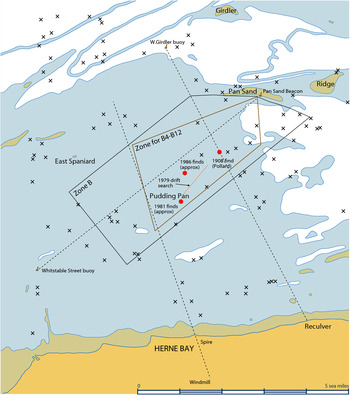
The location of the pottery-producing Roman wreck after which ‘Pudding Pan Rock’/‘Pan Sand’ received their names remains to be firmly identified, despite numerous past and continuing attempts to identify seabed evidence. The following pottery was recovered in the 1980s by two Whitstable fishermen while trawling. Mr John Martin recovered items B1, B2 and B3 (see below) about seven years before the interview (i.e. c. 1981) ‘from an area to the south-west of Pan Sand’; Mr Doug Ward recovered the remaining pottery from his nets at the end of trawls (the 1986 material after a single trawl) ‘from Pan Sand’ and, he thought, from the south side, which was most frequently trawled. Finds were noted as coming from the vicinity of 51° 26′.1N, 1° 7′.3E; limits of the distribution were defined as lying east of a line between 51° 26′.75N, 1° 5′.3E and 51° 24′.8N, 1° 6′.2E, and north of a line between 51° 24′.8N, 1° 6′.2E and 51° 26′.85N, 1° 10′.05E. A net fastening was recorded at 51° 26′.7N, 1° 9′.0E, but not inspected.
At the time of recording, items B1–B3 remained in the private collection of the salvor; items B4–6 and B8–10 were transferred to the care of the author and are destined for Whitstable Museum.
Terra sigillata
The listed examples are all plain and where bases survive bear stamps on their interiors.
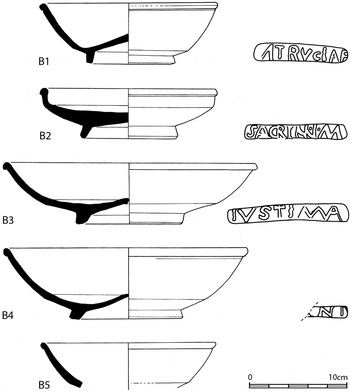
B1. Small bowl, form Dragendorff 31 (fig. 3, B1)
Roman terra sigillata from Zone B (scale 1:4; stamps 1:1). (© author)

Description/comments: this bears die 6g of Albucianus of Lezoux on the base, reading ALBUCIA.F [ALBVCIANI] (a revision by Hartley and DickinsonFootnote 15 of a stamp often read as ATRUCIANI). External rim diameter 181 mm; height 62 mm. Hartley and Dickinson record three other stamps of this die on vessels of the same type from the Rock.Footnote 16
Condition: loss of surface around foot ring, some of which is missing.
Finder: J. Martin.
Date: Hartley and Dickinson date Albucianus stamped products to c. a.d. 155–95.
B2. Dish, form Walters 79 (fig. 3, B2)
Description/comments: this bears Hartley and Dickinson die 3a of Sacrillus of Lezoux, stamped on base SACRILLI M, ‘by the hand of Sacrillus’. External rim diameter 180 mm; height 48 mm. Hartley and Dickinson record three other stamps of this die on vessels of this form from the Rock.Footnote 17
Condition: some of dish rim missing; external wear/loss of surface, particularly around foot ring.
Finder: J. Martin.
Date: Hartley and Dickinson date Sacrillus stamped products to c. a.d. 165–200.
B3. Bowl, form Dragendorff 31R (fig. 3, B3)
Description/comments: this is probably die 2d of Iustus ii of Lezoux and Vichy,Footnote 18 stamped IVSTI MA, ‘by the hand of Iustus’. External rim diameter 258 mm; height 62 mm. No other vessels using this die are recorded from Pudding Pan Rock by Hartley and Dickinson, although vessels using die 2b are present.
Condition: wear and marine growth (bryozoa and worm casts) externally and along 25 per cent of rim and wall internally.
Finder: J. Martin.
Date: a.d. 160–200.
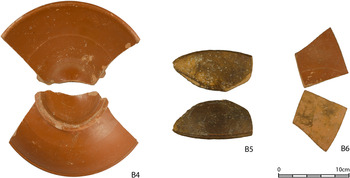
B4. Bowl, form Dragendorff 31R (fig. 3, B4)
Description/comments: stamped on base …I]NI., probably die 8a of Saturninus ii of Lezoux. Hartley and Dickinson list at least eight examples of this die on this form from Pudding Pan Rock and others on form 31.Footnote 19 External rim diameter 248 mm; height 72 mm. The diameter is wider than a bowl stamped SATVRNIN in the collections of the Society of Antiquaries (183 mm).Footnote 20
Condition: a little abrasion on the rim top, but both surfaces were in excellent condition. Worm casts and a few barnacles on interior surface when found.
Finder: D. Ward (found November 1986).
Date: post a.d. 160.
B5. Small bowl form Dragendorff 31 (fig. 3, B5)
Description/comments: rim sherd only. External rim diameter 177 mm.
Condition: worn to a polish both in and out; total loss of original surface.
Finder: D. Ward (found November 1986).
Date: second century.
B6. Bowl, form Dragendorff 31R (not illus.)
Description/comments: wall sherd only.
Condition: interior good surface, exterior worn.
Finder: D. Ward (found November 1986).
Date: second century.
Other Roman wares
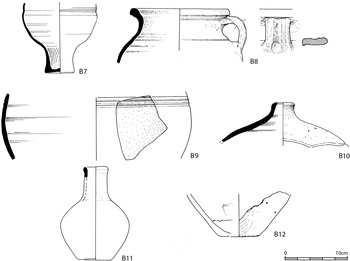
B7. Mid-Gaulish colour-coated beaker (fig. 4, B7)
Roman pottery from Zone B (scale 1:4). (© author)

Description/comments: narrow base of a Mid-Gaulish colour-coated high-shouldered beaker with a tall pedestal base. Maximum girth 118 mm. The bases on most Lezoux colour-coated beakers have a slightly different pedestal form.Footnote 21 The horizontal indentation around the waist also occurs on the so-called feeding cup or biberon (for example at Lezoux),Footnote 22 but the base appears more typical of beakers (as in an example from Paris, Boulevard Saint-Michel).Footnote 23
Condition: some erosion of colour coat, exposing fine light orange fabric.
Finder: D. Ward (recorded 1987).
Date: mid- to late second century.
B8. Coarseware handled jar (fig. 4, B8)
Description/comments: coarse sandy brown fabric with abundant clear and opaque sub-angular quartz, hackly fracture and cream core (not a London fabric), with single groove on shoulder. Single finger imprint at base of handle, which has one main vertical division and slight traces of a second. Maximum external diameter 157 mm. Probably a double-handled form not unlike South Gaulish form A24 from Sallèles d'Aude, attributed to the late first and second centuries,Footnote 24 or (less likely) a single-handled jar (cf. examples from Île de la Cité, Paris).Footnote 25
Condition: pitted surface and abraded fractures; about ⅓ of rim surviving.
Finder: D. Ward (found November 1986).
Date: second century.
B9. Wall sherd from a jar (fig. 4, B9)
Description/comments: wall sherd with orange margins and grey core, probably waist and lower shoulder from a jar. Traces of two shallow grooves on shoulder. Sandy orange fabric: abundant well-sorted rounded and sub-angular fine (<0.4 mm) clear and white quartz; moderate fine black inclusions. Maximum girth about 300 mm. Smith records the discovery during Pollard's 1908 expedition of a sherd of ‘coarse red ware half an inch thick’, from a hemispherical pot with a diameter of 9¾ in, but this could be post-medieval in date, or an amphora body fragment.Footnote 26
Condition: fractures rounded by abrasion.
Finder: D. Ward.
B10. Large lid, possibly from a bowl or casserole (fig. 4, B10)
Description/comments: fragment of wall and handle from a large lid with a worn, irregularly shaped perforation in the top of the knob handle (probably damage). Sandy orange fabric, with oxidised margins and core. Moderate fine (<0.1 mm) clear and white quartz; sparse very coarse opaque white quartz; occasional fine dark grey/black inclusions. Had the handle a perforation in antiquity, it could have functioned as a funnel (cf. a similar second-century form from L'Auribelle-Basse).Footnote 27
Condition: incomplete; worn, with rounded fractures.
Finder: D. Ward.
Date: second century.
Pottery from the same area, but not necessarily from the same site
B11. Greyware bottle or flask minus handle (fig. 4, B11)
Description/comments: external surface worn. Very fine reduced grey fabric resembling terra nigra. Neck becomes slightly narrower to the top. Flat base without foot ring. External rim diameter 39 mm; height 147 mm. This may be a colour-coated bottle which has completely lost its original surface, similar to carafe/cylindrical bottle forms (e.g. fourth-century examples with slightly flaring necks).Footnote 28 However, the overall form resembles some early medieval continental bottles (such as that in a coarse sandy fabric from Rhenen, Utrecht, grave 484),Footnote 29 some of which are in a similar very fine, smooth fabric.
Condition: some erosion of surface, exposing light grey fabric.
Finder: D. Ward (recorded 1987).
Date: uncertain.
B12. Hand formed jar base (fig. 4, B12)
Description/comments: very worn. Hard fabric with moderate angular/sub-angular ill-sorted grog and sparse crushed rock inclusions (<3.5 mm). Brown outer surface and margin; dark grey inner surface, margin and core. Base diameter about 65 mm. Not necessarily associated with the other Roman Pudding Pan wreck material and possibly local.
Condition: about ¼ of base surviving; upper body and rim missing.
Finder: D. Ward.
Date: probably late Iron Age/early Roman (first century b.c. to first century a.d.).Footnote 30
Discussion
As B11 and B12 illustrate, trawls from the Pudding Pan area have recovered a wide range of pottery (including medieval and post-medieval wares) and not all will be associated with contemporary events. The second-century Roman pottery recovered from Pudding Pan was considered in detail by Reginald Smith, who suggested that in addition to plain Central Gaulish terra sigillata and colour-coated wares (including two-handled cups in black-slipped ware with barbotine ‘vine-scroll’ designs) from Lezoux, the vessel carried a consignment of roof-tiles, presumably paying ballast of unused tegulae and imbrices.Footnote 31 Jacob, writing earlier, in the eighteenth century, described a two-handled colour-coated cup, and it may be assumed that these, alongside the beaker base published here (B7), formed part of a mixed cargo.Footnote 32
On the basis of previous discoveries the ‘Pudding Pan’ wreck was dated by Brian Hartley to the period c. a.d. 170–200.Footnote 33 Sacrillus operated at Lezoux c. a.d. 165–200, Albucianus c. a.d. 155–95 and Iustus at the same centre c. a.d. 160–200. The incomplete potter's stamp on B4 appears, to judge from a trace of the base of a letter I before the N, to be the known ‘Pan Rock’ stamp SATVRNINI or one with a similar ending. Collectively these dates fall within the generally accepted range of a.d. 170–95 for the wreck site. Plain terra sigillata published from the New Fresh Wharf quay groups in the City of London showed slight variations in detail and it was suggested that this London assemblage may be a little earlier in date.Footnote 34 Fresh and unworn examples of unused samian were found within the deliberate infill of the quay, one group being of Central Gaulish origin dated c. a.d. 170–80, having 25 potters in common with Pan Sand and a similar range of plain forms.
Variations in condition and wear pattern on the terra sigillata have been studied by other commentators (e.g. Watson, March and Hill) and similar characteristics are apparent on the specimens reported on here. The considerable external wear and growth noted on Nos B1–B3, B5 and B6 was a feature noted on examples of Pudding Pan/Pan Sand terra sigillata now in collections in the Ashmolean, Royal Institution Swansea and British Museum.Footnote 35 The differential wear on the new examples of terra sigillata in this short paper ranges from very little to very severe, reflecting different exposure regimes (fig. 5). Dish B4 has a little abrasion on the rim top, but both surfaces were in excellent condition, suggesting recent exposure. In contrast, B5 is worn to a polish both in and out, suggesting prolonged exposure (no marine growth) and prolonged rolling on the seabed. Wall sherd B6 has a severely abraded external surface but good internal surface.
Differential wear on terra sigillata from Zone B. (© National Museum of Wales) (colour online)

Incomplete amphorae, some with stoppers in place, have been trawled up.Footnote 36 Some of the tegulae from the site in the British Museum display signs of use, having perforations for nail-holes, and at least one imbrex is noted by Watson.Footnote 37 While some tile may have acted as paying ballast, those with holes may have formed part of the ship's operating structure such as the galley and its stove or roofing.
Early accounts
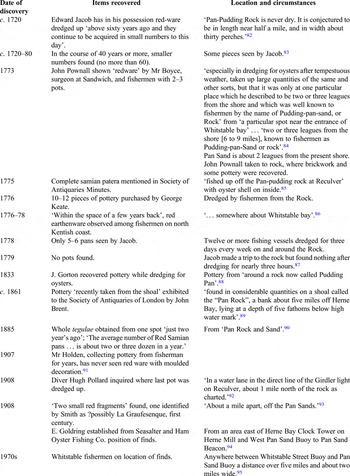
A review of eyewitness and second-hand accounts of earlier discoveries provides a few pointers of value in refining priority areas for survey (see Appendix: Table 1 for summary). The accounts of the pottery (Roman Earthen Ware) given by Thomas Pownall and his brother John were a starting point: pots ‘of the same and other sorts’ being recovered from a spot ‘two or three leagues from the shore and known to fisherman as Pudding-pan-Sand or rock’.Footnote 38 John Pownall recovered broken pots, three complete vessels and brickwork at the Rock ‘in about 9ft of water at low water’.Footnote 39 In a paper read in 1780, Edward Jacob distinguished between Pudding-pan Rock (also called Pan-Pudding Rock) and Pan Sand and had in his possession pottery dredged up ‘more than 60 years before’ (i.e. before 1720).Footnote 40
These reports were clearly the source for Hasted's Reference Hasted1799 description:
For some considerable length of time past, there have been found by the fishermen of this neighbourhood, when dredging with their nets for oysters on and round about a rock in the channel near Whitstaple, called the Pudding-pan rock, which is never dry, quantities of Roman earthen ware; some of the pans entire, but more only fragments; though for some years past there have been but few found.
The traditional story of the country (and tradition has been in general found to have some truth for its foundation, however misrepresented by ignorance and a series of time) that some vessel, freighted with this manufacture, was many ages since cast away on this rock, and its lading dispersed on and about it by the force of the waves from time to time. This, though only tradition, appears to be the most probable conjecture of any that has yet been made, of these pans and their fragments having been deposited here. Such as have been found, have been from time to time carried home by the fishermen, and made use of for domestic purposes in their houses; but of late years, the circumstance of their being found coming to the knowledge of the curious antiquaries, they have been in general sought out and purchased by them, and are now preserved among their respective collections.
Mr. Jacob, of Faversham, wrote some observations on this earthen ware found here, (in answer to governor Pownall, who had ingeniously conjectured this rock to have once had a Roman pottery established on it, of which these were the remains, and to correct several of the governor's mistakes) and strongly inclines to the idea, of their being dispersed here by the misfortune of some ship, loaded with them, having been wrecked on this rock. In which he is followed by Mr. Keate, in a very sensible paper of observations wrote on the same subject.Footnote 41
Keate suggested that the pots remained concealed ‘till portentous winds, acting in a particular manner on the waters, might not only wash away the sands which embedded them, but also prove the means of carrying some of them to a distance from the spot where they originally may have lain’.Footnote 42 Some salvaged pottery was bought by Whitstable jeweller William Holden (about 130 pans and flints) and his shop had a selection on view, some with oyster shells attached. On his death, half were purchased by the British Museum and half by the Whitstable Historical Society. Another collection of samian was ‘dredged from what is known to the fisherman as the Pan Pudding Rock’ and acquired by Mr Teanby, Gravesend.Footnote 43
Reginald Smith re-examined the evidence in his thorough 1907 review and analysis of the pottery recovered by oyster dredge nets over the years, in which he raised the possibility of more than one wreck being involved.Footnote 44 According to Smith, Pan Sand yielded specimens with potters' names not occurring in the ‘Rock’ series, citing ACCIVS, CONGI.M and MVXTVL (for MIXTULLI.M),Footnote 45 though any conclusion awaits the results of research by Michael Walsh. Subsequent discoveries have again raised the question of whether Smith's catalogued wares represent a single site assemblage or material from more than one ship, an interpretation favoured by Walsh (material has been attributed either to ‘Pudding Pan’ or ‘Pan Sand’).
With the growth of recreational sports diving, particularly from the 1970s, underwater searches for the wreck site have been undertaken by dive groups and the evidence for the location was initially reviewed by Singer and Mensikov.Footnote 46 In the 1980s Kit Watson reappraised the published evidence for the site and its pottery, collating information from some 18 museums holding material from the wreck site.Footnote 47 In his discussion of the site's elusive location, he agreed with these previous commentators that Pan Sands rather than Pudding Pan Rock was the most likely location of the wreck, a view not held by Walsh. The eighteenth-century observation that pottery tended to be recovered ‘after very stormy weather’Footnote 48 suggested periodic exposure of material beneath shifting sand and sediment. It has therefore generally been assumed that the cargo has been dispersed around a wreck core somewhere between Pudding Pan Rock and Pan Sand. Periodic exposure of wreck sites is well attested in the vicinity of other sand banks and is one possible mechanism involved; the evidence for transport over long distances by natural agency (as opposed to human intervention through, for example, oyster dredging or wave action) remains conjecture.
In the context of the above, it is worth reporting some minor observations made in the 1980s. In 1979 the author and members of the Underwater Research Group of the Institute of Archaeology, London, in conjunction with Pete Mensikov (North-East London Polytechnic), dived on Pudding Pan Shoal and considered methods of measuring the extent and rate of annual seabed movement, though this was not undertaken. It was noted on a drift dive over Pudding Pan (fig. 7, line of drift shown) that the estuary bed in this area comprised a layer of mobile coarse sand 15–20 cm in depth, above a very hard deposit of small stones (impenetrable by hand) and rough semi-buried cement boulders. The area on Pan Sand Hole north of Decca System Green 36 was reported by fishermen to be rough ground and therefore not usually trawled, the area south of Green 36 undulating and better for fishing. Work on other areas of the Thames Estuary and Goodwins Sands has illustrated considerable sand movement and a high density of man-made material, reflected in a register of net fastenings gathered from local fishermen.Footnote 49 In 1985 MAS surveyed an area of Pudding Pan Shoal using EG&G Mk1b sidescan sonar, Wimpey boomer and Varian proton magnetometer, during which two sidescan sonar contacts were recorded, but without any specific indication of a Roman site.
The pottery recovered from the south side of Pan Sand points to a single main assemblage dating to the period c. a.d. 165–200 (perhaps a.d. 180–200).Footnote 50 However, as other commentators have pointed out, the complete inventory of the pottery from ‘Pan Sands’ in its widest sense suggests the existence of more than one Roman wreck in this treacherous area.Footnote 51
Early statements on where terra sigillata was being recovered are imprecise and cover an envelope about 10 square miles in area (fig. 7; Appendix, Table 1). One of Mr Ward's trawling tracks has also been indicated, showing how far recovery location might differ from seabed location (a reminder that all the recent ‘findspot’ locations are only approximations). The area around Pan Sand Hole is one of the areas prone to rapid change,Footnote 52 similar to other sand banks such as South Goodwin Sand. The former has been suggested as a possible source of the pottery, but it can equally be argued that it might act as a trap for material, if moved by some agency.Footnote 53 Significant changes also occur to the south edge of Pan Sand, while it is to the south of the sandbank that much of the cargo of terra sigillata and other ceramics has been reported to have been recovered. It therefore seems likely that surviving physical evidence for the wreck may yet be found lying on the solid geology, periodically subjected to exposure as the sands shift and banks move. This is supported both by the new finds and by Hugh Pollard's recovery of two ‘small red fragments’ about a mile apart off ‘Pan Sands’, if they are contemporary.Footnote 54 However, adherent oyster shell, well-reported on numerous examples of recovered samian, points to their dispersal in an area conducive to such marine life and there are no oyster beds currently close to the present position of Pan Sand, bottom conditions being too sandy and mobile. Singer's 1972 article marks an early attempt to compare various charted reconfigurations of the sandbank over time, to plot changes and identify areas of high exposure. While shifting sands, oyster dredging, storm action and the passage of time may have dispersed much of the cargo over a wide area, the discovery in 1989 of a well-preserved bowl (fig. 3, B4) suggests that significant elements of the core cargo, perhaps even a wreck matériel cluster, may yet be found. It is hoped that further systematic survey work and site evaluation, such as that conducted under the ‘Roman Shipwrecks Project’ set up in 2000 by the Centre for Maritime Archaeology and the Southampton Oceanography Centre at the University of Southampton and the British Museum (lead investigators J.D. Hill, M. Walsh, J. Dix and J. Adams),Footnote 55 may eventually identify the wreck site and establish reasons for its loss. In 2001 the Roman Shipwrecks Project surveyed a large area of seabed at Pudding Pan Shoal (21 square kilometres), building on previous survey work in 1998 of 6.5 square kilometres to the south of Pan Sand. 450 targets were reported to have been identified and 78 dives conducted on 39 targets. The recovery of a further sherd of terra sigillata during this season has been reported.Footnote 56
SITE C: HORSE CHANNEL (FIG. 1, SITE C)
This pottery was trawled up in the mid-1980s from the Horse Channel, to the north of Reculver.
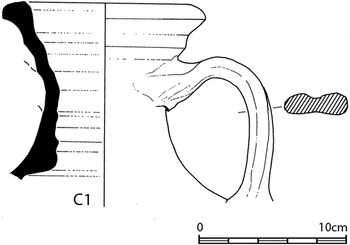
C1. Amphora (fig. 6, C1)
Roman pottery from Site C (scale 1:4). (© author)

Description/comments: neck and rim, orange fabric (moderate fine white quartz inclusions, sparse red inclusions). External rim diameter 135 mm. Perhaps Gauloise 5 form. The profile recalls a vessel from Ironmonger Lane, London stamped ADBVCIVSF, made at Gueugnon (Saône-et-Loire),Footnote 57 and a similar Gauloise amphora profile from the same place.Footnote 58
Finder: J. Martin (1986).
Date: second or third century.
PREVIOUSLY PUBLISHED SITES
SITE D: HERNE BAY NEAR ‘OAZE DEEP’ (FIG. 1, ZONE FOR D)
In 1978 Geoff Marsh published a note on a mortarium recovered from the sea off the north Kent coast, with a diameter of 460 mm and height of 152 mm.Footnote 59 According to Jones, ‘at least four’ such mortaria had been recovered from ‘Herne Bay’.Footnote 60 Belonging to the standard ‘Gillam 238’ mortarium form, which is found on sites in South-East England/North France, next to the spout, it bears the stamp Q. VA. S / Q. VALERIVS SE[…, Quintus Valerius Secundus, working c. a.d. 55–85.Footnote 61
Kay Hartley has recently assembled the evidence for the manufacture of Gillam 238 mortaria in the Oise/Somme area of northern France as part of a general reassessment of her Groups I and II.Footnote 62 Q. Valerius SE.. occurs in the Boudiccan destruction horizon at Colchester and at Richborough, as well as Broxtowe, Baginton, Usk and one from Scotland.Footnote 63
Another complete unworn mortarium of similar date trawled up ‘from the same general area’ was also examined by Marsh while in the possession of a south Essex fisherman.Footnote 64 These have been reported as being recovered more specifically from Oaze Deep and from ‘between Oaze Deep and Pan Sand’Footnote 65 but the precise location is unknown.Footnote 66 The mortarium bears a stamp first read as CAVARIVS (K. Hartley's Group 2 potter), but since given the revised reading of CASSARIUS through the V-formation of the thin double S, dated c. a.d. 65–100 + .Footnote 67
Marsh speculated that the two mortaria, found in the same general area, may have come from a single wreck and while confirmation has yet to be found, their similar dates make this an attractive suggestion. Quintus Valerius Secundus and Cassarius were North Gaulish potters working c. a.d. 55–85 and c. a.d. 65/70–100 + respectively. Therefore, if both were from a single wreck site (and this is not proven), the ship was probably lost between about a.d. 65 and 85.Footnote 68 The wider distribution of mortaria of Gillam 238 type is discussed in the report on the pottery from Usk, which notes its occurrence in southern Britain at Caerleon, Cardiff Castle, Gloucester, Great Casterton, Richborough, Usk and Wroxeter.Footnote 69 They probably reflect cross-Channel trade out of Boulogne and their distribution suggests importation via the South-East and distribution via the Thames Valley, some perhaps redistributed via Richborough, which has produced a large number.
According to some sources, there is little trawling in Oaze Deep as the bottom is not right. A more likely source has been suggested on Shivering Sand, immediately to the east. However, these unworn mortaria had a few oyster shells stuck to them, suggesting a provenance within oyster beds (see fig. 1). Being a close contemporary with an amphora reported to have been found to the north of Pan Sand (designated Site E here; see below), it is not impossible that they all originate from a single wreck loss, though this is not necessarily the case.
A small assemblage of unprovenanced third-century material ‘from the same locality’ has also been reported.Footnote 70
SITE E: NORTH SIDE OF PAN SAND (FIG. 1, SITE E)
In 1983 an amphora was trawled up from a reported position ‘about 500 m north of Pan Sand’ by Mr D.M. Tyrell, a Whitstable fisherman.Footnote 71 As with many other trawled finds, where exactly it had lain on the seabed was not established, as it could have been towed in nets up to 5 km before being observed (and doubts have been expressed about the accuracy of the recorded findspot). The slim cylindrical amphora had deep grooves below the rim, oval handles and a solid, conical basal spike, and was a class that did not fit into existing typologies, being called ‘London 555’.Footnote 72 It was found to contain 6,206 olive stones — a Baetican origin being favoured over a South Gaulish one — and it was dated c. a.d. 70 ± 15. The form appears to have emerged about a.d. 50 and ceased after about a.d. 125/50. This has been taken as strong evidence for the presence of a second wreck in the area of Pan Sands pre-dating the loss of the terra sigillata conveyor. The amphora may be associated with the mortaria reported under ‘D’.
DISCUSSION
Obstacles to suggesting clear contexts for such discoveries, or likely mechanisms for their loss are generally (1) lack of clear dating, (2) lack of firm archaeological association (poor provenance), (3) uncertain artefact histories and (4) factors such as re-cycling, re-use, discard and post-wreck activity such as dragging/drifting. Evaluation of the significance of pottery recovered from the sea depends on a range of criteria, including (a) quantity (single sherds or pots may represent casual loss or discard), (b) condition, (c) wear (information about site composition and exposure), (d) completeness, (e) adherent marine growth, (f) date (contemporary with other material from the same area), and (g) function (cargo, galley equipment, washing). Variations in completeness and wear/abrasion represent part of the cycle, and variations within a group (as demonstrated by the work of others on the Roman assemblage from Pudding Pan/Pan Sands) are crucial to an interpretation of the context and statistical reconstruction. In the above examples, where exactly the various sherds had lain on the seabed may not be known, while material may have been dragged by nets for considerable distances (several miles) before discovery (fig. 1 shows one such trawl). The locations given by fishermen (fig. 7) are therefore only approximations based on the location and nature of their trawling or fishing activity and their memories; the actual source could lie several miles distant.
Early transits (see Table 1) and approximate locations of where trawled pottery has been recovered (Site B). X = net fastenings recorded in the 1980s. (© National Museum of Wales) (colour online)

Walsh has suggested that the Pudding Pan pottery has been recovered in cycles, prompted by publications and increased awareness at the time, and there are peaks of antiquarian recording, though early witness statements imply a regular ‘crop’ of pottery on a more than annual basis. Charts provide evidence for those features of the estuary recognised through contemporary eyes and sometimes clues to the discovery process. The coastal chart of the Thames Estuary by Richard Poulter dated 1584,Footnote 73 giving ‘a discription of the sandes’, was primarily a desk-top risk assessment of enemy landings, but it is interesting to note that Pan Sand is absent (Lid Sand, Columbine Sand, Gilman, Spanyard and Wolpaker Sand are identified).Footnote 74 Singer has noted that Pan Sand is marked on Greenville Collins' Coasting Pilot of 1693, but not named. However, it does appear on late seventeenth-century Dutch charts, labelled ‘Pan Sands’ in the general area of the current sand bank of that name on Iohannes van Keulen II's chart of the Thames Estuary c. 1682. Entitled Nieuwe Paskaert van d'Oost Kust van Engelandt (Amsterdam), this predates the first published accounts of pottery from the area and suggests that pottery was being recovered in the vicinity of the sand bank long before published antiquarian accounts. Pan Sand also appears on a chart of the Thames Estuary by John Bennett (1781), bound in Sayer and Bennett's A Complete Channel Pilot, comprehending the English and French coasts, from the Thames Mouth to the Bay of Biscay, including the North Sea, with sailing directions, while Richard Stanier's chart drawn for pilotage in the Thames in 1790 shows Pan Knowl and Pan Sand (unlabelled) running into Ridge. Pan Sand, Pan Patch and Pan Speck are clearly marked on William Heather's chart of the Downs and Margate Roads of 1796, and William Mudge's Entirely New & Accurate Survey Of The County of Kent, With Part of the County of Essex (1801), which identified depths and sands (but no ‘Pan Rock’) and two small shallows to north-east and south-east, ‘Pan Speck’ and ‘Pan Patch’ (the latter in a similar position to Site B). The appearance and recovery of pottery from the seventeenth century recalls the impact of storms and floods in exposing Roman sites such as the temple of Nehallenia at Domburg (Netherlands). This first appeared from under sand in 1647, with stones visible daily at low tide in 1731 and by the 1750s only at exceptionally low tides.Footnote 75
In addition to the two sites suggested by others in the Pan Sand area, it is interesting that Smith recorded a Dragendorff 24/25 cup/small bowl (made at Lezoux and La Graufesenque) from Pan Sands.Footnote 76 This form is usually found in pre-Flavian contexts in Britain,Footnote 77 raising the question of whether it might be associated with other first-century material from this area (e.g. Site D?). An African Red Slipware bowl in the Museum of London collections has been attributed to Pan Sands, though Marsh has pointed out the problems of modern imports from elsewhere in Britain or abroad being given ‘London’ provenances by dealers in the nineteenth century in order to enhance their value. Just as some Pudding Pan pottery may have acquired a ‘London’ provenance (e.g. a plain bowl from ‘Lombard St’),Footnote 78 one is left wondering whether any subsequent imports could have acquired a Pudding Pan provenance by similar means. Moreover, Watson has warned against using wear and presence of marine growth alone as a unique identifier of Pudding Pan.Footnote 79
Two possible wrecks are suggested, one in the vicinity of Horse Channel and one associated with Ridge Tongue. In the case of the pottery from Site A, even allowing for trawl length and drift, a considerable distance of some four nautical miles lies between it, Pan Sands and Site E, and an even greater distance to the zone for Site D to the west, where the Gillam 238 mortaria were recovered. This information supports the conclusion that at least two mid- or mid/late first-century wrecks may lie somewhere in these areas — lost during a very active period when most pottery was coming from Gaul.
While the pottery reported on here can be viewed as random recovery from the Thames Estuary, it helps inform our understanding of trends in trade, the risks for traders and the complex means by which pottery was imported into Britain. The extent to which it is an indicator of early wreck sites depends on the cumulative evidence for place of loss. Even when artefacts have been securely attributed to a single vessel, they may point to different places of origin, while goods in use may have a moderate circulation rate; others may be replacements for lost or damaged vessels. Cargoes may have identifiable origins — sometimes to main areas of manufacture — but often with additional elements acquired through trans-shipment, products conveyed in transit and picked up by the vessel en route.Footnote 80 In the case of on-board equipment, it may be difficult to determine which of the coarse wares and other vessels may have been personal possessions or galley equipment rather than cargo where evidence of use is absent. The reasons for shipping loss are numerous: striking an unknown sand bank, being driven off course by storms or strong winds, confusion amid the sandbanks and running aground on a falling tide, springing a leak or capsizing and shifting cargo being some of the more obvious causes.
The material from Pan Sands adds to the database.Footnote 81 It is to be hoped that continuing data collection, survey work and site evaluation, such as that conducted under the ‘Roman Shipwrecks Project’, and the future observations of sports divers may eventually lead to the location, identification and analysis of further Roman wrecks in the Thames Estuary.
APPENDIX
SUMMARY OF STATEMENTS ON EARLY DISCOVERIES AT ‘PUDDING PAN’ FROM 1720s TO 1970s (FOR LOCATIONS, SEE FIG. 7)

ACKNOWLEDGEMENTS
In preparing this note, the author would like to thank the following: Tony Daly for figs1, 7 and figure layouts; Brenda Dickinson, Martin Dean, J.D. Hill, Michael Walsh and Steve Waring for information; fishermen John Martin, Tom Brown and Doug Ward for generously sharing their knowledge of the area and providing access to their collections; Peter Webster (Honorary Research Fellow, Amgueddfa Cymru – National Museum Wales) for expertise and comments; for supporting the work of MAS in the Thames Estuary, thanks are due to Wimpey Laboratories, Mike Borrow, Fred J. Wall, David Lyon, Cathy Giangrande, Les Emptage and John Langford. The pottery was drawn by the author.