


A half-century ago—at the midpoint of the Review's historical run—the lead article of Volume 50, Number 4 was “The Political Science of Science: An Inquiry into the Possible Reconciliation of Mastery and Freedom.” No mere article, this was the 1956 presidential address of the newly elected head of the American Political Science Association, Harold D. Lasswell. For those who heard the speech or read it in the Review, there could be no question about the influence or accomplishment of its author. By the 1950s, Lasswell was a giant within political science—in many colleagues' eyes, “the most original and productive” scholar of his day (Almond 1987, 1). A 1963 survey of the profession ranked Lasswell as the second most influential political scientist before 1945 (behind only his former adviser, Charles Merriam) and the fifth most influential after 1945 (just after Robert Dahl). In the words of the survey's designers, Lasswell was “far and away the one individual most often mentioned” across the two periods, making him the clearest exemplar of those rare “‘idea’ pioneers” whose “intellectual originality results in new analytic tools or concepts and eventually in the charting of previously unexplored domains” (Somit and Tanenhaus 1964, 66–67). His election to the presidency was a landslide, lamented only for its belatedness. As one supporter wrote the APSA Committee on Nominations: “We think the time is running out in recognizing the real greatness of Harold Lasswell” (Weidner 1954).
Time was indeed running out. Although Lasswell would continue writing until just before his death in 1978, the address was Lasswell's swan song, his eighth and last article in the Review. His first, more than 30 years earlier, was “Two Forgotten Studies in Political Psychology” (1925). His penultimate article on “the policy-clarifying task” of political scientists (1951a, 142) foreshadowed his presidential address. In the intermediate years, Lasswell published on topics for which he was hailed as a pioneer: propaganda (1927), the political import of mental illness (1929), public opinion (1931), configurative analysis of aggression (1934, with Gabriel Almond), and Fascist elites (1937, with Renzo Sereno). Lasswell was also a prolific reviewer for the Review, and his own books were the object of 16 reviews in the journal, beginning with World Politics and Personal Insecurity (1935) and ending with the posthumously published The Signature of Power (1979). Yet Lasswell's 1956 presidential address was his last true article in the Review, and his most expansive. Delivered at the height of his influence, it stands today as the purest and most prophetic expression of Lasswell's vision of a profession he had powerfully shaped.
What did the renowned pioneer talk about? He talked about “P-bombs” for paralysis and “impenetrable energy shells” for defense. He confidently predicted that “Noah's Jet” would “establish continuing occupation outside the earth” and that “super-gifted men or even new species possessing superior talent” would soon be possible. In this new world, Lasswell declared, the quest for human mastery would have to be reconciled with “the dignity of freedom for all that lives.” The “overriding goal of policy in our body politic” required becoming “life-centered,” not “man-centered.” If Lasswell's speech struck some who absorbed it as more science fiction than social science, then they got Lasswell's message: technological innovation and the Cold War meant the nation's future was up for grabs. The only sure thing was that democratic leaders would face profound challenges. With so much at stake, political science could no longer sit on the sidelines. It needed to project a comprehensive image of the future, clarify fundamental goals, provide “theoretical models of the political process,” and develop policy alternatives to maximize democratic values, particularly dignity. Political science was poised to become “the policy science, par excellence” (1956a, 979, passim), Lasswell announced. It was the charge of the discipline to embrace a new ideal of scientific achievement—not the monastic, value-free practitioner of technical research, but the engaged, value-focused “policy scientist of democracy.”
Lasswell's speech was not the usual sort of political science address, but then Lasswell was not the usual sort of political scientist—or even the usual sort of APSA president. He was, arguably, the closest that the discipline has come to the “policy scientist of democracy” that his 1956 speech lionized. Today, assessments of Lasswell range from the dismissive to the hagiographic. (They did so in his day as well.) But the fixation on Lasswell's contribution to political science blinds us to Lasswell's vision of political science—and its continuing relevance. To grapple with Lasswell's vision is to gain a better picture not just of the complex figure who formulated (and embodied) the ideal of the “policy scientist of democracy” but also of the ambiguous and contested place of political science within a democratic society—and of public policy within political science. For whatever else might be said of Lasswell, he acutely grasped something that too many of us, caught up in the day-to-day work of normal science, forget: Political scientists are engaged in the study of collective policy choices with huge stakes—choices that divide societies; choices that affect millions of people, if not life itself; and choices that political science, with the appropriate mix of rigor and reflexivity, has a special ability, even obligation, to address.
Taking the presidential address of 1956 as the point of departure, this essay has three goals. First, it explores Lasswell and his vision of the policy scientist of democracy in original context. Second, it recovers the reaction to both the man and the ideal in the evolution of the discipline. Third, it reconsiders Lasswell's ambitious and ultimately ill-fated vision against the backdrop of some of the problems that face us today, during this centennial of the Review.
THE POLICY SCIENTIST OF DEMOCRACY
The policy scientist of democracy, as disciplinary persona, emerged from Lasswell's self-conscious turn toward public policy near the midpoint of his long and energetic career. Relying on publication titles, many political scientists date the turn to The Policy Sciences, the 1951 volume that Lasswell coedited with Daniel Lerner. In fact, the policy scientist of democracy debuted within Lasswell's publications in Power and Personality in 1948. The “policy sciences” as a phrase and a vision emerged even earlier—in Lasswell's unpublished writings of the early 1940s—as did “the science of democracy” (Lasswell 1941, 1942). In a 1943 memorandum about his “personal policy objectives,” for example, Lasswell laid out his strategic plan in these terms:
My ultimate objective in the field of science is far from modest. I propose to contribute to the systematic theory of the policy sciences. The policy sciences include the social and psychological sciences; in general, all the sciences that provide facts and principles of direct importance for the making of important decisions in government, business and cultural life (in Muth 1990, 17)
Lasswell, after all, was no armchair theorist. When coining “the policy sciences,” he was Chief of the Experimental Division for the Study of War-Time Communications. Housed at the Library of Congress and funded by grants that he secured from the Rockefeller Foundation, Lasswell's division engaged in the analysis and dissemination of propaganda in league with the Office of War Information, the Office of Strategic Services, the Office of Censorship, the Office of Facts and Figures, the Foreign Broadcast Information Service, the Psychological Warfare Division of the U.S. Army, and other intelligence and morale offices in the military and federal government. Lasswell (1951c) was, as he put it, “a sort of roving consultant to public officials” in these agencies, as well as to the Departments of Justice and Agriculture, the Rockefeller Foundation, and NBC. The roving consultant offered policy advice not only about “propaganda and intelligence programs” but also about trading with South America, reorganizing Civilian Conservation Corps camps, and designing radio programs.

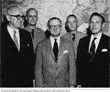
September 25, 1956–Lasswell (far left) is pictured following an address to the U.S. Army War College, three weeks after his historic APSA presidential address. He appears with experts in both the academic and military wings of security studies, including (from left to right): Major General Max Johnson (the Commandant of the AWC); Professor F.S. Dunn (Director of the Center of International Studies at Princeton University); Brigadier General E.C. Doleman (Asst. Commandant of the AWC); and Professor William T.R. Fox (founder of Columbia University's Institute of War and Peace Studies, and best known for coining the term “superpower” in 1943). Standing alongside such formidable scholarly and military company, a map of the Soviet Union looming in the background, Lasswell enthusiastically embodies the elusive policy scientist of democracy.
The war-time chiefdom, most important, allowed Lasswell to draw around him a brilliant group of young policy-scientists-in-the-making, including Lerner, Abraham Kaplan, Bruce Lannes Smith, Heinz Eulau, Gabriel Almond, David Truman, Ithiel de Sola Pool, Nathan Leites, Edward Shils, Morris Janowitz, Irving Janis, and Sebastian de Grazia. He and they collaborated with other intelligence specialists on duty in Washington, like Samuel Stouffer, Paul Lazarsfeld, Kurt Lewin, Bernard Berelson, Wilbur Schramm, Hans Speier, Carl Hovland, Hadley Cantril, and Ralph Casey (see Sproule 1997). There could hardly have been a more famous or promising group of social qua policy scientists. Brought together by war, they defended democracy, advised decision-makers, analyzed policy, devised research, invented methods like content analysis, wrote quickly and at length under deadline, and created an interdisciplinary “corps of scholars seasoned by responsibility” (1951a, 133) who would invent communications research as a field and foment a behavioral revolution in the social sciences.
At the end of the war, Lasswell sought to institutionalize the new policy sciences that he was formulating. With Myres McDougal and George Dession, he created the Policy Sciences Council in 1944. In 1948, the three established the Policy Sciences Foundation, as well as the Policy Sciences Center with offices in New Haven and New York. These institutions elided traditional boundaries between academic and advisory enterprises, while providing independent bases of operations for their members. They undertook a number of activities to promote the policy sciences, like the Library of Policy Sciences (which Lasswell initially edited). In conception, these new organizations married the research center with the law firm—not incidentally, because the original founders were all from the Yale Law School (with which Lasswell had been associated since 1938 and in which he was made professor in 1946). Yet the founders did not just borrow the legal perspective; they changed it. Even as they modeled the policy scientist after the lawyer, they also largely succeeded in moving Yale's own law program “from legal realism to policy science in the world community” (McDougal 1947).
During the period in which the Cold War followed close upon world war, Lasswell's interaction with the government continued. With analysts from his propaganda shop—notably Lerner, Pool, and Eulau—he continued to study elites and symbols at the Hoover Institute and for the RAND Corporation. It was in connection with RAND that Lasswell also came to know the perils of power that the policy scientist faced. He endured an incident that is, for political scientists looking back on our discipline, a gripping reminder of the times. In 1951, the Army–Navy–Air Force Personnel Security Board denied Lasswell's request for “access to certain classified matter at RAND Corporation.” The Security Board now had information, the letter read, that “for many years you have been a Communist Party member and have closely and sympathetically associated with Communist Party members. You have also open and actively expressed sympathy with many Communist doctrines and ideologies” (Lasswell 1951c). The charge, a tissue of lies, hit Lasswell hard, in light of all he had done to expose domestic and foreign Communist propaganda. In a vehement denial, Lasswell fired back against “the ignorance, carelessness, or malice” of his accusers. “I have contributed to the struggle against communism as a scholar, as an educator, as an expert witness, as a government executive, and as a private citizen.” With his denial, Lasswell submitted a huge dossier that included an autobiography, a student text on “The Political Philosophy of Harold Lasswell,” and scores of letters attesting to his anti-Communism and pro-democracy record. His letter writers (and those held in reserve) had impressive titles: the Librarian of Congress; VP, Ford Motor Company; Director of the Bureau of Census; chairman of the ACLU; former director of the Anarchist Squad of the Chicago Police Department; directors from the Hoover Institute and RAND; two senators; the chairmen of CBS and GE; the presidents of Rockefeller, Ford, and Yale; as well as prominent professors, including Merriam and McDougal (who lectured the Security Board that Lasswell studied communists the way “a physical scientist might study snakes”). Lasswell had his security clearance immediately restored.
The “policy scientist of democracy”—forged of such experiences, projected onto the future—was the latest in a longer line of disciplinary personae that Lasswell embodied, imagined, and analyzed. The policy scientist descended from the social psychiatrist, the skill specialist, and the democratic propagandist. Like them, the policy scientist was (to be) a practitioner of a kind of science that took the lawyer's or doctor's practice as its model, putting the methods and findings of a general science to work in solving real-world problems. The policy scientist was interdisciplinary and foresaw the technological implications of science. The policy scientist was strategic, innovative, forward looking. Most of all, the policy scientist was “relevant” to governance in an age of crisis. Contributing directly to decision making on fundamental questions, the policy scientist was an expert, skilled in intelligence, an advisor among elites, comfortable in and around power, braced for struggle. Tyranny and its propaganda were enemies; democracy and its propaganda, friends; the highest goal, the dignity of the individual.
The policy scientist of democracy figured in Lasswell's later works on the policy sciences (especially 1956b, 1957, 1963, 1965, 1971a, 1971b, and 1979). But the democratic policy scientist was there, in imago, at the beginning—in Power and Personality (1948) and The Policy Sciences (1951b). When initially sketching this alluring scientific hero, Lasswell noted problems. The first was self-directed, for “the policy scientists of democracy have the practical problem of winning lay confidence in their good intentions and ability. … At present our civilization is not equipped with a public image of the practitioner of the sciences of democracy.” There was the image of the lawyer, but it was insufficiently democratic; and of the “‘political scientist’ … there is almost no public image.” There was an other-directed corollary: “In collective policy as in somatic medicine the problem is to improve the layman's judgment in selecting expert advisers and guides” (1948, 131–33). Experts, once selected by improved lay judges, were not to advise about “immediate questions.” No, policy concerned “the most important choices” amidst the deepest conflicts in politics. As for science, policy scientists embraced the ideals of generalization and objectivity—as would any positivist—but their “policy orientation” was problem-driven, contextual, and multimethod (with preference for models and quantification). Lasswell showed little apprehension that there might be tensions in all this—between generalization and context, social and natural science, or objectivity and values. Objectivity, for example, was in the service of goal values; “the place for nonobjectivity is in deciding what ultimate goals are to be implemented.” The policy scientist of democracy just “decided” on democracy and its “ultimate goal” of human dignity (1951b, 5, 8, 10, 11, 12, 15). To be sure, Lasswell admitted, the justification or education of leaders in a democracy was “a key problem of the as yet poorly developed policy sciences of democracy” (1948, 146). Though policy scientists advised those in power, they had obligations to citizens as well; they served leaders only when leaders served democracy. But the limits and obligations of that service were, in Lasswell's formulation, left almost wholly unclear.
Problems dogged the policy scientist of democracy as put forth by Lasswell. The ones Lasswell squarely identified were not readily solved. And new ones emerged, as political scientists took the measure of Lasswell's grand disciplinary persona.
DISCIPLINARY REACTIONS, LASSWELLIAN REVISIONS
The initial reaction to the policy scientist of democracy, as Lasswell imagined and embodied him, set the tone for the next quarter-century. The tone was and would remain mixed, running the gamut of reactions. Nathan Leites (1948, 517) deemed Power and Personality “this brilliant book” when making the first reference in the Review to “the policy sciences of democracy.” Leites was a loyal lieutenant who had served in the war-time propaganda division and, with Lasswell, coedited the volume (1950) in the Library of Policy Sciences that showcased its work in content analysis. A sympathizer like David Easton (1950, 453) hailed Lasswell's democratic turn away from elitism, although he recognized that elitist elements remained. As for science, Easton admitted that the positivism and value prescriptions jostled, making Lasswell “a scholar divided against himself.”
Others found more serious logical problems. One was that Lasswell's notion of the policy sciences of democracy combined description with prescription to create an oxymoron. It was one thing to say that science was about objective truths; quite another to say that it was about democracy. “‘Democratic science,’ like ‘policy science,’ when used in this sense, is simply a contradiction in terms” (Moore 1952, 143). The emphasis on experts seemed undemocratic to many readers, a sign of “technicism” (Wolpert 1949, 70). “At no point,” Alan Gewirth (1949, 140–41) charged, “does [the policy scientist or Lasswell] give any indication of recognizing or accepting the Aristotelian doctrine that the many may be better judges in political matters than the few who are experts.” The concept of dignity was not without its problems, too. Even granting its value, as Gewirth did, what followed as a matter of policy? “Open shop or the closed shop, subsidies to farmers or a reduction in the prices of farm products, lower taxes or a balanced budget?” Bernard Crick (1954, 311) could not even figure out what the concept meant: “But what this ‘dignity of man’ consists of is beyond the wit of man to tear from the book. To elucidate such a phrase would seem a good end for a critical activity. … One finds instead an uncritical acceptance of the most popular version of the ‘American creed’”—namely, individualism and social mobility. With so many problems, Wilbert Moore (1952, 144) had to ask: “Inevitably, the query recurs: what are the policy sciences?”
Undeterred, Lasswell blazed on, offering solutions to certain problems of terminology and scope. He specified a model of the policy process in terms of the perspectives, situations, values, and strategies of key participants, with attention to outcomes and consequences. He identified seven “functions” of the decision-making process: intelligence, promotion, prescription, invocation, application, appraisal, and termination (1956b, 2). These functions morphed into “phases” (1963, 14–26) and ended as “power outcomes” (1971a, 28). He specified eight “goal values” of policy: wealth, power, respect, rectitude, skill, well-being, enlightenment, and affection (1956b, 13; modified in 1971a, 18). He itemized five “intellectual tasks” of the policy scientist: goal clarification, trend description, analysis of conditions, projection of developments, and provision of alternatives (1971a, 39). For some would-be policy scientists, these terminological innovations helped them better articulate the policy process. Yet it took “considerable patience and effort to immerse oneself in the subtleties of Lasswellian prose” with its “neologistic vocabulary” (Eulau 1977, 397), and the payoff was not always apparent. The language, in short, was tough going whatever its ultimate rewards; and this was its own problem—though an old one for readers of Lasswell. (His first reviewer for the Review had complained: “It is hard to see how our universities can help our laboring, lumbering democracy by telling people what they know in language they will not understand” [Whittlesey 1935, 501]; and a later one began his review of The Policy Sciences: “This is not an easy book to read” [Wright 1952, 234].)
Nor did the terminological innovations truly address the big questions that Lasswell continued to raise. What did it mean, from the presidential podium, to respect “the dignity of all that lives”? Which advance in methods suddenly made political science “the policy science par excellence” (1956a, 979)? What, now, were “the policy sciences of freedom” (1957, 36)? When did one decide on values? What was “dignity,” and what was democratic about it? Where were leaders to be found? How could citizens better identify advisory elites? Most important, who were policy scientists, and how could they be nurtured and trained? Readers and critics continued to wonder whether answers would be forthcoming.
As problems lingered, Lasswell remained curiously aloof. When the Straussians assaulted “the scientific study of politics,” he was a prime target. Analogizing Lasswell to “the aspiring puppet master,” Robert Horwitz (1962, 304) concluded that “the Master Propagandist was himself the victim of Propaganda” about science, liberalism, and democracy. Unflappable, Lasswell (1963, 165n) responded: “Horwitz has made a conscientious, competent, and often valuable statement.” Even as he called for a new path, Lasswell remained distant from the discipline he had done so much to influence (Eulau 1969, 17). He was distant in another way, too. He invariably pronounced upon the future of the policy scientist. His very titles—The Future of Political Science (1963), “The Emerging Policy Sciences of Development” (1965), A Pre-View of the Policy Sciences (1971)—conveyed a promissory message, another revision. The policy scientist of democracy whom Lasswell idealized was always poised to arrive. Yet Lasswell was confident that the policy scientist of democracy would arrive. In the future, he prophesied (1963, 13), “political scientists whose advisory roles are negligible. … would be as rare as unicorns.”
The decade of the 1970s proved crucial for the fate of this confident vision. In 1970, the journal Policy Sciences was founded as the house organ of the Policy Sciences Center, which remained a hub of Lasswellian scholarship. Lasswell offered up his futurist Pre-View of the Policy Sciences (1971a) and lectured to Indian colleagues that they, too, “can and should accept the challenge to equip themselves to take the lead in studying the policy process” (1971b, 6–7). Some political scientists detected a “postbehavioral turn” toward greater engagement with issues of public affairs. “After a generation of dedication to the canons of ‘pure science,” Charles W. Anderson (1971, 117) opined, “there is renewed enthusiasm for the potential of the discipline as a policy science.” The enthusiasm, however, was not universal. In his retrospective on The Policy Sciences, Duncan MacRae (1970, 309) thought that “the phrase ‘policy science” combines two terms, each of which excessively narrows our perspective.” Worse, “the longer phrase, ‘policy sciences of democracy,’ does not live up to its promise.” Lasswell's editor, Dwaine Marvick (to Eulau 1977, 400n), recalled of Lerner and Lasswell that “their candor in serving democratic values instead of neutral science [was] unpalatable to most political behavioralists.” It was not lost on Marvick or the behavioralists that Lasswell had long been a leading champion of both neutral science and behavioralism. “To scientific ears,” Heinz Eulau explained, the policy sciences sounded “tantalizingly ideological … serving the parochial values of democracy rather than … the values of science and knowledge which are presumably universal.” This was Eulau's candid assessment when he remembered his work with Lasswell at the Hoover Institute, the very time when, in Eulau's recollection, Lasswell “had developed what he called—I think unfortunately—the ‘policy science’ approach” (1977, 394). As had the critics of the early 1950s Eulau called attention to Lasswell's unresolved positivism and elitism lurking at the margins of the policy sciences of democracy.
The problems had not been solved; political scientists were not generally convinced; the unicorns multiplied; and the policy scientist of democracy was put off to the future. In a 1976 interview, Lasswell seemed wistful when asked why his vision went unrealized: “I guess the times just were not right” (in deLeon 1988, 24). Then, too soon, the prototype of the policy scientist of democracy was no more. Lasswell died in New York City in 1978, the victim of a massive stroke that left him for months trapped, wordless, inside his powerful, roving mind.
By then, Lasswell's star—and with it, the policy scientist of democracy—was already fading. According to a recent analysis (Eulau and Zlomke 1999), Lasswell was cited more than 200 times in major political science journals in the 17 years before his death, but just 70 times in the 17 years after. Among the latter references, none were to The Future of Political Science or A Pre-View of Policy Sciences, and one found policy science “weak tea for hard times” (Merelman 1981, 492). Attention to Lasswell's huge body of work did not pick up substantially in the subsequent decade, either. Although Lasswell has become an imposing figure in the growing literature on the history of the discipline, his work is only sporadically cited, and even more infrequently engaged with.
The proximate cause of the falloff was Lasswell's disregard for disciplinary or subfield borders. Despite much lip service paid to the virtues of interdisciplinary collaboration, Lasswell's call for a political science without internal or external borders fit uneasily with the profession's growing specialization. So, too, did Lasswell's largely qualitative methodology, which looked increasingly quaint alongside the growing quantification and micro-focus of the empirical subfields of the discipline. Armed with new statistical techniques and new theoretical tools, many drawn from economics, the mainstream of the discipline embraced with even greater enthusiasm the notion of a rigorous, value-free science with neither the capacity nor the obligation to speak on contested policy issues of democratic debate. Though much of political science had previously been at least moderately accessible to non-specialists, the souped-up science that emerged out of the marriage of political science and economics was generally not. Some of the old guard criticized the turn as scientism; others worried that the big questions of political science's past—about power and personality and political development—were being lost. But most of the debate took for granted that the profession's highest goal was “pure science,” by whatever route that goal was reached.
Lasswell himself had not offered a clear or consistent account of the policy sciences, as a field or as an alternative to the discipline's drift toward specialization, quantification, and economic thought. Torn between positivist canons of “pure science” and faith in the discipline to inform democratic decision making, he had, from the very beginning, presented a conflicted account of what his discipline should be doing, for whom, and for what broader goals. Those who remained sympathetic to Lasswell's account of policy science as science pushed for greater precision than contained in Lasswell's notion of a “configuration” of general variables, values, or functions. Those who remained sympathetic to the ideal of policy science as democratic science candidly complained that “the ‘policy sciences of democracy’ are disturbingly vague as to precisely what is meant by democracy” (deLeon 1995, 886). Keeping Lasswell's designation, they nonetheless moved well beyond his framework of experts and leaders. There needed to be greater citizen involvement and education, and much more public discussion—in a phrase, “a policy science of participatory democracy” (Dryzek 1989, 113; emphasis added). Even those closest in line to Lasswell's mantle—fellows of the Policy Sciences Center or authors in Policy Sciences, for example—struggled to adapt rather than adopt his schemes in the face of altogether new kinds of policy problems. They also wondered aloud about the “sustainability” of the policy sciences as a disciplinary project (Brown et al. 2004).
Behind these developments were two interrelated but distinct concerns, both of which directly implicated Lasswell's vision of the policy scientist of democracy. The first was the nebulous place of public policy within the discipline of political science (Mead 1985). Early editions of the Review included regular and lengthy descriptions of federal and state laws, usually in its regular section, “Legislative Notes.” (The Social Security Act, for example, received 39 pages in 1936, the year Lasswell came out with Politics: Who Gets What, When, How.) By midcentury, as the behavioral revolution reached full flower, the substantive dimensions of policy did not even merit a reportorial mention in the journal. Policy—understood, less grandly than in Lasswell's mind, as the formal rules and organizations that emerged out of the authoritative decisions of public officials—was sometimes a dependent variable in political science research. But when it was, it merely gauged the relationships of true theoretical interest: power, behavior, culture. Despite rumors of a postbehavioral turn, attention to the substantive dimensions of public policy—not just their causes but also their effects, political or otherwise—remained on the periphery of the discipline.
Instead, public policy became increasingly the province of schools specifically dedicated to its study, whose faculties almost invariably were dominated by economists, not policy scientists of the Lasswellian imagination. Within political science, to be sure, rump groups split off, declaring the need for the intensive analysis of public policy to a largely indifferent reception. A related and larger school of thinking known as “policy studies”—closer to the “applied social sciences” that Duncan MacRae (1970) had envisioned, rather than the policy sciences of democracy—had its own adherents, though never all that many enjoying all that much respect. And at the level of teaching, the need for policy-oriented scholars to instruct undergraduate and professional students remained pressing. But political scientists were by no means the first to be recruited for these posts, nor did such positions carry much prestige. The distance between these disciplinary realities and Lasswell's heroic vision could hardly have proved greater.
Given the enormous growth of government in the 30 years after World War II, the lack of an emerging policy focus may seem surprising. But the tensions were clear. Within political science, in-depth studies of the policy process were often seen as little more than exercises in story-telling or inventory-taking that failed to add significantly to the stock of generalized knowledge about political life. Although students of public policy were peppered throughout political science, their place within the profession was somewhat akin to that occupied by area scholars. They were invaluable sources of information, certainly, but also a bit of a nuisance, issuing perennial calls for greater attention to the details of particular policies while at the same time (in many of their colleagues' eyes) failing to offer the kind of generalizations on which the field's development depends. For most aspiring political scientists, the years of time and energy required to understand even a highly restricted range of the increasingly complex actions of government seemed far too much work for far too little reward.
And yet, Lasswell's grand vision did not end with the concern with what government actually did. It also contained the ambitious notion that the policy scientist of democracy would “speak truth to power” (as Aaron Wildavsky [1979] put it shortly after Lasswell's death) and, ideally, exercise power in the shaping of decisions. Democratic scientists studied policy not simply to understand politics, but to expand the grounding for informed democratic choice. They were to wade into ongoing policy disputes and have actual power to make or at least assist decision making at the highest levels. Having such power required active engagement in the hotbed of politics—which, as Lasswell had learned in 1951, carried serious risks. Engagement also entailed taking value-laden stands. Lasswell consistently called for enhancing rather than biasing the quality of political information, but the line between the two was not easy to draw. For political scientists committed to remaining above (or at least outside) the fray, the potential that their work would be seen as biased, or that they would become politically too entangled to be objective, could not help but be seen as a threat to their academic and pedagogical mission. For a discipline bent on establishing itself as a legitimate science of politics in action, the case for value-laden research concerned with substantive policy choices fell largely on deaf ears.
LOOKING BACK AND FORWARD
It is tempting to paint a heroic tale in which Lasswell, the embodiment of his own vision of the policy scientist of democracy, ran afoul of the entrenched traditions of his discipline, the resistance of cloistered minds. But that tale would be too neat and easy, for Lasswell's vision in many ways faltered because of its own contradictions—contradictions that were themselves represented in Lasswell's own work, life, and legacy. These were not just Lasswell's contradictions, of course; they were contradictions in the discipline he powerfully shaped. Nor are they of interest today for merely antiquarian or corrective purpose. Lasswell's ideal of the policy scientist of democracy—as contradictory and unrealistic and unrealizable as it is—continues to speak to questions that political scientists should not stop asking: What is the role of the political scientist in a democratic society? Do political scientists have any obligation to inform or shape policy? Are there democratic values that political science should serve, and if so, what are they?
Lasswell raised these questions, but he did not—and perhaps could not—answer them convincingly, in part because he never came to terms with democracy itself. His earliest and still most striking scholarly statements were, if anything, like Walter Lippmann's: thoroughly elitist in their assumptions and outlook. His theoretical inclinations inclined toward the pessimistic expectations of permanent oligarchy associated with theorists like Mosca, Pareto, and Michels. His nightmare about the “garrison state” remained more vivid than any dream of citizens selecting their expert advisers. Lasswell's emphasis on propaganda, by which “elites” informed the “masses,” was part and parcel of the perspective. Lasswell was not afraid to call his approach “elitist” early in his career; later, he characterized it as “realist.” Had there been a change or epiphany after World War II, as Easton (1950) argued? Possibly, but echoes of the older propagandizing and elitist “democrat” remained—not least in the enthusiasm for government planning and autonomous expert leadership that was the subtext of many of his writings on the policy sciences. The policy scientist of democracy was clearly antifascist (as was Lasswell during World War II) and also anticommunist (as was Lasswell during the Cold War), but not obviously democratic in a doctrinally clear way. His commitment to dignity was laudable, but also not evidently or necessarily democratic. “Dignity” called up the dignitary and hearkened back to the “honor” of an earlier age. To be democratic, the policy scientist would have insisted on the equality of dignity displayed, citizen to citizen, in the actual sharing of power. Dignity alone did not and does not convey a democratic message, or at least a very clear one.
Lasswell's vision, looking back, also suffered from its very ambition. The policy sciences were to be an integrative discipline, drawing on and yet entirely separate from existing fields. To participate actively, policy scientists of democracy would have to become literate in the languages and techniques of many disparate disciplines. This was not only a daunting task in itself. It was frankly unappealing to those who had labored for years to establish themselves in their primary fields. Nor was it within the capacity of mere mortals—save, perhaps, Harold D. Lasswell. “Lasswell calls for the kind of comprehensiveness that characterizes his mind and style,” Charles O. Jones (1973, 1363) observed in the Review, “but there really is only one Harold D. Lasswell. He is a brilliant man. … But that is Harold Lasswell. And who are these policy scientists he talks about? Presumably they will, or should be, even more comprehensive and integrative.”
The policy scientist of democracy, in short, was—and is—too demanding and contradictory a hero, aspiring to possess too much power and expertise and to sit too closely and comfortably with those in power. And yet the inverse portrait is equally alarming: complacent, powerless academics working alone or in small groups on highly specialized topics of interest only to other specialists, afraid to speak up or out on important matters of politics or policy. Despite all the faults and omissions in Lasswell's conception of the policy sciences of democracy, there is something noble and compelling about the idea of political science discharging its democratic duties, even if that means, for example, being critical of administrations or leaders who talk about democracy or march under its banner. If it is hard to state these convictions in ways that do not fall afoul of the very criticisms that Lasswell faced, that may well be reason to sympathize with him as well as chide him for failing to develop and sharpen his ideal.
Thus, even if we cannot—and unquestionably we cannot—accept Lasswell's heroic vision of the policy scientist of democracy, that vision is still worth remembering as we look back at a century of the discipline's development, as reflected in the pages of the premiere journal in which President Lasswell published his 1956 call to arms. For all the changes that have swept the discipline—and our nation—the problem-situation that Lasswell addressed is not so much unlike our own: Is the world not polarized and in crisis again? Do we not now face the latest version of a recurring problem of enormous magnitude: “how to keep sacrifices [to freedom and free choice] at the lowest point consistent with national security, since an unnecessary loss of freedom is an unnecessary blow to security” (1950, 175)? Can we have a science of politics and policy dedicated to democracy in a troubled world?
If we have reason to resist the heroic and all-powerful figure Lasswell imagined, we also have reason to be critical, as Lasswell was, of quietism, resignation, and intellectual conservatism within a science committed to the understanding of public affairs. Perhaps there is happy medium between these two images of the political scientist, the heroic and the quietist. More likely the two are always in creative tension. Certainly Lasswell does not provide that median image for us; his was clearly the heroic. Yet, without doubt, he did ask some of the most important questions. Lasswell dared to innovate. He challenged his colleagues. And he might still challenge us, as we engage with the problems and questions that govern our horizons as scientists of politics and policy in a nation whose tradition, language, and aspirations claim to be democratic.
We are listed alphabetically, following academic convention, and wish to thank each other for the shared collaboration. We would also like to thank Ronald Brunner, Robert Dahl, Mary G. Dietz, Stephen Leonard, Bruce Russett, and Lee Sigelman for assistance or advice.



Comments
No Comments have been published for this article.