Introduction
At present, a significant increase in the use of telemedicine applications in prehospital emergency care (PHEC) and in emergency departments can be observed.Reference Winburn, Brixey and Langabeer1,Reference Kelton, Szulewski and Howes2 In PHEC, the transmission of live video serves for consulting purposes, assistance with procedures, or as an adjunct to an audio emergency call (AC) to the emergency medical dispatch center (EMDC) in various forms.Reference Langabeer, Gonzalez and Alqusairi3–Reference Stipulante, Delfosse and Donneau9 The work of the dispatcher is currently dependent only on the voice description of the situation from the caller, which may have its limitations; for example, the lack of situational context in trauma events.Reference Drennan, Geri and Brooks10,Reference Bakke, Steinvik and Ruud11 The involvement of live video transmission from the site of emergency call to EMDC gradually started alongside with the development of telecommunication networks and mobile phones in the population.Reference Ter Avest, Lambert and de Coverly12,Reference Linderoth, Lippert and Østergaard13 Although to transmit video as a part of an emergency call is technologically easy, this is not a wide-spread practice compared to using, for example, the caller geolocation applications (including Advanced Mobile Location) or text messaging.Reference Weinlich, Kurz and Blau14–Reference Valeriano, Van Heer and de Champlain18
So far, the use of video instructions during an emergency call in out-of-hospital cardiac arrest (OHCA) is the most explored area.Reference Bielski, Böttiger and Pruc19,Reference Lin, Chiang and Hsieh20 Recent meta-analysis and review of studies using video-instructed dispatcher-assisted bystander cardiopulmonary resuscitation (CPR) presents improved bystander CPR quality compared to routine audio telephone CPR and better neurologic outcome and survival.Reference Bielski, Böttiger and Pruc19,Reference Lin, Chiang and Hsieh20
Although video emergency calls (VCs) represent a very modern option and a possible future trend in medical dispatching, technical feasibility and acceptance among callers, bystanders, and dispatchers, as well as potential problems are generally not explored in detail yet. Moreover, limitations and directions of research of adding a live video from smartphones to an emergency call except from video-based dispatching in OHCA have not been reviewed so far.Reference Bielski, Böttiger and Pruc19,Reference Wyckoff, Singletary and Soar21,Reference Chung, Avis and Castren22
The main objective of this review is to examine the scope and the nature of research publications on the topic of medical dispatching in the prehospital emergency care with a real-time video added to the emergency call. The secondary goal is to identify research gaps and to discuss the potential directions of research efforts of VCs.
Methods
The scoping review protocol and manuscript were drafted in accordance with the Joanna Briggs Institute (JBI; Adelaide, Australia) methodology for scoping reviews and by using the Preferred Items for Systematic Reviews and Meta-Analysis Protocols Extension for Scoping Reviews (PRISMA-ScR).Reference Peters, Marnie and Tricco23,Reference Tricco, Lillie and Zarin24 The objectives, inclusion criteria, and methods for this scoping review were specified in advance and documented in a protocol. The original protocol has been revised by all of the academic research team members and published online on the websites of Emergency Medical Services of the Karlovy Vary region, Czech Republic.25 The final protocol with an associated project was prospectively registered with the Open Science Framework (OSF) on January 12, 2022.Reference Sykora, Peran and Renza26,Reference Sykora, Peran and Renza27 No ethical approval was sought for this study.
Randomized controlled trials and observational studies from peer-reviewed journals, written in English, were included if they were published between the period of January 1, 2012 through March 1, 2022. Inclusion criteria were established based on the following population, concept, and context:
-
Population: There were no limitations of the trial population in terms of age, gender, or demographic characteristics.
-
Concept: The search was limited to studies that (1) specifically evaluate the addition of a real-time video transmission to a routine AC to a medical dispatch center to aid the decision on further action (to dispatch an ambulance crew, to provide advice, or to deal with the emergency call otherwise); and (2) studies using live-video transmission by a smartphone (as opposed to photography, electrocardiogram, text messages, and other types of media transfer). No other specific exclusion criteria were applied.
-
Context: There were no limitations to study context with regards the type of event (video-assisted CPR versus medical events versus trauma versus mass casualty), study methodology (quantitative or qualitative), or the setting (real or simulated).
Letters to editor, correspondence, editorials, conference abstracts, systematic reviews, and guidelines and trial protocols were used for the search of secondary references, but were excluded from the analysis.
Initial search was performed in PubMed (National Center for Biotechnology Information, National Institutes of Health; Bethesda, Maryland USA) and Web of Science (Thomson Reuters; New York, New York USA) to help identify the keywords and research strategy. To identify potentially relevant papers, the following databases were searched: PubMed; Web of Science; Scopus (Elsevier; Amsterdam, Netherlands); and Google Scholar (Google Inc.; Mountain View, California USA). The register ClinicalTrials.gov and the gray literature were screened to find registered trial protocols that might be already published. Finally, a secondary reference search was performed from all the selected papers. The full search strategy for all the listed databases was revised by an affiliated university librarian (Appendix 1; available online only). The final results of the database search were exported to Zotero (open-source research tool; Corporation for Digital Scholarship; Vienna, Virginia USA) and duplicates were removed.
The titles and abstract were screened by two reviewers (RS and DP) to find if they met inclusion criteria for this scoping review. Then, all the selected citations were downloaded in full text and assessed in detail again by the two reviewers. Reasons for exclusion of full-text articles were recorded. Any disagreements between the two independent reviewers were solved through the discussion with a third reviewer (MR). Variables from selected articles were extracted by two reviewers (RS and DP) using a data extraction chart developed specifically for this scoping review. The data to extract from articles and the coding procedure included specific details about the study population, study methods, and outcomes relevant to the review were agreed by all authors. The data extraction chart is presented in Appendix 2 (available online only). Study characteristics were abstracted – country of origin, year of publication, design (with detail of the methods used), and main topic of the research.
Outcomes were not a priori defined. From the selected works meeting the eligibility criteria, the research topics and findings were recorded. Content analysis was inspired by the principles of grounded theory with open, axial, and selective coding and the codes grouped into categories – main topics of the qualitative synthesis.Reference Strauss, Corbin, Denzin and Lincoln28 A narrative approach was used to answer the research question.
Results
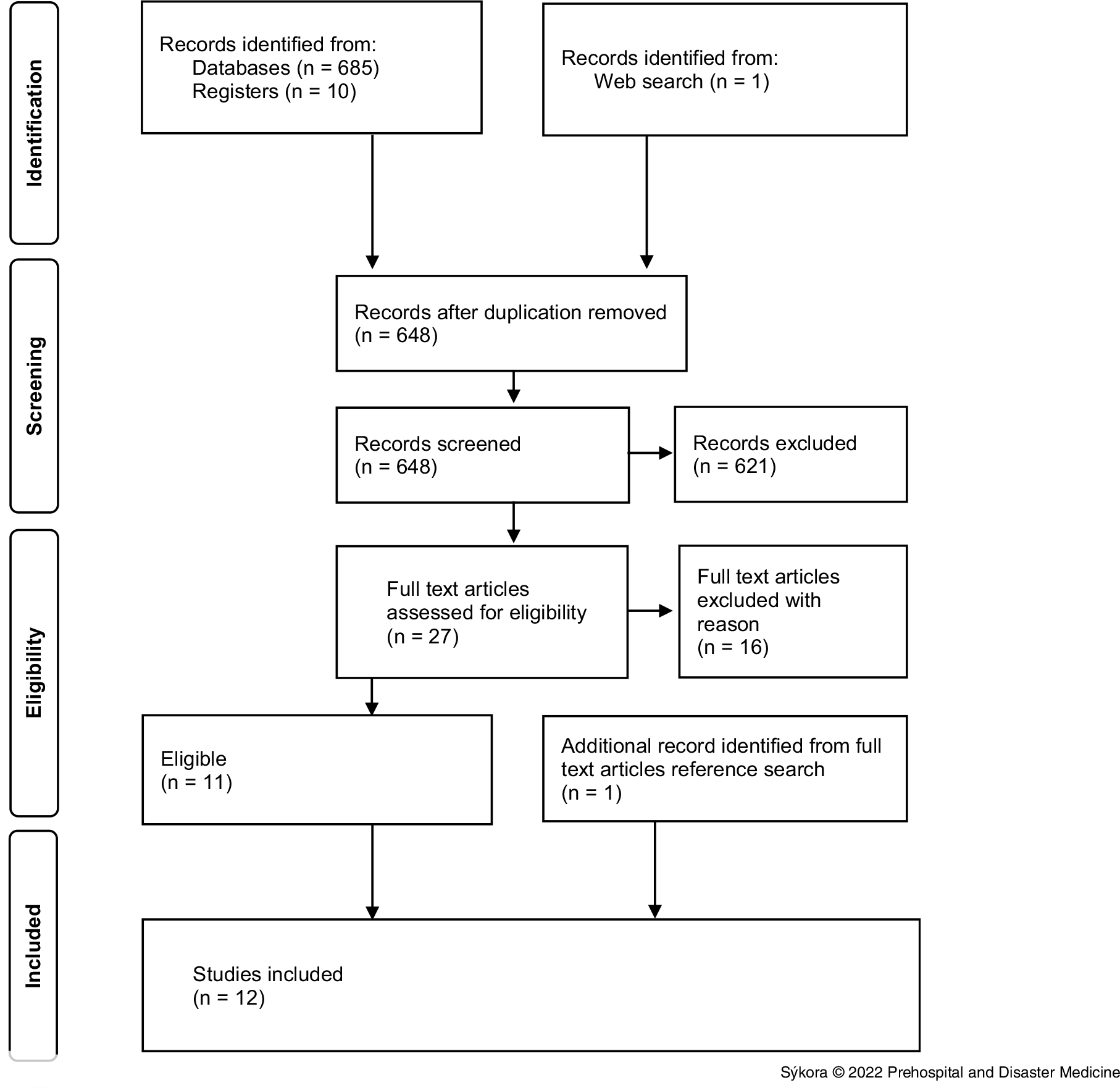
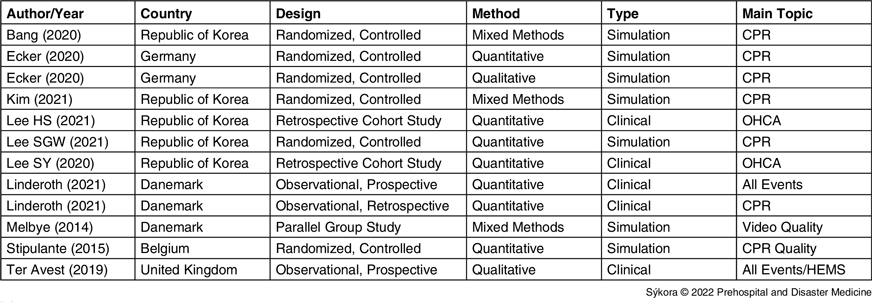
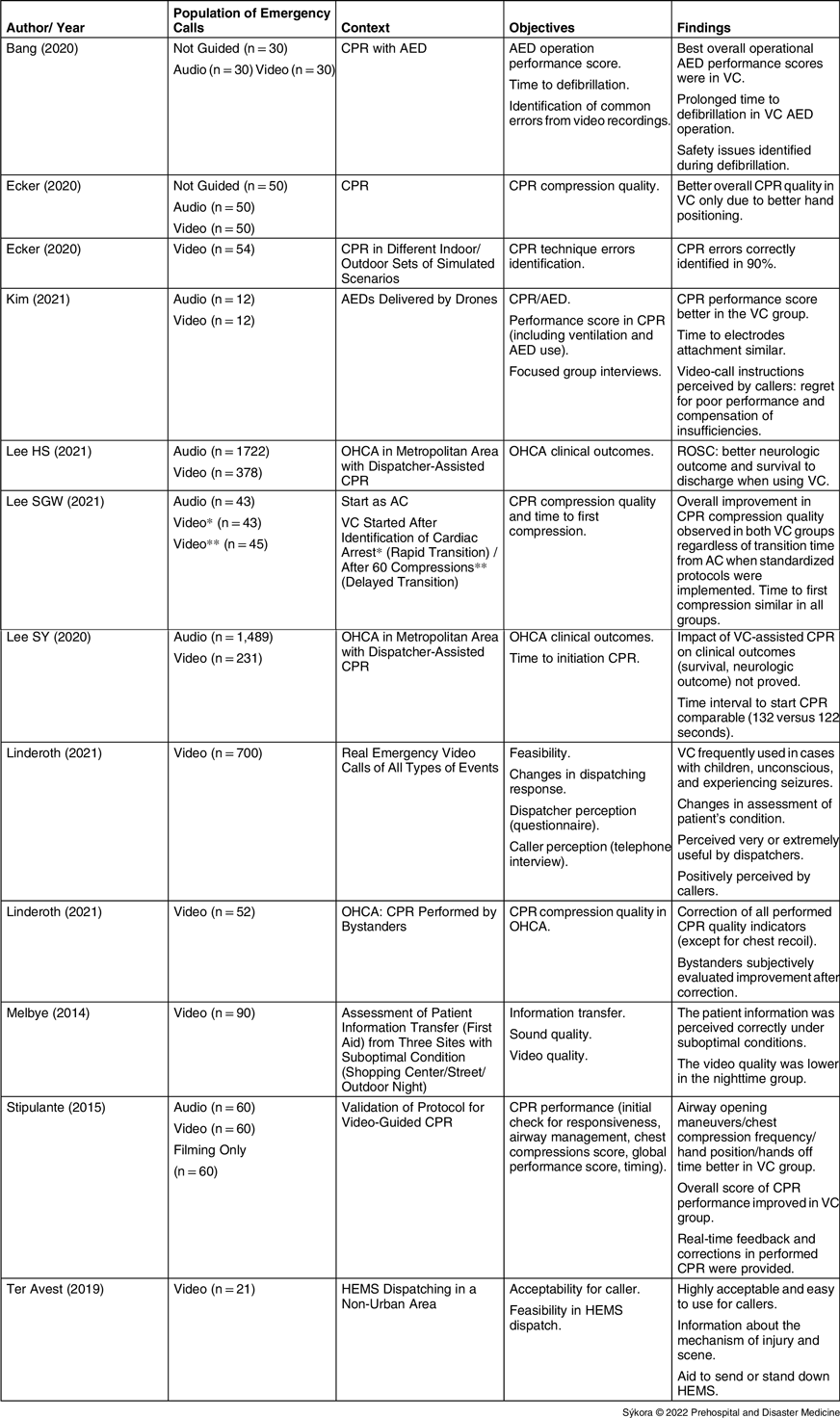
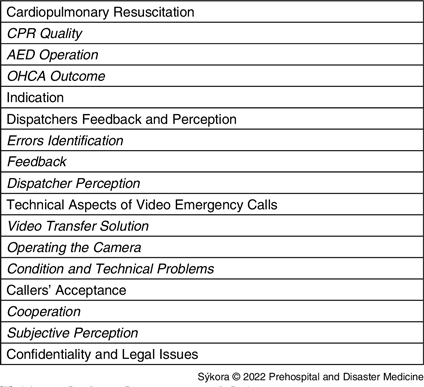
The initial search identified 696 articles, out of which 12 studies were included into the final analysis. The details of the selection process are reported in the PRISMA-ScRReference Tricco, Lillie and Zarin24 flow diagram (Figure 1). Selected studies presented data from simulations (n = 7) and real prehospital clinical setting (n = 5). Most articles used quantitative (n = 7), qualitative (n = 2), or mixed (n = 3) methods. The design and main topics in the final sample of studies are summarized in Table 1. All extracted information about each article, study population, participants, and context with main aims of trials and key findings, are summarized in Table 2. Six main themes together with eleven subcategories were identified in synthesis of results (Table 3).
PRISMA Flow Diagram for the Scoping Review Process.

Characteristics of Sources of Evidence

Abbreviations: CPR, cardiopulmonary resuscitation; OHCA, out-of-hospital cardiac arrest; HEMS, helicopter Emergency Medical Services.
Results of Individual Sources of Evidence

Abbreviations: AC, audio emergency call; AED, automated external defibrillator; HEMS, helicopter Emergency Medical Services; CPR, cardiopulmonary resuscitation; OHCA, out-of-hospital cardiac arrest; ROSC, return of spontaneous circulation; VC, video emergency call.
Coding Categories and Subgroups

Abbreviations: AED, automated external defibrillator; CPR, cardiopulmonary resuscitation; OHCA, out-of-hospital cardiac arrest.
Overall, a better quality of CPR delivered by a layperson was consistently observed in the VC groups in trials from both simulation and real-life settings.Reference Stipulante, Delfosse and Donneau9,Reference Ecker, Lindacher and Adams29–Reference Lee, Kim and Lee32 The delays in the initiation of CPR when using VC, described previously,Reference Stipulante, Delfosse and Donneau9 were not reproduced in recent studies.Reference Lee, Kim and Lee32–Reference Lee, You and Jeon34 In addition, VC compared to AC improved overall operational automated external defibrillator (AED) performance in the two simulation studies.Reference Kim, Kim and Park30,Reference Bang, Cho, Cho, Lee and Kim35 Nonetheless, a positive impact on patient-centered outcomes of VC in OHCA was observed in only one study (ROSC 29.7% versus 13.9%; survival to discharge 27.1% versus 12.3%; and favorable neurological outcome 19.4% versus 6.8% for the VC and AC groups, respectively)Reference Linderoth, Rosenkrantz and Lippert31 while clinical outcomes in previous study were negative.Reference Lee, Song and Shin33
In clinical trials, the criteria to initiate VC from the field were based on presence of at least two bystanders on site, informed consent, and willingness of bystander to accept and stream video to the EMDC.Reference Ter Avest, Lambert and de Coverly12,Reference Linderoth, Lippert and Østergaard13,Reference Linderoth, Rosenkrantz and Lippert31,Reference Lee, Song and Shin33,Reference Lee, You and Jeon34 The initial part of an emergency call starts usually as an AC, and after identification of event (ie, CPR or helicopter Emergency Medical Services [HEMS]) and determining the type of response, the VC is initiated.Reference Ter Avest, Lambert and de Coverly12,Reference Linderoth, Lippert and Østergaard13,Reference Linderoth, Rosenkrantz and Lippert31 It seems to be advantageous to use VC also in pediatric emergencies, disorders of consciousness, trauma, or for indications of HEMS.Reference Ter Avest, Lambert and de Coverly12,Reference Linderoth, Lippert and Østergaard13 Dispatchers evaluated VC as very helpful in 89%, but not necessary in many calls (short arrival times, general medical events).Reference Linderoth, Lippert and Østergaard13
Dispatchers’ assessment of the severity of patients’ conditions changed in high rate after live video was added to an emergency call and helped to appropriate response (ambulance type, HEMS).Reference Ter Avest, Lambert and de Coverly12,Reference Linderoth, Lippert and Østergaard13 Dispatchers can, due to VC, identify common rescuers errors: hands positioning during CPR;Reference Ecker, Lindacher and Adams29,Reference Linderoth, Rosenkrantz and Lippert31 safety issues during simulated defibrillation with AED;Reference Bang, Cho, Cho, Lee and Kim35 left and right side confusions on site; or recognize rescuer fatigue and suggest handover by other rescuer.Reference Ecker, Lindacher and Adams29,Reference Linderoth, Rosenkrantz and Lippert31,Reference Bang, Cho, Cho, Lee and Kim35 In real VC, there was only limited possibility to assess ventilation.Reference Linderoth, Rosenkrantz and Lippert31
Dispatchers reported other phenomenon during VC in study of Linderoth, et al: unchallenging cooperation with caller in 89.3%; emotional stress of callers sometimes led to difficulty following instructions; increased workload due to longer VC than AC (on average 423 seconds versus 242 seconds); and necessity to change habits as the VC can interfere with current dispatching protocols or classifications.Reference Linderoth, Lippert and Østergaard13 Dispatchers also claimed that patients might be evaluated faster if video is established from the beginning of the call.Reference Linderoth, Lippert and Østergaard13
In a large clinical study, the VC was attempted from EMDC in 1.4% of all the real emergency calls and the connection succeeded in 82% of these attempts.Reference Linderoth, Lippert and Østergaard13 During a VC, only one-way video transfer is needed from the scene to EMDC.Reference Ecker, Lindacher and Adams29,Reference Linderoth, Rosenkrantz and Lippert31,Reference Lee, Kim and Lee32 Practical approach is to send a text message with a link from an EMDC. Clicking on the link enables the phone camera and starts a video transmission to the EMDC in addition to the voice call. No specific application on the caller’s video-capable phone is needed.Reference Ter Avest, Lambert and de Coverly12,Reference Linderoth, Lippert and Østergaard13,Reference Linderoth, Rosenkrantz and Lippert31 Text links also enable the use of two mobile phones (one for voice call, one for image transfer).Reference Linderoth, Lippert and Østergaard13 This approach seems better than to interrupt the initial call and start a new video call.Reference Lee, Song and Shin33,Reference Lee, You and Jeon34
Two or more bystanders are helpful to obtain optimal side view on the patient or from above the patient.Reference Ter Avest, Lambert and de Coverly12,Reference Linderoth, Lippert and Østergaard13,Reference Strauss, Corbin, Denzin and Lincoln28,Reference Lee, Song and Shin33,Reference Lee, You and Jeon34 Moreover, at least two bystanders on site were a condition to establish VC in all presented clinical observations.Reference Ter Avest, Lambert and de Coverly12,Reference Linderoth, Lippert and Østergaard13,Reference Linderoth, Rosenkrantz and Lippert31,Reference Lee, Song and Shin33,Reference Lee, You and Jeon34
Majority of the simulation studies were performed under ideal technical conditions.Reference Stipulante, Delfosse and Donneau9,Reference Ecker, Lindacher and Adams29,Reference Kim, Kim and Park30,Reference Lee, Kim and Lee32,Reference Bang, Cho, Cho, Lee and Kim35 However, also relatively low image quality and bad environmental and light conditions seemed to be sufficient for informational transfer and possibility to identify the errors by dispatchers.Reference Ecker, Wingen, Hamacher, Lindacher, Böttiger and Wetsch36,Reference Melbye, Hotvedt and Bolle37 A loss of the video connection can occur during VC in the real emergencies,Reference Ter Avest, Lambert and de Coverly12,Reference Linderoth, Lippert and Østergaard13 but this has not been mentioned as limitation in the studies conducted in metropolitan areas covered by an advanced mobile network.Reference Lee, Song and Shin33,Reference Lee, You and Jeon34
General callers’ experiences were positive towards the live video transmission (non-stressful, safe, improved communication and description of situation, and easy to use).Reference Ter Avest, Lambert and de Coverly12,Reference Linderoth, Lippert and Østergaard13 The option of VC seems to be refused rarely by the callers.Reference Ter Avest, Lambert and de Coverly12,Reference Linderoth, Lippert and Østergaard13 Despite generally positive acceptance of the video calls, some Basic Life Support educated callers were afraid of possible delay of the interventions.Reference Kim, Kim and Park30 Moreover, 12.5% of respondents thought it was difficult to establish the video connection with a dispatcher given the stressful circumstances.Reference Linderoth, Lippert and Østergaard13 Besides activating the link for video, they also must activate the loud-speaker function and accept transmission of video.Reference Linderoth, Lippert and Østergaard13 The callers willingness to accept the VC gradually increased during a study period of three months with a broad concomitant public promotion.Reference Lee, You and Jeon34 In a clinical study, the bystanders were more compliant and CPR with dispatcher assistance was provided in 76.3% of the audio group as compared to 82.7% of the video group.Reference Lee, Song and Shin33 In addition, VC instructions can ensure the caller that the efforts are provided accurately.Reference Kim, Kim and Park30,Reference Linderoth, Rosenkrantz and Lippert31
The callers have been asked to confirm their consent to share their location and stream video from their mobile phone camera and ensured that no video recordings from streamed images will be stored (on a third party server or caller’s phone) and that there is no possibility to access the caller’s phone in some clinical trials.Reference Ter Avest, Lambert and de Coverly12,Reference Linderoth, Lippert and Østergaard13,Reference Linderoth, Rosenkrantz and Lippert31 Details regarding caller consent to image transmission in other clinical trials were not founded.Reference Lee, Song and Shin33,Reference Lee, You and Jeon34 In general, the questions and analyses of the confidentiality and security of image transmission from the site were not addressed in detail by any of the presented clinical studies.Reference Ter Avest, Lambert and de Coverly12,Reference Linderoth, Lippert and Østergaard13,Reference Linderoth, Rosenkrantz and Lippert31,Reference Lee, Song and Shin33,Reference Lee, You and Jeon34
Discussion
The main finding of this review is that VC to EMDC is feasible, well-accepted by dispatchers and callers, and probably does not delay a bystander-delivered CPR and may improve its quality. On the other hand, there is very little evidence that the potential advantages of VC translate into positive patient-centered outcomes.
Majority of analyzed evidence focuses on CPR in OHCA. Bystander CPR quality can be improved by the dispatcher’s support,Reference Bielski, Böttiger and Pruc19 and adding the video to the emergency calls to EMDC in a real clinical setting might have improved CPR qualityReference Linderoth, Rosenkrantz and Lippert31 by improving the communication between provider and dispatcher. Nonetheless, despite some new data in the field,Reference Lee, You and Jeon34 it is not yet possible to make any recommendation for routine use of video-based dispatching in OHCA, in line with the most recent guidelines of the International Liaison Committee on Resuscitation.Reference Wyckoff, Singletary and Soar21,Reference Chung, Avis and Castren22
Decisions to dispatch ambulances or to convey a telephone-assisted first aid or CPR are challenging without seeing the caller.Reference Bolle, Scholl and Gilbert38 In a trauma case, the situation at the scene could be complex and confusing for the caller, which is the only reference for the dispatcher during standard AC. In turn, the dispatcher may have difficulty estimating the severity of the injury and reading the situational context, which may translate into a suboptimal use of ambulance resources and failure to guide the bystander to provide proper first aid.Reference Bakke, Steinvik and Ruud11–Reference Linderoth, Lippert and Østergaard13 Emergency VC help dispatchers to better understand the caller’s situation and to tailor their assistance accordingly.Reference Johnsen and Bolle39
Dispatchers are trained in traditional protocols based on verbal questions and answers.Reference Linderoth, Lippert and Østergaard13 Despite promising results, VC seems unlikely to be significantly superior to telephone CPR without appropriate training of dispatchers and when using special protocols written for audio calls.Reference Bolle, Scholl and Gilbert38 Further exploration is needed about how the dispatchers should approach the emergency calls. However, adding live video required a more comprehensive approach.Reference Linderoth, Lippert and Østergaard13 Furthermore, the dispatcher must be prepared not only for the added value of the image in improving situational awareness, but also trained for the psychological effects of sometimes unpleasant or disturbing visual perceptions. In addition, dispatchers will need to be able to recommend the best way and angle or perspective to capture the whole situation most effectively on camera and to be prepared to deal with the various quality of video image transfer under different ambient conditions,Reference Wetsch, Ecker and Scheu40–Reference Plata, Nellessen and Roth42 as well as solve issues prioritizing filming instead of helping the patient.Reference Bolle, Johnsen and Gilbert43 Such a protocol should be proposed and implemented with a prospective analysis.
Video calls are a common part of human communication that may be required by the public before a thorough examination and research of their benefits and burdens in PHEC is done. It seems very practical to send a text message with a link, after which a video transmission to the medical dispatch center will start, as an addition to a voice call. This will confirm the caller’s consent to the video transmission after informing the caller. There is an added value of not delayed primary classification of event and ambulance deployment. Moreover, the emergency call continues through audio call and video connection is established through the data network even on other bystanders’ phones.
It seems that rescuers feel safer and more confident when they can be under the visual supervision of a dispatcher.Reference Bolle, Hasvold and Henriksen44 On the other hand, possible questions arise regarding privacy, visualization of the unwanted, and concerns about the leakage of sensitive information. This will create additional requirements on emergency call records as a kind or part of medical documentation. The question is, whether in the future it will be just live streaming with audio call recording or whether the image will be recorded and archived. This will certainly depend on the individual national recommendations and legislation. However, it is certain that the issue of confidentiality, security threats, and safety of audio-video communication must be analyzed thoroughly in the light of the current situation and legislation parameters.Reference Langarizadeh, Moghbeli and Aliabadi45
From the perspective of tasks for future research, it is primarily necessary to unify terminology in video-based dispatching and set indicators for evaluation, both in quantitative clinical parameters and qualitative evaluation. Important topics are dispatcher’s education to lead a VC to enhance the value of situational context (especially under suboptimal visual conditions, technique of filming), real-time feedback provision, and psychological and professional support for the caller. Psychological aspects, dispatchers’ subjective perception, possible emotional stress, and increased workload should be analyzed. As well, protocols for subgroups of patients and various types of emergency calls and events (including mass casualty) are needed to validate and share. An extensive prospective clinical study on VC in trauma in Norway is currently registered.Reference Hjortdahl46
Special topic is the rescuer’s acceptance and compliance, which can be enhanced by broad public promotion together with technology solutions to make VC user friendly and easy to use. Finally, there is a need for adaptation to legislation and respect for ethical and privacy issues (including storage of recordings or streaming the video and informed consent of patient or caller as a third party).
Limitations
Time interval for eligible publications seems to be redundantly long, therefore, it partially overlaps with less recent reviews. The authors had relatively strict eligible criteria to find the relevant and focused studies.Reference Pineau, Jenvrin and Péré47 The objectives and methodology of identified studies is variable. Randomized prospective controlled clinical trials where clinical outcomes would be systematically measured in different types of events are missing. The high-quality and detailed qualitative analyses are also missing.
It is obvious that there is a number of other unpublished data about VC involved in the emergency call, which cannot be traced.16,17 Moreover, most published studies are focusing on using VC in OHCA, not in other types of emergency calls or events.
Only a very limited number of dispatchers or not professionally trained dispatchers participated in the simulation studies. Special dispatcher training in conduction of VC was used sparsely.Reference Linderoth, Lippert and Østergaard13
The time to establish the video transmission differs in simulation (VC from beginning of the scenario)Reference Ecker, Lindacher and Adams29,Reference Kim, Kim and Park30,Reference Bang, Cho, Cho, Lee and Kim35–Reference Melbye, Hotvedt and Bolle37 and clinical studies (video stream was added during or after the audio call started).Reference Ter Avest, Lambert and de Coverly12,Reference Linderoth, Lippert and Østergaard13,Reference Linderoth, Rosenkrantz and Lippert31,Reference Lee, Song and Shin33,Reference Lee, You and Jeon34
In the presented clinical studies, apart from fulfilling the conditions of two bystanders on the spot and the ability and willingness of the caller to make a VC, the dispatcher’s decision to start a VC is not specified in more detail. In addition, in the case of studies dealing with CPR, these are retrospective studies where it is not possible to find out whether a VC was used in all the calls that took place whenever these criteria were met.Reference Linderoth, Rosenkrantz and Lippert31,Reference Lee, Song and Shin33,Reference Lee, You and Jeon34
Conclusion
Video emergency calls are feasible and appear to be a well-accepted method between dispatchers and callers. There are promising clinical results, especially in video-assisted CPR. On the other hand, there are still huge gaps in knowledge and implementation into practice. The inclusion of video in emergency calls seems to be a natural part of future development, therefore, its research is needed.
Conflicts of interest/funding
All authors (RS, DP, MR, JB, JS, and FD) declare no commercial, financial, and other relationships in any way related to the subject of this article. The work has been supported by the institutional grant of Charles University, Prague, Czech Republic (“Cooperatio” – Intensive Care Medicine).
Acknowledgement
The team of authors thanks Dr. Martina Habova, head of Center of Scientific Information of Third Faculty of Medicine, Charles University in Prague, for correction and suggestions for the search strategy.
Author Contributions
Roman Sykora drafted the protocol, performed preliminary search, performed database search, analyzed studies, and performed study selection, data extraction, data analysis, and prepared final presentation and drafted manuscript.
David Peran revised the protocol, commented on database search strategy, analyzed studies, and performed study selection, data extraction, data analysis, critically consulted, and commented on all steps during the search and analysis, participated in manuscript writing.
Metodej Renza revised the protocol, commented on database search strategy, solved disagreements in studies selection and data extraction, and commented on manuscript.
Jan Bradna and participated in the manuscript writing.
Jiri Smetana led the research team and supervised all the steps of the process.
Frantisek Duska participated in the manuscript writing.
Supplementary Materials
To view supplementary material for this article, please visit https://doi.org/10.1017/S1049023X22001297.