Introduction
Schizophrenic patients have an increased lifetime risk of co-morbid obsessive–compulsive symptoms (OCS). These are characterized by obsessive, distressing, intrusive thoughts and related compulsions (Poyurovsky et al. Reference Poyurovsky, Weizman and Weizman2004). Epidemiological studies reported that about 30% of schizophrenics meet diagnostic criteria of obsessive–compulsive disorder (OCD) (Buckley et al. Reference Buckley, Miller, Lehrer and Castle2009; Mukhopadhaya et al. Reference Mukhopadhaya, Krishnaiah, Taye, Nigam, Bailey, Sivakumaran and Fineberg2009). Conversely, only 1.7% of OCD patients suffer from co-morbid psychotic symptoms (de Haan et al. Reference de Haan, Dudek-Hodge, Verhoeven and Denys2009). Co-morbid OCD is associated with pronounced positive and negative symptoms and lower levels of social functioning and rehabilitation (Lysaker et al. Reference Lysaker, Lancaster, Nees and Davis2004; Öngür & Goff, Reference Öngür and Goff2005; Cunill et al. Reference Cunill, Castells and Simeon2009; Guillem et al. Reference Guillem, Satterthwaite, Pampoulova and Stip2009). The neurobiological pathogenesis is not clearly understood. The co-morbid sample comprises heterogeneous subgroups, most probably distributed on a dimensional spectrum between typical OCD and schizophrenia. OCD patients without insight might represent a subgroup with genetic, phenotypic and therapeutic vicinity to the schizophrenia-like spectrum (Tumkaya et al. Reference Tumkaya, Karadag, Oguzhanoglu, Tekkanat, Varma, Ozdel and Atesci2009; Catapano et al. Reference Catapano, Perris, Fabrazzo, Cioffi, Giacco, De Santis and Maj2010). Further concepts propose ‘schizotypic OCD’ (Poyurovsky & Koran, Reference Poyurovsky and Koran2005; Poyurovsky et al. Reference Poyurovsky, Faragian, Pashinian, Heidrach, Fuchs, Weizman and Koran2008) or ‘schizo-obsessive schizophrenia’ (Hwang et al. Reference Hwang, Morgan and Losconzcy2000; Bottas et al. Reference Bottas, Cooke and Richter2005; Reznik et al. Reference Reznik, Kotler and Weizman2005; Sevincok et al. Reference Sevincok, Akoglu and Arslantas2006; Rajkumar et al. Reference Rajkumar, Reddy and Kandavel2008). However, a subgroup of co-morbid patients experiences OCS manifestation only after the onset of antipsychotic treatment. Starting with the observations of De Haan et al. (Reference de Haan, Linszen and Gorsira1999), followed up by Lykouras et al. (Reference Lykouras, Alevizos, Michalopoulou and Rabavilas2003), several studies suggested OCS induction by antiserotonergic second-generation antipsychotics (SGAs) (de Haan et al. Reference de Haan, Oekeneva, van Amelsvoort and Linszen2004; Reznik et al. Reference Reznik, Yavin, Stryjer, Spivak, Gonen, Strous, Mester, Weizman and Kotler2004; Kwon et al. Reference Kwon, Joo, Nam, Lim, Cho, Jung, Choi, Kim, Kang, Oh, Park and Hong2009). SGAs significantly differ in their pharmacodynamic properties, in particular regarding inherent serotonergic blockade, monoaminergic reuptake inhibition or even partial serotonergic agonism (Shapiro et al. Reference Shapiro, Renock, Arrington, Chiodo, Liu, Sibley, Roth and Mailman2003; Meltzer & Huang, Reference Meltzer and Huang2008; Meltzer & Sumiyoshi, Reference Meltzer and Sumiyoshi2008; Remington, Reference Remington2008; Lopez-Gil et al. Reference Lopez-Gil, Artigas and Adell2010). While predominantly dopaminergic SGAs such as amisulpride (Scatton et al. Reference Scatton, Claustre, Cudennec, Oblin, Perrault, Sanger and Schoemaker1997) or the partial dopaminergic/serotonergic agonist aripiprazole (Sparshatt et al. Reference Sparshatt, Taylor, Patel and Kapur2010) appear to be beneficial or at least neutral regarding OCS (Connor et al. Reference Connor, Payne, Gadde, Zhang, Davidson, Connor, Payne, Gadde, Zhang and Davidson2005; Zink et al. Reference Zink, Knopf and Kuwilsky2006; Englisch & Zink, Reference Englisch and Zink2008; Kim et al. Reference Kim, Shin, Kim, Yang, Hwang and Yoon2008; Englisch et al. Reference Englisch, Esslinger, Inta, Weinbrenner, Peus, Gutschalk, Schirmbeck and Zink2009), clozapine (Coward, Reference Coward1992; Meltzer, Reference Meltzer1994) and olanzapine (Bymaster et al. Reference Bymaster, Rasmussen, Calligaro, Nelson, DeLapp, Wong and Moore1997) seem to bear an inherent risk of OCS induction most probably due to their antiserotonergic properties (Reznik et al. Reference Reznik, Yavin, Stryjer, Spivak, Gonen, Strous, Mester, Weizman and Kotler2004; Öngür & Goff, Reference Öngür and Goff2005; Lin et al. Reference Lin, Su and Pan2006; Lim et al. Reference Lim, Park, Kwon, Joo and Hong2007; Mukhopadhaya et al. Reference Mukhopadhaya, Krishnaiah, Taye, Nigam, Bailey, Sivakumaran and Fineberg2009). Because ethical and legal conditions preclude the design of a randomized, prospective trial involving clozapine, a cross-sectional comparison was chosen. We recruited cohorts of schizophrenic patients treated with atypical antipsychotics in monotherapy, stratified them according to their pharmacodynamic profile and compared onset, prevalence and severity of OCS in relation to SGA treatment. We further assessed neuropsychological performance with a detailed neurocognitive characterization. We hypothesized that the group treated with antiserotonergic SGAs would show more OCS and additional neuropsychological impairments.
Method
Hypothesis and analysis of power
We hypothesized that pharmacological properties of antipsychotic treatment in schizophrenia influence frequency and severity of OCS in schizophrenia. As the primary endpoint of this cross-sectional investigation, we expected higher mean scores in the Yale–Brown Obsessive–Compulsive Scale (YBOCS) in patients treated with clozapine (Coward, Reference Coward1992; Meltzer, Reference Meltzer1994) or olanzapine (Bymaster et al. Reference Bymaster, Rasmussen, Calligaro, Nelson, DeLapp, Wong and Moore1997) (group I) than during treatment with amisulpride (Scatton et al. Reference Scatton, Claustre, Cudennec, Oblin, Perrault, Sanger and Schoemaker1997) or aripiprazole (Sparshatt et al. Reference Sparshatt, Taylor, Patel and Kapur2010) (group II). A power analysis (statistical power of 0.8, error of first order of α=0.05) was performed using the statistical software G*Power (University of Trier) (Erbfelder et al. Reference Erbfelder, Faul and Buchner1996) to estimate necessary sample sizes. Previously published data on a sample of 32 clozapine-treated patients reported a mean YBOCS score of 9.6 (s.d.=11.0) (Chang et al. Reference Chang, Ahn, Park, Lee, Kim, Kang and Kim2008). We further implemented our own unpublished data regarding YBOCS severity in 20 patients treated with aripiprazole or amisulpride [mean 2.6 (s.d.=4.6)]. The calculated effect size was d=0.83 with an estimated sample size of 19 patients per group, to have enough power. Since the sample size was moderate (32 v. 20), we replaced the standard deviations by the upper limit of the corresponding confidence intervals (14.6 v. 8.8) as a conservative estimation of the true standard deviations in the underlying populations. An effect size of d=0.65 and a necessary group size of 31 were calculated.
Participants
Participants were recruited via their attending psychiatrist or as former or current patients at the Central Institute of Mental Health. General inclusion criteria were: (1) lifetime diagnosis of a schizophrenia spectrum disorder; (2) monotherapy with either clozapine/olanzapine or amisulpride/aripiprazole; and (3) stable medication and psychopathological states over a period of at least 2 weeks and constant severity scores in Clinical Global Impression (CGI-S) and the Positive and Negative Syndrome Scale (PANSS). We excluded patients with combination treatments (e.g. with antidepressants with the exceptions of substances without marked serotonergic effects: reboxetine, bupropion and agomelatine) and a history of alcohol or drug abuse. After providing the participants with a complete description of the study, written informed consent was obtained. This investigation was approved by the ethical committee of the University of Heidelberg (no. 2008-235N-MA) and was performed in complete agreement with the guidelines of good clinical practice.
Diagnostic procedures
Clinical assessments
Diagnostic assessments were performed by F.S. according to DSM-IV-R criteria. Sociodemographic data on age, sex, education level, age of onset, duration of illness, number of psychotic episodes and medical treatment were collected by interviews with the participants, referring to both the past medical history and the current treatment period. Dosage and serum levels of antipsychotic agents were determined. Patients were assessed by a trained and certified rater (F.S.). In addition to the PANSS, we applied the Scale for the Assessment of Negative Symptoms (SANS). Co-morbid depressive symptoms were assessed using the Calgary Depression Scale for Schizophrenia (CDSS). General and social functioning was assessed with CGI and the Personal and Social Performance Scale (PSP). Side effects were assessed applying the Antipsychotic Non-Neurological Side Effects Rating Scale and the Extrapyramidal Motoric Symptom Scale.
OCS
OCS were measured with the YBOCS. Compulsions and obsessions were separately rated on five five-point (0–4) scale items (time, handicap, frequency, controllability, discomfort), yielding subtotal scores for compulsions and for obsessions (each ranging from 0 to 20) (Woody et al. Reference Woody, Steketee and Chambless1995; de Haan et al. Reference de Haan, Hoogeboom, Beuk, Wouters, Dingemans and Linszen2006).
As a secondary OCS assessment, a self-rating obsession and compulsion questionnaire (Hamburger Zwangsinventar; HZI) assessing 72 items was administered (Klepsch et al. Reference Klepsch, Zaworka, Hand, Luenenschloss and Jauernig1993). The subscales include checking, washing, ordering and counting behaviour as well as obsessions and aggressive obsessions.
Neuropsychological assessment
All patients completed a comprehensive neuropsychological test battery consisting of computer-based and paper–pencil instruments to investigate the cognitive domains of processing speed, working memory, executive functions, attention, visual and verbal learning and memory, visuospatial perception and organization as well as pre-morbid verbal intelligence.
Processing speed was measured using the Trail Making Test Part A (TMT-A). Executive function and working memory were evaluated using the Wisconsin Card Sorting Test (WCST), a Go/no-go and Set-shift Task, the Stroop paradigm, the Trail Making Test Part B (TMT-B) and a modified N-back task. Attention abilities were assessed using the d2-Test and a Continuous Performance Test (CPT). Visual recall and memory were examined using the Rey–Osterrieth Complex Figure Test and the Wechsler Adult Intelligence Scale – Revised block design task was employed to assess visuospatial perception. Verbal learning and memory were assessed using a German version of the Rey Auditory-Verbal Learning Test (RAVLT). In addition, the level of pre-morbid verbal intelligence was estimated using a multiple-choice vocabulary intelligence spot-the-word test (Mehrfachwahl-Wortschatz-Intelligenztest; MWT-B). From each neuropsychological test, we chose a priori specific measures to act as dependent variables.
Statistical analysis
The statistical analysis was performed using SPSS (version 18.0; SPSS, Inc., USA). We applied histograms and the Kolmogorov–Smirnov test to test for normal distribution. Non-normal distributed parameters were compared between groups by help of non-parametric Mann–Whitney U tests. Sociodemographic and psychopathological characteristics were compared between treatment groups using analysis of variance (ANOVA) and χ2 tests. The primary endpoint (difference of mean YBOCS between groups) and further differences in OCS characteristics among the two groups were assessed using non-parametric Mann–Whitney U tests. As significance tests depend on sample size, we further estimated the standardized difference (effect size) between the means of participants in group 1 and group 2 using Cohen's d (d=mean group I minus mean group II divided by pooled standard deviation). Cohen classified effect sizes ranging from 0.2 to 0.49 as small, from 0.5 to 0.79 as medium, and from 0.8 and above as large. Differences in neuropsychological characteristics among the two groups were also assessed using ANOVA models. All ANOVAs were performed using robust standard errors including Bonferroni correction for multiple testing to safeguard against potential violations of the standard ANOVA assumptions. Pearson's correlation analyses were performed between psychometric scales assessing OCS severity (YBOCS) or psychosis (PANSS) and treatment characteristics such as duration, dose and blood serum level as well as neurocognitive variables.
Results
Sociodemographic characteristics and clinical assessments
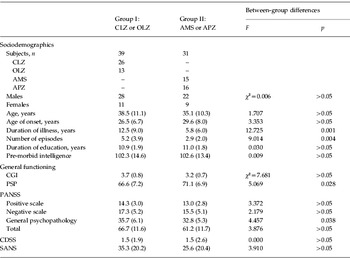
A total of 70 patients with schizophrenia (n=68) or schizo-affective disorder (n=2) according to DSM-IV-R were investigated. Within this sample of patients, 39 (55.7%) were treated with group I antipsychotics (26 clozapine and 13 olanzapine) and 31 (44.3%) with group II substances (15 amisulpride and 16 aripiprazole). Table 1 shows sociodemographic and clinical characteristics. The groups did not differ significantly regarding age, sex, duration of education, estimated pre-morbid verbal intelligence and severity of psychotic illness (PANSS positive, negative and total scores) nor in affective co-morbidity (CDSS, SANS) or general functioning (CGI). However, patients in group I showed significantly higher general psychopathology (GP) scores (PANSS GP; F=4.457, p=0.038), a longer duration of illness (F=9.014, p=0.004), a higher number of episodes (F=12.725, p=0.001) and lower social performance (PSP; F=5.069, p=0.028). Co-morbidity with non-psychiatric disorders was rarely found and did not differ between groups.
Sociodemographic and clinical characteristicsFootnote a

Data are given as mean (standard deviation).
CLZ, Clozapine; OLZ, olanzapine; AMS, amisulpride; APZ, aripiprazole; CGI, Clinical Global Impression; PSP, Personal and Social Performance Scale; PANSS, Positive and Negative Syndrome Scale; CDSS, Calgary Depression Scale for Schizophrenia; SANS, Scale for the Assessment of Negative Symptoms.
a The table summarizes group characteristics and evidence for group-dependent differences regarding sample size, age, sex, age at first psychotic manifestation, duration of illness, number of episodes, education in years, pre-morbid intelligence, general psychosocial functioning and psychopathology regarding psychotic syndromes and mood.
Psychopharmacological treatment
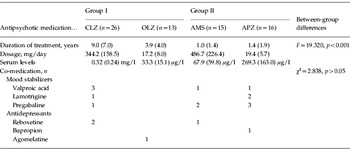
Guided by the inclusion criteria, patients under antipsychotic monotherapy with the index substances were recruited. As shown in Table 2, duration of index medication, drug dosage in mg/day and resulting blood serum levels were assessed. In order to investigate between-group differences and correlations, we transformed doses and serum levels to percentiles according to the recommended maximal doses and upper limits of therapeutic serum levels representing 100%. Analysis revealed significant differences between groups regarding duration of antipsychotic treatment, which was considerably longer in group I. No differences were observed with respect to concomitant treatment with mood stabilizers or antidepressants (reboxetine, bupropion and agomelatine).
Psychopharmacological treatment: duration of treatment with index medication, dose and serum levels, and sizes of subgroups with concomitant treatment with mood stabilizers

Data are given as mean (standard deviation).
CLZ, Clozapine; OLZ, olanzapine; AMS, amisulpride; APZ, aripiprazole.
Obsessive–compulsive symptoms
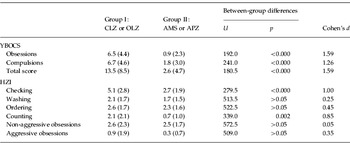
The primary hypothesis of our study was confirmed, since prevalence and severity of OCS markedly differed between groups: only three patients (9.7%) of group II reported OCS with a YBOCS score higher than 8, while 28 (71.8%) patients of group I scored higher than 8 with a mean severity score of 14.2 (s.d.=8.7). Of these 28 (57.1%), 16 (57.1%) had a total score of 16 or more, representing clinically meaningful illness severity. OCS as measured with the YBOCS and HZI were not normally distributed in group II (Kolmogorov–Smirnov test, p<0.01); we therefore calculated non-parametric Mann–Whitney U tests. The analysis revealed significantly different YBOCS subscores on obsessions and compulsions, as well as the two HZI- subscales ‘checking’ and ‘counting’, as shown in Table 3. To analyse effect sizes, standardized mean differences (Cohen's d) on all OCS variables were calculated. In a post-hoc analysis, the comparison of YBOCS and HZI severity within group I between patients treated with clozapine [n=26, mean YBOCS score 14.85 (s.d.=8.1)] and olanzapine (n=13, mean YBOCS score 10.85 (s.d.=8.9)] revealed one significant difference: CLZ patients showed more pronounced controlling and checking behaviour (p=0.009).
Between-group comparison of obsessive–compulsive quality and severityFootnote a

Data are given as mean (standard deviation).
CLZ, Clozapine; OLZ, olanzapine; AMS, amisulpride; APZ, aripiprazole; YBOCS, Yale–Brown Obsessive–Compulsive Scale; HZI, Hamburger Zwangsinventar.
a By non-parametric Mann–Whitney U tests.
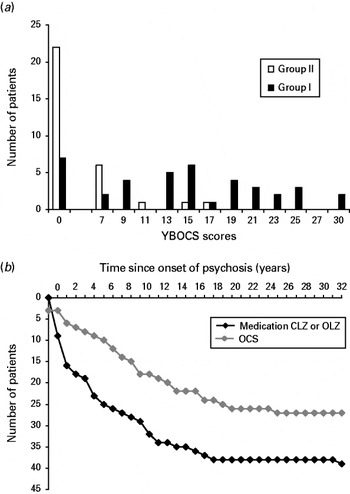
We further attributed patient numbers to ranges within the YBOCS scores and observed a different profile with a marked right shift in group I. Fig. 1 a visualizes the difference of OCS severity distribution between the groups.
(a) Visualization of the distribution of patients along Yale–Brown Obsessive–Compulsive Scale (YBOCS) scores. Group I (□) shows a clear shift towards higher scores compared with group II (▪). (b) Cumulative frequencies within group I (n=39) regarding ‘start of index medication’ (–♦–) and ‘onset of obsessive–compulsive symptoms’ ( ) in years. The time span between onset of psychosis and these events was calculated on an individual level. Three patients suffered from obsessive–compulsive symptoms before clozapine or olanzapine treatment; the majority, however, first experienced psychosis, then index treatment and in consequence obsessive–compulsive symptoms.

To account for significant between-group differences in duration of illness, number of episodes, general psychopathology and social functioning we integrated these factors as covariates. Analysis of covariance (ANCOVA) showed that duration of illness contributed significantly to presented OCS as measured with the three YBOCS scales (total score: F=12.378, p=0.001; obsessions: F=10.413, p=0.002; compulsions: F=7.637, p=0.007) as well as the HZI subscale ‘checking’ (F=10.214, p=0.001) and ‘ordering’ (F=6.696, p=0.012). The number of episodes significantly contributed to the YBOCS total score (F=6.607, p=0.012), the subscale obsessions (F=8.462, p=0.005) and the HZI subscale ‘checking’ (F=4.973, p=0.029). The factors ‘general psychopathology’ and social functioning did not contribute to the presentation of OCS in our sample. Noteworthy, all between-group differences measured with YBOCS and HZI remained significant after correction for the factors number of episodes and duration of illness.
Antipsychotic treatment and OCS
We carefully explored the chronological order of the events ‘first manifestation of psychosis’, ‘start with index treatment’ and ‘onset of OCS’ in interviews with the patients and closely related persons. In most cases of group I (n=39), OCS manifested markedly after the psychosis and after index treatment and only a small minority (n=3) suffered from OCS before medication was initiated (Fig. 1 b).
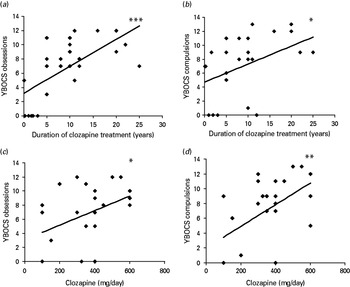
Duration of group I antipsychotic treatment correlated significantly with OCS severity (Fig. 2) as measured with the YBOCS total score (r=0.54, p<0.001), the two subscales obsessions (r=0.57, p<0.001) and compulsions (r=0.42, p=0.008) as well as the HZI subscale ‘checking’ (r=0.44, p=0.006). Within the subgroup of clozapine-treated patients, these correlations also reached statistical significance: YBOCS total score (r=0.59, p<0.001), obsessions (r=0.65, p<0.001), compulsions (r=0.40, p<0.05) and HZI ‘checking’ (r=0.44, p<0.05), while no significant correlations emerged within the subgroup of olanzapine-treated patients. The analysis of group I in total revealed no association between OCS severity and neither group I antipsychotic dose nor blood serum level. For the subgroup of clozapine-treated patients, however, analysis revealed significant correlations between clozapine dose and all three YBOCS scores (total: r=0.50, p=0.01; obsessions: r=0.44, p=0.029; compulsions: r=0.55, p=0.005) as well as with the HZI subscales ‘counting’ (r=0.52, p=0.008), ‘obsessions’ (r=0.53, p=0.006) and ‘aggressive obsessions’ (r=0.61, p=0.001). Even within the subgroup of clozapine-treated patients, the serum levels did not correlate with OCS severity.
Correlations between duration of clozapine treatment and Yale–Brown Obsessive–Compulsive Scale (YBOCS) subscores ‘obsessions’ (a) or ‘compulsions’ (b), as well as between daily clozapine dosage and YBOCS subscore ‘obsessions’ (c) or ‘compulsions’ (d). Significance of correlations: * p⩽0.05, ** p⩽0.01, *** p⩽0.001.

With respect to group II, no correlations were found between duration of treatment, medication dose, nor serum level and OCS as measured with YBOCS and HZI.
We further did not find associations between schizophrenic symptoms as measured with the PANSS and its subscales with duration of treatment, medication dose, and serum levels within the two groups, with the minor exception of significant correlations of PANSS total scores (r=0.46, p=0.003) and negative symptom subscale (r=0.35, p=0.031) with treatment duration within group I.
Neuropsychological assessment
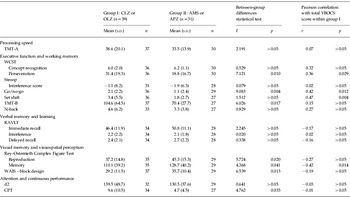
The cognitive domains of processing speed, executive functions, working memory, attention, visual and verbal learning and memory, visuospatial perception, as well as pre-morbid verbal intelligence were evaluated. Between-groups analyses revealed comparable levels of performance in several neuropsychological assessments commonly attributed to the cognitive deficits of psychosis (e.g. processing speed, verbal memory, attention, working memory), as shown in Table 4. However, group I showed significantly more deficits in visuospatial perception and visual memory (block design, Rey–Osterrieth Complex Figure Test), impulse inhibition (Go/no-go), higher perseveration scores (WCST) and diminished set-shift abilities (TMT-B, Set-shift task). In order to attribute these pronounced impairments of group I individuals to the higher prevalence of co-morbid OCS, correlations analysis between the total YBOCS score and neurocognitive variables were preformed. Results revealed significant associations of visual memory (r=−0.42, p=0.014), WCST perseveration scores (r=0.36, p=0.029), Go/no-go (r=0.42, p=0.012) and set-shift abilities (r=0.47, p=0.004) with the total YBOCS score. The subscale ‘obsessions’ correlated significantly with visual memory (r=−0.36, p=0.039), set shift (r=0.46, p=0.006) and WCST perseveration scores (r=0.36, p=0.031). Compulsions significantly correlated with visual memory (r=−0.51, p=0.002), WCST perseveration scores (r=0.34, p=0.046), Go/no-go (r=0.42, p=0.011) and set-shift (r=0.44, p=0.009). Several further correlation analyses were performed, but neither medication dosage nor serum levels correlated with test performance. Duration of treatment significantly influenced TMT-A (r=0.51, p=0.001), TMT-B (r=0.52, p=0.001) and WCST concept recognition (r=−0.40, p=0.016).
Group-dependent performance in a comprehensive battery of neuropsychological assessmentsFootnote a

CLZ, Clozapine; OLZ, olanzapine; AMS, amisulpride; APZ, aripiprazole; YBOCS, Yale–Brown Obsessive–Compulsive Scale; s.d., standard deviation; TMT-A, Trail Making Test Part A; WCST, Wisconsin Card Sorting Test; TMT-B, Trail Making Test Part B; RAVLT, Rey Auditory-Verbal Learning Test; WAIS, Wechsler Adult Intelligence Scale – Revised, subtest block design; CPT, Continuous Performance Test.
a Due to individual performances, not every patient completed the whole battery. Statistical analyses compared the performance between groups (analyses of variance) and correlated the performance with YBOCS total score within group I.
In contrast to YBOCS scores, the total PANSS scores of group I patients correlated significantly with TMT-B (r=0.33, p=0.05) and visual memory (r=−0.36, p=0.04). This fact was not due to positive symptoms, but exclusively influenced by the PANSS negative scale that correlated with TMT-B (r=0.44, p=0.007), visual reproduction (r=−0.34, p=0.046), visual memory (r=−0.41, p=0.015), verbal learning (r=−0.43, p=0.012), concept recognition (r=−0.44, p=007) and Go/no-go (r=0.43, p=0.01). Within group I, duration of illness correlated significantly with TMT-A (r=0.52, p=0.001), TMT-B (r=0.45, p=0.005), verbal learning (r=−0.37, p=0.031), perseveration (r=0.35, p=0.035), Go/no-go (r=0.54, p=0.001), CPT (r=0.57, p<0.001) and visuospatial perception (r=−0.45, p=0.005).
Discussion
In the present cross-sectional investigation, we tested and confirmed the hypothesis that psychotic patients treated with clozapine and olanzapine (group I) suffer more frequently and more severely from OCS than patients under amisulpride or aripiprazole treatment (group II). Our study is the first evaluation of co-morbid OCS in schizophrenia which applied the simple and primary inclusion criterion ‘antipsychotic monotherapy’ and stratified a subsequent sample of patients according to pharmacological properties of antipsychotics.
Association of co-morbid OCS with antiserotonergic antipsychotics
In line with our a priori hypothesis, the two groups showed significant differences in prevalence and severity of OCS. While in group I a substantial proportion (point prevalence=71%) reported OCS, only a minority of three (9.7%) individuals from group II scored positive on the YBOCS. Regarding symptom severity, 16 group I patients (41.0%) achieved a total YBOCS score of >16 representing clinically meaningful illness severity. Only one patient of group II fulfilled this criterion. While data of cross-sectional investigations never allow conclusions on causal interactions, several aspects point towards an OCS induction by clozapine. A retrospective analysis of the onset of OCS revealed a de novo occurrence in 81.5% of our patients after start of treatment (Fig. 1 b), while only one individual in group II reported the onset of OCS at the time of first psychotic symptoms and beginning of treatment. Our results confirm data reviewed by Poyurovski et al. (2004) reporting de novo emergences of OCS in 70% of patients treated with antiserotonergic SGAs (Poyurovsky et al. Reference Poyurovsky, Weizman and Weizman2004). Further hints for a causal interaction are the correlations of OCS severity with dose and duration of clozapine treatment (Fig. 2). Duration of group I antipsychotic treatment was significantly associated with OCS severity, confirming the finding of de Haan et al. (Reference de Haan, Beuk, Hoogenboom, Dingemans and Linszen2002) that severity of OCS significantly correlated with duration of olanzapine treatment. In our trial, especially within the subgroup of clozapine-treated patients, longer treatment was associated with higher OCS severity. The correlation of OCS with the dose of clozapine in this subgroup suggests dose-dependency of drug-induced OCS. This observation is in line with the data of Reznik et al. (Reference Reznik, Yavin, Stryjer, Spivak, Gonen, Strous, Mester, Weizman and Kotler2004), Lin et al. (Reference Lin, Su and Pan2006), Lim et al. (Reference Lim, Park, Kwon, Joo and Hong2007) and Mukhopadhaya et al. (Reference Mukhopadhaya, Krishnaiah, Taye, Nigam, Bailey, Sivakumaran and Fineberg2009). In clinical practice, a reduction of clozapine doses, for example, after combination with aripiprazole was able to ameliorate co-morbid OCS (Rocha & Hara, Reference Rocha and Hara2006; Englisch et al. Reference Englisch, Esslinger, Inta, Weinbrenner, Peus, Gutschalk, Schirmbeck and Zink2009), while aripiprazole per se was associated with an inherent anti-obsessive potency (Chang et al. Reference Chang, Ahn, Park, Lee, Kim, Kang and Kim2008; Englisch & Zink, Reference Englisch and Zink2008).
Several independent arguments suggest a causal interaction between antipsychotic treatment with SGAs and OCS onset: historically, the clinical concern did not come up before the introduction of antiserotonergic SGAs (Meltzer, Reference Meltzer1995; Meltzer et al. Reference Meltzer, Li, Kaneda and Ichikawa2003) and physicians were not faced with this problem by first-generation antipsychotics lacking marked antiserotonergic properties (Zink et al. Reference Zink, Englisch and Dressing2008). Estimations on prevalence of OCS in first-episode patients are difficult and heterogeneous (Kuelz et al. Reference Kuelz, Hohagen and Voderholzer2004; Niendam et al. Reference Niendam, Berzak, Cannon and Bearden2009), but all studies quantify the risk markedly lower than evaluations of schizophrenics during antipsychotic treatment (Buckley et al. Reference Buckley, Miller, Lehrer and Castle2009; Mukhopadhaya et al. Reference Mukhopadhaya, Krishnaiah, Taye, Nigam, Bailey, Sivakumaran and Fineberg2009), suggesting that many schizophrenic patients develop OCS as a consequence of antipsychotic treatment.
Pathomechanism
Due to the heterogeneity of OCS co-morbid schizophrenics, theories of pathomechanisms have to focus on well-defined subgroups such as clozapine-treated schizophrenics with second-onset OCS. This is particularly important in order to work out different modes of treatment (Hwang et al. Reference Hwang, Kim, Yum and Opler2009), for example, the addition of mood stabilizers such as lamotrigine or valproic acid (Poyurovsky et al. Reference Poyurovsky, Glick and Koran2010; Zink et al. Reference Zink, Englisch, Knopf, Kuwilsky and Dressing2007, Reference Zink, Englisch and Meyer-Lindenberg2010). Within the current pathogenetic theories of OCD, a dysregulation of serotonergic neurotransmission has been proposed (Pogarell et al. Reference Pogarell, Hamann, Poepperl, Juckel, Chouker, Zaudig, Riedel, Moeller, Hegerl and Tatsch2003) reflecting the therapeutic effects of selective serotonin reuptake inhibitors and the changes of serotonergic neurotransmission after successful cognitive behavioural therapy (CBT) (Linden, Reference Linden2006; Saxena et al. Reference Saxena, Gorbis, O'Neill, Baker, Mandelkern, Maidment, Chang, Salamon, Brody, Schwartz and London2009). Our observation is in line with these theories: amisulpride exclusively interacts with dopamine receptors (Scatton et al. Reference Scatton, Claustre, Cudennec, Oblin, Perrault, Sanger and Schoemaker1997) with favourable consequences on OCS (Kim et al. Reference Kim, Shin, Kim, Yang, Hwang and Yoon2008). The inherent 5-HT1A agonism of aripiprazole might explain its neutral or even anti-obsessive effects with major importance for cognitive functions in schizophrenia in general (Meltzer & Sumiyoshi, Reference Meltzer and Sumiyoshi2008; McCreary & Jones, Reference McCreary and Jones2010; Newman-Tancredi, Reference Newman-Tancredi2010). Of course, the antipsychotic agents of group I and group II in our study differ regarding several further pharmacodynamic properties, but neither a histaminergic nor a cholinergic theory of OCS has been established so far. It might be discussed whether specific genetic properties dispose schizophrenic patients to the development of secondary OCS during treatment with SGAs. One candidate polymorphism has been located in the gene SLC1A1 (former nomenclature EAAC1: excitatory amino acid carrier 1) encoding the neuronal glutamate transporter (Kwon et al. Reference Kwon, Joo, Nam, Lim, Cho, Jung, Choi, Kim, Kang, Oh, Park and Hong2009).
Alternative explanations for the prevalence of OCS in group I have to be discussed such as a reverse causation. However, OCS are not part of the natural long-term course of schizophrenia as documented by psychopathological descriptions over decades in the early 20th century (Beckmann et al. Reference Beckmann, Bartsch, Neumärker, Pfuhlmann, Verdaguer and Franzek2000). These descriptions further allow a discrimination between catatonia (Fink & Taylor, Reference Fink and Taylor2001) and second-onset OCS during treatment with clozapine. An association between chronic treatment with first-generation antipsychotics and clinically important OCS has not been reported so far.
Neurocognitive profile of co-morbid patients
The groups did not significantly differ in their performance on a range of cognitive domains commonly associated with schizophrenia. Compared with standard test values of healthy individuals, the means calculated in both groups reveal deficits regarding processing speed, attention, executive functioning, visual and verbal learning and memory in both groups consistent with previously described cognitive deficits in schizophrenia (Green et al. Reference Green, Nuechterlein, Kern, Baade, Fenton, Gold, Keefe, Mesholam-Gately, Seidman, Stover and Marder2008; Kern et al. Reference Kern, Nuechterlein, Green, Baade, Fenton, Gold, Keefe, Mesholam-Gately, Mintz, Seidman, Stover and Marder2008; Nuechterlein et al. Reference Nuechterlein, Green, Kern, Baade, Barch, Cohen, Essock, Fenton, Frese, Gold, Goldberg, Heaton, Keefe, Kraemer, Mesholam-Gately, Seidman, Stover, Weinberger, Young, Zalcman and Marder2008). In addition to this basal cognitive deficit which might be attributed to the psychotic disorder per se, patients in group I showed greater deficits than their group II counterparts on seven of the 16 cognitive domains. In particular, patients treated with clozapine/olanzapine performed worse on tests measuring visuospatial perception and visual memory, impulse inhibition, perseveration, set-shift and CPT abilities. Subsequent correlation analyses revealed significant associations between the severity of co-morbid OCS and impaired performance within most of these cognitive domains. At present, the data on neurocognitive correlates of OCS in schizophrenia are to some extent equivocal (Lysaker & Whitney, Reference Lysaker and Whitney2009; Tiryaki & Ozkorumak, Reference Tiryaki and Ozkorumak2010). Rather than suggesting global pronounced cognitive deficits in schizophrenic patients with co-morbid OCS, our results point to a particular pattern of neuropsychological deficits: co-morbid patients showed greater deficits in domains commonly associated with frontostriatal and orbitofrontal functioning. These results confirm studies suggesting that there may be a specific pattern of neurobiological dysfunction in patients afflicted with both schizophrenia and OCD (Lysaker et al. Reference Lysaker, Bryson, Marks, Greig and Bell2002; Kumbhani et al. Reference Kumbhani, Roth, Kruck, Flashman and McAllister2010; Patel et al. Reference Patel, Laws, Padhi, Farrow, Mukhopadhaya, Krishnaiah and Fineberg2010). Berman et al. (Reference Berman, Merson, Viegner, Losonczy, Pappas and Green1998) compared schizophrenic patients with and without OCS and found that patients with OCS performed worse in tasks measuring visuospatial skills, delayed non-verbal memory and cognitive shifting abilities. The authors interpreted this as a confirmation of cognitive deficits in OCD patients without co-morbid schizophrenia. In her dissertation, Sliman (Reference Sliman2007) compared cognitive deficits in schizophrenia versus OCD and found a significant differential neuropsychological profile due to differences in CPT, TMT-B, RAVLT and the Rey–Osterrieth Complex Figure Test, representing deficits in attention, working memory, executive functioning, verbal and visual learning and memory. While our examination cannot completely rule out neurocognitive impairments as a risk factor for developing OCS, we assume the neuropsychological processing deficits to constitute a consequence of OCS. The significant amount of variance shared between neurocognitive and clinical OCS measures merits further examination in longitudinal studies.
Limitations
The heterogeneous pathogenesis of OCS in schizophrenia cannot be resolved with our approach, and even the sample of this investigation proved to be to some extent heterogeneous with small subgroups experiencing OCS before the onset of psychosis. Here, we addressed the interrelation of OCS and long-term antipsychotic treatment of stabilized patients. Favourable short-term effects of olanzapine in acutely ill young schizophrenics (van Nimwegen et al. Reference van Nimwegen, de Haan, van Beveren, Laan, van den Brink and Linszen2008) are not necessarily in conflict with our results due to major differences in study design. Despite clearly defined inclusion criteria, a selection bias cannot be excluded. This study is further limited by the cross-sectional design, lack of blinded rating, the retrospective mode of some assessments, and the sample size that has been calculated to be sufficient only to address the primary endpoint. In accordance with recent suggestions (Cunill et al. Reference Cunill, Castells and Simeon2009), we applied a dimensional and not only a categorical apprehension of OCS. We have discussed possible causal interactions, but are by far unable to prove them with our results. Within the groups, we merged observations obtained with to some extent different substances. Between the groups, we found differences in some sociodemographic and clinical parameters, most importantly the duration of illness. Because this parameter and the supposed causative factor ‘duration of clozapine treatment’ exert parallel effects, we applied an ANCOVA and found that all between-group differences measured with YBOCS and HZI remained significant after correction for the factors number of episodes and duration of illness. We further observed greater impairment in global psychopathology and social functioning in group I, which most likely reflects the co-morbidity itself and is in concert with previous epidemiological studies (Lysaker et al. Reference Lysaker, Lancaster, Nees and Davis2004; Öngür & Goff, Reference Öngür and Goff2005; Cunill et al. Reference Cunill, Castells and Simeon2009; Guillem et al. Reference Guillem, Satterthwaite, Pampoulova and Stip2009).
Perspective
For legal and ethical reasons, the limiting properties of study design and samples cannot be overcome by a randomized prospective trial with clozapine in first-episode patients. We therefore suggest longitudinal follow-up investigations in a head-to-head design that compare within-group changes of endpoints over time between the groups. These studies might be better able to test specific hypotheses of causality, early detection and additional risk factors.
In conclusion, our results provide new evidence supporting the clinically important concern (Mukhopadhaya et al. Reference Mukhopadhaya, Krishnaiah, Taye, Nigam, Bailey, Sivakumaran and Fineberg2009) that treatment with antiserotonergic antipsychotics might be associated with the risk of inducing secondary OCS in schizophrenia. Before and during treatment with antiserotonergic substances, specific neurocognitive domains such as the performance in visuospatial learning and impulse inhibition should be documented. Future research should focus on exploring underlying neurobiological mechanisms, applying methods such as functional magnetic resonance imaging, longitudinal clinical and neuropsychological assessments (Lysaker & Whitney, Reference Lysaker and Whitney2009), and neurogenetic studies (Buckley et al. Reference Buckley, Miller, Lehrer and Castle2009). Improved knowledge about the pathomechanisms might help facilitate early detection and develop therapeutic intervention for this highly disabled subgroup of schizophrenic patients.
Acknowledgements
None.
Declaration of Interest
F.S. was supported by a grant of Evangelisches Studienwerk; S.E. has received travel expenses and consultant fees from AstraZeneca, Bristol–Myers Squibb GmbH & Co. KGaA, Eli-Lilly, Janssen Cilag, Lundbeck, Otsuka Pharma and Pfizer Pharma. A.M.-L. receives consultant fees and travel expenses from AstraZeneca, Hoffmann-La Roche, Lundbeck Foundation, and speaker's fees from Pfizer Pharma, Lilly Deutschland, GlaxoSmithKline, Janssen Cilag, Bristol–Myers Squibb, Lundbeck and AstraZeneca. M.Z. received unrestricted scientific grants of the European Research Advisory Board (ERAB), Pfizer Pharma GmbH and Bristol–Myers Squibb Pharmaceuticals; further speaker and travel grants were provided from AstraZeneca, Lilly, Pfizer Pharma GmbH, Bristol–Myers Squibb Pharmaceuticals and Janssen Cilag.