Introduction
As noted by Secco (Reference Secco2001), despite all the multidisciplinary research being carried out in the Euphorbiaceae, there are still a number of taxonomic gaps in the family. Croton L. is a very large genus and is of considerable phylogenetic interest (Berry et al., Reference Berry, Hipp, Wurdack, Van Ee and Riina2005) due to its controversial infrageneric classification. Croton sampling in herbarium collections is not homogeneous and some Brazilian species are not represented at all in the Brazilian herbaria. This includes some species of Croton sect. Medea (Klotszch) Baill. sensu Webster (Reference Webster1993), to which Croton josephinus Müll.Arg. belongs (according to the key provided by Webster, Reference Webster1993).
Croton sect. Medea consists exclusively of South American shrubs and subshrubs. Relevant taxonomic characters within the section are laciniate or glandular stipules, stellate-porrect indumentum, contracted inflorescences, distribution of glands at the margins of either laciniate or entire sepals in pistillate flowers, and multifid styles.
From the lack of bibliographic citations and determinations of any herbarium material it would appear that Croton josephinus has not been recollected since the collection of the type specimen. Croton josephinus was described in Flora Brasiliensis (Müller Argoviensis, Reference Müller Argoviensis, Martius and Eichler1873) with an incorrect type locality citation and no botanical illustration.
Material and Methods
Field work was conducted from 2000 to 2006, with an intense search for samples of Croton sect. Medea in at least 30 campo rupestre localities in the State of Minas Gerais. Digital images of the type material of Croton josephinus (LE, P) and general material of Croton from the following herbaria were examined: BHCB, C, CESJ, ESAL, FCAB, G, GUA, HB, HXBH, K, M, OUPR, P, R, RB, SP and SPF (cited according to Holmgren et al., Reference Holmgren, Holmgren and Barnett1990). The trichome terminology follows Webster et al. (Reference Webster, Del-Arco-Aguilar and Smith1996).
Results and Discussion
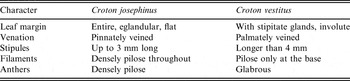
Croton josephinus was found in the Environmental Protection Area of the Serra de São José (21°3–7′S, 44°6–13′W) located north of Tiradentes in Minas Gerais State. This mountain range has been under floristic study for the last 20 years (Alves & Kolbek, Reference Alves and Kolbek2009) and the sampling effort for Croton species was intensified from 2000 as part of the Flora of Serra de São José Project (Medeiros et al., Reference Medeiros, Senna-Valle and Alves2008, Reference Medeiros, Senna-Valle, Emmerich, Alves and Kolbek2009). The occurrence of Croton josephinus seems to be restricted to the highest peak of the Serra, a campo rupestre area which has no particular name but has been designated by its altitude as ‘Pico 1430 m’ (21°3.892′S, 44°7.839′W). However, the species does not occur on the second highest peak of the range, only 5 m lower than the first one and with a very similar campo rupestre habitat, nor in any other known spot of the Serra. The isolation, small population size and difficult access have probably delayed the rediscovery of the species. Due to the silvery leaf indumentum, Croton josephinus is an eye-catching species when compared with its most similar and sympatric species, such as C. arlineae D.Medeiros et al., C. gnidiaceus Baill., C. pradensis D.Medeiros et al. and C. vestitus Spreng. The most similar taxon to Croton josephinus, as Müller Argoviensis (Reference Müller Argoviensis, Martius and Eichler1873) suggested, is C. vestitus in that both species are similar in habit and leaf size and shape, and they have sepals of the pistillate flowers with laciniate-glandular margins. However, Croton josephinus differs from C. vestitus by its entire leaf margin, penninerved lamina, smaller stipules (up to 3 mm long) and filaments and anthers entirely pilose (Table 1). In the diagnosis in Flora Brasiliensis (Müller Argoviensis, Reference Müller Argoviensis, Martius and Eichler1873), the Serra de São José was cited as being in São Paulo instead of Minas Gerais State. The same mistake, placing the Serra de São José in São Paulo, also happened with two species of Stachytarpheta (Verbenaceae), S. sellowiana Schauer and S. ajugaefolia Schauer, which were rediscovered there after a century (Atkins et al., Reference Atkins, Alves and Kolbek1996; Atkins, Reference Atkins2005).
Taxonomic characters distinguishing Croton josephinus from C. vestitus

A more detailed description of Croton josephinus, based on our recent collections, is provided below.
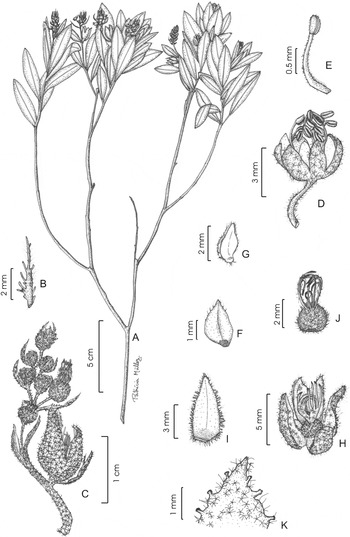
Croton josephinus Müll.Arg., Fl. Bras. 11(2): 195 (1873). – Type: Brazil, ‘In montis St. José, Jun. 1824’, Riedel 246 (lecto LE, designated here; isolecto LE [Riedel, ex Herbarium Fischer, no number]). Fig. 1.
Croton josephinus Müll.Arg. A, branch; B, stipule; C, inflorescence; D, staminate flower; E, stamen; F, sepal of the staminate flower; G, petal of the staminate flower; H, pistillate flower; I, sepal of the pistillate flower; J, gynoecium; K, detail of the sepal of the pistillate flower (adaxial side) showing its stipitate-glandular margin. Drawn from R.A.R. Drummond 169 (R).

Monoecious subshrubs 50–100 cm tall, branching dichotomous, branches terete, indumentum stellate-porrect, 8–10 radiate, silvery-grey. Leaves subsessile, pinnately veined, densely congested at the branch apices, lacking basal glands, trichomes stellate-porrect, 8–10 radiate and dense on both surfaces, silvery-grey; lamina elliptic-lanceolate, 21–40 mm long, 6–12 mm wide, apex acute, base acute, margin entire, eglandular, flat; petiole 2–3 mm long; stipules lanceolate, laciniate-glandular, stellate trichomes on the adaxial surface, glabrous on the abaxial side, caducous, 2–3 mm long. Inflorescences congested, few-flowered racemes, 2.5–3 cm long, with a distinct naked sterile zone separating basal pistillate flowers from the apical staminate ones; bracts lanceolate, laciniate-glandular like the stipules, 7 mm long below the staminate flowers and 6–7 mm long below the pistillate flowers, stellate trichomes on the adaxial side, glabrous on the abaxial side. Staminate flowers 7–10 per raceme, 1 per bract; pedicels 3 mm long; sepals 5, ovate-lanceolate, 2 × 1.2 mm wide, margin entire, sparsely stellate on the adaxial surface, glabrous on the abaxial surface; petals 5, ovate-lanceolate, 1.8 × 0.8 mm, membranous and translucent, margin entire, ciliate, otherwise glabrous; disc with 5 truncated segments; stamens 10–14, filaments 1–1.5 mm long, densely pilose throughout, anthers ovate, 0.7 × 0.4 mm, pilose throughout. Pistillate flowers basal, 1–2 per raceme, sessile; sepals 5, triangular-lanceolate, frequently unequal, 7–10 × 3–3.8 mm wide, margins stipitate-glandular, stellate trichomes on both sides; petals 5, diminutive, glanduliform, sessile, 0.2 mm long; disc with 5 truncated segments; ovary depressed ovoid, 1.5 × 1.8 mm, whitish-stellate, styles 3, 2–4-branched, 1.5–2 mm long, fused at the base, stellate trichomes present almost to the apex. Fruit a globose, stellate capsule, 4.5 mm in diameter; seeds 3, ellipsoid, 2–3 × 2 mm, testa smooth, caruncle translucent, well developed.
Distribution. Croton josephinus is narrowly endemic. The only known population is restricted to the outcrop fissures of the tallest peak in the Serra de São José, Minas Gerais State, at 1430 m above sea level. The summit covers an area of 200 square metres and is distinct from the surrounding campo rupestre due to the presence of a nearly constant orographic cloud leading to a more humid microclimate. An unidentified species of Trimezia (Iridaceae) and several other as yet unidentified plant species in the Serra seem to be restricted to the same microlocality. Seasonal fires have repeatedly been registered on the summit, but the large lignotubers of Croton josephinus shield them from this threat.
Conservation status. Critically Endangered (CR D1) as the number of mature individuals is fewer than 50 (IUCN Standards and Petitions Subcommittee, 2010).
Additional specimens examined. Brazil. Minas Gerais: Tiradentes, Serra de São José, ‘Pico 1430 m’, 21°3.892′S, 44°7.839′W, 13 i 2004 (fl. fr.), R.A.R. Drummond 169 (R, RB); ibid., 18 x 2004 (fl. fr.), R.V. Alves 8345 (R, RB).
Acknowledgements
The authors thank the Editor and the reviewers for their valuable suggestions, Patrícia Müller for the illustration, and Rosana Drummond for her considerable contribution to the field work. This study is part of the first author’s doctoral thesis, carried out at the Postgraduate Program in Biological Sciences (Botany) of the Universidade Federal do Rio de Janeiro (UFRJ), Museu Nacional, Rio de Janeiro, Brazil, and was supported by FAPERJ (Fundação de Amparo à Pesquisa do Estado do Rio de Janeiro). The studies of the second author are supported by the Brazilian National Research Council (CNPq).