1. Introduction
As a learner, the premodern university student shared much with his artisan counterpart. Both youths joined corporations that originated in urban growth from the eleventh century onward, corporations in which “masters” certified and monopolized the flow of products and skills between cities.Footnote 1 In fact, medieval jurists used the word universitas to name every sort of corporation, including early trade guilds as well as the students or masters who comprised the early universities (Michaud-Quantin Reference Michaud-Quantin1970, cited in Verger 1991, 37).
On joining a university or guild, a youth left home and entered a new – largely homosocial – family, in which the master passed on skills and knowledge and also took on moral oversight of the youth in loco parentis, very often housing and feeding his charges. On joining the corporation and attaining status within it, both students and apprentices navigated a documentary culture of certification. A youth might find preliminary training in the craft, whether brickmaking or copying books, enough to secure an opportunity and so leave his training early. Many youths never sought certification (Wallis Reference Wallis2008; Kintzinger Reference Kintzinger, Courtenay and Miethke2000; Schwinges Reference Schwinges and de Ridder-Symoens1992). A significant number, however, did. An ambitious youth might pursue his master’s vocation for himself, completing his years of apprenticeship or studies to gain the certification of journeyman or bachelor, and eventually attain the title of master, which in turn allowed him to train others. Such a youth engaged an economy of fees, gifts, ceremonial processions, and feasts designed to structure and regulate the hierarchies of the corporation, hierarchies that proliferated throughout the early modern period. The Enlightenment cameralist Johann von Justi highlighted the shared frustrations of premodern guild and university: “Mastership too often comes from connections, and is given on the basis of ‘sumptuous masterpieces, never useful for normal life, and not at all given in view of diligence and true talent’” (von Justi Reference Justi1755, quoted in Clark Reference Clark2006, 12).
The analogy of guild and university went even deeper. The material and conceptual realities of university life were often framed as tools and products of craft or ars, a terminology that early modern universities inherited from their medieval forebears. The world was a giant workshop, suggested the medieval master Gerhoch of Reicherberg, and William of Conches added that “all work is the work of the creator, the work of nature, or of man-the-artisan imitating nature” (cited in Le Goff Reference Le Goff1993, 57). Developing this account of mankind as irreducibly artisans, Hugh of St. Victor emphasized that the artes are not sciences but techniques, since that is “called art which takes shape in some material medium and is brought out in it through manipulation of that material, as is the case in architecture”; Hugh therefore became the first to cast the mechanical arts as companions of the liberal arts (Hugh of St. Victor 1961, 62).Footnote 2 Mary Carruthers has shown how deeply craft metaphors of habit and gesture permeated medieval understanding of intellectual work (Carruthers Reference Carruthers1998). Jacques Le Goff and William Clark have suggested that premodern academic authority was vested in material objects and processes of making: books were not simply abstract vectors of ideas, but explicitly described as the tools and the products of intellectual commerce (Le Goff Reference Le Goff1993; Clark Reference Clark2006). Early modern university students and masters, I will show below, explicitly adapted such Victorine categories to explain their own intellectual work.
Participation in book culture – whether production or use – has often justified the distinction of elites from the rest in the imaginations of social and cultural historians. Over the last thirty years, that distinction has worn thin. In the history of science and technology figures such as Robert Boyle turn out to have relied on entire households of “invisible technicians” who contributed both labor and knowledge to his science (Shapin Reference Shapin1989). We have learned from Carolyn Merchant’s insight that women and artisans contributed meaningfully to the new knowledge economy of the seventeenth century.Footnote 3 Recently book historians have taken the problem on more directly, focusing on the practices of collaborative authorship. Even the best-selling author of early modern Europe, Desiderius Erasmus himself, depended on a community to produce physical objects that could project his persona.Footnote 4 This case holds more generally. The often hidden collectors, collators, amanuenses, and other assistants played a more creative role in early modern authorship than we used to think (Grafton Reference Grafton2011; Blair Reference Blair2017a). Grand personalities such as Erasmus and the quixotic encyclopedias of Conrad Gessner turn out not to be the artworks of singular geniuses, but rather the ingenious artefacts of entire communities. Even the apparently standardized and replicable knowledge that Elizabeth Eisenstein saw in printed books was in fact a socially produced object, requiring continual negotiation to be experienced as standardized, as we learned from Roger Chartier and Adrian Johns (Eisenstein Reference Eisenstein1979; Chartier Reference Chartier1994; Johns Reference Johns1998). Context makes science, and it takes a community to make a book.
Through the case examined here, my goal is to extend this logic from the exceptions – Boyle, Erasmus, and so on – to the standard structure of school learning in the earliest period of print. In the scholarship of the previous paragraph, mainstream compendia still take second place to exceptional works of science, literature, and art.Footnote 5 While we may find that identifying a textbook is harder than it seems (as Grafton Reference Grafton, Campi, De Angelis and Goeing2008 points out, what is not a textbook?) it is nevertheless clear that, if we care about the social history of knowledge, we should attend more to textbooks, the objects that mapped the cultural assumptions and cognitive practices of the period.Footnote 6 Furthermore, by considering these texts materially – as objects produced within a particular community and place – similarities emerge between university and workshop. Against the historiographic tendency to seal off “high” from “low” culture, I will focus on what they shared, arguing that artisans and scholars shared a basic educational cycle orientated around the crafting of objects.
The case that I present here comprises a group of men often identified with the early French Renaissance. Rather than viewing them as humanists, a historiographically fraught term associated with abstract ideals, I first present their careers as bookmen, involved in the production and use of particular objects. Then I examine two moments of student engagement in book production, one in manuscript circulation within the classroom and another in the print shop. In a final section, I suggest that these craft practices could be dignified as knowledgeable within the orthodox frame of university thought.
2. Apprentice Bookmen
From the perspective of the material book, Jacques Lefèvre d’Étaples (c. 1450–1536) became influential not by publishing deluxe objects of erudition like his admired friends Ficino, Barbaro, or Poliziano, but by producing short handbooks to the university arts.Footnote 7 After retiring from university teaching in 1508, he became known for innovative editions of and commentaries on Church Fathers and the Bible. But first, during his tenure as a regent master in Paris, Lefèvre expended his energies on producing a wide range of accessible introductions to university arts, from logic and mathematics to natural philosophy and moral philosophy (Trithemius Reference Trithemius1512, 215v–216v). As I shall argue below, these books also bear the thumbprints of a close circle of students. In fact, Lefèvre regularly thanked students for their role in bringing his works into print. A long list may be supplied of the students who corrected Lefèvre’s publications – even more, presumably, contributed without acknowledgment.Footnote 8 He also attributed the genres that made him famous to his students’ ideas. When his patron Germain de Ganay asked why he wrote dialogues, Lefèvre cited his amanuensis:
Accept this reason. The honorable youth Guillaume Gontier, who helped me in many ways when he accompanied me to the Italian shores [in 1492], easily led me to do this. “If you do this,” he said, “you will advise students on how they should ask questions, and how to answer them; thus at once you can usefully assist both student and teacher.” He also advised me to prepare readers with an Introduction at the beginning, by which the artfully arranged matter might be committed to memory. (Lefèvre Reference Lefèvre d’Étaples1493, sig. b1v [PE, 22])
Lefèvre’s response to Germain subtly locates the very origins of textual dialogue in his conversations with a student. It was a topos, but not an empty topos. Between 1490 and 1508, Lefèvre lived and worked with his students at the Collège du Cardinal Lemoine in Paris, a mere ten minutes by foot from the print shops of rue St. Jacques. There he collaborated with students and printers to produce new textbooks for the whole cycle of the arts course. In this collaboration, many of these students became colleagues, notably the theologian Josse Clichtove. Many students, such as the Amerbach brothers and Beatus Rhenanus, became professional bookmen – writers, printers, correctors – after they first apprenticed in Lefèvre’s classroom, as even a brief survey of their careers will show.
In the still-new print shop, such bookmen brought together the practices of university men and artisans.Footnote 9 The university printers in this circle were not merely “sworn booksellers” (libraires jurés) as in times past, but were often themselves MAs: the illustrious print dynasty of Henri Estienne was founded by a university man, Johann HigmanFootnote 10 ; Jodocus Badius (White Reference White2013); Johannes Amerbach (Halporn Reference Halporn2000); and later inheritors of the Estienne press, Simon de Colines and Robert and Charles Estienne (Armstrong Reference Armstrong1954; Schreiber Reference Schreiber1982). As in the Aldine workshop of Venice, in Paris the master bookman oversaw both intellectual and financial sides of the business. In one colophon, Wolfgang Higman recorded himself as both the “ingenious printer” and a canny planner: “Printed at Paris … by the ingenious printer Wolfgang Hopyl.” This thought is always firmly in his mind: great deeds are done not by strength or speed or physical agility, but by planning, judgment, and authority.”Footnote 11 Through an oblique use of Cicero, who opposed youthful agility to measured maturity, the aging printer claimed intellectual engagement with the project as well as practical oversight.
Many students moved between college and print shop, studying with Lefèvre and working alongside Hopyl, Estienne, and Badius, and we should not assume all of them pursued the same career.Footnote 12 A surprising number in this circle, however, eventually took the role of master bookman for themselves. These students offer a particularly significant case because they belong to the first generation of students who could approach the entirety of the arts course through printed textbooks. Active in the decades on either side of 1500, these apprentice bookmen offer a case of authorship at the transition from manuscript to print, a period when the material and social organization of print publication were still in flux. During these decades, key elements of mise-en-page were not yet fixed: such as the title page, page numbers, paragraph divisions, punctuation, frontispieces, indices (e.g. Smith Reference Smith and Osler2000; Janssen Reference Janssen, Enenkel and Neuber2005). Moreover, as the next sections will show, the social organization of print production was similarly fluid. In the next paragraphs, a prosopographical sampling of this circle during this formative period will show the significance of their Paris apprenticeships for their careers as bookmen.
The Flemish theologian Josse Clichtove (1472–1543) was Lefèvre’s closest collaborator from the late 1480s to around 1521, when they broke over Lefèvre’s reform of preaching at Meaux (Bietenholz 1985, 1:317–220; PE passim; Massaut Reference Massaut1968; Farge Reference Farge1980, 88–104). Clichtove’s published work grew out of Lefèvre’s enterprise, largely in the printing houses of Henri Estienne and then Jodocus Badius. After he gained his MA with Lefèvre at the Collège du Boncourt (c. 1490; Farge Reference Farge2006, 155a), Clichtove took up studies in the theological faculty. Throughout the 1490s, however, he continued to teach the arts course at Lemoine and to edit Lefèvre’s works. The extent of their collaboration is hard to overstate: he left his fingerprints on most of Lefèvre’s early printed works, beginning with a poem in Lefèvre’s first printed work. Most of Lefèvre’s famed paraphrases and commentaries on natural philosophy, moral philosophy, and mathematics circulated in editions that included Clichtove’s commentaries. Even after receiving a doctorate in 1506, Clichtove produced editions of medieval theologians and Church fathers in collaboration with Lefèvre – he also defended his old teacher in short polemical works against Erasmus as well as against other factions in the theological faculty of Paris. Clichtove first apprenticed in Lefèvre’s shop, so to speak, and then became its foreman before he stepped out as an independent author.
The Netherlandish humanist and schoolmaster Johannes Caesarius (c. 1468–1550) similarly began his career in Lefèvre’s classroom (Bietenholz 1985, 1:238–9; PE 104–105; Allen 1906-, 2:172). He first studied in Cologne, and then quickly switched to Paris, where he gained the MA in 1498. He returned to Deventer, where he taught at a grammar school beginning an illustrious career as a teacher, humanist, and eventually even a physician – his students included notables such as Heinrich Glarean, Agrippa of Nettesheim, and Heinrich Bullinger. But his teaching always included publishing as well, and he is best known for his editions of Greek grammar and other works of classical scholarship. This pattern, however, began immediately after leaving Paris with the MA, when he worked a corrector at the press of Richardus Pafraet, who was just beginning to enter the market of school handbooks. Caesarius put his Parisian expertise to work in editions of Lefèvre’s introduction to moral philosophy, Clichtove’s brief handbook on logic, and a collection of mathematical works by Lefèvre, Clichtove, and Charles de Bovelles (Lefèvre Reference Lefèvre d’Étaples1502; Clichtove Reference Clichtove1504; Lefèvre et al. Reference Lefèvre1507).
The same pattern of apprenticeship can be discerned in the career of Hieronymus Gebwiler (c. 1473–1545) (Bietenholz 1985, 2:81–82; PE 243–244; Adam Reference Adam1967, 18–21). He first studied in Basel with the humanist Sebastian Brant, but then went to Paris to study with Lefèvre, graduating MA in 1495. His chief role was as a teacher in the famous grammar school at Schlettstadt (now Sélestat), and then in Strassburg, where he encouraged the best of his students to study with his old master in Paris. We have no evidence that Gebwiler served as a corrector in Paris; his own studies concluded while Lefèvre’s circle was still learning what print could do. Yet like Caesarius and others, he combined his teaching with work in the press. Gebwiler saw his old colleagues’ and teachers’ books through print shops in Strassburg, inter alia publishing versions of Lefèvre’s introductions to logic, natural philosophy, and moral philosophy, sometimes including snippets of Clichtove’s commentary as well as his own – through the presses, he adapted the Fabrist university program to a grammar school context (Lefèvre 1511; Lefèvre Reference Lefèvre d’Étaples1514; Lefèvre Reference Lefèvre d’Étaples1516).
The school at Sélestat, with Cardinal Lemoine in Paris, became the seedbed for a generation of Alsatian humanists, including the two older sons of the preeminent Basel printer Johann Amerbach: Bruno (1484–1519) and Basil (1488–1535) (Bietenholz 1985; see Halporn Reference Halporn2000). The two youths arrived in Paris together shortly after 1500, and together graduated with the MA in April 1506. Their father had studied with the Paris theologian Johann Heynlin von Stein in the 1470s, and initially wished his sons to take the same path through the Scotist schools; instead, they remained at the Collège de Sainte Barbe while taking some lectures at the Collège du Cardinal Lemoine, attracted by Lefèvre’s teaching. As it had for their father, the MA degree gave them the foundation for a career in publishing books. Bruno, an outgoing personality, joined his father’s printing shop as a key figure in the great enterprise of editing the works of Jerome, a work the junior partner Johann Froben continued after the senior Amerbach died in 1513. Meanwhile, Basil took a legal degree at Freiburg, but sickness prevented him from practice as a lawyer, and he also found his chief occupation as a corrector in Froben’s workshop. This was the group Erasmus found so congenial when he arrived in August 1514; skilled as expert correctors in both Latin and Greek, they could serve his books to best advantage (Allen 1906-, 3:96–97).
Preeminent among these correctors was Beatus Rhenanus (1485–1538), who studied under Gebwiler at Sélestat before he took the BA and MA at the Collège du Cardinal Lemoine in Paris between 1503 and 1507 (bibliography in Hirstein Reference Hirstein2013). While studying with Lefèvre in Paris, Beatus helped publish several of Lefèvre’s works, including an edition of Ramon Lull’s Contemplations, a reframing of the political works of Aristotle and Plato, another on Lefèvre’s introduction to the Nicomachean Ethics with Clichtove’s extensive notes, and an edition of patristic works (Lull Reference Lull and Lefèvre d’Étaples1505; Lefèvre Reference Lefèvre d’Étaples1506). This experience earned Beatus a firm foothold in the growing business of humanist print. In 1508, after returning to Alsace, Beatus joined the new printing house of a fellow graduate of the Sélestat school, Matthias Schürer (on whom see Bietenholz 1985, 233, and Vanautgaerden Reference Vanautgaerden2012). After 1514, when Erasmus came to the region first attracted by Schürer and then by Froben, Beatus proved one of Erasmus’ most trusted correctors and collaborators, as well as a careful editor of ancient and patristic texts in his own right. It was to Beatus that Erasmus entrusted the task of gathering his opera omnia after his death in 1536. For my purposes, it is significant that Beatus built his reputation on skills he first exercised in Paris, excising solecisms, comparing newly printed sheets to their manuscript exemplars, and carefully framing new books within appropriate headers, letters, and verses. It was these skills in transforming copy into printed books that made these students bookmen – and indeed, as I shall argue, made them authors.
3. Publication Moment One: Manuscript Circulation in the College
The student notes of Beatus Rhenanus offer a rare glimpse into this moment of transition between manuscript and print. While he was in Paris, Beatus’ teachers finished printing new textbooks for the whole cursus artium at the University of Paris – this was the first concentrated program to renovate the cursus in print, and Beatus belonged to the first generation of students that could, in principle, spend their entire university career studying only the printed textbooks of their masters. His extant library shows that he intensively studied these printed text books; they are crammed with detailed notes, many evidently taken in class (Oosterhoff Reference Oosterhoff2015, 8–11). But his notes also reveal hints of the origins of these printed books in a primary circulation of manuscripts. Such printed textbooks grew out this first manuscript context of collaborative learning.
One of his notebooks is especially revealing. At first glance it appears simply to be a series of class notes. The first sections are a series of collectanea on works of logic and natural philosophy. One titled In Librum Introductorium naturalis philosophiae Aristotelis collecta appears to be complete, concluding with the following excipit:
This Introduction to Aristotelian Physics was read at Cardinal Lemoine in Paris, and set down in letters by me, Beatus Rhenanus. [BHS MS 58, 163v. “Parrhisijs In cardinali Monacho: Hoc In Physicen Aristotelicam: Introductio Lecta est et A me “literis mandata” Beato Rhino<wer>.”]
Clearly these texts represent lectures or “readings” (lectiones) in the college, in some format. Since not all are finished, and there are generous sections of blank pages, these texts seem to be rough copy, perhaps written as the lecturer spoke.
But two other texts in the notebook are not so clearly related to lectures. One is a series of theses that Emmanuel Faye has identified as belonging to Charles de Bovelles, introduced with some quotations from Nicholas of Cusa, which sets out a series of statements on the metaphysical place of man in the universe (Beatus, BHS MS 58, 195r-206r. This work is edited by Faye Reference Faye1998). It concludes with the simple colophon Finis Parrhisijs . Anno . : 1:5:0:4: . Cardi[nali]: Mo[nacho]: (Finished in Paris, in the year 1504, at Cardinal Lemoine). Since it is complete, copied in a fair hand, and there is no reference to a classroom context, very likely this text was circulated in the college. Additional support for this possibility comes from independent short works that Bovelles published around the same time, which similarly consist of evocative theses without further elaboration (Bovelles Reference Bovelles1500; Bovelles Reference Bovelles1501). Such lists of theses could therefore be a publishable genre in their own right.
The circulation of manuscript tracts within the confines of the college becomes even more likely with the next treatise in Beatus’ notebook. This one is titled Iacobi fabri Stapulensis In Libros De Anima, analogiarum Compendium, and concludes unambiguously with the Greek telos, and Finis ANALOGIARUM (Rhenanus BHS MS 58, 206v). Here we have a series of reflections on physical analogies for mental or metaphysical operations – a popular theme in Lefèvre’s circle.Footnote 13 Not only is the brief work complete, but it is copied in a fair hand. In particular, one tell-tale sign convinces me that the work was in fact copied from another manuscript: the work includes signature markings. Since these markings do not match the notebook’s signatures, they must come from another exemplar that Beatus copied.
These manuscript treatises, copied into the back of a student’s notebook, can be understood within the late medieval framework of coterie publication as Daniel Hobbins has elucidated for the decades just before print, around 1400. Hobbins defines manuscript publication as typically happening in two moments. In the first, an author shares the work in a limited number of copies within an intimate circle of readers. Then, in a second moment of publication, that circle of readers may, with or without the author’s encouragement, copy and circulate the work more broadly. In a manuscript culture, both of those moments should be seen as “publication,” though it is the second which explains the broad dispersion of works like Gerson’s tracts or Thomas a Kempis’ Imitatio Christi (Hobbins Reference Hobbins2009).
These two moments of publication help us consider why in Lefèvre’s circle certain works circulated in manuscript, and why others were printed. Those works clearly limited to manuscript publication were especially elite and esoteric in nature. We know that early patrons of the circle, the brothers Germain and Jean from the wealthy and powerful officer family Ganay, received deluxe manuscript copies of certain “books of many Platonists” from Ficino, who also dedicated his translation of Athenagoras’ De resurrectione to Germain in manuscript copy in 1495.Footnote 14 Lefèvre’s own dedications follow the same pattern. Ficino’s prisca theologia, perhaps with Germain’s encouragement, was the starting point for Lefèvre’s treatise De magia naturali, which Jean-Marc Mandosio has shown was never intended to be published.Footnote 15 The text exists in four manuscripts, but only one has all six books; the others have only the first four books. Mandosio points out that the first four books are those that are written as a dialogue between Lefèvre, in the role of sage, and his companion Germain de Ganay himself as student. The last two books in the Olomouc copy are written not as dialogue, but as a treatise; they were added, Mandosio suggests, to a text that had been published as a dialogue in manuscript in the early 1490s, perhaps at the request of Germain himself. The esoteric themes of secrets of nature, Cabbala, alchemy, and magia Pythagorica go a long way towards explaining why this text was not meant for print; recent scholarship has shown that manuscript was a main mode of diffusing sensitive or dangerous texts, such as those of magic (Barbierato Reference Barbierato2011). Clearly this was not an introductory text; the manuscript reflected Germain’s place within a close circle of cognoscenti.
Even natural magic was too dangerous to set before students in textbooks. Nevertheless, some of the university books Lefèvre first published in manuscript are consciously aimed at related esoteric subjects, and their introductions flatter patrons with the sense of inclusion within circles of high-minded friendship. Lefèvre’s first mathematical work, after George of Trebizond convinced him to recover the discipline for the glory of Paris, was an edition of Jordanus de Nemore’s Elements of Arithmetic. Though first printed in 1496, the book must have been published in manuscript before 1494, because early that year Lefèvre dedicated his dialogues on Aristotle’s Metaphysics to Germain de Ganay, and mentioned that he had already dedicated his edition of the Arithmetic to Jean de Ganay. Mathematics was especially important for Jean as a kind of “mirror and rule of justice,” because he was an important lawyer in the Paris parlement (PE, esp. 6, 21). For Germain, a bishop called to priestly service, Lefèvre offered metaphysics, the study of eternal truths, “which the Platonists call ideas,” first studied as mysteries by the Egyptian priests and Chaldean magi. Neither of these treatises were basic school texts; they were advanced topics. The role of manuscript publication was to foster what Brian Richardson calls “a sense of close communication and solidarity among those with similar tastes and interests” (Richardson Reference Richardson2009, 1–2). Manuscript publication suited the esoteric interests that might lure elite patrons.
Lefèvre’s more mundane school introductions also fit this model of coterie manuscript publication, at least initially. His earliest known text was not published until at least four years after being written; the Introduction to Metaphysics, which was printed with four additional dialogues in 1494, was first written in 1490, two years before Lefèvre’s first printed publication Paraphrases on the Whole of Natural Philosophy, and one year before he traveled to Italy.Footnote 16 Another allusive example is Lefèvre’s brief 56 octavo pages of Logical Introductions (Reference Lefèvre d’Étaples1496).Footnote 17 The title page reveals that these were “diligently gathered together by Josse Clichtove.” The implication is that the work – like the tracts by Bovelles and Lefèvre in Beatus Rhenanus’ notebook – had already been available, likely circulated in manuscript among close students like Clichtove.
Here the function of manuscript is still to reinforce intimacy, but not through advanced, difficult, or dangerous intellectual topics. Precisely the opposite. Evidently, such handbooks gathered manuscript notes that had functioned as glorified crib sheets. They displayed modes of debate and offered mnemonics and diagrams for easy recall, with short potted arguments to prepare swiftly for debate. Within the intimacy of the college community, therefore, manuscript coterie publication not only protected esoteric subjects, but was the way students shared the helps and crutches of ordinary classroom learning. The distinctive Fabrist introductions seem to have originated in student practices of circulating manuscript tips for managing the curriculum—doubtless a kind of collaborative learning that had long served university students, even though evidence is rarely available to historians. Such manuscript circulation was the first source of this circle’s distinctive, collaborative approach to the arts course.
After this first stage of manuscript circulation, print also offered a powerful second moment of publication, when the circle of intimates replicated the work for a broader audience. Not only did Clichtove gather the material for the Logical Introductions, but in fact Lefèvre’s students Guillaume Gontier and David Laux did all the editorial work, as a postscript to the first edition indicates. If Lefèvre initially hesitated to publish in print, his students were more enthusiastic about what print could do. It was their industry that made these introductions public.
4. Publication Moment Two: Students in the Print Shop
Apprenticeship offers a useful model for understanding the role of students in this second moment of wider publication. University students, as in artisanal guilds, produced new physical objects: books. From the thirteenth century at least, students complained when masters lectured too quickly to let them copy texts verbatim, producing their own copy of the text or commentary in question.Footnote 18 In the reading halls, some students copied books, often for extra money, working within the pecia system. This was the hub of university book production: libraires dealt in old and new books, paper and ink, and would rent out pecia (sections of manuscripts that had been corrected and certified) to students and professional scribes.Footnote 19 When books began to be printed, student participation in book production began to change. In particular, there was a new division of labor. In the line of production, the newcomers were pressmen, manual workmen who sweated over the presses.Footnote 20 To set type, print shops also needed compositors who were at least somewhat learned, as well as learned clerics to correct the proofs as they came off the press.
In guilds and other artisan corporations, apprentices were not necessarily the lowest status figures in a workshop. Such youths were usually entrusted to the master’s care by a parent, under a contract that required that they receive training in the entirety of the craft. Unlike day laborers and domestic help, apprentices had rights not to be deployed only in menial tasks unrelated to the profession. Apprentices therefore expected to work in some relation with the master, on works to which the master would put his name. At least in principle, apprentices were marked out for advancement (e.g. Epstein Reference Epstein1998; De Munck Reference De Munck2007; and Patrick Wallis in this volume, on the expectation of advancement).
Likewise, the apprenticeship model reveals some students in a middle stratum within the print shop. Early print shops were often populated with university graduates and students, and it is not surprising that Lefèvre’s first printers, Wolfgang Hopyl and Johann Higman, were university men, Higman himself having received the bachelor degree in 1478 (Claudin Reference Claudin1900, 1:350). Such early printers frequently found their correctors in universities, often among senior students. The heavy labor of pressmen required more dexterity than literacy, and even compositors did not always read with ease. But to check the proofs, to ensure that they reflected the author in the best possible light, to guarantee every letter was in its place, every solecism safely eluded, to compile swelling indices, and to compose the prefaces and printer advertisements – these tasks required strong Latin, a keen eye, and a thick skin to withstand competing pressure from authors and printers (Grafton Reference Grafton2011, 6–32, and passim). In the hierarchy of book making, correctors belonged to the world of work, namely the print shop; Grafton has shown that although they were often as erudite as their authors, they were more often ignored if not unjustly blamed for errors (cf. Richardson Reference Richardson1994). Correctors of Lefèvre’s works often worked directly alongside the pressmen, recognitores in officina (Tyler Reference Tyler and Moore1952, 23). It would not have been unusual for a corrector to be responsible for the detailed table indexing Lefèvre’s commentary in his Text on the Sphere.Footnote 21
As one of Lefèvre’s closest collaborators, Josse Clichtove’s hand is very often indistinguishable from Lefèvre’s.Footnote 22 Clichtove corrected Lefèvre’ first printed book in 1492, and even added some of his own verses, becoming author as much as editor. In these verses (which disappeared in later editions) Clichtove praised the printer Higman, enjoining the reader to thank this German printer, who took up the job at his own expense. He added that he himself had, as well as he could, corrected any errors that had been left “in lead” – that is, the mistakes of compositors – together with a certain “faithful Bohemus.”Footnote 23 It seems quite likely that Clichtove’s helper was one Stephanus Martini de Tyn (Bohuslas Tinnensis), from Prague, who was then a student in the medical faculty (Massaut Reference Massaut1968, 1:186n46; cf. PE 15). Not long after this, the Frisian humanist Viglius Zuichemus noted in the illustrious shop of Froben in 1534 that a corrector might work with a reader (Gerritsen Reference Gerritsen1991). Stephanus might have read the manuscript exemplar aloud, while Clichtove collated it with the proof. In any case, Lefèvre benefited from the attention of experienced students and fellow academics in preparing his long, folio volume for publication, and his readers knew it.
Indeed, Lefèvre’s introductions to university disciplines were printed with the help of a number of his students, and some followed Clichtove’s example in advertising their involvement. Gontier, already mentioned as Lefèvre’s amanuensis during his travels to Italy, corrected Lefèvre’s popular Moral Art (1497), and had his name put on the title page. Lefèvre’s mathematical books seem to have drawn the widest involvement of students. The Text on the Sphere (1495) colophon includes no fewer than four “recognitores diligentissimi” and “matheseos amatori”: Lucca Walter, Jean Grietan, Pierre Griselle, and Lefèvre’s amanuensis Guillaume Gontier. The number of correctors makes it likely that they made a gift of their time – more likely than Higman paying four correctors.Footnote 24 Four correctors may have been needed to deal with the large number of diagrams, charts and numbers in the book, always in need of yet one more recalculation or comparison with the original. In his prefatory letter, Lefèvre cited “my domestic, Jean Grietan” as a skilled abacist, describing his learning in the variety of mathematical disciplines and saying that he had been a great help in writing the book (Lefèvre 1495, a1v: Affuit levamini domesticus noster Ioannes Griettanus, abaci numerandique peritiae et reliquae matheseos non inscite studiosus; scripsit opus et quasi fesso umerum subiectit Atlanti). The word “domestic” here suggests that Grietan earned his bursary at the Collège du Cardinal Lemoine through household labor, a common arrangement in the Parisian colleges. But instead of carrying water and wood, young Jean was put to work as a computer, no doubt helping to produce the numerous tables of longitudes and latitudes, as well as ascensions of the zodiac that illustrated Lefèvre’s commentary.
Another colleague at the college, David Laux, apparently also bore the weight of the larger and much more difficult Elements of Arithmetic, in 1496, “the year of the Lord, who formed all things in number and harmony.” The colophon emphasized that the printers Johann Higman and Wolfgang Hopyl had published the lavishly illustrated work “at their own heavy labor and expense,” sweating for the sake of Parisian students – adding, not quite as an afterthought, that that they had been helped by “David Laux, the Briton from Edinburgh, who diligently corrected the whole thing from the exemplar” (Lefèvre Reference Lefèvre d’Étaples1496b, colophon: Et idem quoque | facit David Lauxius Brytannus Edinburgensis: Ubique ex archetypo diligens operis recognitor). Given this rhetoric and the financial risk associated with such a labor-intensive, expensively illustrated text, it does seem likely that the colophon was written by the printers themselves, and that the book was indeed a labor of love, or at least economic nerve. (Perhaps they even paid Laux.)
Indeed, the omnipresent labor of students in these books presents another analogy with apprenticeship, in which training is exchanged for labor. Fabrist textbooks were among the most frequently reprinted works of Henri Estienne’s press: in Estienne’s first decade on his own, from 1502 to 1511, twenty-one out of thirty-eight books he published were Fabrist textbooks – and the remainder was mostly works of theology or philosophy edited by Lefèvre and his students (Renouard Reference Renouard1843, 1-10). I know of no account books that would give a closer picture; but since by far most of Estienne’s output was Fabrist works, it seems likely Estienne’s profits, or at least the economic survival of his print shop, depended on the labor of these students.Footnote 25 Yet there is no evidence of Estienne paying Lefèvre or these students for their work. So far I have chiefly highlighted the experience that students gained in return for their extensive labor. Lacking other evidence, it seems unlikely that the leading students chose to work in print shops in exchange for fee exemptions; the Amerbach boys, for example, complain much about fees, but never mention repayment of this kind.
Instead, besides experience, students earned cultural credit for their labor. Learned dedications, letters of flowery praise between friends, lavish prefatory poems, elegant colophons – such paratexts were the currency of the Republic of Letters (Haugen Reference Haugen2007). As we have seen, the students who printed Lefèvre’s were handsomely rewarded in this economy. The ultimate payment, it would seem, was the chance to enter the domain of authorship. Through the names in these paratexts, we trace the first steps of students towards becoming authors. Lefèvre might have singled out his friend Étienne for thanks in his first publication, the Paraphrases on the Whole of Natural Philosophy of 1492, but he gave Clichtove a greater opportunity: the short poem thanking Higman and Stephanus was Clichtove’s first appearance in print. But paratext could itself become a key part of the text. In 1502, Clichtove supplied the Paraphrases with a commentary that frequently was longer than Lefèvre’s own paraphrase. In the following four decades, it was this version of Lefèvre’s paraphrases that was most frequently reprinted.Footnote 26 Clichtove also piggybacked on Lefèvre’s authorial gravity in 1517, when he took the few pages of Lefèvre’s Astronomicon and augmented it with over a hundred pages of dense commentary. Similarly, Charles de Bovelles’ first active role in print was not his Introduction to the Philosophy of Opposites (Reference Bovelles1501), but from the year before. In 1500 Lefèvre invited him to edit a short Astronomical Ring, a description of a miniature astrolabe that he had found in Rome. Apprenticeship as a corrector could lead to authorship.
5. Craft and Books
The products of this circle were books, and books principally aimed at knowledge of the university arts course: logic, mathematics, natural philosophy, and ethics. Yet the language of craft permeated the enterprise. Lefèvre’s own name – fèvre in old French, latinized as faber, means workman or maker (Godefroy Reference Godefroy1884, s.v.) – probably came from his Picard family, but his friends played on its craft meanings for scholarship. He was a master in the craft of forming student souls, “like another craftsman Daedalus having artfully fashioned a chariot.”Footnote 27 Such metaphors recall the pioneering work of Mary Carruthers, already mentioned, who showed how medieval accounts of monastic thought were framed by analogy with craft (Carruthers Reference Carruthers1998). Even after the period Carruthers addresses, the university built its whole edifice of knowledge on the analogy of craft. Above I have stressed the social analogy; here I turn to the conceptual analogy.
The analogy was partly a continuation of the ancient discourse of the liberal arts. The enduring power of this tradition was enshrined in the Latin word ars, which like early modern vernacular cognates art, arte, Kunst, did not differentiate learned art from practical craft; we may use the two words interchangeably.Footnote 28 Josse Clichtove and Charles de Bovelles both wrote schematic overviews of the arts in which one can trace Hugh of St Victor’s account of the liberal arts as analogues of the “servile” mechanical arts or crafts. Bovelles goes one step further, offering a historical development from the mechanical arts that first supplied necessities for bodily sustenance, to the invention of free arts when people first had leisure to consider abstract concepts (beginning with arithmetic and astronomy) (Bovelles Reference Bovelles1500, 6r). Such schemes depended on, while also limiting, the notion of ars as techne, technique or knowhow, for they insisted on a strict distinction between manual and mental craft. From the outset, Clichtove retained the association of “servile” arts with the servant and the body, while the liberal or learned arts belonged to the master and the soul (Clichtove Reference Clichtove1520, A2v).
But Aristotle was another university resource for rethinking this distinction. A continuum between manual and learned craft emerged in Lefèvre’s dialogues on Aristotle’s Metaphysics. The dialogue considers what sort of knowledge characterizes the wise man, who is thought to possess the greatest amount of certain knowledge. The discussants agree that “the experienced person without craft works with greater certainty than the craftsman without experience.”Footnote 29 The kind of “certainty” here has to do with the power to reason from one instance to another. Experience only offers knowledge of singulars, while craft (ars) involves knowledge of universals; therefore someone who has experienced the singular act of binding a book (let’s say) just one time is more likely to succeed in doing it again than someone who has theory but no experience. In the dialogue, the student points out to the teacher that few people master the universals or theory of an art without having first experienced some of it. After all, a universal is inferred from many experienced instances. The teacher recognizes that experience does lead to art, but also that sometimes one might want to have art indirectly, by report or from a book. An example comes from medicine: one might happen to be bitten by a snake immediately after drinking a certain vinegar. Finding that the vinegar kept the bite from making them ill, one might then discover this for similar snake bites, for oneself and for others. This experience is a reliable mode of getting knowledge. But, the teacher hints, this is an unwieldy procedure for gaining the whole craft of healing: one might also read such remedies in a book, learning from the experiences of others. Note that such knowledge is not necessarily bookish – it might be passed on by visual inspection or by verbal report. Besides the physician, the other main example of a craftsman (artifex) in this passage is the architect, whose knowledge is not limited to books but nonetheless is a form of universal knowledge that transcends particular instances. The way to wisdom is through books – but the knowledge that went into books was ultimately drawn from experience.
Indeed, the organization of bookish knowledge drew on the analogy of manual crafts. Aristotle began the Nicomachean Ethics with the sentence that “every art, every teaching and activity, and likewise every choice appears to seek a certain good,” making craft his starting point for practical reasoning of every kind.Footnote 30 The political art of directing a city therefore was an “architectonic” discipline by analogy to the architect, whose craft directed all subordinate building trades. While Aristotle did not hesitate to suggest a hierarchy between the various arts, he awarded each a particular dignity; because each art has its own ends, it cannot be reduced to some other art.
Even manual arts had intellectual value, while intellectual arts required practical expertise. In the Nicomachean Ethics Aristotle classified art as a quality of mind, a habitus to be set alongside prudence and science; ars or techne was a habitus specifically directed to making. As Lefèvre explained, “art is the same as a habitus that makes according to true reason … Every art deals with generation and the production of artifice.”Footnote 31 In Lefèvre and Clichtove’s brief handbook to moral philosophy, ars features as one of the intellectual virtues. Clichtove again notes the ancient contrast of mechanical and literate arts; but frames the discussion more securely within what the two share. After all, painting and writing require the same virtue of their practitioner: “Just as pictorial art deals with depiction by true reason, according to its rules, so the art of writing also proceeds by true reason and according to the matter itself.”Footnote 32 In the next sentences, Clichtove describes the preparation of ink, paper, and pen before the formation of letters on vellum, and compares these to a builder’s tools and his attention to the cement, planks, and stones with which he will build. Authorship is explicitly and literally a craft oriented towards making.
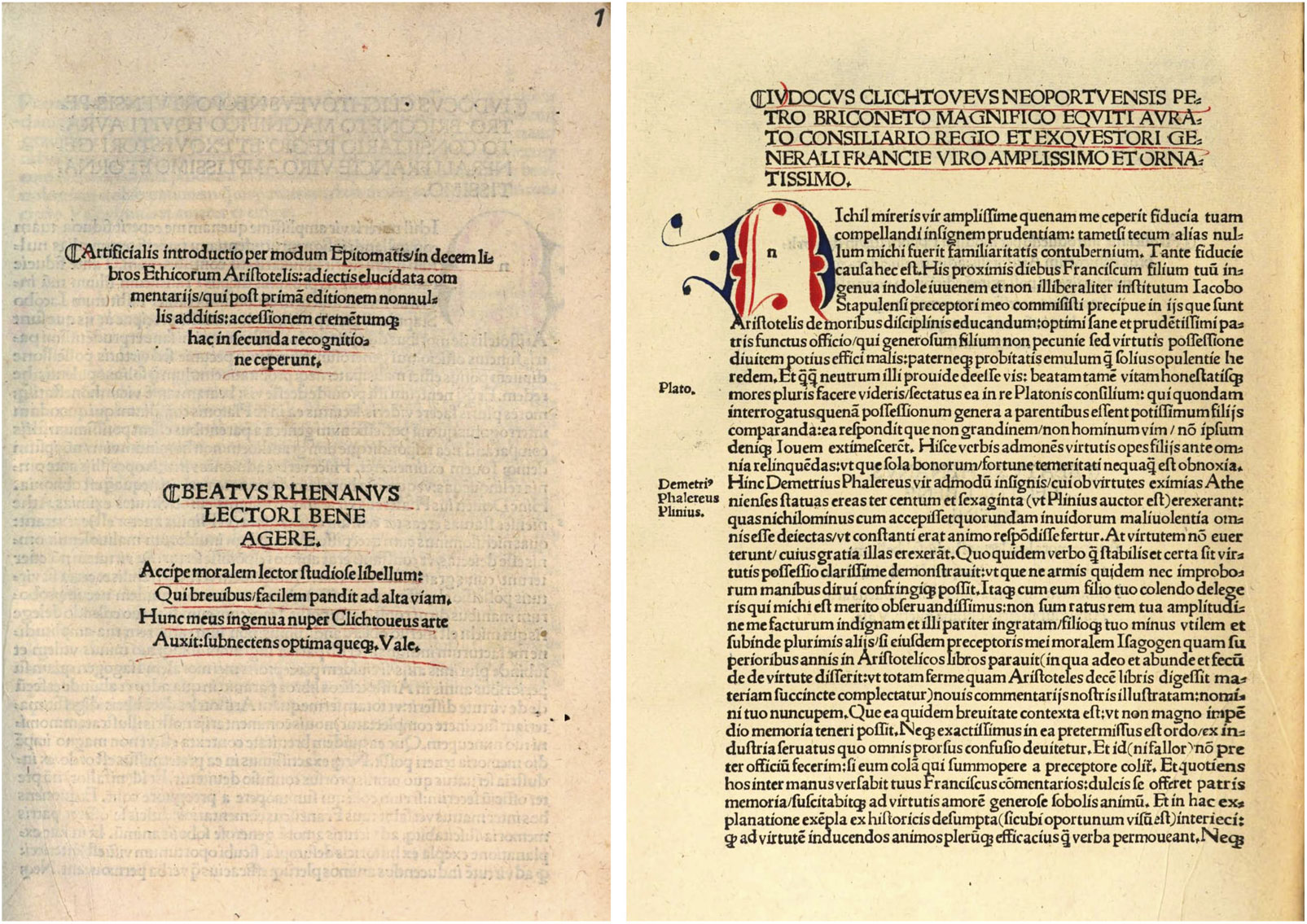
This stress on the factive character of writing suited the Fabrist circle’s interest in producing textbooks. Since they held that craft was oriented around material objects, contingent on the maker’s skill or artfulness, they also recognized that such objects included the handbooks they made.Footnote 33 They supplied these books with titles advertising their “artfulness”: they are repeatedly described as artificialis, which elaborate their topics in an artificiose manner (recall Fig. 1). Such adverbs and adjectives make claims about the physical object, in the first place. They claim that the book is well made. As I alluded above, these texts are only components within complex, innovative objects. They are surrounded by synoptic tables, plentiful figures and diagrams, extensive indices, and experimental title pages and frontispieces – these likely authored by student-apprentices. But, secondly, the claim of artfulness, within the Aristotelian discourse of craft, brings together the material and conceptual aims of these objects: these books are artful precisely because their material construction suits their aims, which is to accomplish a certain habit of knowledge within their users. The crafts bring together particulars with universal judgments in a way that makes scientia possible, as Lefèvre had described it in his dialogues on the Metaphysics.
Lefèvre and Clichtove 1507, title page and first page. As was often the case in a decade when title page conventions were not yet set, the author’s name appears on neither the title page nor the dedicatory epistle to this short, “artful” introduction to Aristotle’s Nicomachean Ethics. Instead of Lefèvre’s name, we find only the names of the student corrector Beatus Rhenanus and the commentator Clichtove, prominently advertised in large letters. Bayerische StaatsBibliothek, shelfmark 1422301 / 2 A.gr.b. 371 (urn:nbn:de:bvb:12-bsb10139325-4), NoC-CC.

With uneven success, some of Lefèvre’s students brought together the domains of craft and books in other ways too. One example is their special attention to handbooks and treatises of mathematics, a discipline they defended not only because it sharpened minds for conceptual thought, but because it bore particular fruits in practical domains. One of Lefèvre’s closest students and colleagues, Charles de Bovelles, especially represented the circle’s fascination with printed images, diagrams, and other visual apparatus that integrated the hands, eyes, ears, and mind (Klinger-Dollé Reference Klinger-Dollé2016). Bovelles developed a philosophy that grounded an operative vision of knowledge, in which intellectual progress depended on human creativity – both within the mind and in the world of manual technique. Bovelles even explored these commitments in the world of work, writing the first printed practical geometry in French, proclaiming it would be useful to artisans and “common men,” while relating observations of craft practices around his native Picardy (Bovelles Reference Bovelles1511).Footnote 34
6. Conclusion
At a very general level, it is obvious that learning in early modern universities retained a residual analogy to learning in craft corporations, owing in part to the origins of universities as guilds. Granting this analogy sustained attention, however, reminds us that learning is more than collecting clever concepts, schemas, or a canon of thoughts. Early modern university students also learned how to make: notes, lists, diagrams, copies, poems, and even entire books. Not all students became authors in their own right, but I have offered a case in which many students took a leading role in collecting, collating, emending, and elaborating the work of their master, the named author. While the evidence of Lefèvre’s circle offers an unusually rich glimpse at these practices, I suspect we would find many similar instances if we look elsewhere.Footnote 35 Such collaborative authorship could be further compared to the shared enterprise of the artisan master’s atelier.
The early modern print shop blurs the analogy between university and workshop. Around 1500 students could find the print shop a novel means for bringing college manuscripts into wider circulation. I have found it useful to distinguish two moments of production, which had characterized late medieval coterie practices of publication. Students first shared the master’s study manuals, and then brought them to wider publics through the press. The first moment established the community through intimacy; the second offered students a means of extending their master’s recognition while they themselves gained experience and credit in exchange for labor. This second moment of print publication offers, therefore a particularly tight analogy with apprenticeship. Further work would be needed to determine how far beyond the early sixteenth century such practices lasted.
Early modern university students likely shared more with their fellow apprentices in the crafts than they do with modern scholars – which should give us pause before we project modern emotions onto past experience. Historians have often distinguished “popular” and “elite” social experiences in early modern culture, sometimes to the point of denying them a shared horizon of meaning. Craft and knowledge present one such distinction. The Aristotelian training of premodern universities is often presented as a source of antipathy to manual and craft knowledge. But this is a partial story at best. To be sure, Aristotelian accounts of the crafts and sciences set out a hierarchy of knowledge in which conceptual knowledge held the highest place. Yet artisans also were considered to have conceptual knowledge. In fact, these texts picked out craft as the driving exemplar of all forms of knowledge – the foundation of wisdom itself. It was within this framework that the circle of Lefèvre treated their own bookish activities as productive crafts. In the classroom, medieval masters and disciples had striven together to gain the craft required for weaving words with ink and paper, for tying pages together into books. I would add that the early print shop intensified the analogy of university and workshop, enabling students to engage and even control the process of producing books, becoming a key stage in the apprenticeship of a class of early modern bookmen.
Acknowledgments
This paper develops arguments begun in Oosterhoff 2018. My warm thanks to the work group “Knowledgeable Youngsters” for unfailing stimulation and accountability; and to Patrick Wallis for reading a draft. Thanks are also due to Feike Dietz, Els Stronk, and Sven Dupré for their thoughtful leadership in the workshops and editorial process leading to this special issue, as well as to the participants of those workshops for their fruitful conversation. I am also grateful to the anonymous peer reviewers for their careful reading and several suggestions. The research leading to this paper has received funding from the European Research Council under the European Union’s Seventh Framework Programme (FP7/2007-2013)/ERC grant agreement no 617391.
Author ORCIDs
Richard J. Oosterhoff, 0000-0001-5419-7644
Richard Oosterhoff is Lecturer in History at the University of Edinburgh. He has written Making Mathematical Culture: University and Print in the Circle of Lefèvre d’Étaples, Oxford-Warburg Studies (Oxford University Press, 2018) and, with Alexander Marr, Raphaële Garrod, José Ramón Marcaida, Logodaedalus: Word Histories of Ingenuity in Early Modern Europe (Pittsburgh University Press, 2018).