





1. Introduction
Second language (L2) use often involves the constant interaction of multiple linguistic systems that co-exist within a learner’s cognitive architecture, where the activation of the non-target language systematically influences specific patterns of behavior in the target language (Jarvis & Pavlenko, Reference Jarvis and Pavlenko2008; Kroll et al., Reference Kroll, Dussias, Bogulski and Kroff2012). This phenomenon, commonly known as crosslinguistic influence, has been extensively investigated across various linguistic domains, particularly at the lexical and syntactic levels (e.g., Dussias & Sagarra, Reference Dussias and Sagarra2007; Hartsuiker et al., Reference Hartsuiker, Pickering and Veltkamp2004; Hwang et al., Reference Hwang, Shin and Hartsuiker2018; Jacob et al., Reference Jacob, Katsika, Family and Allen2017; Marian & Spivey, Reference Marian and Spivey2003; Sanoudaki & Thierry, Reference Sanoudaki and Thierry2015).
Building on this foundation, the current study expands the investigation of crosslinguistic influence beyond isolated lexical or syntactic units, examining how predicate-level information, including not only semantic but also morphological and syntactic properties, influences referential choices during L2 discourse comprehension. To this end, we compare Korean- and Chinese-speaking learners of English, whose L1s differ in the morphosyntactic realization of the relevant predicates. While previous research has established that learners experience crosslinguistic activation at the level of individual items, such as verb semantics (e.g., Chambers & Cooke, Reference Chambers and Cooke2009; Pavlenko, Reference Pavlenko2008; van Dijk & Hopp, Reference van Dijk and Hopp2025), considerably less is known about whether the properties of a predicate in the L1 persist as an active cognitive representation during L2 discourse interpretation.
To investigate this issue, we focus on a key phenomenon that reveals the impact of crosslinguistic influence on referential resolution, called implicit causality (IC) bias. First introduced by Garvey and Caramazza (Reference Garvey and Caramazza1974), IC bias refers to the tendency of certain interpersonal verbs (i.e., verbs involving two event participants) to implicitly assign causal responsibility to one of the referents in a causal dependent clause (Au, Reference Au1986; Brown & Fish, Reference Brown and Fish1983; Garvey & Caramazza, Reference Garvey and Caramazza1974). To illustrate, consider the following example.
-
(1)
-
a. Lily admires Wendy because she…
-
b. Lily impresses Wendy because she…
-
In (1a), the pronoun she is more likely to be interpreted as referring to Wendy, as the verb admire tends to induce a bias toward the object as the cause of the event (thus categorized as an object-biased verb). In contrast, in (1b), she is more preferentially understood as referring to Lily since the verb impress typically attributes the cause of the event to the subject (thus termed a subject-biased verb). These sustained IC-driven expectations about referential continuity have been widely documented across diverse languages, both in the L1 (e.g., Cozijn et al., Reference Cozijn, Commandeur, Vonk and Noordman2011; Featherstone & Sturt, Reference Featherstone and Sturt2010; Ferstl et al., Reference Ferstl, Garnham and Manouilidou2011; Koornneef & Van Berkum, Reference Koornneef and Van Berkum2006) and L2 contexts (e.g., Cheng & Almor, Reference Cheng and Almor2017, Reference Cheng and Almor2018; Contemori & Dussias, Reference Contemori and Dussias2019; Hosoda, Reference Hosoda2023, Reference Hosoda2025; Kim & Grüter, Reference Kim and Grüter2019).
IC bias provides a critical window into crosslinguistic influence in L2 referential interpretation, because languages differ not only in the verbs that carry IC biases but also in the grammatical form encoding those biases. In English, IC is typically encoded through lexical verbs, as illustrated in (1), where verbs such as impress and admire implicitly assign causality to the subject or object. In contrast, Korean uses a more varied range of constructions to express IC information. Some Korean predicates that induce subject-biased interpretations are realized through a syntactic causative (SC) construction, which is formed by attaching a causative morpheme to a verb, as shown in (2a). The causative marker -keyha, glossed as RESULT and translated as ‘cause somebody to do’ (e.g., Lee, Reference Lee2017), combines the resultative suffix -key with the causative verb -ha, providing an explicit morphosyntactic cue that highlights the subject as the main cause of an event. Other Korean IC predicates are realized as lexical verbs without overt causative morphology, akin to English IC verbs. These non-SC constructions can create either a subject bias (2b) or an object bias (2c), depending on the verb’s semantics.
(2)
a.
Subject-biased SC construction in Korean
Tom-i
John-ul
nolla-keyha-yess-ta.
Tom-NOMFootnote
1
John-ACC
be surprised-RESULT-PAST-DECL
‘Tom caused John to be surprised.’
b.
Subject-biased non-SC construction in Korean
Tom-i
John-ul
hyeppakha-yess-ta.
Tom-NOM
John-ACC
threaten-PAST-DECL
‘Tom threatened John.’
c.
Object-biased non-SC construction in Korean
Tom-i
John-ul
pinanha-yess-ta.
Tom-NOM
John-ACC
criticize-PAST-DECL
‘Tom criticized John.’
Chinese employs both periphrastic causative structures and lexical verbs to convey IC information. For example, as illustrated in (3a), Chinese features a subject-biased periphrastic causative (PC) construction involving the verb shi ‘make’, which, similar to the Korean SC construction, explicitly assigns causal responsibility to the subject (Cheng & Almor, Reference Cheng and Almor2017, Reference Cheng and Almor2018; Li & Kim, Reference Li and Kim2026). In addition to PC constructions, IC can be conveyed through lexical verbs without periphrastic causatives (non-PC constructions), leading to either a subject-biased (3b) or object-biased interpretation (3c) depending on the verb’s semantics.
(3)
a.
Subject-biased PC construction in Chinese
Tom
shi
John
shiwang.
Tom
make
John
disappointed
‘Tom makes John disappointed.’
b.
Subject-biased non-PC construction in Chinese
Tom
weixie
John.
Tom
threaten
John
‘Tom threatens John.’
c.
Object-biased non-PC construction in Chinese
Tom
biaoyang
John.
Tom
praise
John
‘Tom praises John.’
Although overt causative marking explicitly presents the subject as the cause of the event in both Korean and Chinese, some English verbs such as threaten may correspond to Korean non-SC predicates without overt causative morphology, whereas their Chinese equivalent may be realized with or without an overt periphrastic causative, depending on the predicate selected. This contrast provides the basis for examining whether differences in L1 predicate realization are reflected in L2 referential choices.
Regarding this issue, Kim and Grüter (Reference Kim and Grüter2019) found that Korean speakers exhibited stronger IC biases in both their L1 Korean and L2 English when processing predicates containing the morphosyntactic causative marker in Korean or their corresponding translations in English. The present study extends Kim and Grüter (Reference Kim and Grüter2019) by addressing a gap that remains unresolved in previous research on IC bias and L2 referential interpretation. Their findings showed that Korean speakers’ L2 English referential choices were modulated by the SC marker -keyha contained in the corresponding Korean predicate. However, because their study focused on a single L1 group, it remains unclear whether this effect reflects a Korean-specific pattern or a more general mechanism through which L1-based predicate information, including morphosyntactic encoding, modulates L2 discourse interpretation. A stronger test requires a comparison between learner groups whose L1s differ in how the same English IC verbs are structurally encoded.
Such an investigation is theoretically important for models of L2 comprehension and bilingual processing because it tests whether L2 learners draw only on the lexical-semantic properties of English verbs or whether their referential expectations are also influenced by morphosyntactic information associated with the verbs’ L1 equivalents. If L1-based predicate information modulates L2 referential interpretation, Korean- and Chinese-speaking learners should differ precisely where the same English verb maps onto an overt causative construction in Chinese but a non-causative predicate in Korean. Addressing this issue allows us to determine whether L1 influence in L2 referential interpretation goes beyond verb-level semantic correspondence and involves predicate-level form-meaning mappings that differ systematically across languages.
To this end, the current study conducted a sentence-completion experiment in L2 English with Korean- and Chinese-speaking learners. English IC verbs were categorized according to the morphosyntactic properties of their L1 translation equivalents – constructions with explicit causative marking in both Korean and Chinese, constructions with marking only in Chinese, and constructions without marking in either language. By comparing referential patterns across these categories and between the two learner groups, the study aims to determine whether systematic differences in L1 causative encoding produce corresponding differences in L2 referential choices, and to characterize the mechanism through which predicate-level morphosyntactic information in the L1 affects discourse-level interpretation in the L2.
2. Crosslinguistic differences in IC predicates across English, Korean and Chinese
IC bias, referring to the tendency of interpersonal verbs to attribute causal explanations to either the subject (NP1) or object (NP2) of a sentence, has received increasing attention, leading to various proposals regarding its underlying sources. Although the origins of IC bias (i.e., what drives such biases) remain a topic of ongoing debate, this paper does not aim to adjudicate between competing theoretical accounts. Instead, it focuses on crosslinguistic differences in the strength of IC biases across English, Korean and Chinese, and explores how these differences affect L2 referential choices during discourse interpretation.
Building on theoretical accounts of IC biases developed primarily in L1 contexts, recent L2 research has examined how IC information is used during L2 comprehension. For example, Hosoda (Reference Hosoda2026) tested the empty-slot theory in L2 comprehension by examining the relationship between coherence bias and coreference bias. The results showed that L2 learners can use IC information to guide referential interpretation, yet the strength of these effects was constrained by the quality of their lexical representations. This finding is important for the present study because it suggests that IC-based discourse expectations are available in L2 comprehension, while leaving open the question of whether those expectations are modulated by crosslinguistic differences in how IC predicates are morphosyntactically encoded in the learner’s L1.
Against this backdrop, the present study investigates whether morphosyntactic marking associated with L1 predicates affects referential interpretation in L2 English. The Korean SC and non-SC constructions are hypothesized to elicit different degrees of IC bias. Kim and Grüter (Reference Kim and Grüter2019) found that Korean speakers selected the subject as the main cause 70.9% of the time in non-SC constructions whereas the rate of subject choice increased to 92.9% in SC constructions. Importantly, Kim and Grüter (Reference Kim and Grüter2019) further showed that this difference between the predicate types persisted in Korean speakers’ referential choices in L2 English, concluding that properties of the Korean SC construction, including its overt causative morphology, heightened referential expectations at the discourse level in L2.
Building on these findings, the current study extends the investigation by examining whether such crosslinguistic influence generalizes across L2 learners from different L1 backgrounds. Rather than focusing exclusively on Korean-speaking learners, this study directly compares Korean- and Chinese-speaking learners to determine whether differences in how causative relations are morphologically and syntactically realized in the learners’ L1s modulate IC biases in L2 English.
The crosslinguistic differences across English, Korean and Chinese have important implications for understanding how Korean- and Chinese-speaking learners interpret IC sentences in L2 English. If morphosyntactic information associated with L1 predicate equivalents contributes to crosslinguistic influence, differences in how causative meaning is encoded in Korean and Chinese should be reflected in the strength of IC biases in L2 English. Specifically, while English verbs corresponding to Korean non-SC constructions are likely to elicit weaker subject biases than those linked to SC constructions for Korean speakers (Kim & Grüter, Reference Kim and Grüter2019), Chinese speakers may show stronger subject biases for the same English verbs if those verbs align with PC constructions in Chinese, even when their Korean equivalent corresponds to non-SC constructions that do not include overt causative marking.
3. Theoretical approaches to crosslinguistic activation of IC information
Recent research on bilingual language processing consistently demonstrates that both linguistic systems within bilingual memory remain concurrently active, even when only one language is in use. This parallel activation extends across multiple linguistic domains, creating conditions for systematic crosslinguistic influence. One influential theoretical framework that accounts for this phenomenon is the Bilingual Interactive Activation Plus (BIA+) model (Dijkstra & Van Heuven, Reference Dijkstra and Van Heuven2002). According to the BIA+ model, bilingual word recognition involves nonselective activation of lexical candidates from both languages and interaction among lexical and semantic representations (Dijkstra & Van Heuven, Reference Dijkstra and Van Heuven2002). Multilink extends this general architecture by providing a computational account of bilingual word recognition and translation based on interconnected lexical and semantic representations across languages (Dijkstra et al., Reference Dijkstra, Wahl, Buytenhuijs, Van Halem, Al-Jibouri, De Korte and Rekké2019). Within this architecture, encountering an L2 word can activate not only its L2 lexical and semantic representations but also representations associated with its L1 translation equivalent.
Crucially, BIA+ and Multilink provide a lexical-access mechanism through which information associated with an L1 translation equivalent may become available during L2 comprehension. Building on this mechanism, the present study tests whether such crosslinguistic activation is reflected in referential choices when the relevant L1 predicate differs systematically in its morphosyntactic realization and causal orientation. More specifically, we propose that when an activated L1 predicate is associated with overt causative marking and a strong subject-causal orientation, this information may increase the accessibility of the subject referent and thereby increase the likelihood of subject remention in the subsequent causal continuation during L2 comprehension.
One domain that offers a particularly useful testing ground for this issue is the referential interpretation of IC sentences, where certain interpersonal verbs bias the resolution of ambiguous pronouns toward either the subject or object referent (Brown & Fish, Reference Brown and Fish1983; Garvey & Caramazza, Reference Garvey and Caramazza1974). As discussed in Section 2, Korean speakers’ referential choices in both L1 Korean and L2 English were sensitive to whether the relevant Korean predicate contained overt causative morphology (Kim & Grüter, Reference Kim and Grüter2019). Within the theoretical framework of crosslinguistic activation of IC information, the present study builds on Kim and Grüter (Reference Kim and Grüter2019) by examining whether their observed effect reflects a Korean-specific pattern or a more general role of L1 predicate-level morphosyntactic information in L2 discourse interpretation. To this end, we adopt a two-L1 comparison using the same English stimuli with two learner groups whose L1s encode the corresponding predicates differently. If Korean- and Chinese-speaking learners show different referential patterns for the same English verbs when those verbs map onto different L1 predicate types, the result would provide stronger evidence that L2 referential choices are associated with L1-specific morphosyntactic mappings. The Korean–Chinese comparison therefore provides a critical test of whether L1 predicate mappings systematically modulate L2 discourse-level referential interpretation.
This focused question can be situated within the broader literature on crosslinguistic influence in L2 anaphora resolution. Previous studies have shown that L1-specific constraints on pronoun interpretation can affect referential choices in the L2 (e.g., Sorace & Filiaci, Reference Sorace and Filiaci2006; Tsimpli et al., Reference Tsimpli, Sorace, Heycock and Filiaci2004). The contribution of the present study, however, is not simply to show that learners’ L1s can influence L2 reference resolution in general. Rather, it examines whether such influence extends to referential expectations associated with IC predicates, and more specifically, whether these expectations vary according to the semantic and morphosyntactic properties of the corresponding L1 predicate equivalents.
4. The present study
The central design feature of the present study is the comparison between Korean- and Chinese-speaking learners who completed the same English sentence-completion task with the same English IC verbs. The verbs were categorized into three predicate types: (a) PC/SC, where both the Chinese and Korean translation equivalents contain overt causative marking; (b) PC/non-SC, where only the Chinese translation equivalents contain overt causative marking; and (c) Implicit, where neither language employs overt causative marking. Among these conditions, PC/non-SC provides the critical test of the two-L1 design because it holds the English verbs constant while allowing their L1 morphosyntactic realizations to differ across the two learner groups.
On the basis of the theoretical frameworks reviewed earlier, we formulate the following predictions. For the PC/SC condition, both Korean- and Chinese-speaking learners are predicted to show stronger subject biases than in the Implicit condition, because the relevant L1 predicate equivalents in both languages contain overt causative marking that foregrounds the subject as causal agent. Critically, in the PC/non-SC condition, the two learner groups are predicted to diverge. Chinese speakers are predicted to show stronger subject biases than Korean speakers for the same English verbs, because their L1 translation equivalents involve overt causative marking, whereas Korean speakers’ equivalents are non-SC constructions without overt causative morphology. This comparison extends Kim and Grüter’s (Reference Kim and Grüter2019) single-group design in an important way. The PC/non-SC condition makes it possible to examine cases in which the same English verb maps onto structurally different L1 predicates across the two learner groups. If Korean- and Chinese-speaking learners respond differently to identical English stimuli in the PC/non-SC condition, this result would provide evidence that morphosyntactic properties associated with L1 predicate equivalents contribute to L2 referential choices at the discourse level.
To test these predictions, we formulate the following research questions.
-
1. Do Korean- and Chinese-speaking L2 learners of English show stronger subject biases for English IC verbs whose L1 translation equivalents carry overt causative morphology than for those whose equivalents do not?
-
2. When the same English IC verb maps onto an overt causative construction in Chinese but a non-causative construction in Korean, do Chinese-speaking learners show stronger subject biases than Korean-speaking learners?
5. Norming study
Prior to the main experiment, we conducted a norming study to establish baseline IC biases among native English speakers. The main purpose of this study was to select English stimuli that elicit subject-biased IC patterns consistently across conditions and across native speakers of English. These materials were intended to serve as baseline items for examining potential crosslinguistic differences in IC bias strength, particularly as a function of the presence or absence of explicit causative marking in the L1s of Chinese and Korean speakers.
5.1. Participants
Thirty native speakers of English (aged 20–47; 10 male, 20 female) participated in the norming study. They were recruited through Prolific and selected from native English speakers who were currently residing in the USA or the UK and had completed at least a bachelor’s degree. Responses to the language background questionnaire, administered via Google Forms, indicated that all participants were either English monolinguals or reported only limited proficiency in any additional language, with self-rated proficiency scores of 5 or below on a 10-point Likert scale. Each participant received compensation equivalent to $10 for their participation. The norming study and main experiment were approved by the Institutional Review Board of Yonsei University (Approval No. 7001988-202502-HR-2316-05). All participants provided informed consent prior to participation.
5.2. Materials
The stimuli consisted of 45 English sentence fragments evenly distributed across three conditions: PC/SC (n = 15), PC/non-SC (n = 15) and Implicit (n = 15), as illustrated in (7). The conditions were defined according to the linguistic structures of their Chinese and Korean translation equivalents.
-
(7)
-
a. PC/SC condition
Samuel surprised Dylan because ____________.
-
b. PC/non-SC condition
Joanna cheered up Wendy because ____________.
-
c. Implicit condition
Simon disobeyed Richard because ____________.
-
The main verbs in the items were selected in the following steps. First, based on previous studies (e.g., Garnham et al., Reference Garnham, Traxler, Oakhill and Gernsbacher1996; Kasof & Lee, Reference Kasof and Lee1993; Kim & Grüter, Reference Kim and Grüter2019; Long & De Ley, Reference Long and De Ley2000; Rohde & Ettlinger, Reference Rohde and Ettlinger2012; Rohde et al., Reference Rohde, Levy and Kehler2011; Stewart et al., Reference Stewart, Pickering, Sanford, Gernsbacher and Derry1998), we chose verbs that elicited subject-biased interpretations at least 60% of the time in sentence completion. In particular, the experimental predicates in Kim and Grüter (Reference Kim and Grüter2019) showed subject-biased remention tendencies in more than 60% of cases. Because the present study extends Kim and Grüter’s paradigm to a crosslinguistic comparison involving Korean- and Chinese-speaking learners, we used this rate of 60% as an initial screening threshold for identifying candidate subject-biased IC verbs. Among them, we selected verbs that frequently appear in vocabulary lists used in Korean and Chinese college entrance English examinations to ensure lexical familiarity among Korean and Chinese learners of English.
In addition to the experimental sentences, 64 filler items were included. Sixteen of them consisted of sentence fragments structurally analogous to the experimental items but containing object-biased predicates. The remaining fillers included non-IC predicates and employed conjunctions other than because, such as although, and, so, when and while. These fillers served to prevent participants from anticipating the referential bias of the target sentences, ensuring a more balanced distribution of subject-biased, object-biased and bias-neutral interpretations.
The whole list of experimental items used in the norming task and the main experiment can be found in Supplementary Appendix A.
5.3. Procedure
Participants completed the language background questionnaire and sentence-completion task online via Google Forms. They first completed a language background questionnaire, then received written instructions and completed a practice item to ensure comprehension of the task. In the sentence-completion task, each item was presented on a separate page. The order of the sentence-completion items was fixed and was therefore the same across participants rather than randomized individually. Participants were instructed to provide a natural continuation for each sentence fragment based on their intuitions about everyday language use, avoiding humorous responses, and were not permitted to revise or revisit their answers once submitted. The entire task took approximately 30 min.
5.4. Data coding and analysis
Participants’ responses were coded by two native speakers of English, who were blinded to the study’s purpose. Following Kim and Grüter (Reference Kim and Grüter2019), each response was categorized according to its intended referent (i.e., the entity described as the cause of the event in the preceding clause) into one of three categories: ‘subject’ (of the preceding clause), ‘object’ (of the preceding clause) or ‘other’ (when the referent could not be unambiguously identified as either the subject or object). Responses with inter-coder disagreement were excluded from analysis, accounting for 0.09% of the entire data. To examine the extent to which different conditions elicit a subject bias, only responses classified as ‘subject’ and ‘object’ were included in the analysis. These responses constituted 95.5% (subject: 81.0%, object: 14.5%).
To inspect native English speakers’ IC biases across conditions, we conducted a logistic mixed-effects regression analysis with Condition included as a fixed effect. Condition was treatment-coded, with the PC/SC condition serving as the reference level. The model included the maximal random-effects structure justified by the experimental design, containing a by-participant random slope for Condition and random intercepts for participants and items.
5.5. Results
The proportion of subject references across the three conditions is presented in Figure 1. Visual inspection reveals that English native speakers maintained relatively stable subject-reference rates across all three conditions.
Mean proportion of subject reference among native English speakers. Error bars indicate 95% confidence intervals.

The logistic mixed-effects model revealed no significant effect of Condition. Specifically, neither the comparison between PC/SC and Implicit conditions (b = −0.852, SE = 0.514, p = .093) nor the comparison between PC/SC and PC/non-SC conditions (b = −0.444, SE = 0.537, p = .409) reached significance. This pattern indicates that English native speakers maintained consistent subject-reference rates across all three conditions.
These findings demonstrate that the English materials elicit subject-biased referential choices in native speakers, with subject references consistently ranging from 84 to 91% across all conditions. More importantly, the absence of condition differences in native speakers provides an essential baseline context for interpreting L2 learner patterns. Because English predominantly encodes IC through lexical verb semantics rather than through explicit morphosyntactic marking, all three verb categories are structurally equivalent from the perspective of the English stimulus and elicit comparable subject biases.
6. Main study: Methods
6.1. Participants
The main experiment involved 60 Chinese-speaking English-L2 learners (Chinese-NNS group, aged 18–39; 16 male, 44 female) and 60 Korean-speaking English-L2 learners (Korean-NNS group, aged 20–42; 19 male, 41 female). The two learner groups consisted of undergraduate and graduate students from China and South Korea, all of whom reported having started learning English during elementary school. No participants in the Korean-NNS group reported any knowledge of Chinese, and likewise, none in the Chinese-NNS group reported familiarity with Korean. The background questionnaire also asked participants to report their length of stay in their mother country. The Chinese-speaking learners reported having lived in their mother country for M = 27.62 years (SD = 4.80), which closely matched their mean age of 27.8 years. The Korean-speaking learners likewise reported having lived in their mother country for M = 27.28 years (SD = 5.08), closely matching their mean age of 28.7 years. These patterns suggest that participants in both learner groups had primarily lived in L1-dominant environments rather than in English-dominant immersion contexts.
To assess English proficiency, participants in both NNS groups completed LexTALE, a lexical decision task (Lemhöfer & Broersma, Reference Lemhöfer and Broersma2012), and provided self-ratings of English proficiency in speaking, writing, reading and listening using a 10-point scale. The two groups were closely matched in their proficiency, with no significant difference found in LexTALE scores, t(118) = 1.367, p = .174, or the average self-ratings over the four domains, t(118) = 0.387, p = .700. Given the individual variability within each group, we included both LexTALE scores and average self-ratings as continuous covariates in our analysis.
Table 1 summarizes the participant information. All participants received the equivalent of $20 as compensation for their participation.
Information on L2 participants

Table 1. Long description
Chinese-NNS: age 27.8 (SD 5.6); onset age of L2 learning 8.0 (3.3); years of English learning 19.3 (5.2); LexTALE score 78.4% (12.1); self-rating 7.8 (1.1). Korean-NNS: age 28.7 (5.6); onset age 8.2 (3.1); years of English learning 19.9 (5.5); LexTALE score 83.2% (13.6); self-rating 7.9 (1.9).
Note: Values in parentheses indicate standard deviations.
6.2. Materials
The stimuli consisted of 45 English sentence fragments containing subject-biased IC verbs, evenly distributed across PC/SC, PC/non-SC and Implicit conditions. All experimental verbs were initially selected from verbs previously reported to show subject-biased tendencies and were subsequently evaluated in the native-English norming study reported earlier. In addition, 64 filler items were included, drawn from those used in the norming study.
6.3. Procedure
Participants completed the experiment in a web-based setting via Google Forms. The sentence-completion task was administered using the same procedure as in the norming study, with the individual items presented in a fixed order. In addition, the L2 participants completed a language background questionnaire, the LexTALE and a translation task, all of which were also administered via Google Forms.
The translation task required NNS participants to translate the main-clause segments of the English stimuli from the sentence-completion task (e.g., Samuel surprised Dylan) into their respective L1s. This task served two main purposes. First, it enabled direct verification of participants’ comprehension of the critical sentences in the sentence-completion task. To ensure that only correctly interpreted items were included in the final analyses, we excluded sentences for which the participants produced an incorrect translation.
Second, participants’ translations allowed us to examine how they mapped the target English verbs onto predicates in their respective L1s. The a priori categories represented the expected morphosyntactic realization of each English predicate rather than an assumption of complete lexical-semantic equivalence across languages. Because crosslinguistic translation correspondences are often many-to-many, participants could select synonyms, paraphrases or contextually preferred predicates that conveyed a related event meaning but differed in semantic specificity or in the use of overt causative marking. The translation task therefore enabled us to assess both whether the intended event meaning was preserved and whether the resulting L1 predicate matched the expected morphosyntactic category.
To control for possible task-order effects, such as priming or interference between the sentence-completion and translation tasks, we counterbalanced the task order across participants (e.g., Kim & Grüter, Reference Kim and Grüter2019). Half of the participants in each L1 group completed the translation task before the sentence-completion task, while the other half completed it afterward.
The entire session took approximately 90 min.
6.4. Data coding and analysis
Responses from the sentence-completion task were annotated for their intended reference, following the same coding procedure employed in the norming study. For these data, two native-speaker coders for each target language, all of whom were highly proficient in English and blind to the purpose of the study, annotated the data. Responses with inter-coder disagreement were excluded from analysis, accounting for 0.05% in the Chinese-NNS group and 0.10% in the Korean-NNS group. Consistent with the criteria applied in the norming study, only responses coded as referring to either ‘subject’ or ‘object’ were retained for analysis. As a result, the dataset included 94.8% of responses from the Chinese-NNS group (subject: 72.1%, object: 22.7%) and 95.4% from the Korean-NNS group (subject: 75.7%, object: 19.7%).
For the translation data, another set of highly proficient English speakers – two native Chinese coders and two native Korean coders – assessed both the accuracy of each translation and whether it preserved the experimental condition of the original English sentence. Items were excluded when the translation was inaccurate (7.4% in the Chinese-NNS group, 9.4% in the Korean-NNS group) or when there was inter-coder disagreement regarding accuracy or condition alignment (0.8% in the Chinese-NNS group, 0.8% in the Korean-NNS group).
Based on the NNS groups’ translation results, we conducted two complementary analyses following the procedure outlined in Kim and Grüter (Reference Kim and Grüter2019). The first analysis used translation-consistent data, and the second employed translation-based reclassification categories. In the translation-consistent analysis, only items whose translations matched the expected predicate type were included. Items whose translations did not align with the expected predicate types were excluded, resulting in a loss of 32.9% of data in the Chinese-NNS group and 22.8% in the Korean-NNS group. Despite these exclusions, the retained dataset comprised 1,631 observations from Chinese-NNS participants and 1,876 observations from Korean-NNS participants. Crucially, even the PC/non-SC condition, the most theoretically critical comparison, retained 315 observations for the Chinese-NNS group and 416 for the Korean-NNS group. Given the repeated-measures structure of the data and the use of logistic mixed-effects models, these observation counts are sufficient to reliably detect the predicted effects. However, while this approach effectively minimizes noise arising from individual variability in crosslinguistic associations, it entails a substantial reduction in the dataset.
To resolve this issue, the second analysis treated participants’ own translation choices as theoretically informative data. In this translation-based reclassification analysis, rather than pre-determining which English verbs should correspond to specific L1 structures, participants’ translations were used to guide condition categorization. Specifically, a binary classification was created based on the morphosyntactic features present in each participant’s L1 translation. The Explicit condition included all items translated with explicit causative marking (shi in Chinese; −keyha in Korean), whereas the Implicit condition included all items translated without such marking. As a result, items originally assigned to different conditions (PC/SC, PC/non-SC, Implicit) were reclassified as either Explicit or Implicit, depending on the participant’s actual translation.
The translation-consistent and translation-based reclassification analyses address related but distinct questions and should therefore be interpreted as complementary rather than as direct replications of the same contrast. The translation-consistent analysis preserves the original three-condition structure and thus permits a direct test of whether Chinese- and Korean-speaking learners diverge specifically in the PC/non-SC condition. By contrast, the translation-based reclassification analysis categorizes each item according to the morphosyntactic properties of the participant’s actual L1 translation, collapsing the original conditions into Explicit and Implicit categories. Because the PC/non-SC condition is no longer represented as a separate category in this analysis, it cannot test the group-specific divergence associated with that condition. Instead, it evaluates whether items that participants themselves translated with overt causative marking elicited stronger subject-reference biases than items translated without such marking, irrespective of their original condition assignment.
For each analysis, we conducted logistic mixed-effects regression analyses with Condition and Group included as fixed effects. In the translation-consistent analysis, Condition was treatment-coded with the PC/SC condition serving as the reference level, and Group was treatment-coded with the Chinese-NNS group as the reference level. In the translation-based reclassification analysis, Condition was likewise treatment-coded, using the Explicit condition as the reference level, while Group was again treatment-coded with the Chinese-NNS group as the reference. All models included the maximal random-effects structure justified by the experimental design, containing a by-participant random slope for Condition, a by-item random slope for Group, and random intercepts for participants and items.
To further investigate the modulating effects of proficiency, we subsequently conducted separate analyses that included English proficiency scores, both the LexTALE scores and self-ratings, as continuous covariates. Furthermore, we included task order as a categorical predictor to evaluate the potential priming effects associated with the task sequence (i.e., completing the translation task before or after the sentence-completion task).
All analyses were run in R (R Core Team, 2025) version 4.5.2.
7. Main study: Results
7.1. Analysis 1: Translation-consistent analysis
This analysis included only items whose translations were consistent with the expected predicate type. The proportion of subject references for each condition across the groups is presented in Figure 2. Visual inspection of the graphs reveals clear group-specific patterns. For the Chinese-NNS group, the PC/SC and PC/non-SC conditions produced high rates of subject reference, both substantially higher than the Implicit condition. In contrast, the Korean-NNS group exhibited a notably stronger subject bias in the PC/SC condition compared to both the PC/non-SC and the Implicit conditions.
Analysis 1: Mean proportion of subject reference among the NNS groups. Error bars indicate 95% confidence intervals.

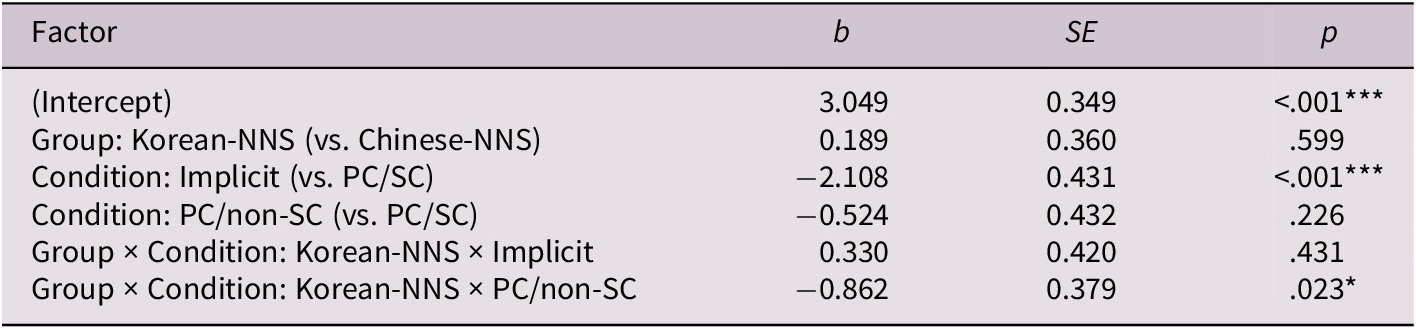
To examine these patterns more closely, we fitted a logistic mixed-effects regression model. A summary of the model outcomes is presented in Table 2. The model revealed a significant effect of Condition, driven by a substantially higher subject reference rate in the PC/SC condition compared to the Implicit condition. Importantly, there was a significant interaction between Group and Condition for the PC/non-SC contrast, indicating that the two NNS groups responded differently to the PC/non-SC vs. PC/SC conditions. Specifically, the decrease in subject reference from PC/SC to PC/non-SC was significantly larger for the Korean-NNS group than for the Chinese-NNS group, a pattern consistent with the prediction that overt Chinese PC marking for these verbs sustained higher subject biases in Chinese speakers, while the absence of overt Korean SC marking produced a steeper decline.
Analysis 1: Global model outcomes

Table 2. Long description
Analysis 1 global model outcomes. Intercept: b = 3.049, SE = 0.349, p < .001. Group, Korean-NNS versus Chinese-NNS: b = 0.189, SE = 0.360, p = .599. Condition, Implicit versus PC/SC: b = -2.108, SE = 0.431, p < .001. Condition, PC/non-SC versus PC/SC: b = -0.524, SE = 0.432, p = .226. Group × Condition, Korean-NNS × Implicit: b = 0.330, SE = 0.420, p = .431. Group × Condition, Korean-NNS × PC/non-SC: b = -0.862, SE = 0.379, p = .023. Significance notation: *** p < .001; * p < .05.
***p < .001; *p < .05.
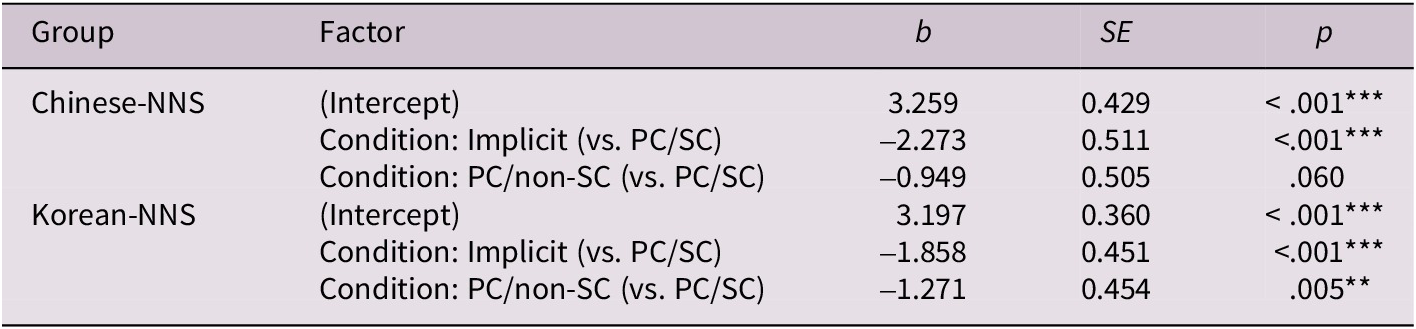
In light of these interactions and to address our research questions, we subsequently conducted separate by-group analyses for each learner group. To account for multiple comparisons, the alpha level was adjusted to .025 (.05 divided by 2). The results of the by-group models are presented in Table 3. For the Chinese-NNS group, the model revealed a significant difference between the PC/SC and Implicit conditions, indicating a reduced likelihood of subject reference when the L1 translation equivalent carried no explicit causative construction. In contrast, the analysis did not provide clear evidence for a difference between the PC/SC and PC/non-SC conditions, although the contrast approached conventional significance. We therefore interpret this pattern cautiously: Chinese-speaking learners showed high rates of subject reference in both conditions, yet the analysis does not license a strong claim that the two conditions were equivalent. This pattern is nevertheless consistent with the prediction that English verbs whose Chinese equivalents involve overt causative marking would elicit relatively strong subject-biased continuations. When participants’ LexTALE scores and self-ratings were included as additional interactive fixed effects in the model, separately, none produced significant interactions with Condition (all ps > .1).
Analysis 1: By-group model outcomes

Table 3. Long description
Analysis 1 by-group model outcomes. Chinese-NNS: intercept b = 3.259, SE = 0.429, p < .001; Implicit versus PC/SC b = -2.273, SE = 0.511, p < .001; PC/non-SC versus PC/SC b = -0.949, SE = 0.505, p = .060. Korean-NNS: intercept b = 3.197, SE = 0.360, p < .001; Implicit versus PC/SC b = -1.858, SE = 0.451, p < .001; PC/non-SC versus PC/SC b = -1.271, SE = 0.454, p = .005. Significance notation: *** p < .001; ** p < .01.
***p < .001; **p < .01.
For the Korean-NNS group, both condition contrasts were statistically significant. Korean speakers were significantly more likely to produce subject references in the PC/SC condition than in both the Implicit and the PC/non-SC conditions. These results suggest that the heightened subject-referential expectation was associated with the PC/SC condition, whose Korean equivalents contain the overt causative marker -keyha. The inclusion of LexTALE scores and self-ratings as interactive terms revealed no significant interactions with Condition (all ps > .1), indicating that the condition pattern remained stable across proficiency levels.
We also examined whether task order moderated the effects by fitting a supplementary global model including Group, Condition, Task Order and their interactions. Neither of the Group × Condition × Task Order interactions was significant, providing no reliable evidence that completing the translation task before rather than after the sentence-completion task differentially altered the condition pattern across the two learner groups. The full model outcomes are reported in Supplementary Appendix B.
To directly evaluate whether the two learner groups diverged within the theoretically critical PC/non-SC condition, we conducted a follow-up analysis restricted to PC/non-SC and Implicit items, with Group included as a predictor. Because this follow-up analysis addressed the a priori theoretical comparison specified in RQ2 and was conducted to interpret the significant interaction observed in the global model, we evaluated it using the conventional alpha level of .05 rather than the adjusted threshold applied to the two by-group models. With PC/non-SC as the reference condition and Korean-NNS as the reference group, the model revealed a significant effect of Group within the PC/non-SC condition (b = 0.708, SE = 0.353, p = .045), indicating that Chinese-NNS participants were more likely than Korean-NNS participants to produce subject references for these verbs. In addition, the significant Group × Condition interaction (b = −1.229, SE = 0.396, p = .002) indicates that this between-group difference was substantially reduced in the Implicit condition. Together, these findings support the conclusion that the divergence between the two learner groups was concentrated in the theoretically critical PC/non-SC condition.
7.2. Analysis 2: Translation-based reclassification analysis
In this analysis, items were reclassified as Explicit or Implicit based on the morphosyntactic properties of each participant’s actual L1 translation, rather than on the a priori condition assignment. Figure 3 displays the proportion of subject references for each condition across the two groups. Visual inspection indicates that for both groups, the rate of subject reference was higher in the Explicit condition than in the Implicit condition.
Analysis 2: Mean proportion of subject reference among the NNS groups. Error bars indicate 95% confidence intervals.

We examined these patterns more closely using a logistic mixed-effects regression model. The model outcomes are summarized in Table 4. The model showed a significant effect of Condition, driven by higher subject reference rates in the Explicit condition compared to the Implicit condition, suggesting that items translated with overt causative marking (shi in Chinese and -keyha in Korean) consistently elicited stronger subject bias than items translated without such marking. This effect remained consistent across groups, as no significant interaction between Condition and Group was observed. When participants’ LexTALE scores and self-ratings were entered as additional continuous covariates separately, none of these variables significantly interacted with Condition (all ps > .1), suggesting that the observed effect of Condition remained stable, regardless of participants’ proficiency.
Analysis 2: Global model outcomes

Table 4. Long description
Analysis 2 global model outcomes. Intercept: b = 2.2366, SE = 0.244, p < .001. Group, Korean-NNS versus Chinese-NNS: b = 0.6188, SE = 0.330, p = .061. Condition, Implicit versus Explicit: b = -0.931, SE = 0.290, p = .001. Group × Condition, Korean-NNS × Implicit: b = 0.076, SE = 0.385, p = .843. Significance notation: *** p < .001; ** p < .01.
***p < .001; **p < .01.
We also examined whether task order moderated the Explicit–Implicit condition effect by fitting a global model including Group, Condition, Task Order and their interactions. The Group × Condition × Task Order interaction was not significant, suggesting that the task order did not affect the Explicit–Implicit contrast across the two learner groups. The full model outcomes are reported in Supplementary Appendix B.
Finally, to examine whether the same results held under stricter item-inclusion criteria from the norming study, we conducted additional robustness analyses using 65% and 70% item-level subject-reference thresholds. The main descriptive patterns remained stable. The inferential patterns were also largely preserved, although the evidence for the group-specific PC/non-SC contrast in the translation-consistent analysis became weaker under the stricter thresholds. These results indicate that the findings were not driven by weakly subject-biased English items, while also suggesting that the PC/non-SC group contrast should be interpreted with appropriate caution. Full details are provided in Supplementary Appendix C.
8. Discussion
The present study investigated how the morphosyntactic properties of IC predicate constructions in Korean and Chinese modulate referential choices in L2 English. We hypothesized that English IC verbs associated with L1 predicates containing overt causative marking would elicit stronger subject-oriented referential expectations than verbs whose L1 equivalents lacked such marking. The results of two analyses supported this hypothesis. The sentence-completion data showed consistently stronger subject biases when the L1 translation equivalent contained overt causative marking. This pattern was especially evident in the theoretically most informative contrast, namely the PC/non-SC condition, where the English verbs corresponded to an overt causative construction in Chinese but not in Korean. Taken together, these findings demonstrate that the presence or absence of overt causative morphology in L1 influences L2 referential interpretation.
This study extends the work of Kim and Grüter (Reference Kim and Grüter2019), who found that Korean learners of English carry over IC biases associated with Korean SC constructions into L2 English. Consistent with their findings, Korean speakers in this study showed near-ceiling subject bias (92%) for SC-aligned verbs in English, reflecting an influence of the overt causative marking associated with their L1 predicate equivalents. However, a notable limitation of Kim and Grüter’s study is its exclusive focus on a single L1 group (i.e., Korean), leaving open the question of whether the observed transfer effects are unique to Korean speakers or whether comparable patterns emerge among learners from typologically different linguistic backgrounds. Our study addressed this limitation by including Chinese-speaking learners, whose L1 encodes causative events through a structurally distinct device, the periphrastic shi construction, that partially overlaps with, but is not identical to, the Korean SC construction in its distribution across IC predicates.
The two-L1 design is theoretically important because it allows us to distinguish L1-specific predicate-mapping effects from patterns that could otherwise be attributed to the English verbs themselves, the shared argument structure or learner-general processing tendencies. This logic is consistent with the view that crosslinguistic influence can be tested more rigorously by comparing learner groups whose L1s differ in the behavior of the target phenomenon (Jarvis, Reference Jarvis, Roberts, Howard, Laoire and Singleton2010; Lago et al., Reference Lago, Mosca and Stutter Garcia2021). In the present study, Korean- and Chinese-speaking learners completed the same English sentence-completion task with the same English IC verbs; what differed was how those verbs mapped onto L1 predicate types. The PC/non-SC condition is especially informative in this respect because the same English verbs were associated with overt periphrastic causative marking in Chinese but not with overt marking in Korean. Thus, the Korean–Chinese comparison advances a stronger theoretical claim than a single-L1 design could support. Consistent with this logic, the present findings indicate that differences in L1 predicate mappings were reflected in discourse-level referential choices.
These findings can be interpreted in relation to accounts of bilingual representation that assume interconnected lexical and conceptual information across languages, including the BIA+ and Multilink models (Dijkstra et al., Reference Dijkstra, Wahl, Buytenhuijs, Van Halem, Al-Jibouri, De Korte and Rekké2019; Dijkstra & Van Heuven, Reference Dijkstra and Van Heuven2002). These models propose that processing an L2 word can activate representations in both languages, including lexical and semantic information associated with its L1 translation equivalent. Applied to the present study, encountering an English IC verb may therefore have made information associated with the corresponding Korean or Chinese predicate available during the task. When that L1 predicate was associated with overt causative marking and a strong subject-causal orientation, this information may have increased the accessibility of the subject referent and, consequently, the likelihood of subject remention in the subsequent causal continuation. The higher subject-reference rates observed for items whose L1 equivalents contained overt causative marking are consistent with this account.
At the same time, BIA+ and Multilink do not directly model IC biases or discourse-level reference resolution. The present findings therefore extend, rather than directly confirm, their accounts of crosslinguistic lexical activation. More broadly, the results are compatible with the view that crosslinguistic influence in L2 referential interpretation can involve more than surface lexical overlap or isolated word-level transfer (Bernolet et al., Reference Bernolet, Hartsuiker and Pickering2013; Dijkstra et al., Reference Dijkstra, Wahl, Buytenhuijs, Van Halem, Al-Jibouri, De Korte and Rekké2019; Hartsuiker et al., Reference Hartsuiker, Pickering and Veltkamp2004). Specifically, predicate-level information associated with an L1 translation equivalent may include not only lexical-semantic information but also grammatical properties, such as whether the predicate is conventionally realized with overt causative marking. In this respect, the findings are consistent with Jarvis’ (Reference Jarvis and Pavlenko2009) account of lemmatic transfer, according to which semantic and grammatical properties associated with lexical items may influence L2 use.
Alongside these implications, we note several limitations. First, the research scope was limited to subject-biased IC verbs, leaving open the question of how object-biased verbs might behave. This focus was motivated by the nature of causative constructions with overt marking in Korean and Chinese, which predominantly exhibit subject biases. Further research should investigate whether similar patterns of crosslinguistic influence emerge among object-biased verbs and among learners with more typologically diverse L1s.
Second, because the present study employed an offline sentence-completion task, it does not provide direct evidence that L1 predicate representations were activated during the moment-by-moment comprehension of the English fragments. Nor do the data allow us to determine whether the observed pattern reflects activation of a full constructional representation, a lexical entry with associated morphosyntactic features or a more general L1-based causal bias. The findings should therefore be interpreted as evidence that morphosyntactic properties associated with L1 translation equivalents are reflected in learners’ final referential choices, not as direct evidence for real-time construction-level activation. Future studies using online methods, such as self-paced reading, eye-tracking or crosslinguistic priming, will be needed to establish the time course and representational basis of this effect more directly.
An additional limitation concerns the substantial data loss in the translation tasks. Although the analyzed data reflect L2 participants’ responses that demonstrated correct interpretation of the English verbs and appropriate mappings to their L1 counterparts, the reduced subset may have reduced statistical power and limited the generalizability of the findings. To assess the robustness of the main translation-consistent findings under this reduced dataset, we conducted supplementary Bayesian mixed-effects analyses, which are reported in Supplementary Appendix D. These analyses were broadly consistent with the frequentist results, while also supporting a cautious interpretation of the direct between-group contrast in the PC/non-SC condition. Although we also conducted the translation-based reclassification analysis, which retained a larger portion of the data by classifying items on the basis of participants’ actual translation choices, this approach necessarily reduced the number of testing conditions from three to two, limiting its interpretive scope. To address this concern, future studies should employ English verbs that map more transparently and consistently onto the intended predicate structures in learners’ L1s.
A further limitation concerns variation in the English verbs’ baseline subject-bias strength. Although the norming study found no significant condition differences, the descriptively higher subject-reference rate in PC/SC than in Implicit makes it difficult to treat the item sets as fully equivalent. We therefore refitted the mixed-effects models with each item’s native-English subject-reference rate as a standardized covariate. As reported in Supplementary Appendix E, while native-English item bias significantly predicted L2 referential choices, the main condition effects and the critical Korean–Chinese divergence in PC/non-SC remained reliable. Thus, English verb bias did not fully explain the association between L1 causative marking and L2 referential choices. Nevertheless, future studies should use larger norming samples and more closely matched item sets.
Finally, we acknowledge the concern regarding the use of an explicit translation task. Although task order was counterbalanced, and the supplementary global analyses reported in Supplementary Appendix B did not show that task order significantly moderated the principal condition effects, completing a translation task may nevertheless have increased the accessibility of L1 predicate information. Future studies should therefore test whether the same pattern emerges without requiring participants to translate the experimental predicates.
9. Conclusion
This study provides evidence that discourse-level referential interpretation in L2 can be sensitive to morphosyntactic information associated with learners’ L1. By comparing Korean- and Chinese-speaking learners of English, the study shows that the same English IC verb can yield different referential biases when its translation equivalents differ in overt causative marking. These findings support an account of bilingual language comprehension in which morphosyntactic information associated with L1 predicate equivalents, rather than lexical-semantic overlap alone, can influence referential biases in L2 English comprehension.
Supplementary material
The supplementary material for this article can be found at http://doi.org/10.1017/langcog.2026.10122.
Data availability statement
Supplementary materials including experimental stimuli, data files and analysis scripts can be found at https://osf.io/edhwm.
Competing interests
The authors declare no conflict of interest.







 Open access

