Introduction
In the past few decades, the search for a sustainable way to solve the global shortage of clean water remains as critical issue for human society. The continued deterioration of clean water resources has been affecting over 1.2 billion people around the world.[Reference Montgomery and Elimelech1, Reference Shannon, Bohn, Elimelech, Georgiadis, Marinas and Mayes2] The industrial sewerage output and the increasing amount of toxic contaminants are released into lakes or rivers, worsening the clean water shortage problem. The rapid growth of water-borne bacteria and enteric viruses also pose threat of countless intestinal parasitic infections and diarrheal diseases to human beings. Though seawater and saline aquifers account for 97.5% of all water sources on the Earth, they cannot be directly utilized as safe drinking water.[Reference Shannon, Bohn, Elimelech, Georgiadis, Marinas and Mayes2]
The extensive research on clean water generation mainly focuses on the following three aspects: desalination, decontamination, and disinfection (sterilization).[Reference Shannon, Bohn, Elimelech, Georgiadis, Marinas and Mayes2–Reference Elimelech and Phillip10] The desalination of seawater and inland saline aquifers has recently become popular since they are the most abundant water resources in hydrological cycle system on the Earth. The facilities of desalination have been configured in developed and developing countries that are under clean water-stress. Until 2016, the global water output through desalination water was 38 billion cubic meters per year, twice of the amount in 2008.[Reference Mathioulakis, Belessiotis and Delyannis6] Currently there are two main desalination technologies. One technology relies on the multistage flash distillation that was mostly practiced in the arid Persian Gulf countries.[Reference Shannon, Bohn, Elimelech, Georgiadis, Marinas and Mayes2] This desalination technology is based on the evaporation and condensation process, and consumes large amounts of thermal and electric energy, accompanied by the release of greenhouse gas.[Reference Homaeigohar and Elbahri11] The other technology is the reverse osmosis (RO) membrane technology.[Reference Shannon, Bohn, Elimelech, Georgiadis, Marinas and Mayes2, Reference Homaeigohar and Elbahri11] The saline water is forced to pass through semi-permeable membrane by hydrostatic pressure. Such RO-based technology has been employed in many different applications.[Reference Shannon, Bohn, Elimelech, Georgiadis, Marinas and Mayes2–Reference Veerapaneni, Long, Freeman and Bond4] The system displays high energy efficiency in desalination, but this technology still suffers from brine discharge, high fouling potential, and formation of toxic disinfection by-products.[Reference Shannon, Bohn, Elimelech, Georgiadis, Marinas and Mayes2, Reference Werber, Osuji and Elimelech12] As for the purification of contaminated water, the conventional approach involves the addition of different kinds of chemicals to polluted water to remove toxic substances, which the production of clean water may not be promised for edible standard. In addition, it will take a long term for waiting the natural subsidence of residue.[Reference Schwarzenbach, Escher, Fenner, Hofstetter, Johnson, von Gunten and Wehrli7] Disinfection is another important water treatment process for bio-contaminated water. One of the promising approaches to deactivate viruses or bacteria is the combined use of photons and engineered nanostructures.[Reference Shannon, Bohn, Elimelech, Georgiadis, Marinas and Mayes2, Reference Li, Liang and Shang13] High energy UV light can induce the photocatalytic capability of specially designed nanostructures such as nano-titania (TiO2).[Reference Li, Liang and Shang13] Continuous research focusing on the high-efficient use of photocatalysis is aimed to further developing the disinfection function on a thin membrane, which makes them more amenable to practical use ranging from large-scale water-treatment plants to point-of-use systems designed for hygiene.[Reference Shannon, Bohn, Elimelech, Georgiadis, Marinas and Mayes2, Reference Fisher, Ostovapour, Kelly, Whitehead, Cooke, Storgards and Verran14]
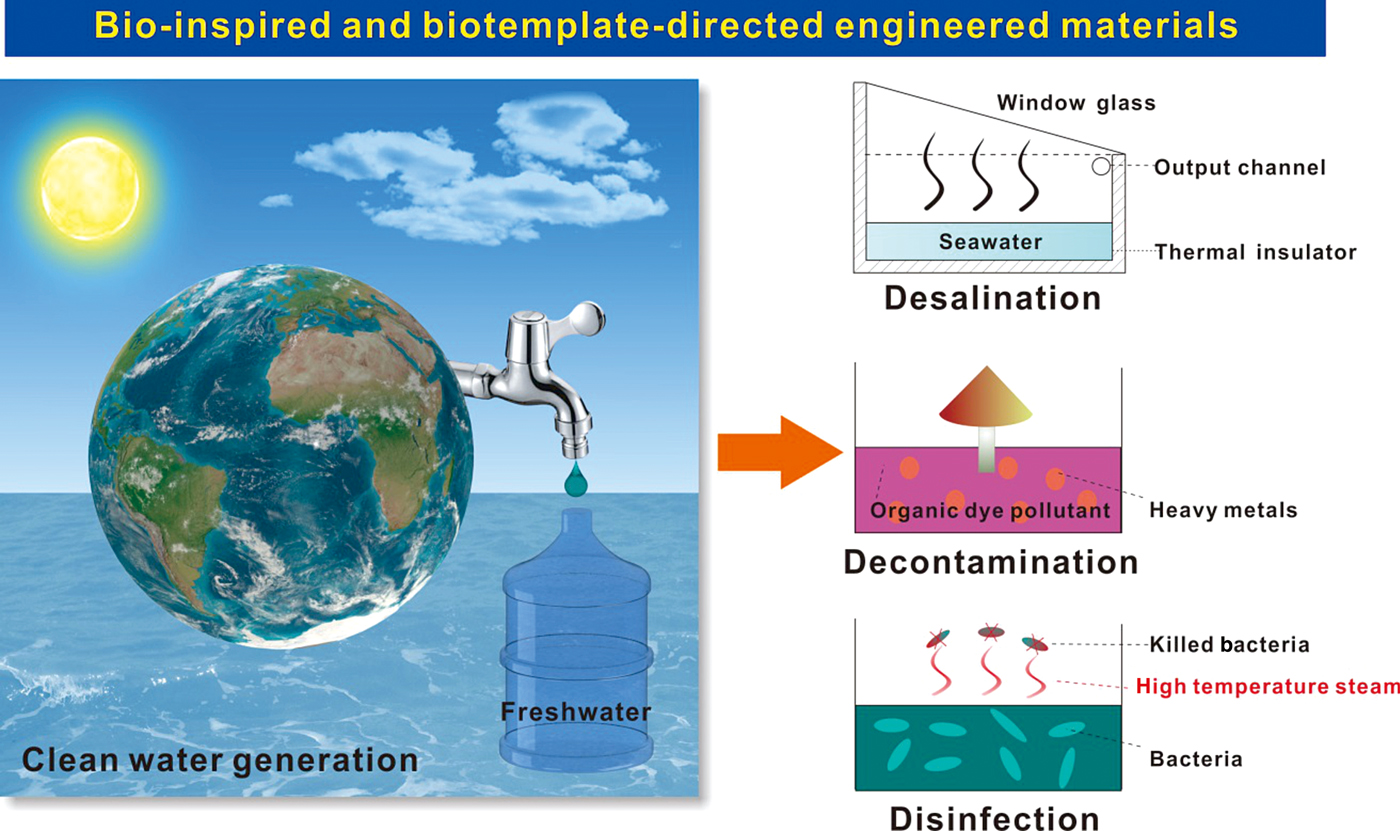
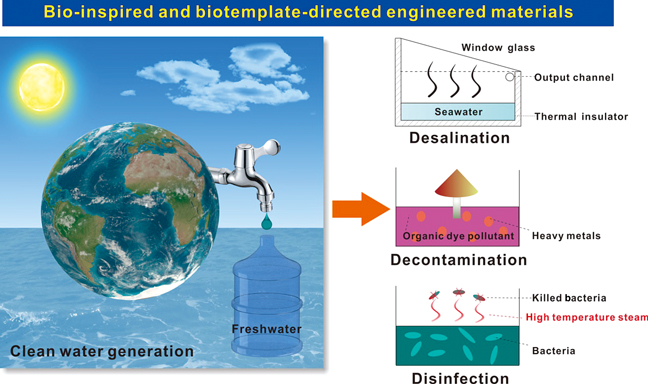
In nature, through billions of years, those higher organisms possess complex and subtle biostructures that have gradually evolved to adapt to different environments, some of bio-inspired organisms were functionally evolved to collect and maintain the clean water for every creatures’ need. Such elaborate hierarchical biostructures survived from the natural selection process often exhibits astonishing efficiency for specific applications. In this perspective, we will introduce bio-inspired and biotemplate-directed interfacial evaporation approaches that utilize solar power to enable saline water desalination, waste water decontamination, and disinfection (Fig. 1). Interfacial evaporation systems without regarding to bio-inspired and biotemplate-directed methods are not discussed here in detail.
Bio-inspired and biotemplate-directed approaches to clean water generation.

The exploration of bio-inspired approaches on solar vapor generation
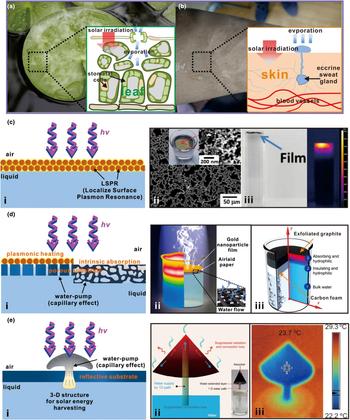
Rapid growth of human population and increasing shortage of non-renewable fossil fuel resources force people to find alternative energy sources that can generate more sustainable clean water, and mitigate global water scarcity. Over the past few decades, scientists and engineers have developed solar-enabled harvesting technology for thermal desalination of seawater or inland saline aquifers. The relatively complex optical design for concentrating solar light has largely impeded the advancement of solar light-based method for clean water generation. It is reported that an aqueous plasmonic nanoparticle-based evaporation system has been developed as a new solar-enabled harvesting technology for clean water generation. Such system contains discretized gold nanoparticles (AuNPs) which harvest incident solar energy and convert it into heat [Fig. 2(a)].[Reference Neumann, Urban, Day, Lal, Nordlander and Halas15] The generated heat is localized around the surface of nanoparticles, leading to rapid water vaporization after the surrounding liquid absorbs heat. Though the theoretical light-to-heat energy conversion efficiency of plasmonic AuNPs can reach 100%, the large thermal mass of aqueous nanoparticles solution still leads to large heat loss and low evaporation efficiency during heating the bulk liquid.[Reference Neumann, Urban, Day, Lal, Nordlander and Halas15] What's more, this newly developed nanoparticle solution-based evaporation system remains infeasible in industry since the nanoparticles are hard to be re-collected and re-dispersed after each cycle, and the free nanoparticles are easily aggregated in the solution if other impurities are present. New technologies are eagerly encouraged for developing transferrable, recyclable, and thermostable materials without sacrificing the evaporation efficiency. And the answer may be found in biologic systems. A broad range of engineering innovations are inspired by the unique functions and excellent performances of natural biologic structures.[Reference Shannon, Bohn, Elimelech, Georgiadis, Marinas and Mayes2, Reference Fournier, Hawari, Streger, McClay and Hatzinger16–Reference Nednoor, Gavalas, Chopra, Hinds and Bachas19] For instance, the superhydrophobic hierarchical microstructures of aquatic insects’ leg enable the condensed water being easily collected in the desert, and similar microstructures on the lotus leaves endow it with self-cleaning capability.[Reference Liu and Jiang20, Reference Tao, Shang, Song, Shen, Zhang, Luo, Yi, Zhang and Deng21] Evaporation, a vital function in biologic systems, has brought new insights into engineering efficient clean water generation systems. The biologic systems take advantage of localized solar energy conversion and thermal integration on surfaces to achieve efficient evaporation under sunlight illumination. As shown in Fig. 2(a), the transpiration process occurs when water vaporizes at the surface of leaves. During evaporation, the capillary force in the leaves allows the water and nutrients to be sucked up and transported to every part of plant through its roots and stem, and the electrolyte concentration is balanced at the same time.[Reference Graham and Wilcox22, Reference Koch and Barthlott23] Figure 2(b) shows the thermal regulation in human skins. Heat has been transported to the surface of human skin by the blood in the vessels. Sweat absorbs the dissipated heat in the glands, and carries heat away during vaporizing. Both cases involve the precisely-controlled localized heating. The generated heat efficiently provides energy for the phase transformation of water with low heat loss, which is essential for the thermal regulation of plants and human bodies.[Reference Wang, Liu, Tao, Shen, Yi, Zhang, Liu, Song, Zhang, Shang and Deng24]
(a) Schematic illustration of evapotranspiration. (b) Schematic illustration of sweating of human skin. (c) (i) Scheme of plasmonic AuNP thin film enabled evaporation under solar light illumination. (ii) Scanning electron microscopy (SEM) of microstructures of plasmonic AuNP thin film. The insets are optical image and magnified SEM image. (iii) Optical image of free-floating AuNP thin film and infrared image of thin film under solar irradiation. Adapted with permission from Wang et al.[Reference Wang, Liu, Tao, Shen, Yi, Zhang, Liu, Song, Zhang, Shang and Deng24] Copyright (2014) by Wiley-VCH. (d) (i) Schematic illustration of double-layered structures containing plasmonic thin film and porous intrinsic absorber layer, respectively. Interfacial evaporation schemes for composite plasmonic AuNP thin film/airlaid paper (ii) and GO/carbon foam composite membrane (iii). Adapted with permission from Deng et al.[Reference Liu, Yu, Feng, Bernard, Liu, Zhang, Duan, Shang, Tao, Song and Deng25] Copyright (2015) by Wiley-VCH. Adapted with permission from Chen et al.[Reference Ghasemi, Ni, Marconnet, Loomis, Yerci, Miljkovic and Chen26] Copyright (2014) by Nature Publishing Group. (e) (i) Schematic illustration of 3D transpiration device; 3D cone shape solar vapor generator (ii) and its temperature distribution under solar illumination recorded by infrared camera (iii). Adapted with permission from Zhu et al.[Reference Li, Lin, Ni, Xu, Hu, Zhu, Lv, Li, Zhu and Zhu44] Copyright (2017) by Oxford University Press.

Inspired by the localized evaporative surfaces of biologic systems, tremendous efforts have been dedicated to modifying the evaporative surface structures to enhance the efficiency of solar energy-based interfacial evaporation systems. The recent development might provide a promising solution in solving water shortage problem without the consumption of non-renewable energy. In 2014, Deng's group proposed the bio-inspired evaporation system through self-assembled plasmonic AuNPs thin film at the water/air interface.[Reference Wang, Liu, Tao, Shen, Yi, Zhang, Liu, Song, Zhang, Shang and Deng24] The plasmonic film, under solar light illumination, can generate instant and intense localized heat at the surface of water, and achieve higher evaporation performance by avoiding the bulk heating of liquid [Fig. 2(c)]. This free-floating film, however, was brittle and could not be easily taken off and transferred to other solutions. Additionally, owing to the high-thermal conductivity of metallic AuNPs thin film, the heat conduction loss to the bulk water under the AuNP thin film is inevitable, and limits the enhancement of evaporation efficiency of such system.
To overcome the fragility of plasmonic film, Liu et al. introduced a new reusable interfacial evaporation system relying on double-layered paper-based AuNP composite membrane with strong mechanical property for large-scale evaporation[Reference Liu, Yu, Feng, Bernard, Liu, Zhang, Duan, Shang, Tao, Song and Deng25] [Fig. 2(d)]. By depositing AuNPs on top of a freely floated porous airlaid paper substrate, the assembled plasmonic structure serves as broadband absorption due to the multi-scattering effect resulted from the rough surface of paper substrate. The low thermal conductivity of airlaid paper substrate reduces the conduction heat loss to underlying water. The porous structure of substrate allows the continuous replenishment of water. All of these merits lead to much higher evaporation efficiency (74%) under 4.5 Suns’ irradiation. Recyclability test has also been demonstrated in their work. With a similar design, Ghasemi et al. proposed an efficient interfacial solar vapor generation device based on a double-layered structure that included a top exfoliated graphene layer and a bottom carbon foam layer[Reference Ghasemi, Ni, Marconnet, Loomis, Yerci, Miljkovic and Chen26] [Fig. 2(d)]. With the excellent absorption performance of top layer in the solar spectrum and thermally insulating supporting carbon layer, their system achieved high solar thermal efficiency of 85% at the power density of 10 kW/m2. They concluded that better evaporation performance could be obtained by optimizing the flow rate, insulating materials, and water transportation ability. The above pioneering works triggered the flourishing development of multi-layered composite membranes for interfacial evaporation system to generate clean water.[Reference Yang, Yang, Fu, Zou, Li, Cao and Yuan27–Reference Ni, Li, Boriskina, Li, Yang, Zhang and Chen39]
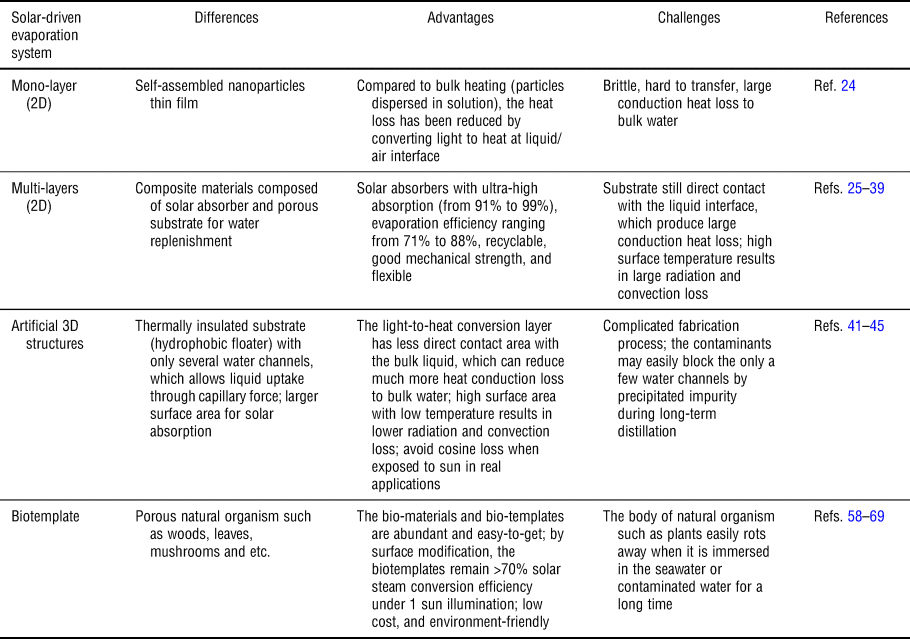
In the above discussion, the porous substrates (bottom layer) are treated not only as the absorber-load platform, but also as the functional device for water replenishment. The multi-layered composite structures require the bottom layer to be in direct contact with water for replenishment. Therefore, the bottom layer has usually been modified into hydrophilic for the transportation of water.[Reference Yu, Zhang, Duan, Liu, Quan, Tao, Shang, Wu, Song and Deng40] Such design would increase the possibility of conduction heat loss due to the large contacting surface between the bottom layer and water. Furthermore, the high temperature of the evaporative surface of 2D multi-layered structure would result in large radiation and convection loss. For natural transpiration process in the stems of plants, water transportation occurs only in the vessels within the stem, which provide possible inspiration to reduce such contacting area. Thermal insulation material is used as bottom layer to lower thermal conduction loss, and only several water channels were allowed to pass through thermal insulation layer to transport water from beneath to the surface for evaporation[Reference Li, Gao, Yang, Chen, Luo, Song, Hitz, Jia, Zhou, Liu, Yang and Hu41–Reference Hong, Shi, Li, Zhang, Jin and Wang45] [Fig. 2(e)]. In nature, the specific multi-layered creature with natural 3D structure and the network of capillary veins is the mushroom. Li et al. reported a 3D mushroom-like artificial transpiration device, where 3D absorber is connected with 1D water channel that directly contacts with bulk water[Reference Li, Lin, Ni, Xu, Hu, Zhu, Lv, Li, Zhu and Zhu44] [Fig. 2(e)]. In contrast to 2D multilayered direct contact, 1D water channel suppressed heat conduction because of the reduced contact area. Additionally, the increased evaporative surface of 3D transpiration device leads to lower surface temperature under the similar sunlight illumination, which reduced the radiation and convection heat loss. The three components of heat loss were therefore minimized at the same time. In real applications, the incident angle of sun light also needs to be considered since the Sun keeps moving in the sky during a day or in the different seasons. Such 3D cone shape design of artificial transpiration device can harvest solar energy from a wide range of incident angle in avoid of the cosine losses occurring in regular 2D multilayered composite structure. However, the complicated fabrication process and the easy blockage of only a few water channels by contaminants make the 3D artificial structures still unamenable to large-scale practical use. The comparison of different types of solar-driven evaporation system is summarized in Table I.
The summary of various bioinspired solar energy-enabled interfacial evaporator in recent years

Bio-inspired interfacial evaporation system for solar clean-water generation
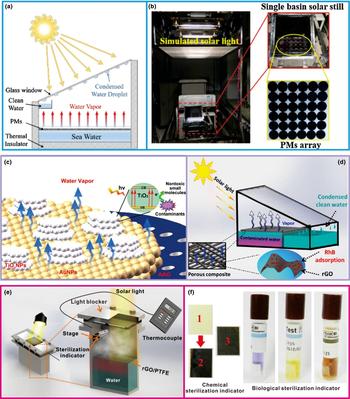
With the fast development of bio-inspired interfacial evaporation systems, different kinds of water treatment applications have been demonstrated. The efficient interfacial evaporation system can provide a reliable, sustainable, and economical method for water desalination.[Reference Yang, Yang, Fu, Zou, Li, Cao and Yuan27, Reference Zhou, Tan, Wang, Xu, Yuan, Cai, Zhu and Zhu29, Reference Zhang, Li, Lv, Zhao and Qu33, Reference Ren, Tang, Guan, Wang, Yang, Wang, Wang, Shan, Chen, Wei, Peng and Liu46–Reference Ma, Chiu, Zhu, Tang, Long, Qarony, Zhao, Zhang, Lo and Tsang52] Zhu's group fabricated a bioinspired plasmonic AuNP porous composite film for solar desalination[Reference Wang, He, Liu, Cheng and Zhu53] [Fig. 3(a)]. The microfibers of paper substrate coated with a densely packed layer of AuNPs forms sub-microscale rough structure, and exhibits broadband absorption of the incident solar light due to the multiple-scattering effect. Black appearance was, therefore, observed in Fig. 3(b). Interfacial evaporation enabled solar desalination has been demonstrated that the concentration of ions originally present in the seawater is dramatically decreased after desalination. And the purity after desalination by using this approach is lower than the freshwater obtained through membrane-based and distillation-based methods.[Reference Wang, He, Liu, Cheng and Zhu53] Besides the plasmonic materials as solar energy absorbers, the carbon materials, including carbon nanotubes (CNTs), reduced graphene oxide (rGO), and carbon black composite membrane are also capable of obtaining the similar full broadband absorption for water desalination.[Reference Yin, Wang, Jian, Li, Xia, Zhang, Wang, Wang, Ma, Zheng and Zhang34, Reference Wang, Ye, Liang, Xu, Chang, Song, Shang, Wu, Tao and Deng47, Reference Wang, Zhang and Wang54]
(a) Schematic illustration of the free floating porous filter membrane with plasmonic AuNPs for solar desalination. (b) Experimental setup of seawater desalination and black appearance of composite membrane. Adapted with permission from Wang et al.[Reference Wang, He, Liu, Cheng and Zhu53] Copyright (2017) by Elsevier Ltd. (c) Titanium oxide (TiO2)/AuNP composite membrane under solar illumination for the reduction of organic contamination. Adapted with permission from Liu et al.[Reference Liu, Lou, Ni, Song, Wu, Dasgupta, Tao, Shang and Deng55] Copyright (2016) by American Chemical Society. (d) rGO porous composite membrane for clean water generation. Adapted with permission from Lou et al.[Reference Lou, Liu, Wang, Zhao, Song, Wu, Dasgupta, Zhang, Zhang, Tao, Shang and Deng56] Copyright (2016) by American Chemical Society. (e) Schematic illustration of high-temperature solar vapor generation under regular atmospheric pressure. (f) Chemical and biologic vapor sterilization test. As for chemical test, the white test paper (1) turned to black color (2), indicating that the temperature of vapor reached 120 °C. No. 3 paper is the standard sample. As for biologic test, the brown color demonstrated the successful sterilization test. The yellow one is unsterilized after incubating at 120 °C. The purple one is original indicator. Adapted with permission from Zhang et al.[Reference Zhang, Zhao, Yu, Yang, Lou, Liu, Chen, Wang, Tao, Shang, Wu, Song and Deng57] Copyright (2017) by the Royal Society of Chemistry.

Water decontamination is another most promising application of interfacial evaporation systems in recent years.[Reference Li, Lin, Ni, Xu, Hu, Zhu, Lv, Li, Zhu and Zhu44, Reference Liu, Lou, Ni, Song, Wu, Dasgupta, Tao, Shang and Deng55, Reference Lou, Liu, Wang, Zhao, Song, Wu, Dasgupta, Zhang, Zhang, Tao, Shang and Deng56] Liu et al. designed a bioinspired bifunctional membrane by combining interfacial evaporation and photocatalytic process. Such membrane consists of a top layer of TiO2 nanoparticles, a middle layer of assembled AuNPs and a bottom layer of anodized aluminum oxide[Reference Liu, Lou, Ni, Song, Wu, Dasgupta, Tao, Shang and Deng55] [Fig. 3(c)]. Different from traditional photocatalytic decontamination process where solar energy is converted to chemical energy, the interfacial evaporation process converts the solar energy into localized thermal energy as first step. The converted heat not only results in efficient clean water generation through evaporation, but also enhances the photocatalytic organic contaminant reduction capability of TiO2 nanoparticles with the assistance of plasmonic AuNPs. Especially in this approach, clean water has been obtained from both distilled water and decontaminated water. This integrative design enables the couple of both photocatalytic function of TiO2 and plasmonic heating of AuNPs, which helps propose a new strategy for maximizing utilization of solar energy. Followed by the above composite membrane for successful water decontamination, paper-based rGO for multifunctional interfacial evaporation system has also been introduced for water purification [Fig. 3(d)].[Reference Lou, Liu, Wang, Zhao, Song, Wu, Dasgupta, Zhang, Zhang, Tao, Shang and Deng56] Under solar illumination, the rGO enabled immediate photothermal conversion with high evaporation efficiency. Efficient removal of pollutants was realized in two aspects. First, the uniform rGO within the porous airlaid paper could absorb the contaminants. Second, the vaporized polluted water could induce the rapid diffusion of contaminants into the floating membrane for continuous photocatalytic reduction. Apart from organic contaminants, heavy metallic ions such as copper ions could also be removed by interfacial evaporation system with coherent design.[Reference Li, Lin, Ni, Xu, Hu, Zhu, Lv, Li, Zhu and Zhu44]
The solar-driven evaporation systems at the liquid/air interface could provide a new vapor sterilization (disinfection) approach [Fig. 3(e)]. Zhang et al. designed a rGO/polytetrafluoroethylene membrane as a solar vapor generator.[Reference Zhang, Zhao, Yu, Yang, Lou, Liu, Chen, Wang, Tao, Shang, Wu, Song and Deng57] Compared with complex conventional autoclave device, this new low-cost vapor sterilization interfacial system demonstrates a successful sterilization capability by producing high-temperature vapor over 120 °C under regular atmospheric pressure [Fig. 3(f)]. The interfacial evaporation-based sterilization system requires no complex design for bearing high-pressure vapor. Such merit makes it more suitable in undeveloped areas with inferior healthcare conditions but ample solar irradiation. With the blooming evolution of interfacial systems, we believe that more and more applications will emerge to satisfy various desires from clean water generation.
Biotemplate as 3D interfacial evaporation systems for clean water generation
The efficient, sustainable, and multifunctional biologic systems offer great insights and opportunities to the development of biotemplate-directed engineering of materials. As the recent emergence of interfacial evaporation system was inspired by the evapotranspiration of leaves and skin sweating, scientists have utilized various biostructures to achieve high evaporation efficiency and multifunctional capabilities.[Reference Xue, Liu, Chen, Yang, Li, Ding, Duan, Qi and Zhou58–Reference Wang, Wang, Song, Huang, Megarajan, Shaukat and Jiang68] The subtle and elegant biostructures of natural plants have always provided us unexpected superior properties that we cannot obtain by using regular man-made materials. In the following examples, the ubiquitous biostructures of various plants are utilized and modified to tune the local evaporation and higher evaporation efficiency could be achieved.
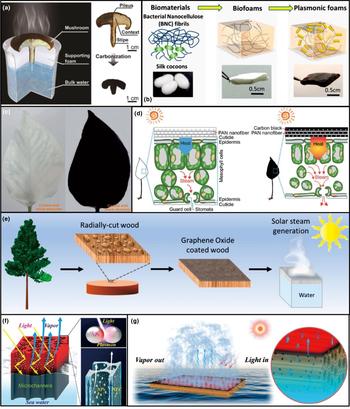
Inspired by the internal structure of mushroom, Zhu and his co-workers have employed mushroom as a biotemplate to produce a solar vapor-generation device[Reference Xu, Hu, Xu, Li, Zhou, Zhu and Zhu66] [Fig. 4(a)]. The umbrella-shaped black pileus of carbonized mushroom allows efficient broadband light absorption. The porous context increases the evaporative surface for vapor escape. The 1D fibrous stipe with small cross section permits water supply but reduces contact area with bulk water. All of these merits of carbonized mushroom enable the large suppression of heat losses and high evaporation efficiency. Bacterial nanocellulose fibrils such as silk cocoons can be obtained from a static culture of Gluconacetobacter hansenii grown under aerobic conditions at room temperature. After integrating with plasmonic nanostructures and forming 3D porous aerogels, the high photothermal capability due to the plasmonic heating effect, low density, low thermal conductivity, and high porosity of such biofoam allow it to generate clean solar vapor but low heat loss[Reference Tian, Luan, Liu, Jiang, Tadepalli, Gupta, Naik and Singamaneni65] [Fig. 4(b)].
(a) Carbonized mushroom biotemplate for clean water generation. Adapted with permission from Xu et al.[Reference Xu, Hu, Xu, Li, Zhou, Zhu and Zhu66] Copyright (2017) by Wiley-VCH. (b) Gels of bacterial nanocellulose fibrils decorated with plasmonic nanostructure for the fabrication of floating composite membrane. Adapted with permission from Tian et al.[Reference Tian, Luan, Liu, Jiang, Tadepalli, Gupta, Naik and Singamaneni65] Copyright (2015) by American Chemical Society. (c) Optical images of green leaf coated with white absorber and black absorber, respectively. (d) Schematic illustration of plant transpiration when applying white absorber coated leaf and black absorber coated leaf. Adapted with permission from Zhuang et al.[Reference Zhuang, Zhou, Xu, Xu, Hu, Li, Lv, Zheng, Zhu, Wang and Zhu64] Copyright (2018) by Wiley-VCH. (e) The fabrication process of GO-coated wood and the usage for solar vapor generation. Adapted with permission from Liu et al.[Reference Liu, Jiang, Tadepallifit, Raliya, Biswas, Naik and Singamaneni59] Copyright (2017) by American Chemical Society. (f) Biotemplate wood coated with plasmonic nanoparticles for solar seawater desalination. Adapted with permission from Zhu et al.[Reference Zhu, Li, Chen, Zhu, Dai, Li, Yang, Yan, Song, Wang, Hitz, Luo, Lu, Yang and Hu60] Copyright (2017) by Wiley-VCH. (g) Reverse-tree design for highly efficient clean water generation under concentrated solar illumination. Adapted with permission from Liu et al.[Reference Liu, Chen, Chen, Kuang, Zhao, Song, Jia, Xu, Hitz, Xie, Wang, Jiang, Li, Li, Gong, Yang, Das and Hu63] Copyright (2018) by Wiley-VCH.

Plant transpiration is a daily vital evaporation process of a plant, which can greatly impact on the local atmospheric temperature, humidity, and hydrologic cycle in the environment. The knowledge achieved through studying the interfacial evaporation system[Reference Wang, Liu, Tao, Shen, Yi, Zhang, Liu, Song, Zhang, Shang and Deng24, Reference Yu, Zhang, Duan, Liu, Quan, Tao, Shang, Wu, Song and Deng40] can be employed to tune the plant transpiration by rationally designing the surface structure of leaf. Zhuang et al. reported that green leaf coated with black absorber would increase the surface temperature of leaf due to the stronger solar absorption[Reference Zhuang, Zhou, Xu, Xu, Hu, Li, Lv, Zheng, Zhu, Wang and Zhu64] [Fig. 4(c)]. The mesophyll cells undergo enhanced photosynthesis/respiration, and water loss is increased. The cells shrink in volume, and water uptake (transpiration) is subsequently increased. In contrast, the leaf coated with white absorber exhibits lower surface temperature compared to normal green leaf. Therefore, water is not easily released by mesophyll cells, and the plant transpiration would be suppressed, as shown in Fig. 4(d).
Recently, wood has been utilized as an excellent material in evaporative systems because of its low weight, high porosity, and hierarchical micro/nano-structures. The design of clean water generation device based on wood is inspired by the water transpiration process in trees. During the process, water is transported from roots to xylems, and then to mesophyll cells. The pumping process in water transpiration as well as intrinsic low thermal conductivity makes wood a potential candidate for interfacial evaporation systems.[Reference Xue, Liu, Chen, Yang, Li, Ding, Duan, Qi and Zhou58–Reference Liu, Chen, Chen, Kuang, Zhao, Song, Jia, Xu, Hitz, Xie, Wang, Jiang, Li, Li, Gong, Yang, Das and Hu63] Liu et al. developed wood–GO composite for solar vapor generation. GO flakes were deposited on wood surface, and the efficient transportation of water to evaporative surface was provided through the micro-channels of the wood. Due to the low thermal conductivity of wood (0.525 W/m/K) and broadband absorption of wood surface coated with GO, a large temperature rise and evaporation efficiency of 82.8% was achieved at a concentrated solar power density of 12 kW/m2 [Fig. 4(e)].[Reference Liu, Jiang, Tadepallifit, Raliya, Biswas, Naik and Singamaneni59] Hu and his co-workers extended the research into the application of wood in solar vapor generation and desalination further. The surface of wood coated with hair-like CNTs was demonstrated an ultrahigh absorption of about 98% in the wavelength range from 300 to 1200 nm. Chemical treatment of original wood broke some of the tracheid cell walls, leading to the formation of large channels within wood and flexibility. Such chemically modified wood membrane showed good recyclability and evaporation efficiency of 81% under the concentrated solar power density of 10 kW/m2.[Reference Chen, Li, Song, Yang, Kuang, Hitz, Jia, Gong, Jiang, Zhu, Yang, Xie and Hu61] By decorating the mesoporous wood with uniform plasmonic metal nanoparticles, extremely high light absorption of ~99% over a broad wavelength range from 200 to 2500 nm was obtained due to the delocalized plasmonic effect of metallic nanoparticles and the waveguide effect of microchannels in wood[Reference Zhu, Li, Chen, Zhu, Dai, Li, Yang, Yan, Song, Wang, Hitz, Luo, Lu, Yang and Hu60] [Fig. 4(f)]. A higher evaporation efficiency of 85% under solar illumination of 10 kW/m2 was demonstrated. In addition, the plasmonic wood could keep stable after 144 h-illumination without degradation. Another recent work by Hu has presented a reverse-tree design that the wood evaporator floating on water is parallel to the tree-growth direction. Therefore, water is transported through the wood evaporator in a direction perpendicular to the growth direction of natural tree. Such design enable the wood-based evaporator achieve much lower thermal conductivity (0.11 W/m/K) in the direction to the normal line of the surface of water. The structural characterization data revealed that large numbers of longitudinal parenchyma cell of 2–3 µm in size in the wood cell wall as well as the wood vessels form 3D interconnected porous structure. These ubiquitous structures allow the rapid and sufficient water replenishment under solar illumination. Even higher efficiency of 89% at 10 kW/m2 has been demonstrated in the study of wood template-based clean water generation[Reference Liu, Chen, Chen, Kuang, Zhao, Song, Jia, Xu, Hitz, Xie, Wang, Jiang, Li, Li, Gong, Yang, Das and Hu63] [Fig. 4(g)]. The integration of biologic systems and interfacial evaporation just opened up new gates for the more exploration of bio-inspired interfacial systems for clean water generation, but it is still challenge to scale up biologic template for solar clean water generation in real applications. Since the body of natural organism easily rots away when it is long-term immersed in the seawater or contaminated water (Table I).
Summary and perspective
In this perspective, we introduce the history, development of structural design, and application of clean water generation via bio-inspired interfacial evaporation systems. The idea of mimicking biologic materials, inspired by the localized heating effect of transpiration and skin sweating, provides new opportunities to evaporative systems. The proposed concept of multi-layered composite membrane and 3D structural design of interfacial evaporator enable the reduction of the thermal loss of such system, and higher evaporation efficiency can be achieved compared to the traditional method.
Organisms have evolved to natural ubiquitous microstructures for specific function in the past of billions of years. In this perspective, we also introduce biotemplate-directed engineering approach to fabricate solar enabled interfacial evaporator. Highly efficient solar vapor generation can be obtained by employing and modifying such subtle and ingenious microstructures of biotemplate. There are many other interesting applications of bio-inspired interfacial evaporation in the progress. For example, the self-cleaning and self-healing is one of the important and environment-friendly practical application of interfacial evaporation system. Jiang and his co-workers introduced superhydrophobic gauze, based on carbon black, to achieve low-cost and self-cleaning interfacial evaporation system.[Reference Liu, Chen, Guo, Cao and Jiang69] By combining solar evaporation and superhydrophobic surface, Jiang et al. demonstrated that the hydrophilic NaCl crystals and hydrophobic carbon black nanoparticles on the floating gauze could be removed by the moving droplet on the surface, which guaranteed a good self-cleaning performance during solar interfacial evaporation. Wang and his co-workers reported interfacial photothermal membrane with hydrophobic self-healing ability based on polypyrrole-coated stainless steel mesh.[Reference Zhang, Tang, Wu, Li and Wang70] Fluoroalkylsilane moieties, preserved by coating film, were the hydrophobic self-healing agents and could migrate to coating surface for self-healing upon the damage of outmost functional groups on the surface. The self-healing property of this interfacial evaporation system is quite promising in the long run of interfacial systems.
Are there more possible biologic materials with desirable functions to be utilized for clean water generation? We believe the answer is yes. The floating algae, a diverse group of photosynthetic organisms, could serve as a potential source of inspiring biologic system. Most algae lack some key tissue, such as stomata and xylem, which are very important in water transportation and evaporation in land plants. The ability of algae to absorb water and utilize solar energy for photosynthesis might provide some useful insights for the further development of interfacial systems involving both evaporation and catalysis. In summary, the bio-inspired interfacial evaporation system has been proved to be excellent approach for efficient clean water generation from experimentally and theoretically. We expect that more biologic systems would be studied in the coming future to open up new gates for the development of interfacial systems, not only for clean water generation, but also for other sustainable benefits.
Acknowledgments
The authors thank the financial support from the National Key R&D Program of China (No. 2017YFB0406100), the National Natural Science Foundation of China (Grant No. 21401129, 51521004, 51420105009, and 51873105), the Natural Science Foundation of Shanghai (Grant No. 14ZR1423300), and the Zhi-Yuan Endowed fund from Shanghai Jiao Tong University.