International politics is characterized by a high level of information asymmetry between the negotiating governmental agent and his or her elected principals in the national parliament. This information asymmetry is the root cause of the executive dominance we observe in international and European politics. From a normative perspective, this diagnosis calls for countermeasures. From an institutional perspective, effective parliamentary oversight depends on resourceful specialized standing committees, the right to compel witnesses, to question the government and to rewrite draft bills. Yet most importantly, a parliament’s strength depends on its ability to access all relevant information early on in the process (Winzen Reference Winzen2012). Effective parliamentary oversight is of particular relevance where governmental agents are tempted to use their inside information to follow their own agenda. Such ‘governmental drift’ is more likely in situations where the agent holds preferences different to the median MP. In these circumstances, the parliamentary majority has every incentive to scrutinize the government. Depending on the political system, such a majority may be organized by the opposition or by a sceptical coalition partner (Martin and Vanberg Reference Martin and Vanberg2004). From the latter perspective, parliamentary scrutiny offers the coalition partner a toolkit to reinforce the coalition agreement. Finally, Finke and Dannwolf (Reference Finke and Dannwolf2013) provide evidence that in European Union (EU) politics parliamentary scrutiny is deployed strategically to strengthen the bargaining power of the negotiating minister. This argument suggests that scrutiny manipulates the domestic constraints which allow the negotiating minister to get rather than to make concessions in Brussels.
Most existing studies focus on scrutiny activities aggregated over time and policy areas (see Auel et al. Reference Auel, Rozenberg and Tacea2015). Those who study the scrutiny of individual policy proposals focus on instruments that can be utilized by individual party groups such as committee referrals, amendment proposals, debates and questions. By contrast, this is the first empirical study of collective positions agreed by the parliamentary majority on individual policy proposals. For example, numerous parliaments have the right to explicitly mandate their negotiating minister before the minister travels to Brussels. These mandating systems, originally introduced in Denmark and then exported to many Eastern European member states, have long been considered the holy grail of effective parliamentary scrutiny (e.g. Holzhacker Reference Holzhacker2007; Karlas Reference Karlas2012; Raunio Reference Raunio2005; Winzen Reference Winzen2012). Yet, from a theoretical perspective, these mandates are similar to other ‘majoritarian instruments’ such as recommendations or statements which, too, codify the majority’s position. The majority provision challenges the two most prominent explanations for parliamentary scrutiny: with the exception of minority governments, the parliamentary opposition alone cannot muster a majority of votes. With the exception of surplus governments – where at least one partner is redundant in order to obtain a majority in parliament – coalition partners alone cannot muster the majority necessary to constrain the leading minister. Consequently, we ask the question: which party groups coalesce to adopt statements and recommendations on EU politics?
On the empirical side, we study recommendations on EU legislative proposals adopted by the committees of the German Bundestag and statements on EU legislative proposals adopted by the committees of the Finnish Eduskunta in the period from 2003 to 2013. In the comparative literature, both parliaments are considered to be very strong (Winzen Reference Winzen2012). But whereas Germany has a history of minimum winning coalitions and high levels of coalition discipline, Finland has a tradition of surplus coalitions and weaker coalition discipline (Müller and Strøm Reference Müller and Strøm2003: 580). From a theoretical perspective, we study domestic-level as well as two-level explanations. With a view to domestic politics, we expect that in the Eduskunta the homogeneity of policy-specific party positions is decisive. By contrast, the high level of coalition discipline renders policy-specific preference similarity almost irrelevant in Germany. With a view to two-level explanations, we expect two types of coalitions. Type I is initiated by the governing parties and strengthens the bargaining position of ‘their’ leading minister. Type II is initiated by the opposition and weakens the bargaining position of the leading minister. Given the differences in coalition discipline, we expect Type I coalitions to be more likely in Germany and Type II coalitions to be more likely in Finland.
The article continues with a summary of the literature on parliamentary scrutiny of EU politics. Thereafter, we introduce the relevant aspects of party politics in Germany and Finland. Next, we derive our theoretical expectations, which we test in the subsequent empirical section. The article ends with a concluding discussion of our results. Specifically, we discuss the consequences of institutional reforms which facilitate the use of parliamentary positions, such as the popular introduction of mandating procedures.
NATIONAL PARLIAMENTS IN EUROPEAN POLITICS
The political trends over the last 30 years have caused a possible increase in the importance of national parliaments in foreign policymaking. Globalization and internationalization have led to the juridification of international politics and the so-called ‘governance beyond the nation state’ (Dahl Reference Dahl2000; Keohane et al. Reference Keohane, Macedo and Morvcsik2009; Moravcsik Reference Moravcsik2004; Zürn Reference Zürn2004). Recently, scholars have observed a reinforced electoral connection in foreign affairs which has been explained by the availability of reports and information on international politics (Aldrich et al. Reference Aldrich, Gelpi, Feaver, Reifler and Thompson Sharp2006; Norris Reference Norris2011). It does not come as a surprise, therefore, that international relations have become more politicized (Zürn Reference Zürn2014) and foreign affairs increasingly salient to voting behaviour (Aldrich et al. Reference Aldrich, Gelpi, Feaver, Reifler and Thompson Sharp2006; De Vries et al. Reference De Vries, Edwards and Tillman2011). By all accounts, ‘the level of executive dominance in foreign policy has decreased over the decades’ (Raunio and Wagner Reference Raunio and Wagner2015: 5).
These developments are most evident in the process of European integration, which has been accompanied by concerns about democratic legitimacy. These concerns were met by an increasing parliamentarization of EU politics. Besides the well-known empowerment of the directly elected European Parliament (EP), the role of national parliaments in European policy formulation has been strengthened in various ways (Auel Reference Auel2007; Norton Reference Norton1995). First, national parliaments have increased their cooperation on the supranational level via institutionalized meetings (Krekelberg Reference Krekelberg2001).Footnote 1 Second, cooperation between national parliaments and the European Parliament has improved the amount of information available to members. Examples of such mechanisms include bilateral committee meetings (Maurer and Wessels Reference Maurer and Wessels2001: 458–60), the establishment of offices of national parliaments at the European Parliament (Neunreither Reference Neunreither2005) and participation of members of the European Parliament (MEPs) in European Affairs Committees (Raunio and Hix Reference Raunio and Hix2000: 157). Third, as of September 2006, the European Commission has forwarded all its communications and proposals to national parliaments (Commission of the European Communities 2008: 2).
At the domestic level, the additional supply of EU documents has been met with significant improvements of parliamentary scrutiny systems (e.g. Maurer and Wessels Reference Maurer and Wessels2001; Raunio and Hix Reference Raunio and Hix2000). However, the formal powers of national parliaments differ across countries (Bergman Reference Bergman1997; Pahre Reference Pahre1997; Saalfeld Reference Saalfeld2005). Most parliaments are limited to issuing a non-binding scrutiny reserve; few have the right to issue a binding mandate that limits the minister’s discretion in the Council (Raunio Reference Raunio2005: 322–3).Footnote 2 Moreover, the effectiveness of parliamentary scrutiny systems depends on the available resources, such as administrative staff, the size and composition of the European Affairs Committees (Bergman et al. Reference Bergman, Müller, Strom and Blomgren2003), or informal contacts with MEPs (Maurer and Wessels Reference Maurer and Wessels2001). Behavioural assessments of scrutiny activities are often based on aggregate indicators, such as the frequency of European Affairs Committee meetings, the opinions produced, number of meetings with European Parliament committees, and memoranda received by the government on its positions (Bergman Reference Bergman1997; Bergman et al. Reference Bergman, Müller, Strom and Blomgren2003; Karlas Reference Karlas2011).
Winzen (Reference Winzen2012) offers the most encompassing data on the evolution of parliamentary scrutiny rules in all EU member states over time. Specifically, he distinguishes between two dimensions of oversight. The first dimension is associated with a parliament’s ability to obtain information such as a standing European Affairs Committee, reporting requirements of the government and the relevance of sectoral committees. Institutions on the second dimension constrain governments’ actions and include scrutiny reserves as well as mandating procedures. In this respect, Hill (Reference Hill2003: 255) argues that the greatest powers that parliaments have are not based on formal provisions for constraining foreign policy, but instead on their ability to scrutinize and investigate. Kaarbo (Reference Kaarbo2012) considers parliaments as a potential channel through which junior coalition partners can influence foreign policymaking.
Meanwhile, authors have begun to question the ‘real’ degree of parliamentary involvement as some formal rights may be under-used (Hefftler et al. Reference Hefftler, Kreilinger, Rozenberg and Wessels2013; Neuhold and de Ruiter Reference Neuhold and de Ruiter2010). Only recently a number of studies have focused on parties’ incentives for investing time and other resources into the scrutiny of EU policymaking (e.g. Auel and Benz Reference Auel and Benz2005; Finke and Dannwolf Reference Finke and Dannwolf2013). The authors of a special issue of West European Politics analyse the interrelation between scrutiny institutions and behaviour from various perspectives (Auel and Christiansen Reference Auel and Christiansen2015). Auel et al. (Reference Auel, Rozenberg and Tacea2015) explain different scrutiny activities aggregated at country-times-year level. They conclude that formal rights are a ‘crucial precondition’ for the observed extent of scrutiny activities (Auel et al. Reference Auel, Rozenberg and Tacea2015: 300). In a similar fashion, Gattermann and Hefftler (Reference Gattermann and Hefftler2015) study the issuance of reasoned opinions as part of the Early Warning System. They find that reasoned opinions are more likely in the event of high political contestation over EU integration, low ideological cohesion, high issue saliency and minority governments.
Our approach differs from this research in that we study the co-sponsorship of collective position papersFootnote 3 issued on individual EU policy proposals. Specifically, we study recommendations issued by committees in the German Bundestag and statements issued by committees in the Finnish Eduskunta, both parliaments featuring very strong scrutiny institutions (Winzen Reference Winzen2012). In doing so, we apply the standard conditional logit model used in the co-sponsorship and coalition literature.
MOTIVATIONS FOR USING SCRUTINY INSTRUMENTS
The party-centred literature on parliamentary scrutiny of EU politics offers three explanations. First, students of comparative politics argue that parliamentary oversight mechanisms furnish one important means for the opposition’s influence on policymaking (e.g. Powell Reference Powell2000). From this perspective, the government’s policy drifts away from the median MP. The opposition’s incentive to counteract this drift increases with its policy distance to the government. The goal of scrutiny is to pull the policy towards the position of the opposition. Second, Martin and Vanberg (Reference Martin and Vanberg2004) find that parliamentary scrutiny is being used to reduce information asymmetries among coalition partners. From this perspective, the leading minister holds private information on the policy proposals in his jurisdiction. This information asymmetry can cause ministerial drift, that is, the minister’s policy proposal deviates from the coalition agreement. The likelihood for, and severity of, ministerial drift increases with the dissent between the coalition partners (Martin and Vanberg Reference Martin and Vanberg2004: 20). Parliamentary scrutiny constitutes one mechanism by which the coalition partner can counteract ministerial drift. From this perspective, the incentive for scrutiny increases with intra-coalition dissent. Third, Finke and Dannwolf (Reference Finke and Dannwolf2013) argue that parliamentary scrutiny is used strategically to manipulate the negotiating minister’s domestic constraint. Scrutiny strengthens the leading minister if it reveals a coalition partner who is even more sceptical towards the expected EU policy outcome than the minister’s own party. Scrutiny weakens the position of the leading minister if it reveals a coalition partner who is less sceptical towards the expected policy outcome than the leading minister’s own party.
All three approaches share the assumption that scrutiny can be activated by individual party groups. Yet, the most powerful parliamentary scrutiny instruments such as recommendations, resolutions, mandates or statements require a parliamentary majority. By how far can we adapt these three existing explanations to this majority requirement? At first sight, this seems to be an impossible quest. By definition, the opposition does not command a majority in parliament, the exception being minority governments. Similarly, coalition partner(s) of the leading minister do not command a majority in parliament; the exception being surplus governments. Hence, we expect government and opposition parties to cooperate. But who organizes this cooperation and which parties coalesce? To answer this question, we first consider the comparative literature on coalition politics before we return to the two-level perspective typically applied in the study of the EU.
Theories of legislative bargaining provide expectations relating to the composition and size of a successful legislative coalition as well as to the policy outcome agreed among its members (for a summary of the literature, see Diermeier et al. Reference Diermeier, Swaab, Medvec and Kern2008). Legislative coalitions are primarily motivated by policy-seeking; hence, they are also referred to as ‘policy coalitions’. Legislative coalitions are prominently important in presidential systems where the administration is not (or at least not exclusively) elected by the legislature. The most prominent example is the US Congress, in which, however, the importance of party politics is at least disputed (Cox and McCubbins Reference Cox and McCubbins1993; Krehbiel Reference Krehbiel1998).
Yet, the bulk of coalition theories focus on the making and breaking of governments (Laver and Budge Reference Laver and Budge1992; Laver and Shepsle Reference Laver and Shepsle1996; Müller and Strøm Reference Müller and Strøm1999). This literature typically considers at least two further motivations for joining a coalition: vote-seeking and office-seeking. While the office-seeking approach assumes that political parties are mainly concerned with controlling as many posts as possible (Riker Reference Riker1962), policy-driven theories take the programmatic positions of parties into account (Axelrod Reference Axelrod1970; de Swaan Reference De Swaan1973). Policy-seeking parties prefer those coalitions that produce the most favourable policies (for an overview see Martin and Stevenson Reference Martin and Stevenson2001; Strøm et al. Reference Strøm, Müller and Bergman2003).
Here, the question is in how far the governing coalition is disciplined enough to avoid policy coalitions with opposition parties. In this respect, Finland and Germany are (within the world of parliamentary democracies) most dissimilar cases. Finland is characterized by a tradition of surplus governments in combination with a relatively low coalition discipline (Jungar Reference Jungar2002; Müller and Strøm Reference Müller and Strøm2003: 580; Rasch Reference Rasch2011; Raunio Reference Raunio2004). The weakness of governing coalitions is most evident in the area of foreign and EU policy. In fact, until the reform of the constitution in March 2000, Finnish foreign policy had long been the exclusive domain of the president, and for that reason Finland has been classified a semi-presidential state (Nousiainen Reference Nousiainen2001). Even after the constitutional reform, the president still plays a part in foreign policy (Nousiainen Reference Nousiainen2001: 106–8). Accordingly, we should expect that policy coalitions play an important role in the parliamentary scrutiny of EU politics in Finland.
By contrast, Germany has always been governed by highly disciplined and stable minimum winning coalitions (Müller and Strøm Reference Müller and Strøm2003: 579; Saalfeld Reference Saalfeld2003: 46). Saalfeld (Reference Saalfeld2003) attributes coalition stability mainly to the German party system. The party system evolved from ‘“polarized” pluralism to a moderately pluralist, bipolar party and coalition system’ after 1949 and the two major parties – the Christian Democrats and the Social Democrats (CDU/CSU and SPD) – tried to win the Free Democratic Party (FDP), the pivot party in the centre, as coalition partner (Saalfeld Reference Saalfeld2003: 80). Furthermore, the strength of the chancellor and his or her ability to control their own party as well as the degree of consensus within coalition parties have added to coalition stability (Saalfeld Reference Saalfeld2003). In fact, wedge politics is a rarely seen but very powerful strategy of the German opposition, which has its moment of glory when the government is divided. Furthermore, there are no elements of presidentialism in German foreign and EU policy. Accordingly, we should expect policy coalitions to be of very limited relevance when it comes to parliamentary scrutiny of EU politics in Germany.
Policy coalitions aim to realize their members’ shared policy preferences. Other motives such as office- or vote-seeking are irrelevant. Therefore, we expect that:
Hypothesis 1: Finnish statements on EU policy proposals are co-sponsored by cohesive and connected winning coalitions. Preference similarity is of little relevance to explain the co-sponsorship of German recommendations.
So far, we have conceived of recommendations in the Bundestag and of statements in the Eduskunta in the same way as we would conceive of domestic policies. Yet, neither statements nor recommendations materialize as substantive policies. Instead, they are used to specify and constrain the mandate for the negotiating minister. In doing so, coalition partners can either follow a domestic or an international logic.
The parliament acts as an important domestic principal of the leading minister. Assuming simple majority, the median MP represents the policy preference of that principal. If, therefore, position papers are intended to counterbalance agency drift, we should expect those parties as co-sponsors which are located on the other side of the median MP from the leading minister. If, for example, the leading minister prefers more free trade than the median MP, we should expect those parties to sponsor a statement/recommendation who are more sceptical towards free trade than the median MP. Accordingly, we expect that:
Hypothesis 2: Party groups co-sponsor a position paper that counterbalances the negotiator’s deviation from the median MP.
From an international perspective, position papers constrain the mandate of the negotiating minister (Finke and Dannwolf Reference Finke and Dannwolf2013). From the perspective of the negotiator this can be beneficial if reference to such a written mandate restricts his or her ability to grant unfavourable concessions in Brussels. However, it can just as well be detrimental if the written mandate explicitly allows for further, from the negotiator’s perspective, unfavourable concessions.
Subsequently, we assume that the government has an incentive to support its minister. Moreover, we argue that the minister’s own party will find it easier to convince its coalition partner to initiate and organize support for a statement/recommendation. Accordingly, we expect that:
Hypothesis 3: Governing parties are more likely to co-sponsor position papers which strengthen the position of the leading minister (Type I). By contrast, the opposition is more likely to co-sponsor position papers which weaken the position of the leading minister (Type II). Type I co-sponsorship is more likely for the highly disciplined coalitions in the German Bundestag than in the Finnish Eduskunta.
How do we distinguish Type I from Type II coalitions? How do we identify a position paper which counterbalances a deviant ministerial agent? We think about the interest constellations between the leading minister, their foreign partners and domestic principals in spatial terms. Specifically, a mandate strengthens the leading minister if it is located on the same side of the expected policy outcome in the Council of Ministers as the minister’s own party. At best, the mandate should specify something like a red line which makes it impossible for the leading minister to grant further concessions. Unfortunately, identifying such ‘red lines’ quantitatively is next to impossible. In general, we can try to infer the content of a position paper by looking at the identity of its sponsors. There are many possible mechanisms to aggregate individual actors’ preferences to predict a collective outcome. Most popular is the asymmetric Nash bargaining solution, which can be approximated by the weighted average of actors’ policy positions (see Achen Reference Achen2006). A different approach is offered by the literature on interest groups, the so-called ‘influence function’ (Becker Reference Becker1983). Here, the basic idea is that each actor (here: party group) activates their resources to ‘pull’ the policy proposal in their preferred direction. The overall influence of a coalition depends on all partners’ policy preferences weighted by their resources, e.g. their seat share. Compared with the Nash bargaining solution, the influence function does not predict a precise location for the coalition agreement, but the strength and direction of the coalition’s influence.
To sum up, we offer three explanations for the composition of coalitions that co-sponsor position papers on EU legislative proposals. Firstly, we can think of these statements as legislative or policy coalitions. From this perspective, we should expect coalition partners to be homogeneous. We assume this perspective to be of relevance in Finland, where coalition discipline is lower. Secondly, we can think of statements/recommendations as a parliamentary tool to counter- balance agency drift. From this perspective, we expect parties to co-sponsor which are located on the opposite side of the median MP from the leading minister. Thirdly, we can think of statements/recommendations as a tool to strategically manipulate the minister’s domestic constraint. If that is the case, we expect governing parties to sponsor papers which strengthen ‘their’ minister, whereas we expect opposition parties to sponsor papers which weaken the leading minister.
EMPIRICAL ANALYSIS
Dependent Variable
Subsequently, we study the sponsorship of all 810 available statements on EU legislative proposals adopted by committees of the Finnish Eduskunta and of all 183 available draft recommendations on EU legislative proposals tabled by committees of the German Bundestag between 2003 and 2013. According to Winzen (Reference Winzen2012), the parliamentary scrutiny procedures for scrutinizing EU policies are very strong in these two parliaments. The only other parliament in that group is the Danish Folketing with its well-known mandating mechanism. By studying the Eduskunta and the Bundestag, we can infer how collective scrutiny action works under otherwise ideal conditions, meaning that both parliaments have extensive information rights and sufficient resources at their disposal.
At the same time and as outlined above, we are well aware that the two countries differ in respect of the types and discipline of the governing coalitions. In our period of observation we cover three terms of the Finnish Eduskunta and five different cabinets. All Finnish governments have been surplus coalitions, meaning that one (2003–7) or several (2007–13) parties were unnecessary for the government to be supported by a parliamentary majority.Footnote 4 After the general elections in March 2003, three parties joined a coalition (Centre Party, Social Democrats, Swedish People’s Party) that disposed of 116 out of 200 seats. As the Centre Party and the Social Democrats together already had 108 seats, the Swedish People’s Party (8 seats) was not necessary to secure the parliamentary majority. In 2007, after the general elections, the National Coalition Party and the Green League also joined the coalition, now uniting 125 out of 200 seats.Footnote 5 The Social Democrats were no longer part of the government. Similar to the previous term, the Centre Party and the National Coalition Party were already supported by a parliamentary majority (101 seats) without any further partners. The oversized coalition continued after the general elections in March 2011, now with six parties forming a coalition (National Coalition Party, Social Democrats, Left Alliance, Green League, Swedish People’s Party and Christian Democrats) and again controlling 125 out of 200 seats. Both the National Coalition Party and the Social Democrats were necessary in order to secure the parliamentary majority, but at least two of the other partners were dispensable.
In Germany, too, we are covering three legislative terms and three different cabinets. Yet, in contrast to Finland, all German governments were minimum winning coalitions, though the Grand Coalition between the CDU/CSU and SPD (2005–9) was heavily oversized, with 448 out of 614 seats. The coalition between the SPD and Greens (2002–5) comprised only 306 of 604 seats. This coalition ended early with an unsuccessful vote of confidence for Chancellor Schröder in July 2005. The second Merkel government (2009–13) was a coalition between CDU/CSU and FDP, uniting 332 of the 622 seats. In all cabinets, the coalition partner was necessary to secure support by the parliamentary majority and none of the partners was dispensable.
During our period of observation, both parliaments were confronted with an identical set of 1,713 EU legislative proposals, handled under either the co-decision or the consultation procedure. The data have been collected at both parliaments’ web archives.Footnote 6 Committees in the German Bundestag can issue recommendations for resolutions, which are sent to the plenary for discussion and vote. It is also possible for the plenary to adopt the recommended resolutions without discussion (Mayer Reference Mayer2012: 252). The government should take into account and respect the Bundestag position during the negotiations at EU level (Art. 23, Abs. 3 of the German Constitution). We downloaded and screened all draft recommendations (Beschlussempfehlungen) according to whether or not they related to an EU legislative proposal. We find that the committees of the Bundestag drafted 183 recommendations on 160 different EU law proposals. A total of 37 of these recommendations have not been adopted by the committee.
In the Eduskunta, all committees can adopt statements – lausunto – on EU legislative proposals by majority vote (see Finnish Eduskunta 1999: Section 38 and 40). Most of these statements are adopted by the advisory committees and forwarded to the Grand Committee, which is the central interface between government and parliament on all EU matters. Unfortunately, the records reveal neither the identity of the sponsors nor the voting behaviour of the committee members. However, party groups frequently voice their dissent over statements.Footnote 7 Consequently, we assume that a statement is sponsored by all those party groups not voicing their dissent.Footnote 8 In order to identify the set of relevant statements, we first had to extract all internal EU document numbers (beginning with ‘E’, ‘U’ or ‘UTP’) by screening the minutes of the Grand Committee and the Foreign Affairs Committee. Using these document numbers, we were able to harvest all relevant EU dossiers via the advanced search function of the Eduskunta’s website. These dossiers are systematically structured, mentioning not only the related Commission proposal number, but also every statement issued by either one of the advisory sectoral committees or by the Grand Committee itself. The committees of the Eduskunta drafted 810 statements on 766 different law proposals.Footnote 9
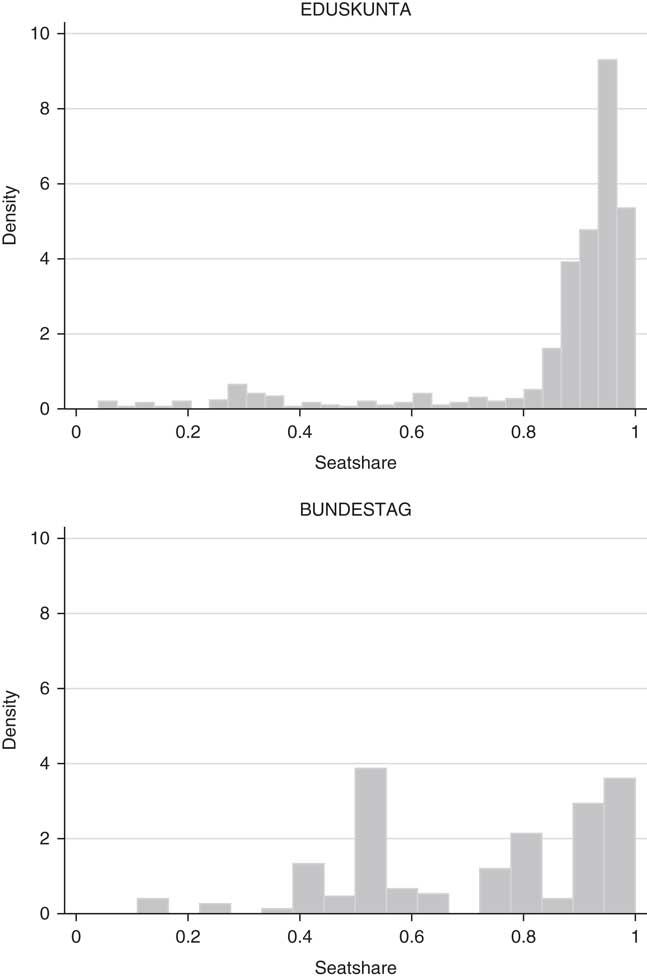
Figure 1 depicts the distribution of coalition size in the Eduskunta as compared with the Bundestag. In the Finnish parliament the distribution is clearly skewed rightwards, only 8 per cent of the observed sponsoring coalitions hold less than 50 per cent of the seats and about 40 per cent of all coalitions unite more than 90 per cent of the seats. This finding confirms the consensual approach to decision-making in the Grand Committee and to parliamentary scrutiny of EU affairs in the Eduskunta in general. The scrutiny system is designed to achieve national unity and not decisions of governing parties against the opposition or vice versa (Raunio Reference Raunio2016: 237). By contrast, in the Bundestag we observe a significant number of minimum winning coalitions and only 8 per cent of the coalitions unite more than 90 per cent of the seats. Moreover, approximately 20 per cent of the observed coalitions are not supported by a majority, which corresponds to the 37 rejected draft recommendations. It is possible that these failed ‘minority’ proposals are motivated by signalling instead of policy-seeking. However, this is not necessarily the case because: (1) committees are not the most promising arena for signalling policy positions; and (2) we observe a number of successful minority proposals in other policy areas (Finke 2016). Consequently, we checked the robustness of our results against excluding the failed draft recommendations. Our substantive results remain unchanged.
Seat Share of the Coalition Co-sponsoring Statements in the Eduskunta (top) and Draft Recommendations in the Bundestag (bottom)

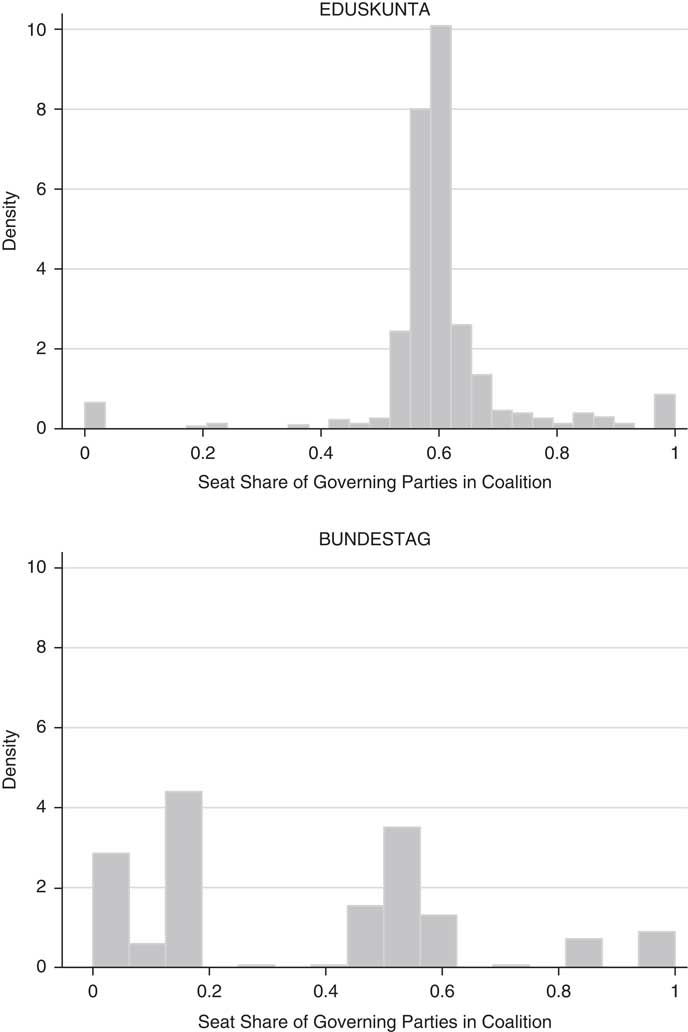
Figure 2 reveals that both governing and opposition parties participate in drafting statements and recommendations. But whereas in Finland we hardly ever find drafting coalitions which are dominated by the opposition, we do observe a significant amount of opposition-dominated draft recommendations in the German Bundestag. Given the oversized Finnish surplus coalitions, this picture does not come as a surprise.
Seat Share of Governing Parties Co-sponsoring Statements in the Eduskunta (top) and Draft Recommendations in the Bundestag (bottom)

Independent Variables
Here, we are interested in the formation of coalitions that sponsor recommendations and statements. Martin and Stevenson (Reference Martin and Stevenson2001: 38) model coalition formation as an unordered discrete choice problem in which each formation opportunity constitutes a single case. The number of choice alternatives is equal to 2n−1, where in the case of the Bundestag n = 5 and in the case of the Eduskunta n=8. Thus, we encounter 31 permutations of possible coalitions in the Bundestag and 255 permutations of possible coalitions in the Eduskunta. In the data set, we observe 28 of the 31 possible coalitions in the Bundestag. In Eduskunta, we witness 71 of the 255 possible coalitions. According to McFadden (1974), this discrete choice problem can be modelled as a system of conditional logits in which the probability of individual i to choose alternative k is:
 $${\rm pik\,{\equals}}\,{{{\rm e}^{{{\rm z}_{{{\rm ik}^{{{\rm \alpha {\plus}x}_{{\rm i}} {\rm \beta }_{{\rm k}} }} }} }} } \over {\mathop{\sum}\limits_{{\rm k\,{\equals}}\,1}^{\rm K} {{\rm e}^{{{\rm z}_{{{\rm ik}^{{{\rm \alpha {\plus}x}_{{\rm i}} {\rm \beta }_{{\rm k}} }} }} }} } }}$$
where zik denotes covariates which vary across alternatives and individuals, and xi denotes covariates which vary across individuals. In the present application, the ‘individuals’ are the 810 Finnish statements and the 183 German recommendations. The alternatives are the 255 (31) possible coalitions. With the exception of the minister’s locations vis-à-vis the expected outcome, all of the above hypotheses relate to alternative-varying covariates (zik). Accordingly, we estimate a model in which the alternative-specific parameter βk is unrelated to any covariate at the individual level. In this case, the conditional logit model can be simplified to the fixed-effects logistic regression model which is used for the analysis of panel data.
To test our theoretical arguments, we need a measure of parties’ policy preferences. Here, we resort to the Comparative Manifestos Project data (Klingemann et al. Reference Klingemann, Volkens, Bara, Budge and McDonald2006; Volkens et al. Reference Volkens, Lacewell, Regel, Schultze and Werner2010). Specifically, we deploy the following 10 issue scales proposed by Lowe et al. (Reference Lowe, Benoit, Mikhaylov and Laver2011): ‘environment’, ‘freemarket’, ‘international’, ‘libcons’, ‘logeu’, ‘logplaneco’, ‘logrile’, ‘stateconomy’, ‘statservices’ and ‘technology’. We assign these policy dimensions to the legislative proposals using information about the responsible directorate-general (see the online Appendix). This approach enables us to calculate each party’s policy preference in a given policy area within a given electoral period.
Intra-coalition Conflict
Coalition homogeneity is measured as the standard deviation of these positions across all parties in the coalition. Furthermore, the data allow us to code a dummy variable indicating whether or not a coalition is connected, i.e. members of the coalition are not separated by non-members on the respective issue scale (see above).
Position of the Leading Minister
We gathered information on the partisan affiliation of all ministers in both countries during our period of observation. We use information on the leading committee in the European Parliament to assign the ministries to each legislative proposal (see the Appendix). Importantly, we were able to cross-validate this matching procedure using information on roll call votes in the Council of Ministers. With a subset of 125 policy proposals, we find that our matching procedure identifies roughly 84 per cent of the leading ministers correctly. Please note that all actor positions vary over time, across countries, and across policy dimensions.
Expected Outcome
Following Achen (Reference Achen2006), the asymmetric Nash bargaining solution can be approximated by the weighted mean of actors’ positions. Therefore, the position of a national government has been calculated as the weighted (by seat share) mean of all coalition partners’ positions. The expected policy outcome has been calculated as the weighted (Council voting weights) mean of all member states’ governments’ positions.
Influence Function Domestic Level
To test our hypothesis H2 we calculate a different influence function:
 $Pull\_Domest\,{\equals}\,\mathop{\sum}\nolimits_m^ {^{i\,=1}} pos_{i} \,{\minus}\,med} $
, where m denotes the number of partners ranging from 1 to 5 in the Bundestag and 1 to 8 in the Eduskunta, pos
i
denotes the policy preference of coalescing party i and median is the position of the median MP in the respective chamber. Please note that Pull_Domest varies across coalitions, policy areas and electoral periods.
Influence Function International Level
To test our hypotheses H3 we calculate the following influence function:
 $Pull\_Intern\,{\equals} \mathop{\sum}\nolimits_m^ {^{i\,=\,1}} pos_{i} \,{\minus}\,out} $
, where m denotes the number of partners ranging from 1 to 5 in the Bundestag and 1 to 8 in the Eduskunta, pos
i
denotes the policy preference of coalescing party i and out is the expected policy outcome. Please note that Pull_Intern varies across coalitions, policy areas and electoral periods.
Results
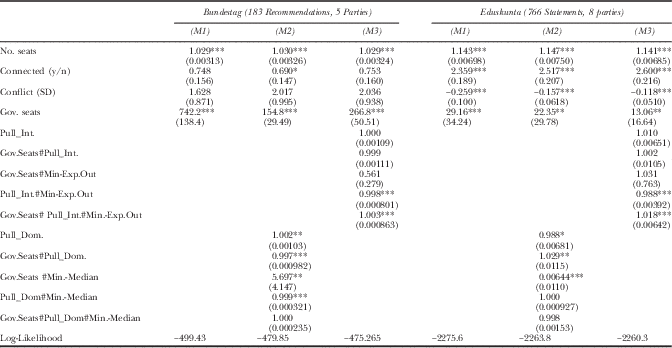
We estimated three conditional logit models for each of the two parliaments (Table 1). The first model includes the seat share, the share of governing parties and two measures for intra-coalition conflict, namely the standard deviation among coalition partners and the connectedness. The results forcefully support our first hypothesis. Only in the Eduskunta, we observe policy coalitions which form around shared policy preferences. Heterogeneous coalitions are significantly less likely and the dichotomous indicator for connectedness turns out significant and positive. By contrast, in the German Bundestag both variables are insignificant. Instead, we observe a very strong and significant effect of governing parties’ seat share. In Finland, too, we observe a positive effect of governing parties’ seat share, but the effect size is almost 10 times smaller than in the Bundestag. Finally, the larger a coalition the more likely it will materialize in both parliaments.
Results of the Conditional Logistic Regression Analysis (proposal-level fixed effects)

Note: seEform in parentheses, ***p<0.01; **p<0.05; *p<0.1.
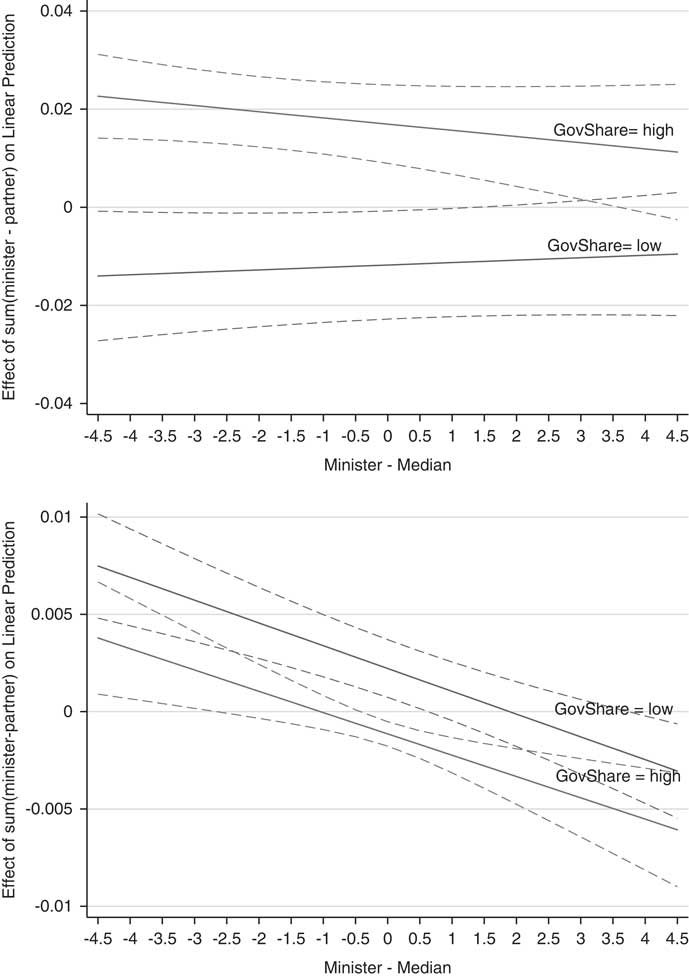
In the second model we test our argument that statements and recommendations are used to counterbalance the leading minister’s deviation from the floor median (H2). For this purpose we add a triple interaction effect between the domestic influence function (Pull_domest), the governing parties’ seat share (Gov.SeatShare) and the minister’s deviation from the median (Min.−Median). We plot the marginal effects in Figure 3. In the Finnish Eduskunta, the support for H2 is very much limited to statements dominated by the governing parties and the situation where the minister is located to the left of the floor median.
Effect of Influence Function
 $\mathop{\sum}\nolimits_M^{i\,{\equals}\,1} {pos_{i} \,{\minus}\,med} $
in the Finnish Eduskunta (top) and the German Bundestag (bottom)

By contrast, the results for recommendations in the German Bundestag are very much in line with our expectations. If the leading minister’s party is located to the left of the floor median, the chances are high that we will observe a recommendation by right-leaning party groups and vice versa. Interestingly, this result is independent from the part governing parties play in sponsoring the recommendation. Seen from a different angle, our findings seem to support Martin and Vanberg’s (Reference Martin and Vanberg2004) argument that coalition partners use the parliamentary arena to scrutinize their leading minister’s deviation from the coalition agreement by initiating amendments. The crucial difference is that in order to have a recommendation adopted, the coalition partner requires support from the opposition; hence, the net effect can be observed for recommendations authored by governing and opposition parties.
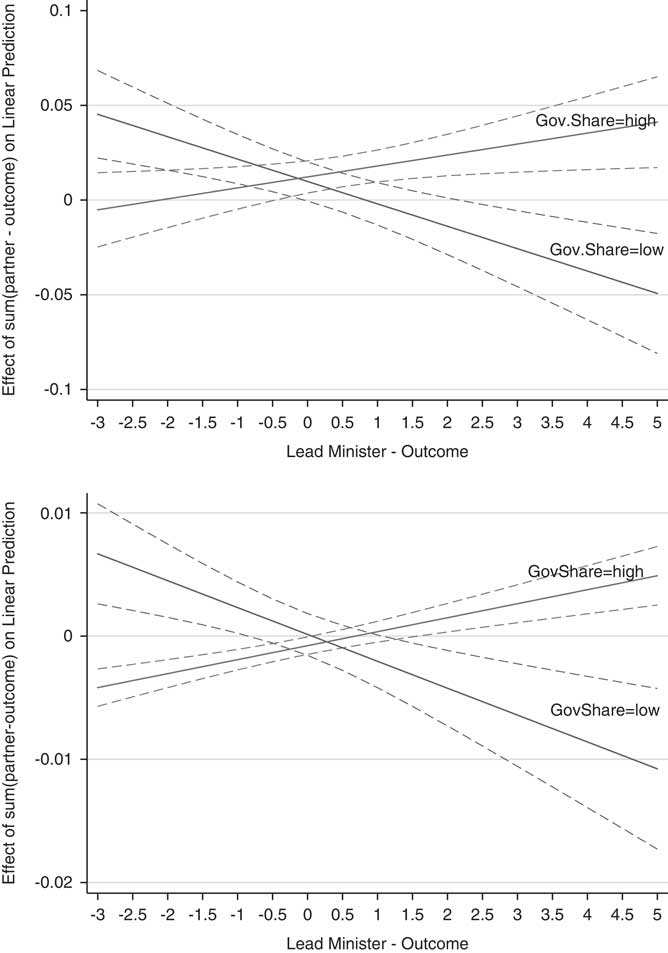
Finally, we test hypothesis H3, which expects that governments will push for coalitions that strengthen the leading minister’s bargaining position in Brussels. Specifically, we expect that governing parties try to draft statements/recommendations which pull the expected outcome leftwards (rightwards) whenever ‘their’ minister is located to the left (right) of the expected outcome, too. By contrast, opposition parties engage in drafting statements when they have an incentive to weaken the leading minister. Hence, they should try to draft statements which pull the expected outcome rightwards (leftwards) whenever the minister is located to the left (right) of the expected outcome. To test this argument, we add a triple interaction effect between Gov.SeatShare, Pull_Intern, and a term capturing the location of the minister vis-à-vis the expected outcome (Min.-Exp.Out.). We plot the resulting marginal effects in Figure 4.
Effect of Influence Function
 $$\mathop{\sum}\nolimits_M^{i\,{\equals}\,1} {pos_{i} \,{\minus}\,out} $$
in the Finnish Eduskunta (top) and the German Bundestag (bottom)

In both parliaments, we observe that statements/recommendations which are predominately drafted by opposition parties weaken the minister’s position in Brussels. For example, if strong liberal opposition parties see that the minister is trying to avoid a too liberal EU policy, they draft a statement or recommendation which signals that a majority of MPs are actually supporting the liberal forces in Brussels and not the protectionist position of their own minister. Yet, the flip side of the argument is only to be seen in the German Bundestag, where coalitions that are dominated by the governing parties are more likely to form in strategic support of the leading minister. For example, this has been the case during the negotiations over the scope of the so-called Banking Union. The German minister of finance, Wolfgang Schäuble, preferred far-reaching banking regulation – at the time a minority position in Brussels. To support his position, the CDU and the FDP recommended and adopted a Bundestag resolution which codified the German government’s position. In the Eduskunta, this effect turns out weaker and only in one direction – that is, the opposition controlling the government. Again, this seems to support our hypothesis H3, which expects that Finnish coalitions form around common policies whereas coalition building in Germany is dominated by the government–opposition cleavage and both sides’ strategic interests.
Comparing the explanatory power of Models 2 and 3 leads us to conclude that the international influence function clearly outperforms the domestic influence function. Moreover, if tested simultaneously, the results for Model 2 are barely significant. Our results are robust against excluding individual policy areas and years as well as against excluding those 37 draft recommendations which have been rejected by committees in the Bundestag.
CONCLUSION
Most of the existing literature studies aggregated scrutiny activities. The literature which studies scrutiny of individual policy proposals has a focus on unilateral instruments such as parliamentary questions, committee referrals, proposed amendments and debates. With regard to party politics, the literature offers two prominent explanations. Parliamentary scrutiny is either used by the opposition to control the government or by a governing party to control the leading minister. In respect of recommendations, resolutions or statements, neither the opposition alone nor individual governing parties alone can muster a parliamentary majority. Against this background we ask: Which parties coalesce in sponsoring such collective positions on EU legislative proposals and why?
Tying in with the existing literature, we offer three explanations. Firstly, statements and recommendations are co-sponsored by so-called ‘policy coalitions’ – that is, a group of parties that hold similar preferences on the policy at hand. Secondly, governing parties form coalitions which support their ministers’ position vis-à-vis their international partners in Brussels. Thirdly, party groups co-sponsor position papers to counterbalance the leading minister’s deviation from the floor median.
On the empirical side, we look at two of the strongest parliaments in the EU, namely the Finnish Eduskunta and the German Bundestag over a period of 10 years. Hence, we study the sponsorship of position papers under otherwise ideal conditions. Yet, the political systems in Finland and Germany differ significantly, not least with a view to coalition politics. Whereas Finland has a tradition of less-disciplined, oversized surplus coalitions, German governments have always been highly disciplined, minimal winning coalitions.
Our results clearly mirror these differences. In the Eduskunta, statements on EU legislative proposals are frequently co-sponsored by parties with similar policy preferences. By contrast, the homogeneity of policy preferences has no explanatory power in the German Bundestag. Here, co-sponsorships can be explained by the competition between government and opposition. Government parties often form coalitions which support the minister’s bargaining position in Brussels. Specifically, these coalitions pull the expected Council outcome in the direction of the leading minister’s party. By contrast, opposition parties are more likely to co-sponsor recommendations which pull the expected outcome in the direction opposite to the leading minister, thereby weakening the minister’s bargaining position in Brussels. We find only weak and limited evidence for this logic in the Eduskunta.
Finally, we find limited evidence that recommendations are being used to counterbalance deviations from the floor median. Interestingly, we find extensive collaboration between government and opposition parties in both parliaments. Given its weaker overall coalition discipline (Müller and Strøm Reference Müller and Strøm2003: 580), this finding has been expected for the Finnish Eduskunta. However, the collusion between government and opposition is surprisingly high in the German Bundestag, too. In a similar vein, Dörrenbacher (Reference Dörrenbacher2016) observes that MPs from governing parties are significantly more likely to ask parliamentary questions on EU politics than in any other policy area. Hence, this collusion between government and opposition may be a peculiarity of EU politics – not least triggered by the strategic motivation for parliamentary scrutiny as tool in this two-level game.
This is the first analysis of those scrutiny activities which require a parliamentary majority. These instruments, which comprise recommendations, statements, resolutions and mandates, are extraordinary powerful precisely because they are supported by a majority of elected deputies. Hence, future research should study the effects of those ‘position papers’ on political behaviour and policy outcomes. Moreover, future researchers should extend the scope of our analysis and study the use of majoritarian instruments in weak parliaments.
SUPPLEMENTARY MATERIAL
To view supplementary material for this article, please visit http://dx.doi.org/10.1017/gov.2016.28