1. INTRODUCTION
The ship domain has been widely applied to marine traffic engineering since the concept was firstly proposed by Fujii (Fujii, Reference Fujii and Tanaka1971) and Goodwin (Goodwin, Reference Goodwin1975). Since then, researchers (Davis, Reference Davis, Dove and Stockel1980, Reference Davis, Dove and Stockel1982; Coldwell, Reference Coldwell1983; Zhao, Reference Zhao, Wu and Wang1993; Zhu, Reference Zhu, Xu and Lin2001; Smierzchalski, Reference Smierzchalski2001; Kijima, Reference Kijima and Furukawa2001, Reference Kijima and Furukawa2003; Pietrzykowski, Reference Pietrzykowski and Uriasz2004, Reference Pietrzykowski and Uriasz2006, Reference Pietrzykowski2008, Reference Pietrzykowski and Uriasz2009) have presented various ship domains with different shapes and sizes. It is well-known that ship domains play a very important role in risk assessment (Gucma, Reference Gucma and Pietrzykowski2006; Pietrzykowski, Reference Pietrzykowski2008; Szlapczynski, Reference Szlapczynski2006), collision avoidance (Hwang, Reference Hwang2002; Kao, Reference Kao, Lee, Chang and Ko2007; Pedersen, Reference Pedersen and Inoue2003; Wilson, Reference Wilson, Harris and Hong2003), marine traffic simulations (Lisowski, Reference Lisowski, Rak and Czechowicz2000) and the optimal trajectory planning (Smierzchalski, Reference Smierzchalski and Michalewicz2000), etc. It is not difficult to find that so far there are no systematic and flexible ship domain models although various ship domains have been proposed in the past 30 years. The main reasons are that:
• Different factors considered while assessing navigational situations would determine different shapes and sizes of ship domains;
• Most ship domains are estimated by statistical methods based on plenty of questionnaire data or simulator trials which would lead to complex shapes (Pietrzykowski, Reference Pietrzykowski and Uriasz2009).
Another problem is that existing ship domains are mostly described in a geometrical manner which is easy to understand but difficult to implement in practical applications. To circumvent this problem, a unified analytical framework for describing ship domain models has been presented by Wang et al. (Wang, Reference Wang, Meng, Xu and Wang2009). However, these transformed analytical ship domains are still inflexible. Therefore, a reasonable and dependable ship domain is urgently required for systematic navigational safety. In this paper, we propose a novel ship domain model named quaternion ship domain (QSD) whereby the size is determined by four radii (i.e. fore, aft, starboard and port) and the shape is modelled by another index parameter. It should be noted that these parameters sufficiently take into account factors affecting the ship domains, i.e. manoeuvring capability, dimensions, courses and speeds of encountered ships and COLREGS rules, etc. Based on the QSD, a fuzzy QSD (FQSD) is developed by using fuzzy sets, which can deal with uncertainty and fuzzy information in the real-life world. The FQSD is therefore a much more flexible ship domain. Furthermore, an intelligent spatial collision risk based on the FQSD is presented by defining the longitudinal collision risk (LonCR) and the lateral collision risk (LatCR). Finally, computer simulations on several encounter situations are presented and comparative studies are comprehensively conducted in a uniform framework. Simulation results demonstrate the validation and superiority of the proposed QSD, FQSD and SCR based on the FQSD.
2. THE PROPOSED QUATERNION SHIP DOMAIN (QSD)
Usually, the definition of a ship domain is that described by Goodwin (Goodwin, Reference Goodwin1975): “the surrounding effective waters which the navigator of a ship wants to keep clear of other ships or fixed objects”. In light of this descriptive concept of ship domains, various geometrical ship domains with different shapes and sizes have been presented in related literature (Wang, Reference Wang, Meng, Xu and Wang2009). However, the main limitations of these models are as follows:
• The previous ship domains lack analytical presentations so that they are difficult to use in applications;
• These ship domains would be considered as objective zones in the marine traffic rather than subjective areas which navigators voluntarily want to keep since they are usually derived from VTS statistical data;
• These geometrical ship domains are essentially stationary spatial models since they just make use of temporal information (i.e. the distance and relative bearing between the own and target ships) to judge whether the target ship violates the predefined area at that time;
• And these models cannot be reasonably used for collision risk assessment, collision avoidance and VTS systems, etc. since there are no analytical or systematic definitions of collision risk and decision-making, etc. on the basis of ship domains.
For the first problem mentioned above, Wang et al. (Wang, Reference Wang, Meng, Xu and Wang2009) have presented an excellent survey on previous ship domains and proposed a unified analytical framework to describe ship domain models in order that these models could play a powerful role in marine traffic engineering. Note that previous results make it impossible to definitely and systematically identify the shape and size of a ship domain. The main reasons are:
• Factors considered in a certain ship domain are usually partially emphasized since it is difficult to consider all the factors which would affect the ship domain and,
• The ship domain determination is usually obtained by different methods (i.e. statistic and analytical methods) based on various statistical data.
To circumvent these problems, a quaternion ship domain (QSD) is proposed in this paper to make it feasible for the practical application of the ship domain in the process of collision risk assessment and collision avoidance at sea, particularly in shipboard navigational decision support systems.
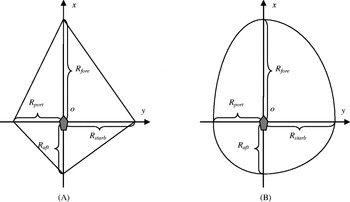
Unlike previous ship domains defined by circles, ellipses and polygons, the proposed QSD is identified by the quaternion consisting of four elements R fore, R aft, R starb, R port, where R fore and R aft indicate longitudinal radius R lon of the QSD in fore and aft directions respectively, and R starb and R port indicate lateral radius R lat of the QSD in starboard and port directions respectively. Consequently, the QSD is an area defined by a closed curve joining these four elements and the inner zone, which can be described as follows:

where f(.) is the function defining the boundary of the QSD and Q={R fore, R aft, R starb, R port} is the quaternion. Intuitively, these four parameters make it more straightforward and more effective for a navigator to establish a simple and feasible ship domain quickly. As a consequence, the QSD can be easily used in collision risk assessment and avoidance, etc. To be precise, the function f(.) in (1) can be implemented in a linear or nonlinear manner. Note that polygons and ellipses are frequently used in previous ship domains. Without loss of generality, the QSD boundary can be presented in two shapes, i.e. the quadrangle and the combined ellipse in this paper, which are illustrated in Figure 1. Vertices of the quadrangle and semi-axes of the combined ellipse are defined by longitudinal and lateral radii in the quaternion, respectively.
A. Quadrangle ship domain. B. Combined ellipse ship domain.

Therefore, according to (1), the quadrangular and the combined elliptical QSD can be respectively given by:


and the boundary functions f q(.) and f ce(.) can be described as follows:


where the sign function sgn(.) is defined as follows:
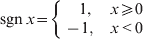
From (4) and (5), it is found that the QSD boundary can be modelled by a family of parameterized functions where the power varies. On the other hand, note that the convex boundary is suitable for ship domains which navigators onboard and observers onshore build. It follows that the general QSD can be defined as follows:


The power k determines the shape of the QSD while the quaternion Q (i.e. R fore, R aft, R starb, R port) identifies the ship domain size. Therefore, we can reasonably model the QSD by the parameters Q and k. Estimation formulae for parameters of the blocking area (Kijima, Reference Kijima and Furukawa2003) are referred to estimate longitudinal and lateral radii in Q which can be given by:
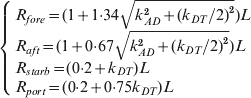
where L is the own ship length, k AD and k DT represent gains of the advance A D and the tactical diameter D T respectively, and can be calculated as follows:

where V own is the own ship speed represented in knots. It should be noted that the QSD reasonably takes into account the ship manoeuvring capability identified by the advance A D and the tactical diameter D T. Besides, the ship speed V own is used to determine the instantaneous manoeuvring capability which would be responsible for a reasonable ship domain. A D and D T of the own ship can be easily obtained while it is difficult to know these parameters of other ships encountered. For the sake of simplicity, k AD and k DT in (9) can be preset by navigators according to their onboard specifications.
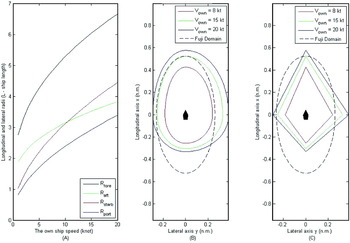
In order to demonstrate relationships between longitudinal and lateral radii R fore, R aft, R starb, R port and the own ship speed V own, a numerical simulation has been conducted and results are illustrated in Figure 2, where the ship length L=160 m and the ship speed V own varies from 1 to 20 knots. As shown in Figure 2, it is evident that the QSD size increases with the ship speed. Compared with the Fujii ship domain, which is considered to be a simple and powerful ship domain at all times, the fore and the port radii of the QSD is similar to those of the Fujii domain when the ship speed is about 15 knots, while the aft radius is much less than that of the Fuji domain and the starboard radius is slightly larger than that of the Fujii domain since the ship manoeuvring capability and encounter situations defined in COLREGS have been reasonably considered in the QSD.
A. Longitudinal and lateral radii for various ship speeds. B. Combined elliptical QSD (QSD2) and Fujii ship domain. C. Quadrangular QSD (QSD1) and Fujii ship domain.

3. THE FUZZY QUATERNION SHIP DOMAIN (FQSD) AND THE NOVEL MODEL OF COLLISION RISK BASED ON THE FQSD
The conventional ship domains divide the area around a ship into two zones, dangerous and safe – the ship domain and an area outside the domain, respectively. However, the human being tends to distinguish the area around the ship to be more than two zones which can be described in linguistic terms, very safe, safe, less safe, dangerous, very dangerous, etc. Depending on these fuzzy terms, the navigator tries to maintain certain zones clear of other ships and objects, while these fuzzy terms can be modelled by fuzzy membership functions. Therefore, the conventional ship domain with a clear boundary which is ideal, but limited in applications, can be extended to fuzzy ship domains with a series of boundaries to indicate different levels of navigational safety. On the other hand, the ship collision risk can be modelled by fuzzy ship domains since a series of fuzzy boundaries can be used to identify the level of navigational safety or danger.
3.1. The Fuzzy Quaternion Ship Domain (FQSD)
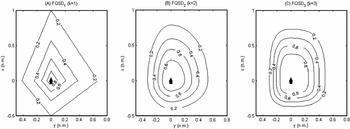
Based on the definition of the QSD, the generalized fuzzy QSD (FQSD) shown in Figure 3 can be formulated as follows:

where


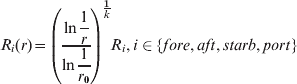
where r∊(0, 1) is used to indicate the collision risk of the corresponding fuzzy boundary of the FQSD. It should be noted that we get FQSD k(r 0)=QSD k since Q(r 0)=Q. Usually, we set r 0=0·5.
A. Fuzzy QSD while k=1 (FQSD1). B. Fuzzy QSD while k=2 (FQSD2). C. Fuzzy QSD while k=3 (FQSD3).

3.2. The Novel Model of Collision Risk Based on the FQSD
According to the definition of the FQSD, fuzzy set theory can be used to define a novel model of ship collision risk (or navigational safety). To be precise, definitions of longitudinal and lateral collision risk based on the FQSD are first presented to define the spatial collision risk (SCR), which combines longitudinal and lateral collision risk.
3.2.1. Longitudinal Collision Risk (LonCR)
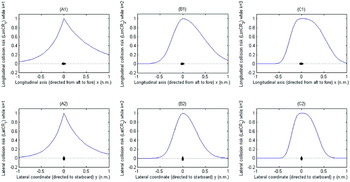
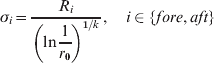
Based on the FQSD, the longitudinal collision risk shown in Figure 4 can be defined by the following fuzzy set where the membership function is given by the asymmetrical Gaussian function as follows:

where,
Longitudinal collision risk (LonCRk) while k=1, 2, 3 (A1. LonCR1, B1. LonCR2 and C1. LonCR3), and lateral collision risk (LatCRk) while k=1, 2, 3 (A2. LatCR1, B2. LatCR2 and C2. LatCR3).

3.2.2. Lateral Collision Risk (LatCR)
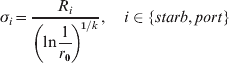
Similar to the LonCR, the lateral collision risk shown in Figure 4 is also defined by an asymmetrical Gaussian membership function given by:

where,
3.2.3. Spatial Collision Risk (SCR)
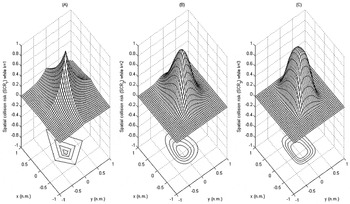
As a consequence, the combined spatial collision risk (SCR) can be composed by the LonCR and the LatCR, and is described as follows:

Comparing (19) with (12), we find that (12) can be deduced from (19) if we set SCR k(x, y)=r (0<r<1). In other words, the fuzzy boundaries of the FQSD f k(x, y; Q(r))=1 indicate the corresponding spatial collision risk SCR k(x, y)=r, which are depicted in Figure 3 and Figure 5, respectively.
Spatial collision risk (SCRk) while k=1, 2, 3 ((A) SCR1, (B) SCR2 and (C) SCR3).

4. SIMULATION STUDIES
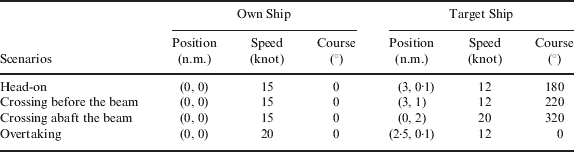
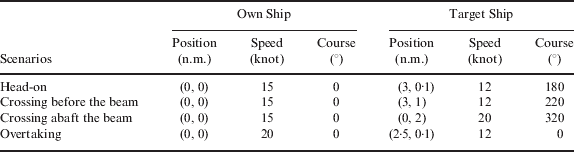
In this section, several encounter situations of own and target ships in collision risk are made to demonstrate the validity and superiority of the presented QSD and FQSD. Encounter scenarios between ships include three types of situations, i.e. head-on, crossing and overtaking, while crossing situations can be divided into before and abaft the beam. All the abovementioned situations will be considered in this paper in order that the validity of the QSD and FQSD can be well tested. For comparative studies with other ship domains, numerical simulations are presented in the uniform simulation circumstance whereby the principal dimensions of own and target ships are listed in Table 1 and initial conditions of ships in encounter situations are listed in Table 2, respectively.
The principal dimensions of own and target ships.

The initial conditions for own and target ships in encounter situations.
4.1. Head-on Situation
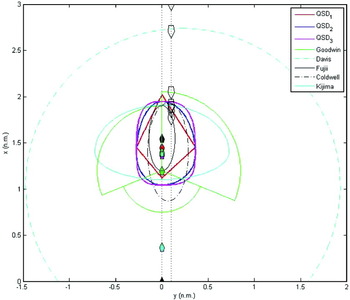
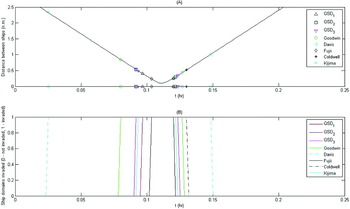
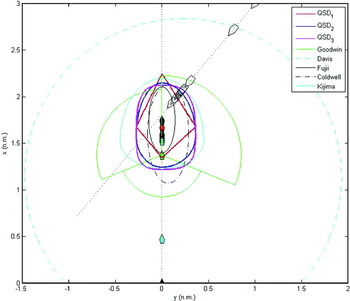
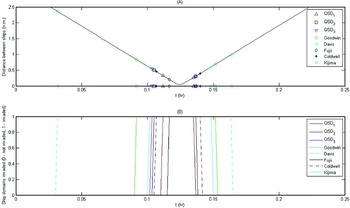
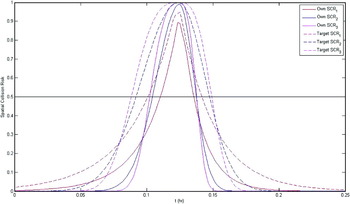
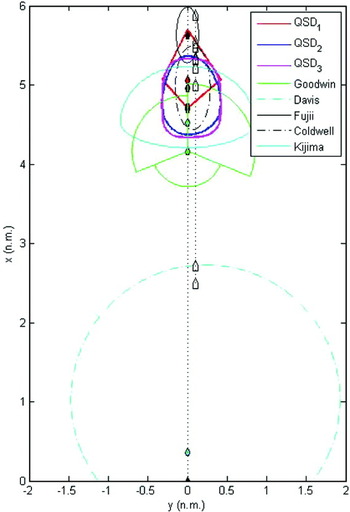
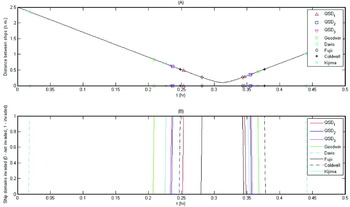
In this situation, the target ship comes towards the own ship from the front. As these two ships approach closer and closer, different ship domains are violated sequentially as shown in Figure 6. The Davis model is the most conservative ship domain while the Fujii ship domain is the most risky one. It can be seen from Figure 6 that the proposed QSD models (QSD 1, QSD 2 and QSD 3) provide more appropriate and more reasonable ship domains than other models. Figure 7 shows in detail the points where various ship domains would be invaded as the distance between the two ships decreases. It also shows that the QSD models provide moderate results among these considered ship domains. Therefore, the QSD model can be widely used for risk assessment and collision avoidance. As shown in Figure 8, the spatial collision risk (SCR) can be obtained based on the FQSD. We can see that the own ship SCR and the target SCR are identical while the target SCR is much larger than the own SCR since the target ship is larger than the own ship. In other words, the SCR varies reasonably with different ships since the manoeuvring capability is considered in the FQSD.
The QSD models compared with other ship domains in a head-on encounter situation.

A. The points where ship domains are invaded as distance between ships decreases. B. The invaded ship domains (0 – not invaded, 1 – invaded) in a head-on encounter situation.

Spatial collision risk in a head-on encounter situation.

4.2. Crossing Situation before the Beam
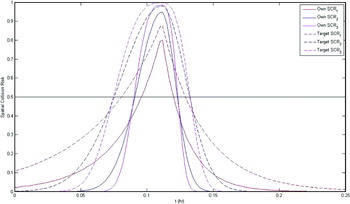
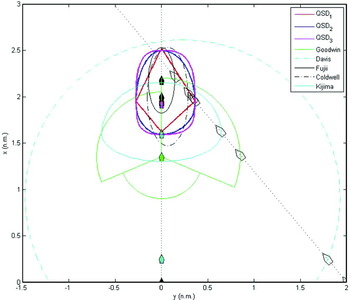
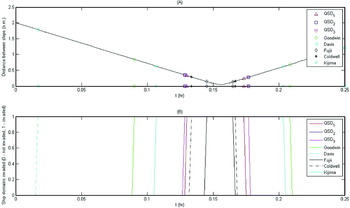
On this situation, the target ship is positioned before the beam of the own ship at the beginning and crosses the own ship trajectory. Simulation results, shown in Figure 9, are similar to those of head-on situation. QSD models (QSD 1, QSD 2 and QSD 3) provide the most reasonable ship domains. Figure 10 shows in detail the points where various ship domains would be invaded as the distance between the two ships decreases on this situation. We can draw the same conclusions that the QSD models are moderate among these considered ship domains. For the SCR based on the FQSD, simulation results are shown in Figure 11.
The QSD models compared with other ship domains in a crossing situation before the beam.

A. The points where ship domains are invaded as distance between ships decreases. B. The invaded ship domains (0 – not invaded, 1 – invaded) in a crossing situation before the beam.

Spatial collision risk in a crossing encounter situation before the beam.

4.3. Crossing Situation abaft the Beam
In this situation, the target ship is positioned abaft the beam of the own ship at the beginning and crosses the own ship trajectory. Simulation results are shown in Figures 12–14, respectively. It should be noted that the superiority of the QSD is well demonstrated in this scenario since the QSD is not only non-conservative but also secure for navigators at sea or VTS ashore. Similarly, the SCR based on the FQSD on this situation is also reasonable for risk assessment and collision avoidance.
4.4. Overtaking Situation
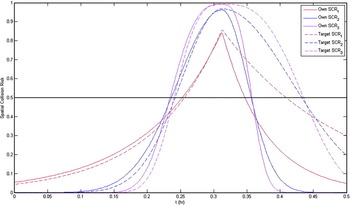
In this situation, the target ship overtakes the own ship from the stern. Simulation results are shown in Figures 15–17. It can be seen that simulation results coincide with the actual situations. Note that the QSDs are reasonable for this scenario. According to the COLREGS, the target ship does not need to take actions unless critical situations appear. Therefore, the QSD is appropriate and moderate for this situation. From Figure 17, we can see that the target SCR is identical to the own SCR before the maximum SCR. The main reason is the flexibility of the QSD with asymmetrical radii that consider many factors (i.e. encounter situations, manoeuvring capability, and COLREGS rules, etc.). It should be noted that the target SCR is much larger than that of the own SCR when the own ship overtakes the target ship since the aft domain of the own ship is much smaller than the fore domain of the target ship. Actually, there is no collision risk for these two ships at that time since the own ship speed is much greater than the target ship speed. On the other hand, navigators at sea usually take appropriate actions to avoid collision when the SCR is large.
The QSD models compared with other ship domains in a crossing situation abaft the beam.

A. The points where ship domains are invaded as distance between ships decreases. B. The invaded ship domains (0 – not invaded, 1 – invaded) in a crossing situation abaft the beam.

Spatial collision risk in a crossing encounter abaft the beam.

The QSD models compared with other ship domains in an overtaking situation.

A. The points where ship domains are invaded as distance between ships decreases. B. The invaded ship domains (0 – not invaded, 1 – invaded) in an overtaking situation.

Spatial collision risk in an overtaking situation.

5. CONCLUSIONS
In this paper, a novel quaternion ship domain (QSD) has been proposed to make up a universal and reasonable ship domain model for the practical application in the process of collision risk assessment, collision avoidance at sea and VTS systems, etc. Unlike various forms of ship domains defined by circles, ellipses and polygons, the proposed QSD model is parameterized by the quaternion Q and the index k, where Q determines the domain size and k determines the domain shape. It should be noted that some factors (i.e. manoeuvring parameters, dimensions, courses and speeds of encountered ships and COLREGS rules, etc.) affecting the ship domain have been taken into account by four elements R fore, R aft, R starb, R port in the quaternion Q while the parameter k increases the flexibility of the QSD shape. In order to present an intelligent ship domain termed fuzzy QSD (FQSD), fuzzy sets have been introduced to generalize the QSD. It is not difficult to find that the FQSD is more practical than the QSD since uncertainty and fuzzy information can be well utilized in the FQSD. Furthermore, longitudinal and lateral collision risk (LonCR and LatCR) based on the FQSD have been proposed to implement the spatial collision risk (SCR) which can be used for risk assessment, collision avoidance and trajectory planning, etc. Several computer simulations on different encounter situations have been presented for the validation of the proposed ship domain models and the analysis of comparative studies with other typical ship domains. Simulation results show that the QSD and the FQSD models are effective and superior to other ship domains. It should be noted that the SCR based on the FQSD provides reasonable and dependable results whereby the own ship SCR is identical to the target ship SCR. It follows that these simulation studies indicate that the QSD, FQSD and SCR based on the FQSD can be well used in collision risk and avoidance. Note that collisions are the major cause of shipping losses. Therefore, there is no doubt that the research results in this work could be widely applied to ship navigation in the future. However, there are still some problems to be dealt with in this framework of ship domains for collision risk and avoidance. Future work is required to determine collision avoidance based on the proposed SCR and to further estimate a safe trajectory for the ship.
ACKNOWLEDGMENT
This paper is supported by Fundamental Research Funds for the Central University, under Grant 2009 QN025.