Introduction
Healthcare transition, the purposeful, planned movement from paediatric to adult care settings, Reference Moreno1 is an inevitable and complex process as children with chronic diseases, including CHD, survive into adulthood. Despite guidelines outlining the necessity of transition care in primary care services as well as for early planning and collaboration between primary care and cardiology services, significant lapses in care remain a frequent occurrence during the transition period. Particularly for individuals with CHD, continuity of care in both cardiology and primary care services is critical for managing the long-term, evolving complexity of cardiac and non-cardiac health needs. Reference Sable, Foster and Uzark2
Lapse in care for young adults with CHD is associated with adverse outcomes, including increased visits to the emergency room, hospitalisations, and emergency intervention needs. Reference Goossens, Bovijn, Gewillig, Budts and Moons3–Reference Yeung, Kay, Roosevelt, Brandon and Yetman9 About 50% of current Adult CHD patients do not have established, ongoing cardiology care—even in regions with access to specialised Adult CHD services. Among adult females with CHD, this gap is even greater, with around 62% lacking consistent follow-up care. Reference Cordina, Nasir Ahmad and Kotchetkova10–Reference Mylotte, Pilote and Ionescu-Ittu13
Females with CHD have healthcare needs that require management from primary care and cardiology services. These needs, which typically manifest simultaneously with the recommended timeline of the transition period (at 12 years of age), amplify the gaps for these women and are often overlooked. Barriers such as fragmented care models, shifts in insurance coverage, poor communication between providers, lack of knowledgeable providers, and unclear care responsibilities also often occur during the transition period, which ultimately contribute to the delay in continuity of care Reference Chira, Ronis, Ardoin and White14–Reference Toft, Taylor and Claridge21 .
Three healthcare transition goals for the population of adults with CHD include improved continuity of care, optimal quality of life, and ideal perceived health status. Studies have suggested that uninterrupted care during the transition period is associated with improved quality of life and better perceived health status Reference Goossens, Bovijn, Gewillig, Budts and Moons3,Reference Moons, Pinxten and Dedroog22,Reference Reid, Irvine and McCrindle23 . However, the way that lapses in both primary and cardiology care intersect and affect the quality of life and perceived health status of these females with CHD remains poorly understood. To address this gap, we aimed to examine the relationships among length of lapses in care in primary care and cardiology services with quality of life and perceived health status in the population of adult females with CHD.
Methods
Design
This pilot study used a convergent mixed-methods design, in which quantitative and qualitative data were collected in parallel, analysed independently, and later integrated to obtain a complete understanding of the issue. Specifically, this study used a descriptive correlational cross-sectional quantitative design and Moustakas’s phenomenological framework. Reference Moustakas24
Theoretical frameworks
From conception to reporting, this study was guided by two frameworks. The Framework for Transforming Primary Health Care for Women Reference Zephyrin, Viswanathan, Augenstein and Bachrach25 outlined a comprehensive model of care throughout women’s lifespan that addresses the needs for primary care systems to provide high-quality sex-specific, sex-aware, and gender-sensitive care for all women. It also recognises the need for collaboration with specialty care providers to provide this high-quality care. We modified this framework to fit the population of females with CHD, as seen on Figure 1.
Modified framework for transforming primary health care for women with CHD.

Next, to address the relationship between lapse in care and quality of life or perceived health status, we also applied the Individual and Family Self-Management Theory by Ryan and Sawin. Reference Ryan and Sawin26 Individual and Family Self-Management Theory proposes three dimensions that affect self-management: context, process, and outcomes. In this study, healthcare transition serves as the context, lapse in care as the process, and quality of life and perceived health status as outcomes. A modified Individual and Family Self-Management Theory specifically addressing the outcomes of interests in this study is depicted in Figure 2.
Focused Individual and Family Self-Management Therapy.

Sample and setting
This study was conducted in a southern state in the United States. Using purposive sampling, females with CHD between 21 and 30 years old who had received care from the state’s only paediatric healthcare system that has a hybrid paediatric-adult CHD clinic were recruited. Study recruitment occurred between April 2024 and December 2024. Eligible participants were identified through electronic medical records and were contacted by the study team via phone call or electronic messaging through the patient health portal. Eligible participants were able to understand and speak English, had no neurodevelopmental disability that prevented their ability to understand or answer questions, and had experienced the transition to adult care. All participants completed the electronic questionnaires, and the characteristics of the participants are described in the results section. Completion of the questionnaire implied consent to participate in the study.
Data collection
Quantitative
Participants completed questionnaires electronically via Research Electronic Data Capture (REDCap), which promoted flexibility and convenience for the participants. Reference Harris, Taylor and Minor27,Reference Harris, Taylor, Thielke, Payne, Gonzalez and Conde28 Demographic data were collected using a 12-item questionnaire. A 21-item lapse-of-care questionnaire, designed to assess each participant’s experiences of lapse in care in cardiology, primary care, and women’s health services, consisted of open-ended narrative prompts and close-ended questions with predetermined categorical responses.
Two validated scales utilised in this study were the Short Form 12v2 (SF-12) and the CHD-TNO/AZL Adult Quality of Life. The 12-item Short Form-12 is an abbreviated version of the Short Form-36, which is used to assess an individual’s perceived health status and was developed to reduce the burden of participation. It consists of two summary scales, the Physical Component Summary and the Mental Component Summary, which together address eight domains (physical functioning, role-physical, bodily pain, general health, vitality, social functioning, role-emotional, and mental health). Reference Ware, Kosinski and Keller29 Both physical component summary and mental component summary scales utilise norm-based methods scoring system, with mean score set to 50 and a standard deviation of 10 in the general U.S. population Reference Ware, Kosinski and Keller30 . Scores range from 0–100, with scores above 50 indicating better physical or mental health status than the general population.
The CHD-TNO/AZL Adult Quality of Life is a 26-item scale to assess quality of life for the CHD population. It consists of three domains: Symptoms, Impact Cardiac Surveillance, and Worries (Cronbach’s alpha 0.77, 0.78, and 0.82). Reference Kamphuis, Zwinderman and Vogels31 Each domain is measured as an independent scale, with raw scores linearly transformed to a 0–100 scale, where higher scores reflect better functioning. Reference Kamphuis, Zwinderman and Vogels31
Qualitative
Upon completion of the questionnaires, participants were asked if they agreed to be interviewed. Semi-structured private interviews were conducted by virtual platform (n = 21) or in-person at public (n = 1) or hospital (n = 2) settings, as chosen by participants. For consistency, the primary author conducted all the interviews herself, using a refined interview guide which was pilot-tested in 2023. The interview guide included one grand tour and 12 main questions to cover the participants’ experiences of their healthcare transition process, including lapse of care as well as barriers and facilitators to the process.
Data analysis
Quantitative analyses were conducted using MAXQDA Analytics Pro (VERBI Software, 2024). Descriptive statistics including means, standard deviation, median, and interquartile ranges were calculated for continuous variables. Frequency and percentage calculations were completed for categorical variables. Spearman’s correlational analyses were conducted to assess the correlation between the length of lapses of care and Short Form-12 subscale score (physical component summary and mental component summary), as well as between the length of lapses of care and CHD-TNO/AZL Adult Quality of Life overall and subscale scores (Symptoms, Worries, and Impact Cardiac Surveillance). Analysis of variance was completed to compare Short Form-12 and CHD-TNO/AZL Adult Quality of Life scores and the length of lapses of care. Original categories for length of lapse of care were used for Spearman’s analysis, which included less than 3 months, 3 to 6 months, 6 to 9 months, 9 to 12 months, and more than 12 months. For all other analyses, lapse of care categories were collapsed as follows: less than 6 months, between 6 and 12 months, and more than 12 months. This aligned with the recommendation of transition guidelines that the interval between the final paediatric visit and the first adult healthcare visit should not exceed six months to maintain continuity of care. Reference Cooley and Sagerman32
Qualitative data analysis followed Moustakas’s phenomenological framework Reference Moustakas24 and Braun and Clarke’s thematic analysis. Reference Braun and Clarke33 Data were analysed using an inductive-deductive approach. The primary author (DA) developed a predetermined set of codes to use for initial coding on three sets of transcriptions. Another researcher (MR) independently coded the same sets of transcriptions using the codebook developed by DA. Both researchers analysed emerging codes and themes simultaneously, and then developed the final codebook used to analyse all the transcriptions. Researchers conducted weekly discussions until discrepancies were resolved and codes and themes were finalised.
Results
Patient characteristics
Thirty adult females with CHD completed the questionnaires. Almost half of the participants (46.7%) were between 24 and 26 years of age, while 36.7% were between 21 and 23 years, and 16.7% were between 27 and 30. The majority of participants identified themselves as white (80%), non-Hispanic (93.3%), employed (76.7%), and having post-secondary education (66.7%), private insurance (63.3%), and an adult primary care provider (70%). Two participants identified as non-binary (6.7%) and 28 (93.3%) identified as female. For further description of participants’ demographics, see Supplementary Table S1.
Twenty-four participants agreed to be interviewed. The interviews ranged from 22 to 81 minutes. They were audio-recorded, transcribed verbatim, and analysed using MAXQDA Analytics Pro (VERBI Software, 2024).
Lapse of care
For both cardiology and primary care services, the participants were categorised based on length of lapse of care as less than six months (no lapse), between 6 and 12 months (moderate lapse), and more than 12 months (extended lapse). Among those receiving cardiology services, 33.3% (n = 10) participants reported experiencing no lapse, 20.0% (n = 6) reported a moderate lapse, and 46.7% (n = 14) reported extended lapse of care. In contrast, in primary care services, there was a higher proportion of participants who experienced extended care lapses. Only 23.3% (n = 7) reported no lapse of care, while 16.7% (n = 5) reported moderate lapses, and 60.0% (n = 18) experienced extended lapses in primary care. Notably, all participants who did not currently have an established primary care provider (30.0%, n = 9) reported an extended lapse in primary care.
Cardiology services
As previously noted, participants were sampled from the state’s only paediatric healthcare system with a hybrid paediatric-adult CHD clinic. Six participants reported being followed by non-Adult CHD specialty clinics, which included one cardiac transplant specialty clinic and five non-Adult CHD cardiology clinics (one out of state and four in state). The remainder of the participants were followed in the Adult CHD specialty clinic, either staying with their paediatric cardiologists or switching to the adult cardiology providers. Depending on their condition, some reported being seen every six months to a year, while some reported being seen every two to three years by their cardiologist. For those being followed in the Adult CHD clinic, their primary reasons for transitioning to an adult cardiologist included the retirement of their paediatric cardiologist or a recommendation from their paediatric cardiologist based on pregnancy or disease aetiology.
Primary care services
Thirty percent of the participants reported that they had not established adult primary care services. Regardless of this, for medical concerns unrelated to their CHD, eight out of 30 participants reported going to urgent care facilities, and one reported going to a student health centre, while two participants reported continuing to rely on their cardiology providers. Participants reported seeing two types of paediatric primary care providers during their childhood, which were paediatricians and family medicine providers. Those previously seen by a paediatrician reported an abrupt transition process into adult care that contributed to a disruption in care. This difficult transition process included the sudden discharge from their paediatrician into adult care without clear guidance on this transition process and the difficulties of finding adult primary care providers who were willing to accept new patients with CHD. Other contributing factors to these disruptions in care included physical relocation and limited access to primary care services.
Quality of life and perceived health status between lapse of care groups
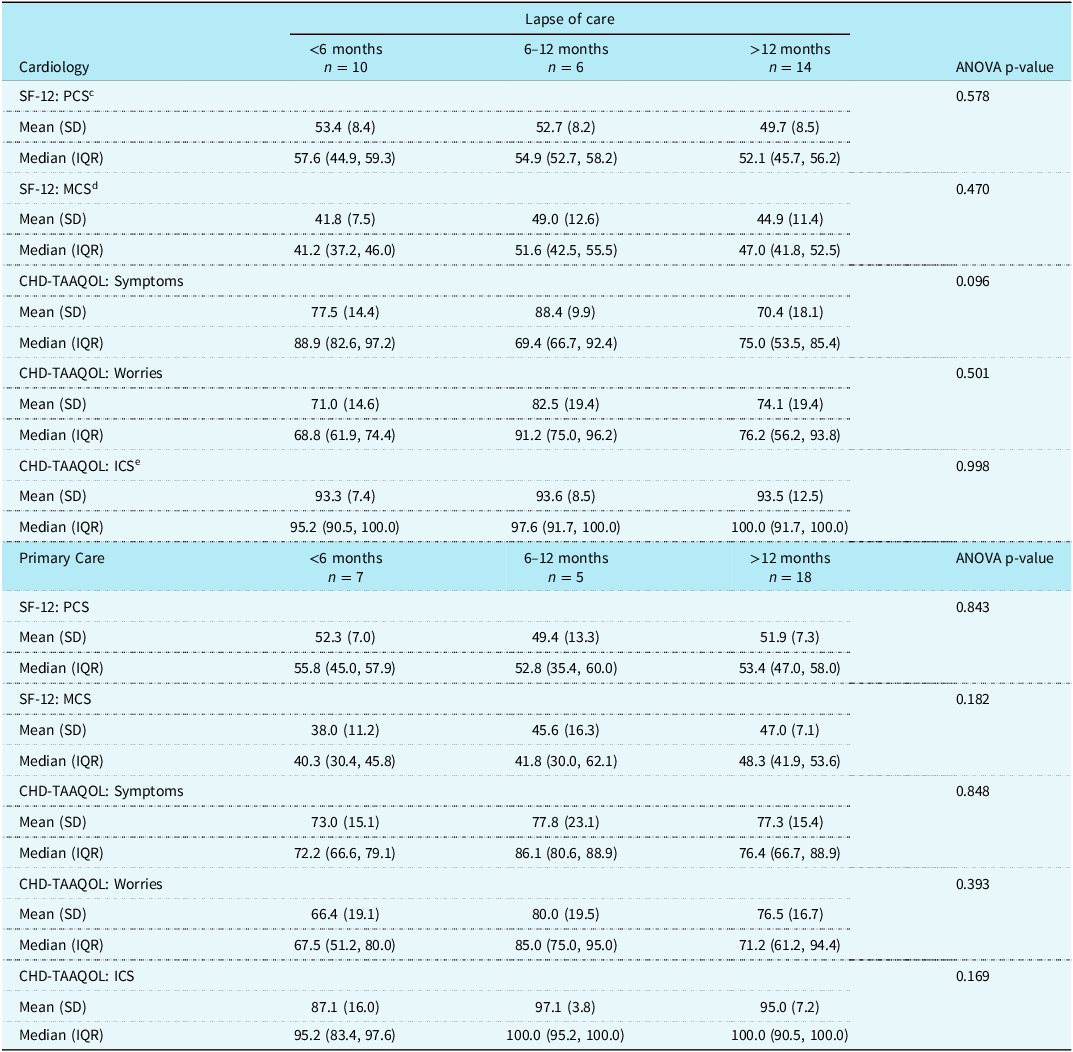
Regardless of the length of lapse of care in cardiology and primary care services, most of these adult females with CHD reported physical health status (Short Form-12 physical component summary scores) as the same or better than the general population (76.7%). However, those experiencing no lapse in care in either cardiology or primary care services, or extended lapse in care in cardiology services, reported mental health status (Short Form-12 mental component summary scores) below the general population (Table 1).
SF-12a and CHD-TAAQOL b scores based on length of lapse of care

Note: aSF-12: Short Form 12v2.
b CHD-TAAQOL: Congenital Heart Disease-TNO/AZL Adult Quality of Life.
c PCS: Physical Component Summary.
d MCS: Mental Component Summary.
e ICS: Impact Cardiac Surveillance.
For cardiology services, participants with no lapse in care reported the highest physical health status (mean = 53.4), followed by the 6–12 months group, with the lowest mean in the extended lapse group (49.7), suggesting a trend toward lower perceived physical health with extended lapses of cardiology care. In contrast, the mental health status was highest in the 6–12 months lapse of cardiology care group (mean = 49.0), with lower scores in both the extended lapse (mean = 44.9) and the no lapse (mean = 41.8) groups. These scores indicate that mental health status for all lapses in cardiology care groups was below (worse than) that of the general population. For those with a lapse in cardiology care, quality of life (as measured by the CHD-TNO/AZL Adult Quality of Life) was highest (better) among those with a 6–12 month lapse of care for the Symptoms, Worries, and Impact Cardiac Surveillance domains. For all lapse in cardiology care groups, quality of life on the Impact Cardiac Surveillance was higher (better) than in the Symptoms and Worries domains. However, differences in perceived mental and physical health status, and the quality of life domains, were not statistically significant between the lapse of care groups (Table 1).
Participants with an extended lapse in primary care reported higher mental health status (mental component summary), while those with the shortest lapses in primary care reported the lowest (worse) mental health scores. While mental component summary scores were not statistically significant between lapse of care groups, all groups reported lower mental health status than the general population. Physical component summary scores (physical health status) were similar across groups with lapses in primary care and in comparison to the general population. Those with the shortest lapse in primary care (< 6 months) reported the lowest (worst) quality of life scores across all three CHD-TNO/AZL Adult Quality of Life domains, while those with a lapse in primary care between 6 and 12 months reported the highest quality of life. For all lapse of primary care groups, quality of life on the Impact Cardiac Surveillance was higher (better) than in the Symptoms and Worries domains. It is important to note that these results were statistically insignificant.
Correlations between lapse of care, perceived health status, and quality of life
Non–statistically significant correlations were found between perceived health status, quality of life, and lapse of care in cardiology and primary care. A weak negative correlation was discovered between physical health status (physical component summary on the Short Form-12) and length of lapsed care for cardiology (ρ = −0.206 [p = 0.275]), while no correlation was observed between physical component summary and lapse duration in primary care services (ρ = −0.012 [p = 0.949]). Mental health status (mental component summary scores) had a weak positive correlation with lapse of care in both cardiology and primary care services (ρ = 0.145 [p = 0.446] and ρ = 0.270 [p = 0.149], respectively).
The associations between length of lapse in care for cardiology and quality of life are very weak for Symptoms (ρ = −0.182, [p = 0.337]) and Worries (ρ = −0.041 [p = 0.832]), while there was a weak positive association for Impact Cardiac Surveillance (ρ = 0.133 [p = 0.484]). Similar to cardiology, the associations between length of lapses in primary care and quality of life scores showed no correlation for Symptoms (ρ = 0.040 [p = 0.834]), and a very weak positive correlation for the remaining scores (Worries: ρ = 0.161 [p = 0.396]; Impact Cardiac Surveillance: ρ = 0.147 [p = 0.440]).
Barriers contributing to lapse of care through a socioecological lens
Regardless of whether lapses in care occurred in cardiology or primary care services, participants consistently identified certain healthcare system factors as barriers to uninterrupted care in adult healthcare settings. These barriers can be effectively understood through a socioecological framework, as noted in Table 2.
Patient-reported barriers to uninterrupted care categorised by socioecological level

The qualitative data identified one key theme, which is that the barriers that affect lapse of care are multilevel and socioecological. The theme that emerged from the data aligns with a socioecological perspective, which included five subthemes: (1) individual-level barriers, including limited understanding of the condition, of the healthcare transition process, and of the adult healthcare system, (2) interpersonal barriers, which arose from inadequate communication between paediatric and adult providers or a suboptimal parental or family dynamic, (3) organisational barriers, due to the absence of structured transition protocols and the provider’s lack of knowledge affecting delay in care, (4) community barriers, such as physical relocation and limited access to adult care providers, both primary care and cardiology, and (5) policy barriers, which included changes in insurance coverage and the lack of guidance in navigating the adult healthcare system. See Table 2 for quotes describing these barriers.
Discussion
This mixed-methods pilot study investigated the relationships among quality of life, perceived health status, and lapse of care, both in cardiology and primary care services, in the population of adult females with CHD. The convergent mixed-methods design particularly fits this study due to the small sample size and its ability to support comprehensive understanding of the issue of lapse of care as it relates to the healthcare transition process.
A notable finding from this study is the high prevalence of care lapses in both cardiology and primary care services, with 46.7% and 60.0% of participants, respectively, reporting lapses exceeding 12 months. Even more concerning is that, at the time of the study, 30% of participants did not have an established adult primary care provider. This highlights a persistent gap between recommended best practices and real-world implementation. Despite established guidelines outlining the healthcare transition process, including early transition planning, coordinated handoffs between paediatric and adult providers, and primary care oversight, many adults with chronic conditions such as CHD lack consistent access to primary care. Consequently, they often depend exclusively on their specialty providers for complete health management, highlighting systemic inadequacies in delivering comprehensive and coordinated adult care.
The quantitative analyses revealed no statistical differencesbetween any of the groups nor a correlational relationship between length of lapses of care, quality of life, and perceived health status. However, the findings demonstrated notable clinical significance with important implications for patient outcomes and continuity of care. Most participants, regardless of the duration of the lapse of care in cardiology or primary care services, reported physical health scores similar to or better than the general population. This was supported by the qualitative findings, in which participants described delaying to seek care due to feeling healthy or having no symptoms. However, mental health scores for those who experienced no lapse of care in either cardiology or primary care services, or who experienced a lapse longer than 12 months in cardiology services, were lower than the general population. Incidentally, these same groups that reported no lapse of care in either cardiology or primary care services also reported the lowest Worries scores on the CHD-TNO/AZL Adult Quality of Life. For participants without any lapse of care, this may reflect underlying anxiety or psychological distress associated with the uncertainty of the transition process and navigation of the adult healthcare system, particularly among those still receiving care from their ageing paediatric cardiologists without a clear plan for transfer to adult providers. This aligns with prior findings that uncertainty around transition planning and prolonged dependence on paediatric providers can contribute to emotional strain and decreased self-efficacy in adolescents and young adults with chronic conditions. Reference Betz, Smith and Macias34,Reference Schwartz, Tuchman, Hobbie and Ginsberg35 For participants with lapse of care longer than 12 months, the lower mental health scores could also be related to disengagement and care avoidance due to persistent anxiety and stress from the burden of managing their complex healthcare needs, as well as other life events as they become older and assume responsibility for their own family unit. These patterns are consistent with Ryan and Sawin’s Individual and Family Self-Management Theory, Reference Ryan and Sawin26 where context (healthcare transition process and healthcare systems) and process (perceived health status and relationships) have direct effect on mental health and self-management outcomes.
Importantly, the perceived impact of cardiac surveillance remained consistently high across all cardiology lapse of care durations, suggesting that the participants continued to value and trust their cardiology providers regardless of follow-up timing. There was also a trend toward lower physical health scores and higher CHD-TNO/AZL Adult Quality of Life Symptoms scores among patients with longer lapses, indicating potentially poorer physical functioning and greater symptoms burden, which are patterns consistent with prior findings that discontinuity in cardiology care may be associated with worse health perceptions.
Interestingly, however, participants who experienced no lapse of care in primary care services reported lower quality of life and mental health scores, challenging previous findings that uninterrupted care or improved continuity of care leads to better patient-reported health outcomes. The qualitative findings provided further context to the quantitative findings, highlighting the complexity of quality of care beyond access, continuity, and care coordination alone, and may be related to other factors such as provider relationships, communication challenges, or unmet needs within adult primary care settings. Through a socioecological lens, participants described multilevel barriers that resulted in a lapse of care during their transition process, including limited access to knowledgeable providers, poor inter-provider communication, insurance constraints, and logistical difficulties such as geographic relocation. They also reported challenges such as abrupt transfer processes, particularly for those who had been followed by paediatricians rather than family-medicine providers.
These findings highlight the need for integrated transition planning that combines cardiology and primary care perspectives for adult females with CHD. Using models like the Framework for Transforming Primary Health Care for Women, the results of this study suggest that to improve outcomes for adult females with CHD, it is necessary to address not only time-sensitive clinic appointments and referrals, but also systemic structures that support engagement, autonomy, and psychosocial well-being during the transition. The integration of these quantitative and qualitative findings offers a more comprehensive understanding of the healthcare transition experiences of adult females with CHD. While the quantitative data did not show statistically significant results, the qualitative data revealed nuanced and meaningful narratives of care disruption, unmet needs, multilevel barriers, and emotional distress during the transition period, which are clinically significant issues and, therefore, highly relevant to patient care. This underscores the importance of assessing both clinical and statistical significance, particularly when addressing complex, person-centred health outcomes. Reference Barría36
There are some limitations to this study. First, this study is limited by its small sample size (N = 30), which restricts the generalisability of findings and reduces statistical power to detect significant associations. The cross-sectional design prevents determining causality between care lapses and perceived health status or quality of life. Self-report measures can capture personal experiences but may suffer from recall bias or social desirability effects. The study was sampled from a single paediatric healthcare system in a southern state of the US, where the percentage of those residing in rural areas is higher than the national average; this could translate into significant disparities in cardiovascular health and might present as a biased socio-demographic profile. Finally, while the study concentrated on adult females with CHD to emphasise gender-specific experiences, it is recommended that future research encompass a wider gender representation and a more diverse demographic to enhance our comprehension of diverse transitional challenges.
Conclusions
Adult females with CHD face many challenges beyond their cardiology needs. Findings from this study support the critical role of interdisciplinary collaboration to manage transition care for adult females with CHD. Primary care providers need further education to equip them to manage adult CHD patients, while cardiology providers must be encouraged to initiate consistent, structured transition planning discussions with their patients before transfer is imminent and to emphasise the necessity of having consistent primary care providers. It is important for healthcare systems and providers to establish a care model in which primary care and specialty providers could collaborate actively to improve transition outcomes for adults with chronic conditions and to reduce barriers to establishing adult primary care.
Supplementary material
The supplementary material for this article can be found at https://doi.org/10.1017/S104795112511007X.
Acknowledgements
The authors of this manuscript acknowledge the participants for sharing their experiences and providing their time. Appreciation is also extended to Dr C. Dumas for his editorial support and guidance during the preparation of this manuscript.
Financial support
This research was funded by Arkansas Children’s Research Institute/Arkansas Biosciences Institute Nursing and Allied Health Grant.
Competing interests
The authors declare no conflicts of interest.
Ethical standard
Ethical approval was obtained from University of Arkansas for Medical Sciences IRB (IRB# 2735354).