




No CrossRef data available.
The use of articles by monolingual Puerto Rican Spanish-speaking children with specific language impairment
Published online by Cambridge University Press: 01 November 2005
Abstract
The present investigation sought to evaluate patterns of article use in a group of monolingual Spanish-speaking children with specific language impairment (SLI). In particular, because of conflicting results reported in previous studies, it was of interest to discern specific types of nontarget responses and how these corresponded to what has been reported in other Spanish-speaking children with SLI. Eleven children with SLI and 11 age-matched peers participated in the study. Three different spontaneous speech samples were gathered from each child. In addition, an experimental task that assessed the children's use of articles with a variety of nouns was also administered to the children. The results of the study for both spontaneous speech and experimental data indicated that the children with SLI performed significantly poorer in their use of Spanish articles than their age-matched peers. Most of the nontarget responses consisted of omission of the target article. In contrast to a previous study by Restrepo and Gutiérrez–Clellen, the children did not present with deficits in noun phrase gender agreement. The gender errors that were observed appeared to be due to difficulties accessing the correct article form and not due to deficits in knowledge of the gender agreement paradigm. Possible theoretical explanations were explored suggesting that both processing and linguistic explanations, in particular optionality of determiners, could explain the observed patterns. Reasons for cross-study differences in error patterns are suggested, including relative phonological skill and language learning environment.
Information
- Type
- Articles
- Information
- Copyright
- © 2005 Cambridge University Press
Over the past two decades, the cross-linguistic study of children diagnosed with specific language impairment (SLI) has significantly increased (cf. Leonard, 1998). Said research has provided indispensable data for understanding SLI, both from a theoretical and clinical perspective. Theoretically, such research provides a vast amount of data to test the various explanations of the underlying problem of SLI, as any theory must explain the phenomenon as it is manifested across languages. Clinically, it presents important information for identifying SLI across speakers of different languages. One language that has begun to receive more attention is Spanish. Studies on SLI in Spanish speakers have attempted to identify potential markers for SLI, focusing on grammatical aspects that have been noted as being “problematic” in speakers of other languages, some typologically similar (e.g., Italian) and others less similar (e.g., English). Of particular interest to the present investigation is the research that has focused mainly on Spanish-speaking children with SLI's use of determiners, specifically articles. It is of interest because the research on children's use of articles does indicate that it is a particular area of deficit. Nevertheless, the patterns of error noted across studies have differed, which in turn, may impact our explanations as to why children do present with deficits in article use. Prior to examining the available data on article use by both typical and atypical Spanish-speaking children, a brief discussion of the language's noun phrase (NP) structure, with special focus on the use of articles, is necessary.
SPANISH NPs
One of the most salient characteristics of Spanish NPs is that all constituents must agree in both gender and number. Thus, Spanish articles differ with respect to these two characteristics: gender (masculine, feminine, and neuter) and number (singular and plural). Each noun in Spanish has an inherent or lexical gender (Harris, 1991), and both articles and adjectives must conform to this gender. A summary of the Spanish article forms, both definite and indefinite, is presented in Table 1. As can be observed, the feminine singular and plural, and the masculine plural articles conform to the default Spanish syllable structure where the initial sound is a consonant (Alarcos Llorach, 1994). Singular masculine forms, both definite and indefinite, have a VC syllable structure. Definite articles in Spanish have been described as being unstressed (Alarcos Llorach, 1994). On the other hand, indefinite articles can be either stressed or unstressed (Alarcos Llorach, 1994). For example, indefinite articles are stressed in instances where the speaker wants to indicate that they are describing one, and not two, objects (e.g., Quiero un cuchillo./I want a [one] knife.).

Various Spanish linguists have attempted to establish rules for ascribing lexical gender to Spanish nouns (Klein, 1989; Natalicio, 1983; Roca, 1989; Teschner, 1987). Nevertheless, most attempts have resulted in long lists of “rules” where the word origin, for the most part, is used to establish particular rules, which seem cumbersome at best, especially for a child acquiring Spanish as a first language (cf. Bergen, 1978; Ritter, 1993). This does not mean that there are no general patterns that coincide with the noun's inherent gender. For example, nouns ending with -a tend to be feminine (e.g., la [fem.] casa [the house]), and nouns ending with -o are generally masculine (e.g., el [masc.] pelo [the hair]), although exceptions abound in the language (e.g., el [masc.] problema [the problem], la [fem.] mano [the hand]). Many nouns do not end in a or o, and similar word endings can be masculine or feminine (e.g., el [masc.] café [the coffee], la [fem.] torre [the tower], el [masc.] avión [the airplane], la [fem.] canción [the song]). Because of this, it has been suggested that lexical acquisition includes learning the noun's corresponding gender; that is, gender is a feature of the noun (Bybee, 1985; Gariano, 1984). The learner's role, then, is twofold: identifying the lexical gender of new nouns; and, when producing NPs that require determiners and/or adjectives, establishing what particular form corresponds to the head noun's inherent gender.
The way lexical gender is ascribed to a Spanish noun can be categorized with respect to two aspects of the noun, its phonetic characteristic (word ending), and its referent or semantic features. As mentioned previously, in general, nouns ending in -o are masculine, and nouns ending in -a are feminine; thus, these can be described as typical-ending nouns for gender (Harris, 1991; Ritter, 1993). Nouns ending in other vowels and in consonants can be either feminine or masculine, and for ease of presentation, will be described as atypical noun endings. Certain nouns, specifically animate, present with an inherent gender. Some examples of these are el padre (the father), la hija (the daughter), el padrino (the godfather), making these semantically transparent as to noun gender agreement. Most nouns, on the other hand, do not have an inherent gender, as, for example, the words la casa (the house), el pie (the foot), la torre (the tower). In these cases, agreement is not determined by word meaning (i.e., nontransparent semantically). These patterns suggest that gender agreement cues vary across nouns and that the type of noun may thus impact use of correct gender agreement. Table 2 provides examples of Spanish nouns that differ among the semantic and phonological transparency features.

Data from research on article use in typically developing children provide some insight as to how determiners, in particular articles, and thus gender agreement, are acquired. Available studies, mostly based on data from one child, agree that articles are acquired quite early in Spanish-speaking children. By 3 years, 0 months (3;0) of age, children demonstrate correct use of gender and number agreement, with minimal errors (cf. Barreña, 1997; Clark, 1985; Hernández–Pina, 1984; Idiazabal, 1995; Smith, Nix, Davey, López Ornat, & Messer, 2003). Early acquisition of the determiner system in Spanish has been ascribed to the relatively uniform and rich determiner–noun agreement paradigm (Baauw, 2002). For example, at least one feature of agreement (plural or gender) is always expressed in the NP. In addition, use of determiners is obligatory in many contexts. Incorrect use of article with respect to gender agreement has been reported in the research, albeit the incidence of this error pattern is rather low. What is interesting about this aspect is that the direction of error described has not been consistent across the studies. Although some studies suggest that children's agreement errors are mainly masculine to feminine (i.e., la/el; cf. Clark, 1985; López–Ornat, 1997), others present data that indicate the direction of the error from feminine to masculine (i.e., el/la; cf. Barreña, 1997; Hernández–Pina, 1984; Idiazabal, 1995).
When addressing the issue of gender agreement in acquisition, one of the problems with the developmental data collected thus far is that the researchers, for the most part, failed to consider the particular characteristics of the noun when studying gender agreement and how these may impact children's acquisition of lexical gender and thus agreement. In a large cross-sectional study, Pérez–Pereira (1991) evaluated children's use of particular cues to ascribe grammatical gender to invented words. He manipulated the semantic and phonological cues provided in order to identify which were more salient. Invented words referred either to animate beings with an inherent gender or to inanimate forms. The words also varied with respect to their endings, thus providing different phonological cues. The phonological and semantic cues were at times consistent (e.g., the word lodena with a female referent) and at other times were not (e.g., linolo with a female referent). Results indicated that children tended to assign masculine gender on more occasions to invented nouns than feminine gender. Interestingly, the animate/inanimate distinction did not affect the children's use of gender. For example, visually feminine forms did not result necessarily in the use of the feminine article. When cues were conflicting, the children tended to rely more on the phonological characteristics of the noun. Based on these results, it is plausible that the different error patterns noted across the Spanish developmental studies may result from the particular characteristics of the nouns produced by the children.
ARTICLE USE IN SPANISH AND SLI: PREDICTIONS
Why study articles in Spanish-speaking children with SLI? Cross-linguistic research on SLI, specifically English and Italian, has reported that children with SLI present deficits in the productive use of articles (cf. Bortoloni, Leonard, & Caselli, 1998; Leonard, 1998). In both languages, children with SLI, compared to both age-matched and language-matched (mean length of utterance [MLU] in words) peers, present with a significantly higher incidence of article omissions in their spontaneous speech. Because it is thus a potential area of deficit, articles have been studied by various researchers focusing on Spanish. In addition, due to Spanish NP structure, where determiners must agree with the head noun's lexical gender, children's use of articles may aid in evaluating how aspects of agreement at the NP level may be affected in Spanish-speaking children with SLI.
In general, accounts of the inherent deficits in children with SLI have tended to follow two different routes, which sometimes can explain the same patterns of deficits: (a) a processing or surface account and (b) various linguistic accounts. These can be used to make predictions as to the possible error patterns observed in Spanish-speaking children. The process/surface account suggests that children with SLI have difficulty producing linguistic forms that are not perceptually salient, especially when these have a particular grammatical function. This is due to a limited processing capacity, whereby the child will focus on more salient characteristics of the input, and less on “weaker” or less salient forms. Due to this limited processing capacity, children may evidence difficulty in perceiving certain morphemes and in ascribing to these specific grammatical functions, thus resulting in problems producing certain forms in the language. As described in the previous section, Spanish definite articles are unstressed; it would be expected, then, that Spanish-speaking children with SLI would present with deficits in the use of articles, specifically the forms el and la. This pattern would result because these are of short duration and have low perceptual saliency. Such an account also postulates that certain prosodic contexts will be more difficult for the children. Specifically, contexts where these articles are preceded by a weak syllable would be hypothesized as being more problematic (cf. Restrepo & Gutiérrez–Clellen, 2001). As to gender errors, because the NP agreement paradigm for Spanish can be described as rich and uniform, and thus relatively salient and transparent, it is expected, as noted in the Italian research, where NP agreement is similar in its structure to Spanish, that gender errors will be minimal (cf. Bortoloni et al., 1998). Thus, semantic, prosodic and phonological aspects of the language interact to render some grammatical forms more difficult for children with SLI, with the resulting error pattern being omission.
The linguistic account can take two forms: missing feature/agreement deficit in the child's language (cf. Clahsen, Bartke & Göllner, 1997; van der Lely, 2003) or target feature is optional in the language (Rice & Wexler, 1996; Wexler, 2003). These two approaches have focused mainly on verbal inflection/agreement, but they can be extended to NPs. Although both fall under the rubric of linguistic explanations, they establish differing reasons for the problems observed in children with SLI. Because of this, diverse predictions are made as to the pattern of error that should be present in the production of articles.
The first account proposes that children with SLI have inherent deficits with particular grammatical aspects, especially with respect to more formal features of the language, such as agreement. For example, Clahsen et al. (1997) suggest that features that do not have a semantic interpretation but are primarily grammatical in nature, as, for example, subject–verb agreement, are particularly difficult for children with SLI. Such an interpretation can be extended to NP agreement, as, for the most part, there is no semantic interpretation for gender assignment (i.e., agreement). In addition, determiner forms, specifically articles, do not provide any semantic information to the NP. Based on this account, article use may be problematic because it is a formal feature of the language, and both gender and omission errors may be evidenced in Spanish-speaking children with SLI. Gender errors would be more evident in contexts where there is no semantic transparency in gender assignment (i.e., any nonhuman referent).
The second linguistic account again focuses more on verbal inflection and proposes that children with SLI go through an extended optional infinitive stage in which the use of agreement is not obligatory. Thus, children's productions would consist of both target and nontarget responses for a longer period, as contrasted to typically developing peers. When produced, agreement morphemes are used correctly (e.g., third person form with nominative third person pronoun: She drinks.). Main proponents of this explanation for the symptomatology of SLI have been Rice and Wexler (1996). Although this optionality principle has concentrated mainly on verb inflection, it has been extended to NPs. It is plausible that determiner use in children with SLI does not follow the adult rules for identifying where these are obligatory, and use of articles is, in fact optional, in the child's linguistic system. If this were the case, the main pattern of error to be observed in the children's use of articles, as in the processing account, would be that of omission. If we follow the pattern noted for verb agreement described by Rice and Wexler, gender errors should not be expected.
LEXICAL LEARNING AND GRAMMATICAL GENDER: FURTHER PREDICTIONS
The previous theoretical accounts of SLI and their predictions as to how articles will be produced by Spanish-speaking children have focused mainly on grammatical or functional aspects of language. With respect to article use, and specifically NP gender agreement, lexical learning can also impact performance. Recall that each noun in Spanish has a lexical gender; thus, as children learn new nouns, they have to also learn the noun's inherent gender. Once this is established and they learn the determiner system, they will be able to mark agreement between the various NP constituents. Deficits in children with SLI's lexical skill have been reported (cf. Hick, Joseph, Conti–Ramsden, & Serratrice, 2002; Leonard, 1998). These have included their ability to learn new words and fast mapping skills (cf. Alt, Plante, & Creusere, 2004; Kiernan & Gray, 1998). Perhaps Spanish-speaking children with SLI will present with deficits in article use, specifically with gender agreement, because of inherent difficulties in word learning. According to the lexical morphology model proposed by Bybee (1985, 1995), certain lexical features are more peripheral to a word's inherent meaning, and thus, are more vulnerable to learning difficulties and to factors such as frequency of use and frequency in the input. Included in these features is gender that, in many instances, is not related to a noun's meaning. Different patterns of performance should be expected, depending on the phonological and semantic characteristics of the word being acquired. Specifically, semantically transparent nouns should result in a lower incidence of gender errors. Another feature of lexical morphology includes regularity of forms and saliency; thus, more regular and salient patterns will result in the learning of inherent gender, as is the case with feminine a-ending nouns and masculine o-ending nouns.
ARTICLE USE IN SPANISH SLI: THE DATA
Bosch and Serra (1997) addressed the area of article use within a broader study of SLI in monolingual Spanish-speaking children from Spain. They analyzed the spontaneous speech samples of a group of 12 children (mean age=7;6) with SLI and contrasted their performance with that of age-matched and an MLU-matched control group. The children with SLI varied in terms of presenting concomitant phonological disorders, one child having no difficulties in sound production, five children with mild to moderate deficits, and four children with significant deficits in this area. The most salient result was the observation that, as a group, the children with SLI made very few errors in the use of articles. In fact, mean percent accuracy for the group was 87%. Although the age-matched and MLU-matched children were significantly more accurate, the children with SLI did evidence high accuracy scores. Bosch and Serra further indicate that when the children evidenced errors in article use, these were mainly errors of omission, with minimal agreement errors. These errors were mostly noted in the use of definite articles (i.e., el, la, los, las). Most of the omission errors were produced by children with moderate and significant phonological deficits, thus suggesting an interaction between phonological skill and production of articles.
A similar pattern of performance, especially with respect to error patterns, was reported by Bedore and Leonard (2001). They studied NP morphology in a group of Spanish-speaking preschoolers with SLI, as contrasted to a group of MLU-matched (words) and age-matched peers. The children were residing in the southwestern United States. NP morphology was assessed via experimental tasks. The children with SLI made significantly more errors in the production of article forms, but only when contrasted with the response patterns of the age-matched peers. Interestingly, the percent accuracy rates for the children with SLI in the use of both definite and indefinite articles was quite low, reaching 46.33 and 47.67%, respectively. Review of the error patterns indicate that omissions occurred with the highest frequency in all three groups. If substitution errors were produced, these tended to affect one feature of the article, most often plurality. Gender errors, although they did occur, were minimal. In addition, there did not appear to be substantial differences in accuracy of production of definite and indefinite articles.
Additional data on article use by Spanish-speaking children with SLI have been provided by Restrepo and Gutiérrez–Clellen (2001). They were particularly interested in studying the pattern of error in the production of articles, as contrasted to those reported by Bosch and Serra (1997). Narrative and spontaneous speech samples were collected from a group of 5- to 7-year-olds with a diagnosis of SLI. Their performance was contrasted to that of a group of age-matched controls. In contrast to Bosch and Serra's study, where the children were living in a Spanish-majority context (Spain), the children in Restrepo and Gutiérrez–Clellen's were living in southwestern United States. In another contrast to Bosch and Serra's study, the children with SLI presented with either no or mild impairment in phonological skill. The children's performance suggested a different error pattern. As Bosch and Serra, the children's performance was significantly different from that of age-matched controls and the article el appeared to be produced less accurately. Unlike Bosch and Serra, the most frequently occurring error was that of gender. They were nevertheless quite accurate in their use of articles, with a range of percent correct production ranging from as low as 77.7% to as high as 83%.
Because of the conflicting results, specifically with respect to particular patterns of error in the use of articles by Spanish-speaking children with SLI, the purpose of the present investigation was to gather additional data on children's use of articles. This study is part of a large study on children from different Spanish language backgrounds use of NP gender agreement morphology. In this investigation, we collected data via conversation, story retell and experimental probes on preschool monolingual Puerto Rican children with and without SLI. In particular, we were interested in addressing the following questions. Do Spanish-speaking children with SLI present with problems in the use of articles, compared to age-matched controls? What are the patterns of error noted and how do these compare to what has been reported in the literature? If children do produce gender errors, do any particular characteristics of the word, such as semantic transparency and phonological pattern, impact the presence of this type of error? The goal of this investigation was to contrast performance with yet another group of Spanish speakers using a variety of procedures and controlling for word characteristics cited in literature as possibly contributing to gender assignment by children (Pérez–Pereira, 1991). It also attempted to provide, based on the results, plausible explanations for the observed differences noted across previous studies that have addressed article use in Spanish speakers.
METHODS
Participants
Twenty-two monolingual Puerto Rican Spanish-speaking children between the ages of 4;3 and 5;4 participated in the study. All children were enrolled in Headstart centers in the metropolitan San Juan area and were thus from low socioeconomic backgrounds. To ensure that the children were monolingual speakers of Spanish, two procedures were followed. Parents were given a questionnaire inquiring about language use at home and their children's proficiency in English and Spanish. Parental reports from all children indicated that Spanish was the only language used at home and the community by both the child and the family. The only instances of English exposure pertained to television viewing. The Preschool Language Assessment Scales—English (Pre-LAS-E; Duncan & De Avila, 1998) was also administered to all the children. This test is used to determine relative English proficiency in learners of English as a new language. All children obtained a score of 1, which placed them at the non-English proficient range.
The 22 children were divided into two groups of 11. One group included children diagnosed with SLI (SLI group, mean age=4;10), whereas the other group comprised age-matched peers (typical language learning [TLL] group, mean age=4;9). All children passed a hearing screening conducted at their Headstart centers by trained nurses. In addition, to ensure that all children had normal intelligence, the nonverbal intelligence subtest of the Kaufman Basic Intelligence Test (K-BIT; Kaufman & Kaufman, 1990) was administered to all participants. All children scored within the normal range (i.e., standard score of 85 or higher), although as a group, the age-matched peers scored significantly higher than the SLI children, t (20)=2.082, p<.05.
Various procedures were followed to identify children with SLI. The children were first identified as having language impairment by a certified Spanish-speaking speech–language pathologist (SLP) with extensive experience in the assessment of preschool children. Following the SLP's criteria, only children who performed below age expectations in both norm-referenced and informal measures were diagnosed as language impaired. As part of her assessment, children were observed in the classroom and administered norm-referenced tests such as the Preschool Language Scale 3—Spanish (Zimmerman, Steiner, & Pond, 1993) and the Test de Vocabulario en Imágenes Peabody (Dunn, Padilla, Lugo, & Dunn, 1986). In addition, she obtained conversational language samples and administered probes when necessary. Parental concern was also used for identifying language impairment, as previous research with Spanish-speaking children suggests that parental concern is a reliable identifier of language disability (Restrepo, 1998). Parents were given a written questionnaire in Spanish, similar to one developed by Restrepo (1998). All parents of the children diagnosed with SLI indicated concern about their child's language skill. Teachers were also given a questionnaire concerning the child's language ability in the classroom. All children were described by their teachers as evidencing difficulties using and comprehending language. A final procedure consisted of the principal investigator, a native Puerto Rican Spanish speaker, independently evaluating the language samples included in the study of the potential children with SLI. All of the 11 children who were first identified as language impaired by the SLP were also identified as such by the principal investigator.
Further information concerning the children with SLI expressive abilities was obtained via information from the SLP and via the obtained language samples for the present study. Based on these data, four of the children presented with moderate phonological deficits (ADA, MCA, JPA, NMA), four with mild articulation problems (KAA, IAA, JOA, KFA), and three presented with typical phonological skills for their age (DSA, CFA, SDA).
The children comprising the TLL group were deemed as normally developing by both the classroom teacher and parental report. Using the same questionnaire that was given for the children with SLI, teachers reported that the children were performing as expected for their age in the classroom. As in the SLI group, the parents of the children in the TLL group were given a written questionnaire to assess their children's language skills. All parents reported typical language development with no concerns with respect to present Spanish language skills. In addition, as with the SLI children, the principal investigator independently evaluated the language samples collected from the TLL children. All children were identified as having age appropriate language skills via this procedure.
Further differentiation between the two groups with respect to language skill was established via t-unit analyses (Hunt, 1965) of two spontaneous speech samples taken on the same taping session from each participant: a story retell task, and a picture description task. Two measures were obtained from the samples: mean length of the t unit and proportion of error per t unit. The t-unit analyses followed the guidelines recommended for Spanish samples by Gutiérrez–Clellen and Hofstetter (1994), and Restrepo (1998). Cross-group comparisons revealed significant differences in mean length of t unit, t (20) = 2.70, p<.015, and proportion of error per t unit, t (20)=5.908, p<.001. In fact, there was no overlap across the groups in proportion of errors across t units. These analyses, as well as the previous identification procedures, show that the two groups of children differed in relative language skill. Summary data for both groups of children are presented in Table 3.

Data collection procedures
General procedures
Each child was seen on four to five occasions. The number of sessions depended on the child's attention level, especially during the experimental procedures. All data were collected by Spanish-speaking research assistants who had been trained by the first author on all tasks. During the first session, the Pre-LAS-E (Duncan & De Avila, 1998) and the K-BIT (Kaufman & Kaufman, 1990) were administered. During the second session, two language samples were obtained: picture description, and a narrative sample (story retell). Experimental tasks were administered during the third or fourth session. One task consisted of real words (to be described later) and one consisted of invented words and focused on the issue of gender assignment based on a variety of cues. The last session consisted of an informal play interaction between the adult and the child, where a third spontaneous sample was collected. All sessions took place in the Headstart centers where the children were enrolled. The time span for data collection varied from 1 to 4 weeks. This was dependent on the child's attendance to the center, as well as to the occurrence of other activities that were taking place at the center (e.g., field trips, holiday celebrations). With the exception of the initial session, all sessions were audiotaped for later transcription and analyses.
Speech sample 1: Picture description
The children were first asked to describe three pictures that contained a variety of familiar activities (i.e., park/playground, supermarket, and birthday party). During this activity, they were asked questions such as ¿Me puedes decir qué está pasando aquí? (Can you tell me what is happening here?), ¿Por qué crees que hizo eso? (Why do you think he/she did that?), ¿Qué pasaría si hace eso? (What would happen if he/she did that?). The order of presentation of each picture was determined by the child, as he/she was given the opportunity to choose the picture he/she wanted to describe.
Speech sample 2: Narrative sample/story retell
A wordless picture book from the Mercer Mayer Frog Stories series was used: Frog goes to dinner (Mayer, 1974). During this task, the adult and the child first looked at the book while the adult narrated the story. After that, the child was asked to tell the story while looking at the pictures in the book. The child was encouraged by the adult to provide more information by asking ¿Y qué más pasó? (What else happened?), ¿Por qué crees que pasó eso? (Why do you think that happened?), and ¿Por qué hizo eso? (Why do you think he/she did that?). Other cues included Dime más (Tell me more.) and Yo creo que pasó algo más (I think something else happened.).
Speech sample 3: Play interaction sample
In this sample, the same toy set was used with all children. This set consisted of a farm with a variety of dolls, horses, furniture, stable items (e.g., hay, horse stalls, rake), and eating utensils (e.g., plates, bottles). The toy set was chosen because it provided opportunities to use both feminine and masculine articles with a variety of word types (i.e., transparent–nontransparent, typical gender ending and atypical gender ending). The main goal of this activity was to provide the child with opportunities to use a variety of NPs. Prompts such as ¿Para quién es el establo? (Who is the stable for?), ¿Qué es esto? (What is this?), and ¿Qué vamos a hacer con esto? (What are we going to do with this?) were used throughout the interaction. All objects were purposely used by the adult in order to provide the child the opportunity to identify these and use them in NPs.
Language sample analyses
All language samples were initially transcribed by a research assistant following the Children's Data Exchange System code (McWhinney, 2000). Because the children were speakers of Puerto Rican Spanish, and the transcribers were not familiar with the dialect (i.e., did not have experience listening to child speakers of the dialect), all transcriptions were then checked by the first author. As expected, most difficulties encountered by the transcribers occurred in identifying inflectional markers that are affected by the dialect's phonology (e.g., use of plurals, third person forms) and by the use of vocabulary that is typical of Puerto Rican Spanish (e.g., diantre, ay bendito, bizcocho, mai, chavao). No differences in the identification of articles were observed. After the transcriptions were corrected, for each sample, all NP productions where article use was obligatory were noted. These included both complete clauses (e.g., Yo tengo un caballo. [I have a horse].) and other productions that had an NP (e.g., con la cuchara [with the spoon]), including isolated NPs (e.g., un nene [a boy]).
After all NPs were identified, these were classified according to various characteristics. First, the NP was categorized as being correct or incorrect with respect to article use. Correct use of article included children's productions that omitted the article's consonant sound, but produced the vowel that corresponded to the target article (e.g., /a/casa/la casa; /e/perro/el perro). Second, the type of noun was described in terms of semantic transparency and noun ending (typical or atypical for the ascribed gender). For example, if the child produced the noun casa (house), it was marked as being nontransparent and having a typical ending for its grammatical gender (a, typically feminine). In contrast, if the child produced the noun señor (man/gentleman), it was described as being transparent and having an atypical ending for its grammatical gender (o, typically masculine; see Table 2).
Following the above categorization scheme, the NP was marked as being correct or incorrect with respect to article use. Four error types were noted: article omission, gender error, number error, and other. Examples of these error types are presented in Table 4. Certain guidelines were followed for identifying the type of error. Omissions were noted only in instances where the use of an article is obligated in Spanish. For example, plural forms can be used without an article as in Yo quiero jugar con caballos (I want to play with horses.). In contrast, the article is required with the singular form (e.g., Yo quiero jugar con el caballo [I want to play with the horse.]). Gender error was identified only when the noun and the article's gender were mismatched. Productions such as la agua (the-fem. water), where the correct form is el agua (the-masc. water) were not counted as gender errors, as the noun's inherent gender is feminine (e.g., el agua fría [the cold-fem. water], las aguas del mar [the-plural/fem. ocean waters]). Other examples included la hacha (the-fem. ax). These nontarget responses correspond to a Spanish phonotactic constraint in the use of articles, where if the word begins with a stressed [a], and is feminine, the singular masculine article forms el and un are used instead. When these nontarget responses occurred, they were identified as “other.” Special attention was given when identifying number errors, especially of plural forms. As mentioned previously, plurality is marked in the article by the addition of final [s]. In Puerto Rican Spanish, final [s] production is characterized on many occasions by elision or aspiration (e.g., lah casah/las casas [the houses]). As this impacts identification of number errors, only instances where such errors could be accurately identified were used. These consisted of plural forms for the masculine articles (e.g., unos and los) and nouns where a vowel needs to be present in the plural suffix (e.g., señor–señores [gentleman–gentlemen]). In instances where more than one error type was noted in the NP, each was categorized individually (e.g., el mujeres [the-masc/sing. women, gender error and number error]).

Experimental task
The purpose of the experimental task was to elicit spontaneous productions of NPs consisting of article plus noun plus adjective sequences, in order to study the children's NP agreement across all constituents. For purposes of the present study, article production was the only aspect analyzed. The target nouns were selected to include a variety of endings, as well as to control for semantic transparency. A total of 24 nouns were chosen (12 masculine, 12 feminine). Half of the masculine and half of the feminine nouns had typical endings for gender (i.e., o, masculine; a, feminine), whereas half did not (e.g., la mano, the hand; el avión, the airplane). In addition, 12 of the nouns (6 feminine, 6 masculine) were semantically transparent (e.g., la mujer [the woman], el astronauta [the astronaut]) whereas the other 12 were not. Care was taken to have an equal number of semantically transparent and nontransparent nouns with both typical and atypical gender endings. In addition, those words that correspond to both feminine and masculine exemplars (e.g., bebé [baby], piloto [pilot], astronauta [astronaut]) were drawn in a way that the gender was clearly apparent. For example, for the female pilot, a drawing of a woman in uniform with a skirt and long hair, next to an airplane was used. (See appendix A for the list of nouns used in the task.)
The task consisted of a modified barrier game similar to that discussed by Lund and Duchan (1993). Because of difficulties in maintaining the children's attention to the task with a barrier between the experimenter and the child, a barrier was not used. Instead, the experimenter and the child sat next to each other at a desk at the child's center. The experimenter had a deck of 48 2×2 in. cards, each depicting an object, separated in 12 groups of 4 cards. The child had a corresponding set of 12 10×4 in. cards containing 4 objects per card. Each card depicted the 4 objects in one of the experimenter's group of 4 single-object cards. In each set, 2 objects were depicted twice (e.g., 2 cars, 2 babies). Each object differed from the other on one characteristic (e.g., size, color). The child was asked by the experimenter to name each of the objects in the order in which they appeared in his/her card, so that the experimenter could order her set of cards accordingly. Because there were two pairs of each object, the child needed to describe the object or provide an adjective. In that way, the experimenter was able to order her cards correctly (e.g., the white car, the fat baby, the skinny baby, the red car). Due to the particular characteristics of the task, only singular articles were targeted. The particular nouns targeted in each set of cards were randomly selected prior to developing the four object cards. In addition, two presentation orders for the complete set of cards were established. At least five of the children in each group were administered one of the orders.
Before administering the task, the child was familiarized with the procedure and how he/she was to respond. Two training cards/card sets were used. Feedback concerning the use of articles and adjectives was provided, but only with respect to the presence/absence of these. If the child failed to produce either form, the investigator produced the target NP and asked the child to repeat. Once the child responded correctly without repetition, the experimental items were administered. Prior to every set of stimuli, the child was introduced to the target nouns and adjectives. This was done to ensure that the child was familiar with the nouns and adjectives (i.e., could name label the items) depicted in the cards. Specifically, the experimenter would say Aquí tenemos bebés y carros. Y tenemos cosas rojas, blancas, flacas y gordas. (Here we have babies and cars, and we have red, white, fat, and skinny things.). Care was taken not to provide any cues as to the nouns' gender. Once these were introduced, the child was then prompted to describe each picture. Prompts, such as ¿Qué cosa es? (What is it?) and ¿Cómo es? (What is it like?), were used throughout the task as needed to encourage the child to produce the complete NP.
As in the language samples, analyses consisted of identifying if the article was produced correctly and if not, the type of nontarget response. The same error categorization scheme (with the exception of number error) was used. In addition, and especially for analyzing any gender error, nouns were also categorized according to semantic transparency and ending type (typical–atypical for target gender).
Reliability
Reliability measures were obtained for both the spontaneous samples and the experimental task. For all spontaneous samples, the transcripts from five children from each group were reanalyzed independently by the first author. Point by point comparisons revealed that there was agreement for identification of NPs that necessitated the use of an article ranged from 98 to 100% for each child. There was 100% agreement across all data in the specification of the type of nontarget response produced by the child and the target article for that particular NP. For the experimental task, a research assistant rescored all of the participants' responses. A third research assistant compared the initial scoring with the second. If there were differences in scoring, he/she established which of the scores was correct.
RESULTS
Language samples
Group comparisons in incidence of errors and error types
Because of the fact that all accuracy and error data are proportions, arcsine transformations were performed on all the data. Prior to examining cross-group differences, an analysis of variance was performed on the data contrasting children's performance across the three samples. Results of this analysis revealed that, for both participant groups, there were no significant differences in performance patterns across the three language samples, F (1, 2) = 0.178, p>.8. Because of this, the data from all three samples were collapsed for all statistical analyses and comparisons. A two-factor analysis of variance with a between-groups factor (Group) and a within-group factor (Error Type) was performed on the data. Main effect for group was significant, F (1, 3) = −4.816, p<.0001, as well as that of error type, F (1, 3) = 8.516, p<.0001. Group by error type interaction was nonsignificant, F (1, 3) = 0.819, p>.4, indicating similar pattern of incorrect responses in the two groups.
Group mean accuracy scores were 98.4% for the TLL children, and 85.4% for the children with SLI. Individual participant accuracy scores are presented in Table 5. Although, as a group, the SLI children did evidence lower accuracy rates, some children demonstrated high rates of correct article use. Accuracy scores in this group ranged from as low as 56.4% to as high as 98.4%, thus showing great within group variability in performance. As expected from the mean group score, all children in the TLL group made minimal errors in article use. Accuracy rates for this group ranged from 95 to 100%.

Because of significant results for the main effect error type, post hoc comparisons were made across the four error types identified in the data. Due to the number of comparisons (six), significant differences were identified with a probability lower than .008. Results from this post hoc analysis revealed significant differences between omissions and other error types (p<.001), with nonsignificant differences between the other error types (i.e., gender, number, and other). For both groups of children, omissions were the most frequently occurring errors in their corpora. Eighty-seven percent of all nontarget responses in the SLI group were omissions. Gender errors accounted for 9.5% of the group's nontarget responses. Seven errors were either in the use of number distinctions or of violation of phonotactic constraints. Ten of the children in the SLI group followed the pattern where omissions were the most frequent nontarget responses. One child showed the same amount of gender and omission errors in her corpora (DSA). Interestingly, this was the child with the highest accuracy rate in article use for the SLI group, thus producing minimal errors (i.e., 1.6%). Percent incidence of errors per type with examples of these errors for the children with SLI are presented in Table 6.

Accuracy rates: SLI group
To address the possibility that a particular Spanish article was more vulnerable to error, and to a specific type of error, the children's use of each article was studied. Because most of the articles produced or targeted were singular, plural articles were excluded from these analyses. Accuracy rates in the production of the singular articles varied from 79.4% for the indefinite masculine article un to 87% for the definite masculine article el. Similar accuracy rates were noted in the production of the feminine articles (79.7% for una [a], 80.4% for la [the]). Chi square analyses comparing accuracy of production across these four articles indicated significant differences, χ2 (3)=9.44, p<.05. The individual articles were further contrasted with respect to relative incidence of error type. Because number and other errors were minimal in the production of the singular articles, only relative incidence of omission and gender errors were contrasted. Results indicated a similar relative incidence of both error types for all four singular articles, χ2 (3)=.657, p>.20.
Because previous research with Spanish-speaking children, as well as with children from other language backgrounds, suggests that relative stress may impact production of articles, this factor was further studied. In particular, as the Spanish definite articles are considered to be unstressed (Restrepo & Gutiérrez–Clellen, 2001), these were further analyzed as to relative accuracy of production according to the prosodic contours in which they were to be produced. This was done to identify possible contexts that are more difficult for Spanish-speaking children with SLI in the production of the definite articles. Four prosodic contexts for articles produced within a clause were identified: W-W-S, S-W-W, S-W-S, and W-W-W (W in bold corresponds to the article). Two contexts were identified for articles in utterance initial position: W-S, and W-W. In the within utterance contexts, higher incidence of errors were noted in the W-W-S context (21.5%), followed by W-W-W (18.1%). A similar percent incidence of nontarget responses was observed in the other two within utterance contexts (10.3% for S-W-W and S-W-S). In utterance initial position, the W-S position had a higher incidence of errors (20.7%) than the W-W prosodic contexts (19%), although the percentages suggest very little difference across contexts in this phrase position.
A factor that may impact the results from the previous analysis concerns the actual incidence of each type of prosodic contour within the language sample corpora. For example, if most of the obligated contexts were of a particular type of prosodic context, the fact that there would be a higher number of errors in this context is not surprising, as there are more opportunities for nontarget responses to occur compared to other prosodic contexts. To control for this possibility, incidence of errors in the use of each of the singular definite articles was analyzed in terms of proportion of error within each prosodic context, and not across the total number of errors. Separate chi square analyses were thus performed for the la article and the el article where the incidence of error relative to the number of targets within the sample for each prosodic contour was determined. Results indicate no significant difference in incidence of error across the different prosodic contexts for both the article la, χ2 (6) = 3.054, p>.2, and the article el, χ2 (6) = 2.103, p>.2. Proportion of occurrence of errors per prosodic context for both el and la are presented in Table 7.

Gender errors
Although the number of gender errors was small, further analyses of these were performed for two reasons. First, Restrepo and Gutiérrez–Clellen (2001) have suggested certain trends with respect to this type of error, particularly in the direction of error. Second, as words vary with respect to semantic transparency and to word ending for ascribing grammatical gender, more careful analyses may point to trends in error patterns resulting from word-specific variables.
Nine of the children in the SLI group produced gender errors. For these children, the incidence of this type of error ranged from one to six. When all errors were analyzed as a group, 42% of the gender errors were due to the use of a feminine article when the noun was masculine (e.g., la papá [the-fem. father]), whereas 58% resulted in the use of a masculine form with a feminine noun (e.g., el muchacha [the-masc. girl]). Analysis of individual child data indicated that children made only one type of gender error. Five children produced masculine to feminine nontarget responses, and four evidenced use of feminine to masculine incorrect responses. The words that the children with SLI produced with a nontarget article for gender were evaluated with respect to their semantic transparency (inherently male or female) and their word ending (typical for gender or atypical for gender). Eight (40%) of the 20 nontarget responses occurred with words with inherent gender (e.g., el muchacha [the-masc. girl]), and 12 (60%) were produced in NPs with nouns with no inherent gender (e.g., un silla/una silla [a-masc. chair/a-fem. chair], una cuchillo/un cuchillo [a-fem. knife/a-masc. knife]). Fourteen (70%) of the errors were with nouns that had endings typical for their grammatical gender (e.g., el rana/la rana [the-masc. frog/the-fem. frog], una cuchillo/un cuchillo). Six (30%) of the errors, on the other hand, occurred with words that have endings that are not the most typical ones for their inherent gender (e.g., el nieve/la nieve [the-masc. snow/the-fem. snow], la papá/el papá).
Experimental task results
Because some of the children made unacceptable responses, in that the noun produced did not correspond to the target noun, proportion accuracy scores were obtained from the data, and not total correct productions. In addition, the proportion of incidences of specific nontarget responses were also gathered for all the children. Two types of errors were evidenced: omission and gender. Because of the use of proportion data in the statistical analyses, arcsine transformations were performed.
As expected, the TLL group evidenced a higher mean accuracy score (94.5%) than the SLI group (64.3%). This difference was statistically significant, t (14) = −4.249, p<.001. As noted in the language sample data, children in the SLI group were quite variable in their performance, evidencing accuracy scores that ranged from as low as 27% to as high as 97.1%. Five of the children in this group scored at or above 80% accuracy, with three scoring higher than the lowest performer in the TLL group. Analysis of nontarget responses showed that, unlike what was noted in the language sample, for the TLL group, gender errors were more frequent than omission errors. The TLL children made a total of 25 errors, 21 (84%) of these consisting of using the wrong gender for the target word. On the other hand, the SLI group made a total of 180 nontarget responses, of which 142 (78.9%) were omissions and 38 (21.1%) were gender errors.
Further study of the children's incorrect gender responses was conducted to identify if particular characteristics of the words targeted impacted use of incorrect gender agreement in the NP. All of the TLL children's incorrect gender responses were noted in the use of nouns with “atypical” endings. Three of these nouns were feminine, two transparent, and one nontransparent for gender (i.e., el bebé/la bebé [the-masc. baby/the-fem. baby], la piloto/el piloto [the-masc. pilot/the-fem. pilot], and el torre/la torre [the-masc. tower/the-fem. tower]). One of the words was masculine and transparent for gender (i.e., la policía/el policía [the-fem. policeman/the-masc. policeman]).
The SLI children's NPs that were produced with the incorrect gender in the article, although more variable in that more nouns were produced in this manner, paralleled what was noted in the TLL data. The same words that were produced with incorrect gender in the article in this group were also commonly produced in error by the SLI group. To ascertain if this pattern was significant, a chi-square analysis was performed on the SLI's data, contrasting relative incidence of gender errors across different types of nouns, contrasting grammatical gender (masculine–feminine), noun ending (typical–atypical), and semantic transparency (transparent–nontransparent). Results of the chi-square analysis was significant, χ2 (7)=46.53, p<.01, in that more errors were observed in NPs with words that were (a) feminine, transparent, and had an atypical ending for gender (e.g., la piloto); (b) feminine, nontransparent, and had an atypical ending for gender (e.g., la torre); and (c) masculine, transparent, and with an atypical gender ending (e.g., el policía). Nevertheless, errors were noted, albeit minimally (one or two instances in a child) in other NPs (e.g., la tenedor/el tenedor [the-fem. fork/the-masc. fork]).
DISCUSSION
The present study sought to provide additional data on article use in Spanish-speaking children with SLI. Previous research has been equivocal in its description of how article use is affected in this group of children. Thus, further data may provide insights as to the reasons for the differences across studies, the particular patterns of article use in this group of children, and possible explanations as to why these patterns occur. Two general trends emerged from the data. The first concerns accuracy rates in article production. The second concerns type of error made when article use was obligatory. Although the children with SLI did perform significantly lower than the typical age-matched group, the majority of the children (eight) were quite accurate in the production of these forms in spontaneous speech. The type of error most frequently produced was that of omission.
Theoretical accounts of SLI and observed patterns in article use
Missing feature account
The data obtained in the present study do not support the missing feature explanation for the observed deficits in children with SLI. Although they did differ from typical peers, the Spanish-speaking children studied were generally quite accurate in their use of articles, with a group mean accuracy score of 85.4%. In addition, minimal errors in gender agreement were evident in the data; thus, there is no evidence that the children did not have knowledge of when and how to use determiners, in this case articles, as well as the feature of gender agreement in the NP.
The data from the experimental task also support the observation that children's article gender errors, when they occurred, were near misses and were not suggestive of inherent difficulty with gender, or that agreement is missing in the children's system. This pattern is specific to the NPs where gender errors were noted, and which did not include the nouns that were problematic for the typical learners. The gender errors that occurred in the children with SLI's productions of NPs with adjectives suggest that children had knowledge of the noun's grammatical gender. In these cases, such as with the word tenedor (fork), the correct gender was observed in the adjective and the article error was inconsistent, such that tenedor was also used in an NP with the correct article, as the experimental task provided for two productions with the same target noun. These two patterns suggest that the children had some difficulty accessing the correct article for the target noun, and not that they lacked knowledge of the gender paradigm for the noun.
Optionality account
A better explanation for the observed patterns can be provided if it is argued that determiner use, in this case the article, is optional. Thus, children may be inconsistent in their use of the article because it is optional in their linguistic system, an account similar to that proposed by Rice and Wexler (1996) concerning use of tense and agreement (extended optional infinitive stage). This explanation would predict that the children may omit the articles when obligatory in the adult system, but when used, these would be correct with respect to agreement. This in fact is the case with the present data.
The process account
This theoretical model predicts that children with SLI will have difficulty in producing linguistic forms that are not perceptually salient. Articles in Spanish, especially the definite articles have been described as unstressed (Bosch & Serra, 1997; Restrepo & Gutiérrez–Clellen, 2001), and indefinite articles can be both stressed or unstressed. Children's omission of articles may be due, then, to the low perceptual saliency of these in the input. The pattern noted in the present investigation is similar to that noted in Italian-speaking with SLI, where omissions, and not gender errors, were the main nontarget responses (cf. Bortoloni et al., 1998); thus, perceptual saliency may explain the results. Nevertheless, specific patterns noted in the children's responses do not correspond to the predictions made by the processing account. These include (a) relative incidence of errors across definite and indefinite articles and (b) incidence of article errors according to specific prosodic contours.
Following the predictions made by the processing account, the Spanish definite articles should present with more nontarget responses than the indefinite articles, as the latter can be stressed whereas the former are unstressed. In the present investigation, lower accuracy rates were reported for the indefinite articles and not the definite articles. Lower accuracy rates in the production of indefinite articles may be due to the type of NP that was included in the analysis. In previous research, specifically that of Restrepo and Gutiérrez–Clellen (2001), isolated NPs (e.g., el niño [the boy]) that did not occur within a complete clause were excluded from analyses. Data from other research (e.g., Bortoloni et al., 1998) are not specific as to if these NPs were excluded. In the present study, they were included. Most of these NPs consisted of labeling of new items and thus of using an indefinite article (e.g., Clinician: “What is this?”; Child: “A basket.”). They were included because the adult speakers that evaluated the children's productions agreed that in those contexts, with singular nouns, an indefinite article is obligated. It is thus plausible that the increase in error production for indefinite articles was due to the inclusion of these NPs. Reanalysis of the data suggests that this was indeed the case. Sixty percent of the errors in the use of indefinite articles occurred when these NPs were produced. All children evidenced both omission and correct use of this form in isolated NPs, suggesting that perhaps they had yet to establish that use of an article in that particular context was obligatory, as would be predicted if optionality of article use is provided as the explanation for the observed patterns.
Following arguments of prosodic factors impacting children's use of definite articles, the present study evaluated incidence of nontarget responses (omissions) across a variety of stress contours, similar to what was done by Restrepo and Gutiérrez–Clellen (2001). The analysis considered incidence of nontarget responses relative to actual presence of the target contours in the children's corpora, unlike most research that has looked at how prosody impacts article use (cf. Restrepo & Gutiérrez–Clellen, 2001). That is, higher presence of errors in specific contexts (i.e., following a weak syllable) may mean that there were more opportunities for the child to produce an error in that context, and not due to the context's particular prosodic characteristics. In fact, the results clearly indicated that there was no trend toward a “preference” for nontarget responses in certain prosodic contexts, if relative incidence of the context is included in the equation. Thus, the argument that prosodic context, which in turn affects the article's relative perceptual saliency, impacts use of these forms was not supported.
Other patterns observed in the use of articles
One significant pattern noted in the present investigation was that in general, the children who presented with concomitant phonological deficits tended to be children who had a higher incidence of omissions in their corpora, for both the spontaneous and experimental task samples. This is consistent with the data presented by Bosch and Serra (1997), where the children who produced the majority of the errors (omissions), presented with phonological deficits. Phonological skill may thus be an important factor impacting children's use of articles and should be considered in further studies of Spanish-speaking children with SLI.
Summary
The data from the present investigation suggest that Spanish-speaking children with SLI do not present with deficits in gender agreement in the use of articles. The agreement feature in the NP is not missing from the children's linguistic system. The particular pattern of omissions noted favors a view where the use of these forms may be optional in their linguistic systems, as incidence of omissions, as predicted by a processing account, did not favor definite articles and more “vulnerable” prosodic contours did not result in a relatively higher incidence of omission of target forms.
Although the data do more strongly support the optionality account, other factors need to be studied to ascertain or establish if, in fact, the pattern of omission is due to specific characteristics of the children's grammar. Because of the relationship noted between phonological deficits and incidence of article omission, it is plausible that children failed to produce these forms not due to an inherent aspect of their grammars, but to poor articulatory/phonological skill. It is also plausible that factors other than perceptual saliency that pertain to processing deficits may play a role in children's use of articles. The general difficulties observed can be explained via the impact that processing demands can have on a child with SLI (Leonard, 1998). For example, it may be the case that the child may fail to use the form consistently, because of deficits in accessing and/or producing the target determiner. These can be the result of the child focusing on the most relevant aspects for deriving meaning at a cost to aspects that do not add, or add little, to the basic understanding of the utterance (Leonard, 1998). It is plausible, then, that features such as articles may not be produced consistently because of the low saliency for deriving meaning, thus the occurrence of omissions. Systematic study of how other aspects of the utterance interact with incidence of problems in the production of articles (i.e., semantic, grammatical, and pragmatic characteristics of the utterance) may provide insight as to how these may impact productive use of articles in Spanish-speaking children and aid in discerning the underlying mechanisms affecting use of determiners.
Lexical learning and grammatical gender?
Although the incidence of gender errors was small in the children's corpora certain interesting patterns emerged. These, in turn, can be contrasted to the predictions made by Bybee (1985) concerning types of nouns more vulnerable to gender errors. Recall that frequency in the input and semantic relevance should impact children's learning the noun's inherent gender. Neither word ending nor semantic transparency appeared to have an impact on incidence of gender agreement errors in the children's spontaneous samples. Errors were noted in nouns that corresponded to both animate and inanimate referents, as well as with a variety of endings, both typical and atypical. As such, semantic transparency (i.e., semantic relevance) does not appear to impact children's lexical learning (inherent gender).
Noun characteristics can be studied in more detail via the children's (both typical and SLI) responses to the experimental task. As in the spontaneous data, the children with SLI evidenced more errors of omission than any other type. In contrast, the children with typical language skills produced more gender agreement errors, and these were noted in NPs with specific nouns. Interestingly, most of the gender errors produced by the children with SLI were also observed in the same NPs, with some exceptions. When these NPs are analyzed in more detail, it is apparent that both groups of children were ascribing a particular gender to the noun in the NP. This can be ascertained by studying what gender was used in the production of the adjective in the NP. (Recall that in this task, the children had to produce an NP with an adjective.) In these particular contexts, the article and the adjective always agreed in gender assignment. Careful evaluation of the target nouns also revealed interesting patterns. The words for the experimental task were chosen with special consideration to their endings and semantic transparency. This, in turn, may have resulted in certain targets being more frequently occurring than others, a factor that was not considered in the development of the stimuli. An example is the target torre (tower), which was one of the words that tended to result in more gender errors across both groups. Compared to other target words, such as tenedor (fork), it is less frequently occurring (Alameda & Cuetos, 1993), and it may have been a “new” word for the children. (Recall that the words were presented to the child prior to eliciting a response.) It is plausible that the children chose a particular gender, for nouns with which they were unfamiliar, in this case masculine, a gender considered the default form (Prado, 1982), and a pattern that is similar to that reported by Pérez–Pereira (1991) in his invented word task. Consistent with Bybee (1985), frequency of occurrence may play a role in children's learning of a noun's inherent gender.
Other words that resulted in a higher incidence of error also presented with interesting characteristics. The word policía (policeman), can be feminine or masculine, not only depending on the particular referent's gender, but on how it is used. If the word policía is used to refer to the institution or grouping of policemen (e.g., a police department/force), the gender is feminine (la policía). If it refers to a particular person, it can be masculine or feminine. It is plausible that the children had yet to establish this semantic differentiation and thus used la in this context. Words such as piloto and bebé can take feminine and masculine articles, depending on the referent, and children may have chosen the usual default, masculine, even though the picture representations for those nouns were feminine.
Contrast to results from previous studies on Spanish-speaking children with SLI
The present data are in agreement with most studies on Spanish-speaking children with SLI in that omissions were the most frequent error type in the use of articles. This similarity was evidenced even though the subject population differed with respect to age (i.e., Bosch & Serra, 1997), and dialectal background (Bedore & Leonard, 2001; Bosch & Serra, 1997). The data are in conflict with those reported by Restrepo and Gutiérrez–Clellen (2001), as these researchers reported gender agreement errors as the most prevalent nontarget response in their subjects. Two factors may account for the differences in results: relative phonological skill, and bilingual versus monolingual language environments.
In their discussion of possible cross-study differences, Restrepo and Gutiérrez–Clellen (2001) indicate that perhaps the presence of phonological deficits in children with SLI results in a different pattern of error. That is, children who present with phonological deficits will show a higher incidence of omission errors whereas those who do not present with these deficits will produce more gender agreement errors. This fact, according to Restrepo and Gutiérrez–Clellen, may explain the differences noted between their study and that of Bosch and Serra's, as the latter included children with phonological deficits. To study this possibility, data on the phonological skill of the Spanish-speaking children who participated in the present study were gathered. As mentioned previously, three of the children identified with significant phonological deficits presented with the lowest accuracy rates, and thus the highest incidence of omissions. Presence of omission errors does appear to be related, at least in the present investigation and that of Bosch and Serra's (1997) to the child's phonological skill. If the children produce a significant amount of omissions, then the incidence of other errors would be lower, as the presence of these necessitates children's production of articles.
The children who participated in the present investigation were in an environment where Spanish was the majority language (i.e., the language of the nation). In contrast, Restrepo and Gutiérrez–Clellen's (2001) subjects were in a context where Spanish was a minority language, that is, not the language of the nation. In this language contact situation it is not uncommon that the minority language, Spanish, will be impacted (cf. Anderson, 2001; Gutiérrez, 1990; Ocampo, 1990; Silva–Corvaléán, 1991). Within this context, researchers have reported that NP agreement is problematic in adults (Lipski, 1993) as well as in children (Anderson, 2001; Brisk, 1974). In fact, recent longitudinal research with Spanish-speaking children with SLI who are in a bilingual environment do present with significant problems in the area of gender agreement in article use (Anderson, 2003).
One obvious consequence of language contact situations where there is a minority–majority relation among the languages is that the use of the minority language is restricted to particular situations or domains. In the United States, it is usually the case that Spanish is confined to home situations and adult–child interactions. As the use of English increases, via schooling and peer interaction (Fillmore, 1991; Kravin, 1992), the amount of time spent speaking and listening to Spanish is reduced. This, in turn, impacts lexical skill. Because gender is an aspect of the lexicon, it is not surprising that gender agreement errors would emerge. Lexical knowledge is particularly vulnerable to L1 loss (Gal, 1989; Weltens & Grendel, 1993), as the child begins to restrict his/her use of lexical items to particular situations, and these diminish across time. As mentioned previously, frequency of use of lexical items or morphological forms affects how readily a speaker can access that form. Because gender is peripheral to the meaning of the lexical item, it is more vulnerable to being affected by relative frequency of use (Bybee 1985, 1995). Gender agreement, which is peripheral to the noun's meaning and does not affect the understanding of an utterance, would thus not be accessed as quickly and result in errors. Research has consistently noted that children with SLI present with deficits in lexical acquisition and in fast mapping of new lexical items (Alt et al., 2004; Kiernan & Gray, 1998; Leonard, 1998). As a result, it is not surprising that changes in relative input that in turn negatively affect lexical access will influence the language skills of children with SLI. To be able to discern how language learning context impacts the children's use of articles (and other language properties), children in language minority contexts should be followed longitudinally so that issues pertaining to how language contact situations impact children with SLI can be studied.
APPENDIX A

ACKNOWLEDGMENTS
This research was supported by a grant from the National Institutes of Health, National Institute on Deafness and Other Communication Disorders (Grant 1-R03-DC-03978-01A2-ZDC1). We are thankful to the staff from Headstart, Archdiocese of San Juan, specifically Teresa Joglar, and to the children and parents who participated in this study. We also acknowledge Melanie Mazur for her help in data collection and transcription.
References
Alameda J. R., &
Cuetos F.
1993.
Diccionario de frecuencias de las unidades lingüísticas del castellano [Dictionary of frequency counts of linguistic units in Castilian Spanish].
Oviedo, Spain:
Universidad de Oviedo.
Alarcos Llorach E.
1994.
Gramática de la lengua española (Spanish language grammar).
Madrid:
Espasa Calpe.
Alt M.,
Plante E., &
Creusere M.
2004.
Semantic features in fast-mapping: Performance of preschoolers with specific language impairment versus preschoolers with normal language.
Journal of Speech, Language, and Hearing Research,
47,
407–
421.Google Scholar
Anderson R. T.
2001.
Loss of gender agreement in L1 attrition: Preliminary results.
Bilingual Research Journal,
23,
389–
408.Google Scholar
Anderson R. T.
2003.
Article use in Spanish-speaking children from varied backgrounds and abilities.
Paper presented at the Fourth International Symposium on Bilingualism, Arizona State University, Tempe, AZ.
Baauw S.
2002.
Grammatical features and the acquisition of reference: A comparative study of Dutch and Spanish.
New York:
Routledge.
Barreña A.
1997.
Desarrollo diferenciado de sistemas gramaticales en un niño vasco-español bilingüe (Differential development in the grammatical systems of a Basque–Spanish bilingual child).
In A. T. Pérez–Leroux &
W. R. Glass (Eds.),
Contemporary perspectives on the acquisition of Spanish. Vol. 1: Developing grammars
(pp. 55–
74).
Somerville, MA:
Cascadilla Press.
Bedore L. M., &
Leonard L. B.
2001.
Grammatical morphology deficits in Spanish-speaking children with specific language impairment.
Journal of Speech, Language and Hearing Research,
44,
905–
924.Google Scholar
Bergen J. J.
1978.
A simplified approach for teaching the gender of Spanish nouns.
Hispania,
61,
865–
876.Google Scholar
Bortoloni U.,
Leonard L. B., &
Caselli M. C.
1998.
Specific language impairment in Italian and English: Evaluating alternative accounts of grammatical deficits.
Language and Cognitive Processes,
13,
1–
20.Google Scholar
Bosch L., &
Serra M.
1997.
Grammatical morphology deficits of Spanish-speaking children with specific language impairment.
Proceedings of the Fourth Symposium of the European Group on Child Language Disorders,
6,
33–
45.Google Scholar
Brisk M. E.
1974.
A preliminary study of the syntax of the five-year-old Spanish speakers of New Mexico.
International Journal of the Sociology of Language,
1,
69–
78.Google Scholar
Bybee J. L.
1985.
Morphology: A study of the relation between meaning and form.
Amsterdam:
John Benjamins.
Bybee J. L.
1995.
Regular morphology and the lexicon.
Language and Cognitive Processes,
10,
425–
455.Google Scholar
Clahsen H.,
Bartke S., &
Göllner S.
1997.
Formal features of impaired grammars: A comparison of English and German SLI children.
Journal of Neurolinguistics,
10,
151–
171.Google Scholar
Clark E. V.
1985.
The acquisition of Romance, with special reference to French.
In D. E. Slobin (Ed.),
The crosslinguistic study of language acquisition, Volume 1: The data
(pp. 687–
782).
Amsterdam:
Erlbaum.
Duncan S. E., &
DeAvila E. A.
1998.
Preschool Language Assessment Scales—English.
Monterey, CA:
McGraw–Hill.
Dunn L. M.,
Padilla E. R.,
Lugo D. E., &
Dunn L. M.
1986.
Test de Vocabulario en Imágenes Peabody.
Circle Pines, MN:
AGS.
Fillmore L. W.
1991.
When learning a second language means losing the first.
Early Childhood Research Quarterly,
6,
323–
346.Google Scholar
Gal S.
1989.
Lexical innovation and loss: The use and value of restricted Hungarian.
In N. C. Dorian (Ed.),
Investigating obsolescence: Studies in language contraction and death
(pp. 313–
331).
Cambridge:
Cambridge University Press.
Gariano C.
1984.
El aprendizaje del género en español (The learning of gender in Spanish).
Hispania,
67,
609–
613.Google Scholar
Gutiérrez M.
1990.
Sobre el mantenimiento de las cláusulas subordinadas en el español de Los Angeles (The maintenance of subordinate class in Los Angeles' Spanish).
In J. J. Bergen (Ed.),
Spanish in the United States: Sociolinguistic issues
(pp. 31–
38).
Washington, DC:
Georgetown University Press.
Gutiérrez–Clellen V. F., &
Hofstetter R.
1994.
Syntactic complexity in Spanish narratives: A developmental study.
Journal of Speech and Hearing Research,
37,
645–
654.Google Scholar
Harris J. W.
1991.
The exponence of gender in Spanish.
Linguistic Inquiry,
22,
27–
62.Google Scholar
Hernández–Pina F.
1984.
Teorías psico-sociolingüísticas y su aplicación a la adquisición del español como lengua maternal [Psycholinguistic and sociolinguistic theories and their application to the acquisition of Spanish as a mother tongue].
Madrid:
Siglo XXI.
Hick R. F.,
Joseph K. L.,
Conti–Ramsden G., &
Serratrice L.
2002.
Vocabulary profiles of children with specific language impairment.
Child Language Teaching and Therapy,
18
165–
180.Google Scholar
Hunt K. W.
1965.
Grammatical structures written at three grade levels. National Council of Teachers of English
(Research Rep. No. 3).
Champaign, IL:
National Council of Teachers of English.
Idiazabal I.
1995.
First stages in the acquisition of noun phrase determiners by Basque–Spanish bilingual child.
In C. Silva–Corvalán (Ed.),
Spanish in four continents: Studies in language contact and bilingualism
(pp. 260–
278).
Washington, DC:
Georgetown University Press.
Kaufman A. S., &
Kaufman N. L.
1990.
Kaufman Brief Intelligence Test.
Circle Pines, MN:
AGS.
Kiernan B., &
Gray S.
1998.
Word learning in a supported-learning context by preschool children with specific language impairment.
Journal of Speech, Language, and Hearing Research,
41,
161–
171.Google Scholar
Klein P. W.
1989.
Spanish “gender” vowels and lexical representation.
Hispanic Linguistics,
3,
147–
162.Google Scholar
Kravin H.
1992.
Erosion of a language in bilingual development.
Journal of Multilingual and Multicultural Development,
13,
307–
325.Google Scholar
Leonard L. B.
1998.
Children with specific language impairment.
Cambridge, MA:
MIT Press.
Lipski J. M.
1993.
Creolid phenomena in the Spanish of transitional bilinguals.
In A. Roca &
J. M. Lipski (Eds.),
Spanish in the United States: Linguistic contact and diversity
(pp. 155–
182).
New York:
Mouton de Gruyter.
López–Ornat S.
1997.
What lies in between a pre-grammatical and a grammatical representation? Evidence on nominal and verbal form-function mappings in Spanish from 1;7 to 2;1.
In A. Pérez–Leroux &
W. R. Glass (Eds.),
Contemporary perspectives on the acquisition of Spanish, Vol. 1: Developing grammars
(pp. 3–
20).
Somerville, MA:
Cascadilla Press.
Lund N. J., &
Duchan J. F.
1993.
Assessing children's language in naturalistic contexts.
Englewood Cliffs, NJ:
Prentice–Hall.
Mayer M.
1974.
Frog goes to dinner.
New York:
Penguin.
McWhinney B.
2000.
The CHILDES Project: Tools for analyzing talk, transcription format and programs.
Mahwah, NJ:
Erlbaum.
Natalicio D.
1983.
Native speaker intuitions as a basis for determining noun gender rules in Spanish.
Southwest Journal of Linguistics,
6,
49–
55.Google Scholar
Ocampo F.
1990.
El subjuntivo en tres generaciones de hablantes bilingües [The subjunctive in three generations of bilingual speakers].
In J. J. Bergen (Ed.),
Spanish in the United States: Sociolinguistic issues
(pp. 39–
48).
Washington, DC:
Georgetown University Press.
Pérez–Pereira M.
1991.
The acquisition of gender: What Spanish children tell us.
Journal of Child Language,
18,
571–
590.Google Scholar
Restrepo M. A.
1998.
Identifiers of Spanish-speaking children with language impairment.
Journal of Speech, Language, and Hearing Research,
41,
1409–
1410.Google Scholar
Restrepo M. A., &
Gutiérrez–Clellen V. F.
2001.
Article use in Spanish-speaking children with specific language impairment.
Journal of Child Language,
28,
433–
452.Google Scholar
Rice M. L., &
Wexler K.
1996.
Toward tense as a clinical marker of specific language impairment in English-speaking children.
Journal of Speech and Hearing Research,
39,
1239–
1257.Google Scholar
Roca I. M.
1989.
The organization of grammatical gender.
Transactions of the Philological Society,
87,
1–
32.Google Scholar
Silva–Corvalán C.
1991.
Spanish language attrition in a contact situation with English.
In H. W. Seliger &
R. M. Vago (Eds.),
First language attrition
(pp. 151–
171).
Cambridge:
Cambridge University Press.
Smith P.,
Nix A.,
Davey N.,
López Ornat S., &
Messer D.
2003.
A connectionist account of Spanish determiner production.
Journal of Child Language,
30,
305–
331.Google Scholar
Teschner R. V.
1987.
Noun gender categories in Spanish and French: Form-based analyses and comparisons.
In L. Studerus (Ed.),
Current trends and issues in Hispanic linguistics
(pp. 81–
107).
Dallas, TX:
Summer Institute of Linguistics.
Van der Lely H. K. J.
2003.
Do heterogeneous deficits require heterogeneous theories? SLI subgroups and the RDDR hypothesis.
In Y. Levy &
J. Schaeffer (Eds.),
Language competence across populations: Towards a definition of specific language impairment
(pp. 109–
134).
Mahwah, NJ:
Erlbaum.
Weltens B., &
Grendel M.
1993.
Attrition of vocabulary knowledge.
In R. Schreuder &
B. Weltens (Eds.),
The bilingual lexicon
(pp. 135–
156).
Amsterdam:
John Benjamins.
Wexler K.
2003.
Lenneberg's dream: Learning, normal language development, and specific language impairment.
In Y. Levy &
J. Schaeffer (Eds.),
Language competence across populations: Towards a definition of specific language impairment
(pp. 11–
62).
Mahwah, NJ:
Erlbaum.
Zimmerman I. L.,
Steiner V. G., &
Pond R. E.
1993.
Preschool Language Scale—3: Spanish edition.
San Antonio, TX:
Psychological Corporation.
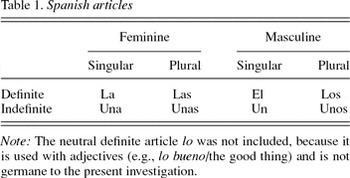
Spanish articles
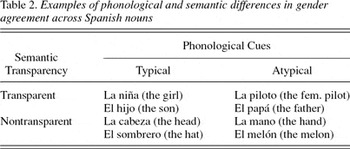
Examples of phonological and semantic differences in gender agreement across Spanish nouns
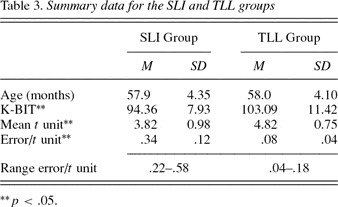
Summary data for the SLI and TLL groups
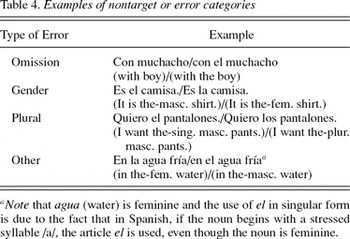
Examples of nontarget or error categories
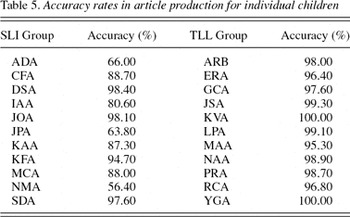
Accuracy rates in article production for individual children
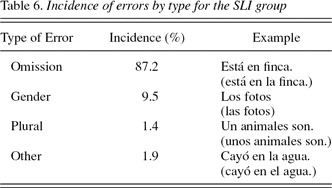
Incidence of errors by type for the SLI group
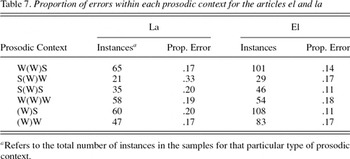
Proportion of errors within each prosodic context for the articles el and la
 You have
Access
- 52
- Cited by