Introduction
Among the many facets of persisting social inequality, those that shape human anthropometric dimensions have recently attracted much scholarly attention (Deaton, Reference Deaton2008; Batty et al., Reference Batty, Shipley, Gunnell, Huxley, Kivimaki and Woodward2009; Zurawiecka et al., Reference Zurawiecka, Marchewka and Wronka2019). Adult body height is a highly heritable trait, but it has also been shown to be associated with early life environment across a set of developed and developing countries (Meyer & Selmar, Reference Meyer and Selmer1999; Silventoinen et al., Reference Silventoinen, Lahelma and Rahkonen1999; Pawlowski et al., Reference Pawlowski, Dunbar and Lipowicz2000; Chen & Li, Reference Chen and Li2009). Furthermore, it may be linked to inter-generational transmission of existing social inequalities. Taller people are more likely to report better health (Silventoinen et al., Reference Silventoinen, Lahelma and Rahkonen1999), find a mating partner (Tao & Yin, Reference Tao and Yin2016), experience fewer adverse health events in their lifetime (Smith, Reference Smith, Hart, Upton, Hole, Gillis, Watt and Hawthorne2000; Jousilahti et al., Reference Jousilahti, Tuomilehto, Vartiainen, Eriksson and Puska2000), be better educated (Silventoinen, Reference Silventoinen2003) and earn a higher wage (Schultz, Reference Schultz2002).
Twin studies attribute between 0.70 and 0.90 of variance in height to heritability (Silventoinen et al., Reference Silventoinen, Sammalisto, Perola, Boomsma, Cornes and Davis2003; Jelenkovic et al., Reference Jelenkovic, Sund, Hur, Yokoyama, Hjelmborg and Möller2016). Evidence from genome-wide association studies (GWAS) further support these estimates (Visscher et al., Reference Visscher, Medland, Ferreira, Morley, Zhu and Cornes2006). Such studies have allowed the identification of specific genes associated with height, but a significant part of the genetic variation remains unexplained (Visscher et al., Reference Visscher, McEvoy and Yang2010; Perola, Reference Perola2011). With regard to environmental influences, the majority of factors affecting height operate at the pre-puberty stage (Gunnell, Reference Gunnell2002). Adult body height is linked to their height in childhood, with the height-for-age z-score (HAZ) being a cross-nationally validated indicator of children’s level of nutrition (Chen & Li, Reference Chen and Li2009). Early living conditions are influenced primarily by parents’ and grandparents’ socioeconomic characteristics (Peck & Lundberg, Reference Peck and Lundberg1995; Moltchanova & Eriksson, Reference Moltchanova and Eriksson2015), and in particular their educational attainment. Parental education has been shown to have a significant association with both children’s HAZ and their nutritional status (Moestue & Huttly, Reference Moestue and Huttly2008). Studies on adoptees have suggested that in the case of height the impact of nurture – that is, everyday childrearing practices – may be as strong as that of genetic makeup (Chen & Li, Reference Chen and Li2009).
Parental education may affect a child’s development through different channels. Father’s education is more likely to represent the social status of the family, and may give access to higher social positions and resources that can be invested in the child’s health and well-being. Mother’s education may be indicative of the quality of everyday childcare (Silventoinen, Reference Silventoinen2003). Educated mother are also more likely to immunize their children and engage in more effective everyday health-promoting behaviours (Desai & Alva, Reference Desai and Alva1998). Education has also been related to individuals’ fertility choices (Lindeboom et al., Reference Lindeboom, Llena-Nozal and van der Klaauw2009). Maternal age, number of siblings, self-care during pregnancy and socioeconomic position before birth have all been shown to be associated with anthropometric traits and the life-long health of children (Hack et al., Reference Hack, Schluchter, Cartar, Rahman, Cuttler and Borawski2003; Black et al., Reference Black, Devereux and Salvanes2007; Barker, Reference Barker2012), with babies born to mothers in the lowest educational categories being, on average, the shortest (Howe et al., Reference Howe, Tilling, Galobardes, Smith, Gunnell and Lawlor2012).
Education has also been linked with certain lifestyle choices. As such, it is often assumed to act as a proxy for an individual’s ability to access and utilize health information (Currie & Moretti, Reference Currie and Moretti2003). While formal education may indeed increase these abilities (Woods-Townsend et al., Reference Woods-Townsend, Leat, Bay, Bagust, Davey and Lovelock2018), an individual’s educational attainment should not be seen as equivalent to their level of functional literacy. Functional literacy and, specifically, functional health literacy, is defined as a skill that is necessary for acquiring knowledge on good health practices, and for using this knowledge to make appropriate health-related decisions (Driessnack et al., Reference Driessnack, Chung, Perkhounkova and Hein2014). Sufficient health literacy means that an individual is able to understand medical information and to act upon that information (Sanders et al., Reference Sanders, Zacur, Haecker and Klass2004). Research shows that even in countries with high levels of formal literacy, a significant proportion of the population is functionally illiterate (Kirsch, Reference Kirsch1993; Sanders et al., Reference Sanders, Federico, Klass, Abrams and Dreyer2009), which means that they are able to read but not to understand written information. The inability to comprehend and process health-related information has been seen as one of the contributors to existing health and social inequalities, including those starting in early childhood (Braveman & Barclay Reference Braveman and Barclay2009; Sikora et al., Reference Sikora, Evans and Kelley2019).
The health literacy of parents has been linked to important health outcomes for their children (DeWalt & Hink, Reference DeWalt and Hink2009), including their nutrition status and body mass index (Chari et al., Reference Chari, Warsh, Ketterer, Hossain and Sharif2014). Low parental health literacy has been found to be associated with a substantially higher probability of exhibiting behaviours negatively affecting child health (Sanders et al., Reference Sanders, Federico, Klass, Abrams and Dreyer2009). Both education and health literacy rank among the key independent determinants of health (Kickbusch, Reference Kickbusch2001). However, in studies analysing parental influence on children’s anthropometric traits, the impact of health literacy is either implicitly assumed to be accounted for by educational attainment, or is not acknowledged at all. Since positive links between education, health literacy and children’s health have been reported across different societies and in many social contexts (DeWalt & Hink, Reference DeWalt and Hink2009), it is likely that both parental education and their health literacy will be independently associated with children’s attained height.
Adult height has also been shown to be associated with other factors operating at the individual level. To account for those characteristics, together with parental education and health literacy, this study used a set of potential covariates of height: type of settlement where the respondent and their parents were born, family’s socioeconomic position and whether they belonged to an ethnic majority in the country. Urban and rural settlements are likely to differ in terms of access to information and health care services. Urbanization status is associated with significant height and weight differences in children, with urban children in low- and middle-income categories being on average taller and heavier than their rural counterparts (Paciorek et al., Reference Paciorek, Stevens, Finucane and Ezzati2013). Furthermore, selective migration may affect height distribution between rural and urban areas as more socially mobile individuals are also likely to be taller (Zielińska, Reference Zielińska1991; Silventoinen et al., Reference Silventoinen, Lahelma and Rahkonen1999). The socioeconomic position of the father has been used as a key indicator of a family’s socioeconomic situation, but the evidence of its impact on individual height is inconclusive. Some studies have reported significant links between father’s position in the socioeconomic hierarchy and child height (Silventoinen, Reference Silventoinen2003), while other have reported no such association (Hasle & Boldsen, Reference Hasle and Boldsen1991). Lastly, ethnic majority status may account for possible inequalities related to the usual disadvantaged position of ethnic minorities (Nazroo, Reference Nazroo1998). Ethnic minority groups are more likely to concentrate in deprived residential areas (Karlsen & Nazroo, Reference Karlsen and Nazroo2002) with poorer access to health care facilities. Potential hostility, and different forms of abuse from majority groups, are likely to affect an individual’s mental and physical health (Karlsen & Nazroo Reference Karlsen and Nazroo2002). Ethnicity-related risks are very relevant for many countries covered in the Life in Transition Survey (LITS). In the late 1980s and early to mid-1990s most of the countries included in the LITS dataset underwent an abrupt systemic transition. Many country borders have appeared relatively recently, and the quality of life and living conditions of ethnic minorities have been compromised, in particular for the cohorts whose infancy and childhood fell in the times of increased ethnic violence.
Adult height has also been linked to broader contextual factors, including year of birth and the general living conditions in a country. Human height increased consistently throughout the 20th century due to improvements in living conditions and child nutrition, and the quality of health care (Bielicki, Reference Bielicki, Falkner and Tanner1986; Howe et al., Reference Howe, Tilling, Galobardes, Smith, Gunnell and Lawlor2012; Moltchanova & Eriksson, Reference Moltchanova and Eriksson2015). In countries covered by the LITS, an individual’s birth cohort may be important not only because of the general trends in height dynamics, but also the region-specific history. Firstly, the impact of the Second World War might be seen for cohorts born during or immediately after the war. Earlier studies have demonstrated that individuals born around the time of the war were significantly shorter, and that this result could not be explained by cohort effects alone (Moltchanova & Eriksson, Reference Moltchanova and Eriksson2015). Furthermore, systemic transition during the 1990s resulted in major cuts to social and health spending, and a substantial increase in social inequality (King et al., Reference King, Hamm and Stuckler2009; Azarova et al. Reference Azarova, Irdam, Gugushvili, Fazekas, Scheiring, Horvat and Stefler2017).
The other important contextual covariate – a country’s level of economic development at birth – represents general standards of living. Together with other environmental factors they are estimated to account for around 20% of the variation in a population’s height, with this number being even higher in poorer societies (Silventoinen, Reference Silventoinen2003; Quintana-Domeque et al., Reference Quintana-Domeque, Bozzoli and Bosch2011).
Methods
The study used data from the LITS commissioned by the European Bank for Reconstruction and Development (EBRD, 2016). The LITS was conducted in 2016 in the following 34 countries in Central, Southern and Eastern Europe, the Middle East and Central Asia: Albania, Armenia, Azerbaijan, Belarus, Bosnia and Herzegovina, Bulgaria, Croatia, the Czech Republic, Cyprus, Estonia, North Macedonia, Georgia, Germany, Greece, Hungary, Italy, Kazakhstan, Kosovo, the Kyrgyz Republic, Latvia, Lithuania, Moldova, Mongolia, Montenegro, Poland, Romania, Russia, Serbia, Slovakia, Slovenia, Tajikistan, Turkey, Ukraine and Uzbekistan.
Respondents were drawn randomly, using a two-stage sampling procedure. Primary sampling units (PSU) were electoral districts, polling station territories, census enumeration districts or other administrative areas. Secondary sampling units (SSU) were households. Each country had a minimum of 50 PSUs with each PSU containing at least 20 SSUs. After deletion of missing information and censoring individuals aged below 20 (those who had not yet achieved their full height), 17,331 men and 21,909 women were included in the analyses. The LITS has been used in comparative social and health research (Gugushvili, Reference Gugushvili2019; Gugushvili et al., Reference Gugushvili, Jarosz and McKee2019), but post-socialist countries have generally been under-represented in multi-country surveys (Slomczynski & Tomescu-Dubrow, Reference Slomczynski and Tomescu-Dubrow2006). Also, there are no other comprehensive accounts of the association between parental socioeconomic characteristics and children’s anthropometric dimensions in the majority of the analysed countries.
Individuals’ height
All LITS respondents were asked to report their height with the following question: What is your height in centimetres without shoes? Empirical reports on the accuracy of self-reported height are not conclusive, with height often being overestimated by both men and women (Engstrom et al., Reference Engstrom, Paterson, Doherty, Trabulsi and Speer2003; Gorber et al., Reference Gorber, Tremblay, Moher and Gorber2007). The LITS allows how respondents’ self-reported heights correspond to their objectively measured heights to be checked. In one randomly selected PSU in each country respondents’ height was measured using a portable stadiometer. This took place after the declarations of height had been made by the respondents. The results of the bivariate analysis of reported and measured height showed that the mean difference between reported (170.2 cm) and measured (170.3 cm) height was –0.05 cm, and it was not statistically significant (95% confidence interval (CI) –0.27 to 0.18) (Gugushvili & Jarosz, Reference Gugushvili and Jarosz2019).
Individual-level independent variables
As mother’s and father’s education could affect the child’s height via different channels, both were included in the models. The following categories were used for mother’s and father’s educational attainment: (1) no education; (2) primary and lower secondary education; (3) secondary and post-secondary education; and (4) tertiary education.
The preferred measure of parental functional health literacy would be a version of the Test of Functional Health Literacy in Adults (TOFHLA) (Parker et al., Reference Parker, Baker, Williams and Nurss1995). To the authors’ knowledge, the TOFHLA is not available in any of the cross-national datasets open to public use. However, earlier research has demonstrated that the number of books in the parental home is a good proxy for parents’ functional health literacy (Sanders et al., Reference Sanders, Zacur, Haecker and Klass2004; Driessnack et al., Reference Driessnack, Chung, Perkhounkova and Hein2014). Specifically, having ten children’s books, or more than ten adults’ books, at home has been shown to be a valid independent indicator that a parent has adequate health literacy (Sanders et al., Reference Sanders, Zacur, Haecker and Klass2004). In this study, the number of books in the respondent’s childhood home was used as indicative of parental functional health literacy. The original LITS question asked about the approximate number of books in the respondent’s childhood home, not counting magazines, newspapers and school books. Four possible answer options were given: (1) none or very few (0–10 books); (2) enough to fill one shelf (11–25 books); (3) enough to fill one bookcase (26–100 books); and (4) enough to fill two or more bookcases (101–200 books). In the current study, the terms ‘health literacy’ and ‘functional literacy’ are used interchangeably as they both refer to the ability to understand written information.
Mother’s and father’s sectors of employment were used as proxies for the socioeconomic status of the household. The LITS offers no information on parental social position or household income, but using both of these variables may give a picture of an individual’s childhood living conditions. This variable included the following categories (same for both parents): (a) employed in agriculture; (b) employed in manufacture; (c) employed in public administration; (d) employed in other not classified sector; and (e) parent never worked.
Birth cohort was coded based on the respondent’s year of birth in the following categories: (a) born before 1946; (b) 1946–1955; (c) 1956–1965; (d) 1966–1975; (e) 1976–1985; and (f) 1986–1995. Type of settlement at birth used an original binary variable asking whether a respondent was born in a rural or an urban settlement. The LITS allows differentiation between rural and urban type of settlement at birth for both respondents and their parents, and all relevant variables were used in the study. To account for the respondent’s minority status, a binary variable was created with a value of 1 for respondents belonging to the ethnic majority in their country of residence.
Country’s level of development at birth
To derive this contextual variable the measure of Gross Domestic Product (GDP) per capita by Purchasing Power Parities (PPP) in international dollars with fixed 2011 prices was used. This measure considers inflation and differences in cost of living between countries. The source of this variable is Gapminder (2018), which has compiled the data from numerous sources, such as official statistics, historical sources and their own estimates. Gapminder is arguably the only comparative dataset that provides information on the level of economic development for most years of the 20th century for each country included in the LITS. This allowed information on the level of economic development for individuals who were born as early as in the first decades of the 20th century to be derived.
Analytical strategy
The analytical strategy consisted of a two-stage approach. First, baseline and fully adjusted ordinary least squares (OLS) models were fitted with individual height as a continuous dependent variable. In this approach unobserved country characteristics were accounted for by the country fixed effects. However, the focus of the study was not only on an individual’s absolute height, but also on how parental education, parental functional literacy and other covariates were linked with the probability of them appearing at the lower or higher end of the height distribution. To derive these relative measures, in the second step, quartiles of height in all cohorts were calculated separately for each country. Next, binary variables were created for those whose height fell within the bottom 25% of the height distribution, and for those whose height appeared in the top 25% of the distribution by sex in a given country. These variables were used as outcome variables in the Poisson regression models. Conventional logistic regressions with corresponding odds ratios are likely to overestimate the actual associations of the independent variables in the model. On the other hand, the Poisson regressions, used in this study for binary outcome variables, allowed prevalence ratios with corresponding 95% CIs to be derived, which are more appropriate measures of association with high prevalence of positive outcomes in the binary dependent variables (Barros & Hirakata, Reference Barros and Hirakata2003).
To assess the robustness of the findings, the treatment effects were estimated via regression adjustment of linear and Poisson models. This approach uses contrasts of averages of treatment-specific predicted outcomes to estimate treatment effects. In other words, regression adjustment is based on a two-step approach to estimating treatment effects. First, separate regression models of the outcome on a set of covariates were fitted for each reference group used for social comparison. Second, the averages of the predicted outcomes were computed for each subject and reference group. The contrasts of these averages provided the estimates of average treatment effects.
In order to identify if the broader social environment moderated the associations between mother’s education, parental functional literacy and an individual’s adult height, aggregate mean values of both of these variables were generated by each country and by cohort. Next, they were fitted into the multilevel fixed effects linear regressions. Models were estimated separately by sex using Stata 15 statistical software.
Results
Descriptive statistics and bivariate associations
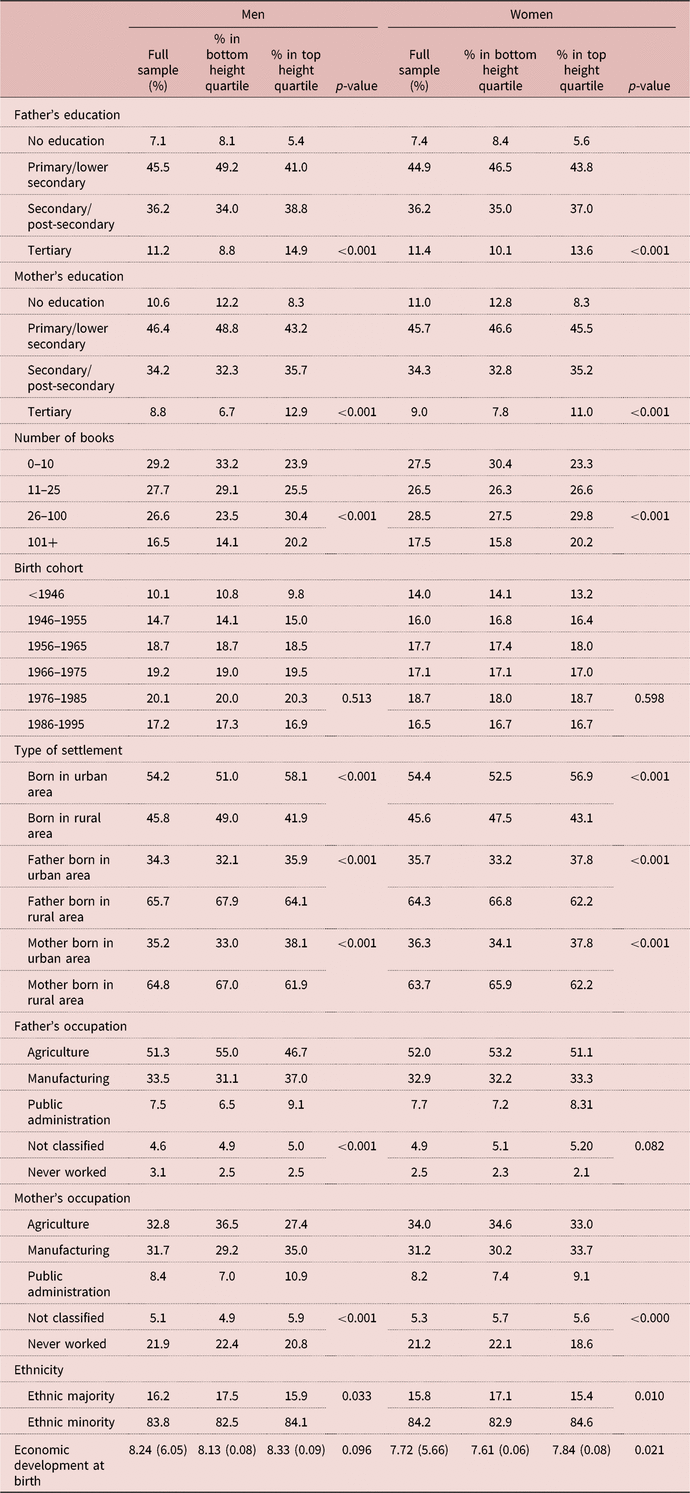
Table 1 presents the descriptive statistics for the independent variables, and distributions of these variables by groups of individuals in the bottom and top height quartiles. Regarding parental educational attainment, less than 10% of fathers had no formal education, while this share was just above 10% for mothers. In all instances, levels of parental education were higher among individuals in the top height quartile with corresponding significant differences in proportions when compared with individuals in the bottom height quartile. Regarding parental functional health literacy, represented by the number of books in the childhood home, a significant proportion of individuals (up to 30%) grew up in homes with ten or fewer books. Individuals who reported having a larger number of books in the parental home were more likely to fall within the top quartile of the height distribution.
Descriptive statistics (% and means) of study individuals and bivariate associations

The p-values are from bivariate tests of differences in means or proportions for each covariate across the bottom and top height quartiles. Source: authors’ analysis of data from EBRD (2016).
Multivariate analyses
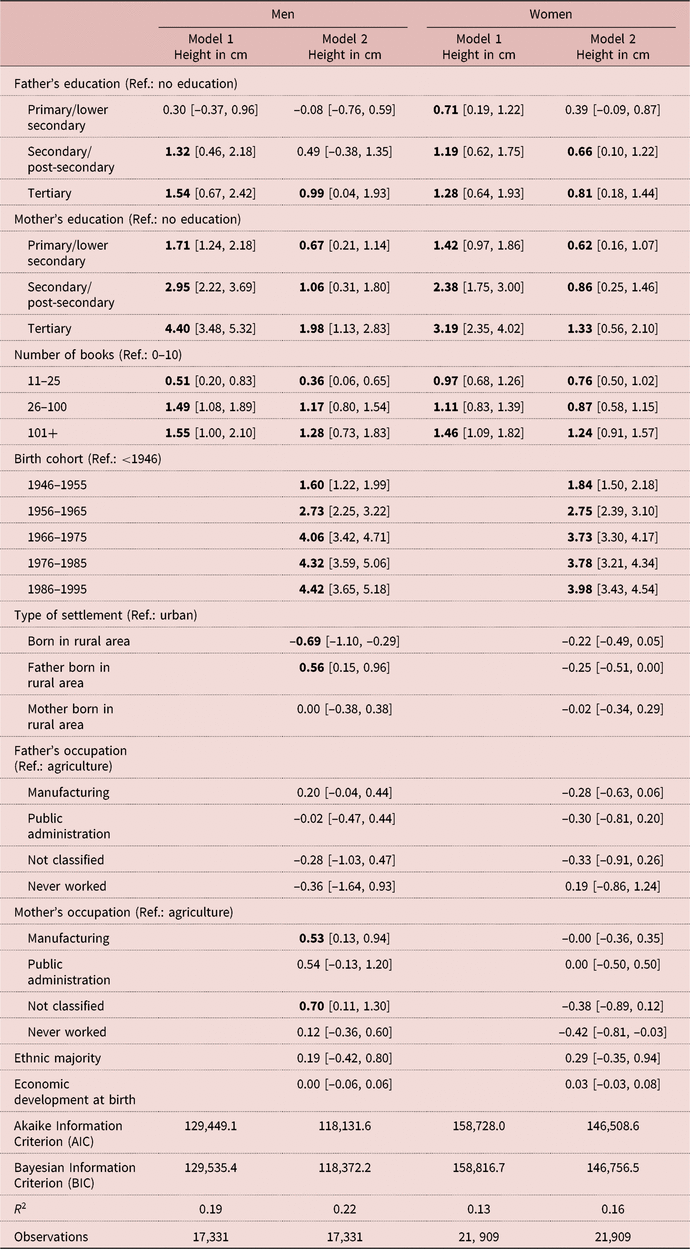
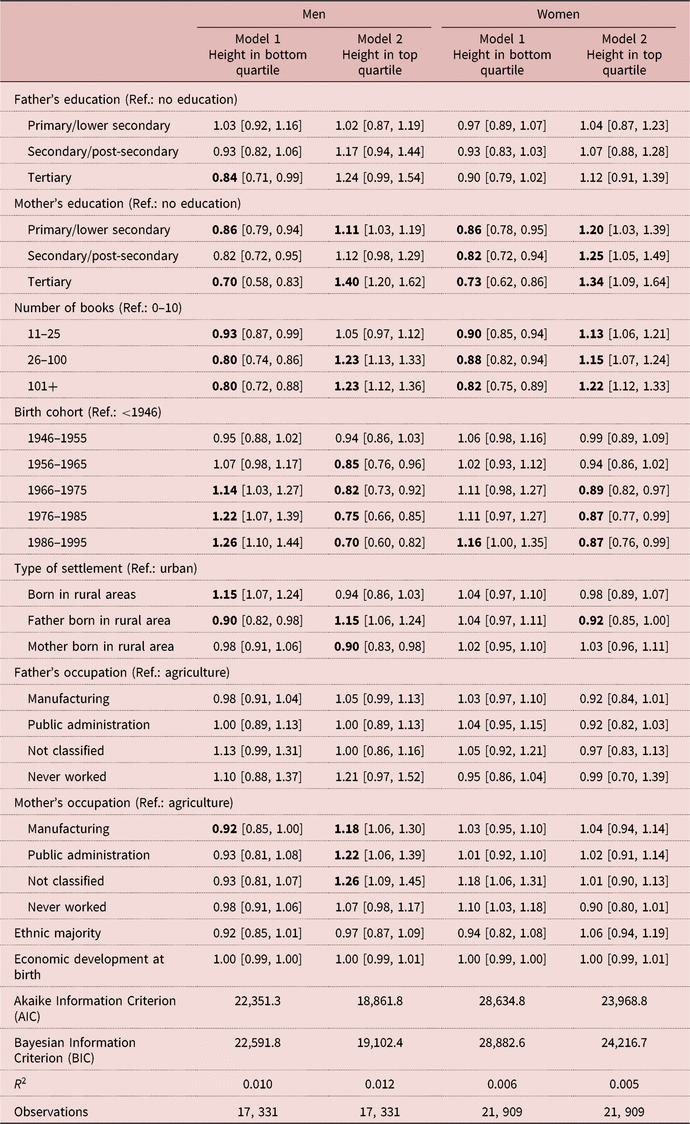
Tables 2 and 3 show the associations between parental education, parental functional literacy and individual’s height controlling for a set of individual and contextual characteristics. In the fully adjusted models (Models 1 in Table 2 and Models 1 and 2 in Table 3), father’s education mattered for individual’s height only in certain instances: for instance, having a father with tertiary education compared with having a father with no education was associated with a 1.0 cm increase in height for men and a 0.8 cm increase for women. In contrast, mother’s education was positively associated with height in all models for both men and women. Children of better-educated mothers had a much lower chance of being in the bottom of the height distribution within respective cohorts, and much a higher chance of appearing in the top height quartile. For instance, compared with individuals having mothers with no education, the sons of tertiary-educated mothers had a risk prevalence of 0.70 for being in the bottom height quartile, while the daughters of tertiary-educated mothers had a risk prevalence of 1.34 for being in the top height quartile.
Parental education, parental health literacy and individuals’ adult height: point estimates from OLS regression models (β [95% CI])

All models account for country fixed effects; 95% CIs in parentheses; significant associations are shown in bold.
Source: authors’ analysis of data from EBRD (2016).
Parental education, parental health literacy and individuals’ adult height: prevalence ratios from Poisson regression models (PR [95%CI])

All models account for country fixed effects; 95% CIs are in parentheses; significant associations are shown in bold.
Source: authors’ analysis of data from EBRD (2016).
Parental functional literacy was positively and significantly associated with both men’s and women’s height, net of other variables in the models. Individuals who reported having more than ten books in their childhood home were taller than those who reported having fewer than ten books. More specifically, in the adjusted Model 2 in Table 2, men and women growing up in households with more than 100 books were, on average, 1.3 and 1.2 cm taller than those who had only a few books in their parental home. The number of books mattered for both men and women in terms of the likelihood of being in the lowest and highest quartiles of the height distribution. In Table 3, both men and women were about 20% less likely to appear in the bottom height quartile within their cohorts if they grew up in homes with enough books to fill two or more bookcases.
Both men’s and women’s mean heights increased over the 20th century. Men and women born in 1986–1995 were, on average, 4.2 and 3.0 cm taller, respectively, than those who were born before 1946. Furthermore, the type of settlement where respondents were born was associated with their height. Men born in rural areas were, on average, 0.7 cm shorter than men born in urban areas. Furthermore, men whose fathers were born in rural areas were significantly taller compared with men whose fathers were born in urban areas.
In some instances, mother’s sector of employment was associated with individual’s height. Men whose mothers were employed in manufacturing, public administration or in other, unspecified sectors had, respectively, 18%, 22% and 26% higher chances of being in the top quartile of the height distribution compared with men whose mothers worked in agriculture. Father’s sector of employment was not associated with individuals’ height. No evidence was found for a significant association between ethnic minority status or level of economic development at birth and individual’s height.
Interaction between mother’s education and parental functional literacy
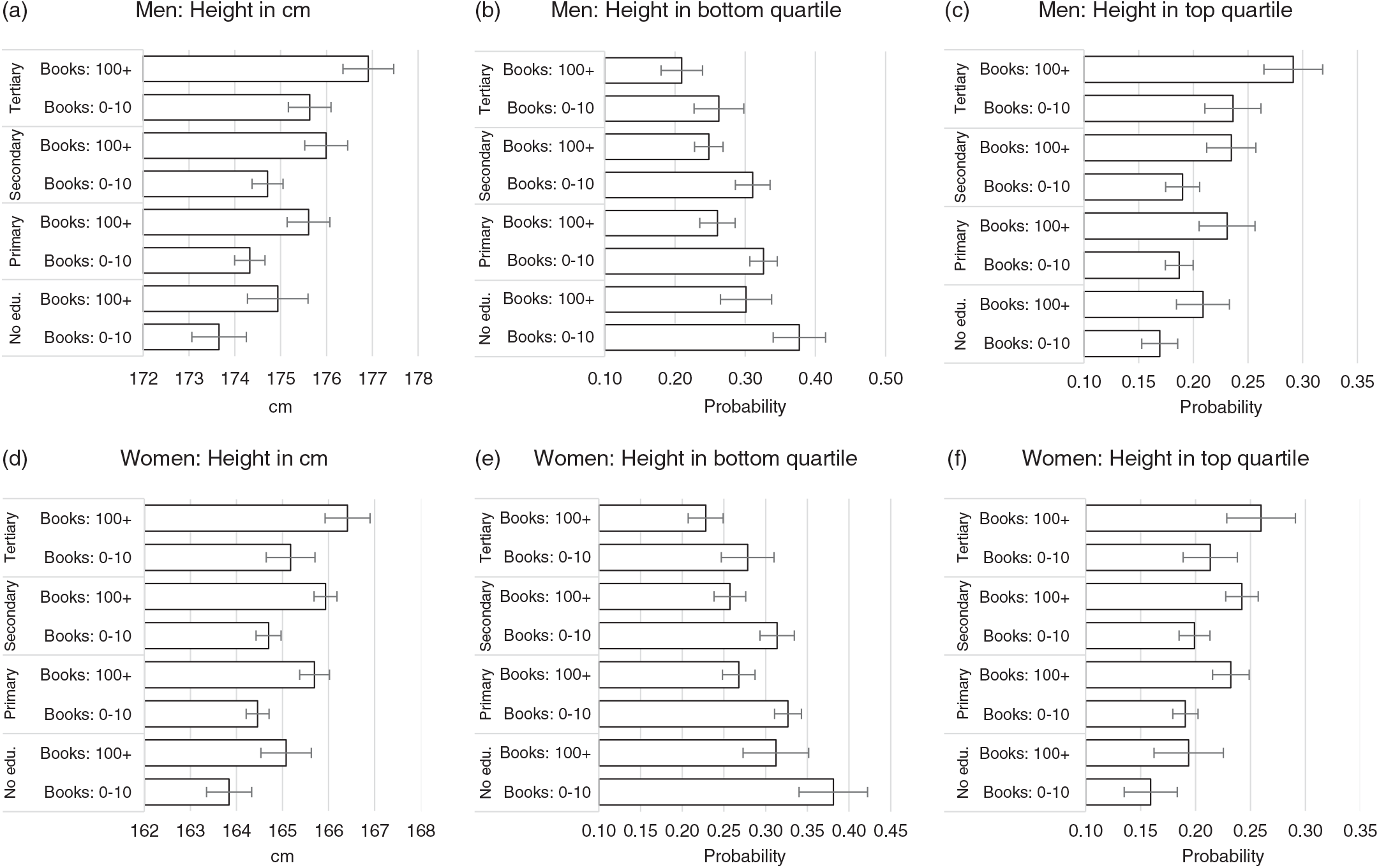
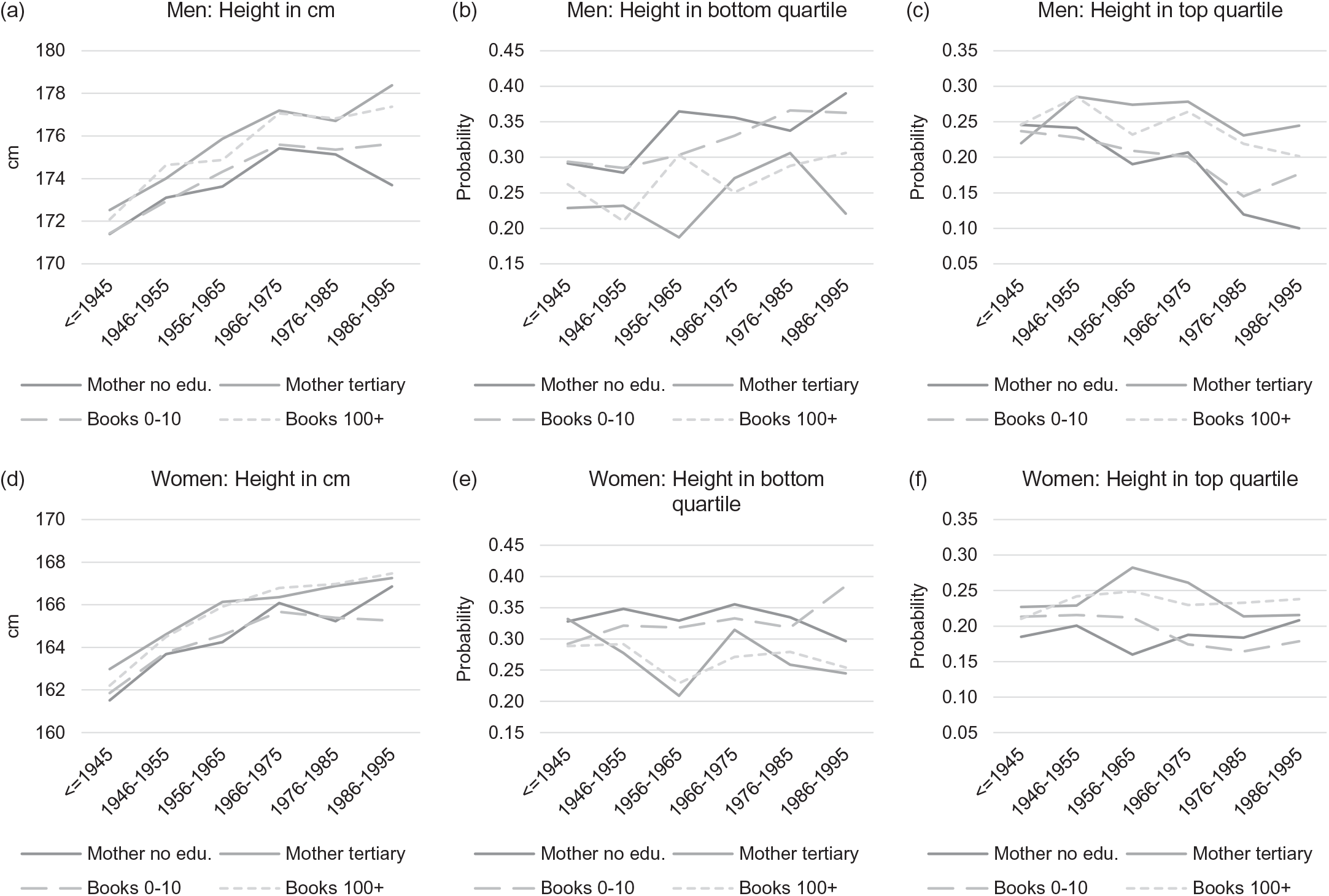
Figure 1 shows the predicted values for height in centimetres and the predicted likelihood of appearing in the bottom and top quartiles of the height distribution by mother’s level of education and parental functional literacy. In most cases the differences between individuals having mothers with no education and those having mothers with tertiary education were significant regardless of the number of books at home. At the same time, regardless of the level of maternal education, the number of books at home showed a strong and consistent association with individuals’ height. For instance, among men with tertiary-educated mothers who also had 100 or more books in the childhood home the probability of appearing in the lowest quartile of the height distribution was around 0.20, whereas for individuals with low-educated mothers but the same number of books at home it was around 0.30. Furthermore, if mothers had tertiary education but the number of books at home was low, the probability of appearing in the bottom quartile increased to 0.37. In short, there was no interaction effect between maternal education and the number of books at home, but rather these two variables maintained an independent association with individuals’ height.

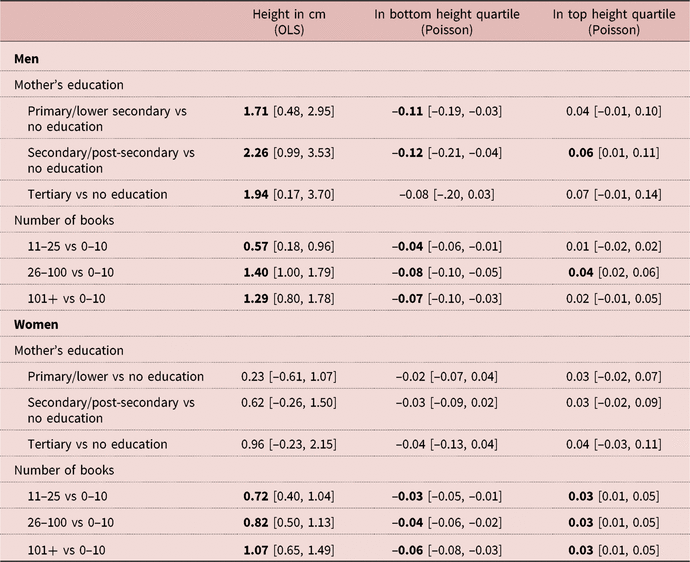
Regression adjustment estimators
Table 4 presents the treatment estimators from regression adjustment models. For men’s height the results were very similar to the estimates using conventional OLS regression models in Table 2. Those who had mothers with tertiary education were 1.94 (CI 0.17 to 3.70) cm taller than men with the lowest educated mothers. For the women’s sample, using the more robust treatment effect estimators removed the associations with maternal education found in the conventional regression models. Nonetheless, parental health literacy, measured by the number of books in the childhood home, was consistently associated with higher height, lower likelihood of appearing in the bottom height quartile, and higher probability of appearing at the top of the height distribution. For instance, after regression adjustment those who grew up in a home with more than 100 books were 6% less likely to be in the bottom quartile of the height distribution in their respective cohorts.
Average effects of mother’s education and number of books in the parental home on individuals’ adult height from treatment estimators using regression adjustment models

Change over time in the association between maternal education and number of books with individual’s height
Figure 2 shows the associations between maternal education, parental functional literacy and individual’s height for individuals born in different time periods from pre-1945 until 1995. The first observed trend is that, regardless of level of maternal education and number of books, individuals’ height increased throughout the entire period. The most significant change was observed for men born in 1986–1995, when the role of maternal education also became more salient. More specifically, the lowest level of maternal education was associated with 174 cm of predicted height, while the highest level of education was associated with 178 cm of height. The same pattern was also repeated in terms of attaining the highest and the lowest position in the relative height distribution. The difference between individuals born to the highest- and lowest-educated mothers increased in both instances. For women, there were no systemic or significant differences across time in terms of the effects of maternal education and the number of books in the childhood home.

Contextual factors
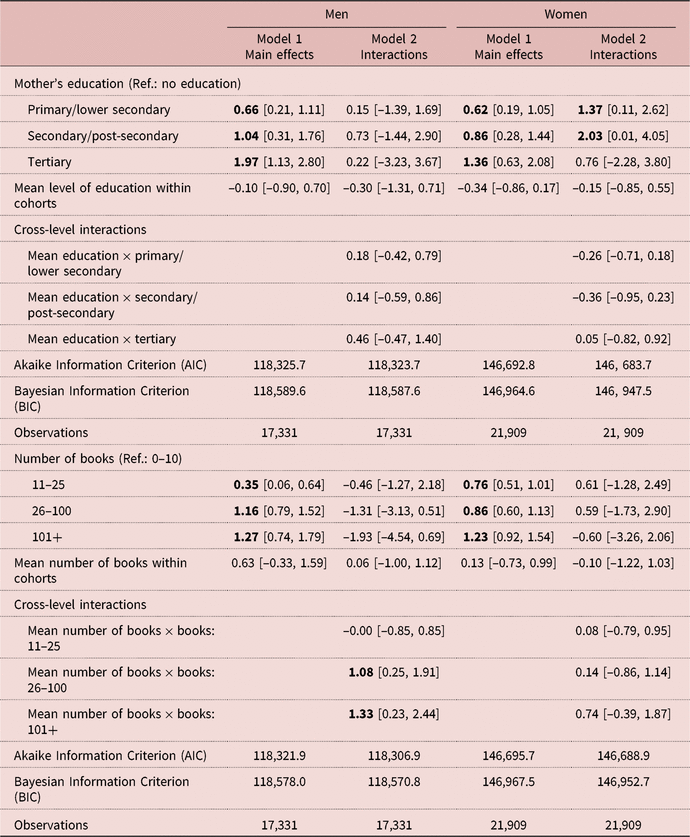
In Table 5, the mean values of maternal education and number of books in the childhood home, calculated for specific countries and cohorts, were first introduced in multilevel mixed-effects linear models as macro-level variables, and then interacted with individual-level variables describing mother’s education and parental functional literacy. The results suggest that the aggregate level of maternal education and the number of books do not explain the variation in adult height. The cross-level interaction terms in most cases were not statistically significant, but for men the number of books had a greater effect on height in the context when the mean number of books reported in the cohort was higher.
Parental education, parental health literacy and their interactions with contextual environment, and point estimates from multilevel mixed-effects linear regressions (β [95% CI])

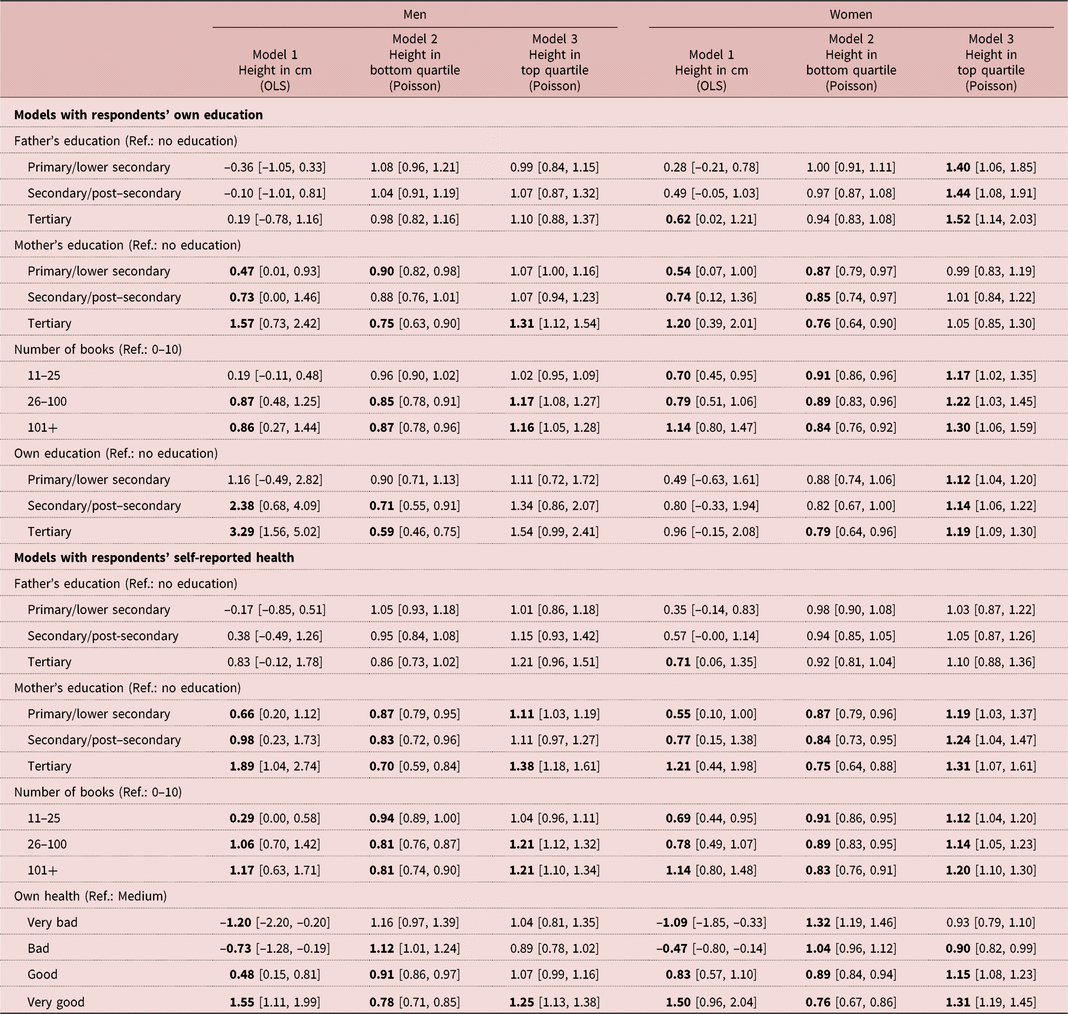
Further analyses: individual’s own educational attainment and health
The additional models in Table 6 were run to account for two types of associations frequently reported in other studies on height: those between individuals’ height and self-reported health and between individuals’ height and their own educational attainment. The main analyses were re-run, this time also including respondents’ attained level of education and self-reported health, which were expected to moderate, at least to a certain extent, the association between parental characteristics and individuals’ height. The models showed that respondent’s education was a statistically significant covariate of their height. Better-educated individuals were taller than their lower-educated counterparts. Accounting for own education reduced the association of maternal education and height but it remained significant in most instances. Regarding parental functional literacy, represented by the number of books in the childhood home, this variable remained one of the most significant explanations of individuals’ own height.
Parental education, parental health literacy and individuals’ adult height accounting for individuals’ own education and self-reported health

Lastly, individuals’ self-reported health was negatively and significantly related to their height. Including this variable in the models did not change the substantial and statistically significant associations between mother’s education, parental functional literacy and individuals’ height.
Discussion
In line with earlier reports, this study found that parental educational attainment was positively associated with their offspring’s attained height. Studies to date have been inconclusive regarding comparisons between maternal and paternal effects, with some finding that the impacts of father’s and mother’s education are similar (Moestue & Huttly, Reference Moestue and Huttly2008), and other reporting that the effect of father’s education is substantially weaker (Chen & Li, Reference Chen and Li2009). The present study found a consistent and positive association between mother’s education and children’s height, net of other socio-demographic and contextual characteristics. In the fully adjusted models, the association of father’s education with individual’s height was significant only in some instances and only for individuals with tertiary-educated fathers. It was also substantially weaker than the association with mother’s education.
The impact of maternal education on adult height was stronger for men, in particular in more robust regression adjustment models, which is somewhat contradictory to results reported for the United States, Brazil and Ghana (Thomas, Reference Thomas1994), and possibly due to the specific cultural settings. The present findings are likely to reflect differences in the child rearing of boys and girls occurring primarily during early childhood (Case & Paxson, Reference Case and Paxson2008). An important factor that could not be accounted for in the analyses is that mother’s education has also been found to be associated with the child’s risk of dying by the age of two (Kickbusch, Reference Kickbusch2001). As infant mortality rates, in particular for the older cohorts covered in LITS, were substantial (Ksenofontova, Reference Ksenofontova, Lutz, Scherbov and Volkov1994), it may be that the effect of maternal education would be even stronger had these children survived and been included in the survey.
The number of books in the parental home, indicative of parental functional health literacy, was consistently found to be associated with individuals’ height for both men and women. The association with parental functional literacy was independent of other factors included in the models and was as strong as the association with mother’s education. These results were largely confirmed using regression adjustment treatment estimators from linear and Poisson models. In this study, the number of any books, apart from school books, was used as a proxy for health literacy, but earlier research has shown that the number of children’s books at home may also be indicative of parental care and time dedicated to children early in life (Brunello et al., Reference Brunello, Weber and Weiss2016), with such resources playing an even more important role in low-income families (Tomopoulos et al., Reference Tomopoulos, Dreyer, Tamis-LeMonda, Flynn, Rovira, Tineo and Mendelsohn2006).
The available data did not allow for more detailed analysis of different aspects of health literacy, but it has been argued that health literacy includes the following three components: access to health care, connection between the patient and health provider and self-care (Paasche-Orlow & Wolf, Reference Paasche-Orlow and Wolf2007). The relationship between these three aspects is not straightforward, as even individuals’ high literacy levels do not guarantee that they will respond in a desired way to the health information they receive (Nutbeam, Reference Nutbeam2000). The implication of this knowledge for the present study is twofold. Firstly, a higher number of books in the childhood home may be seen as a factor that, overall, positively contributes to children’s physical and cognitive development, but it may also be indicative of both parental care and time spent with children, and the likelihood that a parent would understand and follow written medical advice. Secondly, the effect of an individual’s functional literacy on health should be analysed in relation to a broader social context, in particular that of systemic limitations (such as significant cuts in health care provisions in post-socialist countries after the transition to a market economy), or access to different sources of health information.
After accounting for the independent effects of parental education and health literacy, there were no interaction effects between the number of books in the parental home and mother’s level of education, but predicted mean height for both men and women was significantly higher in each mother educational category if there were more than 100 books in the parental home. Furthermore, having a high number of books lowered the probability of falling within the bottom quartile of the height distribution, even for those whose mothers were low-educated. The level of education and related level of health literacy had been treated as a single variable in earlier studies describing competences involved in health care decision-making (Smith et al., Reference Smith, Dixon, Trevena, Nutbeam and McCaffery2009). The present findings, together with other reports (Kalichman et al., Reference Kalichman, Benotsch, Suarez, Catz, Miller and Rompa2000), show that an individual’s level of education and their functional literacy should be analysed separately as these characteristics may have independent effects on the variable of interest.
As expected, birth cohort mattered for an individual’s height, and there was a gradual increase in average height for the entire population over the 20th century. There was also a consistent height gap between individuals with tertiary-educated and low-educated mothers, as well as between those who were brought up in homes with a low and a high number of books. This gap persisted across the entire time covered in the analyses, i.e. it appeared in each cohort. A novel finding not reported previously is that of different trajectories of height differences for men and women across time. In the case of men, among the youngest cohorts there was a divergence between the mean height of individuals whose mothers had no education and those with tertiary-educated mothers. In other words, the height gap related to mother’s education was higher for individuals born just before and soon after the collapse of socialism. Conversely, the height gap between women whose mothers had no education and those whose mothers had tertiary education did not widen, which is in line with the claims that boys are more vulnerable to socioeconomic changes (Petranović et al., Reference Petranović, Tomas, Narančić, Škarić-Jurić, Veček and Miličić2014). It can be assumed that this drift in height was caused by the negative social and health consequences of systemic transition, with individuals in low social positions, including those with low educational qualifications, being affected most negatively (Cockerham, Reference Cockerham2002; Doniec et al., Reference Doniec, Stefler, Murphy, Gugushvili, McKee and Marmot2018). Similar findings have been reported in other studies from Central Eastern Europe (Petranović et al., Reference Petranović, Tomas, Narančić, Škarić-Jurić, Veček and Miličić2014).
The association identified between type of settlement and individuals’ height may be indicative of mobility patterns. Migrants are generally healthier than non-migrants (Lu, Reference Lu2008), which is the first selection mechanism. There is also evidence that taller individuals are more likely to move from rural to urban areas compared with shorter individuals in equivalent social positions (Zielińska, Reference Zielińska1991). The findings of this study show that men whose fathers were born in rural areas, but who themselves were born in urban areas, were more likely to fall within the top quartile of the height distribution. This may suggest that more spatially mobile fathers were taller and, for this reason, had taller sons. No such effect was found for women.
This study comes with a set of limitations. Firstly, it did not account the for genetic determinants of height due to a lack of information on parental height in the survey. Secondly, indicators of material deprivation during childhood, or, alternatively, of household income, and associated quality of nutrition, were not available. Earlier studies reporting a relationship between an individual’s height and the material situation in the household found that the association between these variables, although significant, did not decrease the importance of parental education (Silventoinen, Reference Silventoinen2003). Because household income was not controlled for, it might be that some of the variance explained by the number of books could be attributed to economic differences between households. However, disparities in height related to the number of books in the parental home did not increase over time, including after the systemic transition in post-socialist countries, which suggests that the association between the number of books and the financial situation of the household may be weak, if any.
Despite these limitations, this study offers a unique contribution to the existing research by tracking the long-term trends in height and its childhood-related explanations in the large number of countries in Central, Southern and Eastern Europe, the Middle East and Central Asia. It has demonstrated that the main explanatory variables – mother’s education and parental health literacy – maintained independent associations with individuals’ height. On the macro level, individuals’ height was associated with being born in a particular cohort, but not with the general economic conditions at birth, which suggests that there is a secular increase of individuals’ height not accounted for by economic growth. However, the substantial increase in the height gap for the cohort born around the times of the systemic transition in post-socialist societies suggests that the newly emerged social inequalities may play a detrimental role for health equity, including shaping individuals’ early living conditions and consequently may affect disparities in individuals’ height in adulthood.
Funding
This research received no specific grant from any funding agency, commercial entity or not-for-profit organization.
Conflicts of Interest
The authors have no conflicts of interest to declare.
Ethical Approval
The authors assert that all procedures contributing to this work comply with the ethical standards of the relevant national and institutional committees on human experimentation and with the Helsinki Declaration of 1975, as revised in 2008.