INTRODUCTION
Defining diet is a crucial first step to better understanding of trophic interactions and building robust marine food web models (Murphy et al., Reference Murphy, Cavanagh, Hofmann, Hill and Constable2012). Cephalopods constitute a significant prey for larger fish, seabirds and marine mammals and as such, they hold a pivotal role in structuring of marine ecosystems. Their importance as prey is enhanced by their very high growth rates, which, together with other life cycle characteristics (exclusively carnivorous diet, short lifespan and semelparity) lead to high biomass turnover rates or productivity (P/B ratio) (Boyle, Reference Boyle2002).
Despite the ecological and economic key positions of cephalopods, there is limited information about their overall role in the marine environment, i.e. their significance as food resources for higher trophic levels and their impact as predators of finfish and invertebrates (Clarke, Reference Clarke1996). The reason for this is that several cephalopods, particularly the pelagic ones, are not widely fished and conventional gears, used in monitoring other pelagic taxa, usually collect juveniles, since adult specimens generally avoid being captured (Clarke, Reference Clarke1996; Piatkowski et al., Reference Piatkowski, Pierce and Morais da Cunha2001). Therefore, diet composition analysis of various top predators, such as cetaceans, seabirds, sharks and large pelagic finfish, is a standard technique that provides valuable information on their ecology, geographic distribution, abundance and seasonal fluctuations (Clarke, Reference Clarke1986; Xavier et al., Reference Xavier, Walker, Elliott, Cherel and Thompson2014).
In the Mediterranean Sea, cephalopods are significant for the diet of several marine predators (e.g. Blanco & Raga, Reference Blanco and Raga2000; Salman et al., Reference Salman, Bilecenoğlu and Güçlüsoy2001; Madurell, Reference Madurell2003; Salman, Reference Salman2004; Romeo et al., Reference Romeo, Battaglia, Pedà, Perzia, Consol, Esposito and Andaloro2012; Dede et al., Reference Dede, Salman and Tonay2016). Nevertheless, in the Hellenic waters (eastern Mediterranean), data on the cephalopod prey-specific composition is still poor regarding whales, finfish and sharks, and research has focused on the Aegean (Peristeraki et al., Reference Peristeraki, Tserpes and Lefkaditou2005), Ionian (Lefkaditou & Poulopoulos, Reference Lefkaditou and Poulopoulos1998; Lefkaditou et al., Reference Lefkaditou, Anastasopoulou and Mytilineou2016) and Libyan Seas (Roberts, Reference Roberts2003).
This study focuses on cephalopod species that are part of the diet of two demersal sharks, the small-spotted catshark Scyliorhinus canicula (Linnaeus, 1758) and the longnose spurdog Squalus blainville (Risso, 1826), captured in the Aegean Sea. Both species inhabit the Mediterranean Sea and the eastern Atlantic Ocean (Compagno, Reference Compagno1984a, Reference Compagnob). They are considered small-sized sharks (maximum length = 1 m), with S. canicula exhibiting philopatric behaviour (Kousteni et al., Reference Kousteni, Kasapidis, Kotoulas and Megalofonou2015) and S. blainville showing high dispersal potential and the ability to cross open water masses (Kousteni et al., Reference Kousteni, Kasapidis, Kotoulas and Megalofonou2016b).
The identification of cephalopod species found in the stomach contents of the examined sharks was achieved through the taxonomic classification of their beaks, as being quite resistant to digestive processes (Clarke, Reference Clarke1962). The cephalopod prey species diversity was examined for each predator by sampling depth and size, and further compared with the findings of similar studies in the Mediterranean Sea and the eastern Atlantic Ocean. Finally, the mantle length of the consumed cephalopods was reconstructed and the relationship of prey-predator size was investigated in relation to the maximum size known for the cephalopod species.
MATERIALS AND METHODS
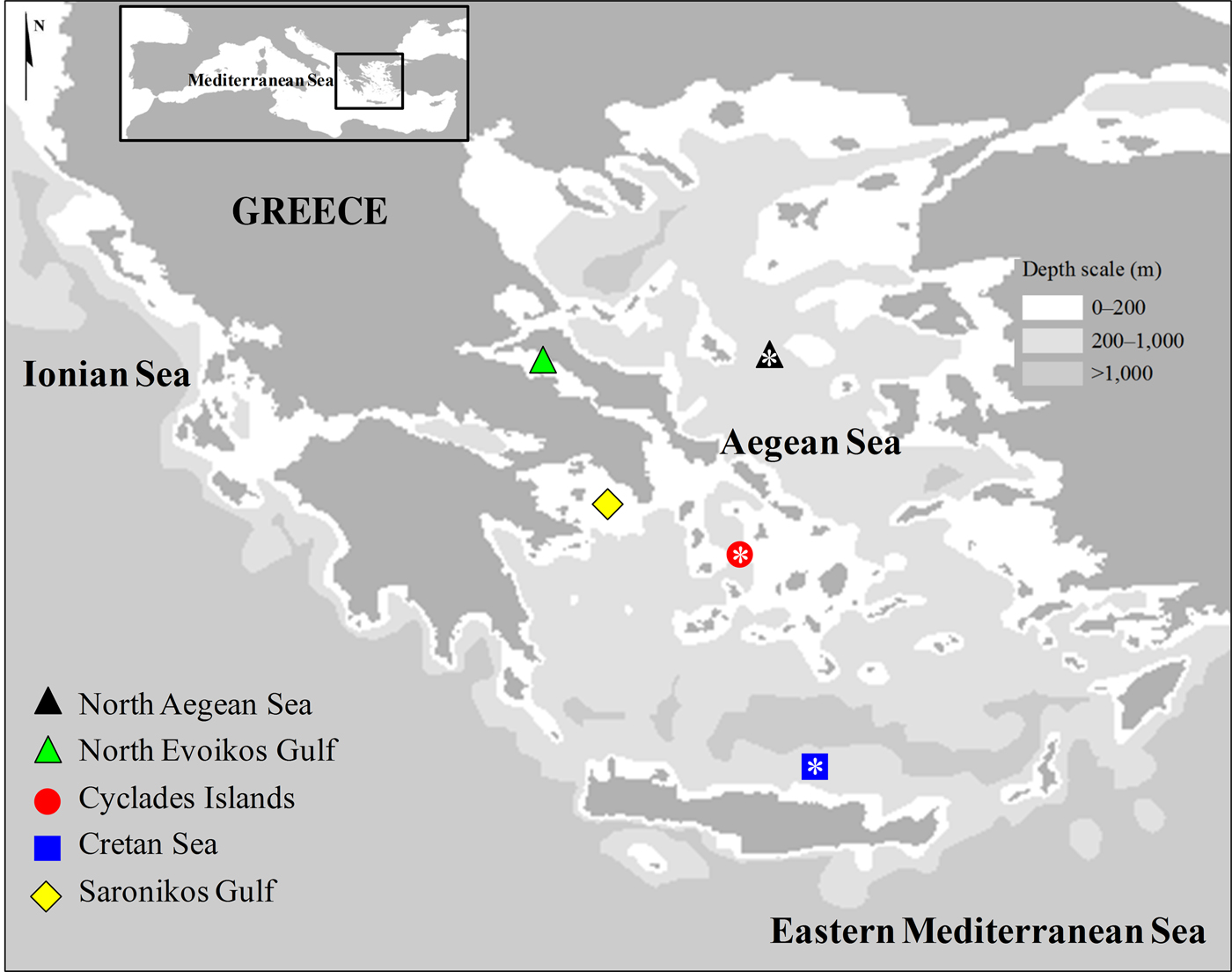
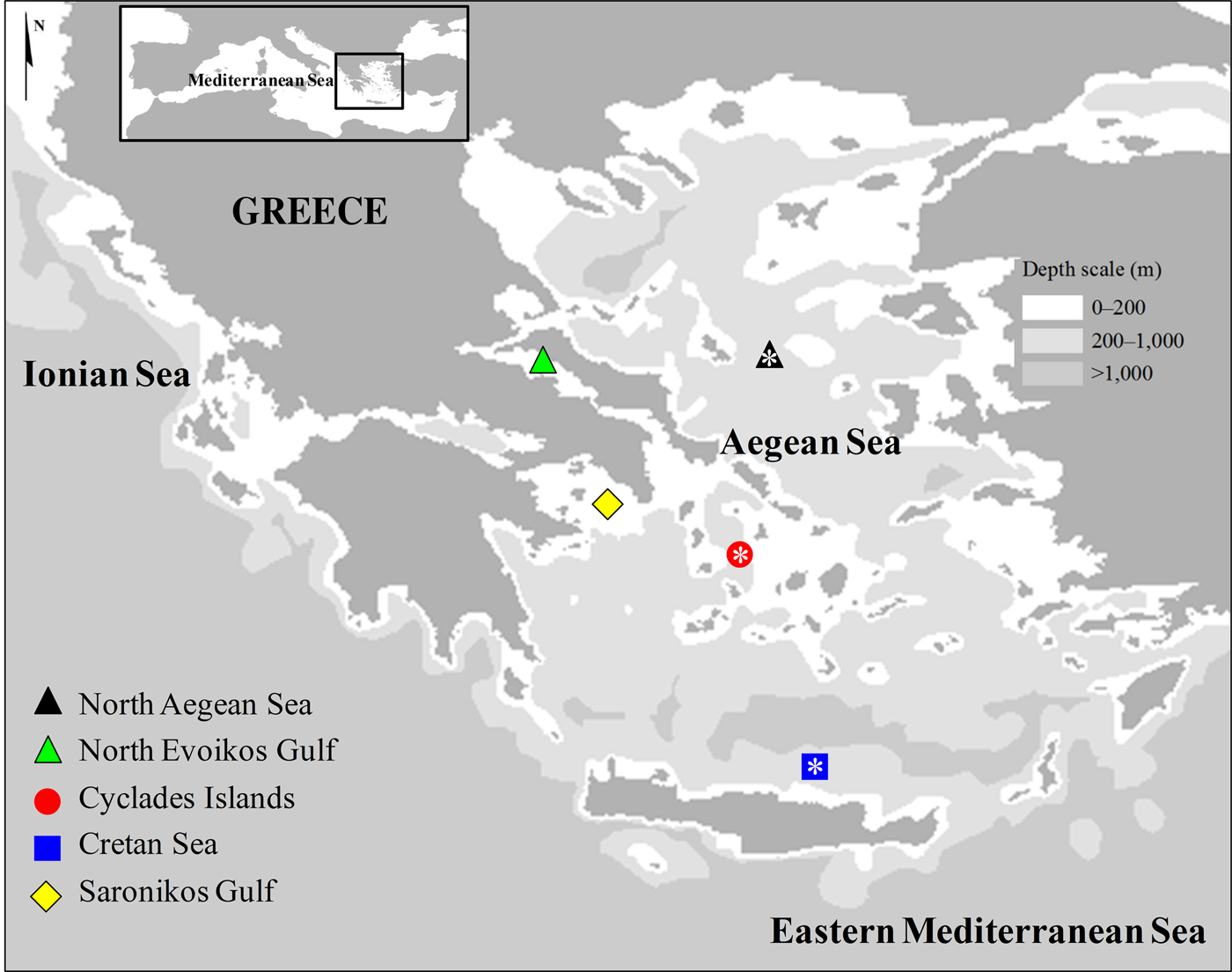
A total of 432 and 212 individuals of Scyliorhinus canicula and Squalus blainville, respectively, were incidentally captured by commercial trawlers in the Aegean Sea from November 2005 to January 2012 at depths of 101–513 m (Figure 1). Individuals were immediately frozen at sea and transported in ice boxes to the laboratory, where total length (TL) was measured to the nearest millimetre (mm), from the tip of the snout to the tip of the upper caudal lobe.
Map of the study area indicating the sampling locations (north Aegean Sea, north Evoikos Gulf, Cyclades Islands, Cretan Sea and Saronikos Gulf) of 432 individuals of Scyliorhinus canicula and 211 individuals of Squalus blainville captured by trawlers and included in the present study. The locations where S. blainville individuals were captured are indicated with a white asterisk. An average geographic position is presented.
The digestive tract of each specimen was removed and the stomachs were isolated and fixed in a 10% formalin solution. Cephalopod prey items, including flesh, eye lenses and beaks that were either loose or embedded in buccal mass remains, were isolated during stomach content examination. Cephalopod beaks were cleaned, separated into upper and lower ones, and preserved in 70% ethanol. They were then assigned to species using taxonomic keys and illustrations by Naef (Reference Naef1923), Clarke (Reference Clarke1986) and Xavier & Cherel (Reference Xavier and Cherel2009), and after being compared with the beaks of the IMBRIW-HCMR reference collection. Although beaks can be retained in the stomachs of marine predators for a long time, they are affected by chemical and mechanical digestion processes. According to the level of erosion, beaks were categorized into three types with type A representing ‘fresh’ beaks still bearing intact wings and cartilages covering the front edge of the lateral wall; type B including beaks still uneroded but not possessing cartilages while wings might be broken; and type C representing abraded, very darkened beaks with rounded rostrum, as suggested by Piatkowski & Pütz (Reference Piatkowski and Pütz1994).
To facilitate identification and measurement of beak remains, calibrated digital images of their lateral view were obtained through a stereoscope connected to the image analysis system of HCMR. Standard dimensions of the beak's rostrum, crest and hood, following Clarke's (Reference Clarke1986) definitions, were measured using Image PRO-Plus algorithms. Specifically, upper rostral length (URL) and lower rostral length (LRL) in squids and sepiolids, and lower crest length (LCL) and lower hood length (LHL) in octopuses were measured to the nearest 0.01 mm. The mantle length (ML in mm) of each cephalopod prey individual was estimated using previously established allometric equations relating ML with LRL for squids and with LCL or LHL for octopus species (Table S1).
The identified cephalopod species were characterized based on their habitat as demersal (d), epipelagic (e) and mesopelagic (p). In demersal species, squid species closely associated to the bottom that are supposed to undergo vertical migrations at night, such as Illex coindetii and Abralia veranyi (Roper & Young, Reference Roper and Young1975; Rodhouse et al., Reference Rodhouse, Dawe and O'Dor1998), were also included.
Percentage (%) frequency of cephalopod prey species occurrence was estimated for the total number of specimens of each predator and also for two groups of predator specimens considered in relation to their sampling depth (<250 m over the continental shelf; >250 m over the slope). To establish a probable foraging zone in the plot of prey species occurrence by predator group, cephalopod species, except for the epipelagic octopod Argonauta argo, were ranked according to the depth of their maximum abundance in the Hellenic waters as estimated by Lefkaditou (Reference Lefkaditou, Papaconstantinou, Zenetos, Vassilopoulou and Tserpes2007) by the ‘centre of gravity’ (GOC) method (Moranta et al., Reference Moranta, Stefanescu, Massutí, Morales-Nin and Lloris1998). Furthermore, the prey species contribution by ML class was shown by ranking prey species according to their MLmax (Table S1). Finally, the ML size of each cephalopod prey vs the TL of each predator was plotted in a graph.
RESULTS
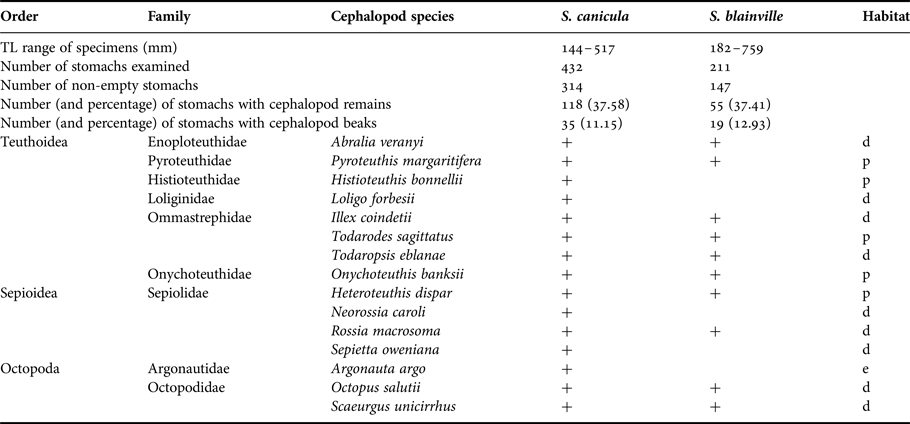
Cephalopod flesh, eye lenses and beaks were found in 118 out of the 314 non-empty stomachs of Scyliorhinus canicula and in 55 out of the 147 non-empty stomachs of Squalus blainville, representing about 37% of stomachs analysed by predator species. Identified cephalopod beaks (Figure S1) occurred in 36 and 19 individuals with non-empty stomachs of S. canicula and S. blainville, respectively.
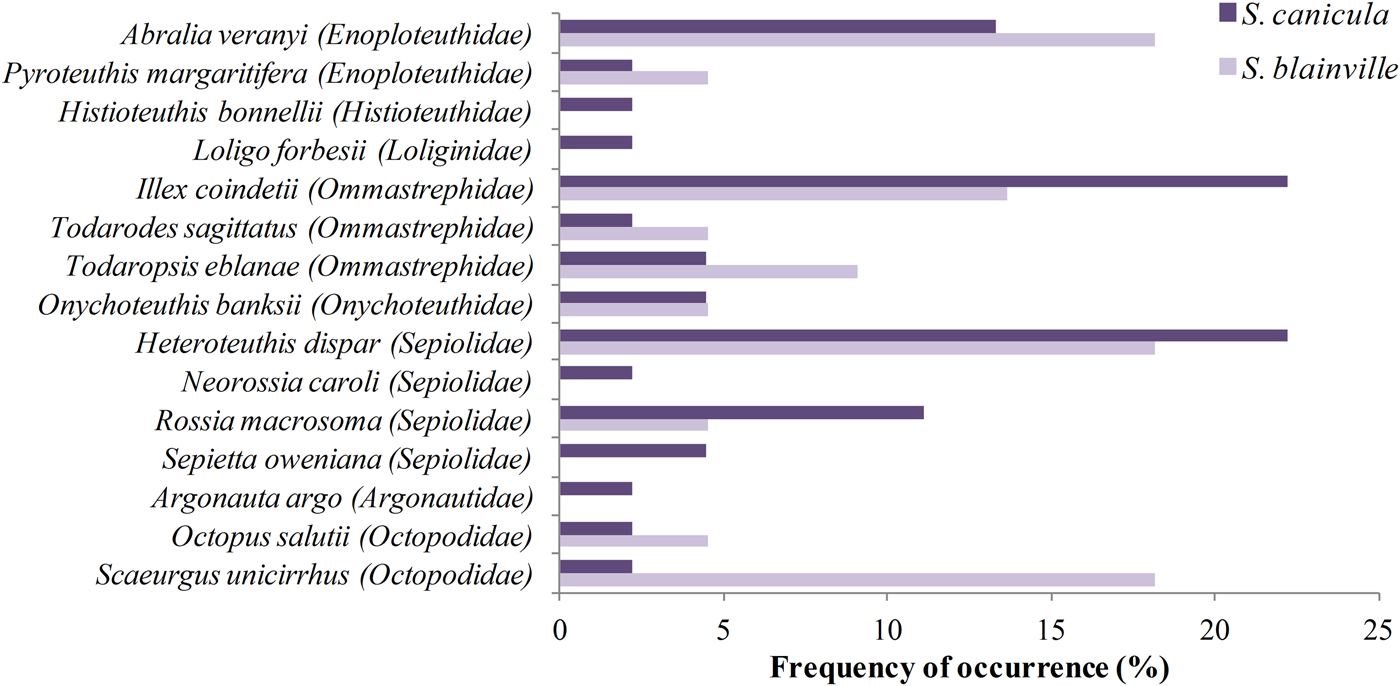
Both predators preyed upon Teuthida, Sepiida and Octopoda. Higher cephalopod species diversity was recorded in S. canicula (N = 15) compared with S. blainville (N = 10). Specifically, representatives of six families of cephalopods (Enoploteuthidae, Pyroteuthidae, Ommastrephidae, Onychoteuthidae, Sepiolidae and Octopodidae) were common in the diet of the examined predators, while species belonging to Histioteuthidae (Histioteuthis bonnellii), Loliginidae (Loligo forbesii) and Argonautidae (Argonauta argo) were found in S. canicula stomach contents only (Table 1, Figure 2).
Percentage (%) frequency of cephalopod prey species occurrence in the stomach contents of Scyliorhinus canicula and Squalus blainville that were identified based on the beaks (N = 45 and 22, respectively).

Characterization of the cephalopod species identified in the stomach contents of Scyliorhinus canicula and Squalus blainville sampled in the Aegean Sea based on their habitat.

d, demersal zone; e, epipelagic zone; p, mesopelagic zone; +, present.
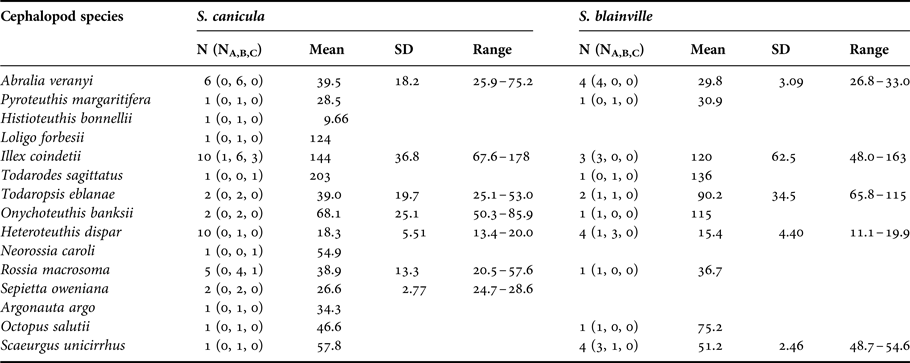
Nektonic cephalopods consisted the major part (>72%) of preyed species by both sharks, out of which about 55% inhabit the demersal zone and 45% the mesopelagic. In the diet of S. canicula, the demersal squid Illex coindetii and the pelagic sepiolid Heteroteuthis dispar were equally represented composing 45% of prey specimens, followed by the small-sized squid Abralia veranyi and the demersal sepiolid Rossia macrosoma representing 25%. The latter species was substituted in the diet of S. blainville by the demersal medium-sized octopod Scaeurgus unicirrhus, which with the almost equally represented A. verany, H. dispar and I. coindetii, composed 50% of cephalopod prey specimens (Table 2).
Descriptive statistics (mean value, SD and range) of the estimated ML of the cephalopod species identified in the stomach contents of Scyliorhinus canicula and Squalus blainville sampled in the Aegean Sea.

N, number of individuals; NA,B,C, number of type A, B and C beaks according to Piatkowski & Pütz (Reference Piatkowski and Pütz1994); SD, standard deviation; all measurements in mm.
The majority of beaks obtained from the stomach content of S. blainville were fresh (type A), usually extracted from remains of buccal masses, whereas beaks of type B were dominant in the stomach of S. canicula (Table 2).
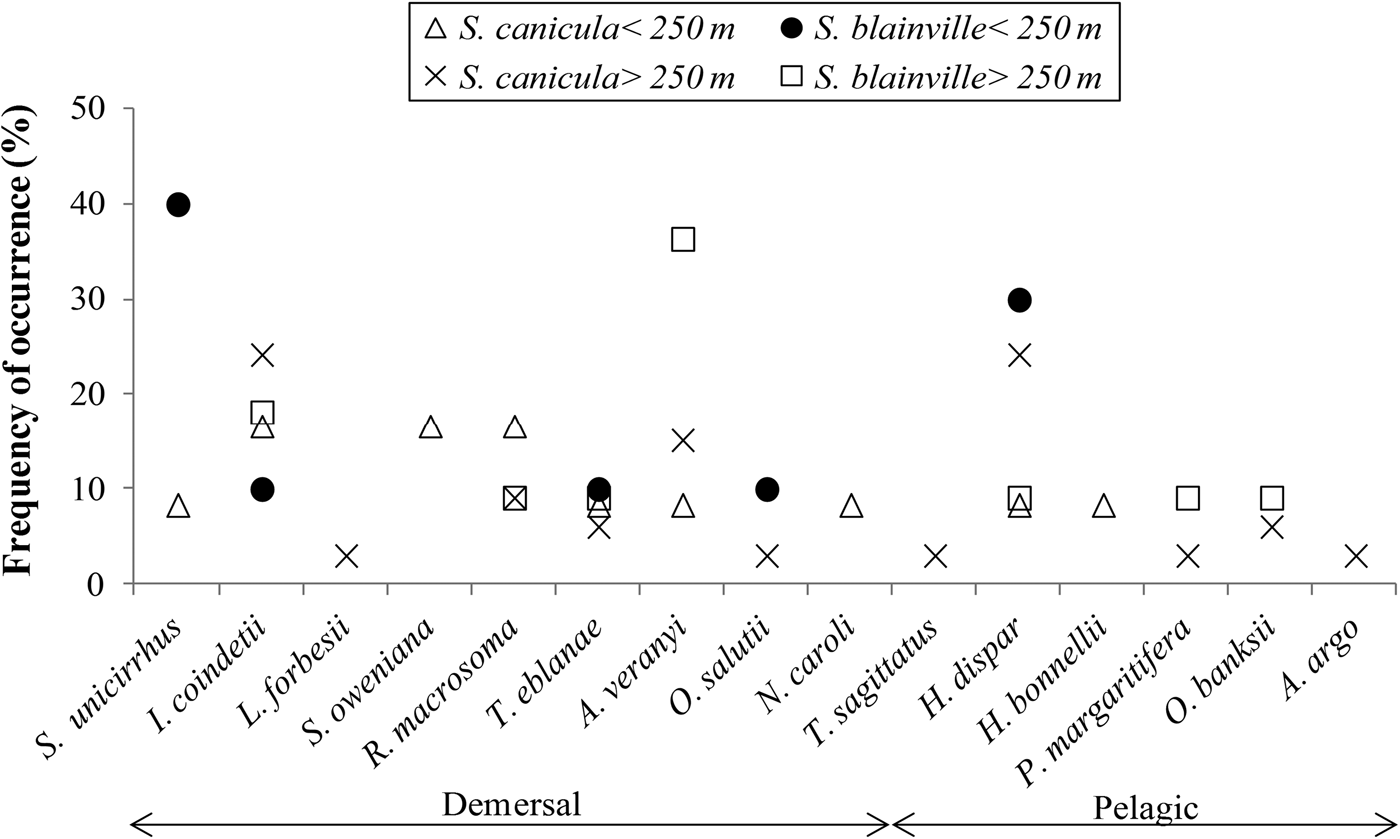
Based on the cephalopod prey species occurrence in the diet of the predator specimens caught over the continental shelf (<250 m) and slope (>250 m), it was shown that cephalopod species distributed over shelf-break and upper slope were identified in the stomach contents of both predators and regardless of the depth zone of their capture (Figure 3). The presence of cephalopod prey species distributed mainly over the continental slope in the stomach content of specimens caught over the shelf, was more frequently observed in S. canicula.
Percentage (%) frequency of cephalopod prey species occurrence in the diet of the predator specimens caught by trawl over the continental shelf (<250 m) and slope (>250 m) in the Aegean Sea. Cephalopod species are ranked following their depth distribution in the Hellenic waters (Lefkaditou, Reference Lefkaditou, Papaconstantinou, Zenetos, Vassilopoulou and Tserpes2007).

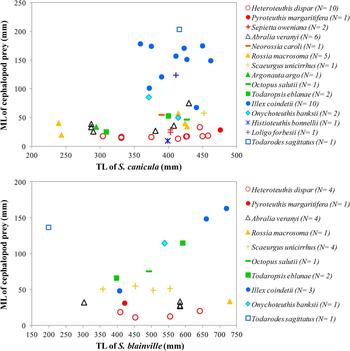
Ommastrephids dominated among larger prey specimens (ML > 100 mm) of both predators, whereas smaller prey-specimens (ML < 40 mm) belonged mainly in small-sized cephalopod species and only among those consumed by S. canicula juveniles of H. bonnellii and Todaropsis eblanae were recorded. According to the estimated ML values, the size range of the cephalopod prey was wider in S. canicula than S. blainville (Table 2). This is probably due to the larger sample of S. canicula examined. However, the limited number of the identified beaks could not allow for between-species comparisons. Finally, based on the cephalopod ML–predator TL relationships (Figure 4), both predators showed an increasing cephalopod species diversity as they became larger in size. An increasing trend of ML with TL size was evident only for the demersal ommastrephids I. coindetii and T. eblanae consumed by S. blainville (Figure 4).
Relationship between the estimated mantle length (ML) of the cephalopod prey and total length (TL) of Scyliorhinus canicula and Squalus blainville individuals sampled in the Aegean Sea. Cephalopod species are ranked in relation to their MLmax recorded in the Mediterranean Sea (Table S1).

DISCUSSION
The present study examines the cephalopod prey species diversity and contribution in the diet of Scyliorhinus canicula and Squalus blainville in the Aegean Sea, two demersal sharks that consume cephalopods in large quantities, although they are both characterized as generalist predators, and contributes to the existing knowledge about the diet of these predators from the Hellenic waters (Kousteni, Reference Kousteni2015; Kousteni et al., Reference Kousteni, Karachle and Megalofonou2016a, Reference Kousteni, Karachle and Megalofonou2017).
Considering previous dietary studies of S. canicula and S. blainville (e.g. Capapé, Reference Capapé1975; Kabasakal, Reference Kabasakal2002; Özütemiz et al., Reference Özütemiz, Kaya and Özaydın2009; Gravino et al., Reference Gravino, Dimech and Schembri2010; Karachle & Stergiou, Reference Karachle and Stergiou2010; Martinho et al., Reference Martinho, Sá, Falcão, Cabral and Pardal2012; Kousteni, Reference Kousteni2015; Kousteni et al., Reference Kousteni, Karachle and Megalofonou2016a, Reference Kousteni, Karachle and Megalofonou2017), cephalopods are one of the three most consumed prey groups, among fish and crustaceans, confirming the general view that predator fish that consume cephalopods have a broad diet spectrum that includes other groups (Smale, Reference Smale1996). In the area of study, cephalopods seemed to be an important prey group for both predators with a higher contribution to the diet of S. blainville (%W = 51.2) compared with that of S. canicula (%W = 30.8), thus characterizing it as a teuthophagus species (Kousteni, Reference Kousteni2015; Kousteni et al., Reference Kousteni, Karachle and Megalofonou2016a, Reference Kousteni, Karachle and Megalofonou2017). However, cephalopods have not always contributed significantly to the diet of S. canicula (Olaso et al., Reference Olaso, Velasco and Pérez1998, Reference Olaso, Velasco, Sánchez, Serrano, Rodríguez-Cabello and Cendrero2005; Serrano et al., Reference Serrano, Velasco, Olaso and Sánchez2003; Valls et al., Reference Valls, Quetglas, Ordines and Moranta2011; Martinho et al., Reference Martinho, Sá, Falcão, Cabral and Pardal2012; Mnasri et al., Reference Mnasri, El Kamel, Boumaïza, Reynaud and Capapé2012; Šantić et al., Reference Šantić, Rađa and Pallaoro2012) and S. blainville (Kabasakal, Reference Kabasakal2002; Martinho et al., Reference Martinho, Sá, Falcão, Cabral and Pardal2012), which might be spatio-temporal specific (Hanlon & Messenger, Reference Hanlon and Messenger1996). It should be noted that the cephalopods found in stomach contents would not necessarily come from the area where the predator was caught. Beaks of cephalopods are known to remain undigested for longer periods than fish bones and otoliths (Clarke, Reference Clarke1996) and as S. blainville has been assumed to move long distances (Kousteni et al., Reference Kousteni, Kasapidis, Kotoulas and Megalofonou2016b), the region from which the cephalopods originate probably cannot be precisely determined. This assumption, however, does not stand for S. canicula, a species with philopatric behaviour that tends to form distinct stocks on small geographic scales (Kousteni et al., Reference Kousteni, Kasapidis, Kotoulas and Megalofonou2015).
With regard to cephalopod prey species levels, initial records in the diet of S. canicula derived from the present study represent 2/3 of the identified cephalopod prey species, resulting in a higher diversity compared with that reported in other studies (Table S2). In the case of S. blainville, seven out of the 10 identified cephalopod prey species in the present study have not been previously reported (Table S3). In general, the diversity of cephalopod prey species was lower in S. blainville (N = 10) compared with S. canicula (N = 15), but similarly to S. canicula higher than that reported in other studies (Table S3), despite the few cephalopod beaks recovered from their stomach contents. This could reflect either the higher cephalopod species diversity in the Aegean Sea, the wider bathymetric range of the sampling procedure compared with previous studies (e.g. <70 m in Martinho et al., Reference Martinho, Sá, Falcão, Cabral and Pardal2012; 90–130 m in Šantić et al., Reference Šantić, Rađa and Pallaoro2012) or the difficulty of assigning the beaks to species (Romeo et al., Reference Romeo, Battaglia, Pedà, Perzia, Consol, Esposito and Andaloro2012). It is also possible that the few recovered cephalopod beaks compared with the total sample size could be attributed to evacuation phenomena during sharks’ ascent from great depths (Yano & Tanaka, Reference Yano and Tanaka1984), a feature which was also reflected in the relatively high numbers of empty stomachs that were recorded in S. canicula and S. blainville (27.3 and 30.3% respectively).
In the Aegean Sea, members of Ommastrephidae (Illex coindetii, Todarodes sagittatus and Todarodes eblenae) were prominent in the diet of S. canicula and S. blainville (N = 13 and 6, respectively), highlighting the potential importance of the arrow squid family within the study area as a food supply. This is consistent with previous dietary results of other predators (Lansdell & Young, Reference Lansdell and Young2007). The pelagic squid T. sagittatus is an important energy source because of its size (MLmax = 780 mm, common ML = 250–350 mm; Wood & Day, Reference Wood and Day1998) and particularly its muscular body composition in contrast with the ammoniacal body of Histioteuthis species (Clarke et al., Reference Clarke, Denton and Gilpin-Brown1979). The most consumed Ommastrephidae species was the demersal I. coindetii, which could also be considered as a significant dietary source given its recorded MLmax of 320 mm (González et al., Reference González, Castro and Guerra1996).
Considering the habitat of the preyed cephalopods, demersal species dominated in the diet of both sharks. This could imply that any change in their communities caused by intense fishing could affect the predator-prey relationships and should be considered when developing management plans for sustainable fisheries. Mesopelagic Histioteuthidae, neritic Loliginidae and epipelagic Argonautidae species participated only in S. canicula stomach contents. On the other hand, Heteroteuthis dispar was the most consumed pelagic cephalopod prey species in both examined predators. Heteroteuthis dispar, although very rarely caught by bottom trawl, seems to be quite abundant over the upper slope of the Mediterranean Sea, as it is among the most frequently found cephalopods in the diet of demersal chondrichthyans (Bello, Reference Bello1997; Lefkaditou, Reference Lefkaditou, Papaconstantinou, Zenetos, Vassilopoulou and Tserpes2007), large pelagic fish (Bello, Reference Bello1991, Reference Bello1999; Salman & Karakulak, Reference Salman and Karakulak2009) and dolphins (Orsi Relini & Relini, Reference Orsi Relini and Relini1993), as well as among catches of experimental mesopelagic trawls and macroplankton devices (Roper, Reference Roper1974; Lefkaditou et al., Reference Lefkaditou, Papaconstantinou and Anastasopoulou1999). The presence of H. dispar in the stomach contents of predators coming from different depth zones corresponds to its high tendency for vertical migrations (Roper, Reference Roper1974).
In the present study, cephalopod prey size showed a wide range (ML = 10–207 mm), but ML values between 10–60 mm were the most frequent in both shark species. This is consistent with the fact that small- or medium-sized predators cannot capture large cephalopods and so prey on smaller ones, as was assumed by Velasco et al. (Reference Velasco, Olaso and Sánchez2001) after examining the role of cephalopods as forage in 27 demersal fishes. In general, cephalopods are difficult to catch and can avoid predators using various mechanisms (Clarke & Merrett, Reference Clarke and Merrett1972).
Differences observed between S. canicula and S. blainville in the condition of beaks retained from their stomach contents may mirror differences in their foraging tactics (hunting vs scavenging behaviour) and habitats. The majority of beaks found in the stomach content of S. blainville were fresh, probably implying that this predator has a more effective hunting ability or preys mainly in the benthopelagic zone. Nevertheless, scavenging behaviour of this predator can be demonstrated by identifying a large T. sagittatus specimen (ML = 136 mm) as prey of a small-sized individual (TL = 199 mm). On the contrary, the dominance of worn beaks in the stomach content of S. canicula could imply that its cephalopod prey are the result from scavenging on the bottom, a behaviour that has previously been reported (Olaso et al., Reference Olaso, Velasco and Pérez1998, Reference Olaso, Velasco, Sánchez, Serrano, Rodríguez-Cabello and Cendrero2005). This species is known to use its olfactory lobes to detect the lifeless prey (Dijkgraaf, Reference Dijkgraaf1975). Nevertheless, it should be noted that the level of beak erosion could be related to the fact that beaks can be retained in the stomach of marine predators for a long time (Piatkowski & Pütz, Reference Piatkowski and Pütz1994).
Finally, both predators showed higher cephalopod species diversity when becoming larger in size, corresponding to a food selectivity attitude, probably related to an increase in gape size. It was apparent that S. canicula showed a sudden increase in cephalopod prey species diversity with the onset of maturity (total length at 50% maturity; L 50 = 397 and 382 mm for females and males, respectively; Kousteni, Reference Kousteni2015), as well as a preference for cephalopod species of larger size, such as Loligo vulgaris, I. coindetii, T. sagittatus and Octopus salutii. The greater energy expenditure of the larger, and thus mature, individuals may also explain the observed ontogenetic shift in the cephalopod forage of S. canicula. Rodríguez-Cabello et al. (Reference Rodríguez-Cabello, Sánchez and Olaso2007) observed that this shift to larger prey in the diet of S. canicula reflects its transition from the immature to mature state. In the case of S. blainville, there was a clear correlation between the increase of Ommastrephid prey species (I. coindetii and T. eblanae) ML and the predator's size, whereas a clear dietary cephalopod prey species diversity pattern in relation to S. blainville body size was not observed.
With the increasing focus on fishing impacts, environmental change and the development of ecosystem-based management strategies, understanding the ecological role of cephalopods could contribute to our understanding of these changes (Lansdell & Young, Reference Lansdell and Young2007). The central role of cephalopods in marine food chains is underlined in the many pelagic ecosystem models being currently developed (e.g. Olson & Watters, Reference Olson and Watters2003), while understanding their trophic inter-relationships will help to elucidate cephalopod ecology and form the basis for further ecosystem modelling. Considering the frequent loss of food in sharks as they are being hauled up from great depths (Yano & Tanaka, Reference Yano and Tanaka1984) in combination with the sampling difficulties of cephalopods themselves (Piatkowski et al., Reference Piatkowski, Pierce and Morais da Cunha2001), further sampling is needed to fully elucidate their predation upon cephalopods, which would provide at the same time data on the distribution and abundance of cephalopods in new, unexplored habitats.
FINANCIAL SUPPORT
The sampling of this study has been partially co-financed by the European Union (European Social Fund-ESF) and Greek national funds through the Operational Programme ‘Education and Lifelong Learning’ of the National Strategic Reference Framework (NSRF)-Research Funding Programme: Heracleitus II: investing in a knowledge society through the European Social Fund.
SUPPLEMENTARY MATERIAL
The supplementary material for this article can be found at https://doi.org/10.1017/S002531541700159X.