1 Summary
The central claim of Even-Simkin & Tobin 2013 (henceforth E-S&T) is that English nouns that form their plurals and verbs that form their past tenses by alternating the root vowel, and which are popularly called ‘irregular’, are in fact phonologically and semantically regular. E-S&T use the term ‘internal vowel alternation’ (henceforth IVA) to characterize the inflection of these nouns and verbs.
The phonological regularity proposed in this book is twofold, with one pattern proposed for the nouns and one for the verbs. The past tenses of the IVA verbs are marked by vowels that are pronounced farther back in the mouth than the vowel of the present tense. The plural forms of the IVA nouns are marked by vowels that are pronounced farther forward in the mouth than the vowel of the singular. IVA is thus simply another term for ablaut. A verb that ‘retains its IVA pattern’ is one that has retained a strong inflection to the present day, and one that has ‘lost its IVA pattern’ is one that has passed into the much larger class of weak verbs. Their ‘backing process’ is a claim that verbal ablaut is characterized by having a back vowel in the past tense. The backing process does not hold of 100 percent of strong verbs in either Old English or Modern English, but it holds of a high enough proportion that the authors conclude that the correlation cannot be accidental.
E-S&T hypothesize that the correlation between past tense verb and back vowel and between plural noun and front vowel is iconic. In other words, they mean that a position farther back in the physical space of the mouth iconically represents the position further back in time of the past tense, relative to the present tense. Similarly, a position farther forward in the physical space of the mouth iconically represents the increase in number of entities represented by the plural, relative to the singular.
The semantic regularities are drawn at two levels. At a very high level, all the IVA verbs are marked for resultative aspect; while all the IVA nouns are marked for Semantic Integrality, meaning ‘the perception of potentially discontinuous entities in continuous space’ (p. 70).
On a more fine-grained level, E-S&T propose common semantic denominators (henceforth CSDs) for each vowel alternation pattern. They do this for both Old English and Modern English by examining the dictionary definitions for each group of words with similar inflection. They use these definitions to come up with a phrase that encompasses the meanings of all the words in that inflectional class. For instance, in Modern English, the verbs bid, give, cleave, come and lie, which all have a past tense with [ei], are said to have in common the semantic force of ‘TO APPROACH SOMETHING BY BODY OR MATTER’ [capitals and emphasis in original].
The search for CSDs follows from the sign-oriented approach taken by E-S&T. According to the theoretical underpinnings of their work, there is a one-to-one correspondence between linguistic form and meaning. Thus, if we see a set of verbs that mark their past tense in the same way, we expect the verbs also to exhibit similar semantics.
E-S&T hypothesize that these phonological and semantic regularities allowed the Old English verbs to retain their IVA inflection, if with different phonetic realizations, in Modern English.
2 Principles of methodology
This section enumerates the criteria according to which I will, in section 3, evaluate the book under review to see how well it conforms to the standard expectations of methodological rigor in the empirical sciences.
2.1 Falsifiability
The principle of falsifiability, as explicated by Karl Popper (Reference Popper1935), says that while a scientific hypothesis cannot be proved through induction from examples, it can be disproved, i.e. falsified, by counterevidence. The proper way to test a hypothesis, then, must involve defining what would constitute counterevidence, and then looking to see if that counterevidence can be found. If none is found, despite the best efforts of the researchers, the hypothesis gains strength.
2.2 Burden of proof
The default position on any hypothesis is an absence of belief in the absence of evidence. The burden of proof lies on the side arguing for the validity of the hypothesis. The proof must involve producing both compelling reasons to believe that the hypothesis does a good job of explaining some phenomenon, as well as showing that the hypothesis holds up against rigorous attempts to refute it.
2.3 Null hypothesis
The absence of belief in the absence of evidence is related to the null hypothesis. The null hypothesis states that any relationship proposed between two phenomena can be explained by random coincidence. The researcher's job is to look for a reason to reject the null hypothesis.
2.4 Statistical significance
Rejecting the null hypothesis is done by accumulating enough data to show that it is unlikely that so much correlation could be random. If the null hypothesis is so unlikely that believing in it requires believing in implausible amounts of coincidence, we look for an alternate hypothesis.
2.5 Explanatory power
The alternate hypothesis mentioned in the previous paragraph cannot be any hypothesis chosen at random. It must make predictions about the phenomenon that can be measured and tested. It must result in an effect that is distinguishable from the effects of other established causes. For if it leaves no evidence, however indirect, of its existence, we fall back to the default position, which is absence of belief in the absence of evidence.
2.6 Parsimony
When it comes to explaining data, the principle of parsimony, popularly known as Occam's Razor, tells us not to multiply entities without reason. If one variable satisfactorily explains all the data, positing a second explanatory variable that makes no different predictions than the first leaves us with a situation where the second hypothesis has no measurable effect. In this case, we have no evidence for subscribing to a belief in this proposed correlation between the second variable and the phenomenon.
For instance, the arrangement of the stars in the sky is explained by various principles from physics. No matter how plausibly a description of the arrangement of the stars matches a description of a Greek warrior with a belt, sword and shield or bow, the pattern of Orion must add something to our understanding of the real world before we subscribe to a belief in it. The null hypothesis is that the constellation of Orion exists only in the minds of observers.
2.7 Evidence and counterevidence
In the empirical sciences, we are often not trying to show that a proposed cause guarantees a certain effect. Rather, we are attempting to show that there exists a relationship between two variables. One is an independent, or explanatory variable, such as taking a hair-loss prevention drug. It is compared with a dependent, or response variable, such as keeping one's hair.
This is because there are often multiple factors contributing to an outcome. In isolation, every instance of someone taking a hair-loss prevention drug and still losing their hair is a counterexample of the claim ‘Taking this drug prevents hair loss.’ In the simplest case, where the claim is a guarantee, that hypothesis could be stated in propositional logic as P (‘taking this drug’) implies Q (‘keeping one's hair’). Examples of P and not Q – taking the drug and not keeping one's hair – are counterexamples that invalidate the proposition.
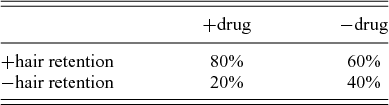
In a more complex system such as language or biology, it is most often the case that multiple causes are at work. Rather than making a guarantee that a drug prevents hair loss, we more usually investigate the possibility of a correlation between the two variables ‘taking the drug’ and ‘keeping one's hair’ by setting up a contingency table that allows us to judge relative risk of hair loss. The contingency table for this example would contain four cells, each containing the percentage of one of the four possibilities: taking the drug and keeping one's hair; taking the drug and not keeping one's hair; not taking the drug and keeping one's hair; not taking the drug and not keeping one's hair. A sample contingency table, with fabricated values, is included as table 1 for ease of visualizing the possible outcomes.
A sample contingency table
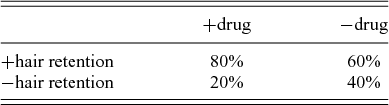
In table 1, 80 percent of users of the hair-loss prevention drug retained their hair, compared to only 60 percent of people who took no such drug. No one cell of a contingency table, such as the 80 percent success rate for the drug in table 1, is meaningful in isolation as evidence for the efficacy of the drug. It would not be meaningful in isolation even if it were a 100 percent success rate.
2.8 Confirmation bias
The principles of scientific methodology are counterintuitive and must be consciously learned. The instinctive modus operandi among humans is to gather support to bolster a favored hypothesis, not to search for evidence to tear it down. The urge to support a hypothesis is so strong that people who are sufficiently psychologically invested in a hypothesis can even interpret counterevidence as evidence. This phenomenon is known among cognitive scientists as confirmation bias. See Nickerson (Reference Nickerson1998) for a good overview of studies on confirmation bias.
2.9 Summary
In conclusion, as scientists we set out to establish belief in the truth or falsehood of a hypothesis by determining how well it explains the phenomenon under investigation. We refrain from adopting any new belief in the absence of evidence. We recognize that any hypothesis, however appealing, that fails to bear up under the evidence must be refined or discarded. A strong hypothesis must have held up under repeated attempts to refute it. A meaningful hypothesis is one that contributes new information and enhances our understanding of the world.
3 Evaluation of E-S&T's methodology
The two central claims made by E-S&T are that the IVA verbs and nouns are phonologically motivated by iconic fronting (nouns) or backing (verbs); and that they are semantically motivated by common semantic denominators that encompass each morphological class.
Evaluating these claims is tantamount to asking whether they are similar to laws of astrophysics in that they explain the observed phenomena, or similar to constellations in that they are patterns that exist only in the minds of the observers. Answering this question means finding testable implications to test the strength of the hypotheses. Section 3.1 evaluates the strength of the phonological claim and section 3.2 the morphological claim.
3.1 Fronting and backing
The phonological claim of E-S&T is that the backing process of vowels in IVA verbal past tenses and the fronting process of vowels in IVA nominal plurals are iconic: a motion backward in space corresponds to a motion ‘backward’ in time; and a motion forward in space corresponds to an increase in the number of entities.Footnote 2
Within this claim, three hypotheses can be distinguished.
(1) There exists a morphophonological correlation between the backing process and the IVA verbal past tenses and between the fronting process and the IVA nominal plurals.
(2) The effects of backing and fronting in the language are real and not illusory: i.e. they explain data that are not accounted for by other hypotheses.
(3) These backing and fronting tendencies are iconic.
In sections 3.1.1 to 3.1.3, each of these three hypotheses is evaluated in turn.
3.1.1 Morphophonological correlation
In support of (1), E-S&T successfully show that, in both Old English and Modern English, most past tense IVA verbs have vowels that are relatively back compared to the vowel of the present, and that most plural IVA nouns have vowels that are relatively front compared to the vowel of the singular. The relativity of frontness and backness is an important detail, since in some cases, both vowels are back or both are front. In other cases, one or both are diphthongs. Chapters 8 and 9 of the book thoroughly compare the vowels of the past and present verbal forms, and the vowels of the singular and plural nominal forms. Spectographic analyses of the phonetic realizations of the vowels, carried out by Ladefoged, are invoked to support the claim of the relative frontness and backness of the vowels.
3.1.2 Explanatory power of backing/fronting
Hypothesis (2) advances the claim from ‘There is a preponderance of back or front vowels among IVA forms’ to ‘The preponderance arises not as a side effect of some other cause, but because back or front vowels are specially preferred in IVA forms.’ In order to test this claim, we must distinguish between back or front vowels that can be explained as the effect of some other cause, and back or front vowels that can be explained only as the effect of a preference for backness or frontness. The following sections present other, well-studied linguistic principles that make predictions about vowel quality, and how these predictions relate to the predictions made by E-S&T's hypotheses that backing and fronting processes are real phenomena.
3.1.2.1 Phonological inertia
From a diachronic perspective, patterns of phonological change known, somewhat imprecisely, as sound change laws are well understood for a significant portion of the history of the English language as it evolved from Proto-Indo-European (henceforth PIE) to Modern English. These laws are essentially predictions for how reconstructed phonemes in PIE are expected to manifest in Modern English. Epistemologically, framing it as a prediction is backward, because we reconstruct PIE from primary evidence in English and other languages. But it makes sense to say that if we encountered primary evidence of PIE that was not formulated on the basis of later languages, we would make predictions about what the reflex of that word in a given later language was expected to be.
For instance, the regular sound change laws predict that PIE /oi/ emerges regularly in many varieties of Modern English as /әu/, through a series of intermediate steps spelled out in greater detail below. They predict that /uː/ followed by /j/ in the next syllable emerges regularly as /ai/ in Modern English, also through a series of intermediate steps. Only divergences from such predictions need to be explained by additional hypotheses, according to Occam's Razor.
Thus, after looking at the predictions made by the sound change laws, we see that no specific backing or fronting rule is needed to explain the /әu/ of rode or the /ai/ of mice. This does not mean that these two forms might not contribute to a predominance of back or front vowels, which the speaker might later formalize into a pattern of [+past, +back]. It means that the outcomes of these forms do not provide us with a reason to believe in a backing or fronting rule, only with a possible explanation of the rule should we decide, on the basis of other evidence, that such a rule exists and requires explanation. Only if a specific pattern of backing or fronting makes some different predictions from these regular sound change patterns are its effects visible in the domain of phonology.
What the sound change laws tell us about the fronting of vowels in pairs like mouse ~ mice is that fronting was not originally restricted to noun plurals. Rather, fronting was part of a more general pattern, called i-umlaut, that resulted in the fronting of a back vowel followed by /j/ or /i/ in the subsequent syllable, such as in *mūs-iz ‘mice’ (Wright & Wright Reference Wright and Wright1925: 26–8). There are plenty of examples outside of noun plurals, such as doom ~ deem from *dōm ~ *dōm-jan (OED). If any correlation arose between noun plurals and vowel fronting, it arose after the phonological rule had ceased to be productive, and was not the initial cause of the fronting. Moreover, any noun plural, such as mice, that has in Modern English the exact form that we would predict of it based on rules such as i-umlaut gives us no evidence for the existence of a fronting rule. E-S&T summarize the history of i-umlaut (pp. 37–8), but without considering its implications for what does and does not constitute evidence for their hypotheses.
Similarly, we have reason to believe that historically the back vowels of past tenses go back to an ablaut system in Proto-Indo-European that was integral to nearly every part of the grammar (Ringe Reference Ringe2006: 234–5). Through regular phonological change, these back vowels have for the most part remained back vowels, or have become diphthongs with some component of backness. For instance, the Modern English verb ride [raid] traces its origin back to the PIE e-grade form *reidh- (Wright & Wright Reference Wright and Wright1925: 108). The diphthong was monophthongized in Proto-Germanic (Wright & Wright Reference Wright and Wright1925: 23), and diphthongized again by the Great Vowel Shift in Early Modern English (Lass Reference Lass1999: 72). Its expected outcome in Modern English is [ai], exactly as we find it. The Modern English word rode goes back to the PIE o-grade *roidh- (Wright & Wright Reference Wright and Wright1925: 108). The vowel was lowered in Proto-Germanic (Wright & Wright Reference Wright and Wright1925: 23), monophthongized by Old English (Wright & Wright Reference Wright and Wright1925: 78), and raised and diphthongized by the Great Vowel Shift in Early Modern English (Lass Reference Lass1999: 72). Its expected outcome is [әu], exactly as we find it. The past participle ridden goes back to the zero-grade PIE *ridh- (Wright & Wright Reference Wright and Wright1925: 108), and the vowel has quite regularly remained the same to the present day. None of these vowels either call for further explanation or provide evidence for any other factors at work. Again, this does not mean other factors were not at work in the verbal system. It only means that these forms, and others like them, do not constitute evidence, because the effects of other factors, if any, on these forms were invisible.
3.1.2.2 Morphological inertia
From a diachronic morphological perspective, the null hypothesis is that, in the absence of other factors, a past tense form in Modern English is directly descended from a past tense form in Old English. Divergences from this prediction must be explained by adducing hypotheses. I will call this hypothesis ‘morphological inertia’. Thus, if a backing hypothesis predicts when the past tense vowel of a strong verb is extended to the past participle or vice versa, then the backing hypothesis offers some explanatory power above and beyond the morphological inertia hypothesis.
Another important violation of morphological inertia that would constitute evidence for a backing hypothesis is the not infrequent case of a strong verb becoming weak, or vice versa. If verbs without back vowels in the past tense display a greater tendency to become weak than do verbs with back vowels, then the backing hypothesis offers some explanatory power above and beyond the morphological inertia hypothesis.
E-S&T do assert that backing ‘triggered and allowed the Old English . . . forms to be retained in Modern English’ (p. 211). However, they fail to demonstrate this hypothesis. They illustrate past tense IVA verbs with back vowels in Old and/or Modern English and consider this sufficient evidence for their claim. This method is comparable to providing the success rate of a hair-loss prevention drug without providing any control group figure to compare it to. E-S&T acknowledge the existence of verbs with back vowels that nevertheless lost their IVA pattern – contrary to the hypothesis that backing allowed verbs to retain IVA forms – but deny that these cases constitute counterexamples.
[T]he −backing cases of IVA in Modern English verbal forms should not be considered as counterexamples, because all of these cases followed the +backing process in their Old English forms. (p. 210)
If the intent is to support (2), the claim that a backing process makes predictions above and beyond the predictions made by morphological inertia and regular phonological change, counterexamples are exactly what these are.
They are obviously not directly counterexamples to (1), the claim that back vowels predominated in Old English forms. However, since back vowels are expected to predominate based on their descent from PIE ablaut patterns, and since E-S&T are claiming (2), these forms are counterexamples to (2). Furthermore, and crucially, the only examples given in support of (1) are Old English verbs that survive into Modern English. E-S&T do not systematically consider verbs that later became obsolete. Since these verbs presumably formed part of the grammar of Old English speakers, omitting them is only legitimate if the book is concerned specifically with explaining diachronic survival patterns rather than describing the synchronic state of Old English grammar.
Given a hypothesis that the backing process helped verbs retain their IVA pattern, i.e. remain strong rather than becoming weak verbs, there are four possible outcomes: [+backing, +retention]; [+backing, −retention]; [−backing, +retention]; [−backing, −retention]. Just as in the case of the pharmaceutical company promoting a hair-loss prevention drug, it is important to calculate and present all four possibilities in order to have a meaningful case. To include only [+backing, +retention] as evidence, and to dismiss [+backing, −retention] as not being counterevidence, is exactly parallel to arguing ‘Take our drug because these people took it and retained their hair. These other people who took it and did not retain their hair aren't counterevidence, because they historically had hair.’ The parallel sentences in (4) and (5) show how the structure of the argument made by E-S&T concerning the nature of evidence matches the structure of the argument about taking a hair-loss prevention drug.
- (4)
(a) Many subjects took the hair-loss preventing drug and retained their hair.
(b) Many verbs had an IVA-loss preventing back vowel and retained their IVA.
- (5)
(a) These other subjects that took the drug and still lost their hair aren't counterevidence, because historically they had hair.
(b) These other verbs that had the back vowel and still lost their IVA don't count, because historically they had IVA.
No one would be persuaded by (5a), and a thoughtful consumer might think to query (4a) by asking whether the same proportion of people who did not take the drug might have retained their hair anyway.
Similarly, E-S&T claim that the backing process is productively applied to weak verbs to make them strong (p. 64). This too is a testable hypothesis. However, immediately following their claim that the backing process is productively applied to weak verbs, they deny that originally weak verbs that exhibit a [–backing] pattern instead are counterexamples, because ‘historically they are not originally “strong” verbs’ (p. 167). Since their claim is that the backing process applied to verbs that ‘historically . . . are not originally “strong” verbs’ (p. 167), once again, counterevidence is exactly what these cases are.
This and the previous instance of denying counterevidence are clear examples of confirmation bias. Rather than trying to see how the hypothesis stands up against attempted refutation, E-S&T adduce only evidence in support of their theory, including evidence that is meaningless in isolation. Because they are not systematically trying to determine what predictions their hypothesis makes, they miss cases that defy the predictions. When they should be considering the proportion of verbs that remained strong without having a more back vowel in the past tense, or that became weak despite originally having a more back vowel in the past tense, they introduce only isolated examples and dismiss them.
Not clearly laying out the predictions made by their hypotheses also causes the authors to miss the opportunity to compare those predictions to the other hypotheses which have already gained credence in the literature. These include most notably type and token frequency, the subject of many studies by Bybee and colleagues, particularly those collected and reprinted in Bybee (Reference Bybee2007), and the consonantal structure of the root, such as the famous -ng/-nk attractor of the sing and sling patterns (Krygier Reference Krygier1994; Albright & Hayes Reference Albright and Hayes2003). Several of Bybee's studies are cited by E-S&T (p. 248), and token frequency is given a passing mention (pp. 40, 70), but how the predictions of the frequency hypotheses in the literature compare to the backing hypothesis made by E-S&T is not explored.
Nevertheless, with a more rigorous study, the hypothesis might hold up thus far to the demands made on it. In other words, there might be sufficient evidence to conclude that speakers do actively prefer relatively back vowels for past tenses and relatively front vowels for noun plurals. Taking as a working hypothesis the possible scenario that this claim has gained support by future study, we can consider what the next set of challenges to the claim would be.
3.1.2.3 Salience
Even if a preference for selecting a past tense from the set of vowels described by E-S&T as [+backing] is demonstrated, the feature of backing must be distinguished from other potential features these vowels might have in common. E-S&T discuss the importance of communicative salience. IVA verbs, which convey important information about morphological grammar in a single vowel, tend to be monosyllabic. This is likely to be, as E-S&T argue, because the vowel is easier to perceive in a single syllable than in a word of more syllables (p. 74).
Similarly, several alternate hypotheses for the quality and quantity of the vowel in a past tense must be entertained. Where the vowel diverges from the predictions of morphological inertia and sound change patterns, is it because backing is preferred? Is the vowel chosen longer than its competitors in duration, perhaps even a diphthong, with the result that the listener has more time to perceive the tense? Does backing or fronting have the effect of increasing the distance in the vowel space between the present and the past tense forms, again enhancing ease of perception?
Psycholinguistic evidence would be useful for teasing out the different possibilities. Such evidence would also be useful for distinguishing between a general rule of backness and a more specific tendency of verbs to be attracted to existing classes as a result of type frequency. For instance, it can be hypothesized that verbs ending in -ng or -nk demonstrate a tendency to inflect like sing or sling, without the speaker necessarily having to access generalizations about the verbal system as a whole. Accessing ‘backness’ as a feature in its own right, rather than an emergent property, is a separate hypothesis that needs to be tested to answer the question: Does the set of preferred vowels just happen to be [+back] in most cases, or are they selected for being [+back]?
3.1.3 Iconicity
If the argument makes it this far, we have still to consider hypothesis (3), the reality of iconicity. If backing is indeed being selected for, then interpreting it as an iconic representation of anteriority in time is one hypothesis that would explain the significance of backness. However, this still must be framed as a falsifiable and testable hypothesis.
In testing it, the following questions would arise. Is there psycholinguistic evidence that people are sufficiently attuned to where in the mouth vowels are pronounced, something that takes place without conscious awareness on their part, with the result that they can make an analogy with a metaphorical expression that they learn more consciously? One certainly could not ask an untrained speaker where these vowels are pronounced! Even the early orthoepists often overlooked the role of the back of the tongue in pronouncing vowels (Lass Reference Lass1999: 60).
Another question to be asked is whether there is any crosslinguistic correlation between languages that refer to the past as ‘back’ and languages that mark the past tense with a back vowel. Similarly, is there any tendency for languages, such as ancient Greek, that refer to the past and future with reverse metaphors, to exhibit the reverse vowel patterns to preserve the iconicity? For instance, ὄπισθεν (LSJ) has a spatial meaning of ‘behind’ and a temporal meaning of ‘future’. See Núñez & Sweetser (Reference Núñez and Sweetser2006) for an example of a crosslinguistic treatment of spatial metaphors for time, both as events relate to each other and as they relate to the speaker. Such languages would be prime testing ground for searching for evidence that speakers can relate spatial metaphors of time to spatial aspects of phonetics. It is not adequate to make an assumption that speakers can do this, without providing evidence.
Though I would not dispute that the dominant metaphor in English equates ‘back in space’ to ‘back in time’, the contrary metaphor is also found. Moving a deadline ‘forward’ can mean to move it earlier in time, whereas to move a deadline ‘back’ can mean to move it to a later time. The usage of forward to mean ‘earlier in time’ goes back to Old English (OED). The word anterior refers to the past when using it of time but to the front when using it of space, and vice versa for posterior. If I enter a building ‘before’ the person behind me, I am in front of them spatially, but the event of my entry took place in the past relative to theirs, hence the two meanings of before. These reverse usages even in English mean that speakers are more likely to have to think consciously about whether they want to announce that a deadline is being moved forward or backward in order to communicate their meaning.
The answers to the preceding questions would either support or fail to support the idea that iconicity is an operative factor. Our strength of belief in the reality of iconicity would depend on the strength of the evidence that morphology driven by the iconicity of vowel quality is possible and plausible.
3.2 Common semantic denominators
The semantic claim of this book is that verbs or nouns that share an IVA pattern also share common semantic ground. The search for the common semantic denominator (CSD) of each pattern is guided by two lines of reasoning. One is theoretical. As noted in the introduction of this review, this book takes sign-oriented linguistics as its theoretical foundation. As a result, one basic principle that guides the reasoning of the arguments in the book is the principle that each sign communicates a meaning. From this, it follows that if one set of verbs marks the past tense with one particular vowel, we should a priori expect to find that this common vowel corresponds to some common meaning. The second line of reasoning draws on the empirical findings of previous scholarship. For instance, E-S&T cite studies showing that neurological patients with semantic dementia have more difficulty with the morphology of strong verbs than would be expected if strong verbs had no special semantic characteristics.
Armed with this expectation of semantic similarity, E-S&T amass a set of dictionary definitions for each verb.Footnote 3 They look for commonalities in the definitions, from which they construct a CSD for each class. This is the first step: to be able to find similarities among this and that set of verbs, and E-S&T have accomplished it. The next step is to wonder, can such similarities be found among any arbitrary set of verbs? If so, then any claim for the reality of CSD-driven morphology is vacuous. E-S&T fail to provide the reader with any sort of methodology that would allow us to rule out the possibility that the rules are flexible enough to create a CSD out of any set of verbs.
In the following sections of this review, I present some questions to fill in the methodological gap. If answered, they would give us a rigorous way to exclude a verb from a CSD. Each of these questions is illustrated by a CSD proposed in the book.
3.2.1 Which definitions are to be included?
If a dictionary such as the Oxford English Dictionary includes, say, twenty definitions and subdefinitions for a word, some of which come into or fall out of use at different periods throughout the history of the language, which ones are likely to have played a role in the morphology of the verb? If a definition is not attested until Modern English, should we invoke it to explain morphological features of Old English? Presumably not, but E-S&T use the same set of definitions for Old English and Modern English. One hopes they were careful in their selection, but without an explanation of which definitions were excluded, one cannot be sure without repeating the legwork through the dictionaries oneself.
One instance that does not inspire confidence is stink. It is a member of a group of verbs whose CSD is summarized as ‘A COMPLEX MOVEMENT– GRADUAL OR STRONG in order to obtain a goal or to reach an end-point’. Stink is included in this group by virtue of its meaning ‘to spring, leap’, which, out of all the definitions given for this word, is the only one placed in bold. Unfortunately for E-S&T's case, ‘to spring, leap’ is cited by the OED as a meaning of words in other Germanic languages that may be etymologically related to stink, ‘but in view of the great diversity in meaning it cannot be positively asserted’. If the only meaning that E-S&T could make fit is one that is not even certainly related to this word, and if it ever was, passed out of use before English was attested, the word most likely does not belong to this CSD in Modern English.
3.2.2 How obscure can the definitions be?
The CSD that encompasses bite and slide in Modern English is said to denote the ‘MECHANISM/ACTION OF MOVING DOWN OR MOVING FORWARD (ALSO IMPLEMENTED IN SKATING)’ (p. 152). For bite, E-S&T arrive at this meaning by emphasizing the gripping motion of a tool such as ‘of a skate on the ice’ (p. 146). ‘Bite the ice’ is used literally of skates to stop forward motion, and idiomatically as a way of telling someone to ‘go to hell’. Since hell lies below the earth, saying ‘bite the ice’ is a way of inviting someone to engage in downward motion (p. 152). E-S&T relate slide by emphasizing the definitions ‘formerly used of skating’ and ‘to move forwards’. The semantic similarities between bite ~ bit and slide ~ slid in Modern English are thus supposed to involve ice skating.
Given the infrequency of ‘bite the ice’ in a skating context, the obscurityFootnote 4 of the idiom ‘bite the ice’ = ‘go to hell’, and the number of connections needed to make bite resemble slide in the semantic domain of downward motion, the obscurity of the evidence does not inspire confidence that the foundation of the rest of the CSD edifice is less flimsy, in the absence of a clearly defined methodology.
3.3.3 How vague can the CSD be?
As discussed, the ability to exclude verbs from membership is a sine qua non of a meaningful CSD. The question ‘How many verbs of other classes would also fall under this CSD?’ is therefore important. It is all the more important because E-S&T point to cases where some verbs do fall under multiple CSDs and exhibit multiple past tense forms as well. This argument implies that if verbs fit into multiple CSDs, they are more likely to exhibit predictable morphological variation.
One CSD in which the need for guidelines to limit vagueness makes itself felt is ‘AN ACTION THAT ENTAILS SOME KIND OF ENDPOINT’ (p. 153). This CSD is supposed to motivate the morphological similarity of choose and shoot in Modern English. If, as E-S&T claim, all the IVA verbs are marked for [+result], are these two verbs really especially similar in meaning? The need to motivate morphological similarity by semantic similarity is all the more questionable in that the vowels of the past tenses, chose and shot, are phonologically dissimilar in Modern English, most likely because shoot is grouping with other dental-final verbs more than with choose. If we can claim that these two verbs, choose and shoot, form a semantic class, of what two verbs could we not make this claim, given a comparably all-encompassing semantic umbrella?
3.3.4 How to avoid overfitting the data?
How far can we go in adding extra material to a CSD to cover a verb that otherwise would not be described by it? For instance, one could say that what the last names of the most recent seven American presidents have had in common is that they’ve begun with O or B or C or R or F, but that should not strike anyone as an especially convincing model for representing the similarity of presidential surnames, because of the high ratio of 5 variables needed to predict 7 data points.
One CSD in which the need for guidelines to limit overfitting makes itself felt is ‘ONWARD MOTION: TO DRIVE OR FORCE WITH SOME EFFORT TO MOVE; TO DRAW/TO APPEAR OR TO CONTINUE IN EXISTENCE’. This CSD is supposed to motivate the morphological similarities of abide, rise, shine, drive, strive, dive, write, ride, smite and stride.
Abide does not seem to fit the semantics of ‘onward motion’. In fact, abiding strikes me more as the absence of motion – as well as the absence of [+result], for that matter – and unlike ‘bite the ice’ in its meaning ‘to stop forward motion’, does not even presuppose the existence of motion. Abide is made to fit by the inclusion of ‘to continue in existence’ which has nothing to do with onward motion, save perhaps metaphorically through time. However, the action of most non-punctual verbs begins at one point in time and continues until some future (or forward) point in time. Here we find ourselves again running up against the objection against all-inclusive vagueness. Similarly, shine is made to fit by the inclusion of ‘to appear’. E-S&T place in bold the transitive meanings of shine in the list of definitions, where forward motion is a little more apparent, but include the intransitive ‘to appear’ in the final CSD. Again, this inconsistency highlights the absence of a clear methodology. The meaning ‘to appear’ is in turn included by virtue of being a derived and less common meaning of rise, as in ‘A prophet rose up among the people.’ There exist a number of strong verbs, such as shoot, for which propelled onward motion forms an essential part of their meaning, compared to verbs like write, where the dragging motion of the pen is less essential to the understanding of the verb.
This CSD, ‘ONWARD MOTION: TO DRIVE OR FORCE WITH SOME EFFORT TO MOVE; TO DRAW/TO APPEAR OR TO CONTINUE IN EXISTENCE’, is noteworthy for stringing together as many loosely related definitions as necessary to include all the verbs that the authors need to include. The question again arises, what secondary definitions could we not append to this CSD if we found a verb sharing the same morphology, whose definition did not seem at first to fit?
Here I must add the disclaimer that I am neither a semanticist nor a computational linguist, but I will offer a suggestion for an avenue of research that might prove fruitful. I begin by acknowledging that the example given above of presidential surnames, in its simplicity, makes a useful pedagogical tool for illustrating what overfitting a model to the sample is, and how it makes for a poor predictive model of the population. However, in its very simplicity, that example is in some ways not a fair comparison to the domain of semantics.
It has long been recognized that membership in semantic categories is not binary, but that some members are more typical than others (Zadeh Reference Zadeh1965). The classic example (Lakoff & Johnson Reference Lakoff and Johnson2003: 123) is the set of birds: a robin is a more typical bird than a penguin, which cannot fly; while a bat is not quite a bird, but neither is it entirely outside the set of referents that come to mind when speakers think of birds. In this way, the semantic set encompassed by ‘the set of birds’ is substantially different from the set of ‘the set of first letters of presidential surnames’. The latter is clearly binary, whereas the former is not.
The theory of fuzzy sets was developed to deal with cases like ‘the set of birds’ (Zadeh Reference Zadeh1965), with a quantitative methodology for defining gradient membership. A robin would get a membership score of 1 in ‘the set of birds’. A penguin would get a lower score, but still greater than 0. A spoon would get a score of 0. This methodology seems promising for E-S&T's problem of defining membership in a set of nouns or verbs that perhaps cannot all be encompassed in a single definition, yet are clearly related somehow. Rigorously applied, fuzzy logic might allow us to navigate the problems both of vagueness and of overspecificity in an empirically verifiable manner.
3.3.5 Predictions of CSDs
I would argue that until some limits are established for what constitutes a valid CSD, we have no way of distinguishing it from a system where anything goes. In principle, though, establishing limits could be accomplished, as the questions above try to show. If we imagine that a more rigorous approach has been achieved, what then? It is important to keep in mind that even once a CSD has been framed rigorously, it does not necessarily follow that the CSD accurately reflects the processes that take place in the language. The CSDs must make testable predictions.
One testable prediction made by E-S&T is that CSDs helped preserve the IVA morphology of strong verbs on the one hand and helped attract originally weak verbs on the other hand. However, E-S&T, eager to adduce evidence for their theory without considering what might constitute counterevidence, again fail to provide the four possible combinations of ‘membership in the CSD’ as the explanatory variable and ‘retention of IVA’ as the response variable, so that we can see how strong the correlation is. A verb either (1) fits in a group with a well-defined CSD and retains its IVA, (2) fits in a group with a CSD but has lost its IVA, (3) does not fit in a group with a well-defined CSD but has retained its CSD, or (4) does not fit in a group with a CSD and has lost its CSD. No one of these proportions is meaningful in isolation. To illustrate the logical flaw, consider E-S&T's argument:
Although the verbs sow and mow follow the rule of lexical item + -ed/d in the conjugation of the Past Tense in Modern English, historically they belonged to the phonological IVA pattern of the seventh class/group, and still reflect the same CSD of this seventh class. (p. 212)
They do not consider this case counterevidence for the claim that CSDs helped preserve IVA inflection. In fact, the loss of IVA inflection in sow and mow is the exact opposite of the prediction that would follow from their hypothesis that it was the ‘systematic phonological and semantic patterns and features that triggered and allowed the Old English nominal and verbal IVA forms to be retained in Modern English’ (p. 211). This mistaking of counterevidence for evidence is another clear case of confirmation bias. As with their phonological claim, the structure of E-S&T's argument is exactly parallel to our imaginary pharmaceutical company's argument, equating ‘subjects’ with ‘verbs’, ‘drug’ with ‘CSD’, and ‘hair’ with ‘IVA’. As illustrated in section 3.1.2.2 of this review, such an argument is unconvincing because it provides us with no reason to believe that the same proportion of people (verbs) would not have kept their hair (IVA) even without taking the drug (belonging to the CSD), and it invokes the historical presence of hair (IVA) to refute examples of the drug (CSD) not working as predicted.
In order to construct a more rigorous argument, we would need to compare verbs that were not members of one of the CSDs with verbs that were. A strong verb that is not a member of a CSD is predicted to be more likely to regularize than one with semantic support from verbs that share its CSD. In the case of originally weak verbs, we should look for cases where all other factors, such as token frequency, are equal, and consider whether they are more likely to acquire a past tense marked by IVA if they participate in the CSD than if they do not.
I have emphasized the phrase more likely to call attention to the fact that more is a comparative that presupposes comparison. Saying that some percentage of verbs in a CSD behaved in a similar way tells us nothing about whether the CSD played a role, unless we compare the percentage to the verbs that did not belong to the CSD.
3.3.6 Invocation of CSDs
Instead of treating the CSDs as hypotheses to be tested, and accepted or discarded according to how well they are supported by the data, E-S&T, once having framed the CSDs, treat them as a priori truths. They immediately begin using these a priori truths to explain pieces of data in isolation, without giving the reader any empirical evidence to determine whether the CSD does indeed do a good job of explaining it. Only once a hypothesis has been tested should it be invoked to explain a single datum, and only if other hypotheses do not explain the datum better.
Specifically, E-S&T apply their CSDs to explain the one datum, the co-existence of shrunk with shrank as the simple past tense of shrink, on the basis of a single utterance, ‘Honey, I Shrunk the Kids.’ According to their principle of ‘one form, one meaning’, E-S&T consider the co-existence of shrunk and shrank as the simple past tense in English to be in need of a semantic explanation. Thus, they predict that shrunk and shrank belong to different CSDs. They dismiss the claims of other scholars that the different forms can be explained by geographical or chronological differences of the language communities in which they are used. They argue that if the difference had no semantic force, one or the other of the forms would fall out of use (pp. 217–18). This reasoning ignores the fact that if one form or the other is used to the exclusion of the other in a particular time period, dialect, or idiolect, it means that the other form has fallen out of use.
Asserting that one form cannot be used in one place or time with the same meaning as another form in another place or time is akin to claiming that Modern English I cannot co-exist with Old English ic or with German ich. It is, moreover, perfectly possible for speakers to be passively aware of the use of a different form in a different dialect or period of the same language, without ever actively using more than one form themselves.
The argument that co-existence would lead to semantic differentiation applies only where both forms are used. In that case, it's necessary to look at a body of speech that includes both examples, and to show that each form correlates in a statistically significant fashion with one or the other meaning, instead of examining the single utterance ‘Honey, I Shrunk the Kids.’ Because their CSD – extrapolated from a selection of dictionary definitions, not from actual usage – for forms like shrank involves the word ‘muscles’, E-S&T explain shrunk in the movie title as following from the fact that the children do not shrink because of muscular deficiencies, but due to an outside electronic power (p. 217). This single datum hardly constitutes sufficient evidence for their hypothesized CSD. It ignores the possibility that the creator of that title has only shrunk in his or her grammar. It also ignores the possibility that the CSD could have been framed so as not to include the word ‘muscles’, which could lead to a completely different prediction about this case. Quantifiable data is needed to test a hypothesis that shrank is used where muscles are concerned and shrunk elsewhere. See Anderwald (Reference Anderwald2011) for an example of a study that opens with a reference to ‘Honey, I Shrunk the Kids’, and then proceeds to fit a hypothesis to the data, rather than a datum to a hypothesis.
In sum, we cannot simply assume that the CSDs have been formulated so as to closely reflect every usage of every verb in the language. Actual usage needs to be shown, in a lab or in a corpus, to correlate with the CSDs in a statistically significant manner.
4 Conclusion
E-S&T present hypotheses that the nouns and verbs of English that use vowel alternation in their inflectional morphology are characterized by certain phonological and semantic motivations. Evidence that, in isolation, supports these hypotheses is amassed in great amounts, but no attention is paid to how well the hypotheses stand or fall in the face of evidence that might challenge them. In fact, any counterevidence presented is presented only in a denial that it is counterevidence.
In this review, my purpose has been to evaluate how strong the book's hypotheses are in light of plausible alternative hypotheses, by judging them according to the standard guidelines used in the empirical sciences for structuring and evaluating arguments. I have done this mostly by raising the sorts of questions that need to be answered in order to arrive at a methodologically rigorous demonstration.
Not all these questions need to be investigated at once. A particular study might well choose to focus on evidence of a particular sort, e.g. psycholinguistics or corpus-based historical linguistics, and leave work for further research. However, any new hypothesis presented by any scholar must be compared to other hypotheses. This means beginning by identifying the null hypothesis. The new hypothesis must make predictions that can be distinguished from the predictions made by the null hypothesis, as well as other hypotheses in the scholarly literature that have been shown to have some support from the data. Above all, it is absolutely essential to recognize what constitutes evidence and counterevidence, and to avoid the temptations of the natural human tendency toward confirmation bias.
Until that point is reached, all that can be said about this book is that it presents some intriguing ideas, but lacks the evidence to persuade us that these are explanatory principles rather than comparable to illusory constellations. I await with interest further work that will give us reason to accept or reject the phonological and semantic hypotheses presented in this book.