Introduction
Since the 1960s the number of women who are gainfully employed has been increasing steadily in practically every industrialised country. However, in spite of this general trend towards higher female labour market participation,Footnote 1 one cannot speak of one single model of change.
Compared internationally, countries differ not only in their starting level of female participation rates but also in the degree of increase. Additionally, higher labour market participation does not qualitatively mean the same thing across countries. With this background of substantial national disparities in mind, Pfau-Effinger (Reference Pfau-Effinger1996: 462) even speaks of a divergence rather than a convergence in international development.
Following these comments, the question as to the reasons for these country-specific developments arises. This is relevant in so far as the extent of female employment serves as an indicator to measure the equality of opportunities between women and men in the labour market (Beckmann, Reference Beckmann2003: 3; Mammen and Paxson, Reference Mammen and Paxson2000: 141; Merkel, Reference Merkel2001: 146; Pfau-Effinger, Reference Pfau-Effinger2000: 14). In most western societies, gainful occupation generally outvalues work in other areas, such as work at home. At the same time, women and men participate unequally in professional work in most countries. Labour market participation can thus be seen as an indicator of change in the gender-related division of work (Pfau-Effinger, Reference Pfau-Effinger2000: 14, 95). Additionally, at the political-economic level, women's employment is often associated with the development of the welfare state and its funding (Behning, Reference Behning, Rosenberger and Sauer2004: 197). On the one hand, female labour market integration is an important determinant of welfare state expansion (Huber and Stephens, Reference Huber and Stephens2000: 323ff.). Against the background of demographic development, on the other hand, higher female labour market participation could be a possible way of financing pensions.
It is here that this article finds its starting point: asking how international differences in female employment can be explained and, in particular, whether precise political instruments and measures help explain these disparities.
In so doing, this article goes beyond existing research in two respects. First, the present paper analyses a much larger country sample, as well as a broader range of policies, than earlier studies. Thus, while the studies of Kenworthy (Reference Kenworthy2008, forthcoming), Jaumotte (Reference Jaumotte2003), O'Connor et al. (Reference O'Connor, Orloff and Shaver1999), Meyers et al. (Reference Meyers, Gornick, Ross and Sainsbury1999), Gornick et al. (Reference Gornick, Meyers and Ross1996, Reference Gornick, Meyers and Ross1998) and Schmidt (Reference Schmidt and Castles1993b) also investigated the relationship between public policies and female labour market participation, they are limited to specific policy areas and/or a (rather) small number of countries. By contrast, a broad range of policies for 28 countries will be measured and their effects on women's employment will be analysed in this contribution.Footnote 2 As a result, decisive and less essential policy areas in respect of women's employment can be identified.
Second, direct and indirect causal effects on women's labour market integration are distinguished and investigated. Following Sundström (Reference Sundström2003: 2), it is not primarily political institutions and values that matter for explaining female labour market participation but rather the consequent political contents, due to the fact that policies directly influence the conditions for women's work. However, policies are the result of interactions between political institutions, political preferences and the balance of power (de Leon, Reference De Leon and Sabatier1999; Howlett and Ramesh, Reference Howlett and Ramesh2003), and are also shaped by the economic, societal and cultural framework in which policy decisions take place. Political institutions and actors – as well as economic, societal and cultural factors – can therefore influence women's employment in an indirect way and should also be integrated into the analysis of female labour market participation. This claim is realised in this article by applying a path analysis, which allows us to distinguish between direct and indirect effects.
Theoretically, the study follows comparative welfare state research, whereby its newer developments in relation to the consideration of gender aspects in comparative research are of particular importance (Bussemaker and Van Kersbergen, Reference Bussemaker, Van Kersbergen and Sainsbury1994: 20, 22; Pfau-Effinger, Reference Pfau-Effinger2000: 31; Pierson, Reference Pierson2000). From a methodological point of view, a quantitative comparative approach forms the basis of the contribution, using data on 28 OECD countries mainly derived from the ILO and OECD.
The article is structured as follows: first, I address the theoretical background concerning both the influence of policies on women's employment and the policies' political determinants, and go on to describe the methodology and the operationalisation of the variables. The empirical results are presented in the next section, and the article concludes with a summary of the most important findings and conclusions.
Theoretical background and hypotheses
In political science, the vast majority of studies analysing women's labour market participation rely on welfare state research. According to these studies, cultural and institutional conditions are seen as most important for explaining female employment. The focus thus lies on the orientation of the welfare state as a result of the political process. To be precise, it is supposed that welfare state arrangements substantially determine female labour market participation (Daly, Reference Daly, Scharpf and Schmidt2000; Drobnic et al., Reference Drobnic, Blossfeld and Rohwer1999; Huber and Stephens, Reference Huber and Stephens2000; O'Connor et al., Reference O'Connor, Orloff and Shaver1999; Sainsbury, Reference Sainsbury1994, Reference Sainsbury1999; Sauer, Reference Sauer and Rosenberger2004).
Compared to traditional welfare state theories narrowly following the typology of Esping-Andersen (Reference Esping-Andersen1990, Reference Esping-Andersen1999), the stronger focus on the situation of women in the labour market has led to a rethinking of welfare state research. It is argued that the traditional welfare state literature emphasises a dichotomy between state and economy, at the same time neglecting the importance of households. In so doing, these approaches cannot satisfy the gender aspect, as women in particular form part of this third sphere (Bussemaker and Van Kersbergen, Reference Bussemaker, Van Kersbergen and Sainsbury1994: 20, 22; Mazur, Reference Mazur2002; Pfau-Effinger, Reference Pfau-Effinger2000: 31; Pierson, Reference Pierson2000). If the situation of women in society is to be analysed, it is therefore necessary to expand the scope from a narrow perception of welfare state regimes to a broad consideration of welfare state policies (Pierson, Reference Pierson2000). Several examples show that general welfare state principles are not necessarily connected to a specific policy aiming at the integration of women into the labour market. Empirically, such a relationship can be shown for Sweden or Finland, where social-democratic principles of the welfare state are reflected in corresponding egalitarian policy. Other countries, such as Norway and more particularly the Netherlands, however, show evidence to the contrary. According to their general cultural principles, both countries can be assigned to the social-democratic model of welfare state; nevertheless, up until the 1980s, their policies were not based on female employment, even trying to preserve the traditional familial and gender-specific division of work (Pfau-Effinger, Reference Pfau-Effinger2000: 31f.). O'Connor et al. (Reference O'Connor, Orloff and Shaver1999), using the liberal welfare states as an example, show that there are indeed considerable differences in women's employment within welfare state regimes. Finally, Mazur (Reference Mazur2002) adds that even if policies are clearly defined to be ‘feminist’, their goals, as well as the degree to which they are effectively implemented, vary considerably between countries.
These comments show that the assumption of a close linking of welfare state regimes with policies towards female employment is indeed questionable (cf. also Gornick et al., Reference Gornick, Meyers and Ross1996), as even within the same type of welfare state different problems are given different priority, and consequently the design of specific political measures can vary substantially. By integrating policies as an analytical category, policy analysis can make an important contribution. Compared to welfare state regimes that are last but not least seen as indicators for cultural attitudes and structures by sociologists, policies also integrate the political dimension to a stronger degree: policies too are shaped by societal and institutional conditions, but ultimately are the result of political preferences and the balance of power. For this reason, they have different designs, even among groups of states with similar cultural backgrounds. It is therefore not the welfare state itself but its functionalities that take centre stage (Sauer, Reference Sauer and Rosenberger2004: 116).
Therefore, in order to explain women's employment, the following emphasises specific policy areas that influence conditions for women in the labour market. In addition to public activities consciously designed to diminish gender-specific inequalities, there are also more or less intended side effects of policies that can reduce the likelihood of unequal participation (Schmid, Reference Schmid, Schmid and Weitzel1984: 282; Schmidt, Reference Schmidt1993a: 28). Policies regarding taxation, social security, welfare or migration are usually not directly intended to influence female employment. However, they are frequently not neutral in relation to female labour market participation, but influence women's behaviour in the labour market (Mincer, Reference Mincer1985: 28). This broad perspective is also in accordance with the recognition that there are sources of women's labour market inequality that lie outside the labour market (O'Connor et al., Reference O'Connor, Orloff and Shaver1999).
The following section describes the different policies and their influence on women's employment. Within the literature, many policies that may influence women's employment are discussed. In this article, the focus lies only on those policies for which a direct effect on female labour market participation can be hypothesised. That is why policy areas such as education or migration are not at the centre of this study, as we can expect an indirect effect rather than a direct one. It is not the policy instrument itself (such as a high level of investment in women's education) that influences women's employment, it is rather the policy outcome (such as a higher level of female education).
Policies and their influence on women's labour market participation: the central hypotheses
In the area of labour market policy, female employment can be influenced by protection against the risks of the labour market. Iversen and Rosenbluth (Reference Iversen and Rosenbluth2004: 11) assert that arrangements protecting specific skills generally consolidate the insider–outsider segregation of the labour market. Examples are job security, payment based on experience, and generous benefits paid by the employer. As women are often ‘outsiders’, in the sense that they tend to possess fairly general skills and limited professional experience, they are penalised by such a policy. It can therefore be argued that strong regulation of employment conditions has a negative influence on women's labour market participation.
On the other hand, it can be argued that ample protection arrangements (for example in the case of cessation of employment) increase the incentive to hold a paid job. A well-known example of this effect can be seen in the case of Swiss women. After the introduction of unemployment insurance in the 1980s, women in Switzerland started to participate more consistently in the labour market; whereas in the 1970s they often withdrew from the labour market, forming a ‘hidden reserve’ in periods of recession (Schmidt, Reference Schmidt1995).
Another important element of labour market policy includes instruments for the improvement of employment equality (O'Connor et al., Reference O'Connor, Orloff and Shaver1999). For example, and in accordance with rational choice approaches, equal pay measures reducing the gender wage gap influence the incentives for women to enter the labour market. The same effect can be hypothesised for instruments aiming to reduce gender-based occupational segregation.
A similar argument, as in the case of unemployment insurance, can be used in relation to social policy in general. Not only with respect to unemployment, but one generally can expect that the prospect of social benefits requiring an individual employment contract increases the incentive for women to hold paid employment. Entitlement to pensions, as well as sickness or invalidity benefits bound to contributions from paid work, should therefore positively influence female labour market participation (Cornez, Reference Cornez1986: 432).
With regards to family policy, the compatibility of child care and gainful employment is seen as crucial for explaining female labour market participation (see O'Connor et al., Reference O'Connor, Orloff and Shaver1999; Gornick et al., Reference Gornick, Meyers and Ross1996, Reference Gornick, Meyers and Ross1998; Schmidt, Reference Schmidt1993a, Reference Schmidt and Castles1993b). First, there is the possibility of paid maternity and parental leave. From a theoretical perspective, generous leave arrangements can have an ambivalent effect on women's employment. On the one hand, the existence of maternity leave arrangements can be considered to be a mother-friendly scheme, increasing the incentive for women to work and compensating for the ‘costs of reproduction’ (Hiilamo, Reference Hiilamo2004: 32). Furthermore, it discourages women from leaving the labour market (Trzcinski, Reference Trzcinski, Hyde and Essex1991). However, on the other hand, financial burdens placed on employers due to leave arrangements may lower the demand for women in the labour force and thus negatively influence female employment. Finally, it can be mentioned that long leave periods reduce the continuity of women's work and may therefore have a negative long-term effect on mothers' earnings, and thus on their labour supply (Gornick et al., Reference Gornick, Meyers and Ross1996: 3).
Second, following on from maternity and parental leave, external childcare arrangements gain in importance. In particular, the extent to which social infrastructure allows the externalisation of family commitments is central (Cornez, Reference Cornez1986: 432). Comprehensive childcare arrangements should therefore increase female labour market participation (Gornick et al., Reference Gornick, Meyers and Ross1996, Reference Gornick, Meyers and Ross1998; Schmidt, Reference Schmidt1993a, Reference Schmidt and Castles1993b).
Finally, tax policies are expected to influence women's employment. Following economic approaches, the tax burden in relation to income is important. A high tax load can make it necessary for a household to generate additional income: for instance, by both partners holding paid jobs (de Villota and Ferrari, Reference De Villota and Ferrari2001: 272; Schmidt, Reference Schmidt1993a: 55). This relationship can be expected particularly if a substantial share of the tax load is raised indirectly, independently of income. However, concerning direct income taxes and following economic arguments, inverse relationships can also be postulated. Accordingly, high income taxes reduce the labour supply, as taxes reduce net income and thereby the incentive for employment.Footnote 3
The indirect effects on women's employment: the determinants of policies
Following this article's central argument, it is not political institutions and values that matter primarily for the explanation of the female labour market, but rather the consequent political systems, as policies directly influence the conditions for women's work (Sundström, Reference Sundström2003: 2). However, in policy analysis, policies are seen as the result of the interaction between political institutions (polity) and the political process (politics). In this sense, political institutions and the political process, as well as the actors involved, form a ‘policy universe’, which determines the public interventions and actions that are finally implemented (de Leon, Reference De Leon and Sabatier1999; Howlett and Ramesh, Reference Howlett and Ramesh2003). With regard to the present study, polity and politics do not influence women's employment directly, but rather have an indirect effect on female labour market participation by means of policies. I now present a short overview on the hypotheses behind these indirect effects (for further information about the institutional and ideational foundation of public policy, see White, Reference White2002).
Political veto points
Political institutions form the framework in which public activities take place and thereby influence public expenditures in general and welfare expenditures in particular. Against this background, two types of so-called veto points (Crepaz, Reference Crepaz1998; Immergut, Reference Immergut1990) can be distinguished. On the one hand, collective veto points tend to increase public expenditures. For example, a consensual decision-making process is expected to integrate the concerns of various societal groups, and presumably women's interests as well. A similar effect can hypothesised for corporatist decision-making structures, which again lead to the integration of a broad(er) set of actors. Competitive veto points such as federalism, on the other hand, should hinder state intervention and therefore possibly the introduction of women-friendlyFootnote 4 public policies.
Party-political dimensions
Concerning the political process, the power balance between party-political ideologies is crucial. By means of their political platforms and involvement in the political decision-making process, parties affect a country's policies and therefore indirectly influence the supply of and demand for female labour. In this respect, the most fundamental differences can be expected to exist between leftist and Catholic-conservative parties (Hibbs, Reference Hibbs1977; Lovenduski and Norris, Reference Lovenduski and Norris1993, Reference Lovenduski and Norris1996; Schmidt, Reference Schmidt1993a: 64; Siaroff, Reference Siaroff and Sainsbury1994: 94ff.; Sundström, Reference Sundström2003: 37).
In the following, these hypotheses will be empirically tested. Before doing so, however, the research design, methodological procedures and operationalisation of variables will be explained.
Research design, methododological procedures and operationalisation
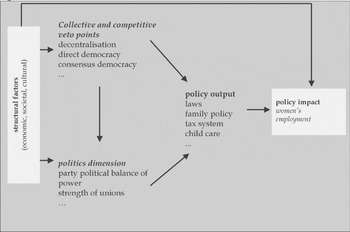
Following the theoretical discussion, direct effects (policies directly influencing women's employment) as well as indirect causal relationships (political factors determining policy output and thus indirectly influencing female employment) have to be investigated in order to obtain a comprehensive picture of female labour market participation. The research design can be summarised as shown in Figure 1.
Policy approach.
Source: own illustration.

Following this model, the analysis is comprised of two steps.Footnote 5 First, the direct relationship between policies and women's employment is of interest. Cross-sectional OLS regressions for the year 2000 are estimated. The explanatory factors are lagged by one (or, depending on the data, several) period(s) in order to model causalities between the explanatory and the dependent variables and also to avoid endogeneity problems. In addition to the central policy variables, further structural and societal-cultural factors are integrated into these models as controlling variables: they form the framework for the women's employment decision and can therefore also directly influence female labour market participation. The following variables will be considered.
Economic conditions
One characteristic of capitalist markets is that employment decreases during an economic downturn (Schmidt, Reference Schmidt1993a). Women are more likely to be affected than men by such conditions because their employment is less deep-seated. Therefore, it is women rather than men who retreat from the labour market in periods of recession. Women's employment is furthermore influenced by structural factors of the labour market, such as the size of the service and public sectors (Behning, Reference Behning, Rosenberger and Sauer2004: 192; Schmidt, Reference Schmidt1993a: 36ff.). Buchmann et al. (Reference Buchmann, Kriesi, Pfeifer and Sacchi2002: 137) showed that mothers primarily find jobs in the service sector. A similar assumption can be made for the public sector, in which the basic conditions for employed women appear to be more advantageous than in the private sector: the public sector offers jobs in administration, social services, education and health care, which women tend to prefer and be professionally qualified for (Schmidt, Reference Schmidt1993a: 40f.). To summarise, economic growth and the unemployment rate, as well as the size of the third sector (employment in the service sector) and the size of the public sector (share of the public sector in GDP), are integrated into the models as indicators for the economic conditions.
Societal-structural framework
Following Ott (Reference Ott and Behning1997), increased modernisation forces the traditional gender-related division of labour to lose its exigency or even to be a risky strategy. First of all, when taking the increased frequency of divorce into consideration, the division of labour inflicts a loss in welfare on the partner who is specialising in work at home, as her/his chances in the labour market will be decreased due to the specialisation. At the same time, technological progress has not only made household chores less time-consuming but has also reduced the need for specific skills (O'Neill, Reference O'Neill, Schmid and Weitzel1984: 71). Furthermore, urban structures and better education are shaping the social distribution of living standards and opportunities for social mobility (Shaver, Reference Shaver2002: 206). For these reasons, it can be hypothesised that highly modernised societies offer an environment more conducive to women's employment than countries with more traditional social structures. As indicators for the degree of modernisation, income per capita, average educational achievements of women, the degree of urbanisation and the fertility rate are included in the models.
Cultural framework
Sociological studies often emphasise that women's employment is largely influenced by the ‘gender culture’: that is, the dominant cultural guiding principles governing the preferred division of labour between women and men in society (Lovenduski, Reference Lovenduski1998; Pfau-Effinger, Reference Pfau-Effinger2000: 21; Stetson and Mazur, Reference Stetson and Mazur1995). These values not only influence the individual employment decisions of women but also the design of a ‘women-friendly’ societal and political framework. According to Schmidt (Reference Schmidt1993a: 69ff.), a strong influence is also exerted by the confessional structure. While Catholicism stresses the traditional role of women in the family, Protestantism is more open to a modern division of labour between women and men, and therefore has positive effects on women's employment. In consideration of these cultural factors, the ‘gender-related development index’ from the Human Development Reports 2003, the share of women in parliament,Footnote 6 as well as the share of Catholics in the population, are used.
In a second step, and in line with Figure 1, indirect effects on women's employment are integrated and tested via a path analysis. Variables describing political institutions, the political process and the actors are therefore included in the models, as it can be expected that these factors influence the policy outcome. As for the political veto points, the degree of consensual decision-making, the degree of decentralised structures, and the strength of unionsFootnote 7 are considered. Furthermore, the proportion of leftist parties in the government is included in the analysis representing the party political dimension. Again, the economic, societal and cultural factors (see above) are used as controlling variables, as policies are shaped by the economic, societal and cultural framework in which the policy decisions are taken.
Four indicators are used to measure women's employment. These include the standardised labour force participation rate of women, the full-time participation rate of women, the proportion of women in the labour force, and the proportion of women who work part-time. Both quantitative and qualitative aspects of women's employment are considered with these indicators.
A detailed description of the independent variables and their operationalisation and sources can be found in the appendix.
Emprical results
Since high correlations between some of the policy variables exist, and as the number of variables in the model has to be kept low due to the rather small number of cases, it is not possible to analyse all policy variables separately. The policy variables are therefore concentrated into four factors by means of a factor analysis. This procedure is suitable here because the main focus is on the importance of different policy dimensions in the policy process (see Figure 1), not on the specific meaning of each and every policy variable (Gornick et al., Reference Gornick, Meyers and Ross1996, Reference Gornick, Meyers and Ross1998).
I refrain from a purely explorative factor analysis and instead consider theoretical arguments in the building of the factors. In other words, those variables are combined into one factor analysis that, for theoretical reasons, should be part of the same factor. Just as variables describing maternity leave and childcare arrangements should load on the same factor, for example, the variables considering tax policy should also together form a ‘tax factor’. Similarly, variables concerning unemployment protection and those describing social security arrangements in general are assumed to form two more factors. The advantage of this method compared to explorative factor analysis is that the factors consist only of a particular policy dimension and are not overlaid by influences of other policy dimensions.
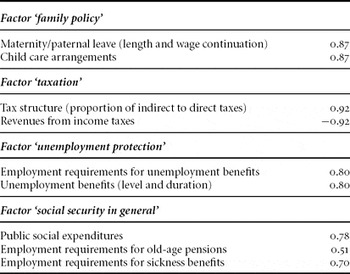
The factor analyses confirm these assumptions: the variables included load together on one factor in the respective analyses. Table 1 shows the factors and their factor loadings which will be integrated into the following analyses.Footnote 8
The four policy factors and their loadings

Notes: Principle components factor analysis.
Due to the small number of cases, it is not possible to include all independent variables discussed in previous sections together in one model. Over the course of the analysis, various models including different combinations of all independent variables (as previously discussed) were estimated. In addition to the four dependent variables, each model presented contains only those framework variables that significantly improve the explanatory power of the model and/or influence the estimation results.Footnote 9
The influence of public policies on the level and the intensity of female employment
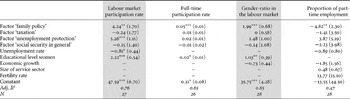
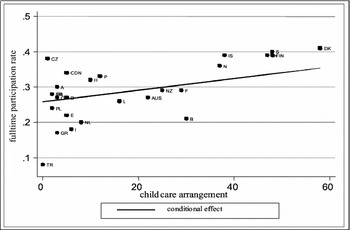
Table 2 presents the cross-sectional estimation results for the explanation of female labour market participation. This table shows that the factor ‘family policy’, as well as the unemployment factor, is most important in the four models. Generous arrangements for reconciling family and work not only increase the level of women's employment in terms of higher participation rates, but also influence the proportions of women and men in the labour market and of full-time and part-time female employment as well. Further analyses not presented here in which the factor is replaced by its single policy variables show that the provision of pre-school arrangements is the strongest variable of this factor (see, for example, Figure 2).
Determinants of women's employment in OECD-countries: Cross-sectional regression analysis

Notes: Non-standardised OLS-coefficients, robust standard errors in brackets (HC3). The following variables were also included in the course of the analyses, but did not exhibit significant explanatory power: size of the public sector, urbanisation, share of Catholics in total population, share of foreigners in total population. Furthermore, the models have been tested for outlier-influences, as according to Jann (Reference Jann2006). The results proved to be robust. For exceptions the reader is referred to the discussion in this text.
Child care arrangements and women's full-time participation rate.
Notes: Conditional effects for child care arrangements on full-time participation rate. All other independent variables (maternity leave, taxation, unemployment protection, social security, schooling) are kept constant at their respective means.

While the duration of maternity leave and the percentage of wage replaced exerts an influence only on the full-time employment rate, the availability of external childcare gains statistical significance in all models. The family policy factor – according to the hypothesis – seems therefore to have primarily an enabling effect on women: it is easier to reconcile work and family life, thereby making it possible for more women to work, and to work more hours.
A high level of protection in case of job loss affects women's participation rates but neither influences women's share in the labour market nor their intensity of employment. This can be interpreted to mean that the existence of unemployment protection generally stimulates labour market participation. However, in the case of very generous protection – that is, if work conditions are low – there is no incentive provided for more intense employment. If employment conditions and unemployment benefits are analysed separately, the first emerges as the dominant variable in this factor. It is therefore of greater importance that unemployment benefits are provided at all, while the scale of benefits is of lesser significance.
As for the two other policy factors – taxation and social security – no significant influence on female employment can be shown. These results are not that surprising. The theoretical discussion of taxation has shown that positive as well as negative effects on women's employment can be hypothesised. It can therefore be argued that these effects cancel each other out, resulting in insignificant coefficients. Furthermore, general social security measures may not influence women's employment decisions, as their personal income (typically as second earner) does not greatly affect retirement and health insurance. Following Daly (Reference Daly and Sainsbury1994: 108), welfare programmes such as pensions and health insurance are often directed at households as collectives. Since a woman's income is typically much lower than her husband's, social security benefits primarily depend on the husband's income, while the woman's additional income does not affect them much. For this reason, social security in general will not be a significant motivation for pursuing employment.
Apart from the policy factors, (socio-)economic variables are important in explaining cross-national differences in women's employment. The mean educational achievement of women in particular should be mentioned, as it also influences the level of female employment and the gender ratio in the labour market. In contrast, high unemployment rates result in a lower participation rate in general, whereas full-time employment and the share of women in the labour market remain unaffected. This can be explained in so far as problems in the labour market influence both female and male employment negatively and do not necessarily hit women harder than men.
Furthermore, it should be mentioned that some data points (that is, countries) in the models differ substantially from the others and have to be considered as outliers. Detailed outlier diagnostics were conducted in order to check whether they possibly influenced the estimated results (Jann, Reference Jann2006).Footnote 10 The model explaining part-time employment is the most sensitive to country-specific particularities. Additionally, the four policy factors explain this indicator least. The model is particularly affected by high correlations between economic and cultural variables. The latter do not reach statistical significance, although they substantially increase the explanatory power of and are therefore integrated into the model. Regarding the policy factors, only the factor ‘family policy’ shows a consistent effect in the sense that generous maternity arrangements result in a lower proportion of women that ‘only’ work part-time.
Path models: the combination of direct and indirect causal relationships
Until now this article has shown that political measures and instruments play an important role in explaining international differences in women's employment. However, it can be argued that political, economic and societal characteristics influence the respective design of these policies. The aim of this step is to combine these two-stage relationships into one comprehensive model in order to analyse causalities between these different levels intensely.
Path models are estimated for this purpose.Footnote 11 The idea behind such models is that a particular variable can have an effect on a second variable and, at the same time, be influenced by a third variable. In other words, while policies explain the extent to which women participate in the labour market, their design is also dependent on basic political, economic and societal conditions. Formally, such multi-stage causal relationships can be described by means of a system of equations.


Equations (1) and (2) show a simple example of such a system of equations, where Y represents female employment, X the design of the policies which explain Y in equation (1), while they are explained by a set of economic, political and societal variables Z in equation (2).
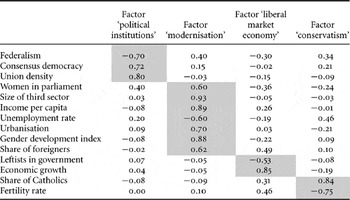
It is shown that the variables describing the political, economic and societal framework strongly correlate with each other. For this reason, an exploratory factor analysis is conducted, producing four factors that can be labelled modernisation, liberal market economy, political institutions and conservatism (Table 3). These factors are integrated in the path analysis.
Factor analysis of the political variables as well as the economic, societal and cultural framework-variables

Notes: Principal component factor analysis, varimax-rotation. The Kaiser-Meyer-Olkin criterion equals 0.61, which means that a factor analysis is appropriate for the data.
Those policy variables that attained significance in the previous analyses are included in the path models. For example, in the model explaining female labour market participation rate, the family policy and unemployment protection factors proved to be statistically significant. Accordingly, these two variables, as well as the framework factors, are integrated into the structural equation model for female employment and the respective causalities are modelled.
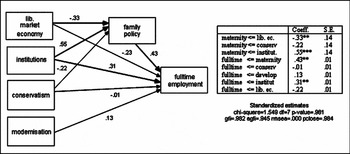
A first and important result of these analyses is that the findings of the previous regression estimations are confirmed. The variables that exhibited significant coefficients in the OLS-regression also attain statistical significance in the path models. In all models the policy variables are among the strongest variables. This can be especially observed where the focus is on the intensity of women's labour market participation or the gender ratio in the labour market: in these models, the direct influence of family policy on women's employment is stronger than the effect of the economic, political and societal framework variables (Figure 3).
Path-model for the explanation of female full-time labour market participation rate. Notes: Structural equation model estimated in AMOS. Standardised maximum likelihood estimates. Bold arrows: significant effects. Thin arrows: non-significant effects. Due to the small number of cases, the latter have been removed from the models in further estimations to test the robustness of the results. The findings presented here are confirmed in these estimations. In preliminary analyses the factor modernisation was not relevant in explaining a country's family policy. This path was therefore not modelled in order to allow for a parsimonious model. ** = significant at the 5% level; *** = significant at the 1% level.

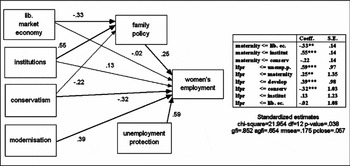
Conversely, the latter play a more important role if the labour market participation rate in general is analysed (Figure 4). In this model, the degree of development and the factor conservatism exert the strongest direct influence on women's employment. I therefore conclude that cultural characteristics and the societal and economic degree of development creates a general environment that is beneficial to women's (and possibly also men's) employment. However, specific ‘women-friendly’ political measures are necessary in order to influence qualitative aspects of female employment in terms of intensive employment and equal gender ratio.
Path-models for the explanation of female labour market participation rate in general.
Notes: Structural equation model estimated in AMOS. Standardised maximum likelihood estimates. Bold arrows: significant effects. Thin arrows: non-significant effects. Due to the small number of cases, the latter have been removed from the models in further estimations to test the robustness of the results. The findings presented here are confirmed in these estimations. In preliminary analyses the factor modernisation was not relevant in explaining a country's family policy. This path was therefore not modelled in order to allow for a parsimonious model. ** = significant at the 5% level; *** = significant at the 1% level.

A similar interpretation can be drawn when the direct and indirect relationships are compared. It can be observed that indirect causal chains, running from the framework variables to the policies, and then to women's employment, are of substantial importance. Overall, indirect and direct effects of these variables account for approximately one half each of the total effect. However, there are still some differences between the models: causal chains including policies are indeed of particular importance if qualitative aspects of women's employment such as the intensity of female employment or the gender ration in the labour market are examined. The proposition that policies consciously aimed at promoting women's employment are important in order to improve women's chances in the labour market is once again supported.
Conclusion
This article began by asking how international differences in female labour market participation can be explained and whether policies in particular can contribute to these explanations. The analyses presented lead to the conclusion that the design of political measures and instruments is important for the explanation of women's employment in the OECD countries.
The central finding of this article is that policies are decisive factors in order to explain women's employment. Although in accordance with previous research (Jaumotte, Reference Jaumotte2003; O'Connor et al., Reference O'Connor, Orloff and Shaver1999; Meyers et al., Reference Meyers, Gornick, Ross and Sainsbury1999; Gornick et al., Reference Gornick, Meyers and Ross1996, Reference Gornick, Meyers and Ross1998; Schmidt, Reference Schmidt1993a, Reference Schmidt and Castles1993b) this finding has been empirically tested for all industrialised countries and for a broad range of policies for the first time. Furthermore, it can be shown that policies concerning the family have most influence on women's employment, while ‘economic incentives’ arising from taxation policy or general social security are less important in explaining female labour market participation. More precisely, the analyses prove that, first, family policies that have an enabling effect on female employment are crucial. Measures such as maternity and parental leave schemes, as well as external childcare arrangements, are particularly relevant in explaining differences in the level and the intensity of women's labour market participation. Second, political measures that provide incentives to hold paid employment (including social security) influence women's employment. Generous benefits in case of redundancy increase the incentive for gainful employment, as does the right to return to employment after a (short) period of care leave. However, while such incentive systems seem to improve the general willingness to be gainfully employed in the first place, they are less important for the more intensive or more egalitarian labour market participation of women compared to that of men. Thirdly, indirect policy effects on women's employment must not be underestimated. Although not the focus of this article, the results concerning the level of female education revealed the considerable potential of education policy for promoting women's employment.
Consistent with previous research (Buchmann et al., Reference Buchmann, Kriesi, Pfeifer and Sacchi2002: 8; O'Neill, Reference O'Neill, Schmid and Weitzel1984: 71; Pfau-Effinger, Reference Pfau-Effinger2000: 21; Schmidt, Reference Schmidt1993a), a country's economic, political, societal-structural and cultural characteristics influence women's employment. However, by applying a path analysis it can be demonstrated more clearly that the effect of these factors on female labour market participation is twofold: they build the framework in which not only women's individual employment decisions are made, but also public policy formation. As hypothesised in the first part of this article (Figure 1), the results last but not least confirm the importance of politics and polity for welfare policy, and therefore indirectly for women's employment.
Lastly, as to their political implications, the results reveal the importance of deliberate political action in order to influence female labour market participation. This is true for two reasons. First, while the economic, societal and cultural background can establish a generally positive environment for women's employment, particular political measures are necessary in order to influence qualitative aspects of women's employment and the gender ratio in the labour market. Second, it could be shown that more or less unintended ‘side effects’ of policies, following Schmid (Reference Schmid, Schmid and Weitzel1984: 282) or Schmidt (Reference Schmidt1993a: 28), are insufficient. In particular, policies such as unemployment protection measures do not influence qualitative aspects of women's labour market participation in terms of the intensity of women's work or the gender ratio in the labour market. Therefore, if it is the aim to influence these latter aspects of women's employment, public activities consciously designed to diminish gender-specific inequalities are indispensable.
Variables, operationalisation, sources

Acknowledgement
My thanks to Adrian Vatter, Fritz Sager and two anonymous referees for helpful remarks on earlier versions of this paper, and Jennifer Shore for linguistic assistance.