Introduction
Rodentolepis nana (syn. Hymenolepis nana) is a cyclophyllidean zoonotic enteric parasite with a worldwide distribution. It is the most prevalent tapeworm of humans, especially in temperate zones. Due to its capability of direct transmission, it is more prevalent in children. Adult tapeworms have an armed rostellum that attaches to the small intestine of their host. The cestode is capable of internal and external autoinfection (Smyth, Reference Smyth1994). A morphologically similar species of R. nana infects rats and mice in different geographical areas (Kia et al., Reference Kia, Homayouni, Farahnak, Mohebali and Shojai2001; Foronda et al., Reference Foronda, Lopez-Gonzalez, Hernandez, Haukisalmi and Feliu2011; Chaisiri et al., Reference Chaisiri, Chaeychomsri, Siruntawineti, Ribas, Herbreteau and Morand2012; Mohd Zain et al., Reference Mohd Zain, Behnke and Lewis2012). Natural infections in gerbils have also been reported, exemplified by reports on infected Mongolian gerbil Meriones unguiculatus (Lussier & Loew, Reference Lussier and Loew1970), Persian jird Meriones persicus (Kia et al., Reference Kia, Shahryary-Rad, Mohebali, Mahmoudi, Mobedi, Zahabiun, Zarei, Miahipoor, Mowlavi, Akhavan and Vatandoost2010) and the great gerbil Rhombomys opimus (Kamranrashani et al., Reference Kamranrashani, Kia, Mobedi, Mohebali, Zarei, Mowlavi, Hajjaran, Abai, Sharifdini, Kakooei, Mirjalali and Charedar2013). Rodentolepis nana also occurs in laboratory animals such as rats (Mohammadzadeh et al., Reference Mohammadzadeh, Sadjjadi, Motazedian and Mowlavi2007), mice (Okamoto et al., Reference Okamoto, Agatsuma, Kurosawa and Ito1997; Mohammadzadeh et al., Reference Mohammadzadeh, Sadjjadi, Motazedian and Mowlavi2007) and hamsters (Okamoto et al., Reference Okamoto, Agatsuma, Kurosawa and Ito1997).
During the past decade, molecular tools have been applied for identification of R. nana in isolates originating from humans (Macnish et al., Reference Macnish, Morgan, Behnke and Thompson2002), mice (Foronda et al., Reference Foronda, Lopez-Gonzalez, Hernandez, Haukisalmi and Feliu2011), rats (Foronda et al., Reference Foronda, Lopez-Gonzalez, Hernandez, Haukisalmi and Feliu2011), and laboratory rats and mice (Mohammadzadeh et al., Reference Mohammadzadeh, Sadjjadi, Motazedian and Mowlavi2007). Comparison of genetic variation in the cytochrome oxidase 1 (CO1) gene and the internal transcribed spacer 2 (ITS2) region has shown larger intraspecific variation and interspecific variation for CO1 and ITS2, respectively (Okamoto et al., Reference Okamoto, Agatsuma, Kurosawa and Ito1997). Molecular phylogeny studies on R. nana isolates from mice and humans suggested that this species is a complex or ‘cryptic’ species (Macnish et al., Reference Macnish, Morgan, Behnke and Thompson2002). However, phylogenetic studies on isolates derived from wild gerbils are lacking. Therefore, in the present study, molecular characterization of R. nana isolated from R. opimus in north-eastern Iran was performed.
Materials and methods
Collection of isolates
Samples of R. nana included five isolates of adult worms stored in 70% ethanol, which had already been removed from the small intestine of R. opimus and deposited in the Helminthological Laboratory of the School of Public Health, Tehran University of Medical Sciences. These samples had been obtained from R. opimus captured in the Golestan Province (36°83′93″N and 54°44′44″E) (two isolates) and Razavi Khorasan Province (36°17′52.8″N, 59°36′20.52″E) (three isolates), both in north-eastern Iran, during a study on helminth parasites of this particular gerbil in this part of the country in 2011 (Kamranrashani, Reference Kamranrashani2012). Identification of R. nana had been based on morphological characterization of the adult cestode, following specific cleaning and staining (Kamranrashani, Reference Kamranrashani2012).
Molecular analysis
Samples of adult R. nana were washed three times in phosphate-buffered saline (PBS) in order to remove the ethanol. Next, DNA was extracted using the AccuPrep® Genomic DNA Extraction Kit (Bioneer Corporation, Daejeon, South Korea) according to the manufacturer's instructions. Extracted DNAs were eluted in Tris–EDTA (pH 7.5) and stored at − 20°C until further use.
The primers ITSf (5′-GTG AAT CGC AGA CTG CTT TG-3′) and ITSr (5′-CTG AGG TCA GGT CTT CCA TAC-3′), which amplify a 628 bp fragment of the ITS2 region, were designed using the web primer designing tool available from the National Center for Biotechnology Information (at http://www.ncbi.nlm.nih.gov/tools/primer-blast/), based on the accession numbers AB494476 and AB494474 available in GenBank. Amplification was performed in 50-μl reactions, containing 1.2 units of Taq polymerase (Fermentas, Thermo Fisher Scientific, Lithuania), 5 μl of 10 × buffer, 2 mm MgCl2, 0.2 mm of each deoxynucleoside triphosphate (dNTP) and 10 pm of each primer. Sterile water was used as the template in the negative control. DNA amplification was carried out using a Peqlab thermal cycler (PEQLAB Biotechnologie GmbH, Germany) and a polymerase chain reaction (PCR) programme comprising an initial denaturation at 95°C for 3 min, followed by 35 cycles at 94°C for 30 s, 54°C for 30 s and 72°C for 40 s, and a final extension at 72°C for 3 min. PCR products were electrophoresed on a 2% agarose gel and visualized by ethidium bromide. All PCR products were sequenced using an ABI 3130xl platform (Applied Biosystems, Foster City, California, USA), and the sequences were compared with those available in GenBank by BLAST queries.
Sequence alignments were performed using the sequence alignment tool, ClustalW. Phylogenetic analysis was performed on all isolates, based on the neighbour joining (NJ) method using the Tamura 3-parameter model (Tamura & Dudley, Reference Tamura and Dudley2007). Relevant GenBank sequences were collected and subsequent comparisons were carried out using MEGA5 software (Tamura et al., Reference Tamura, Peterson, Peterson, Stecher, Nei and Kumar2011).
Results and discussion
Rodentolepis nana sequences of about 628 bp were acquired from all isolates, and all had high similarity (more than 95%) with other R. nana sequences previously registered in GenBank. All isolates in this study were obtained from R. opimus in rural areas adjacent to residential areas. Therefore, transmission of R. nana to humans via ingestion of contaminated soil with eggs is probable, emphasizing the medical and potentially zoonotic importance of the parasite.
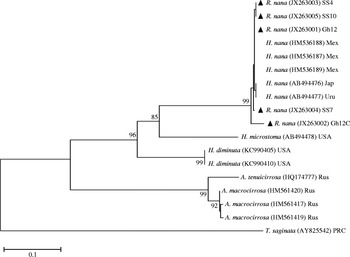
The MEGA5 software was used for intraspecies distance and similarity calculations. The intraspecies distance and similarity among the isolates were about 0.011 and 98.9%, respectively. Based on phylogenic analysis, all five sequences clustered with R. nana sequences. The two isolates SS4 and SS10 clustered together, while the other three isolates were located at different sites in the R. nana phylogenetic tree (fig. 1). Isolates SS4 and SS10 had specific signature regions at positions 122–127 and 311–312 of the nucleotide sequence alignments in comparison with the other three isolates. Moreover, isolate Gh12C exhibited a single nucleotide polymorphism (SNP).
A phylogenetic tree of Rodentolepis nana isolates from Rhombomys opimus in north-eastern Iran, based on ITS2 nucleotide sequences (▲) and constructed using the Tamura 3-parameter model in MEGA5. GenBank sequences of Hymenolepis nana and H. diminuta are included with Taenia saginata as the outcrop. Mex, Mexico; Uro, Uruguay; Jap, Japan; USA, United States of America; Rus, Russia; and PRC, People's Republic of China.

Rhombomys opimus has a vast distribution range from Iran through Pakistan, Afghanistan via Kazakhstan to China and Mongolia (Tinnin et al., Reference Tinnin, Ganzorig and Gardner2011). In Iran, they are distributed throughout the southern, central and north-eastern regions of the country (Misonnes, Reference Misonnes1959). The gerbil is capable of harbouring a wide variety of helminth parasites (Tinnin et al., Reference Tinnin, Ganzorig and Gardner2011), including R. nana (Kamranrashani et al., Reference Kamranrashani, Kia, Mobedi, Mohebali, Zarei, Mowlavi, Hajjaran, Abai, Sharifdini, Kakooei, Mirjalali and Charedar2013). In the genus Hymenolepis, only the genome of H. microstoma is completely known (Olson et al., Reference Olson, Zarowiecki, Kiss and Brehm2012) while genomes of other Hymenolepis species are still under investigation
Based on primary investigations, the ITS region, a non-coding region in the ribosomal RNA gene, appeared to be conserved (Okamoto et al., Reference Okamoto, Agatsuma, Kurosawa and Ito1997), which could be helpful for distinguishing intra- and interspecies genetic variation. Genetically, R. nana is still controversial and is expected to be a cryptic species (Macnish et al., Reference Macnish, Morgan, Behnke and Thompson2002). In this study some isolates of R. nana from R. opimus in north-eastern Iran were characterized molecularly by sequencing of the ITS2 locus. Although only a few isolates were available, interesting results concerning the genome of R. nana in the wildlife of north-eastern Iran were revealed. The results showed the presence of variation in nucleic acid sequences of R. nana. Although it has been stated that geographical distance is not always related to genetic variation (Mohammadzadeh et al., Reference Mohammadzadeh, Sadjjadi, Motazedian and Mowlavi2007), in the present study multiple alignment of the sequences of isolates from the same geographical area (Razavi Khorasan Province) revealed the presence of two distinct signature regions in isolates SS4 and SS10 compared with the third isolate (SS7). Although the bootstrap value of the node for SS4 and SS10 was not well supported, phylogenetic trees using other methods showed identical results. Therefore, considering the result of the multiple sequence alignment that showed sparse genetic variation between isolates SS4 and SS10 compared with other R. nana sequences, the cryptic nature of R. nana was well revealed. Phylogenic analysis also proved the similarity of isolates SS4 and SS10, whereas isolate SS7 showed higher similarity to Gh12, which was obtained from neighbouring Golestan Province. The sequence of isolate Gh12C, in comparison to other isolates, showed sparse single nucleotide polymorphisms throughout the entire sequence. In most studies, variations in the ITS region have been used for interspecies determination; however, in this study, the ITS2 fragment was also useful for analysis of intraspecies genetic variation. Our results revealed that intraspecies variation in this locus could be integral to H. nana genetic description. As previously mentioned, the ITS region is conserved, and genetic variation in this locus could be an interesting subject for future studies on genetic variation in the Rodentolepis genome among different domestic and wildlife host species.
This study provided an introductory insight into the ITS2 region of R. nana isolates from a naturally infected wild host. Further studies applying other loci, such as mitochondrial genes, on more isolates from this type of gerbil and other rodent species, and also from humans, in various geographical areas of the world, will assist in clarifying the host specificity of this cestode.
Acknowledgements
The authors would like to thank all people who have contributed to this research, especially Professor M. Mohebali, Mr M. Abaie and Mr Z. Zarei from the School of Public Health (TUMS).
Conflict of interest
None.