Introduction
In the post green revolution era, the growth and yield of many crops have started declining in spite of continuous development of improved varieties and technologies. This has been attributed to poor soil management particularly with regard to no or negligible use of organic manures in crop cultivation, leading to development of macro- and micro-nutrient deficiencies under intensive cropping. The faulty practice of solely depending on the major nutrients (N, P and K) and over mining of all the essential nutrients has further aggravated the problem. The unique advantage with organic manure (farm yard manure (FYM), compost and green manuring) is that besides supplying major as well as trace elements, it improves the physical and biological properties of the soil. On the other hand, besides their difficult availability, higher cost and being manufactured from non-renewable energy sources, inorganic fertilizers are potent agents for polluting the environment and contaminating ground water. The basic problem with organic manure is that the nutrients supplied through them are not sufficient to sustain the productivity of high-yielding food and other crops. The best proposition, therefore, is to manage the crop with a judicious combination of organic and inorganic source of plant nutrients, putting less emphasis on expensive synthetic inorganic fertilizerReference Patra, Anwar and Chand1.
Vermicomposting has been recognized as an efficient, environment friendly technology for converting organic waste into high-value organic manureReference Kale, Bano and Krishnamoorthy2, Reference Senapathi, Subba Rao, Balgopalan and Ramkrishna3. Distillation wastes (after extraction of essential oils) of many aromatic crops retain their nutritional values and may be recycled directly or after vermicompostingReference Kalra, Santhakumar, Khanuja and Griffee4 to supplement both the major and minor nutrient requirements of the crop(s)Reference Patra, Anwar and Chand1. Chemical fertilizers together with available quantity of organic manure/compost are now commonly used to sustain soil fertility and attain the desired level of yield of high-value essential oil-bearing cropReference Anwar, Patra, Chand, Kumar, Naqvi and Khanuja5.
In the past few decades, the economics of rice–wheat rotation has turned less attractive, and diverse crop rotations with rice, involving seasonal vegetables and menthol mint have become popular. A recent survey showed that in the indo-Gangatic plains, rice remains the principal kharif crop, occupying about 76% of land. In the rice-cropped area, rabi grains occupied only about 70% of land; mint and vegetables occupied the rest of the land. The conventional rice–wheat rotation has now been replaced by rice–wheat–mint rotation after release of short-duration varieties of menthol mint, resulting in larger profits to the farmers from a unit area.
The present study was conducted in farmers' fields in the existing Mentha-based cropping system with an objective to elucidate the extent of chemical fertilizers that can be avoided by supplementing the nutritional requirement of the crop with vermicompost (VC) produced from the distillation waste of Mentha arvensis vis-à-vis its effect on productivity and soil quality in mint and mint–rice–wheat rotation.
Materials and Methods
Experimental sites
The experiments were conducted in selected farmers' fields belonging to nine villages (Safdarganj, Dalutpur, Dadra, Dhaurmau, Nargismau, Jamuvassi, Muzafarmau, Sarsuandhi, Ghorsara of districts Barabanki and Lucknow, Uttar Pradesh). Barabanki is located at 27°19′ to 26°30′ N and 80°05′ to 81°51′E, whereas Lucknow is located at 26°30′ to 27°10′ N and 80°30′ to 81°13′E and 123m above mean sea level.
Production of quality VC
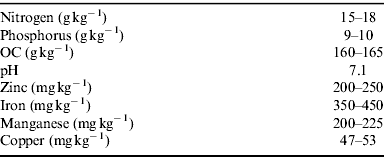
The Central Institute of Medicinal and Aromatic Plants (CIMAP) has developed a technology for production of quality VC utilizing distillation waste of aromatic cropsReference Kalra, Kumar, Katiyar, Bahl, Bansal, Chauhan, Prasad, Pandey, Dhawan, Krishna and Srivastava6, Reference Kalra, Chandra, Awasthi, Singh and Khanuja7. VC was produced in the farmers’ experimental sites (farmers owning distillation units and having sufficient quantities of mint distillation waste) of nine villages utilizing distillation waste of menthol mint and earthworm epigeic species Eisenia foetida in vermicomposting pits along with cow dung (6m×1.25m×0.5m). Cow dung is added as a worm-bedding material together with the mint distillation waste. The substrate was turned-over every week to avoid a thermophilic stage. The pits were harvested after 12 weeks when the compost was ready by its physical appearance, as judged by development of a dark brown to black color with uniformly granular structure, and at this stage watering was stopped. Two days later, the compost was removed from the pits along with worms and uniformly spread on plastic sheets under shade. The harvested material was allowed to shade dry for 2 days to retain the moisture content of approximately 45±2.0. VC was recovered after sieving (<2mm) the produced VC and the adult worms were separated and used in other pits for the same process. Samples were collected from sieved VC (about 50g) for chemical analysis. The produced VC was used in the experimental trails. The chemical composition of VC used in the two trials conducted is given in Table 1.
Characteristics of VC produced from M. arvensis.
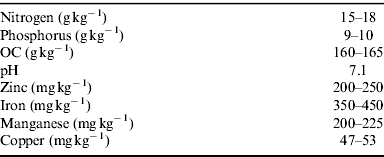
OC, organic carbon.
Treatments and crop culture
The experimental field trials were conducted in a plot size of 5m×10m with the following treatments:
T1=Full recommended dose of chemical fertilizers N:P:K (75:60:60) kgha−1
T2=VC (2.5tha−1)+50% NPK
T3=VC (5tha−1)+25% NPK
T4=VC alone (7.5tha−1).
The treatments were evaluated in two experiments. In the first experiment, a total of nine villages were involved and each village represented five farmers. The average data of each treatment of each village (pooled data of five farmers) were taken as a replication. The second experiment was also conducted during two cropping seasons. For the second experiment, six farmers were selected based on practicing a rice–wheat-mint cropping system. The four treatments (same as in experiment 1) were imposed on a plot area of 50m2 of each farmer. Six farmers represented replications. For the above experiments, nursery raised seedlings of menthol mint (cv. Kushal) were transplanted in the last week of March and the first week of April during each cropping season. In all the crops, weeding and intercultural operations were carried out as and when required. The treated plots were maintained with the same treatments for all the crops (mint–rice–wheat). The cultivars included in the present study were ‘Kushal’ of menthol mint, Pusa-1 of rice and PWB 343 of wheat. The recommended doses of inorganic fertilizers were applied through urea, single super phosphate and muriate of potash at the rates of 75kgN, 60kg P and 60kgKha−1, respectively.
Yield measurements
Above-ground foliage of the mint crop was harvested during the first fortnight of June. For determining essential oil content, extraction of oil was conducted with 200g fresh herb following hydro-distillation using Clevenger's apparatusReference Langenau and Guenther8 for 4h. The harvesting of rice and wheat was performed in the fortnight of October and the first week of April, respectively, in each cropping season.
Gas chromatography
Gas chromatography (GC) analyses of the oil samples were performed on a Perkin-Elmer Autosystem XL with FID attachment and a PE-5 column (30m, 0.32mm i.d., 0.25-μm film thickness), using hydrogen as the carrier gas at 6 psi inlet pressure. Injector and detector temperatures were 200 and 250 °C, respectively. The column temperature was programmed from 60 to 230 °C at 5 °Cmin−1, with initial and final temperature holds of 2 and 4min, respectively. The data were processed on Turbo-Chrom Navigator software (Perkin-Elmer) for oil composition. Kováts RI software was used for the measurement of retention indices from FID data.
Economic analysis
Economic evaluation of fertilizers (NPK), VC and their combinations was made through net income (NI). For this, the cost of cultivation (CC) of mint–rice–wheat was calculated on the basis of different operations performed and materials used suckers, nursery preparation and maintenance of saplings, field preparation, transplanting, fertilizer application, irrigation, harvesting and distillation of essential oil. The expenditures for use of the different materials and operations performed were: mint suckers at $0.78kg−1, nursery raising, field preparation and planting of mint sapling $133.3ha−1, N $0.14kg−1, P $0.22kg−1, K $0.34kg−1, VC $0.022kg−1, irrigation $2.22unit−1, per day labor charges $1.67, essential oil distillation $0.67kg−1 fresh herb. Gross income (GI) was calculated by multiplying essential oil yield by oil price, that is $7.78kg−1. Net income (NI) was calculated as=GI–CC.
Soil and VC analysis
In the beginning and at harvesting of each crop (mint and rice–wheat–mint cropping system), soil samples were collected using a soil auger from 0 to 15cm depth at five places in the experimental field covering all treatments and replications. The collected soil samples were screened, pulverized using a wooden pestle and mortar, and passed through a 2-mm nylon mesh sieve. The physical and chemical analyses of soil/VC are presented on a dry weight basis. The processed samples were analyzed for organic carbon (OC) by the Walkley and Black methodReference Nelson, Sommers and Sparks9, available N by the alkaline KMnO4 methodReference Subbiah and Asija10, 0.5M NaHCO3 (pH 8.5) for extractable PReference Olsen, Cole, Watanabe and Dean11 and 1N NH4OAc for extractable KReference Page, Miller and Keeney12.
The pH was measured in a 1:5 (w/v) suspension of VC with de-ionized waterReference Thomas and Sparks13. Total N was measured in oven-dried (60 °C) samples by sulphuric acid digestion using selenium (Se), CuSO4 and K2SO4 as the catalyst mixture and the regular Kjeldahl distillation methodReference Boltz and Howell14. Total OC content was determined by the Walkley Black methodReference Nelson, Sommers and Sparks9. One gram of material was dry-ashed at 550 °C in a muffle furnace and the ash was extracted with 2M HCl. The extract was analyzed for total P using the ascorbic acid methodReference Kuo and Sparks15, total potassium by flame photometerReference Page, Miller and Keeney12 and total zinc (Zn), iron (Fe), manganese (Mn) and copper (Cu) by atomic absorption spectrometryReference Wright, Stuczynski and Sparks16.
Statistical analysis
Data on all observations were subjected to the analysis of variance (ANOVA) method and least significant difference (LSD) was calculated to determine the statistically significant treatment differences at the 5% level of significance for the error degree of freedomReference Little and Hills17. Linearity in associations between different yield and soil status/characteristics were observed using correlation coefficients (r) over the treatments. The standard error (SE) of the mean in vertical bar charts was computed with the help of Sigma Plot 10 (http://www.sigmaplot.com).
Results and Discussion
Experiment 1
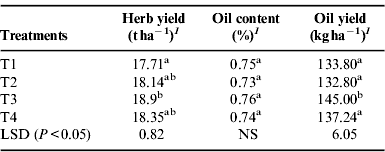
Data collected on yield attributes of menthol mint in the experiment conducted in the fields of nine villages indicated that the percentage essential oil content (1.0±0.1%) and oil quality (menthol: 80±2.1%, neomenthol: 2.0±0.8%, methyl acetate: 3.28±0.11%, isomenthone: 3.2±0.1%, menthone: 4.63±0.12%) did not change significantly under different treatments; however, herb yield had a marginal response with application of VC in combination with inorganic fertilizer. Significantly higher herb yield (6.7%) was obtained with T3 over T1 (Table 2). As an organic fertilizer, VC from wastes of medicinal and aromatic crops has been shown to improve soil nutrient status and overall healthReference Anwar, Patra, Chand, Kumar, Naqvi and Khanuja18. The presence of nitrates and available forms of phosphorus, calcium and magnesium in VCReference Madan19vis-à-vis the micronutrients might have favorably influenced the yields. Findings of the present study are similar to the previous studies showing improved plant growth and yield with the application of VC in other crops such as tomatoReference Atiyeh, Lee, Edwards, Arancon and Metzger20. Accordingly, the oil yield followed the same pattern as of herb yield with the decreasing order of T3>T4>T1>T2 (Table 2). The application of VC produced from raw distillation waste has been observed to be a good source of organic manure for supplementing the nutritional requirement of the crop(s) in mint–wheat and mint–mustard cropping sequenceReference Patra, Anwar and Chands1. VC-based integrated nutrient management has been observed to improve the physical, chemical and biological properties of the soil under Mentha piperata and basil (Ocimum basilicum)Reference Patra, Anwar and Chand1, Reference Anwar, Patra, Chand, Kumar, Naqvi and Khanuja5.
Effect of single and combined applications of inorganic fertilizer and VC on essential oil yield of M. arvensis cv. Kushal (Experiment 1).
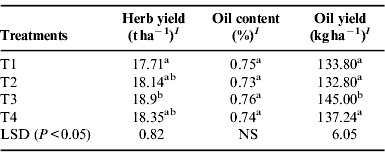
1 Mean of nine observations for each treatment; values in vertical columns followed by different superscript letters are significantly different at P<0.05 by ANOVA (LSD) test.
100% NPK, 75:60:60kgha−1; T1,100% NPK; T2, VC 2.5tha−1+50% NPK; T3=VC 5.0tha−1+25% NPK; T4, VC 7.5tha−1; VC, vermicompost; NS, non-significant differences.
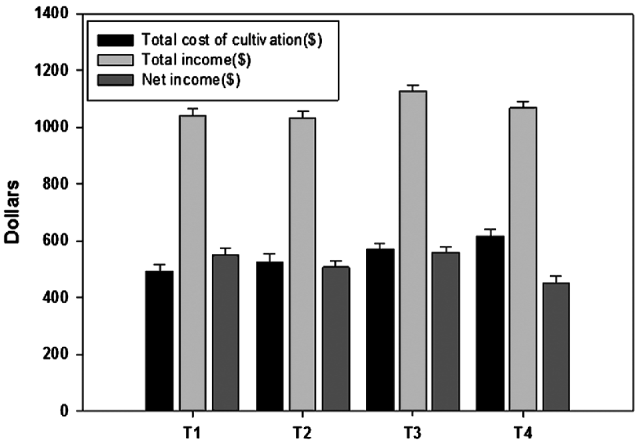
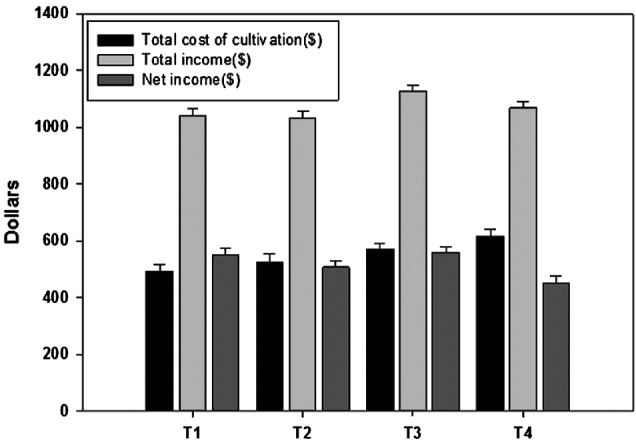
Economic analysis of the production of essential oil as influenced by various treatments revealed that the application of VC along with inorganic fertilizers (T3) increased the total income but failed to improve NI as compared to 100% inorganic fertilizers (T1). Higher cost of fertilizer inputs in T3 probably could not benefit in terms of higher NIs (Fig. 1), but would definitely enhance the overall benefits by improving soil health (Table 3).
Economics of menthol mint cultivation (Experiment 1); vertical error bars indicate the standard error (SE); T1=100% NPK, T2=2.5tha−1 VC+50% NPK; T3=5.0tha−1 VC+25% NPK; T4=7.5tha−1 VC; 100% NPK=75:60:60kgha−1; VC=vermicompost; 1$=45 INR.
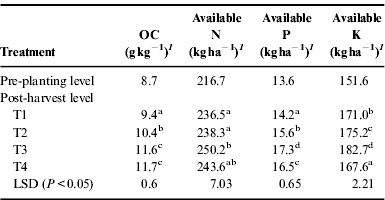
Major chemical properties of soil (pre-planting and post-harvest of Mentha) (Experiment 1).
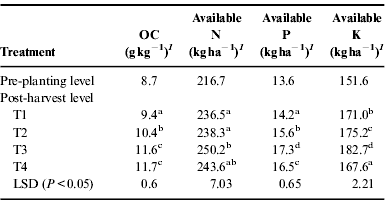
1 Mean of nine observations for each treatment; values in vertical columns followed by different superscript letters are significantly different at P<0.05 by ANOVA (LSD) test.
100% NPK, 75:60:60kgha−1; T1, 100% NPK; T2, VC 2.5tha−1+50% NPK; T3, VC 5.0tha−1+25% NPK; T4, VC 7.5tha−1; VC, vermicompost; OC, organic carbon.
A comparison of the data on initial soil chemical properties with those after harvest indicated that soil OC, available N, P2O5 and K2O did show increases in the post-harvest soil. The OC in the soil after the crop harvest increased by 8.0, 19.5, 33.3 and 34.5% over that present before the crop under T1, T2, T3 and T4, respectively; highest being in plots receiving 7.5t of VC (T4) (Table 3). Highest available N, on the other hand, was observed with T3 (combination of 5.0t ha−1 VC and 25% of the chemical fertilizers) with an increase of 15.4% over the initial value (Table 3). Available phosphorus in the post-harvest soil, which was significantly higher than the initial status, followed the order T3>T4>T2>T1 (Table 3). The available potassium followed almost the identical trend as that of P and the highest K2O was observed with T3, which was about 20.6% more than the initial value (Table 3). Organic manure significantly improves cation exchange capacity of the soil to hold cations such as K+ which might have enhanced K availabilityReference Magdoff and Barlett21. All these indicate that VC, besides enhancing the yield of the crop, had a significant role in maintaining and improving soil fertility. Use of VC as the organic manure has been reported to have positive influence on nutrient build-upReference Chand, Chattopadhyay, Anwar and Patra22, Reference Chand, Singh, Anwar and Patram23, physical parameters such as bulk density and water-stable aggregatesReference Patra, Anwar and Chand1, and microbial biomass-mediated nutrient turnoverReference Chand, Anwar, Patra and Khanuja24, Reference Chand, Anwar and Patra25 and survival of beneficial microbesReference Kalra, Chandra, Awasthi, Singh and Khanuja7. In this context, the application of VC at 5tha−1 with 25% of the recommended dose of NPK had an edge over rest of the treatment combinations.
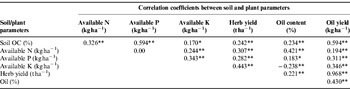
The results of correlation analysis between soil and mint yield parameters are given in Table 4. Correlation coefficient showed a positive relationship between herb and oil yield and oil content (%) and oil yield. The relationships between soil OC and available N, soil OC and available P and soil OC and available K, soil OC and herb yield, soil OC and oil% and soil OC and oil yield were positive. Also, available N had positive correlation with yield and soil characteristics. The presence of sufficient OC, available P and K probably would have contributed to higher herb and oil yield (Table 4).
Correlation coefficients between soil parameters and essential oil yield in menthol mint (M. arvensis) crop cultivated in farmers' fields in the districts of Lucknow and Barabanki of Uttar Pradesh (Experiment 1).

* , ** Significant at 5 and 1%, respectively.
OC, organic carbon.
Experiment 2
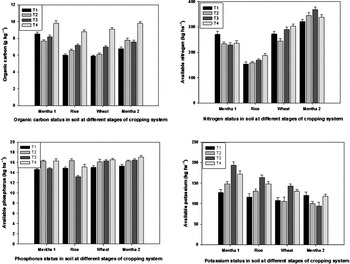
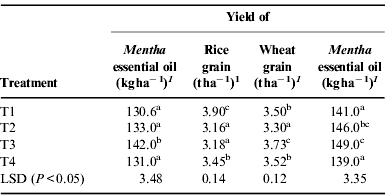
In the second experiment involving similar treatments in mint–rice–wheat–mint-based system, it was also observed that the highest oil yield of mint and grain yield in wheat was recorded in treatment T3; the extent of increase in mint oil yield being 5.6–7.2% and in wheat being 6.6% over the plots receiving the full dose of chemical fertilizers (T1) (100% NPK) (Table 5), whereas there was no significant difference observed in menthol mint oil quality. VC integration with chemical fertilizers may influence above-ground ecosystems by contributing to the plant nutrition, plant health, soil structure and soil fertility in soilReference O'Donnell, Seasman, Macrae, Waite, Waite and Davies26. The trend in yield enhancement was different in the case of rice, where the highest yield (3.90tha−1) was recorded in T1. Rice is a nutrient-exhaustive crop and this might be attributed to a higher nutrient acquisition in terms of N, P and KReference Ndaeyo, Iboko, Harry and Edem27 as compared to mint. The higher availability of nutrients to the rice plant in plots treated with chemical fertilizers (T1=100% NPK) compared to the other treatments (T4, T3 and T2) might be responsible for higher rice grain yield. This is evident from low OC, N, P and K in post rice harvest soil (Fig. 2). Higher N losses, probably because of leaching in rice fields, coupled with high anaerobic decomposition leading to emission of methane would have contributed to the low OC levels in soil after the harvest of rice. The order of yield in rice was T1 >T4>T3>T2. Wheat yield, however, followed the same trend as that of mint and the highest yield was achieved with T3 (3.73tha−1) as compared to the rest of the treatments; the extent of increase was 4, 13 and 6% with T1, T2 and T4, respectively. Likewise, the highest mint oil yield was recorded with T3 and was of the order of T3>T2>T1>T4. The crop sequence mint–rice–wheat again followed by mint in the rotation recorded maximum yield with T3 except in rice. This can be presumed to be due to soil fertility build-up under those treatments. Similar observations have been observed in mint and basil, respectivelyReference Patra, Anwar and Chand1, Reference Anwar, Patra, Chand, Kumar, Naqvi and Khanuja5, while working on recycling of distillation waste of aromatic herbs.
Data on nutrient status of soil after harvest of each crop (Experiment 2); vertical error bars indicate the standard error (SE); initial organic carbon=8.7gkg−1, initial available nitrogen=216kgha−1, initial available phosphorus=13.6kgha−1, initial available potassium=148kgha−1, T1=100% NPK, T2=2.5tha−1 VC+50% NPK, T3=5.0tha−1 VC+25% NPK; T4=7.5tha−1 VC; 100% NPK=75:60:60kgha−1; VC=vermicompost.

Effect of sole and combined application of inorganic fertilizers and VC on yield of different crops in the rotation (Experiment 2).
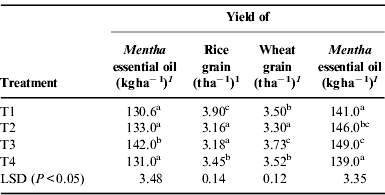
1 Mean of six observations for each treatment; values in vertical columns followed by different superscript letters are significantly different at P<0.05 by ANOVA (LSD) test.
100% NPK, 75:60:60kgha−1; T1, 100% NPK; T2, VC 2.5tha−1+50% NPK; T3, VC 5.0tha−1+25% NPK; T4, VC 7.5tha−1; VC, vermicompost.
Data on different soil properties after harvest of each crop (Fig. 2) indicated that soil after harvest of mint (first crop) had a higher N, P, K and OC. On the other hand, these levels significantly declined after the harvest of rice which might be attributed to a higher nutritional requirement of rice and a greater loss of nutrients, mainly N and K. Nevertheless, all the parameters increased in the subsequent period of the cropping sequence. At all the stages of sampling, the soil receiving VC, in general, had an improved soil fertility status.
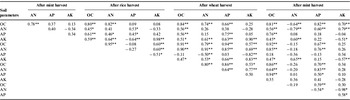
The relationship of soil fertility parameters such as soil OC, available N, available P and available K with harvest of each crop was investigated using correlation coefficients (r value) (Table 6). This reveals that soil OC was positively correlated with soil fertility parameters at all harvests except after mint, where available N content in soil showed a negative correlation with soil OC. Significant positive relationships were also recorded with available P at all harvests (Table 6).
Correlation coefficients between soil parameters and yield of menthol mint (M. arvensis), rice (Oryza sativa) and wheat (Triticum aestivum) crops cultivated in farmers' fields (Experiment 2).

OC, percent organic carbon; AN, available N; AP, available P; AK, available K.
* , **, Significant at 5 and 1%, respectively.
Conclusion
The results clearly show that 75% of the inorganic NPK requirement could be reduced by supplementing with the application of VC (5tha−1) produced from distillation waste of menthol mint, improving the productivity in menthol mint and mint–rice–wheat rotation and fertility of the soil. Use of VC (7.5tha−1) without chemical fertilizers significantly improved the health of soil but yield benefits could be maximized by integrating the use of VC (5tha−1) with chemical fertilizers. The present study has demonstrated the potential benefit of recycling of menthol mint de-oiled herb via vermicomposting for increased productivity and better soil health.
Acknowledgements
The authors are grateful to the Council of Scientific and Industrial Research (CSIR), Department of Biotechnology, Government of India, New Delhi and the Director, Central Institute of Medicinal and Aromatic Plants, Lucknow for financial support to undertake the present study.