Forest regeneration occurring on abandoned agricultural land in the tropics tends to occur without intentional human assistance (Aide et al. Reference AIDE, ZIMMERMAN, PASCARELLA, RIVERA and MARCANO-VEGA2000) therefore it is important to document possible impediments to this type of secondary succession. Factors influencing regeneration include the severity of previous degradation, the surrounding matrix and edge type (Aide et al. Reference AIDE, ZIMMERMAN, PASCARELLA, RIVERA and MARCANO-VEGA2000, Ewers & Didham Reference EWERS and DIDHAM2005, Griscom & Ashton Reference GRISCOM and ASHTON2011, Griscom et al. Reference GRISCOM, GRISCOM and ASHTON2009, Harper et al. Reference HARPER, MACDONALD, BURTON, CHEN, BROSOFSKE, SAUNDERS, EUSKIRCHEN, ROBERTS, JAITEH and ESSEEN2005, Mesquita et al. Reference MESQUITA, MASSOCA, JAKOVAC, BENTOS and WILLIAMSON2015). These in turn influence the ability of pasture grasses to persist at the time of abandonment (Aide & Cavelier Reference AIDE and CAVELIER1994, Griscom & Ashton Reference GRISCOM and ASHTON2011, Guariguata & Ostertag Reference GUARIGUATA and OSTERTAG2001). However, it remains less understood how natural regeneration processes vary across different tropical vegetation types.
In wet tropical forests, canopy closure is critical to kill sun-loving species, including pasture grasses (Aide et al. Reference AIDE, ZIMMERMAN, PASCARELLA, RIVERA and MARCANO-VEGA2000, Holl Reference HOLL, Perrow and Davy2002, Nepstad et al. Reference NEPSTAD, UHL, SERRÃO and Anderson1990, Uhl et al. Reference UHL, BUSCHBACHER and SERRÃO1988). Where many canopy trees are deciduous, such as in tropical dry forests, seasonal leaf fall may favour longer persistence of pasture grasses (Aide et al. Reference AIDE, ZIMMERMAN, PASCARELLA, RIVERA and MARCANO-VEGA2000, Nepstad et al. Reference NEPSTAD, UHL, SERRÃO and Anderson1990, Uhl et al. Reference UHL, BUSCHBACHER and SERRÃO1988), or allow their colonization (Janzen Reference JANZEN, Perrow and Davy2002, Veldman & Putz Reference VELDMAN and PUTZ2011). Dry forests are also prone to fire, which promotes the persistence and colonization of exotic pasture grasses (D'Antonio & Vitousek Reference D'ANTONIO and VITOUSEK1992, Griscom & Ashton Reference GRISCOM and ASHTON2011, Janzen Reference JANZEN, Perrow and Davy2002, Scholes & Archer Reference SCHOLES and ARCHER1997, Veldman & Putz Reference VELDMAN and PUTZ2011). Remnant and colonizing exotic grasses also compete with tree seedlings delaying or arresting forest succession (Scholes & Archer Reference SCHOLES and ARCHER1997, Sun & Dickson Reference SUN and DICKSON1996, Zimmerman et al. Reference ZIMMERMAN, PASCARELLA and AIDE2000).
To improve our understanding of regeneration in dry tropical environments, we surveyed exotic grass abundance in secondary forests adjacent to active pastures, and compared these patterns with those on the edges of mature forests. Despite 20–25 y of abandonment, we hypothesized that significantly higher amounts of pasture grasses would still be found in secondary forest and that these penetrate further into secondary forest interiors compared with mature forest fragments.
We conducted our study in a fragmented landscape of dry forests in coastal Ecuador in the surroundings of Tabuga (UTM 17M 590180m E 9983303m S). This area is part of the Chocó/Darién/Western Ecuador biodiversity hotspot (Myers et al. Reference MYERS, MITTERMEIER, MITTERMEIER, DA FONSECA and KENT2000). A mosaic of land-cover types characterizes the landscape, dominated by a matrix of pasture grasses (i.e. Megathyrsus maximus and Cynodon spp.) introduced from Africa (Jørgensen & León-Yánez Reference JØRGENSEN and LÉON-YÁNEZ1999, Williams & Baruch Reference WILLIAMS and BARUCH2000). Forest cover includes secondary, mature and selectively logged forests.
We surveyed grass abundance in eight secondary forests and in eight mature forests adjacent to unfenced, active, pastures. The secondary forests we sampled developed in areas cleared for cattle in the 1950s and 1960s but abandoned in the 1980s and 1990s (Rweyemamu et al. Reference RWEYEMAMU, ROEDER, MACKAY, SUMPTION, BROWNLIE, LEFORBAN, VALARCHER, KNOWLES and SARAIVA2008). The eight mature forests surveyed showed no signs of intensive logging or other recent anthropogenic disturbances, and most were protected by the Ecuadorian government's Socio Bosque programme at the time this study was conducted (de Koning et al. Reference DE KONING, AGUIÑAGA, BRAVO, CHIU, LASCANO, LOZADA and SUAREZ2011).
We measured exotic pasture grass abundance in evenly spaced 1 × 3-m plots on randomly selected sides of transects that ran perpendicular to the forest edge. Each transect started in an open pasture and ended in the forest interior where grass was no longer found (11–44 m); inter-plot distances varied with transect length from 0 m in transects shorter than 20 m and up to 3 m in transects of 44 m. Per cent grass cover was estimated as the proportion of 20 × 20-cm subplots in which grass occurred.
To understand the effect of distance from the edge on grass cover, we used spline regression. Sampled transects were divided into three sections: exterior (open pastureland), edge (the transition between pasture and forest) and interior. In its simplest form, a spline regression partitions the explanatory variable of grass cover into disjoint hyper-regions, where the slope of the regression changes at specific points called knots. Within each hyper-region a linear relationship is used to explain the influence of one or more explanatory variables on the response variable (Balshi et al. Reference BALSHI, MCGUIRE, DUFFY, FLANNIGAN, WALSH and MELILLO2009, Marsh & Cormier Reference MARSH and CORMIER2001). We constrained the model to identify two knots in grass cover, which divided the sampled transects into exterior, edge and interior. To remove random variation in management across sites, we used the running mean between adjacent plots. Spline regressions were conducted independently for each secondary forest and mature forest transect.
To compare mature and secondary forests on the basis of distance from the edge on grass abundance, we used a general stepwise regression model with the running mean of grass cover as the response variable. Categorical predictors included forest type (mature or secondary) and transect sections (exterior, edge and interior). The relative distance of each plot from the edge-interior knot was used as continuous predictor and we tested for interactions between each of our predictors. Multiple regression models were conducted using SPSS (version 21). The Breush-Pagan & Koener and Hayes & Cai (Reference HAYES and CAI2007) macros in SPSS were used to statistically identify and account for heteroscedasticity in model residuals. To ensure normality of residuals, grass cover was square-root transformed (Standardized Residual Kolmogorov–Smirnov P = 0.067). Spline regression models were conducted in R (Version 0.98.1062) using the ‘segmented’ package (Muggeo Reference MUGGEO2003, Reference MUGGEO2008).
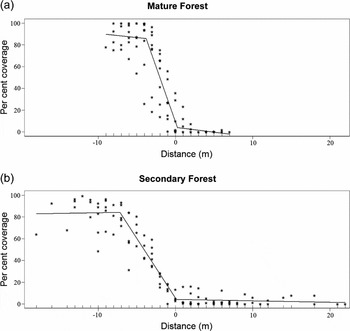
Grass cover decreased from open pastureland into both mature and secondary forest interiors, but grasses were more abundant in the interiors of the latter (Figure 1, Table 1). Higher variation in grass cover was found in pastures bordering secondary forests compared to those bordering mature forests. The calculated width of secondary forest edges for the response variable grass cover (~7 m, Figure 1b) was also more than double that of mature forest (~3 m, Figure 1a). In the forest interiors, grass disappeared at 10 m from the edge in mature forest (Figure 1a) but was still present > 20 m from the secondary-forest edge (Figure 1b).
Spline regression models of grass abundance across eight pasture–mature forest transects (a) and eight pasture–secondary forest transects (b) in tropical dry forests in Ecuador. Distance denotes the relative distance of a sampled plot from the edge–interior transition point (or knot).

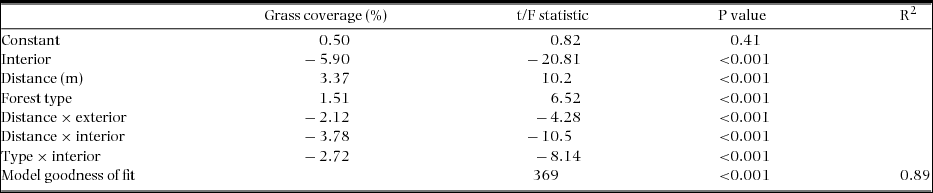
Parameter estimates plus interactions in a stepwise spline regression of grass abundance across eight pasture–mature forest and eight pasture–secondary forest transects in tropical dry forests in Ecuador. P values indicate significance (only significant variables are shown). R2 indicates model goodness. Interior = transect section in mature or secondary forest. Exterior = transect section in pastureland. Distance = squared root of relative distance between edge-interior-knot and exterior/interior transect sections. Forest type = mature or secondary forest.

The stepwise regression model of grass cover along transects revealed a decrease in the categorical predictor interior habitat (Pearson Correlation [PC] with grass cover = −0.838). The interaction between the predictors distance from edge and interior habitat (PC with grass cover = −0.023), and the interaction between habitat type and interior habitat (PC with grass cover = −0.545) were significant. In other words, grass cover decreased with distance into forest interiors, but this relationship differed between mature and secondary forest (Table 1).
The presence of grasses in secondary forests at a distance > 20 m from the pasture edge and a wider ‘edge’ section in secondary forests indicates a more permeable edge in secondary forest compared to mature forest. Higher variation in grass cover found in pastures bordering secondary forests (Figure 1b) compared with mature forests (Figure 1a) likely reflects differences in management. These findings should be interpreted in light of the fact that the 20–25-y-old secondary forests we sampled were the oldest in the region. We suspect that the presence of grasses on the edges of mature and especially secondary forest is related to the seasonal loss of leaves and low-density canopy of these forests compared with those in more humid tropical areas. Also, given that these pastures were not fenced, continued perturbations by cattle are likely, especially on the edges of secondary forests developing on abandoned pastures. Whether the grasses in the secondary forests are remnants or colonists, their presence is worrisome insofar as they compete with tree regeneration and increase forest flammability. The persistence of exotic grasses in seasonal tropical secondary forests despite two decades of abandonment could inform regeneration initiatives, specifically in fragmented landscapes, where secondary forests have an important role in conservation.
ACKNOWLEDGEMENTS
D.R. Foster (Harvard University), F.E. ‘Jack’ Putz and J. Southworth (University of Florida) and T. Fik (University of Florida) provided advice. Landowners allowed us to work on their lands. F. Rodríguez-Rayos assisted in the field. The Ceiba Foundation for Tropical Conservation provided logistic support. The Ecuadorian Ministry of Environment granted research permits. This study was supported by the Harvard University Center for the Environment's Undergraduate Summer Research Fund and the Harvard College Research Programme.