Introduction
The current trend toward a community-based health care system means that when older people require care, much of it will be provided at home. This trend will lead to family members providing care for ill or disabled older relatives. The majority of family caregivers are older spouses and middle-aged adult children who care for a spouse or a parent with functional limitations.
Longitudinal studies have demonstrated that being a caregiver who is experiencing mental or emotional strain is an independent risk factor for psychiatric morbidity in the form of increased depression, contributes to the risk of health problems, and is an independent risk factor for mortality (Kiecolt-Glaser et al., Reference Kiecolt-Glaser, Marucha, Malarkey, Mercado and Glaser1995; Gallicchio et al., Reference Gallicchio, Siddiqi, Langenberg and Baumgarten2002). Caregiver depressive symptoms indicate a mood disturbance that can result from the stress of providing care. A number of studies were conducted to identify the factors related to the depressive status of caregivers, and they found those factors to include the care recipient's dependency with regard to activities of daily living (ADL), dementia, and behavioral disturbance and the caregiver's the relationship to the patient (Farran et al., Reference Farran, Miller, Kaufman and Davis1997; Clyburn et al., Reference Clyburn, Stones, Hadjistavropoulos and Tuokko2000; Covinsky et al., Reference Covinsky2003; McCusker et al., Reference McCusker, Latimer, Cole, Ciampi and Sewitch2007; Schulz et al., Reference Schulz2008). Although it has been reported that caring depressed recipients is associated with poor mental health of caregivers including increased dissatisfaction and burden (Sewitch et al., Reference Sewitch, McCusker, Dendukuri and Yaffe2004; Soldato et al., Reference Soldato2008), the relationship between care recipients’ depressive symptoms and those of caregivers remains largely unknown. In the present study, we evaluated the association between depression in community-dwelling frail elderly and depression in their caregivers.
Methods
Cohort participants
In the present study we employed baseline data for the care recipient and caregiver pairs in the Nagoya Longitudinal Study for Frail Elderly (NLS-FE). Japan introduced a universal-coverage long-term care insurance (LTCI) program in 2000. Under the LTCI program, each applicant's care levels are determined according to eligibility criteria. Eligibility status is classified into six levels (“needs support” and care levels 1–5) via the estimation of care needs based on an assessment of the current physical and mental status of the patient and his or her use of medical procedures (Campbell and Ikegami, Reference Campbell and Ikegami2000; Tsutsui and Muramatsu, Reference Tsutsui and Muramatsu2005).
The NLS-FE was designed to compare the outcomes of different uses of the community-based care services provided by the LTCI program (Kuzuya et al., Reference Kuzuya2006a; Reference Kuzuya2006b). The study population consisted of 1875 community-dwelling frail elderly (632 men and 1243 women, age 65 years or older) with some degree of physical or mental disability who were eligible for the LTCI program and lived in Nagoya City, Japan. They received various kinds of community-based services from the Nagoya City Health Care Service Foundation for Older People, which has 17 visiting nursing stations associated with care-managing centers. These 1875 NLS-FE participants and 1502 caregivers (owing to the lack of a primary caregiver for 373 of the 1875 participants) were enrolled between 1 December 2003 and 31 January 2004. They were scheduled to undergo comprehensive in-home assessments by trained nurses at baseline and at 6, 12 and 24 months. At 3-month intervals, data were collected about any important events in the lives of the participants, including mortality, admission to hospital for acute illness, or institutionalization in long-term care facilities during the 3-year follow-up. Written informed consent for participation was obtained from the participants, care recipients and caregivers, or, for those with substantial cognitive impairment, from a surrogate (usually the closest relative or legal guardian) according to procedures approved by the institutional review board of Nagoya University Graduate School of Medicine.
Data collection
The data were collected at the clients’ homes through standardized interviews with care recipients or their surrogates and caregivers, and from care-managing center records taken by trained nurses. The data included each participant's demographic characteristics, general socioeconomic status, living arrangements, use of medical services, and overall health or nutritional status. When the participants were unable to answer or had cognitive impairment, surrogates and caregivers were asked. The data also included depressive symptoms as assessed by the 15-item Geriatric Depression Scale (GDS-15) (range: 0–15, with higher values indicating more depressive symptoms) (Yesavage, 1997), the presence of behavioral disturbance in the care recipient according to the primary assessment dataset of the public LTCI, and a rating for ten basic activities of daily living (bADL) (feeding, mobility in bed, bathing, grooming, dressing, using the toilet, walking inside and outside, transferring, and using stairs) using summary scores ranging from 0 (total disability) to 20 (no disability). Information on the following physician-diagnosed chronic conditions was obtained from care-managing center records: cerebrovascular disease, dementia, hypertension, neurodegenerative disorders, and other diseases comprising the Charlson Comorbidity Index (Charlson et al., Reference Charlson, Pompei, Ales and MacKenzie1987), which represents a sum of weighted indexes and takes into account the number and seriousness of pre-existing comorbid conditions (range: 0–19, with a higher value indicating higher comorbidity).
Data were also obtained from caregivers concerning their own personal demographic characteristics including the caregiver's relationship to the care recipient (spouse, adult child, daughter-in-law or other), depressive symptoms as assessed by the GDS-15, and the caregiver's subjective burden as assessed by the Japanese version of the Zarit Burden Interview (ZBI) (Arai et al., Reference Arai, Kudo, Hosokawa, Washio, Miura and Hisamichi1997), which is a 22-item self-reported inventory that examines the burden associated with functional behavioral impairments in the home care situation (range: 0–88, with higher values indicating a greater burden).
Subjects for analysis
The study population consisted of 893 community-dwelling disabled elderly (337 men and 556 women, age range: 65–104 years) and paired caregivers (213 men, 680 women, age range: 31–90), made up of those who completed the GDS-15 assessment at baseline among the 1502 pairs. Of these 1502 care recipients, 389 could not complete the GDS-15 because of severe cognitive impairment or communication impairment. Among the 1502 caregivers, 330 could not complete or refused to take part in the GDS-15. Compared with participants, 389 care recipients who could not complete the assessment had lower mean bADL scores (mean ± SD, 10.6 ± 7.5 vs 12.9 ±5.9, p < 0.001), higher prevalence rate of behavioral problems (24.5% vs 15.1%, p < 0.001) and dementia (51.0% vs 30.5%, p < 0.001), Compared with participants, 330 caregivers who were excluded in the analysis were younger (mean ± SD, 63.1±12.4 vs 64.8 ± 12.6, p = 0.003) and had higher score o ZBI scores (mean ± SD, 31.3 ± 17.2 vs 28.0 ± 17.0, p = 0.002).
Statistical analysis
To evaluate the relationship between the GDS-15 scores of caregivers and those of care recipients, Spearman's rank correlation coefficient was used. Partial rank correlation coefficients adjusted for the age and gender of the care recipients and caregivers, the caregiver relationship to the care recipient (spouse or nonspouse), bADL scores and chronic diseases of the care recipients, and ZBI scores of the caregivers were also used to measure the relationships between the GDS-15 scores of the caregivers and care recipients. Student's t-test was used to determine differences in the GDS-15 scores of caregivers between those whose care recipients had chronic disease and those whose care recipients did not.
GDS-15 scores were categorized into three groups: 0–5 points (lowest), 6–10 points (modest), and ≥11 points (highest group). Comparing the Japanese version of the GDS-15 with a psychodiagnostic interview, a cut-off score of 6 yields the highest sensitivity and specificity (Wada et al., Reference Wada2004). Therefore, this cut-off was used in the present study. Univariate and multivariate logistic regression models were used to assess the independent predictors of the caregivers’ depressive moods, defined as a GDS-15 score of 6 or higher. The following baseline data were used in univariate analysis: (i) the care recipients’ data including gender, age, GDS-15 score, bADL score, presence or absence of behavioral problems and neurodegenerative disorders, and Charlson comorbidity index; (ii) the caregivers’ data including gender, age, relation to care recipient (spouse or nonspouse (models 1 and 2); daughter-in-low, spouse, adult child or other (model 3)), and ZBI score. The covariates included in the multivariate analysis were variables associated with dependent variables where p <0.1 in univariate analysis. The risk of a variable was expressed as an odds ratio (OR) with a corresponding 95% confidence interval (CI).
All analyses were performed using the Statistical Package for the Social Sciences (SPSS) Version 16.0. A probability value of 0.05 or less was considered significant.
Results
Characteristics of care recipients and caregivers
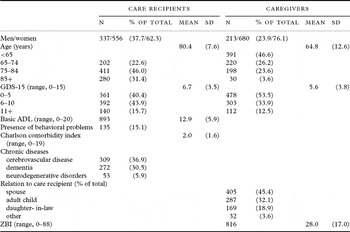
Table 1 shows the characteristics of the care recipients and caregivers. The mean age of the 893 care recipients was 80.4 years, with 31.4% of the total aged 85 years or older, and 62.3% were women. The mean GDS-15 score of the care recipients was 6.7 points, while 59.6% of the total had a score of 6 or higher, and 15.7% of the total had a score of 11 points or higher. Among the care recipients, 15.1% had behavioral problems, 36.9% had cerebrovascular disease and 30.5% showed dementia. The mean age of the caregivers was 64.8 years, and approximately 27% of the caregivers were 75 years or older. The caregivers were predominantly women and family members (45.4% were spouses). The mean GDS-15 score of the caregivers was 5.6 points, while 46.5% of the total had a score of 6 or higher and 12.5% had a score of 11 or higher.
Baseline characteristics of the 893 care recipients and their caregivers

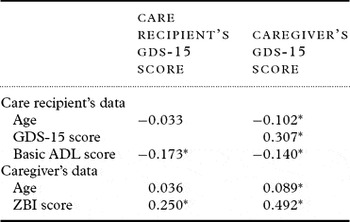
As shown in Table 2, there were positive correlations between the bADL scores or ZBI scores of the caregivers, and both the GDS-15 scores of the care recipients and those of the caregivers. The ZBI scores of the caregivers were well correlated with the GDS-15 scores of both the care givers and recipients (Spearman's ρ = 0.492, p < 0.001; r = 0.250, p < 0.001, respectively). In addition, positive correlations were found between the caregivers’ GDS-15 scores and the care recipients’ GDS-15 scores (Spearman's ρ = 0.307, p < 0.001). The correlation between the GDS-15 scores of the caregivers and those of the recipients persisted after adjusting for potential confounders (partial rank correlation coefficient adjusted for the age and gender of care recipients and care givers, caregiver relationship to care recipient, bADL scores and neurodegenerative disorders of recipients, and caregiver's ZBI scores, r = 0.207, p < 0.001).
Correlation coefficient between GDS-15 score of care recipient and that of caregiver

*Correlation is significant at the 0.01 level (2-tailed).
Caregivers providing care for recipients who exhibited behavioral problems or neurodegenerative diseases showed significantly higher GDS-15 scores compared with those providing care for recipients who did not exhibit such problems (mean (SD), behavioral problems: presence, 6.24 (3.68), absence, 5.45 (3.78), p = 0.026; neurodegenerative disorders: presence, 6.85 (3.69), absence, 5.49 (3.77), p = 0.011). However, there were no differences in the caregivers’ GDS-15 scores between the absence and presence of cerebrovascular disease, dementia, or hypertension in the care recipients (data not shown).
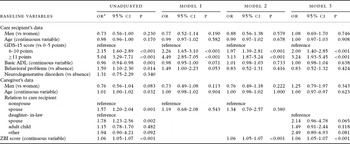
To identify predictors of the depressive status of the caregiver (GDS-15 score ≥ 6), logistic regression analysis was conducted. Univariate analysis demonstrated that the depressive status of caregivers was associated with a GDS-15 score of the care recipients in the modest (6–10 points) or highest group (≥11 points) (vs lowest group), higher bADL score, the presence of behavioral problems (vs absence), being an older caregiver, being the spouse of the care recipeint (vs nonspouse, or vs daughter-in-low), and higher ZBI score (Table 3). Multivariate analysis adjusting for the gender and age of the care recipients and caregivers, bADL scores, presence/absence of behavioral problems in the recipients, and caregiver relation to the recipient (model 1) indicated that the depressive status of the caregiver was associated with the care recipient having a GDS-15 score in the modest or highest group (OR: 2.26, 95%CI: 1.65–3.10, OR: 4.49, 95% CI: 2.85–7.05, respectively). When the analysis was adjusted for the variables used in model 1 plus the ZBI scores of the caregivers, these associations persisted between the depressive status of the caregiver and the depressive status of the care recipient (modest, OR: 1.97; 95% CI: 1.39–2.81; highest OR: 3.13, 95% CI: 1.87–5.24). In addition, these associations persisted when nonspouse caregivers were divided into 3 categories (daughter-in-law, adult child or other) (model 3 in Table 3).
Logistic regression analysis to identify independent predictors of caregiver depressive symptoms (GDS-15>6)

*OR:Odds ratio
model 1 includes gender, age, caregiver's gender, caregiver's age, care recipient's GDS-15 scores, care recipient's bADL scores, care recipient's behavioral problems, caregiver relationship to care recipient (spouse).
model 2 includes model 1 and caregiver's ZBI scores.
model 3 includes caregiver's relation to care recipient instead of nonspouse in model 2.
Listed variables were care recipient/caregiver gender and age, the presence/absence of neurodegenerative disorders, and those associated with caregiver depressive status with p<0.1 in univariate analysis. The presence/absence of neurodegenerative disorders was listed because of the significant higher GDS-15 score of caregiver with recipients who exhibited neurodegenerative disorders.
Since the GDS-15 scale is used for the depressive symptoms for age 65 years or older, analysis involving caregivers ≥65 years (n = 448) was also conducted. Similarly, the depressive status of caregivers (GDS-15 score ≥ 6) was associated with a GDS-15 score of the care recipients in the modest or highest group (vs lowest group): univariate analysis, OR: 2.07, 95%CI: 1.36–3.16 or OR: 4.07, 95%CI: 2.28–7.27, respectively; multivariate model 1, OR: 2.05; 95% CI: 1.33–3.15 or OR:3.95, 95% CI: 2.17–7.20, respectively; multivariate model 2, OR: 1.76; 95% CI: 1.09–2.83 or OR:2.71, 95% CI: 1.38–5.34, respectively).
Discussion
In the present study we observed a relatively high prevalence of depressive mood, not only in community-dwelling care recipients but also in their caregivers. We also demonstrated that the caregiver's depressive symptoms are associated with the depressive mood of the care recipient even after adjusting for confounders.
It has been shown that 8–16% of the general elderly population have clinically significant depressive symptoms (NIH Consensus Development Conference, 1992; Blazer, Reference Blazer2003). We observed a much higher prevalence of depressive symptoms among care recipients and caregivers (59.6% and 46.4%, respectively), a finding that is consistent with previous studies showing that late-life depressive symptoms often arise in the context of medical and neurological disorders including dementia, poor physical health, and disability (Alexopoulos, Reference Alexopoulos2005). In addition, it has been demonstrated in a finding that is consistent with our results that caregivers of elderly disabled individuals are twice as likely as non-caregivers to develop symptoms of depression (Baumgarten et al., Reference Baumgarten1992; Alexopoulos, Reference Alexopoulos, Sadavoy, Jarvik, Grossberg and Meyers2004).
Previous studies demonstrated that the predisposing factors of caregiver depression include a care recipient with behavioral problems (Clyburn et al., Reference Clyburn, Stones, Hadjistavropoulos and Tuokko2000), being a male caregiver, being an older caregiver, being a spouse caregiver (Farran et al., Reference Farran, Miller, Kaufman and Davis1997), and higher ADL dependency (Covinsky et al., Reference Covinsky2003). In agreement with previous reports, we observed that caregiver depressive symptoms were associated with the presence of behavioral problems, poorer ADL status of the recipient, being an older caregiver, and being a spouse caregiver (in univariate analysis). However, after adjusting for confounders the association between these factors and caregiver's depressive symptoms disappeared. On the other hand, multivariate logistic models revealed that depressive symptoms in the caregiver (GDS-15 ≥ 6) were associated with the caregiver's burden and the presence of depressive symptoms in the care recipient.
It has been reported that depressive symptoms in older people are independently associated with significantly higher levels of informal caregiving (i.e. caregiving that was needed for a longer time) (Langa et al., Reference Langa, Valenstein, Fendrick, Kabeto and Vijan2004; McCusker et al., Reference McCusker, Latimer, Cole, Ciampi and Sewitch2009), and that caring for elderly depressed family members was associated with caregiver burden, poor caregivers’ quality of life, and poor mental health in informal caregivers (Sewitch et al., Reference Sewitch, McCusker, Dendukuri and Yaffe2004; Soldato et al., Reference Soldato2008). In fact, in the present study we observed that the ZBI scores of caregivers were well correlated with the GDS-15 scores of care recipients. It is possible that depressed patients (care recipients) may require more help in performing everyday basic tasks, including basic and instrumental ADL, than non-depressed patients (Penninx et al., Reference Penninx, Deeg, Eijk, Beekman and Guralnik2000), therefore increasing the caregiver burden. In the present study we have clearly demonstrated that the caregiver's GDS-15 score was well correlated with the GDS-15 score of the care recipient, even after adjusting for confounders. Furthermore, caregiver depressive symptoms were associated with care recipient depressive symptoms in univariate analysis. It is possible that this association was mediated though caregiver burden, since caregiver burden may be a predictor of depression in the caregiver (Raveis et al., Reference Raveis, Karus and Siegel1998; Clyburn et al., Reference Clyburn, Stones, Hadjistavropoulos and Tuokko2000; Sherwood et al., Reference Sherwood, Given, Given and von Eye2005). The OR of depressive symptoms of the care recipient for caregiver depressive symptoms decreased after adjusting for ZBI score, but still reached statistical significance, suggesting that caregiver burden may contribute to caregiver depressive symptoms at least in part, but that caregiver burden may not be a major mediator of the association between caregiver and recipient depressive symptoms. It is also possible that being a caregiver can produce psychological benefits including an enhanced caregiver–care recipient relationship (Amirkhanyan and Wolf, Reference Amirkhanyan and Wolf2003). The caregivers of patients with depression may lack this kind of reward. However, depression in the care recipient could also be a consequence rather than a cause of caregiver depressive symptoms.
The present study has several limitations. First, cross-sectional data can reveal associations but cannot be used to delineate whether caregiver depressive symptoms are a cause or result of the depressive status of the care recipient. To examine the causality of the association between the depressive symptoms of caregivers and those of recipients, further study is required. Second, the results of the present study cannot be applied to independent community-dwelling older individuals, since there are many differences between the participants of NLS-FE and independent older people, including differences in ADL levels and comorbidity. Finally, these findings may not be generalizable to other populations given that they may have been influenced by cultural differences, health practices, and a variety of social and economic factors. These findings need to be confirmed in longitudinal studies in the future.
It should be noted that although GDS-15 is frequently used for subjects under 65 years old, it is also used for the measurement of depression in older people (Covinsky et al., Reference Covinsky2003; Molyneux et al., Reference Molyneux, McCarthy, McEniff, Cryan and Conroy2008). When analysis involving caregivers aged ≥65 years was conducted, similar results were observed as described here.
The present study shows that there is an association between depression in caregivers and the depressive symptoms of their care recipients. Clinicians and policy-makers should recognize the potential increase in depressive mood in caregivers who care for dependent older people with depressive symptoms. Clinicians should inquire about the adequacy of social support for their older patients with depressive symptoms and should also be alert to potential caregiver depression among family members who provide care.
Conflict of interest
None.
Description of authors’ roles
S. Izawa analyzed the data and wrote the paper. J. Hasegawa conducted the study and interpreted data. H. Enoki analyzed and interpreted data. A. Iguchi assisted with the concept. M. Kuzuya supervised all authors involved and edited the paper.
Acknowledgments
The authors wish to thank all the patients, caregivers and the many nurses who participated in the study, and the Nagoya City Health Care Service Foundation for Older People for their full cooperation.